Pages

Friday, October 31, 2025

October 31, 1921: Was Dr. Klinetop to Blame?

Grok AI illustration
During the inquest into Dr. Charles Klinetop's role in the 1923 abortion death of Lydia Nelson, Emma Sales of South Morgan Street, Chicago, jumped to her feet and struck Klinetop in the face. 

Mrs. Sales said that the death of her daughter, Harriet Grimm, was due to an abortion Klinetop had perpetrated. Klinetop had already been implicated in the 1912 death of Minnie Miller and the 1917 death of Edna Lamb.

According to Illinois death records, Harriet had died October 31, 1921 at the age of 20. I've never seen any evidence that Klinetop was prosecuted for Harriet's death.

Klinetop was evidently making bank as an abortionist -- in October of 1923 his wife, Venus, was the victim of a purse snatcher who got away with $12,000 worth of jewels (over a quarter of a million in 2025). According to the American Medical Association, Klinetop graduated from Hering Medical College in Chicago in 1894.

According to public records, Klinetop was born in Iowa in 1864 to Edwin and Emmah Bassett Klinetop. His father was a farmer and his mother was a homemaker. He had one older brother, two younger brothers, a younger sister, and a younger half-brother. He married Vienna "Venus" Waite in Chicago in April of 1903. Klinetop relocated to Pasadena, California after Lydia's death. He died of myocarditis in 1938 at the age of 74, five months after the death of his wife.

Watch Drama at the Inquest on YouTube.
Watch Drama at the Inquest on Rumble.


October 31, 1946: Scant Information on Young Woman from Puerto Rico

On October 31, 1946, a 24-year-old Puerto Rican woman named Aurora Cruz died at Lincoln Hospital in The Bronx, New York, from a septic abortion. 

This criminal abortion had caused an abscess and general peritonitis.

Aurora might have sought the abortion because she was unmarried. She had worked as an embroider and lived with her parents, Jose and Maria, at 168 Brook Avenue in New York.

I've been unable to find any more information about this unfortunate young woman.

Thursday, October 30, 2025

October 30, 1923: Back Alley Butcher Kills Chicago Teen Bride

Englewood Hospital

On October 24, 1923, 19-year-old Lydia Nelson was brought to Chicago's Englewood Hospital by her husband. He was alarmed by her condition, which had deteriorated since October 8, when she had undergone an abortion. In a written statement, Lydia identified her abortionist as by Dr. Charles Klinetop. 

According to public records, Lydia was the daughter of immigrants from England. She was born in Massachusetts. She had married her husband in March of 2021. The couple had a son later that year. 

Lydia died on October 30.

During the inquest held October 31, Mrs. Emma Sales leaped up, slapped Klinetop's face, declared that her daughter, Mrs. Harriett Grimm, had died exactly a year earlier after an abortion he had perpetrated. 

On January 15, 1924, Klinetop was indicted by a grand jury for felony murder in Lydia's death. He admitted that he had treated Lydia once at her home but denied any criminal responsibility for her condition.

Back in 1912, he had been identified by a coroner's jury as the doctor responsible for the abortion death of Minnie Miller. Klinetop was evidently making bank as an abortionist -- in October of 1923 his wife, Venus, was the victim of a purse snatcher who got away with $12,000 worth of jewels (over a quarter of a million in 2025). According to the American Medical Association, Klinetop graduated from Hering Medical College in Chicago in 1894.

According to public records, Klinetop was born in Iowa in 1864 to Edwin and Emmah Bassett Klinetop. His father was a farmer and his mother was a homemaker. He had one older brother, two younger brothers, a younger sister, and a younger half-brother. He married Vienna "Venus" Waite in Chicago in April of 1903. Klinetop relocated to Pasadena, California after Lydia's death. He died of myocarditis in 1938 at the age of 74, five months after the death of his wife.

Lydia's abortion was typical of criminal abortions in that it was performed by a physician.

Sources: 

Tuesday, October 28, 2025

October 28, 1993: Lack of Monitoring Leave Haitian Immigrant Dead

On October 9, 1993, 25-year-old Haitian guest worker Giselene Lafontant underwent an abortion by Dr. Irwin Scher at his Gynecare in Monsey, New York. The abortion 9 or 10 week abortion was started at 10:59 AM and completed at 11:05.

Giseline was brought to the recovery room but no pulse oximeter was used to monitor her pulse and blood oxygen. Thirteen minutes later a nurse tried to awaken Giseline and found her unresponsive. Then her faint heartbeat stopped. 

The staff started resuscitation and were able to get Giseline's heart started again after about two minutes. She was taken to Good Samaritan Hospital and placed on a respirator. Efforts to save her life failed; Giselene died on October 28, leaving behind a two-year-old son. Her family took her body to her native Haiti for burial.

Watch the YouTube video.

Newly added sources:

October 28, 1876: Sarah Jane's "Interesting Condition"

 Sarah Jane and her Family

Fifteen-year-old Sarah Jane Beaver lived with her mother, Mrs. Sarah Beaver Spencer, and her two brothers, Andrew and William, on a farm owned by Shepherd Cox in Ursa Township, near Quincy, Indiana.

Sarah Jane and her brothers were the children of their mother's first marriage, prior to the Civil War. Sarah Jane's father was a soldier who died at Vicksburg. The family went north after the war. They were poor and illiterate.

What to Do About Sarah's "Interesting Condition"

In April of 1876, Mrs. Spencer sent Sarah Jane and one of her brothers into town for some medicine. The two parted ways in town, and the boy was unable to find Sarah Jane. He went home to his mother alone. Though there were sightings of her with Cox in Texas, Sarah Jane remained at large until late July.

About four weeks after her return, Mrs. Spencer "discovered that the daughter was in an interesting condition".

Oil of Tansy Found

Sarah Jane named Cox, who was there during the conversation, as the responsible party. Shortly after this conversation, Mrs. Spencer said, she discovered a bottle with a few drops of oil of tansy -- a popular abortifacient -- in it. When confronted, Cox reportedly admitted that he had bought it for Sarah Jane.

A Mother's Objection

Shortly after this confrontation, Cox reportedly came to the house indicating that he had two tickets to the Centellian, and he wanted to take Sarah Jane with him so that he could "take her to a doctor who would make things all right". Mrs. Spencer said that she objected to the plan. Sarah Jane did not go with Cox.

A Mysterious Parcel

On about Tuesday, October 17, Mrs. Spencer said, Cox came to the house with something rolled up in a small parcel. Mrs. Spencer said that she went outside to do chores for about 20 minutes, and that when she returned she found her daughter with a broom in her hands and a flushed face. She denied that Cox had said anything to offend her. She was taken sick that night, and the next night expelled her dead baby.

Condition Grave

Mrs. Spencer said she sent for Dr. Duncan, who could not come until the next Wednesday, October 25. Duncan said that Sarah Jane had not miscarried but had undergone an abortion caused by instruments of some sort, used with force. Mrs. Spencer was able to show the fetus to Duncan. It was about three and a half months old.

When Cox came to the house, Mrs. Spencer told him that he had killed her daughter. Cox pointed out that Sarah Jane wasn't dead, and said he expected her to survive her illness.

Dr. Duncan continued to provide care to Sarah Jane, at first expecting her to recover, but her condition deteriorated. He asked her repeatedly to tell him who had gotten her pregnant and who had injured her. She made a statement to him that was not admissible in court because she didn't then believe she was dying.

Deathbed Statements


On the evening of Friday, October 27, Sarah Jane called her brothers to her bedside, told them she was dying, and asked their forgiveness.

She then spoke again to Dr. Duncan, telling him that she knew she was dying. He asked her again who had injured her. Mrs. Spencer was there, telling Sarah Jane to tell Dr. Duncan who had done the deed, but shaking her head all the while as if to warn Sarah Jane not to speak. Sarah Jane told Dr. Duncan, "I did it." After her mother left the room, Duncan again asked Sarah Jane to name the guilty party.

Dr. Duncan: Who did it?
Sarah Jane: I did.
Dr. Duncan: But who helped you?
Sarah Jane: My God, I have done wrong.
Dr. Duncan: Tell me who helped you?
Sarah Jane: I did.
Dr. Duncan: You could not have done it alone. Who helped you?
Sarah Jane: He did it, with instruments.

Sarah Jane died the following morning.

Covering Up

On Sunday, Cox came to the house, crying and lamenting Sarah Jane's death. Mrs. Spencer said Cox told her to keep quiet about the death, since if she said anything about it she would get into trouble. He pointed out that she had no money, but he had money and would help the family and pay the doctor's bills.

Dr. Duncan corroborated that Cox promised to pay the $56 medical bill, although he quibbled about the price.

Andrew and William corroborated their mother's testimony about Sarah Jane's April disappearance, her return, seeing Cox at the house the night before Sarah Jane took ill, and his visiting twice during her illness. The boys also testified that they'd heard Cox say he'd help with the medical bills. They also testified to Sarah Jane's deathbed plea for their forgiveness.

Indictment, Trial, and Acquittal

Cox was indicted for murder in December, 1876. He fled to avoid prosecution. Eventually his attorney negotiated a deal for him to return for the trial but remain free on bail of $3,000. He was also able to negotiate a change of venue, so that the trial took place in Hancock County.

During the trial, several witnesses placed Cox at a distance from the farm on October 17 -- the day the abortion allegedly was performed.

Dr. Parks, another area physician, testified that Mrs. Spencer had showed him a catheter and a probe asking if they could be used to cause an abortion and lamenting that her daughter was pregnant. Parks told Mrs. Spencer that the instruments would not produce an abortion. Afterward, he testified, he saw the instruments in the possession of Dr. Springer. Springer said he'd bought them from Mrs. Spencer.

Another witness, Mrs. Arnez, stated that while she and Mrs. Spencer were in jail together, Mrs. Spencer had told her that Shep Cox had nothing to do with her daughter's death.

It took the jury a full day of sparring to come back with a verdict of not guilty.


Watch Who Killed Sarah Jane? on YouTube.

Sources:

Monday, October 27, 2025

October 27, 1991: Happy Birthday, Ana Rosa

Ana Rosa and her mother

How Ana Rosa Ridriguez wound up as front-page news, and featured on Phil Donohue, began on October 25, 1991 when Rosa Rodriguez, 20 years old, went to National Abortion Federation member Abu Hayat's Avenue A abortion practice on New York's lower East Side.

A single mother with a 2-year-old daughter, Rosa had found Hayat's practice, Women's Medical Clinic, by reading his ad in a Spanish-language newspaper, El Diario.

Hayat charged $1,500 for the procedure, for which Rosa produced $1,000 cash and her passport, green card, and her watch as collateral for the remaining $500. 

On this first visit, Hayat sedated Rosa, inserted laminaria to dilate her cervix, and gave her some sort of abdominal injection. When she awoke he sent her home, instructing her to return the following day.

Rosa returned as instructed at about 9 a.m., but she expressed misgivings about proceeding with the abortion, since she had felt fetal movement. She said that she had changed her mind. Hayat told her that it was too late to stop the abortion. Rosa said that two assistants held her down and clamped her feet into the stirrups while Hayat again sedated her. When she awoke, he told her that he had changed the laminaria, and again instructed her to return the following day. Hayat gave Rosa specific instructions that if she had any problems, she was to call his facility and no one else.

That night, Rosa was in pain, so she called as instructed. Hayat's assistant, who took the call, paged Hayat and then told Rosa that this was normal, that Hayat had said she "wasn't ready" for "further treatment".

Rosa called again when the pain would not abate. After several hours, she finally told her mother about the abortion. A family friend called an ambulance to take Rosa to Jamaica Hospital in Queens. There, at about 8 a.m. on October 27, Rosa gave birth to a 3 lb. 1 oz. baby girl of approximately 32 weeks of gestation. The little girl was healthy except for a traumatically amputated right arm. Doctors at the hospital performed a D&C, an abdominal X-ray, and an ultrasound on the young mother, trying to find the baby's arm. Evidently Hayat had removed it in the abortion attempt and disposed of it.
Nobody asks,
"What happened to
Baby Ana?"


 Somehow the story got out, and all hell broke loose.

The medical board took action, faulting Hayat with lack of informed consent,  failure to perform a complete examination,  having inadequate facility and staff, having medical records that were "not credible and are incomplete", and for performing an illegal third-trimester abortion. They revoked his license.

Hayat's receptionist, Marjorie Andrade, testified before the medical board that Hayat did any number of dubious things, including keeping a 6-month fetus in his freezer for two weeks in spite of the law requiring that fetuses be sent to a pathology lab. She testified that she never saw him sterilize any instrument, that he re-used them when they had dried blood on them. She also was interviewed on WNBC-TV, saying, "I've never seen any instruments sterilized. He used to rinse them out with water and soap."

More than thirty additional women stepped forward to complain that he had botched their abortions. Though he had been sued numerous times, none of the women had been able to collect because he did not have malpractice insurance and had declared bankruptcy.

While the circus was at its peak, National Right to Life seized onto the story in its attack on the newly-reborn late term abortion method they dubbed "Partial-Birth Abortion", even though Hayat had evidently been using an established variation of the more common Dilation and Evacuation procedure. And, interestingly, National Right to Life never took note of one particularly telling fact: Hayat was a dues-paying member in good standing of the prestigious National Abortion Federation.

Newspapers investigating "The Butcher of Avenue A" also learned from the medical board that the previous year Hayat had botched an abortion resulting in the death of 17-year-old Sophie McCoy.

Abu Hayat in court
Hayat was prosecuted for assault against both Rosa and her unborn daughter, as well as for other cases, and sentenced to a total of 29 years in prison. Hayat remained unrepentant, and told the judge who sentenced him, "I am in a very difficult situation. I know I am not guilty. .... I compare myself the best of any of the witnesses. I could teach them."

Rosa Rodriguez, noting the lack of success other patients had in seeking redress, didn't sue. "There really very little point," her attorney said.

It's hard for me to conjecture that Ana is thriving. The day before every birthday is the anniversary of the day that her arm was torn off during an attempt to kill her. And that attempt to kill her was something her mother had sought out and paid for.

Still, the human spirit is strong. Gianna Jessen, who has cerebral palsy as a result of a prenatal attempt on her life, is thriving and happy. Here's wishing the same to Ana Rodriguez. Wherever you are: Happy Birthday.


Sources include: "Butcher of Avenue A gets 29 Years," NY Daily News, January 15, 1993


October 27, 1947: An Heiress Trusts the Wrong Men

At 11 PM on October 17, 1947, Dr. Paul Singer, a Park Avenue gynecologist, called police and reported that a woman had come to his office suffering from an incomplete abortion. She reportedly had staggered in, "slumped over with her head down on her chest." Singer said she lapsed into a coma while he was beginning his examination.

He said that he had taken 22-year-old Jane Ward, heir to the Drake Bakeries fortune, to Park East Hospital, "almost pulseless -- lifeless -- she was almost dead." 

Dr. Oswald Glasberg, a plastic surgeon, had helped him to perform emergency surgery. Singer had to remove 1.5 quarts of blood and three parts of a 5-month fetus from Jane's abdomen and the body of Jane's ruptured uterus. Her bowel had also been injured, but Jane's condition was so fragile that Singer decided to close Jane up and hope for the best with transfusions and antibiotics.

Jane died on October 27, and the autopsy confirmed the cause of death as criminal abortion. What's more, Singer had left more fetal parts inside Jane's body.

After the death, Singer and Glasberg were arrested and released on bail. The baby's father, Eduardo Schneidewind, a trade promotion executive for a South American government, was questioned as a material witness but was never indicted. He said that he had arranged the abortion through Alejandro Ovalle, who was posing as a doctor, paying $2,000. Ovalle then gave Glasberg $900, and Glasberg gave $500 to Singer.

Ovalle was sentenced to one year after pleading guilty as an accessory, having profited from abortion referrals.

Singer's first trial ended in a mistrial when one juror fainted during testimony regarding Jane's injuries. A second trial ended with a hung jury. Singer and Glasberg were eventually convicted of manslaughter in Jane's death, and sentenced to 2 1/2 years in prison. The judge, Francis L. Valente, said that Jane had been subjected to "surgical mayhem," and that Singer and Glasberg were "completely devoid of human feeling and decency."

Glasberg was never sentenced because six hours after the verdict on June 14, 1948, he committed suicide in his cell, having poisoned himself. Singer appealed his conviction, which was upheld.

As for Eduardo Schneidewind, not only was he not prosecuted, as far as I can determine he wasn't even deported.

During the 1940s, while abortion was still illegal, there was a massive drop in maternal mortality from abortion. The death toll fell from 1,407 in 1940, to 744 in 1945, to 263 in 1950. Most researches attribute this plunge to the development of blood transfusion techniques and the introduction of antibiotics. Learn more here.

Watch the YouTube video covering how much additional information I've found this year.

Sources:

October 27, 1972: Second of at least 18 Deaths at Allred-Founded Facilities

SUMMARY: Natalie Meyers, age 16, died October 27, 1972 after an abortion performed by Milton Gotlib at San Vicente Hospital in Los Angeles, CA.

Natalie Meyers
Sixteen-year-old Natalie F. Meyers was brought to San Vicente Hospital in Los Angeles by her mother for a safe and legal abortion on October 21, 1972. Natalie was examined and found to be in excellent health.

The Risky Procedure

Dr. Milton Gotlib initiated a saline abortion the following day by injecting a strong sterile salt solution into Natalie's uterus. The idea was that the fetus would inhale and swallow the fluid, which would cause massive internal hemorrhaging and death. this would then trigger labor. 

Saline abortion was hardly a pleasant experience. The abortionist would remove as much amniotic fluid as he could using a needle and syringe. He would then replace the amniotic fluid with a concentrated saline (salt) solution that would poison and kill the fetus. The woman would then go into labor and expel the fetus.

Saline abortions became very popular in Japan following WWII. Within the Japanese medical community, however, word quickly spread: this method was unsatisfactory. Too many women were being injured and killed. Over 70 papers were published in the Japanese medical community reporting hazards of saline abortions, including at least 60 maternal deaths. The Japanese Obstetrical and Gynecological Society condemned the technique, and it was quickly abandoned. But the Japanese abortionists kept news of the trouble among themselves -- until Western nations discovered instillation abortions and embraced them with great enthusiasm.

Two Japanese doctors, Takashi Wagatsuma and Yukio Manabe, broke the silence. Wagatsuma wrote, "It is, I think, worthwhile to report its rather disastrous consequences which we experienced in Japan." Manabe wrote, "It is now known that any solution placed within the uterus can be absorbed rather rapidly into the general circulation through the vascular system of the uterus and placenta. Thus any solution used in the uterus for abortion must be absolutely safe even if given by direct intravenous injection. ... A solution deadly to the fetus may be equally toxic and dangerous to the mother. ... In spite of the accumulating undesirable reports, the use of hypertonic saline for abortion is still advocated and used ... in the United States and Great Britain. I would like to call attention to the danger of the method and would predict the further occurrence of deaths until this method is entirely forgotten in these countries."

As western abortionists gained experience with saline abortions, other grim reports arose. A British study published in 1966 found that the saline would enter the mother's bloodstream and cause brain damage. Swedish researchers noticed an unacceptably high rate of complications and deaths. Sweden and the Soviet Union abandoned saline abortion as too dangerous for women in the late 1960s.

For whatever reasons, American abortionists were deaf to these warnings. When New York had completely repealed its abortion law, doctors had tremendous leeway in abortion practice. In New York City in particular, it became popular to inject the woman with the saline in the office, then send her home with instructions to report to a hospital when she went into labor. This was, to say the least, a highly irresponsible way to use an abortion technique that was risky even when performed in a hospital under close medical supervision. Women started dying from these reckless saline abortions.

The Consequences for Natalie

On October 22, Natalie expelled the dead baby but retained the placenta. She had trouble breathing and suffered abdominal pain, so San Vicente staff transferred Natalie to County-USC Medical Center at about 10:45 pm.

Natalie was in shock when she arrived at County-USC. She underwent a D&C there, but remained in shock from infection in her uterus. On October 26, a hysterectomy was performed to try to control the infection, to no avail. Natalie was pronounced dead at 9:35AM on October 27.

The autopsy found most of Natalie's internal organs swollen and hemorrhagic. Death was attributed to hyaline membrane disease brought on by the abortion. (Source: LA County Coroner Report 72-11445)

Natalie is one of many women to die at one of Edward Allred's facilities. Others known to have died after abortion at Allred's facilities include:

Sources:

Sunday, October 26, 2025

October 26, 1929: When Killing Your Patient was Still a Big Deal

Agnes Johnson

On a mid-October day, October 12, to be specific, 33-year-old homemaker Agnes Johnson went to the Chicago office of Dr. Joseph Stern for an abortion.

After leaving Stern's office at 435 West 19th Street, Agnes took ill. She died on October 26 at Jackson Park Hospital.

Had the year been 2022, Stern could have expected prolifers to take to the internet with pictures from Agnes's Facebook page and to pester the Illinois medical board to investigate the circumstances of Agnes' death. And unless the board found something Gosnellesque -- say, a high school student administering massive amounts of powerful drugs or rows of severed fetal feet in specimen containers or a room full of soiled recliners upon which women writhed and moaned while waiting for their abortions to be completed -- that would probably be the end of it. The board would declare that Stern had done no wrong and as long as Stern didn't Google his dead patient's name, he'd probably never have to give Agnes another thought.
 
The absolute worst case scenario for Stern had the year been 2019, 2009, or 1999 or 1989 or even 1979, would have been that Agnes' survivors would have sued him. Again, unless there was some Gosnellesque behavior, the insurance company would take care of all that and it would all blow over. Stern could go about his business unimpeded. 

But the year was 1929, and an abortion patient's death wasn't something that could be shrugged off as one of those things that just happen and only weirdo right-to-lifers could possibly get their knickers into a twist over. This was 1929, and a woman's abortion death was homicide. Stern was arrested that day, and on November 1, he was indicted for felony murder by a grand jury.

I've been unable to find out what repercussions there were for Stern beyond the indictment. One thing is safe to say, though: His life would have been a lot easier had abortion been legal.

Whether Agnes would have benefitted is another matter.


Sources: 

Saturday, October 25, 2025

October 25, 1922: A Midwife's Fatal Work in Chicago

On October 25, 1922, 24-year-old homemaker Lillian Hulbert died at Chicago's St. Anne's Hospital from septicemia as a result of a criminal abortion performed on her there that day. 

According to public records, Lillian was the daughter of Norwegian immigrants Sam and Karoline Colberg and the wife of Frank C. Hulbert. The 1920 census shows them living with their daughters Francis C (age 4 -- born 1916) and Lois M. (age 2 -- born 1918), and Dorothy H., an infant.

The coroner identified a Mrs. M.C. Anderson as responsible for Lillian's death. Anderson's profession is given as nurse or midwife.

Abortion rights groups will blame the deaths of women like Lillian on the legal status of abortion at the time. Seeking out a midwife, ad Lillian did, rather than a doctor, wasn't because of abortion's illegality but because women of that era often went to midwives rather than doctors for all of their obstetric and gynecological issues.

Graph showing abortion deaths in the US since 1940. The graph falls sharply from 1940 to 1950, levels off a bit in the 1050s, then resumes a downward trend unchanged by Roe vs. Wade, which is marked with a vertical line at 1073.Abortion-rights activists also forget that all surgery, including induced abortion, was riskier in the pre-legalization days. As the 20th century progressed, all maternal mortality, including abortion mortality, fell as medical care improved. Antibiotics and blood transfusions -- along with overall better health due to increasing prosperity -- deserve the credit for falling mortality, which was hardly caused retroactively by the 1973 Roe vs. Wade Supreme Court ruling striking down all the nation's abortion laws.

No doubt there was quackery prior to legalization -- but such quackery persists today. Removing the threat of jail for any but the most egregious behavior does not provide motivation to run a tight ship. Three erstwhile criminal abortionists that I know of -- Benjamin Munson, Milan Vuitch, and Jesse Ketchum -- didn't lose a single abortion patient until after legalization made them less fearful of repercussions and thus far more careless. Each went on to kill two legal abortion patients, not out of simple surgical complications, but due to appalling quackery.

It's time we got real about how little is different between illegal and legal abortion practice: the main difference is how much risk of being shut down or sent to prison the safe-and-legal abortionist faces.

Sources:

Friday, October 24, 2025

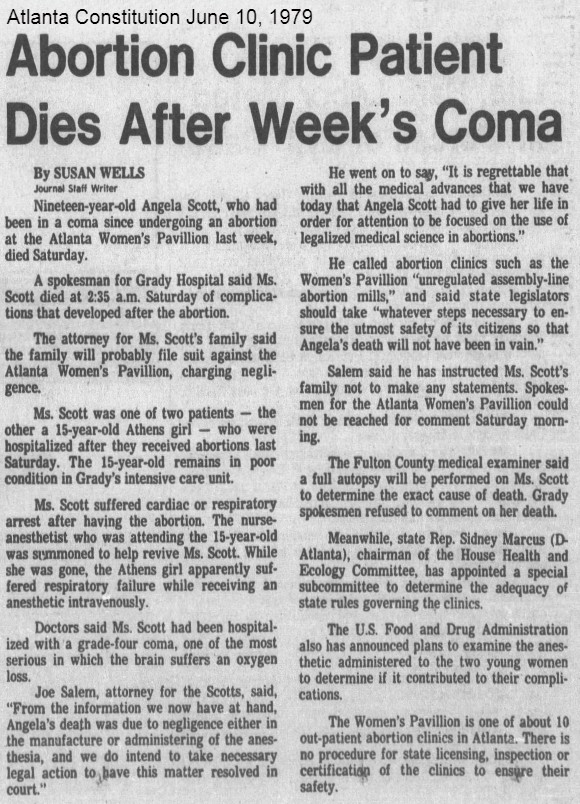
October 24, 1979: One Negative Pregnancy Test, Two Dead Teens

 Summary: Delores Jean Smith was the second of two teens to die of nearly simultaneous injuries at a National Abortion Federation member clinic.

In the era of safe, legal abortion, we find a case of striking ineptitude. 

On June 2 of 1979. National Abortion Federation member Atlanta Women's Pavillion rose to new levels of incompetence when staff there managed to fatally injure two teenage abortion patients in less than an hour.

Recovery Room at Atlanta Women's Pavilion

Dr. Jacob Adams was a co-owner of the clinic, along with Dr. Otis Hammonds and Dr. Olly C. Duckett. Adams performed an abortion under general anesthesia on 19-year-old Angela Scott. He sent her to the recovery room then began performing an abortion on 14-year-old Delores Jean Smith.

Angela went into cardio-respiratory arrest in the recovery room due to what was reported as an "idiosyncratic reaction" to anesthesia. 

Nurse Teresa Stearns, who was not certified as an anesthetist, was administering anesthesia to Delores while Adams was performing her abortion. Stearns ran to assist in efforts to revive Angela, leaving Delores with her intravenous anesthesia drip still running while Adams continued with the abortion.

There was a 25-minute delay in getting an ambulance to the clinic because staff didn't tell the ambulance service that the call was for an emergency. 

After the staff had resuscitated Angela and loaded her into an ambulance, they returned their attention to Delores , who had gone into cardio-respiratory arrest. 

Dr. Jacob Adams

Adams had accompanied Angela to the Grady Memorial Hospital, and even though the ambulance could have transported both patients, staff refused to release Delores until the physician had returned to discharge her. This resulted in a 30-minute delay, during which the ambulance crew was unable to attend to Delores or begin transporting her.

Angela lingered for a week in a coma before dying at 2:35 a.m. on June 9. 

Delores remained comatose in an intensive-care unit at Grady.

Fulton County District Attorney Lewis Slaton launched an investigation. Atlanta homicide chief Lieutenant W. K. Perry said, "We've had everybody, including the CDC, calling to see what happened and why." 

State legislators held hearings about regulating abortion clinics. The medical board held formal hearings. The Food and Drug Administration examined the anesthesia drugs used on the patients.

Delores never regained consciousness. She was admitted to a nursing home in August, where she died of adult respiratory distress syndrome on October 24, 1979. Her 15th birthday had come and gone while she was in her coma. Delores's mother, Nancy Smith, filed a $12.3 million suit against the clinic after learning that her daughter's pregnancy test performed at the clinic had come up negative.

Both young women were Black -- a fact that made them at higher risk of abortion death for reasons that, to my knowledge, have never been investigated.

Watch the YouTube video.

Sources:

October 24, 1917: An Unknown Chicago Perpetrator

 On October 24, 1917, 24-year-old homemaker Stella Ahern died at her Chicago home from an abortion performed by an unknown perpetrator.

Note, please, that with overall public health issues such as doctors not using proper aseptic techniques, lack of access to blood transfusions and antibiotics, and overall poor health to begin with, there was likely little difference between the performance of a legal abortion and illegal practice, and the aftercare for either type of abortion was probably equally unlikely to do the woman much, if any, good.

In fact, due to improvements in addressing these problems, maternal mortality in general (and abortion mortality with it) fell dramatically in the 20th Century, decades before Roe vs. Wade legalized abortion across America. The fact that abortion-rights organizations claim credit for what others accomplished in public health and medical care speaks volumes about their character.

October 24, 1981: Mentally Disabled Teen Dies from Abortion

SUMMARY: Diane Boyd, age 19, died on October 24, 1981 after a drug error made during an abortion performed by Robert Crist at Reproductive Health Services in St. Louis, MO.

naflogo.jpgAbortionist_Robert_Crist_small.jpgNineteen-year-old Dianne Alicia had the mental capacity of a 14-month-old child. She was cared for by her mother, Barbara Bates, until she was ten years old, then was placed in various facilities until finally being moved into St. Louis State Hospital's Developmental Disabilities training Center when she was around 18 years old. There she lived 
on an all-female ward. There, she was beaten and raped in July of 1981, and was later discovered to be pregnant. Diane's mother was notified of the rape and pregnancy on September 25.

The rapist was never identified, and it was not determined where the assault occurred. Staff were questioned and polygraphed. Other patients couldn't be interviewed because, like Diane, they were severely intellectually disabled. Walter Sloan, president of a patient advocacy group, said, "I doubt if anyone on that hall has the mental capacity of even a 5-year-old."

Diane did not spend all of her time in the facility. She had attended two movies, four dances, three picnics, three swimming outings, one bowling outing, and two other unspecified field trips during the period in question.

Diane's mother and a court-appointed guardian went before a judge to get permission for an abortion, which they held would be in Diane's "best health interests." The judge gave approval on October 13.

Diane was 16 weeks pregnant when she was taken to Reproductive Health Services in St. Louis, Missouri. Diane's mother signed the consent form and the abortion was performed October 22, 1981 by Dr. Robert Crist. 

Diane stopped breathing, went into shock and was taken to the intensive Care Unit at Barnes Hospital. She was placed on a respirator. Her EEG showed flat brain waves, so Diane was kept on life support until organ donation surgery could be arranged. She was removed from life support and pronounced dead at 1:30 pm on October 24.

According to suits later filed by Diane's mother, RHS staff and abortionist Robert Crist did not check for possible drug interactions before giving Diane valium and sublimaze. Dr. Mary Case of the St. Louis Medical Examiner's Office said that sublimaze could depress a patient's respiration. "This was a severely brain-damaged individual," Dr. Case told the United Press. "She could not tolerate any respiratory depressant. The reaction was totally unpredictable."

It's unclear how it would be unpredictable that a drug known to cause respiratory depression could have caused Diane's respiratory depression, especially if given to a patient who was already taking thorazine. The drug combination is likely what caused Diane to stop breathing. 

Clinic staff told the Associated Press that they would never have administered the drugs they did to Diane had they known that her disability had been caused by brain damage. But again, she was already taking a medication that could cause respiratory depression and gave her additional respiration-suppressing drugs.

Diane's mother also said that the clinic lacked heart monitoring equipment or resuscitation equipment.

Diane was not the last woman to die after abortion by Crist. Seventeen-year-old Latatchie Veal bled to death after an abortion by Crist in 1991. Twenty-two-year-old Nichole Williams died of DIC (disseminated intravascular coagulopathy) after an abortion by Crist in 1997.

Fourteen-year-old 
Sandra Kaiser committed suicide after a 1984 abortion at RHS, performed without her mother's knowledge or consent.


Sources:

Thursday, October 23, 2025

October 23, 1913: Scanty Info from Chicago

Also on October 23, 1913, 22-year-old Mary Tureck died in Chicago from an abortion performed by an unknown perpetrator.

Source: Homicide in Chicago Interactive Database

October 23, 1936: The Second of Two Deaths Attributed to Dr. Aloysius Mulholland

On October 16, 1936, 26-year-old Katherine DiDonato, mother of two, was admitted to Roosevelt Hospital to be treated for complications of a criminal abortion. 

Katherine's husband, who was left to raise their two children alone, reported that the abortion had taken place three days earlier. Detectives were told that Katherine had bought pills from drug clerk Hyman Kantor, who had then recommended Dr. Aloysius Mulholland to perform an abortion. 

Katherine died at 2:00 AM on October 23. Both Mulholland and Kantor were arrested and charged with homicide. 

Mulholland had previously been charged with the 1931 abortion death of Jane Merrill. He finally went to prison in 1943 on charges related to a number of abortions not fatal to the mothers. He reportedly committed up to 10 abortions a day for which he charged $100 to $300, or a little over $1,500 to $4,600 in 2020 dollars. This meant that he could make the equivalent of  $46,000 in a single day. 

Sources: 

October 23, 1920: Doctor Gets Away With Abortion Murders

Summary: Nineteen-year-old Francis Karies was one of five deaths attributed to Dr. Charles Waldstein Millikin in Akron, Ohio.

Background

Dr. C. W. Millikin

Charles Waldstein Millikin was a trained, licensed physician and very highly respected in his community. It's important to grasp this as we look at what he did with his training and license over a six-month period from October of 1920 through March of 1921.

The sixth son of Thomas and Tamar (Clark) Milliken, C.W. was born April 17, 1856 in Johnston, Trumbull County, Ohio. Milliken was an 1880 graduate of the University of Pennsylvania School of Medicine in Philadelphia. He was licensed as an allopath in Ohio in 1896 after having served a residency at Harrisburg Hospital and Philadelphia Hospital in Pennsylvania. 

Millikin moved to Akron, Ohio in 1882.

In 1887, Milliken served as secretary of the 64th quarterly meeting of the Northeastern Ohio Medical Association. 

Things started going wrong when Milliken was around 64 years old, nearing retirement age.

He should have retired.

September and October, 1920 

Around September 23, 1920, Milliken performed a criminal abortion on 19-year-old Francis Karies (also sometimes spelled Kerris) underwent an abortion at his Akron practice. 

I've been unable to determine anything about Francis's whereabouts or condition in the following weeks. However, Millikin was keeping busy. He performed an abortion on Maud Sporn, alias Spohr, on October 2. She died in Akron on October 12

Though Francis had undergone her abortion in Akron, she died at Chicago's Swedish Covenant Hospital on October 23. The coroner recommended Milliken's arrest, but there is no record if any legal action was taken against him for Francis's death until, sadly, too much later. In fact, as far as I know, no authorities outside of Chicago seemed to take notice.

February Through March, 1921

No ill seems to have befallen any other women at Milliken's hands in November or December. Even January of 1921 got off to a good start. But things started going wrong in Millikin's practice in February.

Iva Jean Tripplett, nee Isner, 28, wife of Artie George Tripplett, 317 Bowery St. Akron. Millikin was 65 in 1921

Funeral services at Billows' mortuary chapel interrupted on afternoon of October 10. Family had been planning to transport Ida's body to West Virginia for burial.

Coroner Kent performed post-mortem.

Millikin filed death certificate indicating acute tuberculosis. Health department issued burial certificate. Coroner found Ida's lungs in perfect condition but found evidence of septicemia. Removed organs and preserved them for prosecution.

Artie said he hadn't know about the abortion until Ida took ill and told him. Four young children. "Doyle stated tat the death of Mrs. Tripplett makes four in seven days all from the same causes, and each of them charged against Dr. Millikin.

Milliken was free on March 1 or 2, 1921 when he performed an abortion on Iva J. Triplett at his home office at 365 E. Market St. in Akron. Immediately after the abortion, Ida took ill. Millikin attended to her until her death from septicemia and peritonitis at 7:00 on the morning of March 9, leaving behind a husband and children. That was the third death in a week reported to Doyle.

Florence Cobb

As Ida lay dying under Milliken's care, he performed another criminal abortion which resulted in the March 6 death of 22-year-old telegraph operator Florence Heath Cobb, wife of Thomas Cobb of Kenmore, who worked for Goodyear Tire and Rubber. Died at Akron Hospital at 1:00 the afternoon of Sunday, March 6, 1921. Florence and Thomas had married only on the 22nd of the previous June. Her family brought her body to her home town of Salt Lake City for burial. Millikin arrested on the 5th while Florence was still alive, a few hours after the illness was reported to Doyle. Assistant prosecutors Scheck and Wanamaker visited Florence Cobb at City hospital on Saturday the 5th. She made a dying declaration saying Milliken had performed the fatal abortion. Her husband agreed. An autopsy showed that Florence had died as the result of an abortion. Florence, a graduate of the LDS University in Salt Lake City, had been a swimming instructor at Desert Gymnasium before moving to Akron, where she married Thomas Cobb on June 22, 1920.

"Doyle stated that when the first reports came to him he was loathe to place any credence on them inasmuch as the physician is reputed to be one off the best in Summit county and one, through his long residence and wide practice here has earned the reputation of being a man of high ideals." Had to order bodies exhumed.

"The physician who has practiced for 40 years or more in Akron and is well known to most of the older residents of the city and vicinity was arrested Saturday night when Doyle had been informed of the serious condition of Mrs. Cobb, and he was released on bond furnished by himself and A. G. Miller." Doyle wanted to await the April grand jury to present the four deaths.

On March 15, 1921, five more indictments were handed to the judge by the grand jury, for a total of seven at that point, some for the abortions, some for falsification of documents to cover up the abortions.

Louise Marie Vogt, 19, died of peritonitis on March 5, 1921 after an abortion perpetrated on February 26.

And what became of the illustrious Dr. C. W. Millikin after all of these deaths? He pleaded guilty for the death of Louise Marie Vogt in exchange for a suspended sentence, dismissal of the indictments for the four other deaths, and revocation of his medical license. Three judges, Anderson, C. P. Kennedy, and F. J. Rockwell pushed for clemency on the grounds that Millikin was old, a first-time offender, and an all-around great guy.

Judge Anderson further stated, "Courts have made the practice of late years of giving young first offenders that benefit of a parole, and we feel that this is a case where the court can do likewise. It is extremely hard at his age for this defendant to be in such trouble as he now finds himself in. This young woman was in trouble. He had treated the members of her family for 30 years, and when she came to him begging him to assist her he did so in order to protect her good name and that of the family. He is not really guilty, although technically he is. I have known him for a great many years, and have never known him to do an unkind act. The appeal of the woman in distress affected him, and he was justified, morally, in doing what he did. Although the publicity given him has caused the loss of his good name, he will always enjoy the confidence of his friends."

Judge Ahern chimed in, "Dr. Millikin has admitted his guilt, however, but on account of his past record and his many manifestations of public spiritedness the court feels that he is entitled to a suspended sentence."

Prosecutor Doyle merely commented that legally the judges had the authority to turn Millikin loose. His rather tight-lipped comments to reporters tend to indicate that he did not take kindly to the leniency granted to a man who had cost five young women their lives.

Milliken remained in Akron until his death from cerebral hemorrhage and chronic myocarditis on April 13, 1929. "Last Rites For Dr. Millikin To Be Held Tuesday," announced the April 15, 1929 Akron Beacon Journal. The notice sang his praises as a political and social figure. "Dr. Millikin's Death," published in another edition that same day, praised him to the skies: "In the death of Dr. C. W. Millikin this community loses another fine type of the old-time physician whose fifty years of service here spanned the interesting transit of Akron from village to city class. .... He was chief of staff of the City Hospital in 1915. He was a lover of nature and a member of the National Audubon society and the National Society of Natural Research Next to his professional work and his devotion to his friends, public service held his chief interest. This was expressed through his association with the Democratic party, of whose local organization he was often chairman. He sought no preferment for himself. Having no children of his own he sent many a student to and through college. He was a lover of children and of young people. One so kindly and gentle in character will be deeply missed in the circles where he was best known and highly regarded."

He likely was not so nearly highly regarded by the loved ones of Iva Triplet, Maud Sporn, Louise Marie Vogt, Florence Cobb, and Francis Karris. 

Sources: