Untimely Death
 |
| Merl Williams |
Her mother, Emma Williams, described as a "black-haired, elderly, toothless little woman," was in shock and under a doctor's care after hearing of Merl's death. "I never even knew my girl was ill until the day before she died," Emma sobbed. "Then they called me to come to the hospital and I went as quickly as I could."
"There was my little girl looking whiter than the sheets on her hospital bed, and she was so ill she could barely talk to me."
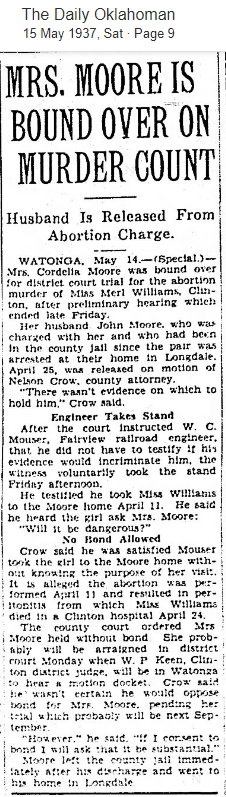
W. C. Mouse, a railroad engineer, testified that he had taken Merl to Cordelia "Della" Moore's remote 3-room house on April 11, not knowing the reason for the visit. He said only that he had provided a $10 fee (about $222 in 2025 dollars) and had heard Merl ask Moore, "Will it be dangerous?"
He then waited for Merl to finish whatever she'd come to the house for and heard Moore give Merl some unspecified "advice" as she prepared to leave.
Mouse, who was not prosecuted in exchange for information, was a married man and a father of two. After Merl's death, he was hospitalized for what was described as "a nervous breakdown." Investigators somehow concluded that he was not the baby's father, but just a friend of Merl and her family.
Who Was Merl Williams?
Public records searches indicate that Merl (also spelled Merle) was evidently a nickname for Muriel. She came from a large Arkansas family that had already experienced grief, starting with the birth of a son who died at only three days old. Her parents then had a daughter, then a son, both of whom survived, followed by another little boy who died the day that he was born. They had another son before the birth of Muriel. She was followed by three little sisters. They moved with their brood to Oklahoma when Merl was 14 years old.
"My little Merl was always a good girl, very obedient, and I was proud of her. She had to work hard for a living, and while I didn't see her as often as I wanted to in the last few years I had the feeling that she was getting along all right and this comforted me," her mother told The Oklahoma News.
Merl's landlady, Mrs. Katie Jones, described her as "a model tenant." She had a boyfriend who too her out and visited but never stayed overnight. When Merl went out she usually came home at a reasonable hour. She occasionally went out with friends. She "seemed to be conservative in all her habits of living." She largely kept to herself.
Protecting the Guilty
It was Merl's family that started the ball rolling on the investigation, contacting the county attorney's office and requesting an autopsy.
Merl herself hadn't been cooperative at all as she lay dying.
Mrs. Jones reported that when Merle fell ill shortly after her April 11 visit to the village of Longdale, she tried to provide care to the young woman. She summoned Dr. Harry Cushman. When Cushman came to treat her, Mer insisted that she was merely suffering from a bad cold. Dr. Cushman provided some medication and left.
The medicine, of course, didn't help, so Mrs. Jones called Dr. Cushman in again. Merl had by that point told her landlady the real reason for her illness, and Mrs. Jones relayed this to the doctor. Merl then reportedly admitted the abortion to Dr. Cushman, "but," Mrs. Jones said, "she would make no statement involving anyone else."
Mrs. Jones also indicated that when she became ill, Merl received $100 (just over $2,200 in 2025 dollars) from her "friend" -- presumably the father of the baby -- to cover her medical bills.
As time went on Merl because "violently ill," as her landlady described it. It was at 1:00 on the morning of Thursday, April 22, that Merl was finally admitted to the hospital. She left the $100 with her landlady with instructions to use it to pay the medical bills. But even then Merl refused to name either her baby's father or her abortionist. She took their guilty secret to her grave.
Or so she might have thought.
Initial Discoveries
In her illness, Merl evidently forgot that she had written, but never mailed, a letter to Della Moore describing her symptoms, which had started troubling her the day after the abortion. This led investigators to the abortionist. Deputy Sheriffs Allman Russell and Merrill Baskins drove to a farm owned by Della Moore and her husband about a mile and a half north of Longdale, OK. They found Mr. Moore there and arrested him.
 A more in-depth description in The Oklahoma News on April 28, 1937 relayed descriptions by authorities of Della Moore's abode and abortuary. "It was a terrible place," county prosecutor Nelson Crow told reporters. "When we entered the little house, we found almost incredible filth on every hand. Even the surgical instruments we found in a cabinet in the corner of the bedroom were filthy." He added, "How any woman accustomed to ordinary cleanliness could bring herself to submit to being touched by some of the instruments and appliance we found is completely beyond my imagination. Why, some of the instruments were actually made out of ordinary fence wire. They had long tapering handles, and the handles were wrapped in filthy rags. The whole place had a furtive, dejected air and is encrusted with filth. There are perhaps no more unsanitary premises in this county."
Moore was arrested on April 25 and charged with abortion murder. She reportedly fainted upon hearing that she was being arrested for murder and was taken to jail once she revived. She denied even knowing or having ever met Merl Williams. After her arrest, Moore "unworriedly set her glasses on the end of her nose and continued her quilting in the county jail." Her husband, John, actually got up in his cell and jigged when a jaunty tune came on the radio.
 |
| Cordelia "Della" Moore |
They then drove to the other family property -- "a three-room, weather-beaten shack" -- where Della Moore lived most of the time while her husband lived at the farm. They found two abortion patients there, and "let the young women depart without asking them any questions."
In the bedroom of the shack they found a pair of three-quarter bedsteads. This is a size not typically used any longer, larger than a twin bed but smaller than a full. They also found "an old-fashioned surgical cabinet, numerous instruments and suppositories and a quantity of disinfectants. A pan of water was beside one of the beds, and a bottle of disinfectant was nearby."

Lest readers blame the conditions, and women's willingness to endure them, on the legal status of abortion, remember that women in the 21st century era of legalization submitted to abortions in Kermit Gosnell's "house of horrors," where flea-infested cats freely roamed and defecated throughout. There seems to just be something about abortion that makes women feel like they deserve the squalor.
The instruments were seized -- both ordinary instruments a doctor might have and the makeshift ones -- along with records indicating an abortion practice going back between seven and nine years. Correspondence found in the house from all over western Oklahoma and into neighboring states indicated a wide geographic reach of the business. The investigation found evidence that the 57-year-old Moore, formerly a registered nurse, had perpetrated hundreds of abortions in her home. The police found guilty correspondence from women in Oklahoma, Texas, Kansas, Colorado, and even one from California.
The prosecutors also believed that Moore and her husband habitually harbored felons, including three men who had escaped from the Granite reformatory in 1935 after murdering a guard.
Chilling in The Cooler
 |
| John Moore |
Evidently John Moore wasn't stuck in his cell all the time, because the May 6, 1937 Geary Star said that he "has appointed himself as an official reception committee of one at the jail. He shows visitors through the structure, declares that it is the cleanest in the state, and points to repair places where former occupants sawed their way through the bars.
Moore consistently denied perpetrating any abortions, saying that she practiced as a midwife and engaged in "the installation of contraceptive devices." IUDs were not totally unknown at the time, but they were cutting-edge experimental medicine, not something an obscure self-identified midwife is likely to have known about. It's more likely that Moore came up with an excuse for meddling with women's wombs that she believed would head off any abortion charges. She also said that she dispensed suppositories that she ordered by mail from a physician who, of course, denied any knowledge of Moore or her goings-on.
More Revelations
As they read through the correspondence found in Della Moore's dilapidated property, they found that the $10 that Mouse reportedly provided was the typical abortion fee, though more prosperous-looking patients were charged $15. Many of the letters were patients complaining about painful complications after their abortions. One exchange of letters described a young woman's arrangements to pay for her abortion in installments with a $2.50 down payment (about $55 in 2025 dollars).
The Moores also had two children -- a married daughter and a son, Guy, who had been in a Civilian Conservation Corps camp. Some of the correspondence found in the home indicates that men from the CCC camp were arranging abortions for the women they had impregnated. This might explain how women from such far-flung places learned of an obscure abortionist in rural Oklahoma
The Trial that Never Happened
The prosecutor's office went through a list of about 100 abortion patients to find the ones that would give the most effective testimony. In addition to W. C. Mouse, the state gathered 14 additional witnesses in the case against Moore, including women swearing under oath that Moore had done abortions on them. The prosecutors were also investigating the possible abortion death of a married woman a few years previously.
One of Merl's brothers, either Paul or Lyman, was expected to testify as well. The prosecutor expected to call Mrs. Katie Jones, who was Merl's landlady, along with Dr. Paulson and Dr. Cushman, who performed the autopsy.
Moore was held until she was released on $6,000 bond on May 14. John was released as well, and there's no mention of having to pay bond.
The trial was first delayed in April of 1937 when a key witness, likely W. C. Mouse since he was identified in the Muskogee Daily Phoenix as the man "who took girl to Watonga farmer's home for operation," took ill and was thought to be moribund.
In October, Moore herself took ill, resulting in a continuance of her trial. At the time she was free on a $6,000 bond. By January of 1938, her condition had deteriorated even further. She was suffering from diabetes but would sometimes stop taking her medicine.
Moore's trial was delayed so many times that eventually the judge dropped the bail requirement in August of 1939.
A woman by the same name died in Oklahoma City on May 7, 1944 after a long illness so it is likely that illness and death were the reasons that the case never went forward.
Any Follow-Up?
The April 28, 1937 Oklahoma News spoke of other cases that might be pursued, including "the death three years ago of a Blain County High school girl" whose mother was "about to make a statement." That case also seems to have fallen off the radar, likely because Moore had died and there seemed to be no point in pursuing the case.
Sources:
- “Murder Is Charged In Abortion Death,” Miami (OK) Daily News-Record, April 28, 1937
- "Town Wants Case Details Hushed," Oklahoma (Oklahoma City, OK) News, April 28, 1937
- "Death of Clinton Girl Discloses State Abortion Ring; Names of Scores Found After Watonga Couple Is Held," The (Oklahoma City) Daily Oklahoman, April 28, 1937
- "Prosecutors Shocked by Shack's Filth," Oklahoma (Oklahoma City, OK) News, April 28, 1937
- "Mother's Faith in Daughter Unshaken," Oklahoma (Oklahoma City, OK) News, April 28, 1937
- "Girl Operation Victim Died Attempting to Shield Others," Oklahoma (Oklahoma City, OK) News, April 28, 1937
- "Officials Probe 'Abortion Racket' After Death in Northwestern County," Muskogee (OK) Times-Democrat, April 28, 1937
- "Pair Plead Not Guilty to Illegal Operation Racket," Sapulpa (OK) Herald, April 28, 1937
- "Accuse Nurse in More Operations," Oklahoma (Oklahoma City, OK) News, April 28, 1937
- "Abortion Quiz May Bare More Deaths," The Enid (OK) Daily Eagle, April 28, 1937
- “Midwife Nabbed In Abortion Racket In Oklahoma; 500 Case Are Aired,” (Harlingen, TX) Valley Morning Star, April 29, 1937
- “Abortions Admitted By Watonga Midwife,” Pampa (TX) Daily News, April 29, 1937
- “Seek New Evidence of Illegal Operations,” Cleveland Plain Dealer,” April 29, 1937
- “Huge Abortion Racket Found,” Greensboro (NC) Record, April 29, 1937
- "County Couple Jailed Pending Abortion Trial," Geary (OK) Times-Journal, April 29, 1937
- “Death of Girl is Basis of Couple’s Arrest for Murder,” Miami (OK) Daily News-Record, April 30, 1937
- "State's Star Witness In Abortion Case Near Death In Kansas City," (Seminole, OK) Evening Reporter, April 30, 1937
- "Abortion Inquiry Starts Saturday," Ponca City News, April 30, 1937
- "Inquiry Court to be Held in Abortion Case," The Enid Daily Eagle, April 30, 1937
- "Witness' Illness Hampers State In Abortion Case," Muskogee Daily Phoenix, April 30, 1937
- "Six Questioned In Abortion Death Of Clinton Woman, 21," The (Holdenville, OK) Morning Tribune, May 1, 1937
- “Officer Seeks 11 Patients in Abortion Quiz”, The Oklahoman, May 1, 1937
- “Abortion Death Hearing is Set,” Brownsville (TX) Herald, May 2, 1937
- "Husband of Accused Woman Receives Guests at Jail," The Geary (OK) Star, May 6, 1937
- "Abortion Case Judge to Hear Seven Today," Muskogee Daily Phoenix, May 14, 1937
- “Mrs. Moore is Bound Over on Murder Count”, The Oklahoman, May 15, 1937
- “State to Help Push Charge on Abortion”, The Oklahoman, June 1, 1937
- “Watts is Assigned to Aid in Murder Case,” Miami (OK) Daily News-Record, June 1, 1937
- untitled, The Arapaho Bee, October 8, 1937
- "Mrs. Moore May Never be Tried in Murder Case," The Clinton (OK) Daily News, January 24, 1938
- "Keen Ends Case Against Midwife," Geary (OK) Star, August 24, 1939
- "Court Cases are Dismissed," Watonga (OK) Republican, August 15, 1940




No comments:
Post a Comment