Friday, April 10, 2015

Coroner and Jury Disagree in 1924 Abortion Death

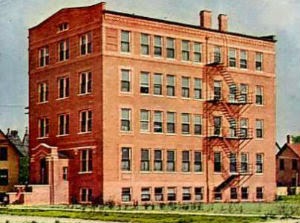
On March 29, 1924, 30-year-old Etta Marcus died at Chicago's Francis Willard Hospital (pictured) from complications of a criminal abortion performed that day. The coroner concluded that Dr. William J. Wick had performed the fatal abortion at his office. However, on April 10, Wick was acquitted.

Etta's abortion was typical of criminal abortions in that it was attributed to a physician.

Keep in mind that things that things we take for granted, like antibiotics and blood banks, were still in the future. For more about abortion in this era, see Abortion in the 1920s.

Maternal deaths from all causes, including induced abortions, fell sharply through the beginning of the 20th century, long before abortion was decriminalized. For more on pre-legalization abortion, see The Bad Old Days of Abortion

Monday, April 06, 2015

Abortion Deaths in 1873, 1880, 1906, and 1969

Sarah Hall, a widow about 31 years old, died under suspicious circumstances on Sunday, April 6, 1873 at the Grand Central Hotel in Chicago. Her death was very sudden, and this, coupled with the strange action of her physician, Dr. Reynolds, regarding her death certificate made the hotel owner and other guests suspicious. The coroner had Sarah's body intercepted before it could be shipped out of the city. A postmortem examination showed that she had died from a botched abortion. She had become unwell about a week prior to her death, and as she'd grown increasingly ill she had more medications sent to her from a nearby pharmacy. At the inquest, Reynolds testified that he'd been summoned to care for Sarah once during her final illness but that he never suspected a miscarriage or an abortion. He said that Sarah had refused to be examined, saying it would just make her feel more ill. When he was next summoned to care for her, she was dead. The family asked for a death certificate, he said, so he went and got Dr. Bell to confirm the cause of death as "inflammation of the womb followed by hemorrhage." He and Bell went to the hotel, where they found Sarah laid out in the coffin. They discussed the case and Bell completed the death certificate. However, while embalming her body, Reynolds said, he found a foul-smelling necrotic piece of tissue which Bell told him was placenta. Reynolds asked the family if they wanted a further investigation of Sarah's death. They declined the offer so Reynolds and Bell cut away the bloody parts of Sarah's clothes and put them in a wash basin prior to completing the embalming. I've been unable to uncover any further information about Sarah's death or the investigation.

On April 7, 1880, a woman's bloody cloak, with clumps of hair clinging to it, was found hanging from a spike protruding from a bridge over the River Rough, just south of the Village of Delray, Michigan, near Detroit. After two days of dragging the river, the body of a woman was found. From a description of the dead woman in the newspaper, Mr. Clemens suspected that she was his sister, 26-year-old Anna Clemens of Bay City, Michigan. Anna had last been seen alive in Detroit on April 2. Mr. Clemens positively identified his sister. Mr. Clemens told police that Anna had been engaged to marry Thomas Merritt, who ran the G.D. Edwards & Co. clothing business. They'd been keeping company for about four years. An investigation revealed the abortionist to be Dr. W.G. Cox, who had a drug store at the corner of Cass and Grand River in Detroit. Henry w. Weaver, "an aged furniture repairer," was also arrested, charged with disposing of Anna's body.

Bessie Braun, a 22-year-old homemaker, mother of two, and immigrant from Austria, died April 6, 1906, at Michael Reese Hospital. Chicago from septic complications of an abortion performed on March 20. Before her death, Bessie named midwife Julia Gibson as the person who had perpetrated the abortion, both verbally and in a signed statement. She said she'd paid $5 for the abortion. Bessie's husband, Abraham, testified at the inquest. He said that he had not known anything about an abortion until she became seriously ill on Sunday, though she remained at home until Thursday, when she finally was hospitalized. Gibson, who had been at Bessie's bedside during the declaration, was being escorted out of the hospital by police when she asked to go to the women's dressing room in the hospital basement. She was permitted to go in while a police officer stood guard outside the door. He soon heard a shot, then forced the door and found Gibson lying on the floor suffering from a self-inflicted gunshot wound to the chest. She was admitted to the hospital for treatment and was kept both under arrest and under suicide watch. As she lay near death, Gibson confessed her guilt. I have only been able to find conflicting reports on whether she was expected to survive and no confirmation of either her death or her recovery. Gibson had previously been indicted for the November 16, 1905 abortion death of 18-year-old Dorothy Spuhr. 


On April 6, 1969, 35-year-old Mrs. Catherine Barnard of Arvada, Colorado, died of a botched criminal abortion. Catherine had flown from her home to Will Rogers Airport in Oklahoma City, and evidently took a taxi to the office of Dr. Virgil Roy Jobe. A cab driver testified that he'd picked Catherine up at Jobe's office and taken her to the airport, but she ended up instead at South Community Hospital. There, doctors found her gravely ill from a punctured uterus and small intestine. She told them Jobe had perpetrated an abortion. A judge had to rule whether or not Catherine knew she was dying when she confessed to the doctors so that he could decide if her statement was a legally admissible deathbed statement, or inadmissible hearsay. There was, however, other evidence that pointed to Jobe, including two prescriptions written by Jobe both in Catherine's purse, along with her plane ticket and a paper with Jobe's office address and phone number written on it. Around 40 women, identified as abortion patients from Jobe's records, were questioned about his practice, and offered immunity in exchange for their testimony. Jobe, who was later also charged with performing an abortion on a 17-year-old Oklahoma girl, was convicted in Catherine's death. However, somehow after his convictino the charge was reduced to a misdemeanor negligent homicide charge and Jobe was freed after paying a $1,000 fine.[4] 

Friday, April 03, 2015

Two Early 20th Century Chicago Deaths

On April 3, 1919, 22-year-old Mrs. Mary Kizior died at Chicago's Jefferson Park Hospital from an abortion perpetrated by an unknown suspect. A year later, on April 3, 1928, 30-year-old homemaker Stefania Kwit died from complications of a criminal abortion performed that day by midwifePauline Majerczyk. On May 3, Mauerczyk was held by the coroner for murder by abortion, and indicted for felony murder on May 15.

Keep in mind that things that things we take for granted, like antibiotics and blood banks, were still in the future. For more about abortion in this era, see Abortion in the 1920s.


Thursday, April 02, 2015

Fatal Effort of a Likely Midwife

On April 2, 1912, 25-year-old homemaker Elizabeth Jorgeson died from an abortion perpetrated that day by Katie Sauer, whose profession is not given. Sauer was held by the Coroner's Jury and indicted by a Grand Jury on November 30. The case never went to trial.

An article in the Chicago Inter-Ocean from the year before Elizabeth's death identifies a Chicago woman named Katie Sauer as a midwife. I am working to verify if the midwife and the abortionist are the same person.

Note, please, that with overall public health issues such as doctors not using proper aseptic techniques, lack of access to blood transfusions and antibiotics, and overall poor health to begin with, there was likely little difference between the performance of a legal abortion and illegal practice, and the aftercare for either type of abortion was probably equally unlikely to do the woman much, if any, good. For more information about early 20th Century abortion mortality, see Abortion Deaths 1910-1919.


Due to improvements in overall health and medical care, maternal mortality from all causes fell rapidly after 1920. Legalization of abortion didn't even make a blip on the trends.


For more on pre-legalization abortion, see The Bad Old Days of Abortion

Wednesday, April 01, 2015

The Fatal Work of Three Doctors and a Midwife

Edith McIntyre, age 26, died April 1, 1904 at Dr. Charles Eastman's sanitarium in Maine from a botched abortion. Eastman quietly shipped Edith's body home for burial, but suspicions were raised and she was exhumed for the autopsy that confirmed her cause of death. He was convicted of manslaughter.

On April 1, 1911, 23-year-old Chicago homemaker Annie Murphy died from an abortion perpetrated by a midwife (or possibly obstetrician) named Carolina Adams. Adams was held by the Coroner's Jury but the case never went to trial

On March 29, 1921, Dr. Simeon B. Minden performed an abortion in his office on 32-year-old Catherine Riga. Catherine died three days later at Lincoln Hospital. It took only two days for his trial, which ended in a conviction. Minden collapsed upon hearing the verdict. A New York Times note card on Ancestry.com indicates that Minden was granted a new trial on May 18, 1922, and was pardoned by the governor after serving one year and four months of a 2.5 to 10-year sentence on December 12, 1924.


Headshot of a bald man with round, Harold Lloyd-style glasses.
Dr. Guy Brewer
Ruby Ford is the third of six women whose abortion deaths were attributed to Dr. Guy E. Brewer, a beloved philanthropist in the small town of Graber, Oklahoma. Ruby, a homemaker, died on April 1, 1934, 11 days after an abortion committed on March 20 "at the combination bachelor dwelling and office of Dr. Brewer in Garber." Ruby, a resident of Ponca City, Oklahoma, was married to Vernon Ford. She was about 27 years old. The other victims were Mrs. Wanda Lee Gray, 20, of Enid; Mrs. Myrtle Rose, 21, of Ponca City; Mrs. Elizabeth Shaw, 23, of Roxanna, and Doris Jones. Brewer was sentenced to six four-year sentences, to run concurrently, for the six abortion deaths.

Tuesday, March 31, 2015

Two Doctors and a Midwife Implicated in Historic Abortion Deaths

Sketch of a young woman of the late 19th century
I found so much today when doing supplemental research on today's first death that I'll just present a synopsis. On March 31, 1891,  a sickly young woman boarded a train out of San Francisco, aided by a middle-aged man with enormous muttonchop whiskers.  At Benicia, California, a fellow passenger helped the young woman to leave the train and get into a carriage. She died in the carriage before arriving at her final destination. The young woman was identified as Ida Shaddock. The man who put her on the train was eventually identified as Dr. Samuel Hall. Dr. H. Janeway performed the autopsy. He found damage from a sharp instrument used to perpetrate an abortion. The injuries were so extensive that Dr. Janeway said that it was highly improbable that Ida could have caused them herself. Hall was tried twice for murder in Ida's death. The first trial ended in a hung jury, and the second in an acquittal.

On March 31, 1914, 24-year-old Frances Fergus, formerly of Salt Lake City, died at Chicago's German Evangelical Deaconess Hospital from peritonitis caused by an abortion. Dr. James R. Struble was implicated but released after the coroner's jury inquest. Two years later Struble was implicated in the abortion death of Augusta Bloom.

On March 31, 1926, 24-year-old Louise Maday died at Chicago's West End Hospital from complications of an abortion performed at an earlier date.Midwife Amelia Becker was held by the coroner on April 27.

Thursday, March 26, 2015

Safe and Legal in 1986

Gail Wright was 29 years old when she underwent a legal abortion. She was 20 weeks pregnant.
After her abortion, she developed sepsis.

She died of adult respiratory distress syndrome on March 26, 1986, leaving behind a husband.

Wednesday, March 25, 2015

Fatal Abortions from 1848 Through 2000

In January of 1848, 20-year-old Ann Gallager of Boston approached a married friend, Catherine Beath, with the news that she was pregnant. Ann asked Catherine to go with her to Dr. John Stevens to arrange an abortion. "The doctor refused, saying that he was an old man and did not do such things." Ann offered him $50, Catherine said, but Stevens insisted that "he would not do it for all the world." Ann was angry, and went home to try to abort the baby herself. Over the following weeks, Ann tried pouring boiling water over tobacco leaves and breathing the steam as well as drinking some rum in which she had soaked rusty nails before she finally tried a knitting needle, which Catherine took away from her. Ann retorted to Catherine that she was going to do the abortion one way or another. She went to Catherine's house to get the knitting needle for another attempt, this time producing some bleeding. In March, Ann went to Dr. Stebbins, asking for some abortifacient pills. She described her prior attempts at abortion, including the bleeding after the knitting needle attempt. "I told her if she continued to use the means thus far employed, she would kill herself." As March wore on, Ann took ill. She gave a sworn statement that on March 15, she had gone to Dr. John Stevens for an abortion, which he had done with instruments. Two days later, she said, she had expelled the dead baby, a boy. Ann's condition continued to deteriorate until her death on March 25. The primary evidence that the state presented in Dr. Stevens's trial consisted of Ann's statement and the testimony of a jailed prostitute whose story kept changing. Stevens was acquitted.

Delia Bell, aged 14 in 1889, had been the product of her mother's first marriage, in Texas. After a divorce, she had moved to Birmingham, Alabama and married a Mr. McDermott. She separated from him, suing for divorce on the grounds of adultery, and set up a small dressmaking shop that she ran with Delia. The two of them lived with a Mrs. Bell, who I presume was Delia's maternal grandmother. Evidently the women in that house were not of the highest repute, and neighbors reported an unseemly coming and going of men. When Delia took violently ill on a Sunday morning, the neighbors were suspicious. Three doctors were called in to care for the girl on March 25. "All the aids known to medical science were tried without avail, and about 3 o'clock in the afternoon it was decided to resort to an operation." One of the doctors concluded that Delia's mother had known that she was pregnant, but her grandmother hadn't. The doctors notified the coroner and turned over a bottle to him that had contained an abortifacient traced to a man named George A. Foule of East Birmingham. Foule was a saloon keeper. He called his potion a treatment for "blood diseases and feminine troubles" -- a code for abortifacient.

A five-story, boxy red-brick building with many windows, two chimneys, and a fire escape
Ravenswood Hospital
On March 25, 1909, 37-year-old homemaker Carrie Pearson died at Ravenswood Hospital in Chicago from septicemia caused by an abortion perpetrated by 39-year-old midwife Caroline Meyer of on March 18 at 447 Wells Street. Meyer was held by the coroner but the case resulted in a hung jury.

Homemaker Celia Schultz, age 29, died in a Chicago home from septicemia caused by an abortion on March 25, 1910. A woman named Mary Rommell was indicted for felony murder by a grand jury. The source document does not indicate her profession, or that the case ever went to trial.

On March 25, 1916, Angela Raia of Astoria, Long Island died, evidently from the results of an abortion. Her husband Ignazio sued two doctors, Harlan E. Linehan and Dennis McAuliffe, for $400, asserting that their negligence had caused Angela's death. McAuliffe joined the military and went to France. Linehan joined a medical advisory board and was busy with his duties at the time the suit was filed. He offered to settle with Angela's husband, saying that he wanted "to relieve himself of the annoyance of the case." Angela's husband took the offer.

Headshot of a miiddle-aged bespectacled man who is looking down
Emil Gleitsman
In the spring of 1933, Edward Dettman's 21-year-old girlfriend, Mary Colbert, told him that she'd missed her period and asked him, "What can be done?" Later, during the inquest over her death, he said that he'd responded, "I don't know, that was up to her." He had, he said, offered to marry her, but she'd refused, saying she didn't want to marry "in disgrace." Her aunt, on the other hand, said that Mary told her that she didn't want to marry anybody at all at that point in her life. Once Mary elected to seek an abortion, Edward took her to Dr. Emil Gleitsman. Afterward, Mary took ill and confided in her aunts. One, Annie Cullinan recalled having asked her, "Mamie, why did you not tell me, and I would get a good doctor." Mary died on March 25. 
A middle-aged white man with short hair and glasses wearing a white shirt with the collar open
Dr. Henrie
On March 3, 1962, Dr. W.J. Bryan Henrie, an osteopath, performed an abortion on 33-year-old Jolene Joyce Griffith, at his clinic in Grove, Oklahoma. Jolene developed an infection, and, according to her survivors, Griffith abandoned her and provided no care to treat the infection. On March 10, Jolene was admitted to a hospital in Tulsa. She died there on March 25, leaving behind a husband and three minor children. Henire was conviced, and served 25 months of a 4-year sentence. Upon his release, he went right back to doing abortions. Abortion rights activists continue to revere Henrie, and to totally ignore the fate of Jolene Griffith. What's a few dead women among friends?

On March 25, 2000, 22-year-old Maria Rodriguez went to Steve Lichtenberg's Albany Medical Surgical Center  in Chicago for a late second trimester abortion. Albany is part of Family Practice Associates Medical Group, a large chain of abortion clinics and founding member of the National Abortion Federation. Lichtenberg estimated Maria's pregnancy at 18 weeks and went ahead with the what a later expert consultant called "a seemingly uncomplicated (albeit short) procedure." At about 9:00 a.m., Maria was showing signs of shock from hemorrhage. The expert consultant pointed out that Lichtenberg had failed to notice that he had ruptured Maria's uterus. Lichtenburg treated the bleeding with methods that would contract the uterus but would not, of course, address a rupture. He continued to deal with the emergency at his clinic for an hour and a half before somebody called 911. Doctors at the hospital tried to save her, to no avail, she died that evening. 
N.B. At a National Abortion Federation Risk Management Seminar in the 1990s, Michael Burnhill of the Alan Guttmacher Institute scolded Lichtenberg for "playing Russian roulette" with patients' lives by performing risky abortions in an outpatient setting and treating serious complications on site in his procedure room rather than transporting them to a hospital. Evidently Lichtenberg chose not to listen to Burnhill's warning. Maria was not the only woman to die at an FPA facility. Other women to die from abortions at FPA facilities include Denise Holmes,  Patricia Chacon,  Mary Pena,  Josefina Garcia,  Lanice Dorsey,  Joyce Ortenzio,  Tami Suematsu,  Deanna Bell,  Susan Levy,  Christina Mora,  Ta Tanisha Wesson, Nakia Jorden,  Maria Leho,  Kimberly Neil, and Chanelle Bryant.

Tuesday, March 24, 2015

Two Doctors, a Dentist, and a Mystery Abortionist

On March 24, 1870, Catherine "Kate" Shields died in Jersey City from an abortion perpetrated by Dr. Charles Cobel. "The infamous doctor was arrested, as was also one Patrick Waterson, charged with having outraged the person of the unfortunate girl." The coroner's jury also reprimanded Mrs. Downes, who kept a Jersey City boardinghouse, for failing to properly look after Kate. Kate had come to the United States in July of 1868, leaving her mother behind in Ireland. She took a job as a servant in Waterson's boardinghouse, which was tenanted by train conductors and drivers from the Bergen railroad depot. When Kate became pregnant, she traveled to New York City, where Cobel perpetrated the abortion. During the coroner's inquest, a letter from Cobel to Waterson was produced, in which he demanded $25 for the abortion, threatening to sue if he did not get his fee. Cobel had already been held responsible for the 1856 death of Catharine DeBreuxal, the 1858 death of. Amelia Weber, the 1865 death of Emma Wolfer. He was later implicated in the 1875 death of Antoinette Fennor.

On March 24, 1905, 28-year-old Ida Alice Bloom, a Swedish immigrant working as a domestic servant, died suddenly in Chicago from septic peritonitis caused by an apparent criminal abortion perpetrated on or about March 15. Dr. Julius N. Goltz as arrested as a principal, and James McDonald as an accessory. Both men were held without bail by a coroner's jury. Alice's abortion was typical of pre-legalization abortions in that it was performed by a physician.

On March 24, 1915, 31-year-old Frances Kulczyk died at her Chicago home from an abortion performed by an unknown perpetrator. Frances, who kept house and worked as a scrub woman, was the widow of Walter Kulzyk,who had worked as a molder in a foundry. With Frances' death, the three children, all under the age of 10, were left orphans.

On March 21, 1947, Ilene Lorraine Eagen, age 24, was brought to Mankato, Minnesota, to the dental office ofW. A. Groebner for an abortion. Court records indicate that Ilene was pressured into the abortion by her paramour, Raymond Older, who refused to marry her and threatened her with bodily harm if she refused an abortion. After the abortion, Ilene became violently ill and lost consciousness. Groebner and Older failed to seek or provide properly care for the sick woman. Instead, Older took Ilene to his service station in Granada, Minnesota and kept her there through the remainder of the night, into the morning of March 22. Older allowed Ilene to languish without medical care. She died March 24, leaving a seven-year-old daughter motherless. Older tried to escape civil liability on the grounds that despite his refusal to marry her, and the threats, Ilene had consented to the abortion and that therefore she was responsible for her own sickness and subsequent death.

Monday, March 23, 2015

The Fatal Work of Three Doctors and a Mystery Abortionist

On March 23, 1905, Mrs. Ida Pomering, a 30-year-old German immigrant, died in Chicago from an abortion performed earlier that day. Dr. Apollonia Heinle was held by the coroner's jury for Ida's death.

On March 23, 1907, Dora Swan, age 24, died at Englewood Union Hospital in Chicago from infection caused by a criminal abortion that had been perpetrated on March 16. Dora, wife of a railroad worker, had been living with her mother at the time. Dr. Louise Achtenberg, who was identified as the abortionist, was called to the home several days after the abortion to attend to Dora. It wasn't until the family physician was consulted that Dora was hospitalized. Though Actenberg was held responsible by the coroner, but there is no record that charges were filed. Achtenberg, a doctor identified as a midwife due to her obstetric work, had been implicated in the 1909 abortion deaths of Stella Kelly and Florence Wright. She was also implicated in the 1921 abortion death of Violet McCormick. Later, in 1924, it was Dr. Louise Achtenberg who was held responsible for the death of Madelyn Anderson.

On March 23, 1917, 19-year-old Mary Conners died at Chicago's County Hospital, refusing to name the abortionist who had fatally injured her that day.

Lynn McNair, age 23, died March 23, 1979 after an abortion performed by Edward Rubin at Jewish Memorial Hospital in New York, NY.  Lynn was 23 weeks pregnant when she was injected with saline by Dr. Edward Rubin at Jewish Memorial Hospital. The first injection of saline failed to kill the fetus, so Lynn was given a second injection. After this second dose, Lynn went into contractions and slipped into a coma. She died March 23, 1979 of a pulmonary embolism of amniotic fluid. She left two children motherless.

Tuesday, March 10, 2015

Reprint: A Fetus With Attitude

Scary Stuff

Some things are just too scary to contemplate. For Congresswoman Patricia Schroeder (D-CO), like other abortion-advocating members of the House Judiciary Committee, there's nothing scarier than having a fetus speak about abortion.

I'm not talking about hallucinations or nightmares. If the Hon. Ms. Schroeder is visited by fetuses in her dreams or visions, she hasn't shared the news with the world at large. I'm talking about a real fetus: flesh and blood, targeted for an abortion, subjected to an abortion technique, somehow lived to tell the tale. And Ms. Schroeder would probably rather face a graveyard full of George Romero zombies than a single real human being who is alive despite its mother's attempt to abort it.

Ms. Schroeder did not express her reluctance to meet the fetus in terms of fear. No. Ms. Schroeder sent her regrets on the grounds that having a fetus speak on abortion is an underhanded attempt to "undermine the public’s consistent and overwhelming support for Roe v. Wade." Well, Ms. Schroeder, what do you expect? Consistent and overwhelming fetal support for Roe v. Wade?

The fetus said what anybody left with cerebral palsy from the toxic effects of abortion chemicals might be expected to say: that being aborted isn't very pleasant. That abortion wreaks havoc on fetuses. That fetuses, given their druthers, would rather be left unmolested. This should come as a surprise to nobody. And if Ms. Schroeder later developed an itching curiosity about exactly what a fetus would have to say about abortion, she could always read the transcript later.

Ms. Schroeder's refusal to hear the fetus speak was clearly a case of sticking to her guns. First, thanks to Roe v. Wade, the fetus was scalded with hypertonic saline, expelled prematurely, and left in a bedpan to die -- which was all good and proper as spelled out by the Constitution, right? No problem. But then something went wrong. Some nurse spirited the fetus away to a hospital nursery, whence it was adopted by some nutcase right-to-lifer who had enough of a fetish for fetuses to want one around the house. The fetus had multiple surgeries to enable it to walk. The fetus even learned to talk. The fetus became old enough to vote. Then the fetus had the unmitigated gall to speak to its elected officials. The nerve of some non-people!

The Nerve of Some Non-People!

Ms. Schroeder's outrage is understandable. The majority opinion in Roe v. Wade clearly stated, "The appellee and certain amici argue that the fetus is a 'person' within the language and meaning of the Fourteenth Amendment. In support of this, they outline at length and in detail the well-known facts of fetal development. If this suggestion of personhood is established, the appellant's case, of course, collapses, for the fetus' right to life would then be guaranteed specifically by the Amendment." In other words, if a fetus is a person, you can't kill it. The whole foundation of Roe v. Wade would collapse like a house of cards if a fetus was able to demonstrate that it's a person. So when an aborted fetus limps up to the podium and reads its prepared comments, that's good news for fetuses, but bad news for somebody who gets campaign support from the abortion establishment.

This put Ms. Schroeder in a tight position. Since the fetus in question was sitting in a Congressional chamber rather than in Ms. Schroeder's uterus, The Hon. Ms. Schroeder had no Constitutional grounds for bringing in a qualified physician to complete the botched abortion and evacuate the troublesome fetus. Due to some grave judicial oversight, Blackmun et. al. had failed to allow for the proper disposal of ex-uterine fetuses with opinions of their own to express. Ms. Schroeder couldn't silence this fetus. But that didn't mean she had to listen to it.

Prolifers have always quipped that if fetuses could vote, abortion would quickly be outlawed. Well, after roughly thirty years of more-or-less unfettered abortion, some of the fetuses who slipped through the cracks have reached voting age. If we only count those who survived actual abortion attempts (rather than count all people under age 30, who gestated in a shooting gallery of sorts and are mightily lucky to have emerged alive) there are about 100,000 of them walking, limping, wheeling, or lying around (depending upon how badly injured they were by the abortion attempt), at large or in institutions of some kind here in the United States. Only about a third of them have reached voting age, so they're not much of a bloc for candidates to worry about in an election year.

But they've started speaking out. And that has abortion advocates shaking in their shoes. Because sooner or later some less-enlightened Supreme Court is likely to mistake them for people.

Wednesday, February 11, 2015

Fatal Abortions: 1861, 1879, 1905, 1916, 1957, 1985, and 1992

During early 1861, a German physician by the name of John H. Joecken was caring for Mr. Malinken, who was ailing in his Brooklyn home. On one of his visits, Malinken's 35-year-old wife, Caroline, approached Joecken privately and told him "she did not want to have so many children, and wished to know if it was possible to get rid of her present burthen. The doctor replied that it was the easiest thing imaginable, and that in eight days all would be over." Joecken set to work on Caroline, "and by the use of drugs as well as instruments succeeded in making her very sick." Over the course of several days her condition deteriorated. She died late Monday night, February 11. The coroner's jury concluded that Caroline had died from "pyemia, supervening upon metritis, consequent of an abortion produced at the hands of Dr. Joecken." Joecken was arrested.

On February 11, 1879, 65-year-old Henry Sammis of Northport, Long Island, got a dispatch to go to Brooklyn immediately. His daughter, 21-year-old Cora,was deathly ill. Mr. Sammis boarded the next train with his wife. About halfway to New York, he got a copy of the morning paper, where he read that his daughter had already died from the results of a botched abortion. When he arrived in Brooklyn, police asked him about Frank Cosgrove. Mr. Sammis said that Cosgrove had been courting Cora for about two years, and the couple had become engaged and had planned to marry before the spring. Cora's body was then taken to the coroner's office, where an autopsy was performed "which showed conclusively that death had resulted from malpractice." Cora's aunt, Mary D. Betts, testified that Cora and her "alleged seducer," Frank Cosgrove, had met at her house and from there went to the home of 35-year-old Bertha Berger. About two hours after they arrived at the house, Berger perpetrated the abortion. Cora was to convalesce there but instead grew increasingly ill. Cosgrove, who sat up with Cora every night, found an ad for Dr. Whitehead, who advertised that he practiced midwifery, and offered him $100 to take over Cora's care. Upon examining Cora, Whitehead found that she had a raging fever from a uterine infection. He declared that the case was hopeless. Berger offered him $50 to provide a death certificate but on the advice of his attorney Whitehead refused, instead notifying the authorities. Police came to Berger's house to question Cora, who was told that she was dying. Cora said that she and Frank had rented the room for the express purpose of having Berger perpetrate the abortion. Berger's defense was to pin the blame on Dr. Whitehead, claiming alternately that he had perpetrated the abortion elsewhere then sent the ailing woman to Berger's house to die, and that he had come to the house and perpetrated the abortion in Cora's room. Whitehead later admitted that he'd "been concerned in several malpractice cases" and had been arrested five times, but added that he'd never been convicted in an abortion case. The police evidently believed Whitehead's story, and called him as a witness against Berger. Cosgrove was arrested as an accessory. He plead guilty and sentenced to four years.

On February 11, 1905, 17-year-old Leona Loveless died in the Ischua, New York home of Dayton M. Hibler, where she had been working as a domestic for two years. Rumors immediately began circulating that she had died as the result of an abortion, and that Hibler was responsible. When word of the rumors reached his hears, Hibler took his shotgun out to the barn, first wounding himself in the chest, then successfully finishing himself off with a blast to the head. I have been unable to learn who perpetrated the fatal abortion.

On February 11, 1916, 42-year-old Eva Krakonowicz died in her Chicago home from an abortion perpetrated that day by midwife Agnes Dzugas. Dzugas was held by the coroner and indicted by a Grand Jury on February 1, but the case never went to trial.

On February 11, 1957, veterinarian Ira Ledbetter performed an abortion on 38-year-old Alice Kimberly. Ledbetter used a veterinary instrument called a milk tube on Alice, causing lacerations and an embolism. A milk tube is a cannula with a bulb syringe attached, which sounds very much like the early abortion device popularized by Harvey Karman. She quickly died of her injuries. Ledbetter had picked Alice up at her home about 1:00 p.m. Leter that afternoon he up to a mortuary in Coldwater, Kansas and announced that he'd found a dead woman lying by the side of the road and had her body in his car. Agnes Swarmer, the mortuary attendant, contacted the Dr. McCoy, the county coroner, who summoned the sheriff. Upon autopsy, McCoy found a lot of frothy blood in the pulmonary arteries, clear evidence of a massive air embolism. Death, he concluded, would have been almost instantaneous. Alice had been about ten to twelve weeks pregnant, with the placenta torn lose. McCoy concluded that somebody with enough skill not to have injured Alice's cervix -- and thus not Alice herself -- had used the milk tube to put air between the placenta and the uterine wall, causing the fatal embolism. Ledbetter, age 65, appealed his conviction. He was offered release on $10,000 bond pending appeal after being convicted of first-degree manslaughter in Alice's death, but the court upheld his conviction. 

In late January of 1985, Pentecostal pastor Ruth Ravenell got a phone call. "They told me I had to get down to St. Luke's right away, that Dawn was at that hospital fighting for her life. I was going, 'How can she be fighting for her life? She left for school this morning, looking healthy, never been sick.'"  When she got to the hospital, Ruth learned that her 13-year-old daughter had gotten pregnant by her 15-year-old boyfriend. With the secret help of a teacher and counselor at school, Dawn had arranged an abortion at Easter Women's Center in New York City, a National Abortion Federation member clinic.  Anesthetist Robert Augente didn't administer enough anesthesia to get Dawn through the entire procedure. About halfway through, she began to cough, vomit, and choke. Abortionist Alan Kline put a breathing tube in Dawn's throat, put her aside, and left her unattended to lapse into a coma. "While I was there at the hospital -- they were doing tests -- I had to keep my hand pressed over my mouth to keep from screaming in horror." Ruth said. "I kept going, 'This is all a bad dream. I am going to wake up and this will not have happened.'" Day after day Dawn's family gathered at her bedside, talking to her, playing tapes of the family singing together, trying to lure her back from the brink of death -- all to no avail. Dawn died three weeks after her abortion, on February 11, 1985, without ever having regained consciousness.

DaNette Pergusson, a 19-year-old medical assistant, submitted to a safe, legal abortion on February 11, 1992, at the hands of Robert Tarnis of Phoenix, Arizona. During the abortion, DaNette stopped breathing, and paramedics were summoned. The Maricopa County deputy medical examiner determined that DaNette died from a pulmonary embolism.

Tuesday, February 10, 2015

Start Preparing Now for Abortionist Appreciation Day!

March 10 has been designated "National Day of Appreciation for Abortion Providers" by the abortion lobby. This "celebration" was mainly intended to overcome the powerful negatives of working in abortion. Dr. Rachel McNair has explored the stresses of abortion work in her Achieving Peace in the Abortion War. 

Though it was originally launched with much fanfare, it seems to be petering out over the years and becoming more of a day for prolifers to remember abortionists than for prochoicers to "appreciate" them. They've not forgotten that this was supposed to be a day where the people they "help" let them know how much they're appreciated. I picture the abortionists sitting lonely and forgotten, like the Maytag Repairman. This is where we can step into the gap!

Join National Day of Outreach to Abortion Providers! 

On March 10, participate in any way you think appropriate to reach out to abortion workers so that they can follow in the footsteps of ex-abortionists and ex-clinic workers like Bernard Nathanson, Carol Everett, and Abby Johnson. 

Here are a few suggestions for what people can do to reach out to abortion workers:
  • Send clinic staff letters or emails gently letting them know that though they may have meant well, they hurt you or your loved one.
  • Bring your local staff gift baskets that include information on And Then There Were None, or Clinic Worker.com. Make the gifts real gifts, like gift cards for a restaurant, a nice flower basket, bath salts, and so forth, not phony "gifts" intended to crush the worker's spirit, like dismembered baby dolls, baby clothes, etc. 
  • Join the activities of the local 40 Days for Life in your community.
  • Invite your local abortion staff to coffee, to let him or her vent in a safe environment without fear of being labeled a traitor.
  • Write to your local newspaper, and call talk shows, to educate people about how people can provide real help to pregnant women.
  • Tweet, using the hashtags #abortionproviders and #appreciateabortionproviders, inviting abortionists to turn in their instruments of death and instead provide real help to pregnant women.
Keep in mind that we're not dealing with evil people who enjoy killing babies. Yes, there's greed. Yes, there's egotism. But a common underlying motivation is the idea that somehow what they're doing is helping the patients. The typical abortion worker views himself as bravely overcoming his natural revulsion at destroying fetal life in order to better the lives of women.

So what we need to do is break through that illusion.