
Monday, June 17, 2024
June 17, 1918: Chicago Doctor Dies Before Trial


June 17, 1913: Doc Implicated but Never Prosecuted

Sources: Homicide in Chicago Interactive Database; Illinois death records
Sunday, June 16, 2024
June 16, 1993: Fatal Hemorrhage in Newark
 |
| Dr. Steven Berkman |
"We are intensely investigating this matter," said an attorney for Jane's family. "We know something occurred that shouldn't have. We had a healthy 20-year-old go into that clinic and not come out. And I think a delay had something to do with it." Her medical chart showed the injury occurring at 10 a.m., but the ambulance wasn't summoned until two hours later.
A state report cited "chaos and confusion" when the ambulance arrived at the clinic to find Jane lifeless. The ambulance workers were not given adequate information about her condition.
Berkman said that there was no delay in transporting Jane to the hospital. He also said he did not believe she died from blood loss. The Bergen County Medical Examiner found that Jane had died from hemorrhage from a perforated uterus. Jane also had developed a clotting disorder that made it difficult to stop any bleeding. He ruled the death accidental.
Jane Roe is "Tracy" on Life Dynamics' "Blackmun Wall".
Watch "Did They Wait Too Long?" on YouTube.
Sources:
- "Family mulls suit in abortion death," Burgen/Hudson Record, July 16, 1993
- "State clears clinic in abortion death," The (Hackensack, NJ) Record, July 31, 1993


Friday, June 14, 2024
June 14, 1991: Deadly Abortionist Better Than No Abortionist At All?

Angela Hall, a 27-year-old mother of five, felt unable to deal with a sixth child. She saw an advertisement for safe, legal abortion at Thomas Tucker's office in Alabama. The ad, which pictured a couple walking arm-in-arm, said that Tucker did abortions to 24 weeks. Angela called to schedule an appointment.
Angela was keeping the abortion a secret from her mother, and drove to Tucker's Birmingham clinic with a friend, Annette Wilson. One of Tucker's employees, Joy Davis, screened Angela and felt that she had risk factors that made abortion in an office setting unsafe. She had a fever and was anemic. Joy got on the phone with Tucker and indicated that she felt that Angela should be referred to a hospital. Tucker told Davis that "we need the money. Just do it. Just put the patient through."
Tucker ordered her to prep Angela, who was in the second trimester of pregnancy. The fee for Angela's abortion was $1,800. She was already unconscious, under general anesthesia, when Tucker started the abortion on June 11, 1991. Angela started gasping for breath. Her blood pressure fell, setting off an alarm on a piece of monitoring equipment. Tucker told Davis to turn the alarm off because other patients could hear it. "It was a very panicked atmosphere," Joy Davis said. "Dr. Tucker was screaming at us." He managed to stabilize Angela's blood pressure and sent her to the recovery room.
While in recovery, Angela bled so heavily that Davis became alarmed and called an ambulance. "Blood was running down the table," Joy Davis tearfully told reporters. "It was pooling in the floor and running down behind her back." Angela's sheets and hospital gown were soaked. Davis said that Tucker told her that he was the doctor and if anybody was going to make a decision to call the ambulance, it was going to be him.
Davis reported to Tucker that Angela was bleeding through the packing put in place after the abortion, and asked him to do something for his patient.
"What do you want me to do?" he asked her.
"I don't know," Davis said she responded, "but I want you to do something. She's going to lay here and die."

"Fine. Call the f*ing ambulance," Tucker said before leaving the building, according to Davis. He was loath to call an ambulance, Davis reported, because he had already referred a patient to a hospital that day for complications.
Angela was taken to the hospital, where she suffered respiratory failure, clotting, and sepsis. It was hours after she was admitted that her friend finally called her mother, in hysterics, to say that Angela was being taken to the Intensive Care Unit. Annette didn't mention the abortion. Angela's mother rushed to the hospital, where she saw her daughter hooked up to tubes, pale, and breathing only faintly.
She died just before midnight June 14. The autopsy found numerous tears and lesions in the pelvic area, and congestive necrosis in Angela's liver and spleen. The doctors concluded that amniotic fluid embolism had caused clotting problems resulting in necrosis, septic shock, and cardiac arrest.
When Alabama authorities subpoenaed Angela's records, Tucker ordered Davis to destroy some and falsify others. Davis tore up the records, which he then tried to burn in an ash tray, Davis said. When this set off the clinic's smoke alarm, Tucker put out the fire, bagged up the papers, and told Davis to take the papers to the basement and burn them. Instead, she said, she taped them back together and eventually turned them over to the medical board.

During the initial investigation, the board learned that Tucker allowed his untrained staff to do medical procedures, including inserting the laminaria sticks to dilate a patient's cervix prior to the abortion, while he wasn't even in-state much less at the clinic.
Tucker surrendered his medical license in order to halt the investigation, planning to renew his license at a later date.
It is interesting to note that in the publicity surrounding the lawsuit filed by Angela's family, Ron Fitzsimmons of the National Coalition of Abortion Providers, among other prochoice groups, balked at efforts to close Tucker down, on the grounds that he was Alabama's only abortionist, and that even he was better than no abortionist at all.
Angela's parents took their five grandchildren into their two-bedroom house. Her youngest child has no memories of his mother, only of taking flowers to her grave.
Watch How Important is a Local Abortionist? on YouTube.
Sources:
- "Critics ask why abortion doctor still practicing," (page 2) Montgomery Advertiser, March 25, 1994
- "Suits missed during check of physician," Montgomery Advertiser, April 13, 1994
- "Doctor's license suspended," Montgomery Advertiser, April 28, 1994
- Jefferson County Circuit Court Case No. CV93-00632


June 14, 1983: Death After Hospital Abortion in New York
A lawsuit filed by Eduardo Bermeo alleged that his wife, Ecuadoran-born Rosario Bermeo, age 30, died following abortion by Dr. Joseph B. Shapse at Prospect Hospital in New York June 14, 1983.
Shapse noted that no autopsy had been performed, so Eduardo could not prove that Rosario had die for any reason "beyond respiratory and cardiac arrest." He said that the abortion proceeded without incident, and that he had no responsibility for actions of the certified registered nurse anesthetist.
The CRNA, Shapse noted, had been the one monitoring Rosario after the abortion, when her vital signs began to fail. Therefore, he said, he was not to blame for her death.
Eduardo's attorney countered with an affidavit by a physician that Shapse was indeed responsible for supervising the SRNA and that he had a duty to monitor and evaluate his patient's condition during and immediately after surgery.
June 14, 1977: First Known National Abortion Federation Death
Eighteen-year-old Barbaralee Davis had already lived an intense life. With her mother's permission, she had married David A. Davis II in September of 1973 at the age of only 15. She was separated from her husband and was caring for a 3-year-old son. Barbaralee had a history of irregular periods, but when she noticed symptoms of pregnancy she visited a local hospital for a pregnancy test, which came out negative. However, her symptoms continued so she returned to the hospital two weeks later and this time the pregnancy test was positive.
 |
| Hope Clinic for Women |
When Barbaralee arrived at the clinic on June 14, 1977, it had been five months since her last menstrual period.
Hope Medical Director Hector Zavalos examined Barbaralee and concluded that she was 11 weeks pregnant. Zavalos performed a suction curettage abortion.
Barbaralee was moved to the recovery room. The last recording of her blood pressure, taken about 45 minutes after the abortion, was low, at 100/68.
Barbaralee attended a post-abortion counseling session, during which she was pale and reporting lower abdominal cramping. She was kept for observation an additional half an hour.
At some point staff told Barbaralee's worried sister, Rita Tripp, that there had been complications but that everything would be fine.
About two hours after the abortion, Barbaralee reportedly told staff that she felt better and asked to be sent home. Barbaralee was not given a discharge examination. Zavalos simply discharged her, asserting that she seemed to be okay. However, according to the CDC's investigators, Barbaralee was showing symptoms "suggestive of internal hemorrhage." Her sister, Rita Tripp, said that Barbaralee was pale and weak when she helped her out to the car.
Barbaralee lay in the back seat on the way home. When they arrived, Rita said, Barbaralee told her that she felt like something was wrong.
Rita said that she tried to call Zavalos but was unable to reach him.
Barbaralee remained lethargic and seemed to go to sleep. About two hours after returning home she tried to stand up but fainted. She was rushed to the Pinckneyville hospital by ambulance, where an emergency hysterectomy was attempted to save her life. Barbaralee died during the surgery, leaving her child motherless.
The autopsy found the face and spinal column of Barbaralee's baby embedded in a hole in her uterus. There were two quarts of blood in her abdomen. Barbaralee had bled to death.
The medical examiner noted: "A very large retroperitoneal hematoma is present with dissection of blood along right ureter. A 4 mc. tear is noted on the right anterior surface of the lower third of the uterus and a large amount of blood, estimated at 2000 ccs. is present in the pelvis. Two fetal parts, the face and thoracic spinal column, are embedded in a 700 cc. fresh hematoma inside the uterus."
Illinois law placed a 12-week limit on outpatient abortions. Zavalos told CDC investigators that he thought Barbaralee had been only 11 weeks pregnant even though her last normal menstrual period had been five months earlier. The clinic records examined by CDC staff said that the gross examination of the fetal tissue removed during the abortion was consistent with an 11-week pregnancy. However, the medical examiner drew a different conclusion, based on the tissue that had been left embedded in Barbaralee's uterus:
In an attempt to estimate the length of gestation in the absence of the whole fetus, the two parts, namely the face, less the crown, and the thoracic vertebral column without the rump, are laid end to end. Together they measure 9 cm. A conservative estimate of the crown to rump length would be 10 to 11 cm. This will place the gestational age at 16 to 16 1/2 weeks.
 Barbaralee's family sued both Zavalos and the clinic for $1 million. In particular, Barbaralee's family attorney brought up the following issues:
- "Patients who receive abortions should be observed at the clinic 'for a period of time sufficient to ensure that no immediate post-operative complications are present'."
- "Patients in whom any adverse condition exists or in whom a complication is known should be transferred to a hospital"
- "Clinics should have a 'written agreement' with an approved hospital to provide 'prompt transfer' of persons requiring in-patient care."
Illinois law required that outpatient surgery centers have a written agreement with a hospital not more than 15 minutes away for transfer of patients needing care. Hope Clinic did not have any such written agreement.
A doctor reviewing the case for Barbaralee's family noted that it would be evident from the fetal remains whether Barbaralee's unborn baby was over 16 weeks or merely 11 weeks. For reference, an 11-week fetus is about 1.6 inches long and weighs about 1.6 ounces, while a 16-week fetus is about 7.3 inches long and weighs a little over 5 ounces. A foot measurement, which is commonly used in abortion facilities to verify fetal age, would be 7-8 mm in an 11-week fetus and 20 mm in a 16-week fetus.
The defendants tried to get the case thrown out on a technicality, because the family's attorney had sued both the facility and the doctor under the same count. In response, the attorney severed the two cases and asked for $1.4 million from each rather than $1 million for the two defendants.
Hope Clinic for Women was not only permitted to remain in operation, it was allowed to remain a member in good standing of the National Abortion Federation.
Sources:
- Marriage license of David A. Davis II and Barbaralee Themm
- "Cutler woman, 18, dies, inquest pending," Southern Illinoisan, June 16, 1977
- "Inquest set in death of Cutler woman," Southern Illinoisan, August 26, 1977
- "Zavalos' Lawyer Defended Edelin," Southern Illinoisan, August 26, 1977
- "Abortion suit due to be filed," News-Democrat, August 29, 1977
- "Abortion Lawyer Defended Edelin," Decatur (IL) Daily Review, September 1, 1977
- "Byron assigns abortion death investigator," Edwardsville (IL) Intelligencer, September 1, 1977
- "Lawyer Who Defended Edelin Joins Illinois Abortion Case," Decatur (IL) Herald, September 2, 1977
- "Criminal prosecution said unwarranted," Edwardsville (IL) Intelligencer, September 28, 1997
- "Doctor Won't Be Charged; Evidence Not 'Sufficient'," Decatur (IL) Herald, September 29, 1977
- "Family to file $1 million lawsuit," Edwardsville (IL) Intelligencer," August 30, 1977
- "Clinic Passed Inspection After Fatal Operation," St. Louis Post-Dispatch, August 30, 1977
- "Pro-life group blasts abortion practices of Hope Clinic," Edwardsville (IL) Intelligencer, August 30, 1977
- "Girl's Post-Abortion Death Results in $1 Million Suit," Decatur (IL) Review, August 30, 1977
- "Suit Against Abortion Clinic and Medical Director Amended," St. Louis Post-Dispatch, September 2, 1979
- CDC Abortion Surveillance Summary 1977 (relevant excerpt)


Watch "Lying or Clueless?" on YouTube.
As I was updating the entry for Barbaralee Davis, the first known abortion death at a National Abortion Federation member clinic, I because disgusted as I always am by the cavalier attitude the abortion lobby -- and their media lapdogs -- take towards women's legal abortion deaths. I just want to take some time to call out a particularly infuriating example.
 The September 1, 1977 Decatur Daily Review quotes attorney Frank Susman, who had defended Dr. Kenneth Edelin in an infanticide case related to a post-viability abortion.
The face and spine of Barbaralee's fetus were found embedded in a rip in her uterus. But how did Susman characterize the failure to even notice that major parts of the fetus hadn't been removed? "[A]bortion, like all surgical procedures involves a risk, and possibly a risk of death. And this patient in this procedure was advised of that."
Was Barbaralee informed that it was possible that pieces of her dead fetus would be left embedded in a uterine tear, and that she might be sent home with an undiagnosed, life-threatening injury? And why is "Well, all surgery has risks" an excuse for an abortion death caused by such an egregious injury? Had Barbaralee's abortion been illegal, though still performed by a doctor, no doubt that same spokesperson for the abortion lobby would have been livid about how the legal status of abortion had forced Barbaralee to seek substandard care and suffer an injury she never would have died from had her abortion been legal. If it weren't for double standards, the abortion lobby would have no standards at all.
Then there's the misinformation: "I think we just have to put this in perspective and realize that -- for example -- well over a million abortions were performed last year in the United states and there were five deaths."
That statement simply wasn't true. According to the 1976 CDC Abortion Surveillance Summary, there were ten legal abortion deaths -- twice the number Susman claimed. To be fair, the CDC doesn't exactly leap out and announce abortion death numbers right away. The 1976 summary wasn't issued until August of 1978. Susman doesn't say where he got the lowball number. The CDC also admittedly missed one, since the 2019 Abortion Surveillance Summary notes 11 legal abortion deaths for 1976. Of course, that's assuming that the CDC actually knows -- or even cares -- how many legal abortion deaths there are. There's abundant evidence that their data collection on legal abortion deaths has been perfunctory at best since Willard Cates and David Grimes left the abortion surveillance branch.
The kicker, though, is the way Susman, the abortion lobby, and the media simply dismiss legal abortion deaths as nothing worth worrying your pretty little head about. Imagine if, after an airline crash, the NTSB and the airlines insisted that the concern was far out of proportion and started citing the overall safety of airline travel. Such a transparently self-serving attitude would be roundly condemned. For some reason, though, the abortion lobby is able to dismiss cases of fatal malpractice by reminding us that comparatively few patients actually die.
The proper response to any death caused by mistakes, or slipshod procedures, or faulty equipment is to do a preventability study and to at least suggest corrective action. Why aren't abortion facilities held to this standard?

Thursday, June 13, 2024
June 13, 1925: Suicide or Abortion?

On June 13, 1925, 24-year-old Betty Fisher died in the Chicago office of doctors August Goetz and Henry Gautsen. News coverage said that Goetz and Gautsen were spiritualists and faith healers. The pair asserted that Betty had come to them for treatment six months earlier after becoming estranged from her husband, and had died from deliberately drinking poison.
After an inquest, though, the coroner concluded that Betty had actually died from an abortion perpetrated by one or the other of the pair.
The doctors were acquitted on October 16. The source documents don't say why. I've found no evidence that either doctor was involved in any other abortion deaths.
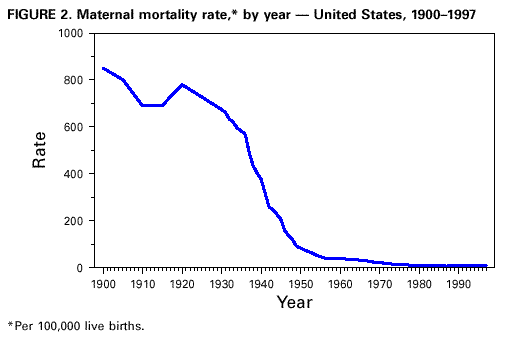
During the first two thirds of the 20th Century, while abortion was still illegal, there was a massive drop in maternal mortality, including mortality from abortion. Most researches attribute this plunge to improvements in public health and hygiene, the development of blood transfusion techniques, and the introduction of antibiotics.
Watch "Abortion or Suicide?" on YouTube.
Sources:
- Homicide in Chicago Interactive Database
- "Woman Poisons Self and Dies in Healer's Office," Chicago Sunday Tribune, June 14, 1925
- "Inquest Today Into Death in Spiritualists' Office," Chicago Daily Tribune, June 15, 1935


Wednesday, June 12, 2024
June 12, 1874
Rosetta Jackson, around 18 years of age, lived as a servant with a married sister, Lizzie Flagg. Lizzie's husband, William H. Flagg, was a barber with a shop on West Lake Street.
The family were originally from New York. Lizzie had moved to Chicago around 1868. Rosetta had first lived with another sister, Mrs. Otis, where she worked and was paid as a servant before moving in with Lizzie and William about a year before the fatal abortion. At that time Rosetta began attending Western Avenue Methodist Episcopal Church, and became known to the pastor and a couple named Watson. Rosetta was considered to be "a modest, retiring woman." Mr. Watson testified that once, while getting his hair cut, he heard Flagg tell Rosetta that if she want to live with her other sister she could never come into his house again.
Evidently a liaison took place between Rosetta and her brother-in-law, resulting in a pregnancy that the two wanted to keep secret from Rosetta's sister, who later testified that she had never noticed any untoward behavior of the two towards each other.
An abortion was perpetrated by Dr. Charles Earll, resulting in Rosetta's death on June 12, 1874. Flagg and Earll arranged for a private burial at Graceland Cemetery, but somebody tipped off the authorities, leading to an exhumation and autopsy. The cause of death was detected - injuries to the uterus caused during an abortion. Those injuries had become infected, leading to peritonitis.
In addition to Earll and Flagg, a woman named Kate Holland was implicated as an accessory because the Rosetta had died in her house.
Police raided Earll's practice and confiscated abortion instruments, along with a bottle of oil of tansy, a popular herbal abortifacient. The bottle of tansy was shown to Mrs. Holland, who identified it as a medicine that Rosetta had been taking.
A fetus was discovered buried in the back hard of Mrs. Holland's house.
Dr. Defendants in Court
The Chicago Tribune notes that Earll "was dressed in a scrupulously neat manner, and was exceeding calm and collected in his behavior, Betraying little or no anxiety for the fate that may befall him."
The Chicago Tribune noted that the Flaggs "appear[ed] to be reputable people" who tried to avoid public attention as much as possible.
Mrs. Holland was described as "a shrewd-looing person of uncertain age." Her daughter, Francelia Bullard, was described as having "an innocent-looking appearance."
Lizzie's Testimony
Lizzie said that the last she saw her sister alive was at Mrs. Holland's house on the first Sunday in June. She hadn't know that Rosetta was ailing until after her death. She saw her sister's body at Holland's home.
Francelia's Testimony
Francelia Bullard, Mrs. Holland's daughter, testified that Rosetta had come to stay at her mother's house, giving her name as Alice Hayes. About three days after Rosetta moved in, she and Francelia went for a walk to Dr. Earll's office. Francelia waited while Rosetta went into a private room with Earll for about five minutes. It was about two days after that visit that Rosetta took ill and never recovered. During Rosetta's illness of about nine days, Earll came to the Holland home about 5 or 6 times to attend to her.
Flagg's Testimony
William Flagg denied being the father of Rosetta's baby but did indicate that he had known about the pregnancy and had given Earll $10 to "continue his treatment" of Rosetta.
The Appeal
Earll was convicted of manslaughter in an abortion death in August of 1874. His attorney appealed for a new trial on the following grounds:
- The court admitted improper testimony.
- The court refused to admit proper evidence.
- The court refused proper instructions asked in behalf of the defendant.
- The court gave improper instructions for the people
- The verdict is unsupported by the evidence.
- On account of misconduct of jurors during the trial, reading of newspapers, ad inattention to the evidence given for the defense.
The attorney contended that William Flagg should have been corroborated by other witnesses, and that aside from Flagg's testimony there was no evidence that Earll intended to cause Rosetta's death.
The judge noted that if Earll's attorney had noticed misconduct by the jury, it had been his duty to bring it to the court's attention at that time, not hold back for appeal.
Sources:
- "Dr. Earll: Commencement of His Trial at the Criminal Court," Chicago Daily Tribune, July 29, 1874
- "Dr. Earll," The Chicago Daily Tribune, August 8, 1874


June 12, 1902: The Free-Love Abortionist
 |
| Dr. Frederick Weightnovel |
Early on the morning of June 12, 1902, Captain Carter of the Tampa, Florida police got a notice of a body being removed from the Whiting Street apartment of 65-year-old Dr. Frederick Weightnovel (sometimes identified as Dr. Leontieff Theodore Weightnovel).
According to the June 26, 1902 Tampa Weekly Tribune, "His establishment on Whiting street has always been a subject of suspicion, and he has been generally regarded as a criminal practitioner, who was sharp enough to avoid the courts."
Cpt. Carter learned that the body was that of a young woman and that it was taken to the undertaking establishment of J. L. Reed, whom Weightnovel had contacted at around 7:00 that morning. Weightnovel provided Mr. Reed with a death certificate listing peritonitis as the cause of death. Reed reported that "he ... found the body badly contorted, the usual offices upon the newly dead having been entirely neglected."
The body was that of 18-year-old Irene Randall of Quincy, Florida, daughter of tobacco businessman A. A. Randall. Irene had been spending the previous seven months in Tampa with her aunt, Mrs. Laura J. Christian, to learn dressmaking. She had gone home to Quincy, then returned to Tampa on Saturday, June 7. She was met by her cousin, J. Carl Christian.
Christian had arranged for her to stay at the home of the Russian-born Dr. Weightnovel for an abortion.
Dr. U .S Bird and Dr. J. M Grantham performed an autopsy.
Irene's father received a telegram informing him of his daughter's death and asking what he wanted done with the body. Mr. Randall asked that Irene's body be shipped to Midway, which was near Quincy. In the mean time, as the Tampa Tribune of June 20 said, "The fair dead face ... was viewed at Reed's undertaking parlors yesterday by many who had known her in life, including relatives of the deceased who reside in this city. Despite the rigidity of death, the features bore the traces of the agony, physical and mental, which must have been the lost of the young sufferer in her last hours."
After the viewing, Reed shipped Irene's body to Midway as requested.
What of Weightnovel?
According to the June 26, 1902 Tampa Weekly Tribune, "Dr. Weightnovel ... is one of the most conspicuous characters in Tampa. He has been a resident of the city for many years, and claims to be a refugee from Russia, to escape political persecution. He wears the most luxurious head of hair in Florida, and has attracted particular attention during his residence in the city by invariably occupying a front seat at all theatrical performances and taking conspicuous part in every excursion."
The June 20 Tampa Tribune noted that while mourners and the curious were filing past Irene's coffin, Weightnovel "fanned himself industriously in a cell at the county jail, stroked his plenteous beard and hair, and consulted with his attorney...."
The police confiscated records and letters.
The father of Irene's aborted baby was identified as a young cigar-maker named Robert Floyd. Floyd denied the allegation. Weightnovel's attorney, Henry Cohen, turned over letters to the police which were purportedly written by Irene during her dying days. According to the June 20 Tampa Tribune, one of the letters was written to Floyd. "In this letter, she recalls to her betrayer the occasion of her ruin, mentioning Amy Droty's notorious resort on Fifth avenue, as the scene, and indicating that she was taken there by force and drugged into semi-consciousness. .... This letter was sealed, addressed, and stamped but not mailed, and was found among the papers in Dr. Weightnovel's apartments."
Irene's parents evidently knew where she was. She had gotten letters from her mother "full of a mother's tenderness and solicitations of grief at the condition to which she had fallen." Cohen planned to use these letters to assert that Irene had undergone an abortion at her home in Quincy and had only travelled to Tampa, whereupon Weightnovel had taken her in.
Christian visited Irene many times during her stay at Weightnovel‘s home. Two days after her arrival, Irene asked Christian to telegraph to Waycross for her trunk.
Testimony about days and dates is evidently jumbled. The abortion was reportedly performed June 6, which was a Friday. But Irene's cousin reported that he visited her on a Wednesday, about a week before her death, and she‘d told him that Weightnovel had performed the abortion the previous night, and that she‘d be ready to go home the following Tuesday. The only date we can perhaps rely upon is the date of Irene's death: June 12.
Arrived June 7? Weightnovel called in another doctor on Tuesday night. She told the doctor what had happened and died on June 12 at 2 a.m.
Weightnovel was arrested and held in default of $2,000 bail.
.png) Public outrage was high against Weightnovel. One letter to the Tampa Tribune, June 20, 1902, read:
Public outrage was high against Weightnovel. One letter to the Tampa Tribune, June 20, 1902, read:
It is a well-known and indisputable fact that Dr. Weightnovel, the long-haired quack who murdered the Randall girl, by performing an operation on her has been illegitimately practicing in this city for years and God in Heaven only knows how many poor girls he has butchered and sent to an early grave by his hellish methods. He should be considered in the category of a murderer and as such tried by a jury in the same manner as a midnight assassin... and be compelled to stand the consequences.
It is a reflection on the intelligence of an American people to permit the release of the old scamp and the good people of Tampa should rise up en masse and see that he is properly punished. He is guilty of one of the most heinous crimes known and he is none too good to stretch hemp and the heart-broken parents of the poor murdered girl will never be sufficiently revenged until he and the girl's betrayer are both dangling side by side on a gallows.
Dr. B. G. Abernathy was called in to attend to Irene after the abortion. Abernathy testified that Irene told him she‘d come to Weightnovel about two weeks earlier, that she did well the first day or two after the abortion, but that she became very sick and rapidly declined.
Abernathy diagnosed Irene suffering from blood poisoning caused by retained placenta. Abernathy asked Weightnovel for a curette so that he could perform a D&C, and Weightnovel provided one. Abernathy also returned to his own house to get some other instruments. At some point Weightnovel asked Abernathy to send a telegram to Irene's parents.
State's witness Frank Middaugh testified that on the night Irene died, he‘d heard the cries of a girl calling, “Doctor, doctor," from Weightnovel's house. Middaugh also testified that he saw Weightnovel sitting in a lighted window, fanning himself.
 An undertaker testified that he‘d been summoned to remove Irene‘s body, and was asked to do so quietly and discreetly to keep the news of Irene‘s death secret.
Officer Carter, who had arrested Weightnovel, testified that when he made the arrest, Weightnovel picked up a bundle of women‘s clothing, which he rolled up and tried to toss under a table. Carter saw that the clothing was stained and took the clothing into evidence.
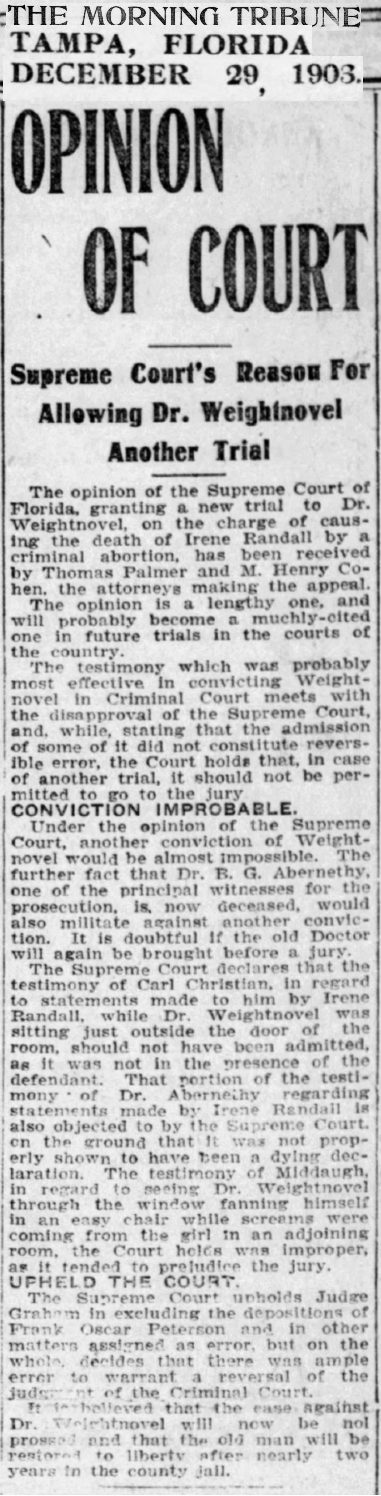
Weightnovel was convicted of manslaughter in Irene‘s death and was sentenced to six years at hard labor. The February 5, 1903 Tampa Weekly Tribune noted, "But for the advanced age of the prisoner, Judge Graham would doubtless have given him at least ten years, the maximum penalty in the case being twenty years. If Dr. Weightnovel should go to a convict camp, the first penalty inflicted upon him would doubtless be the removal of his flowing locks and profuse beard."
He appealed and was granted a new trial. One of the grounds was that Carl Christian's testimony regarding statements Irene had made to him were inadmissible because they were not made in Weightnovel's presence. The testimony of Mr. Middaugh that he had seen Weightnovel fanning himself in an easy chair while Irene was screaming in an adjoining room were found inadmissible because they were prejudicial.
Dr. Abernathy, who had been a key witness for the prosecution, died before a second trial could be held.
Sources:
- "Prosecute Weightnovel," Tampa Tribune, June 20, 1902
- "Her Last Letters," The (Tampa, FL) Morning Tribune, June 20, 1902
- "Fair Girl's Death Exposes Base Crime," Tampa Weekly Tribune, June 26, 1902
- "Hearing Set for Wednesday," The (Tampa, FL) Morning Tribune, June 27, 1902
- "Roars in His Rage at Press and Public," The (Tampa, FL) Weekly Tribune, July 3, 1902
- "Weightnovel Case," Tampa Tribune, January 21, 1903
- "Dr. Weightnovel Found Guilty," The Selma (FL) Times, January 31, 1903
- "Six Years at Hard Labor Doctor's Doom," Tampa Weekly Tribune, February 5, 1903
- 46 Fla. 1, 35 So. 856; Supreme Court of Florida, Division A. Weightnovel v. State, Dec. 19, 1903
- "Opinion of Court," Tampa Morning Tribune, December 29, 1903
.png)

.jpg)


June 12, 1913: A Lingering Death Leaves the Abortionist Free to Kill Again

Annie gave the coroner a deathbed statement in which she said that 60-year-old allopath Dr. F. Waldo Whitney had performed the abortion on February 22, presumably at his office on West 64th Street in Manhattan.
Whitney was arrested based on Annie's statement and held for three weeks before he was finally released on $3,000 bail.
Annie lingered for three months before finally dying on June 12, leaving her husband, George, to raise their four young children alone. An autopsy confirmed that she had died of "exhaustion incident to general septicaemic & suppurative pyelonephritis canadyan induced abortion."
Whitney's attorney was able to get the deathbed statement ruled inadmissible because of the three months that lapsed between the date of the statement and the day Annie died. This left him free to perform a fatal abortion on Margaret Buetelman in 1914.
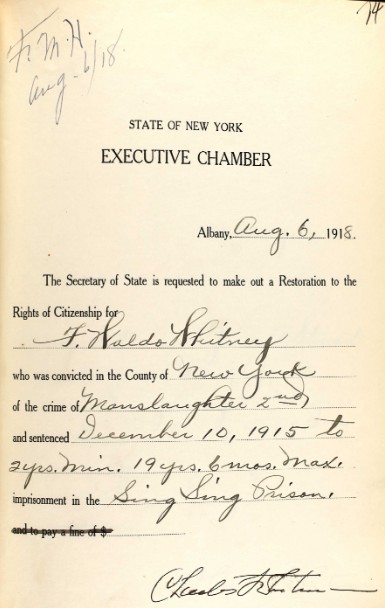
Whitney was convicted of first-degree manslaughter for Margaret's death on December 10, 1915 and was sentenced that day to a sentence of two years to 19 years six months at hard labor in Sing Sing. He was pardoned on August 6, 1918 after serving only 2 years, 7 months, and 27 days. He went on to perform a fatal abortion on a woman whose name I've been unable to determine in 1923.
Watch "Would A Second Statement Have Saved the Next Woman?" on YouTube.
Sources:
- "Woman Dies; Doctor Sought," Brooklyn Times Union, June 13, 1914
- "Increase Doctor's Bail," Brooklyn Times Union, June 14, 1913
- "Held for Woman's Death," Brooklyn Times Union, July 3, 1913
- "Physician On Trial," Evening World, June 12, 1914
- Sing Sing Prison Receiving Blotter Number 66778
- "Convicted of Manslaughter," New York Sun, December 11, 1915
- "Physician Sent to Sing Sing," The (NY) Evening World, December 22, 1915
- Request for Pardon, August 6, 1918
- Restoration to Citizenship, August 6, 1918
- "Regents Revoke 3 Licenses of Law Violators," (NY) Post-Star, March 31, 1924




Tuesday, June 11, 2024
June 11, 1843: Death in a Stranger's House
Caroline Amelia Clark, age 18, lived in Detroit with her mother and stepfather, Mr. and Mrs. Myers. From time to time she resided with the family of her stepfather’s son-in-law, Alonzo Plumstead, in Northville.

On Sunday, June 4, 1843, Caroline told her mother that she was leaving aboard a steamboat for Toledo, accompanied by Mr. Plumstead. Instead of boarding the boat, however, Caroline and Plumstead went to the Farmington home of Mrs. Sophia Sperry, arriving as night was falling. Plumstead gave his name as Marlow, and, referring to Caroline as his wife, Sarah, Plumstead asked if she could stay there for a few days while he went to Livingston County. She was feeling too ill, he said, to continue the trip with him. Mrs. Sperry agreed, and Plumstead left.
Caroline only sat by the fire a short time before saying that she felt unwell and wanted to go to bed. Mrs. Sperry settled her visitor in bed and sat up with her through the night.
Summoning a Doctor
The next day, which was Monday, Mrs. Sperry saw Dr. Wixom passing by, so she called him in to attend to the sick woman. Wixom examined Caroline, who was pregnant and appeared to be in premature labor.
Caroline gave birth to a stillborn child on Wednesday. Wixom checked on her and she seemed to be adequately recovering. However, she took violently ill on Friday.
Caroline Dies
On Saturday Plumstead came to the house, stayed with Caroline for several hours, and then left, instructing Mrs. Sperry to send for him in Northville if “Sarah” died.
She died the very next day, June 11.
The Abortion Revealed
A post-mortem examination was performed at Mrs. Sperry's home. A coroner’s jury concluded that “Caroline Amelia Clark came to her death by inflammation subsequent to abortion, which was produced by extraordinary means used or administered to or upon said Caroline Amelia Clark, by some person or persons, for that purpose, to this jury unknown.”
The News Breaks
News coverage indicated that there was no love lost for Plumstead:
Considered in all its circumstances and revolting details, many of which are unfit for publication, it is indisputably the most diabolical and fiendish outrage, so far as Plumstead is concerned, which has ever disgraced this or any other civilized community. The deceased we understand, was beautiful and accomplished — enjoying an education superior to that of most young ladies by whom she was surrounded, and up to the time of the fatal denouement of their illicit intercourse, both she and her heartless seducer and murderer, (for he can scarcely be looked upon in any other light,) moved in the best society, and enjoyed the respect and esteem of a numerous circle of friends and acquaintances. The scene represented on the arrival of the afflicted mother and sister from Detroit, is said to have been heart-rending to the last degree.
Caroline’s Mother and Plumstead’s Wife React
 “When the sad intelligence was communicated to that too fond and unsuspecting parent, that her daughter lay in the cold arms of death at Farmington, … it required the utmost powers of persuasion on the part of the messenger … to convince her of the fact. She could not and would not believe it. She was sure that her child was then safe with her friends in Toledo, and she remained partially incredulous until she arrived and saw with her own eyes!”
“The wife of the vile seducer was also present, and, with all the eloquence and earnestness of a woman’s confidence and tired affection, protested her husband’s innocence, and the impossibility of his having any thing to do in the perpetration of so foul a crime, until her mouth was closed by his confession, to her face, that he was indeed the wretch.”
Plumstead, however, made himself scarce before he could be arrested.
Sources:
- "Horrible," Brooklyn Daily Eagle, Jan 26, 1843
- “The Case Of Caroline A. Clark,” Boston Post, June 28, 1843
- “Horrible Affair — Seduction and Death,” Boston Courier, June 29, 1843
- “Seduction and Death,” The Middletown (CT) Constitution, July 5, 1843
- "The Case of Caroline Clark, Seduction and Death," Vermont Phoenix, July 7, 1843, reprint from Detroit Advertiser, June 20, 1843


June 11, 1917: Another Death from the Homicide in Chicago Database

Watch More Scanty Chicago Information on YouTube.
Sources:
- Homicide in Chicago Interactive Database
- "Dr. Meinhardt Again Charged With Abortion," Chicago Tribune, June 13, 1917
- census and death records

June 11, 1999: The Utmost in Safe, Lethal Abortion Care

On June 9, 1999, John Weitzner, MD performed a suction abortion on Maria, while Lawrence Hill, CRNA, administered Brevitol for anesthesia. This drug is inappropriate for a patient who had seizure disorder, as Maria had indicated on her medical history. Maria was under anesthesia for a total of four minutes, from 12:40 to 12:44 p.m. Hill then transferred Maria to the recovery room without first verifying that her condition was stable. When she was transferred, the pulse oximeter, which monitors pulse and blood oxygen levels, was removed.
 |
| Albany Medical Surgical Center |
Maria was now in the care of Yvette Johnson, RN. A nurse reviewing Maria's records noted that the nurses did not perform a proper assessment of Maria when she was turned over to their care. They did not take a pulse or check to see if she was even breathing.
Shortly thereafter, Johnson noticed that Maria wasn't breathing and had no pulse. She, Hill, and Hall attempted to resuscitate her with CPR, and ambu-bag, and a defibrillator. Nobody summoned Weitzner, who was performing an abortion on another patient. He came into the recovery room at about 12:50. Staff continued to try to revive Maria for another ten minutes before they finally got around to calling 911, rather than summoning EMS as soon as they realized that their patient was in a life-threatening emergency.
Maria was taken to Rush-Presbyterian-St. Luke's hospital, where she died on June 11. She left behind two sons, a 7-year-old and a toddler.
Albany had already had one patient, Deanna Bell, die from anesthesia complications. Then-owner Edward Campbell Allred admitted that he failed to perform any preventability study to keep any other patients from suffering Deanna's fate.
Other women known to have died after abortions at Allred's facilities include: Denise Holmes, Patricia Chacon, Mary Pena, Josefina Garcia, Lanice Dorsey, Joyce Ortenzio, Tami Suematsu, Susan Levy, Christina Mora, Ta Tanisha Wesson, Nakia Jorden, Kimberly Neil, Maria Rodriguez, and Chanelle Bryant.
Shortly thereafter, Johnson noticed that Maria wasn't breathing and had no pulse. She, Hill, and Hall attempted to resuscitate her with CPR, and ambu-bag, and a defibrillator. Nobody summoned Weitzner, who was performing an abortion on another patient. He came into the recovery room at about 12:50. Staff continued to try to revive Maria for another ten minutes before they finally got around to calling 911, rather than summoning EMS as soon as they realized that their patient was in a life-threatening emergency.
Maria was taken to Rush-Presbyterian-St. Luke's hospital, where she died on June 11. She left behind two sons, a 7-year-old and a toddler.
 |
| Edward Allred |
Other women known to have died after abortions at Allred's facilities include: Denise Holmes, Patricia Chacon, Mary Pena, Josefina Garcia, Lanice Dorsey, Joyce Ortenzio, Tami Suematsu, Susan Levy, Christina Mora, Ta Tanisha Wesson, Nakia Jorden, Kimberly Neil, Maria Rodriguez, and Chanelle Bryant.
Steve Lichtenberg, who oversees and performs abortions at the Chicago FPA facilities, continues to make presentations at their Risk Management Seminars although the Medical Director of Planned Parenthood Federation of America had scolded him at one NAF session for "playing Russian roulette with patients' lives" by treating life-threatening complications at his outpatient clinic rather than promptly transferring them to properly equipped hospitals. Yet they profess a loathing of risky abortion practices.
CRNA Lawrence Hill was also faulted for his fatal oversights in the abortion deaths of Antonesha Ross in 2009 and Nakia Jorden in 1998.
Watch "Deadly Delay" on YouTube.
Source:
- Cook County Circuit Court Daumer v. Family Planning Associates Medical Group
Subscribe to:
Posts (Atom)