Sunday, November 30, 2025

1984: “Safe and legal” abortion causes cardiac problems in healthy woman

 “Irene” was a 32-year-old white woman in good health. She had no history of heart problems or any disorders that would have put her at risk for heart problems. At 16 weeks pregnant, she underwent a “safe and legal” abortion.

An abortion at 16 weeks is a multi-day procedure. A dilator was left in her cervix overnight before she returned to the abortion facility. A suction curettage abortion was then attempted. This was a negligent choice of method because even if Irene’s cervix was dilated enough, the suction would not fully remove a larger baby and was highly likely to leave body parts behind (particularly those involving a lot of bone structure).

Grok AI illustration
Sure enough, Irene began showing signs of infection within 48 hours. A prescribed antibiotic and over-the-counter pain medication didn’t stop the fever and chills, and she was hospitalized a week later. By this time she was described as acutely ill with tachycardia, tachypnea, uterine tenderness, foul-smelling vaginal discharge and (although she had never had any cardiac problems before) a diastolic blowing heart murmur.

The hospital started Irene on a course of medicine and performed surgery to remove anything left behind in her uterus. Sure enough, she was suffering from postabortal endometritis. Despite the hospital’s efforts to fix the damage that had been done, Irene deteriorated.

Within 72 hours of being admitted to the hospital, Irene’s heart murmur worsened. Her blood cultures were positive for Group B streptococcal infection.

On the third day of Irene’s hospitalization, she went into congestive heart failure and had to undergo cardiac surgery. Her heart was abscessed and in such bad shape that doctors had to replace her aortic valve.

After the heart surgery, Irene was hospitalized for six more weeks, during which she was treated for infection and arrhythmia. She seemed to be getting stronger and was finally discharged. The nightmare that had started with her abortion finally seemed to be over.

But ten days after being discharged, Irene noticed fatigue and that her ankles were swelling. This progressed into dizziness and difficulty breathing, so she was readmitted to the hospital. Doctors found a new diastolic heart murmur and attempted heart catheterization followed by corrective surgery the next day, but Irene died in the operating room.

Irene’s initial infection had caused streptococcal endocarditis. Her doctors discovered that although cultures obtained at time of death were sterile, the annular abscess in her heart had been so severe that it eroded into the surrounding structures. Even after the infection was treated and the aortic valve replaced, her heart had been too damaged to function properly.

The CDC’s statistics for the year counted a white woman in the 30–34 age range among the year’s known deaths from legal abortion. However, researchers were able to identify no less than three women matching that description. Even if the 1984 abortion statistics counted Irene, at least two others like her went unnoticed.

Watch Fatal Heart Damage From Abortion on YouTube.
Watch Fatal Heart Damage From Abortion on Rumble.

Source: "Pregnancy-associated group B streptococcal endocarditis: a report of two fatal cases," Obstetrics and Gynecology, September, 1985 (Irene is Case 2 in the report section and Patient 21 on the chart, which specifies her year of death)

Saturday, November 29, 2025

November 29, 1975: Anesthesia Reaction Kills Mother of Four

On November 28, 1975, Kamala Reddy and her husband, G. Pulla Reddy, went to Sigma Reproductive Health Center in Montgomery County, MD, for an abortion. Kamala was a 31-year-old immigrant from India.

Kamala and Pulla completed the informed consent together, indicating that Kamala's only allergy was to sulfa. They also indicated that there had been no complications during the pregnancies and births of the couple's four children. 

Dr. Vibhakar J. Mody was an independent contractor paid piece rate by the facility.

When Mody administered the local anesthetic, Kamala suffered "a violent reaction." She was transferred to Washington Adventist Hospital where she died the following day, November 29.

The defense successfully argued that when Kamala first reported a reaction to the anesthetic, both Mody and a nurse asked if she had ever had a reaction before and she said yet, but didn't tell them because "I didn't think it would be so bad."

Sources:

November 29, 1971: A Miserable, Lingering Death

SUMMARY: "Monica," age 31, died November 29, 1971 after an abortion performed in Massachusetts.

"Monica" is one of the women Life Dynamics identifies on their "Blackmun Wall" as having been killed by a safe and legal abortion.

According to LDI, Monica was a 31-year-old mother of five. She requested an abortion when she was 8 weeks pregnant, but the abortion was delayed about a month in order to address "some health, personal and administrative problems."

Her doctor decided that it was best to simply remove Monica's uterus with the fetus still in it. The hysterectomy was done on November 20, 1971 under general anesthesia with no apparent complications.

The following day, Monica had a mild fever and reported nausea. She had no bowel sounds, indicating possible bowel paralysis. She was treated with IV fluids and nasogastric suction.

Grok AI illustration
On November 22, Monica reported feeling unwell. Her abdomen was distended and she had not had a bowel movement since the surgery. An abdominal x-ray showed patterns of trapped gas that were consistent with bowel paralysis.

Over the next two days, Monica seemed to be feeling better. She was able to take in some food. However, she still had not had a bowel movement.

Six days after the surgery, November 26, 1971, Monica began to scream and vomit. She reported severe abdominal pain and couldn't see. Within an hour of the onset of these symptoms, Monica died.

The autopsy revealed grim findings. Monica had a severe infection that had interfered with her bowel function. As she continued to eat but not to have bowel movements, her bowels backed up, allowing gastric juices to enter her lungs and begin to digest them. She also had bacteria in her brain, which may have caused her blindness in the final hour of her life.

Watch Bowels Paralyzed After Abortion on YouTube.
Watch Bowels Paralyzed After Abortion on Rumble.

LDI Sources: "Committee on Maternal Welfare: Paralytic Ileus," Jewett, New England Journal of Medicine, 290:6, Feb. 7, 1974, 340-41; Massachusetts Department of Health, Database run on maternal deaths

Friday, November 28, 2025

2009-2019: Reckless Drug Use for Eugenic Abortion Kills Mother

A retrospective study was conducted using data from Rush University Medical Center, Northwestern Memorial Hospital and other Northwestern-affiliated hospitals. The study collected data on patients who received care at those hospitals for complications of second trimester abortions or surgical intervention for fetal demise. “Nikki” was one of many who suffered complications from an abortion late in pregnancy, and the hospital she went to was unable to save her life.

Grok AI illustration
Nikki was at least 23 weeks pregnant when she underwent a eugenic abortion at an unspecified facility because her child had been diagnosed with anomalies. (The study does not specify what the diagnosis was or what testing was done to confirm, but many prenatal diagnostic tests have a high rate of false positives.) She had a history of one previous C-section but had no recorded health problems.

Nikki’s baby was subjected to a lethal injection of potassium chloride. The FDA has warned that no company has actually sent them scientific proof that the drug is safe and effective for this use, and that it can cause serious side effects. Misoprostol was then administered. According to the FDA’s warnings on misoprostol, these potentially lethal side effects are more likely if the patient has had a previous C-section and is farther than 8 weeks pregnant.

Nikki delivered her dead child, but began to show symptoms of profound DIC (a clotting disorder that can cause hemorrhage) while the placenta was still inside of her. She underwent an emergency D&C, exploratory laparotomy and finally a hysterectomy in an attempt to save her life, but went into cardiac arrest. CPR was attempted, but she couldn’t be revived.

Nikki had apparently suffered an amniotic fluid embolism. This was a foreseeable consequence because the FDA had warned that the off-label use of misoprostol in this way had been known to result in AFE, DIC and maternal death (among other problems).

Many parents report being pressured to abort if their child was diagnosed with any kind of anomaly in utero. A few other women and girls killed by abortion for known or suspected fetal anomalies include Jennifer MorbelliAlerte Desanges, Linda Boom, Gabriella Cipolletta, Odette Boutte, Michelle Madden, “Beverly Roe” and “Mandy Roe.” Marla Anne Cardamone and Allegra Roseberry also died after being coerced into eugenic abortions, only for their loved ones to later discover that there had never been any fetal anomalies after all.

Contraception, January 2023 Page 55-60

Thursday, November 27, 2025

1970: Pre-Roe Legal in Iowa

According to Life Dynamics research, “Katherine” was able to obtain a legal abortion in Iowa in 1970. She was in her early 20s.

Life Dynamics got information from the Iowa Department of Health about Katherine, but due to a confidentiality agreement are not at liberty to reveal the details.

Iowa abortion law at the time allowed babies to be aborted only if a doctor judged that carrying the baby to term would endanger the mother's life, so either Katherine did have a serious health issue or her doctor was able to make a credible claim that he believed she did.

Other "life of the mother" abortions proved fatal include: 

  • Erika Wullschleger died in 1951 after her doctors got permission to perform an abortion intended to improve her seriously impaired health.
  • Francesca Sardina died a lingering death justified on health grounds in 1970.
  • Allegra Roseberry was pushed into an abortion in order to obtain experimental cancer treatment.
  • Anjelica Duarte sought an abortion on the advice of her physician, and ended up dying under the care of a quack.
  • Barbara Hoppert died after an abortion recommended due to a congenital heart problem.
  • Christin Gilbert died after an abortion George Tiller justified on grounds of maternal health.
  • "Molly" Roe died in July of 1975 when her doctors made the dubious decision to perform a saline abortion to improve her chances of surviving a lupus crisis.
Doctors will sometimes push for an abortion due to maternal conditions that do not make pregnancy nearly as risky as the woman is led to believe. Dr. Thomas Murphy Goodwin wrote about several examples in "Medicalizing Abortion Decisions," First Things, March, 1996:

Case #1: A 21-year-old woman, 19 weeks pregnant, had been referred for "immediate abortion" after being diagnosed with a congenital heart defect. The patient was very distraught at the thought of aborting her baby so she was referred to Goodwin's practice for a second opinion. A second medical evaluation found that the patient's heart condition was mild and she was able to continue her pregnancy and have her baby.

Case #2: A 25-year-old woman, 12 weeks pregnant, was diagnosed with narrowing of a heart valve. Her physician recommended abortion, but Goodwin's practice suggested that the woman have a procedure done to correct the heart condition, since it could be performed safely during pregnancy. Her doctor expressed concerns about his liability if the patient did not abort. Goodwin did not learn of the final outcome of this woman's pregnancy.

Case #3: A 38-year-old woman, 11 weeks pregnant, was referred by her pastor. She had been diagnosed with breast cancer. She was told that she should abort her baby so that she could undergo chemotherapy and actually had the abortion scheduled. Goodwin's practice reviewed the chemotherapy regimen with her and explained that though the long-term effects were unknown, it seemed to be well tolerated by the fetus when administered in pregnancy. The patient's doctor did not want to assume liability for the case so Goodwin's practice managed her chemotherapy. She delivered a healthy baby.

Case #4: A 20-year-old woman, 18 weeks pregnant, was diagnosed with kidney disease that seemed to be due to a new onset of lupus. Her doctor recommended that she undergo an abortion, both for her own health and to avoid any harm that might come to the fetus due to medications. The patient did not want to abort her baby. Goodwin's practice told her that although her chances of carrying her baby successfully to term were slim due to her condition, abortion would have an unpredictable effect on her own health. The patient was able to continue her pregnancy. Goodwin's practice repeatedly had to demonstrate to other physicians that certain diagnostic tests they wanted to do would not be likely to harm the baby and thus could safely be performed during pregnancy. The patient was thus able to pursue care for her own condition without having to abort her baby. Sadly, she went into premature labor at 27 weeks and her baby subsequently died from infection at one week of age.
Goodwin lamented that many women wound up undergoing unwanted abortions of wanted babies because they were misinformed by their doctors. Some of these doctors were merely -- albeit inexcusably -- ignorant, but others recommended abortion purely to avoid potential liability. This sort of bullying into unwanted abortions should be common ground for people all across the political spectrum.

Wednesday, November 26, 2025

November 26, 2003: Sent Home From NAF Clinic to Bleed to Death

Malachy DeHenre

Leigh Ann Stephens Alford, age 34, underwent a safe and legal abortion at the hands of 53-year-old Dr. Malachy Malvin DeHenre at Summit Medical Center of Alabama, a National Abortion Federation member clinic, on November 25, 2003. She was about 17 weeks into her pregnancy.

Leigh Ann was discharged from the clinic 20 minutes after her abortion, according to a lawsuit filed by her husband, Drrrick. Within six hours, he said, he called the facility to report that Leigh Ann was suffering abdominal pain and fever, and was told that his wife did not need to be seen. He later found her lying unresponsive on the floor and called 911.

An ambulance transported Leigh Ann to the emergency room at Medical Center East in Birmingham, Alabama. She died about 18 hours after the clinic had sent her home. 

Death was attributed to hemorrhagic shock because DeHenre has poked a hole in his uterus and failed to notice. 

Several other patients suffered similar catastrophic injuries but were admitted to hospitals where other doctors were able to save their lives.

DeHenre was later convicted of manslaughter after shooting his wife in the head. He served half his sentence then was deported to his native Nigeria. Not only was he a murderer and a quack -- he was an illegal alien.

Watch A Literal Ladykiller on YouTube.
Watch A Literal Ladykiller on Rumble.


Sources:

Tuesday, November 25, 2025

November 25, 1999: "Therapeutic" Abortion Death

Grok AI illustration
I have a death certificate for this young woman, but since her family never went public with her death I am giving her the pseudonym "Marceline Powers."

Marceline was a 25-year-old black woman living in the Seattle area when she underwent what her death certificate calls a "therapeutic" abortion. Though some people used the term "therapeutic" abortion to refer to an abortion done for medical reasons, others use the term "therapeutic" abortion to indicate an induced abortion rather than a miscarriage. 

Marceline died at Harborview Medical Center in Seattle on November 25, 1999. Her primary cause of death on her death certificate is pulmonary embolism as a consequence of deep leg vein thrombosis. Deep leg vein thrombosis is rare, slightly more common in pregnant women and is treatable without harm to the fetus.  I've seen no evidence that it's seen as an indication for abortion, but the use of the term "therapeutic" abortion might indicate that the deep leg vein thrombosis was the reason Marceline ended up undergoing the abortion. 

Autopsy reports are confidential in Washington, and there's no record that her family sued or otherwise went public, so I can't determine how the sequence of events played out that cost Marceline her life.

Watch Therapeutic Death in Seattle on YouTube.
Watch Therapeutic Death in Seattle on Rumble.

Source: Death certificate

Monday, November 24, 2025

Assorted Scriptures and Abortion

 Let's take a look at some assorted Scriptures that can tell us how to approach abortion:

    2 Chronicles 25:3 "...The fathers shall not be put to death for the children, or the children be put to death for the fathers..."

I think this applies not only to rape and incest, but "He's a scumbag, why would I want to have his baby?" Should the fact that the father has sinned -- through abandonment of responsibilities, adultery, fornication, rape, or failing in any way to show the love due to our fellow human beings -- justify punishing the unborn little one? Do we punish children for the sins of their parents?

    Jeremiah 7:6 "...and do not shed innocent blood in this place..."

The blood of the fetus, who is about as innocent as you can get, is irrefutably shed in abortion. Where on this earth can a Christian say is an appropriate place for a Christian to shed innocent blood? There is no hospital, clinic, or doctor's office where God is not present, where His eyes do not see and His heart does not grieve. Does the fact that abortion takes place outside a church building make the shedding of innocent blood any less abominable?

    Matthew 25:40 "...whatever you did for the least of one of these my brothers and sisters, you did for me."

How much more "least" can one be than a tiny fetus in the womb? Do not Christ's words tell us that the very smallness and helplessness of the fetus compell us even more to see Christ, and to treat our unborn brethren as we would our Savior? This scripture alone should be enough to silence Christians who claim that abortion is acceptable in God's eyes. How can they justify it? On the grounds that Christ was willing to be crucified for our sins, therefore He won't mind being cut up with a curette or torn apart with forceps?

    Romans 12:1 "...offer your bodies as living sacrifices, holy and pleasing to God..."

Is making one's womb a place where a creation of God's is torn into little pieces in keeping with this scripture? Likewise, is abortion, the tearing into pieces of God's handiwork, a suitable act for inside our bodies, which are temples of the Holy Spirit?

    1 Corinthians 10:24 "Nobody should seek for his own good, but the good of others."

Is sacrificing the lives of our own unborn children in keeping with this scripture? Since when is the Chrisitian called to ask others to sacrifice their own lives for his or her convenience? We are called upon to lay down our lives for one another, not to demand that our brothers and sisters die for our sakes.

    James 2:26 "As the body without the spirit is dead, so faith without deeds is dead."

Is resorting to abortion a very good sign of faith that God will provide for our needs? Can we be trusting God for daily bread, when we're ready to jump the gun and destroy one of His children out of fear of what will happen many months from now?

    1 Peter 4:9 "Offer hospitality to one another without grumbling."

How hospitable are we being when we deny our own offspring the safety of our wombs? If we refuse to love our own children, sheltered in our bodies, how can we claim to love our brothers and sisters who seek refuge in our homes?

I think people tend to get too literalist when they get to abortion and the Bible, and don't look at general precepts, which are:

1. Trust in God. Are we trusting Him to meet our needs when we act in fear? And isn't abortion really an act of fear, rather than of trust?

2. Reverence. What does it say of our reverence for God when we destroy His handiwork?

3. Love. How loving it it to tear another limb from limb?

And throughout the Old Testament are admonistions to be kind to animals -- to not muzzle the ox, etc. If we're to show kindness to beasts, how are we to treat our unborn offspring?

Scriptures on the Unborn to Apply to Abortion

 Christians most often cite two scriptures when tackling abortion:

    Jeremiah 1:5 - "Before I formed you in the womb I knew you, before you were born I set you apart"
    Psalm 139:16 - "Your eyes saw my unformed body. All the days ordained for me were written in Your book before one of them came to be."

These scriptures certainly speak clearly on the issue of God valuing and treasuring each of us, even before birth. They reflect the marvelous quality of God's handiwork, even before science knew exactly how detailed, complex, and sophisticated the fetus was. By eight weeks -- the time most abortions are performed -- every organ system is present in the fetus. The bones are formed, the hands and feet, kidneys and adrenal grands, eyes and ears and brain. The unborn child is God's handiwork, a masterpiece in progress. The scriptures recognize this.

Another scriptural reference to unborn life is the wrestling in the womb of Esau and Jacob within Rebekah's body (Genesis 25:21-23):

    Isaac prayed to the Lord on behalf of his wife, because she was barren. The Lord answered his prayer, and his wife Rebekah became pregnant. The babies jostled each other within her, and she said, "Why is this happening to me?" So she went to inquire of the Lord. The Lord said to her, "Two nations are in your womb, and two peoples from within you will be separated; one people will be stronger than the other, and the older will serve the younger." (NIV)

Of course, this scriptural passage was written long before ultrasound allowed us to observe behavior in the womb. But it turns out that twins do indeed wrestle in the womb, do touch and interact with one another. And God uses this normal human behavior, and Rebakah's unusual recognition of this behavior, to reveal the future of her descendants to Rebekah.

Perhaps the most famous act by a fetus in the Bible is the leaping of John the Baptist within Elizabeth's womb at the sound of her cousin Mary's voice (Luke 1:41-44):

    When Elizabeth heard Mary's greeting, the baby leaped in her womb, and Elizabeth was filled with the Holy Spirit. In a loud voice she exclaimed: "Blessed are you among women, and blessed is the child you will bear! But why am I so favored, that the mother of my Lord should come to me? As soon as the sound of your greeting reached my ears, the baby in my womb leaped for joy. (NIV)

As John the Baptist was later to announce the coming of the Messiah to the multitudes as a man, he announced the Incarnation to his mother while still in the womb. His destiny was already in motion, and the Spirit of God already active in him, directing him, even before his birth.

If we search the Bible for signs of when God first begins to love each of us, we see that His love is eternal -- that it precedes our existence. But how are we, who live within the limitations of time, to live out that love to one another? We can not act in love toward those who, from within our prison of time, do not yet exist, except to be prepared to welcome our fellows when they arrive in this finite world, to live out their lives among us. To countenance abortion even in theory is to prepare to reject those who God holds in His mind, who He already loves with His perfect love. And to practice abortion in reality is to reject our brothers and sisters, in a very real and concrete way, by killing them. In doing so, we sin not only against our brothers and sisters by breaking the Commandment against murder; we sin against Christ by killing Him in them, for as we do to them, we do to Him.

Exodus 21 and Abortion

 One Scripture that gets batted back and forth between prolifers and abortion defenders is Exodus 21:22-25.

"If men who are fighting hit a pregnant woman and she gives birth prematurely but there is no serious injury, the offender must be fined whatever the woman's husband demands and the court allows. But if there is serious injury, you are to take life for life, eye for eye, tooth for tooth, hand for hand, foot for foot, burn for burn, wound for wound, bruise for bruise." (NIV)

If men strive, and hurt a woman with child, so that her fruit depart [from her], and yet no mischief follow: he shall be surely punished, according as the woman's husband will lay upon him; and he shall pay as the judges [determine]. 23. And if [any] mischief follow, then thou shalt give life for life, eye for eye, tooth for tooth, hand for hand, foot for foot, 25. burning for burning, wound for wound, stripe for stripe. (King James Version)

Some Christians try to use this scripture to defend abortion, saying that it means that causing a miscarriage isn't the same as causing the death of a human being. The person who strikes the pregnant woman, they claim, is only liable if the premature expulsion of the fetus also injures or kills the mother. The death of the fetus, they claim, is a minor offense and only requires restitution, as would be appropriate for damaging a man's property. Which group was interpreting this passage appropriately? I turned to About's Christian Humor Guide, Greg Hartman, for help. Here's what he had to say:

    The King James renders it "her fruit depart from her"; the NKJV gives it as "gives birth prematurely." What does the term mean? We think of premature birth and miscarriage as two different things; miscarriage being a natural abortion and premature birth being a live baby.

    There are several nearly irrefutable arguments against this passage referring to the death of the baby:

    1. The word translated "serious injury" (ason in Hebrew) is never used to refer to death in the Bible. Whether the term "serious injury" refers to injury to the mother or the child (or both) can be determined as a consequence of the survival or death of the baby. We can already see from the passage that death of the mother is not an issue here; on the possible death of the baby:

    2. This verse is in the section of Assault Laws, not the section of Homicide Laws (v 12-17). Therefore it doesn't refer to death at all, either of the baby or the mother.

    3. The statement "eye for eye, tooth for tooth, burn for burn" etc. is a formula statement known the "lex talionis" (i.e., Law of Retribution). It is used in many other places in the Law in the same pattern, and it does not include death.

    Notice, for instance, that the lex talionis covers various types of permanent injury -- dismemberment, loss of an eye or tooth, burns, etc. -- but not death. Murder and/or what we call involuntary manslaughter are covered separately. For instance, Leviticus 24:20 includes the lex talionis, but death is covered separately in the next verse (see also Numbers 35:11).

    Since the lex talionis appears here with no specific reference to death, death is almost certainly not considered here at all. Therefore, the death of mother or fetus would be judged under the murder or accidental death laws cited above.

    4. The phrase translated "premature birth" (yeled yatsa in Hebrew; literally "her children came out") does not favor the idea that the death of the baby is described here. The phrase yeled yatsa is never used in passages referring to miscarriage; the word that is used for miscarriage (Hebrew sakal) is not used here. Sakal is used some 23 times in the Old Testament; sometimes it is rendered as "miscarry" in the NIV but always -- invariably -- it refers to childlessness.

    Bottom line: This phrase refers to a premature birth, caused by the fight, which the baby survives. If there is no other injury beyond the premature birth, the guilty party is fined according the judges' decision based upon the husband's demands. If there is any other injury -- and we have determined that the baby is alive here -- the lex talionis would apply to the mother and the baby equally, meaning that the guilty party would suffer the same retributive punishment determined by the injury of the victim. And in this case, the victim could be either the baby or the mother.

    Therefore the "value status" of the fetus, according to this passage, is equal to that of the mother.

When I looked online for commentaries on this passage, I also found other points being reinforced. One is that this verse underscores is that we are responsible not only for wrongs we deliberately inflict on others, but also even for harm we cause unintentionally, through our carelessness

Another point was that pregnant women were singled out for particular care. The passage doesn't specify penalties for harming bystanders in general during a conflict, but specifically protects the expectant mother and her unborn child. The miraculous process of gestation, of bringing fruition to a new life, is given special attention.

November 24, 1984: The Dreadful Thanksgiving Surprise

Michelle Madden

Eighteen year old Michelle "Shelly" Madden, a freshman at Mobile College, sought a safe and legal abortion from O.B. Evans at Family Planning Medical Center of Mobile, Alabama. It was performed on November 18, 1986. According to the friend who had accompanied Michelle to the abortion facility, Shelly had chosen abortion because a doctor had told her that her baby would have birth defects due to Michelle's epilepsy medication.

This issue was likely not explored during pre-abortion counseling, since Shelly was taken to the procedure room only 15 minutes after she arrived at the facility.

That very day, Shelly's parents were preparing to go to Mississippi to spend Thanksgiving with Mrs. Madden's brother. They got a call from Shelly's roommate telling them that their daughter was sick.


"We didn't think anything of it. We told her we were going to come the next day to pick her up," Shelly's mother told the Mobile Press Register. But before they could leave home the next day, the house mother at the dorm called, asking if Shelly had gynecological problems. Again, the parents weren't particularly concerned. At that point, they weren't even aware that their daughter had been pregnant.

When they arrived at the dorm, they were told that Shelly was in the hospital. "We called the hospital and they said she was in surgery." They were at the hospital for an hour until the doctor finally came to them and told them that Shelly had undergone an abortion. When they were operating on Shelly, doctors told her parents, they found a leg bone, two pieces of skull, and some placenta still in Shelly's uterus.

Angie and Thomas Madden
"From what he told me at that point," said Mrs. Madden, a nurse, "I knew that for her to live would be a miracle, on the order of the Lord raising Lazarus from the dead. She was in such bad shape I didn't see how she could make it."

Shelly's mother was sadly right. Sepsis had already set in, and Shelly remained on life support dying on November 24. Her parents sued Evans and the facility, mostly because nobody would give them answers about how and why her daughter died. In 1991 a jury awarded them $10 million in damages. 


Sources:

Sunday, November 23, 2025

November, 2022: Health Department learns about Planned Parenthood death

Grok AI of Luanne approaching the actual building
where she would be fatally injured
The Indiana Department of Health legally requires Terminated Pregnancy Reports (TPRs) to be submitted for each abortion done in the state. Many abortion facilities have been caught submitting incomplete forms or simply not reporting abortions, but the information we do have shows that at least three women were killed by legal abortion in Indiana between April and November of 2022.

Luanne” was 31, white, unmarried, and had no documented pre-existing medical problems. She had a high school diploma or GED but no education beyond that. This was Luanne's first pregnancy. There's no record of why she decided on an abortion, or why she decided to trust this particular Planned Parenthood to keep her safe. She had no idea that the decision to abort her baby would be the last decision she would ever make.

Rhiannon Amodeo
Dr. Rhiannon Amodeo performed the surgical abortion of Luann's baby, at 6 to 8 weeks of gestation, at Bloomington Planned Parenthood on November 8, 2022. No other details of the abortion are available.

The exact date of Luanne’s death is unspecified, but the Indiana Department of Health received the report documenting her death on November 23. The lack of a pathology exam on the fetal remains is a clue that Luanne might have died so soon after the abortion that the facility didn't consider it worth the cost to do a pathology exam for a patient who had already expired. There is also the fact that they actually knew that she had died, which would indicate that she died while still under Planned Parenthood's care.

Others who lost their lives to Planned Parenthood and affiliated facilities include Alexis "Lexi" ArguelloAlyona Dixon, Suzanne Quinn*, Elise KalatNichole Williams, Roselle OwensIrene StevensonCree Erwin-Sheppard, Tonya ReavesEdrica GoodeBonnie HuntHolly Patterson, Diane BoydSandra Kaiser, Yara Buchanan**, Diana LopezHoa Thuy "Vivian" Tran, Pamela Gardner (contraindicated hormonal birth control without informed consent), “Elodie” (exact cause unknown), “Ella Roe” and “Lucy Roe.” Andrea Corey, Christi Stile, Elizabeth Tsuji and Christin Gilbert died from abortions after Planned Parenthood referred them to their deaths. Women deserve better than Planned Parenthood.

Watch A Fatal Decision on YouTube.
Watch A Fatal Decision on Rumble.


* negligent failure to diagnose cancer
** negligent failure to diagnose cancer and cervical bleeding


Saturday, November 22, 2025

November 22, 1978: Abortion Attempt or Suicide?

On November 15, 1978, 18-year-old "Sharon" was admitted to the Denver General Hospital emergency room. She was suffering from nausea, vomiting, and abdominal pain. Her mood was alternating between agitation and lethargy. She reported having believed that she was pregnant -- though she had menstruated only three weeks previously -- and drinking two half-ounce bottle of pennyroyal oil. Since she had also been seriously depressed, doctors were unsure whether to consider her ingestion of pennyroyal as an abortion attempt or as a suicide attempt. 

Grok AI illustration
Sharon had used pennyroyal tea in the past to start her periods when she'd thought that she was pregnant. She'd become ill within a few hours of drinking the oil.

A medical botanist, Dr. Walter Lewis, wrote about the case:

Within two hours she vomited blood and bled from the vagina and eyes. By the third day her liver was damaged. On the sixth day, she sank into a coma and died on the seventh day.

This would indicate that Sharon died on November 22.

Upon autopsy it became clear that Sharon had not even been pregnant. The pennyroyal oil had done such serious damage to her liver that portions of it had died. During her hospitalization she, like Kris Humphry, had developed disseminated intravascular coagulopathy (DIC, a disorder in which the blood can no longer clot). It was eventually the hemorrhagic damage to her liver that caused her death.

The Centers for Disease Control investigated Sharon's death, along with other deaths from illegal abortion. They concluded that she, like the others whose deaths they studied, had sought an abortion outside the medical establishment for "idiosyncratic reasons." 


Watch Deadly Dose on YouTube.
Watch Deadly Dose on Rumble.

Sources:


Friday, November 21, 2025

1973–1978: “Kristy”

Life Dynamics had a memorial on the Blackmun Wall for “Kristy”, whose death was one of ten documented in a JAMA report.

Kristy was 24 and pregnant with her first child when she was subjected to severe negligence by an unidentified abortionist. A first-trimester surgical abortion by suction curettage was attempted. Records state that fetal remains were macroscopically examined on-site and then sent to an outside pathologist, but if this was done, Kristy wasn’t informed of the danger she was in. It should have been obvious after a competent pre-op exam, macroscopic review and an alleged pathological examination that her pregnancy was ectopic.

The facility later claimed that they had noticed and tried to call Kristy, but that the phone number given had been disconnected. However, it would not have been necessary to try to contact her later if she had been competently examined before or if whoever supposedly macroscopically examined the remains of aborted babies had noticed immediately (as they should have) the absence of fetal body parts.

Kristy didn’t survive for even a week. Five days later, her right fallopian tube ruptured at the midsegment. As she bled internally, the lost blood accumulated in her abdominal cavity. She bled to death, and it was completely preventable.

Kristy was only one of ten maternal deaths in the study. All ten died between 1973 and 1978 of a ruptured ectopic pregnancy after attempted legal abortion. Every one of those women should still be alive.

https://jamanetwork.com/journals/jama/article-abstract/371998 (Kristy is Patient 4)


Thursday, November 20, 2025

New York Pre-Roe legal: Sepsis or Cover-up?

A study published in the Obstetrics and Gynecology medical journal documented 10 cases of maternal death from legal saline abortions in New York City. All of the women in the study had undergone their abortions thanks to New York’s pre-Roe legalization and had died between July 1, 1970 and June 30, 1972.

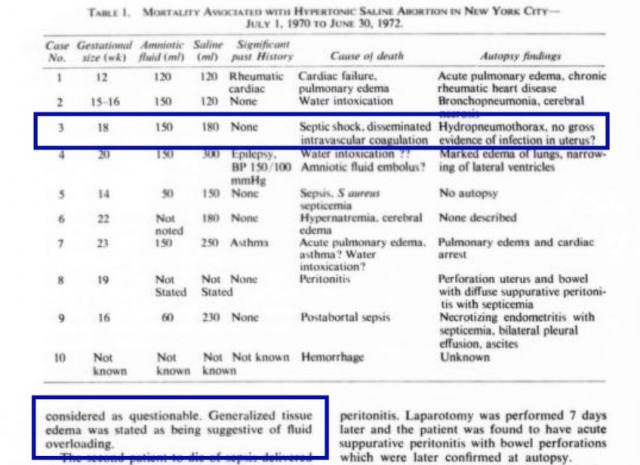
While nine of the cases appear to match some of those documented in another study, the person who was given the designation “Case 3” did not appear to match any known report. (She is given the pseudonym “Phyllis” here to avoid dehumanizing her by reducing her to a number.) In addition, her postmortem findings were found to be suspicious considering the listed cause of death.

“Phyllis” underwent her saline abortion at approximately 18 weeks pregnant. The hazardous method was performed by a New York City hospital, apparently as an outpatient procedure. After receiving the hypertonic saline injections, she was discharged.

The next day, Phyllis returned to the hospital with a fever of 104 degrees. After delivering her dead child, she continued to bleed. Vacuum aspiration was performed and the hospital began treating her for septic shock and abnormally decreased urine output.

Even though she had been healthy with no history of serious illness, Phyllis died in three days. Her postmortem report showed peculiar results that cast doubt on whether or not her complications had been diagnosed and treated correctly.

Even though Phyllis’s diagnosis during her hospitalization had been septic shock, her blood cultures showed no growth at all. Cervical cultures were reported to have grown “multiple organisms,” but did not list what organisms, whether or not they were infectious or which species were likely to have caused her death. Her uterus, which would most likely have been the site of initial infection, had “no gross evidence of infection” and there was a note that “microscopic preparations were not available”— very strange for an in-hospital death supposedly from infection.

Phyllis had both air and fluid in her pleural space. She had been suffering from generalized tissue edema which was stated as “being suggestive of fluid overloading.” Despite all of these findings (and in some cases lack of them), her cause of death was still given as sepsis.

The study that later recorded Phyllis’s death regarded the autopsy findings with some degree of skepticism. While the study listed the diagnosis of sepsis as her cause of death, the authors wrote that “the description of [her] uterus must be considered as questionable.”

Analysis

What really happened to Phyllis? While at this point it may be impossible to know for sure, there are several possible explanations for the suspicious postmortem findings. One is that she really did die of sepsis, but that the lab work was mishandled. If, as the study noted, the description of her uterus was questionable, it could be possible that it was simply poorly examined.

Another possibility is that Phyllis was misdiagnosed and that the hospital decided to list her cause of death as a match for her initial diagnosis to avoid suspicion of malpractice. That may explain why important microscopic preparations were reportedly “unavailable.”

The findings of the autopsy may also indicate that Phyllis may have suffered another complication from saline abortion: hypervolemic hypernatremia. Hypernatremia, an electrolyte imbalance from dangerous levels of salt in the body, had already been well-established to have killed saline abortion clients by the time Phyllis was killed. If this had been the case for her, it could have caused hypervolemia as her body desperately tried to hold onto fluids to regulate her osmotic levels. This is highly consistent with the observations of generalized edema and fluid overloading and could also have explained her abnormalities in urine output. She also suffered disseminated intravascular coagulopathy or DIC, a well-documented symptom in many abortion deaths involving saline in the bloodstream.

(Considering that the same hospital had been responsible for the abortion and for treatment during Phyllis’s last days of life, there is a possibility that they would have an additional incentive to give her cause of death as sepsis. While still avoidable, sepsis could also have happened after birth, stillbirth or miscarriage, making a death from abortion-related sepsis seem more of an “acceptable” risk to some. However, death by hypernatremia after a massive dose of hypertonic saline in the bloodstream would not have occurred naturally for any of these, making her death without a doubt the result of the hospital’s actions.)

Yet another possibility combines some of the others: that the diagnosis of sepsis was correct and that Phyllis was suffering from undiagnosed hypernatremia. A study conducted decades after her death found correlations between hypernatremia and risk of developing sepsis. Both sepsis and hypernatremia can also cause similar problems such as kidney dysfunction, so it is possible that Phyllis died of a combination of complications. Her DIC could be explained by toxic hypertonic saline in the bloodstream, sepsis or both.

At this point it may not be possible to know for sure which exact complications killed Phyllis. What was never in doubt, however, is that she and her baby were two more preventable deaths from pre-Roe legalized abortion in New York City.

(All above images and information are from this study: Mortality Associated with Hypertonic Saline Abortion)

November 20, 2009: Refugee Overdosed in House of Horrors

   Just When Life Seemed Safe 

Headshot of a middle-aged Bhutanese woman with her hair pulled back and a faint smile on her face
Karnamaya Mongar
At the age of 41, Karnamaya Mongar had survived nearly 20 years in a refugee camp in Nepal. What she was unable to survive was a visit to an American abortion clinic.

Karnamaya, her husband, Ash, their three children and one grandchild arrived in the United States on July 19, 2009 as part of a resettlement program. 
Karnamaya was more than 18 weeks pregnant when went to a clinic in Virginia for an abortion. But the Virginia clinic, and another in Washington, D.C., did not do abortions that late in the pregnancy. One of the clinics referred Karnamaya to Kermit Gosnell's Women’s Medical Society in Philadelphia because Gosnell had a reputation for performing abortions regardless of gestational age.

Karnamaya went with her daughter to the Gosnell's clinic on November 18, 2009. That afternoon, 
Latosha Lewis, who had completed a medical assistant course but had never been certified, conducted the clinic’s version of a “pre-examination,” which was so scanty it didn't even involve weighing the patient. Falsified informed consent forms were added to Karnamaya's file.  

After the "pre-examination" was done and the paperwork was completed, Randy Hutchins, a part-time physician’s assistant who worked without State Board of Medicine approval, inserted laminaria to dilate Karnamaya’s cervix and administered Cytotec to soften it. Hen then told Karnamaya to return the next day to complete the abortion.

Drugged Up

Kermit Gosnell's Philadelphia
"house of horrors" where
Karnamaya Mongar was drugged to
death by unqualified staff.
Karnamaya arrived at the clinic on November 19 around 2:30 p.m., accompanied by her daughter and her daughter's mother-in-law. At the front desk, Tina Baldwin gave Karnamaya her initial medication – Cytotec to soften the cervix and to cause contractions; and Restoril, a drug that causes drowsiness.  After giving Karnamaya the medicine, Baldwin told her to wait in the recovery area until the doctor arrived to perform the abortion.

Lynda Williams and Sherry West, who were without any medical-related qualifications medicated Karnamaya in the “recovery room” while she waited for Gosnell.

Karnamaya's daughter, Yashoda Gurung, told the Grand Jury that she waited with her mother in the recovery room for several hours. During that time, between 3:30 and 8:00 p.m., her mother was given five or six doses of oral medicine and repeated injections into an IV line in her hand.  As usual at Gosnell's clinic, no equipment was available to ensure proper monitoring of vital signs.


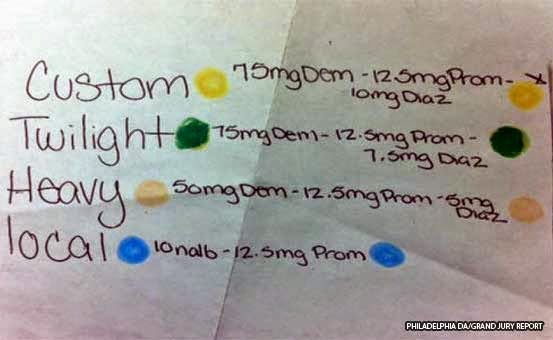
A handwritten, hand-colored chart of names for anesthesia concoctions and the amount of each drug to go in each
Anesthesia chart drawn up by 15-year-old
Gosnell employee Ashley Baldwin
Yashoda did not know what drugs her mother was given, but typically employees gave repeated injections of the concoction of sedative drugs that Gosnell referred to as a “twilight” dose. Each of these “twilight” doses, repeated a number of times at the discretion of the unlicensed workers, consisted of 75 milligrams of Demerol, 12.5 milligrams of promethazine, and 7.5 milligrams of diazepam.

The standard practice was for Gosnell's untrained staff to give repeated doses of sedative and pain-killing drugs to the patients, without regard to a woman's size or weight, whenever it was deemed necessary by the untrained staff. For example, if the woman started moaning, she was presumed to be in pain, and would be given another dose of drugs. Karnamaya, at only 4'11" in height and 110 lb. in weight, would have been endangered by a dose appropriate for an average-sized women, much less by the massive doses administered at Women's Medical Society.

A little before 8:00 p.m., West and Williams sent Karnamaya's daughter to another waiting area. She was left there, with no idea what was happening to her mother until the ambulance arrived after 11 p.m.

Williams helped Karnamaye into the procedure room, put her on the table, and drugged her again, this time with the clinic's "custom" dose of 75 mg. of Demerol, 12.5 mg. of promethazine, and 10 mg. of diazepam. The heavily drugged patient was then left, unattended and with no monitoring equipment, alone in the procedure room.

Cardiac Arrest

Kermit Gosnell mugshot
Sherry West told detectives that, some time after sedating Karnamaya, Williams came out of the procedure room, yelling for help. West said that when she later entered the procedure room, Gosnell was there trying to perform CPR on Karnamaya. Lynda Williams summoned Eileen O’Neill , an unlicensed medical school graduate who worked at the clinic, from her second-floor office.

O'Neill told the Grand Jury that she thought Karnamaya was already dead by the time she got to the procedure room, but she took over administering CPR because Gosnell wasn't doing it correctly. Gosnell, meanwhile, left to retrieve the clinic’s only “crash cart” (the emergency kit to treat a cardiac arrest) from the third floor. After returning with the kit, however, Gosnell did not use any of the drugs in it to try to save Karnamaya's life. Instead he just looked through them and seemed pleased that they were up to date. He seemed purely interested in keeping outsiders from finding out that the crash cart had been nowhere near the procedure room while patients were being sedated.

O’Neill testified that Gosnell told her not to administer Narcan, a drug that could have reversed the effects of the Demerol. She said that Gosnell told her it would not work on Demerol. O’Neill also said that she tried to use the defibrillator to revive Karnamaya, but that the paddles did not work.

Emergency Services

One of Gosnell's filthy
procedure rooms
It was after 11 p.m. – long after O’Neill had decided that Karnamaya was dead and returned to her office – that Lynda Williams finally asked Ashley Baldwin to call 911. Ashley then went into the procedure room and found Gosnell alone with his dead patient. He told Ashley to turn in the pulse oximeter, which they should have been using all along to monitor Karnamaya's pulse and blood oxygen. This surprised Ashley, since Gosnell knew that the pulse oximeter had been broken for months.

Emergency personnel arrived at 11:13. They found Karnamaya lifeless in the procedure room and Gosnell just standing there, not doing anything. The paramedics immediately intubated Karnamaya to give her oxygen, and started an intravenous line to administer emergency medications, since for some reason clinic staff had removed the IV line they'd been using all day to drug their patient. They also failed to tell the paramedics about the drugs they had administered.

Color photograph showing a railed entrance to a door blocked by a heavy security gate with a large lock. Three security barred windows are to the right of the door.
The locked back door to Women's Medical Society
The medics were able to restore weak heart activity. But getting Karnamaya to the ambulance was
 needlessly and dangerously time-consuming because the emergency exit was locked. Gosnell sent Ashley to the front desk to look for the key, but she could not find it. Ashley told the grand jury that a firefighter needed to cut the lock, but “It took him [20 minutes]… because the locks is old.” Karnamaya's daughter and friend ran outside, crying, and witnessed this. After cutting the locks, responders had to waste even more time struggling to maneuver through the cramped hallways that could not accommodate a stretcher.

When the ambulance arrived at the hospital shortly after midnight, Karnamaya had no heartbeat, no blood pressure, and was not breathing. After  aggressive resuscitation efforts, doctors were able to restore a weak heartbeat. Karnamaya was then sent to the Intensive Care Unit, where she remained on life support until family members could make the trip from Virginia to say good-bye. She was pronounced dead at 6:15 p.m. on November 20. She had died of a massive overdose of Demerol.