Friday, December 26, 2025

1965: Pre-Roe Legal “Indicated” Abortion Kills New York Woman

“Dottie” was a New Yorker seeking medical attention because she had started bleeding in the second trimester. She had suffered two miscarriages in the past and likely feared that she might lose this baby too. Unfortunately, the doctor’s dubious course of action would guarantee her baby’s death and her own.

The medical journal that recorded Dottie’s case does not specify what the diagnosis was, but the doctor decided to put Dottie through a hysterotomy abortion and a tubal ligation. This was a questionable course of action considering that hysterotomy abortion is associated with a very high maternal mortality rate. But since it qualified under the health exemption (“life of the mother” exception), it was completely legal.

The report of Dottie’s death raises questions. She was under general anesthesia for the abortion and tubal ligation, but would never wake up. The journal states that “Cardiac arrest ensued during the procedure, and the patient expired following completion of a tubal ligation, never having regained consciousness.”

Later research found that the risk of hysterotomy abortion concurrent with surgical sterilization was unjustified even in someone perfectly healthy. Today, medical knowledge has advanced beyond the antiquated approach of abortion for pregnancy complications— the recommendation that failed Dottie and her child.

New York State Medical Journal, January 1974

Wednesday, December 24, 2025

Christmas Eve, 1955: Dismembered and Dumped After Fatal Abortion

Jacqueline "Jackie" Smith

Over the years, many details of the Jacqueline Smith case have been lost, and the remaining story often is dismissed as an urban legend. But strange and macabre as the story is, it was all too true.

Jackie Smith, age 20, was a slender, brown-eyed blond from Lebanon, Pennsylvania. Over the protests of her father, 41-year-old Chester Smith, and her mother, Josephine, Jackie moved to New York and took an apartment with two other women early in 1955. She wanted to pursue a career as a fashion designer.

That June, friends introduced the soft-spoken, demure Jacqueline to Thomas G. Daniel, an urbane young salesman of 24. Daniel was well-read, multi-lingual, a poet and gourmet cook. Young man had come to New York from Warren, Ohio, three years earlier. He worked at an upscale shop selling riding equipment. With his good looks and sophistication, he was able to win over the small-town girl. She spent more and more time at his apartment, all but moving in with him.


Tom Daniel

Jackie's hometown paper, the Lebanon Daily News, looked into the background of the young man whose attentions turned fatal for their local girl. They sent reporters to Warren, Ohio, to speak to people who knew him.

Warren was a small city of about 50,000, but it outstripped tiny Lebanon, PA, with it's 1950 population just topping 28,000.

Daniel was the only child of Greek immigrants. His parents moved from Weirton, West Virginia, to Warren in 1937. His father committed suicide in 1953. Tom appeared to be quite devoted to his widowed mother, Catherine. He was described as quiet and studious. He graduated from Warren High School in 1948 and attended Kent State University. He was expelled for poor grades but returned with a renewed focus and was able to graduate. He took up weight lifting and body building in college. During summer vacations he worked at a Warren steel fabricating plant, though he did not stand out there in any way. 

Daniel joined the Army in 1952 and served two years with the occupation forces in Germany. Shortly after returning from his stint in the Army he decided to head to New York.

Though Catherine Daniel had not been officially notified that her son was in trouble, she learned about it through news coverage. She left Warren on January 11 and traveled to Baltimore, where relatives joined her for the journey to New York. 

"He's a good boy," Catherine Daniel told reporters. "He wouldn't hurt anybody."

The Abortion

In December, Jacqueline told Daniel that she was pregnant. Daniel did not want to marry Jacqueline. He preferred the company of his girlfriend back in Ohio. Instead he arranged for a 46-year-old scrub nurse, Leobaldo Pejuan, to perform an abortion at Daniel's apartment on Christmas Eve. After performing the abortion, Pejuan became alarmed at the young woman's condition, and summoned Dr. Ramiro Morales, who told him that Jackie was dead.

Daniel and Pejuan cut Jacqueline's body into pieces and took it to Pejuan's home, where over the next several days they cut into as many as 50 pieces, which they wrapped in Christmas paper and disposed of in trash cans along side streets off Broadway, from 72nd to 80th.

Jackie's Father's Search

When Chester Smith arrived for a visit on December 30, he got Daniel and together they went to the police to report Jackie missing. The police were quickly suspicious of Daniel and began to question him more closely. Daniel finally told police that Jacqueline had gone into the bathroom and stabbed herself to death due to his refusal to marry her, and that he had dumped her body in the Hudson River.

Police investigated, and found over 800 stolen medical instruments in Pejuan's apartment. The entire story eventually came out, with Pejuan pleading guilty and testifying against Daniel. 

Two-Timer Gets Prison Sentence

Trying the pair would be tricky. Though prosecutors had not body of a victim, they had the corpus delicti -- the body of the crime. Witnesses' accounts, the abortion instruments, Jackie's possessions, and the confessions of the two principles added up to significant proof of Jackie's death for prosecutors to proceed.

Daniel's widowed mother attended the entire trial. Chester Smith, too, was there, but left the courtroom when testimony came to describing the dismemberment of his daughter's body.

Pejuan was sentenced to 7 1/2 years in prison, and Daniel was sentenced to 8 years. His mother went into hysterics upon hearing the verdict, screaming, "God help me. They have taken my life, my savings, my son."

Nobody recorded the words of Jacqueline's father as he faced a life without his daughter.

The newspaper in Jackie's home town of Lebanon, Pennsylvania, covered Jackie's life and death, and the trial, extensively. Those photos and the information they share are available here.


Sources:

December 24, 1968: Abortion Homicide at Christmas Time

Grok AI Illustration
"Thelma Mitchell," a 23-year-old stenographer, was a bright and active young woman. Her high school year book shows a stylish brunette, active in many extracurricular activities. According to public records, Thelma was the younger of two children of her widowed mother and lived in a small industrial city on the shores of Lake Michigan. 

On December 15, 1968, Thelma underwent an induced abortion by someone who used some sort of instruments. She took ill afterwards and was admitted to a city hospital where she died December on December 24, creating a bleak and tragic Christmas for her family.

An autopsy indicated that her cause of death was pulmonary emboli -- air or foreign matter that got into her lungs due to the abortion. Her death was ruled a homicide.

Newspapers of the time seem to make no note of the young woman's death beyond her obituary, which makes no mention of how Thelma came to her tragic end. All the coverage is expressing enthusiasm for the idea of legalizing abortion. Proponents of legalization no doubt thought that they would prevent tragedies like the one that took Thelma from her loved ones, but time would show that legalization had no impact on the number of young women dying. They merely replaced criminal abortion deaths with deaths from legal abortions. It was no longer a big deal if an abortionist's patient died.

Source: Death certificate


Tuesday, December 23, 2025

December 23, 1951: Self-Induced in Vermont

According to Vermont death records, Fern E. Titus, nee Knapp, attempted a self-induced abortion on December 21, 1951. Fern had methemoglobinemia (a blood disorder effecting the ability of the blood to carry oxygen), which was given as the direct cause of her death. The abortion attemps evidently failed to kill the fetus. Fern was pronounced dead on arrival at Mary Fletcher Hospital in Burlington on December 23.

According to public records, Fern had married her husband when she was only 16 years old. 

December 23, 1909: Mystery Death in Chicago

"Sadie," identified in the source document as "Mrs. D," was 39 years old in November of 1909 when she either had a miscarriage or an illegal abortion. Five weeks later, on December 21, she was admitted to Cook County Hospital. She was vomiting and obviously very ill. Her pulse was 108, her respirations 28, her temperature 100 degrees.

The next day her temperature had fallen to 97.6, and her pulse and respirations had increased to 132 and 30, respectively. For reasons the document doesn't provide, she endured slightly over two hours of surgery during which surgeons removed both of her Fallopian tubes, drained her pelvic cavity, then curetted her uterus and packed it with alcohol gauze. The surgery sent her into shock and she died 14 hours later, either on December 22 or December 23.

December 23, 1931: One of Six Victims of Dr. Guy E. Brewer

Newspaper clipping of a bald, middle-aged white man wearing round black spectacles, in 3/4 profile and with a grim facial expression
Dr. Guy E. Brewer

On June 7, 1935, Dr. Guy E. Brewer pleaded guilty to six counts of manslaughter for the deaths of six women who died from complications of abortions he had perpetrated. He was sentenced to serve six consecutive four-year terms. He spent his incarceration working in the prison hospital. 

One of those young women was Myrtle Helen Rose, age 21, of Ponca City, Oklahoma. According to her obituary, she died in the family home on December 23, 1931 after an illness of three weeks. She was the daughter of Mr. and Mrs. John Rose and lived near Ponca City. According to public records, Myrtle was the 4th of 9 children. Not all of those children lived to adulthood. An older brother had died at birth prior to Myrtle's birth, A younger brother died at birth when Myrtle was a toddler, and a younger sister died as a toddler when Myrtle was 11. 

Ruby Ford,  a 26-year-old homemaker, died April 1, 1934 after an abortion perpetrated by Brewer. Hermoine Fowler, a 20-year-old coed, died in June of 1934. Doris Jones, a 20-year-old mother of two, died in April of 1935. Wanda Lee Gray and Elizabeth Shaw, 23, of Roxanna also died in 1935.

Brewer had graduated from the University of Louisville in 1906 and had been practicing medicine in Garber for 21 of the 29 years he had been a physician. He supported young men during their university studies, maintaining houses for them to live in. Those he had educated over the years rushed immediately to his defense. Though Brewer had spent many long years helping boys and young men, his impact on women's lives was evidently lightning-fast.

Brewer pleaded guilty to second-degree manslaughter on each case, ostensibly to avoid putting those who cared about him through the embarrassment of a public trial on such distasteful charges. One particular statement by Brewer is very telling:

"I could not stand to have my boys brought into this case and I would not betray the trust so many people have placed in me by having them harassed, and in some instances their lives ruined by the notoriety a trial would bring to them."

This implies that a lot of those abortions were done at the behest of Brewer's "boys," who would themselves face serious charges for arranging the fatal abortions on women they had impregnated. 

Those "boys" offered support to Brewer from all corners of the globe, where they had work they attributed to Brewer's support in getting their educations.

The county attorney who arranged the plea, Holbird, didn't seem to think that Brewer had done much harm. "In accepting Dr. Brewer's plea of guilty in these abortion deaths I do so with the feeling that the law has collected its debt. The matter of the penalty assessed is unimportant. The thing that counts is that these crimes have been exposed to the world, and the people can now realize the serious danger and hazard to life in this kind of operation." 

Thus came Brewer's  six four-year sentences, to run concurrently, for all six abortion deaths. The likely reason that he got such a light sentence was his extreme popularity for his benevolence in putting local young men through college. So beloved was Brewer that one victim's husband was fired in retaliation for reporting his wife's death to the police.

Governor E. W. Marland, however, was not exactly delighted with the wrist-slap administered by local officials. "This is the worst case I ever heard of," the governor said, "He was, in my opinion, guilty of mortal turpitude of character almost as serious as that resulting in the death of these women." Noting that Brewer would be eligible for parole after serving only 28 months, the governor urged an investigation which he was certain would uncover more crimes so that additional charges could be brought so that Brewer would end up serving a sentence commensurate with the harm he had done. 

In the end, Brewer's supporters triumphed. The young men prospered, the young women lay dead in their graves.


Source:

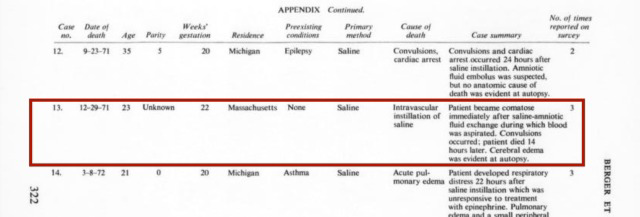
December 23, 1970: Fatal Cardiac Arrest During Safe, Legal New York Abortion

"Kimberly" is one of the women Life Dynamics identifies on their "Blackmun Wall" as having been killed by a safe and legal abortion. Kimberly was 25 years old and 18 weeks pregnant when she underwent a safe, legal abortion under the new law, in New York City on December 23, 1970. During the abortion, she went into cardiac arrest and died, leaving behind two children.

The 1970 liberalization of abortion had made New York an abortion mecca until the Roe vs. Wade Supreme Court ruling that abortionists could legally set up shop in any state of the union. In addition to "Kimberly," these are the women I know of who had the dubious benefit of dying from the newfangled safe-and-legal kind of abortion in pre-Roe New York:

LDI Sources: "Maternal Mortality Associated With Legal Abortion in New York State: Jul. 1, 1970 - Jun. 30, 1972,"± Berger, Tietze, Pakter, Katz, Obstetrics and Gynecology, 43:3, March 1974, 321

Monday, December 22, 2025

December 22, 1989: Happy Birthday, De'Angela!

Tralishia Nicole Gillespie was 17 years old when she went to Family Planning Clinic for Reproductive Health in Nashville, Tennessee for what she thought was a first trimester abortion. She was examined by Dr. Karen Smiley, who told her she was six or seven weeks pregnant and performed an abortion on December 18, 1989.

Four days later, Tralishia went to the hospital, reporting abdominal pain. Doctors examined her and noted that she was still pregnant and her baby still had a heartbeat. She was taken to Vanderbilt University Medical Center, where she delivered a 1-pound 13-ounce baby girl in the hallway.

Grok AI illustration
Tralishia named the baby De'Angela Nicole Alexander.

De'Angela was in critical condition for the first three weeks that she was in the neonatal intensive care unit, but by March 22, she was declared healthy and discharged, weighing just over 4 pounds. 

Tralishia, and De'Angela's grandmother, Joan Stover, sued Smiley, nurse Lola Oni, and the clinic for $5 million in compensatory damages and $5 million in punitive damages. The medical board and health department investigated the case. 

The family's attorney said that Tralishia was "devastated, obviously." She needed to undergo psychiatric treatment, and would never have consented to an abortion had she known that her baby was old enough to survive outside the womb. Tralishia and her fiancé indicated a plan to keep the baby.

The medical board suspended Smiley's license over this and three other cases of incomplete abortions. Family Planning Clinic for Reproductive Health surrendered its license after this and four other malpractice cases and an investigation nothing that two of the facilities doctors had no hospital privileges. Smiley, who was the clinic's medical director and performed most of the abortions "had practically no experience at performing abortions." 

Sources: 

Sunday, December 21, 2025

December 21, 1973: Outpatient Saline Abortion Proves Fatal

About December 14, 1973, 21-year-old Rockland Community College student Beverly Agnes went to a Monsey, New York doctor's office for a safe, legal abortion. She was about five months pregnant.

The doctor chose the risky saline instillation abortion method that had become popular in the United States in New York and California in the years immediately before the Roe vs. Wade decision legalized abortion-on-demand nationwide. This abortion method involves using a large syringe to remove as much amniotic fluid as possible from the womb and replace it with a strong salt solution that poisons the fetus and gives it strong chemical burns both internally and externally. The visible effects on the skin have led to saline-aborted fetuses to be dubbed "candy-apple babies" for their raw, red skin. (Graphic image here).

Given the gruesome effects on the fetus, one can imagine the risks to the mother, which include cardiac arrest, brain damage, and death. Japan, Sweden, and the Soviet Union had all abandoned the saline abortion method as far too risky. Doctors in the United States, however, did not heed the warnings sounded by doctors in other countries. Those in New York were particularly cavalier about potential maternal injures and deaths. Like many of his fellows in the Empire State, Beverly's physician did the saline instillation in his office as an outpatient procedure.

Beverly sickened after the saline was injected into her body. Around December 16, she was admitted to Nyek Hospital. There, doctors discovered that Beverly's doctor had accidentally injected the saline into the uterus itself rather than into the amniotic sac. The damage to the tissues of Beverly's uterus caused an overwhelming infection. Doctors at Nyek Hospital performed a hysterectomy to remove Beverly's festering uterus, and administered massive doses of antibiotics.

Their efforts were all in vain. The infection finally ended Beverly's life on December 21.

Medical Examiner Dr. Frederick Zugibe noted that saline instillation was "quite a common technique" for abortions, and that what Beverly suffered was "one of [abortion's] hazards. He declared that there was "no evidence of criminality." Neither the Medical Examiner's Office nor law enforcement ever released the name of the doctor whose carelessness cost Beverly Agnes her life.

Beverly's death was the third legal abortion death in the same New York county since the state had legalized outpatient abortion-on-demand on July 1, 1970. Edith Clark had died in June of 1971 and Pamela Modugno in May of 1972.


Watch Ordeal and Death for Young Student on YouTube.

Sources: 

December 21, 1940: Scant Information from Manhattan

According to New York death records, 32-year-old Beulah Bowen Felton died at Bellevue Hospital in Manhattan on December 21, 1940.

Beulah, a married Black woman working as a domestic servant, suffered a perforated uterus during a criminal abortion. This caused her to develop gangrenous endometritis, acute peritonitis, and paralytic ileus.

December 21, 1997: Medics Shocked at Conditions After Women's Death

Dr. Earl McLeod
On December 20, 1997, 27-year-old Jennifer Halner went to Potomac Family Planning for a safe, legal abortion, to be performed by D&C. She was 6 weeks pregnant. Dr. Earl McLeod's anesthesiologist, Dr. Jo-Anne Kelly, started an IV, and Jennifer was hooked up to monitors. 

The procedure took about five minutes.

Jennifer  was transferred to recovery at 10:10 a.m. She was put on an oxygen mask but given only a blood pressure monitor. Her blood pressure was 112/60, her pulse 103. The blood pressure monitor was then removed and placed on another patient. Kelly went back to the procedure room without awakening Jennifer.

Ten or fifteen minutes later a nurse noticed that Jennifer was still unresponsive. She started to ask an assistant to go to the procedure room and ask Kelly to approve a dose of Zoloft (and antidepressant), then changed her mind and asked another nurse to get approval for a dose of Zofran (an antiemetic). 

Neither McLeod nor Kelly assessed Jennifer, but instead Kelly verbally complied with the odd request even though Jennifer was not suffering from nausea or vomiting. The nurse gave a dose of Zofran intravenously at about 10:25, and, of course, Jennifer remained unresponsive.

The nurse then requested Romazicon, a drug that would actually reverse the effects of anesthetics, and again, without assessing the patient, Kelly, gave her okay. The nurse administered the medication but again got no response. She put the blood pressure cuff back on Jennifer and only then noticed that the young woman had no pulse. She checked Jennifer's pupils and found them dilated. She fetched Kelly, who stared a second IV and began to perform CPR, using a pediatric-sized bag-valve mask totally inadequate for an adult patient. It was, however, the only bag-valve mask the clinic had on the crash cart. Meanwhile, McLeod performed two other procedures before entering the recovery room and finding his staff performing inadequate CPR on his patient. 

McLeod ordered Epinephrine, Ephedrine, and Lidocaine be administered. He didn't document oxygen saturation because nobody had put a pulse oximeter on Jennifer. He later claimed that Jennifer had been hooked up to a cardiac monitor, but he didn't document cardiac rhythm, respiration, or a neurological evaluation.

It wasn't until around 10:42 a.m. that McLeod told somebody to call 911. Paramedics arrived and  immediately began appropriate resuscitation, including intubating Jennifer -- a step that McLeod or Kelly should have taken. They switched to an adult bag-valve mask, administered Narcan, epinephrine, and atropine, and hooked Jennifer up to a cardiac monitor and defibrillator. They defibrillated Jennifer. 

The medics transported Jennifer to Shady Grove Adventist Hospital. Upon arrival her pupils were fixed and dilated. After aggressive resuscitation efforts by ER staff, Jennifer's heart was restored to a stable rhythm, and she was admitted to the Intensive Care Unit. She died there at 4:15 a.m. on December 21.
 
The appalled paramedics reported McLeod to the medical board, which faulted him with failure to provide adequate and readily-available post-operative monitoring equipment, and failure to provide adequate emergency supplies. The board also required him to get his staff properly certified in CPR. Dr. Kelly was disciplined by the medical board as well.


McLeod also ran the Hillcrest abortion mill in Harrisburg, Pennsylvania, where Kelly Morse had died in 1996 after being inadequately resuscitated.

Watch Out of Sight, Out of Mind on YouTube.

Saturday, December 20, 2025

1972–1975: Tiny teenager massively overdosed on Lidocaine

Grok AI illustration
Elise” was an 18-year-old who underwent a legal suction curettage abortion at 10 weeks pregnant in a hospital between 1972 and 1975. She didn’t know that she was about to lose her own life to gross malpractice.

Before the abortionist began, Elise was injected with lidocaine without epinephrine to produce a pudendal and paracervical block. The abortion seemingly proceeded smoothly until it was almost done.

Then Elise went into convulsions not once but twice before going into cardiorespiratory arrest. Even though she was already in a hospital, all efforts to resuscitate her failed.

Elise had no known allergies or other medical conditions that would have caused or explained something like this. She had given birth once before and been fine. An autopsy was conducted to find out what had happened to her, and the results were horrifying.

Though Elise was tiny at less than 95 pounds, she was given 500 mg of lidocaine. This was more than 2 1/2 times the maximum dose recommended by the manufacturer for someone at her weight. In the medical journal that documented her death, the largest dose of epinephrine-free lidocaine that would possibly have been safe for her was calculated to be 194 mg. The packaging for the lidocaine she was given also clearly said that whenever any patient (regardless of weight) was given epinephrine-free lidocaine, they should never receive a dose higher than 300 mg at once.

The lidocaine level detectable in a blood sample after appropriate therapeutic use should be 1.5 ug/ml or less. Elise’s postmortem blood test came back with a level of 5 ug/ml, and it may have been even higher before her death. There is no legitimate medical reason to give anyone a dose of lidocaine high enough to cause that level. Most likely the overdose had either been careless negligence, or Elise was deliberately overdosed so extremely that the abortionist could rush through the operation (similar to Stacy Ruckman, killed by similar malpractice in 1988).

Source: "Deaths from Paracervical Anesthesia Used for First-Trimester Abortion, 1972–1975," New England Journal of Medicine, December 16, 1976 (Note: Elise is Patient 2)

1971: Mystery Death in New Jersey after Legal New York Abortion Reported

Very little is known about “Jessie” except for the circumstances of her death, listed in a single news source. Sometime after the legalization of abortion on demand in New York but before an April 1971 edition of the New York Times was published, Jessie underwent an abortion in New York. She was probably one of many lured in by “abortion tourism” who had no idea she was going to die.

After undergoing the abortion, Jessie left New York City and went to New Jersey. (She was probably either a resident of the state or was making a stop on her way home when she became unable to finish the journey.) She died in New Jersey from complications of the abortion.

The April 11, 1971 New York Times noted Jessie’s death as one of 14 deaths from NYC abortions since legalization, but also noted the serious deficiencies of the reporting system. Only 3 of 17 non-hospital facilities (“clinics”) were regularly reporting any data, and municipal hospitals that carried out abortions failed to file the termination of pregnancy or TOP reports that were the basis of abortion statistics. From the incomplete data available, it was estimated that about half of pre-Roe legal abortion clients in New York were traveling from out of state like Jessie.

The article offered multiple perspectives on the early legalization. Some sections seemed to almost glorify abortion in New York (albeit while admitting the inherent emotional distress), while others reported that “there are still enough horror stories, enough unsolved problems, to make any report on the city's legal abortion scene sound like a report on the old illegal one.” 

One woman who underwent an abortion at a private hospital woke up to find that her abdomen had been cut open for a procedure that she never consented to; the authors theorized that she had been mistaken for a different client and received the wrong procedure. 

Clients at another facility were left traumatized after abortionists experimented on them by placing an EKG next to the client’s bed and listening to their child’s heartbeat deteriorating. They were effectively made to hear their children slowly die. These experiments were done without the consent of the clients. 

Yet another abortionist described a “typical” client as a minor under 15 whose parents did not know she was there or even that she was pregnant.

While also seemingly claiming that the legalization of abortion offered benefits, the NYT journalists reported inadequate reporting, failure of the Health Department to supervise facilities, horrific cases of malpractice and death. Abortion at even the supposedly high-quality hospitals was described as “inevitable misery.”

Friday, December 19, 2025

1992: Little Information on Death from New York

In 1992, “Priscilla” underwent a legal abortion in New York. Very little is known about her or the exact circumstances of her death.

“Priscilla” was between the ages of 25 and 29. NCHS data confirms she died from a legal abortion, but offers little else. Life Dynamics confirmed, however, that she is not the 27-year-old who died in New York from a saline abortion in May of the same year.

Blackmun Wall source: National Center for Health Statistics, Deaths from Selected Abortion-Related Causes By 5-Year Age Groups and Race: U.S. And Each State, 1992

Thursday, December 18, 2025

1975: A Death Noticed by the CDC

“Reanne” from the Blackmun Wall was Black, 15–19 and died from a legal abortion. Life Dynamics states that Reanne’s race confirms that she is not Jan Simmons, which probably means she died in the same year as Jan did, which was1978.

The CDC did count Reanne’s death as a death from legal abortion. I could not find matching cases where enough data was available to be positive that the year and age were consistent. However, at some point between 1972 and 1978, the CDC counted the death of “Carly Roe”, a 16-year-old Black girl who died of septic shock and respiratory distress from amnionitis and endometritis. There is not enough information to tell if Reanne is Carly, but it is possible.

There were no matches for Reanne’s age range in the 1978 CDC data on abortion deaths from embolism (in a study published much later) so her primary cause of death was probably not listed as embolism-related or the CDC did not have that information.

Source: Life Dynamics Blackmun Wall

Wednesday, December 17, 2025

December 17, 1985: The Attempted Murder of Ximenia Renaerts

On December 16, 1985, 22-year-old Nadine Bourne arrived at the emergency room of Vancouver General Hospital, seeking care for complications of an abortion she'd undergone four days earlier at a Bellingham, Washington Planned Parenthood. She had fever and a rapid pulse. She said that she'd been 14 to 16 weeks pregnant.

Dr. Jaroudi, a resident, was summoned by the ER physian. He examined Nadine but failed to notice that she was still pregnant. Nadine was admitted to the hospital.

At 3:20 a.m. the next morning, December 17, Nadine gave birth to her baby while seatedon the toilet. The little girl weighed about three pounds -- more consistent with an infant much closer to term, well into the third trimester.

A nurse, Vera Wood, did not call a resuscitation team or an infant transport team to take the shivering, whimpering, gasping infant to Children's hospital. Instead, according to court records, "She took the baby into the service room where dead fetuses are stored, and left it there [in a bedpan] for 40 minutes."

Thomas Berger, an attorney representing the child and her adoptive family noted, "We could prove that Vera Wood and other nurses did nothing to suction the baby or to provide warmth or oxygen for the child. Our case was that the baby suffered severe [trauma] as a result of these acts or omissions by VGH and its employees, resulting in brain damage in the form of mental retardation and cerebral palsy." After 40 minutes, nurse Wood called the night nursing supervisor, Joyce Hatherall, who cleared the baby's air passages, provided warmth and called for oxygen.

Mr. Berger also said, "We also had evidence that Dr. Jaroudi, called up to the ward, realized the baby had been delivered by Nadine Bourne, and realized it was viable, but nevertheless told the nurses not to resuscitate the baby ('...let it go'). He was ignored by Joyce Hatherall."

But even after Hatherall's intervention, the baby was placed on a metal counter, where she likely suffered further hyperthermia. And when Jaroudi finally contacted the transport team for Children's Hospital, he gave them insufficient information, causing an additional half-hour delay in providing care to the baby.

Ximenia

That neglected baby, left to die, has since been adopted. And she has a name: Ximenia Renearts. But thanks to the attempts on her life both before and after her birth, she suffered permanent brain damage. She is quadriplegic and has the mental capacity of a three-year-old.

BC police made two abortive (how appropriate!) investigations of the case, with spokesman Sergeant Bob Cooper calling the case "bullshit", comparing it to cases where children die when being delivered by midwives. Which leaves me wondering if BC midwives routinely leave premature infants in metal bedpans in the closet for over half an hour at a time before somebody else comes along and provides care over the midwives' objections.

Part of the reason for the callous attitude of the police may be that the spokesman for the BC Minister of Health's Office, Michelle Stewart, is dismissive of the issue of infants born live during abortions, commenting, "As you know, this Ministry is very much in favor of giving women choices about their reproductive health." British Columbia's Chief Coroner Larry Campbell included a letter in a report on such live births, and dismissed them as to be expected in abortion and therefore outside the purview of BC coroners, who only get involved if a death is "unexpected". In other words, at least in British Columbia, abortion is 100% about achieving the death of the infant, even if the infant is born alive. Which leaves me to wonder if a perpetrator who shot Ximenia dead tomorrow would face charges at all. Is she still, legally, only an aborted fetus?

The family filed suit against the hospital, the doctor, and the nurse, settling out of court for over $8 million, which will be used to build an accessible hosue for Ximena and to provide her with the care she will need for the rest of her life.

The hospital never conducted an internal review of how a live-born infant was treated like a pathology specimen on their premises, in violation of the law forbidding anyone to abandon or expose a child under the age of ten "so that its life is or is likely to be endangered or its health is or is likely to be permanently injured." Under Canadian law, having been born alive, Ximenia was a living human being entitled to full protection under the law. Prolife activists hold that chareges of attempted murder might be more appropriate, since nurse Wood's intent in putting the child in the bedpan aside in a room for dead fetuses was to allow the baby to die and be sent to the pathology lab with the other results of recent abortions.

Ximena's adoptive mother, Margaret, says, "How can you ever bring justice when all the damage is done? I guess my big hope that what happened to Ximena won't be in vain. It could be you in the hospital and what if they feel that you're not worthy of life. We have to stop somewhere."

Sources: "Did Someone Try to Murder Ximena?", Terry O'Neill, B.C. Report, August 30, 1999; The Attempted Infanticide of XimenaSafe and Legal?, Ted Gerk, The Interim, September 1988; "Canadian babies born alive after abortion", Marnie Ko, reprinted from BC Catholic Newspaper; Ximenia Renaerts

1975: AFE or Blood Loss?

Sylvia” was 20 and healthy before the abortion that took her life.Her death from a 16- to 17-week hysterotomy abortion was reported to the CDC as a maternal abortion death from amniotic fluid embolism. However, a case report in a medical journal gave more information on the circumstances of her death.

After Sylvia was put under general anesthesia, the abortionist made the incision in her uterus and immediately “encountered” the placenta underneath. Sylvia immediately lost 200 ml of blood from the injury, and the anesthetist then noted that she no longer had a pulse or detectable blood pressure.

Resuscitation attempts managed to restart Sylvia’s heart, but she never regained consciousness. After five days in a coma, she died.

Sylvia’s death was officially attributed to amniotic fluid embolism, which was the cause apparently received by the CDC for her case. However, the medical journal stated that the AFE diagnosis in this case was “tenuous” and that the time between her injury and death would have made it harder to confirm whether she suffered an AFE or not. Her postmortem report did find “suspicious epithelial-like cells” to support the theory, but the injuries inflicted by accidentally cutting directly into the placenta were likely also a major factor. (It should be noted that if an ultrasound had been done before the abortion, the abortionist should have already known the location of the placenta before making any incisions.)

“Sylvia” is on the Life Dynamics Blackmun Wall.

Southern Medical Journal (see above images)

AJOG and CDC data tables

December 17, 1972: "Therapeutic Abortion" Kills Instead of Saving

"Loretta Orbach" was only 21 years old when she checked into her small town hospital in Virginia for a "therapeutic abortion" -- one done because of health problems in the mother. 

According to public records, Loretta was a newlywed, married only about a year and a half. Her high school yearbook shows a lovely blonde, active in choir and Future Homemakers of America. Though she had a bright future ahead of her, her death certificate indicates that she also had a history of heart problems.

This abortion, intended to preserve Loretta's life, was done on December 15, 1972. But during the procedure, her heart stopped. Though doctors were able to re-start her heart, this started a cascade of problems that ended in the young factory worker's death on December 17.

Source: Death certificate

Tuesday, December 16, 2025

December 16, 1892: 7th of 18 Deaths Linked to Dr. Lucy Hagenow

Dr. Louise "Lucy" Hagenow

When Emily Anderson died on December 16, 1892, she was the 7th of 18 women whose deaths were attributed to the abortion practice of Dr. Lucy Hagenow:

  1. Louise Derchow (1st San Francisco death, 1887)
  2. Annie Dorries (1888)
  3. Abbia Richards (1888)
  4. Emma Depp (1888)
  5. Minnie Dearing (1st Chicago death, 1891)
  6. Sophia Kuhn (1892)
  7. Emily Anderson (1892)
  8. Hannah Carlson (1896)
  9. Marie Hecht (1899)
  10. Mary Putnam (1905)
  11. Lola Madison (1906)
  12. Annie Horvatich (1907)
  13. Lottie Lowy (1925)
  14. Nina Pierce (1925)
  15. Jean Cohen (1925)
  16. Bridget Masterson (1925)
  17. Elizabeth Welter (1925)
  18. Mary Moorehead (1926)

Monday, December 15, 2025

1987–1998: “Necessitated” abortion ends in organ failure and death

 Sometime between January of 1987 and July 30 1998, “Paula” was a patient at the University of Pittsburgh Hospital with severe scleroderma pulmonary fibrosis (although she didn’t need to be given oxygen for it).


Paula developed aspiration pneumonia and ARDS. She was put through a “therapeutic” abortion at 20 weeks pregnant, which didn’t cure anything. She died three months later from multiple organ failure, respiratory failure and malabsorption.

Sunday, December 14, 2025

1972–1978: “The Grossest Kind of Negligence” kills 21-year-old

 “Tess” was 21 and pregnant with her third baby when she was subjected to extreme negligence by an abortion facility.

Tess didn’t know that her pregnancy was ectopic, a diagnosis that should have been obvious with a competent pre-op exam and ultrasound. She was estimated to be 4 to 6 weeks pregnant and underwent a surgical abortion by sharp curettage or D&C. The facility didn’t notice anything was wrong, and nobody ordered a pathology report for the remains. Had the remains— or lack of them— been adequately examined, the absence of a corpse should have been a glaring indicator for a possible ectopic pregnancy.

Nine days later, Tess bled to death. Her autopsy confirmed that her left fallopian tube was ruptured and she had suffered severe internal bleeding before dying. All of it was preventable.

As Dr. Wendy Recant, the director of surgical pathology at Michael Reese Hospital, said to the Chicago Sun-Times after another death caused by the same circumstances, “It would be the grossest kind of malpractice to miss one ectopic pregnancy and one woman went home and bled to death.” Yet many others continue to experience the same negligence at abortion facilities today. A few other examples are the deaths of Tia Parks, Brenda Vise, Angela Satterfield, Magnolia Thomas, Gladyss Estanislao, Laura SorrelsJanyth Caldwell, Yvette Poteat, Nancy Hopper, Sherry Emry, Josefina Garcia, Lynette Wallace, Claudia Caventou, Barbara Dillon, Doris Grant, “Denise Roe,”  “Ella Roe,” “Kristy Roe,” “Shayna Roe,” “Skye Roe,” "Evelyn Roe," "Ava Roe” and “Tanya Roe.” 

https://jamanetwork.com/journals/jama/article-abstract/371998

 (Tess is Patient 9)

2009: Ohio Death Reported to Authorities

Killed-by-choice notes the death of a woman they call “Fiona.” Her death is noted in a document of reported abortion complications in Ohio in 2009. 

I know of the following women who died from safe, legal abortions in 2009:

  • Karnamaya Mongar was overdosed by careless staff at Kermit Gosnell's safe and legal clinic in Pennsylvania.
  • Roselle Owens died after a safe and legal abortion at a Planned Parenthood in New York.
  • Ying Chen, given such appalling care during a safe and legal California abortion that her death was ruled a homicide.
  • Antonesha Ross coughed up blood and died during a safe and legal abortion in Illinois.
  • "Yolanda Mantini" died in California during a safe and legal "fetal indications" abortion.
  • “Belle” died of raging sepsis, kidney failure and DIC 12 days after a chemical abortion.

And the following women who died from safe, legal abortions in Ohio:

  • Elaine Terrell died of an elective abortion at Akron City Hospital in 1973
  • Rhonda Ruggiero died of a pulmonary embolism in 1982, less than a month before what would have been her 30th birthday
  • Minnie Lathan died of infection after her uterus and colon were injured during a safe, legal abortion in 1978.
  • Kathy Davis died at Cleveland Metropolitan General Hospital in 1987
  • L’Echelle Renea Head was found unconscious and unresponsive in 2000 and died that same day
  • Sandra Milton bled to death in front of her three children after a safe, legal abortion in 1990
  • "Carrie" died of multiple organ failure after a safe, legal abortion in 2008.
  • Lakisha Wilson died after her safe and legal abortion in 2014 in a clinic that didn't have means to safely evacuate women suffering complications.

Fiona thus hasn't already been covered in this blog. Her death is another needless tragedy. 


Friday, December 12, 2025

December 12, 2014: Suicide After "Medication Abortion"

According to FAERS Case ID 10966180,  "Lilian" was 30 years old when she went to a facility somewhere in the United States to get mifepristone and misoprostol for a chemical abortion. She did this some time in 2014. 

She might have developed an infection, because she was also given Azithromycin at some point.

On December 12, Lilian ended her own life. 

The death was reported to the Food and Drug Administration and was noted as related to the abortion drugs.

HT: killed-by-choice


Wednesday, December 10, 2025

December 10, 1941: The Last Known Victim of Dr. Emil Gleitsmann

It was December of 1941. Marie O'Malley, age 35,  had an unusual living arrangement. A widow, she lived with Fred Dempsey and his wife and their children. The household also included Marie's six children, one of whom had been fathered by Dempsey.

December 5 - 9

On December 5, Marie, Dempsey, and Marie's cousin Dorothy Salvesen went to the Chicago office of 77-year-old Dr. Emil Gleitsmann. Dorothy said that before taking her back to an exam room Gleitsmann asked Marie why she was there and she answered, "pregnancy." At some point, a $50 (c. $972 in 2022) abortion fee changed hands. 

The following evening, the three again went to Gleitsmann's office. This time Marie went into the exam room with Gleitsmann. When they emerged, Dempsey asked Gleitsmann how things had gone. The doctor replied that Marie had only been pregnant a few months. Marie said that she wasn't feeling well, but, Dorothy said, Gleitsmann told her she'd be feeling better the next day.

Gleitsmann provided instructions for Marie to follow upon her return home. She was to rest in bed for three to five days, massaging her abdominal muscles every day. She would start experiencing severe pains on the 4th or 5th day. He also said that he had put in packing that was to be removed the following day.

Rather than remain in bed, Marie returned to Gleitsmann's office on December 7, accompanied by Fred Dempsey. Again, Gleitsmann took Marie back into the exam room and provided aftercare instructions. She was to perform certain exercises, such as raising her abdomen, which would help her to expel the baby.

Fred Dempsey and Marie O'Malley returned to Gleitsmann's office again on December 8. Dempsey said that Gleitsman lamented that Marie was having to submit to an abortion because she didn't want a baby, and said that in two weeks he'd so something to ensure she'd never get pregnant again.

On December 9, Dorothy Salvesen again joined her cousin and Dempsey to Gleitsman's office. This was a grueling visit. Gleitsmann took Marie back into a treatment room where she lay on a cot. From time to time Dempsey would go into the room, where he observed Gleitsmann rubbing Marie's back while she cried out in pain. Dempsey asked what the problem was. He said that Gleitsmann told him that the procedure was like childbirth and that Marie would have to expel everything that was in her womb. Dempsey said that the bed was bloody and that Gleitsmann kept reaching into Marie's body and pulling out chunks of matter with his bare hand. Gleitsmann also had a metal instrument that he told Dempsey he'd have to use later to scrape Marie out so that infection would not set in. Gleitsmann wrapped all of the tissue he'd extracted in paper and threw it away.

At around 9:00, Gleitsmann assured Dorothy that her cousin would be well cared-for and sent her home.

At around 11:00, Dempsey suggested taking Marie to a hospital, but Gleitsmann recommended against this, saying that this would just lead to Marie developing blood poisoning.

December 10

At around 4:00 that morning, December 10, Dempsey went home to look after his children. He returned at around 8:00. Marie was still lying on the cot. She asked Dempsey to take her home.

Dempsey said he wanted to take Marie to a hospital, but that Gleitsmann assured him that the afterbirth had come out so Marie would be fine in a day or two. He gave Dempsey a "blood builder" to dose Marie with and sent them home.

After taking Marie home, Dempsey called two other doctors. Dr. Lehner arrived at around 10:00 that morning, shortly before Marie died. Gleitsmann arrived shortly thereafter. Upon being told that Marie was dead, he said that he didn't understand how that could have happened and said that he'd sign the death certificate. Dr. Lehner said that he would report the death to the coroner.

Investigation

Dr. Samuel A. Levinson performed an autopsy and concluded that Marie had died from an infection caused by an abortion.

Gleitsmann's Story When Interviewed

Police spoke to Gleitsmann the day of Marie's death. He told them that he practiced "Therapeutics," which consisted of using light, electricity, and massage. He said that when Marie had come to his practice she'd said nothing about pregnancy. She had told him that she didn't want any more children, but they didn't discuss her sex life or the possibility that she might become pregnant. 

Gleitsmann said that Dempsey had accompanied Marie for every visit.

On the first examination, Gleitsmann said, he noticed an inflammation around the cervix, together with an infected exudate. The cervix itself was congested and bluish in color. He noted, he said, a tender mass in Marie's abdomen that was hard to the touch and ended under the navel. He said that he concluded that Marie had cancer. He denied putting anything -- hands, gauze, or instruments -- into her uterus.

When she'd returned on December 9, Gleitsmann said, Marie had pains all over her body and was discharging a tar-like substance which he took to be decomposed blood from where a fetus was decomposing in her uterus. He said, though, that he still didn't discuss pregnancy, or even the possibility of pregnancy, with Marie.

He said that Marie seemed to be in much improved condition by 8:00 on the morning of December 10. He said that he judged from the tarry substance coming from the womb that Marie's fetus had been dead for two or three weeks and could not have decomposed to that degree in just the few days he'd been treating her. 

Gleitsmann admitted that he had indeed discouraged Dempsey from taking Marie to a hospital, but he said that this was because he could provide her with superior care.

Gleitsmann's History

Gleitsmann had a long criminal history of abortion dating back to 1927 when he was implicated in the November 30 abortion death of 22-year-old homemaker Lucille van Iderstine. Gleitsman was indicted for felony murder in Lucille's death but for reasons I do not yet know why the case never came to fruition. 

He was prosecuted but acquitted in the December 12, 1930 death of Jeanette Reder.

After his acquittal for Jeanette's death he was indicted for the February 16, 1931 death of 25-year-old Mathilda Cornelius.

He convicted three times on a single charge of manslaughter by abortion for the March 25, 1933 death of Mary Colbert, but each time his lawyer got a reversal and eventually the prosecutors gave up.

He was implicated again in the June 8, 1934 death of 26-year-old Elsie Quall.

Gleitsman got in trouble again in 1937 for the death of 16-year-old Phyllis Brown. However, that death was eventually attributed to Dr. C. Harold Edmunds.

Gleitsmann's Story in Court

Gleitsmann testified that the first time he'd seen Marie she told him that she'd stopped menstruating and felt unwell. He said that when he examined her there was a foul-smelling pus running from her vagina. He concluded that Marie had peritonitis and blood poisoning and assured her that he could treat her.

Over the ensuing days, Gleitsmann testified, he treated her with electric heat and vibrations. He "cleaned her out" on December 6 and 7. He packed her uterus on the 7th and removed the packing on the 8th and again "cleaned her out."

He admitted to keeping Marie overnight from December 9 because she was in a lot of pain and having trouble breathing. She had, he said, been able to walk to the car when she'd left the office the next day.

He adamantly denied having performed an abortion. Marie, he said, never even requested that he perform one.

They Say He Says

Two women, Pearl Katschke and Edith Hagebush, testified in the trial that Gleitsmann had perpetrated abortions on them in 1941 and 1942 respectively. The treatment they described was similar to what Fred Dempsey and Dorothy Salvesen described.

Gleitsmann testified that he hadn't performed abortions on either woman. He said that when Edith Hagebush had come to him she was already discharging a bloody pus and told him she'd been taking ergot and quinine (abortifacients). He said that he didn't wear gloves during examinations because they're to protect the doctor, not the patient, and he needs to have his sense of touch unimpeded.

Outcome

The jury deliberated a mere 20 minutes before convicting Gleitsmann of murder by abortion. He was sentenced to 1 to 14 years. He appealed but lost. He still had two other indictments, one for murder by abortion and another for abortion, pending at the time of his sentence.

While incarcerated his wife died and he sued his stepson over $25,000 worth of real estate that he said his wife and stepson had bilked him of instead of using it to shore up his defense. He still shows up in the 1950 census as an 84-year-old prisoner in the Illinois State Penitentiary.  He died February 20, 1956.


Sources: