On Saturday, December 8, 1956, 26-year-old Mary Kathryn Davies of New
York City arrived in the Ashland, Pennsylvania office of abortionist Dr.
Robert Douglas Spencer.
Mary, a part time student at Columbia University who worked at a
rheumatic fever treatment center for children, was seeking an abortion.
She was a native of Minnesota.
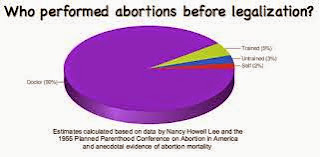
As a physician, Spencer was
typical of criminal abortionists.
What was unusual about him was that rather than sneak the woman in
through the back alley, Spencer plied his abortion trade openly. Spencer was so well-known and admired in abortion-rights circles that he was dubbed "The Angel of Ashland."
The Fatal Abortion
According to Spencer, Mary was alone, and reported that she'd been
bleeding for about two weeks. He didn't examine her, but gave her
medication for pain and
Ergotrate
to stop the bleeding. He told her to return the following day for her
abortion. Spencer didn't indicate why Mary would seek an abortion if her
pregnancy seemed to be ending on its own, which bleeding certainly
would indicate.
Mary returned at about 10 AM on the 9th. He administered 13 ccs. of
Evipal
in a 10% solution to induce anesthesia. "I injected that solution into
the vein of the left arm and in ten seconds she was asleep." Spencer
said that the next thing he noticed was that Mary wasn't breathing. She
also appeared blue. He injected five ccc. of "Metrozol"(
The drug is spelled
"Metrozol" in Spencer's written statement. However, my web searches for
"Metrozol" turn up a veterinary medication used to treat skin diseases
in fish. Spencer clearly meant Metrazol, a drug used as a respiratory and circulatory stimulant.)
into her left leg. She didn't respond, so he gave her an additional
five ccs. of "Metrozol", this time injecting the drug into a vein. Mary
still did not respond, so Spencer attempted to resuscitate her with
oxygen. He called his assistant, Mildred Zettlemoyer, into the room to
assist him. With Mary in Zettlemoyer's care, Spencer went to another
part of the building to retrieve adrenaline. He gave Mary three
injections of adrenaline.
Mary still was not responding, so Spencer had Zettlemoyer call the
laboratory assistant, Steve Sekunda, and tell him to come to the office.
Spencer put a breathing tube into Mary's throat, but had to work blind
because the light on his scope wasn't working. He resumed artificial
respiration, "and pulled on her tongue, but got no response." By the
time Sekunda arrived, at around 11:30, Spencer had concluded that Mary
was dead. The puzzled man concluded "that this patient died in my office
from some heart disease."
Preparing for Trial
William J. Keuch, chief detective of Schuylkill (pronounced "school
kill") County detective, said that Spencer had summoned him and informed
him that he and his assistant had tried to revive Mary with medications
and CPR to no avail. Keuch said that when he'd asked Spencer what a
young woman from New York City was doing in Spencer's office in Ashland,
Spencer answered, "I'm well known in the east. I specialize in women's
diseases." Women, Spencer told Keuch, came to him from all over.
Spencer wasn't arrested until after 12 weeks of investigation, which
included sending Mary's organs to Dr. Milton Helman, a member of the New
York Medical Board, for toxicology review..
When the case was finally ready to go to court in May of 1958, the
entire trial was derailed when, during jury selection, one woman asked
to be excused because, she said, "I served on a jury in which Dr.
Spencer was involved before." This statement was considered prejudicial
to Spencer, thus tainting the other jurors.
Trial
 |
| Dr. Robert Spencer |
Dr. Milton Helpern, chief medical examiner for New York City, was among
the experts that testified in Spencer's trial for Mary's death. Helpern
concluded that Mary had been pregnant, that the pregnancy had been
terminated right before her death, and that she'd died from
administration of a drug used for anesthesia for performing a D&C.
Dr. Emmet Hobbs, a local pathologist, concluded that Mary had indeed
been pregnant, that the fetus had been alive when Spencer had begun the
abortion, and that there had been no medical or anatomical reason that
an abortion would have been advised for Mary's health. In fact, The
conclusion that the fetus had been alive, and that Spencer had not been
treating Mary for a miscarriage, was based on injecting Mary's blood
into a rabbit and a frog, with physiological responses in the animals
being consistent with blood taken from a woman whose fetus was still
alive, not a woman who was in the process of a miscarriage. Mary had
been in good health prior to her death.
The defense argued that the tests using the rabbit and the frog were not
100% accurate, leaving open the possibility that Mary was in the
process of miscarrying. The argument evidently worked; Spencer was
acquitted.
Speculations
Patricia G. Miller, author of
The Worst Of Times, asked
another doctor, "Dr. Bert," who had practiced before legalization, to
review news reports of Mary's death and speculate as to whether Mary
would have died had abortion been legal.
"Dr. Bert" faulted Spencer for not having an assistant while he was
administering general anesthesia. "In my view, to give a general
anesthetic alone is below good medical care, even in those days." He
speculated that Spencer had not had an assistant working with him due to
the law against abortion -- an odd speculation, since Spencer was doing
abortions quite openly, with at least one member of his staff present
in the building. It's also an odd speculation considering how many legal
abortionists have had patients die from
anesthesia complications, either due to inadequate supervision of the anesthesia process or inadequate resuscitation efforts.
Spencer's Response
Spencer's widow, Eleanor, told Patricia Miller that her husband had
been quite stricken by Mary Davies' death. He continued to perform
abortions, however, along with his regular medical practice, up until
the trial. He was acquitted on all counts, likely because it was
impossible to prove that Mary hadn't either miscarried during those two
weeks of bleeding prior to her appointment with Spencer, or been aborted
by somebody else. No mention is made of any fetal remains being found
in Mary's body or in Spencer's office.
Spencer briefly stopped doing abortions after the trial, "for a month or
so," his widow said. But he resumed his business and eventually got
entangled with a fellow named Harry Mace who set up a business for
himself rounding up abortion patients and bringing them to Spencer.
Spencer's widow lamented that Mace flooded Spencer with patients,
pressuring him to rush through abortions. Spencer's health began to
fail. He was arrested again, due to the attention from Mace's
activities, but died before the case went to trial.
Mary Davies is the only woman known to have died from abortion related
complications under Spencer's care. Spencer is estimated to have
performed between 40,000 and 100,000 abortions.
Spencer in Context
During the 1950s, we see an anomaly: Though maternal mortality had been
falling during the first half of the 20th Century, and abortion
mortality in particular had been plummeting, the downward trend slowed,
then reversed itself briefly. I have yet to figure out why. For more,
see
Abortion Deaths in the 1950's.
For more on pre-legalization abortion, see
The Bad Old Days of Abortion.


