Tuesday, October 09, 2012

1916: Chicago Doctor's Fatal Handiwork

Earnest Projahn answered the questions put to him by the deputy coroner during the inquest into the death of his 33-year-old wife, Emily Projahn. The Projahns had four living children; two others had died.

In August and September of 1916 Emily's period did not come. She told her husband of the pregnancy and her plans to get an abortion. since she didn't think they could afford another child on her husband's salary as a firefighter. Ernest testified that he opposed the abortion and "spoke against it all the time." Though he may have made this statement in the hopes of avoiding further legal trouble for his role in the abortion, his remark, "That's the way the wife figured it," suggests that he followed her lead in this matter, however reluctantly. Mr. Projahn eventually came around to his wife's way of thinking and performed the male role of locating the abortionist and accompanying her to the doctor's office on a Friday night in September of 1916.

Emily visited a doctor whom her husband had seen previously, Dr. Clarence W. Mercereau at 4954 Milwaukee Avenue. Dr. Mercereau agreed to do the operation and told them the fee would be $10 and $2 for calling on her afterwards. They paid half the fee that night. Mr. Projahn later explained that the doctor "asked me to be quiet and not say anything more about it. I said I would." The doctor then shut the door and prepared to perform the operation. He had his patient lie in a surgical chair and used an instrument. Mrs. Projahn called the instrument a "womb opener." Her husband described it as "nickel-plated, silver-like" and "ten or twelve inches long." The doctor told her to "stay on her feet until she got sick enough to go to bed."

When they got home that evening, Emily was bleeding. A week later she called Dr. Mercereau, who came to their home and prescribed medicine. He visited her at home twice. After three weeks of chills and fever, she called in a second doctor, who hospitalized her. While at the hospital she told an intern,"My husband and my self came to the conclusion that we had enough children and wanted something done so we would not have to support another."

Emily finally died on October 9.

Though Mercerau was held by the coroner and indicted, the case was stricken off on December 16.


Note, please, that with overall public health issues such as doctors not using proper aseptic techniques, lack of access to blood transfusions and antibiotics, and overall poor health to begin with, there was likely little difference between the performance of a legal abortion and illegal practice, and the aftercare for either type of abortion was probably equally unlikely to do the woman much, if any, good.

In fact, due to improvements in addressing these problems, maternal mortality in general (and abortion mortality with it) fell dramatically in the 20th Century, decades before Roe vs. Wade legalized abortion across America.

For more information about early 20th Century abortion mortality, see Abortion Deaths 1910-1919.

external image MaternalMortality.gif

Saturday, October 06, 2012

1904 & 1937: Illegal Abortion Deaths

On October 6, 1904, Mrs. Mary Lawson died at Passavant Hospital in Chicago, from complications of a criminal abortion. Dr. Alois Rassmussen was sentenced to fifteen years at Joliet for the murder, but was able to get a new trial. In this second trial, he was acquitted.

Eleanor Haynes, age 22, died at Hackensack Hospital in New Jersey on October 6, 1937, after indicating that Dr. P. Ralph McFeely had performed an abortion on her. Eleanor's fiancee claimed no knowledge of an abortion. McFeely, a school and police physician who was also president of the local PTA, said that although he was treating Eleanor for a "minor ailment," he had not performed an abortion. McFeely was not indicted due to lack of evidence. 

During the 1940s, while abortion was still illegal, there was a massive drop in maternal mortality from abortion. The death toll fell from 1,407 in 1940, to 744 in 1945, to 263 in 1950. Most researches attribute this plunge to the development of blood transfusion techniques and the introduction of antibiotics. Learn more here.

external image MaternalMortality.gif


For more on pre-legalization abortion, see The Bad Old Days of Abortion

Thursday, October 04, 2012

The Twat Patrol (profanity alert)

You just can't make this shit up. Abortion-rights activist K. Travis Ballie tweeted this afternoon: “.@NARAL & @NARALColorado as well as a delightful pro-choice vagina, are en route to the debates!”

First let me get my pet peeve out of the way: All the "vagina" clad women indulging in this latest meme are not dressed as vaginas; they're dressed as vulvas. You'd think that they'd at least be able to accurately name the piece of their anatomy they identify with so profoundly.

That said, I wonder who came up with the idea that dressing up like gigantic genitalia would get people to take them seriously.

Let's look at some of the most illustrative examples of the meme:
If you can't identify it, don't dress like it. Or try to dress like it. Not only are they dressed as vulvas, not as vaginas, their costumes look more like giant loops of infected intestine. And what do they mean, anyway, "Don't legislate it?" How would one legislate a vagina (or vulva, depending on whether they're concerned with what they're saying they are or what they're dressed as)?


They've evidently diagnosed Rodney Dangerfield's problem: He didn't go around dressed up in cartoonish genitalia costumes! If only he had, he'd have gotten some respect!
And can't you just see the energy-saving corkscrew-shaped lightbulbs going off over congressional heads as they realize the error of having assumed that female constituents think with their brains, not their crotches? Silly congresscritters!


When you dress up as female genitalia while carrying a huge sign mislabeling the anatomy in question, your message becomes not merely, "I'm a cunt," but "I'm a dumb cunt."


Here's somebody who gets the joke:

Wednesday, October 03, 2012

October 3, 1977: The Death of Rosie Jimenez

In 1976, the Hyde Amendment went into effect, banning the use of Federal funds to pay for abortions except to save the mother from an immediate threat to her life. The measure was named for its author, Congressman Henry Hyde. Abortion advocates had been keening from the moment the Hyde Amendment was up for vote. They painted a ghastly picture of coathanger-impaled women littering the streets as poor women were driven to desperation by lack of "access",

When the Hyde Amendment went into effect, abortion advocates ramped up the hysteria and waited for a death, any death, they could hang around Henry Hyde's neck.On October 3, 1977, the abortion advocacy vultures got what they'd been waiting for: a dead woman they could use as leverage in the fight to once again force taxpayers to fund elective abortions.

On September 26, 1977, 27-year-old Rosie Jiminez had shown up at the emergency room of McAllen General Hospital in the Texas border town of McAllen, with septic shock. She was put in intensive care, but died on October 3 from renal and cardiac failure caused by disseminated intravascular coagulopathy (failure of the blood to clot properly) triggered by gas gangrene from a criminal abortion. She left behind one child.

The initial response of the abortion lobby to news of Rosie's death was little short of euphoric. They had their trophy, their dead woman whose story they could leverage, they hoped, into the restoration of tax money flowing into abortion clinics.

A Voice in the Wilderness

One voice stood out from the crowd: Ellen Frankfort, author of Rosie: the investigation of a wrongful death. Frankfort was disgusted with the bulk of the prochoice movement, who seemed content to make note of the death and then milk it for political gain. She began an investigation into what had led Rosie to her death, and she found a lot that neither the Centers for Disease Control nor abortion advocacy organizations had been willing to look for, since all they'd wanted was political leverage. They weren't looking for the real culprit behind Rosie's death: they'd had a bogeyman in mind even before she'd died, in the form of Henry Hyde.

Off to McAllen Frankfort went, to learn all she could.

The Whole Story

Rosie had already undergone two abortions at taxpayer expense, one performed by her private ob/gyn, the second at a facility Rosie had been referred to by a local Planned Parenthood. In September of 1977, she suspected that she was again pregnant, and consulted with a cousin and a friend, who told her that Medicaid would no longer pay for elective abortions.

Rosie had also gone to her family physician, Dr. Homer, in McAllen for treatment of pain in her sternum. She mentioned that she might be pregnant. He did not arrange for a pregnancy test or discuss her options with her in any way, but simply informed her that Medicaid would no longer pay for abortions, and let it rest at that. A referral seemed to have been in order, either to a prolife center that would help her with the expenses of continuing the pregnancy, or to the local Planned Parenthood, that could arrange an abortion on a sliding scale and could possibly help her tap into private funds for elective abortions. Dr. Homer effectively abandoned his patient.


The week of September 19, Rosie went to Mexico for some sort of injection to cause an abortion. She had the shots at a pharmacy, at $5 each. On September 25, she consulted with her cousin, saying that she wanted to find a cheap abortionist quickly. Rosie's cousin brought her to a lay midwife in McAllen, who charged $120 to insert a catheter into Rosie's uterus. Fifteen minutes later, she sent Rosie home.

Rosie had pain and cramping upon returning home. Over the next 12 hours, she developed an increasing fever, and had nausea, vomiting, chills, dizziness, and increasing vaginal bleeding. The next afternoon, Rosie was unable to get out of bed. She asked a friend to take her to the hospital where in spite of heroic efforts, doctors were unable to save her life.

The Reaction

The doctors reported the death to the CDC, the CDC notified their allies in the abortion lobby, and Rosie's death was quickly trumpeted nationwide as proof that Henry Hyde was a murderer and taxpayers should immediately resume funding elective abortions to prevent another such death.

What is particularly telling in Rosie's death is that prochoice groups had been very successful in spreading the word that public funding for abortion had been cut -- Rosie's friend and cousin, as well as her physician, were well aware of this fact -- but they had pointedly failed to also pass out the word that Planned Parenthood still referred for abortions on a sliding scale, and that private funds were available. It's almost as if the public-relations departments of Planned Parenthood and other abortion-advocacy groups had deliberately increased the odds of a tragedy like Rosie's death in order to provide the corpses needed in order to prop up a drive to restore tax monies to abortion facilities.

Frankfort was particularly disgusted with the response of public health officials, who likewise simply announced Rosie's death and began a call to restore abortion funding, but made no effort to close down the illegal abortion practice where Rosie had undergone her fatal abortion.

Frankfort took it upon herself to orchestrate a sting, with local law enforcement. She coordinated a dramatic raid that put the lay abortionist out of business.

"The FIRST!" Of how many?

And what of the hysteria? Had it been justified? Was Rosie's death the first of a new trend of women dead from being "forced" to resort to criminal abortionists?

There was indeed a small spike in reported illegal abortion deaths after the Hyde Amendment (from 2 in 1976 to 4 in 1977 to 7 in 1978). But there was likewise a spike in reported legal abortion deaths as well -- a far larger spike, from 11 in 1976 to 17 in 1977. (I don't believe that the CDC's reported death numbers are accurate, but they're all we have to work with, and more to the point, abortion supporters place great faith in them.)


Lest abortion rights activists attribute this jump to women having later abortions because they need time to get funds, we'll note that the trend toward earlier abortions continued unabated, as this chart based on one by the Alan Guttmacher Institute shows:


Despite predictions of a surge in carnage from criminal abortions, a study by the Centers for Disease Control, "The Effect of Restricting Public Funds for Legal Abortion," found "no evidence of a statistically significant increase in the number of complications from illegal abortions." In fact, they found that while there was no change in the illegal abortion complications, there was a significant decrease in publicly funded hospitalizations for legal abortion complications in cities where funding was restricted, compared to cities in areas where state or local government picked up the tab for elective abortions.

In other words, cutting funds for elective abortions actually had a measurable positive impact: Fewer women were ending up hospitalized for complications of elective abortions. Which strikes me as a good thing, personally.

The Verdict

So was Rosie's death a fluke? Probably not. The heavy publicity put out by the prochoice movement about how poor women would be "forced" to resort to dangerous criminal abortions probably left Rosie, and some others like her, with the mistaken impression that criminal abortion (rather than birth or even sliding-scale legal abortion) was their only option.

I agree with abortion advocates that the death of Rosie Jiminez was avoidable. But I disagree with them that lack of public funding was to blame. Prochoice organizations had ample opportunity to tout other resources. Prochoice people all around Rosie had opportunities to steer her toward a "safe and legal" abortion, had they chosen to do so. Not a one of them did. And the bigger problem was that nobody ever seemed to entertain the notion that abortion might not be the answer in the first place.

What's additionally puzzling about this whole turn of events is that the facility to which Planned Parenthood referred abortion patients charged only $130 for an abortion for poor women, just $10 more than Rosie paid for the amateur abortion that took her life. It's difficult to believe that a $10 price difference put the legal abortion out of Rosies's reach, especially if we consider that the day before her abortion she'd spent $8 on a cake for a friend's baby shower, and when she died she had a $800 scholarship check in her purse.

Rosie Jimenez remains a poster child of the abortion lobby. Their own role in her death is never acknowledged. Henry Hyde is blamed instead -- in spite of his key role in passing a law that reduced abortion injuries among women like Rosie, and in reducing complications, surely also reduced abortion deaths -- in spite of the abortion lobby's best efforts.

For more abortion deaths, visit the Cemetery of Choice.

PP's "Ask Mitt"

The Planned Parenthood Action Fund has an "Ask Mitt" page purportedly allowing visitors to vote on which question they think Mitt Romney should be forced to answer at the debate. The real reason for the page, of course, is to put forth some assumptions that they hope visitors to the page will assume as facts.

Let's address them, shall we?

Question #1: If you "get rid of" Planned Parenthood, what's the plan for the 3 million people who receive health care there?

This question is actually trying to get the reader to absorb two assumptions as truths:

1. That 3 million people (presumably annually) get health care at Planned Parenthood.
2. That if you take away Planned Parenthood, 3 million people (presumably annually) will be left with no place to get their health care.

Question #2: Why end Title X family planning for 5 million people when every $1 invested saves $3.74 for taxpayers?

The question is trying to get the reader to absorb three assumptions as truths:

1. That Title X funding is the only "family planning" option for 5 million people.
2. That paying for "family planning" is a significant cost-cutting measure for taxpayers.
3. That electing Romney would end Title X funding.

Question #3: If you repeal Obamacare, what happens to the 45 million women who would lose preventive care w/ no co-pays?

Not the clever "w/no co-pays" inserted at the end. What they want the reader to see and absorb as truth is that 45 million women would lose access to preventive care. It would be far less alarming to phrase this as "What happens to the 45 million women who would have to make co-pays on their preventive care?" People who are already making co-pays for their preventive care would say, "Suck it! If I have to make a $15 co pay, you can manage, too!"

There is also the assumption -- meant to be absorbed as truth -- that Obamacare is providing preventive care to 45 million women (presumably annually).

And that doesn't even broach the topic of what Planned Parenthood is qualifying as "preventive care." Do they mean tetanus shots and colonoscopies or do they mean a handful of condoms in anticipation of a hot date?

Question #4: When are you going to address the fact that family planning is an economic issue?

This question wants the reader to absorb two assumptions as truths:

1. That Mitt Romney opposes allowing access to "family planning." (Not wanting to pay for something is not the same as forbidding access unless the a parent is refusing to buy something for a child too young to earn money babysitting.)
2. That "family planning" promotes a strong economy.
Question #5: Is birth control the ONLY health service bosses should be able to deny their employees?
  The assumptions that this question wants the reader to absorb as truths are so absurd that merely pointing them out exposes them as nonsensical:

1. That Mitt Romney would allow employers to somehow keep their employees from getting health care services. (How? Would employees be kept locked in cages so that they couldn't go to doctors, even on their off time?)
2. That specifically Romney would allow employers to somehow keep their employees from getting birth control. (Okay, the employers aren't keeping the workers in cages 24/7, but how are they going to stand between an employee and the condom rack at Rite Aid?

Both of these assumptions, of course, are based on the underlying assumption that refusal to pay for something equals denial of the desired good or service. Of course, this is absurd on its face. You don't gas up your neighbor's car, but that's not denying him access to gasoline.

Your mission, as my readers, is to give me some links that show that the assumptions aren't merely assumptions but are outright falsehoods.

Tuesday, October 02, 2012

I Learn of Two More RU-486 Deaths

Some time in 2008, 29-year-old "Carmen" Roe began a regimen for an RU-486 abortion. She was a Hispanic woman with diabetes. She was given 200 mg of mifepristone orally and 800 units of misoprostol vaginally at 5 weeks of gestation. Despite the documented infection risk, she was not provided with antibiotics. Four days after starting the abortion, Carmen experienced severe cramping, vomiting, and diarrhea. The next day she was admitted to a hospital; her heart was racing and she had abnormal blood test results indicating infection. Exploratory surgery was performed, showing a massive amount of greenish-brown fluid in her abdomen. Parts of her uterus and surrounding tissue were dead and rotting, so a complete hysterectomy was performed. However, in spite of the surgery her blood pressure dropped. She died on the sixth day after the start of the abortion, of massive infection and respiratory distress syndrome.

"Belle" Roe, a 21-year-old white woman, had been in good health when she went to an abortion facility in 2009. She was 7 weeks pregnant and had chosen a chemical abortion. She was given 200 mg of oral mifepristone and 800 μg of vaginal misoprostol. In spite of the known risk of fatal infection, she was not given antibiotics. Six days after beginning the abortion, Belle suffered extreme cramping, diarrhea, and vomiting. The next day she was brought to the hospital with a rapid pulse, low blood pressure, fluid on the lungs, and signs of massive infection. A dilation and evacuation procedure was performed to remove infected tissue from her uterus, and excessive fluids were repeatedly drained. Nevertheless, 12 days after the abortion was initiated, Belle died of severe infection, kidney failure, and a disseminated intravascular coagulopahty (a serious clotting disorder).

Other chemical abortion deaths in the U.S. include Holly Patterson, Wanda Roe Vivian Tran, Cherish Roe, Tara Roe, Chanelle Bryant, Oriane Shevin, and Brenda Vise .

HT: Life News

Monday, October 01, 2012

Five Deaths Over a Century

On October 1, 1908, 21-year-old Mary Rahn died in Chicago from complications of an abortion performed that day. Mrs. Frida Trappe was arrested and held by the coroner's jury on October 14. The case went to trial, but Trappe was acquitted on July 12 0f 1909. Trappe's employment status is recorded as "Outside labor force (incl. criminals)", which may be an indication that she was a professional lay abortionist.

On October 1, 1914, eighteen-year-old Lillie Giovenco died at Wesley Hospital in Chicago from complications of a criminal abortion. Dr. Eva Shaver, Dr. Leopold Pijan, and Dr. John Fernow were held by the coroner in Lillie's death. Lillie's abortion was typical of pre-legalization abortions in that it was performed by a physician. The involvement of Leopold Pijan raises an interesting question to me. A man identified as a "scrub nurse" named Leobaldo Pejuan was sentenced in the 1955 abortion death of Jacqueline Smith in New York. I wonder if they are perhaps the same man. Eva Shaver was prosecuted for the 1915 abortion death of Anna Johnson, which Shaver had tried to disguise as a suicide by shooting the dead woman in the head as she lay on the floor of Shaver's home.

On October 1, 1922, 21-year-old Margaret Sullivan, nee McCarthy, died in her Chicago home from complications of an abortion performed that day. The person or persons responsible were never caught.

Brenda Banks was 35 years old and 13 weeks pregnant when she went to Hillcrest Women's Surgi-Center in Washington, DC, for a safe, legal abortion performed by Llewelyn Crooks on September 30, 1989. Brenda went into shock, and was transported to the hospital by ambulance. Doctors performed an emergency hysterectomy and transfused Brenda with 20 units of red blood cells, to no avail. She died the following day, October 1, 1989. Brenda's uterus had been perforated and several major blood vessels had been cut or severed entirely. On a side note, I have been unable to determine if the Hillcrest where Brenda had her abortion is affiliated with the Hillcrest in Pennsylvania where Kelly Morse had her fatal abortion.

Stacy L. Zallie underwent a safe, legal abortion at the age of 19, in 1999. She didn't tell her family about the abortion, but did mention that she was troubled. She sought psychiatric care, but still kept the abortion a secret. In October of 2000, about a year after her abortion and mere days before she was to serve as a bridesmaid in her brother's wedding, Stacy took her own life. After learning of the abortion and Stacy's unbearable anguish afterward, her parents started the Stacy Zallie Foundation to provide post-abortion care so that nobody else's daughter suffers the fate their daughter did.
The Zallie family takes no stand on abortion, seeking to keep their focus on providing desperately-needed aftercare to suffering women, regardless of politics, creed, or religion.

Sunday, September 30, 2012

Two Deaths 80 Years Apart

On September 30, 1904, Stanislawa Zagonski died in Chicago from an illegal abortion performed that day. Mrs. Alexander Wojtanowski, whose profession is not given, was arrested and held by Coroner's Jury on October 5.

No matter if Mrs. Wojtanowski was a doctor or not, she was probably far more professional than Joe Bills Reynolds, who killed 21-year-old Gaylene Golden on September 30 of 1985. Reynolds (pictured) performed the abortion on Gaylene in his Oklahoma City office. Due to a cervical laceration, Gaylene developed an embolism -- both air and amniotic fluid in her bloodstream. This embolism killed her, leaving Gaylene's son motherless. Reynolds wasn't merely an abortionist. He was a jack of all trades, doing a variety of elective surgeries in his filthy clinic. Reynolds' anesthetist, age 60, had originally been hired as a janitor, and an untrained orderly was acting as his nurse. The operating room was littered with dirty cups and papers. Reynolds tried to collect $500,000 on his wife's life insurance after she bled to death after he opened 25-inch incision, ostensibly for liposuction, on September 7, 1989.

Friday, September 28, 2012

The Viral Tay-Sachs Story

I wish I could have had an abortion… — Paula’s Story

I've tried googling Paula's story for more information, but all I get is re-re-re-re-re-postings. It's ubiquitous, but has no visible source. Who is Paula? Who is the doctor who, Paula intimates, she sued and had divested of his medical license? Where is this family, so desperately in need of help, but shrouded in a haze of mystery that while keeping out prying eyes and ugly words, also keeps out any offers of help?

I will not edit Paula's story, but will let it stand on its own:

My husband Alan and I found out that I was pregnant in late April of 2009. This was a complete accident. Due to the fact that we were both Tay-Sachs carriers, we were going to have a child via IVF. But what was done was done. I scheduled an appointment for a Chorionic Villus Sampling (CVS) for as early as possible (10 weeks). Words cannot describe how relieved we were when the doctor told us that our child was fine.

My pregnancy was an easy one. No complications, plenty of happiness. My husband, my in-laws, my daughter Sophia (from a previous relationship), and the rest of my friends and family were overjoyed. My parents had passed away years before that, but I know they would have been happy too.

I gave birth to my son Elijah on January 15th, 2010. Everything was perfect until Elijah was six months old. He wasn’t reaching the developmental milestones he should have been. My husband became concerned. His brother died at the age of four from Tay-Sachs. Alan remembered watching the disease progress. He said that this watching Elijah was like “deja vu”. I didn’t think much of it, but I figured it was better to err on the side of caution. I made an appointment with an opthamologist to look at Elijah’s eyes, which is a way of diagnosing Tay-Sachs.

My world came crashing down around me when the opthamologist told me that Elijah had “cherry-red spots” in the back of his eyes. That meant that the doctor was wrong. My son did have Tay-Sachs. Furious, I went back to the first doctor and told him what I had found out. I know he was pro-life, and I’m pretty sure he lied to me so I didn’t have an abortion. It’s also possible that he made a mistake. All I know is that he no longer can practice medicine and I recieved a lot of monetary compensation. However, it’s not worth it.

Alan had a lot of issues in his past. After the death of his brother, he started using drugs. He got into methamphetamines by the time he was 15. He got clean when he was 21. Upon hearing of Elijah’s illness, he began using again at the age of 30. I tried to get him help. I wanted to send him to rehab, but he wouldn’t listen to me. He purposely overdosed about a month after Elijah’s diagnosis. His suicide note read “Watching my baby brother die was too much. I can’t watch my son. I’m sorry.” My husband, the love of my life, is dead.

His in-laws are incredibly distraught. They had to bury both of their children, and now they’re going to have to help me bury their first and last biological grandchild. Their depression caused them to lose their jobs, which lead to them losing their house. They live in my house now, but I hardly see them. They only leave their room to eat.

My seven-year-old daughter is so confused. She knows what’s happening, but she wants to know why. I wish I could tell her, but I don’t even know myself. Every night, she holds Elijah in her arms and weeps. She begs him not to leave and tells him how much she loves him. She showers him with kisses and won’t let him go until I put her to bed. She was too depressed to be in school, so I have teachers coming to our house so she can be homeschooled. She’s in therapy three times per week. I’m doing everything I can for her, but it doesn’t seem like enough.

Elijah needs constant care, so I had to give up my job. At first I had a nurse taking care of him, but as his disease progressed, I kept having to leave work for emergency visits either at home or at the hospital. I have more than enough money to stay afloat, but what good is that when I’m home pretty much 24/7 watching my son slowly die.

This is the only time in my life that I’m glad my parents aren’t around. I don’t want them to see this. It’s too painful.

Elijah has is the worst of all. He’s blind, deaf, and paralyzed. He cannot eat, so he needs to be tube-fed. He has seizures every day and is severely brain damaged. He cannot laugh or smile. My baby boy has no quality of life. If I was made aware of his illness, I would have had an abortion. At only 12 weeks, he wouldn’t have felt a thing. Now pain is all he knows and feels. I expect him to pass away within the next few months.

So, pro-lifers, tell me, what good came out of Elijah being born? A few months of happiness? Guess what, it wasn’t worth it, especially not for Elijah. How can you justify me being forced to put him through this? The love of my life is dead, my in-laws will never see their family carried on, my daughter is being robbed of a happy childhood, my mental health is deteriorating every passing minute, and my son is in agony. All of this could have been prevented by an abortion, but my “doctor” manipulated me so I wouldn’t have one.

Don’t tell me that Elijah’s birth is a blessing or that this experience will make me stronger. Don’t tell me that fetuses can feel pain. Not at 12 weeks they can’t, and every credible medical professional agrees. And please, for the love of God, do NOT tell me how much you “care”. Usually, you only care about the fetus. Not the mother, not the family, just the fetus. But in my case, you don’t care about any of us, especially my son. You just want me to live MY life based on YOUR “moral” standards.

Classic Infantile Tay-Sachs is an utterly devastating disease; its very existence is an affront to humanity. The fact that such a thing happens to innocent children is enough to make one question a belief in God. So let's just get that out of the way. Even the bright side -- if there can be said to be one -- is in a way part of why Tay-Sachs is so devastating: A happy, seemingly healthy child will begin to inexorably deteriorate and there's not a damned thing the child's helpless, agonized parents can do to stop it.

Brushing this off with platitudes about every life being worthwhile, about adversity making us stronger, etc. is an obscenity.

To face a prenatal diagnosis of Tay-Sachs and flee from that impending horror to the nearest abortion facility isn't selfishness or cruelty. The closest thing outside abortion I can compare it to would be to imagine a father in Nanking as the Japanese invaders approach in 1937. He knows what's coming. His pregnant wife and 6-year-old daughter will be gang raped before his helpless eyes. His wife's belly will then be slit open and her unborn baby torn out just to compound her anguish and agony as she dies. If the brutality of the rape doesn't kill his daughter outright, she'll be used for bayonet practice. The man might be forced, himself, to perform sexual acts upon his precious little girl before he, too, is tortured to death. Who could dismiss as selfish or cruel a man facing that grim reality who, upon hearing the approaching army and the screams of the victims, quietly pulls out a pistol and shoots his wife and child before turning the weapon on himself?

Of course, the plight of our hypothetical Chinese father only serves to illustrate that it's possible for a parent to feel utterly trapped into killing a beloved child in order to spare that child from unspeakable suffering. It doesn't reflect the reality of a Tay-Sachs diagnosis.

There is no halcyon time between the sound of boot-steps and the onset of the torment for the Chinese family. In shooting his family, the Chinese father would not be depriving them of any happiness. There is nothing left for them to experience but terror and agony. The same is not true after the Tay-Sachs diagnosis. Along with the certainty of deterioration and death is the certainty of love and smiles and laughter and snuggling, of sunshine on the child's face and warm milk in his belly and everything else that brings joy in a small child's life. Aborting the child averts the cruelty of the disease, yes, but it also robs him of everything. Absolutely everything.

Would it not be better to be looking for an option that allows the child -- and the family -- to have the good while mitigating the bad as much as possible? Would it not be better to provide families with love and support that would enable them to cherish every possible moment of love and happiness? Would it not be better to strive for treatments and cures? And for the families who simply can not cope with the ordeal, would it not be better to place the child in a setting where his or her daunting needs can be met? Would it not be better to offer adoption, foster care, and hospice care?


Even with the best of help, Tay-Sachs is a hellish disease. I can not stand in judgment of the parents who fled to the abortionist. There is no greater pain than for a parent to witness the suffering and death of a child. I can not, in this case, even stand in judgment of the abortionist. But, that said, I can stand in judgment of the society that, by making abortion available and remaining sanctimoniously nonjudgmental about it, pretends to have done right by those parents and their innocent, doomed children.

It's the epitome of cruelty to leave families feeling trapped between two nightmare scenarios, between watching a beloved child suffer and averting the suffering by also averting any chance of life at all. And it is utterly inexcusable to use the anguish of those families as a smokescreen to hide from public awareness the abortions perpetrated because the child will have a cleft lip, or will interfere with career plans, or will be the "wrong" sex. Did I say, "inexcusable?" Excuse me: I meant "despicable."

Paula is in a world of pain, pain that I will not belittle by even pretending that I can fathom it. She can lash out at me all day and I'll stand and take it whether I deserve it or not.

But -- and at first this may sound cruel -- we can not base public policy on the cries of those in pain. If we did, there would be no such thing as a suicide hotline; we would just kill the depressed because in their pain, death is what they are crying out for. Then we would be left to deal with the anguish of those they've left behind, and we'd likely be carrying out another round of shooting depressed people.

Now imagine a criminal justice system that simply carried out the wishes of the agonized families of murder victims. What then, as well, would we do with the pain that was then inflicted on the loved ones of the suspects?

Public policy must be based on principles, on a sound footing of human rights and fundamental justice. One person's pain can not be justification to deprive another person of property, liberty, or life. To do so is to deny the other person justice. As undeniably difficult as it is for Paula to struggle in the shadow of Elijah's illness, his life is not hers to take away. We can not give that right to another. Not even to that person's mother, and not even if we go back in time to when that person was very, very young and very, very small.

Sometimes, life just sucks. But we do not improve upon it by adding injustice to the mix.

Wednesday, September 26, 2012

Two Pre-Legal, Two Post-Legal, All Equally Dead

Mrs. Annie Heaney, age 50, died at Post Graduate Hospital in Chicago on September 26, 1906, from complications of a criminal abortion performed there that day. Physician Jonathan L. Miller was arrested in the death.

On September 26, 1922, 35-year-old homemaker Mary Cybulski, a Polish immigrant, died at her Chicago home from complications of a criminal abortion performed there that day. (The source gives the date of offense as September 15 and the date of death as September 1, so clearly there's an error in the database.) On November 15, Lucy Kozolwski, whose profession is not given, was indicted for felony murder in Mary's death.

Debra Walton was 35 years old when she underwent an abortion in the fall of 1989. On September 24, 1989, about three weeks after the abortion, she was admitted to University Hospital in Birmingham, Alabama. She was in septic shock. Despite efforts to save her, she died the next day, September 25, 1989. Her death certificate does not say where the abortion took place or who performed it.

On September 26, 1990, 17-year-old Sophie McCoy died from complications of an abortion perpetrated by National Abortion Federation member Abu Hayat. Hayat had perforated Sophie's uterus and sent her home with the massive infection that later took her life. While denying having treated Sophie, Hayat told one of the physicians who had tried to save her life that she had expelled a fetus at home and come to him for treatment, whereupon he'd sent her to the hospital. But Margie, an employee of his, recognized Sophie from a photo and said that Hayat had indeed treated the girl on two occasions. Margie added that after the second visit, Sophie's mother had called, hysterical and crying. Margie further said that she had seen medical records for Sophie at the facility, and that Hayat had argued with the referring clinic about payments for Sophie's treatment.The case was reported to the district attorney and the New York Health Department, but nobody took any action against Hayat until he pulled the arm off an infant, Ana Rosa Rodriguez, during an abortion attempt in 1991.

Wednesday, September 19, 2012

Safe and Legal Two Years Before Roe

Cassandra Bleavins, a 20-year-old clerk, had a safe and legal abortion performed on her at John Wesley Hospital, owned by Los Angeles County, on September 2, 1971. She bled heavily after the abortion, and a doctor tied off a portion of her cervix to control the bleeding. She was then sent home. On September 15, Cassandra returned to the hospital, reporting heavy bleeding. She was given a follow-up D&C and again sent home. She returned again on September 17, still bleeding heavily, and went into convulsions during treatment. Cassandra slipped into a coma. Staff transferred Cassandra to LA County/USC Medical Center on September 18. She died after midnight. The coroner discovered a 1.25 inch sutured laceration in Cassandra's uterus, additional sutures to her uterine artery, and uterine hemorrhaging. The medical examiner concluded that Cassandra had bled to death due to the lacerations and D&C.

Monday, September 17, 2012

Two Stories and Some Questions

We have plentiful information about today's anniversaries. Click on each woman's name to learn more about her story.

A boarding-house owner and a lodger confront scenes of horror surrounding the September 17, 1893 abortion death of Clara Matthews. Over a century later, Holly Patterson, age 18, died September 17, 2003, from sepsis caused by a fetus incompletely expelled in a safe and legal medical abortion.

After reading their stories, ask yourself:

How did legalization change the consequences of a fatal abortion for the woman?
How did legalization change the consequences of a fatal abortion for the person who performed it?
How did legalization change the consequences of a fatal abortion for the woman's significant other?
Who benefit ted most from legalization?

Saturday, September 15, 2012

Two Pre-Legal, One Safe-n-Legal, All Dead

On September 15, 1925, Mary Williams, a 25-year-old woman born in Mississippi, died at Chicago's County Hospital from an abortion performed on her that day at an undisclosed location. The person responsible for Mary's death was never identified.

On September 15, 1926, 23-year-old Mary Bailek died at Chicago's Lutheran Deaconnes Hospital from complications of a criminal abortion performed at her home that day. Midwife  Rozalia Ossowska was arrested for the death on October 7. On March 15, 1927, she was indicted for felony murder by a grand jury.

Let's fast forward to 1971, the year after California legalized abortion-on-demand as long as it was done in a hospital. Eighteen-year-old Janet Foster underwent a safe and legal abortion at the hands of Richard Neal at Valley Doctors' Hospital in North Hollywood, California on September 11. Janet's abortion had been a "therapeutic" abortion approved by the hospital committee. Neal reported that he'd estimated the pregnancy at 12-weeks and performed what he thought was an uneventful suction abortion. Janet's brother-in-law reported that she was very weak and sleepy when he picked her up at the hospital. After returning home, Janet suffered abdominal pain after returning home, and called Neal on September 14. He told her he'd see her the next day. Janet felt ill, so she went to bed early. In the early morning hours, Janet went into convulsions. Her brother-in-law and paramedics attempted to revive her, to no avail; Janet was pronounced dead at 3:55 am. The autopsy found that in Janet's uterus was a "macerated, lacerated and purulent male fetus of about 19 weeks gestation. This fetus measures 14.5 cm. in crown-rump length, shows lacerations in the shoulder area, evisceration of the bowel through an abdominal laceration, and destruction of the skull and facila structures." Janet's uterus also contained "approximately 20 cc. of red-brown purulent and foul-smelling liquid with similar odor and color to an exudate on the endometrial surface." Janet's death attrubuted to septicemia due to "incomplete abortion, therapeutic, septic." An LA County grand jury indicted Neal on a felony manslaughter charge in Janet's death. The 1976 trial ended with a hung jury.

Thursday, September 13, 2012

Abortion Deaths from the 18th Century to the 20th

In one of the three Pomfret, Connecticut, colonial-era cemeteries leans a headstone reading, "Here Lyes Ye Body of M. Sarah Grosvenor, Daug. of Licester Grosvenor Esq. & M.Mary his Wife: Who Died Sep. 14th 1742 In Ye 20th Year of Her Life." The events that led to Sarah's death began in mid to late May, when she told her lover, Amasa Sessions, that she was pregnant. Amasa was the son of Lieutenant Nathaniel Sessions, who ran a tavern out of his house at a major crossroads about a mile from the village. He was a member of town committees, and many town meetings were held at his tavern. Amasa himself, a nephew recalled, was "a very strong man" in his prime. Sarah had evidently been attracted to Amasa's strength. But when she turned to him in her trouble, he showed a weaker side, refusing to marry her and instead pushing her into the abortion that took her life as well as the life of her unborn child. Click on her name to read her story.

On September 14, 1925, 19-year-old Elizabeth Welter, who worked as a clerk, died in the Chicago office of Dr. Lucy Hagenow from complications of an abortion performed that day. Lawrence Vail or Vaily was identified by the coroner as responsible for the pregnancy, and the coroner recommended his arrest. Though the coroner also recommended the arrest of Dr. Hagenow. However, because Vail refused to give a statement, police were unable to gather enough evidence to arrest her. Other Chicago abortion deaths attributed to Dr. Lucy Hagenow, aka Dr. Louise Hagenow, aka Dr. Ida Von Schultz, include: 1899: Marie Hecht; 1906: Lola Madison; 1907: Annie Horvatich; 1925: Lottie Lowy, Nina H. Pierce, Jean Cohen, Bridget Masterson, and Elizabeth Welter; 1926: Mary Moorehead.
 
On September 14, 1928, 20-year-old Stella Wallenberg, a bindery worker, died from a criminal abortion performed in Chicago. Loretta Rybicki, identified as a "massaguer", was held by the coroner for murder by abortion. Dr. Nicholas Kalinowski was held as an accessory. Rybicki was indicted for felony murder on November 15. Stella was the daughter of Polish immigrants Andrew and Josephine (Bozek) Mateja, and the wife of Leo Wallenberg. Stella's abortion was unusual in that it was performed by an amateur, rather than by a doctor, as was the case with perhaps 90% of criminal abortions.

Rhonda Rollinson underwent a safe, legal abortion by Dr. Jay I. Levin at Malcom Polis's Philadelphia Women's Center September 3, 1992. The abortion attempt was unsuccessful. Rhonda was then sent home, with instructions to return on September 12 to try again. Rhonda experienced such severe pain, dizziness, fever, and discharge that on September 10 she sought emergency care at a hospital. She was suffering "severe non-cardiogenic pulmonary edema consistent with adult respiratory distress syndrome." Doctors did a laparoscopy, dilation and evacuation, abdominal hysterectomy, and splenectomy, to no avail. Rhonda died on September 14. The autopsy revealed a perforation from her vagina into the uterine cavity, sepsis, disseminated intravascular coagulopathy (a clotting disorder), non-bacterial thrombotic endocarditis, pulmonary infarctions, and dysplastic kidney. The suit filed by Rhonda's survivors also charged the facility and Polis with hiring Levin despite his lack of competence, failure to properly supervise his work, violation of applicable laws and regulations, lack of informed consent, failure to give proper post-operative instructions, and failure "to respond to the requests of [Rhonda] and her family for post-operative medical advice."

Wednesday, September 12, 2012

Scant Info From 1917, and Quackery from 2001

On September 12, 1917, 20-year-old Genevieve Popjoy of Momence, Illinois, died at Chicago's Northwest Side Hospital from a criminal abortion perpetrated by an unknown suspect on about August 30.

Brenda Vise, a 38-year-old pharmaceutical representative, died on September 12, 2001, of a ruptured ectopic pregnancy after what she believed would be a perfectly safe, legal abortion at Volunteer Women's Clinic in Tennessee. Despite having been shut down by the state, VMC continued to do business and to advertise in the yellow pages for abortions, including chemical abortions. On Friday, September 7, VMC staff did a pregnancy test and did an ultrasound which showed no fetus in the uterus -- a clear sign of a likely ectopic pregnancy. Instead of performing further tests, the staff just told Brenda that the fetus was "too small to be seen" and gave her a dose of Mifeprex for a chemical abortion. Brenda was then sent home from the facility with a dose Cytotec that she was to self-administer to complete her abortion. No arrangements were made for a follow-up examination. Over the ensuing days, Brenda called VMC repeatedly to report problems upon returning home.  "Instead of advising Ms. Vise to immediately proceed to a doctor, the Clinic continually assured her that all of these were normal symptoms and that she was not to be concerned."
When she called on Monday, September 10, indicating her deteriorating condition, she was told that her symptoms were "to be expected," and was told to travel to VMC, in Knoxville, for a check-up at 3:30 p.m. "She was specifically directed not to go to a hospital in Chattanooga because, according to the Clinic, no hospital in Chattanooga would have knowledge about the drugs that had been administered." Brenda's boyfriend tried to take her to Knoxville, "but was unable to do so" and called an ambulance, which rushed Brenda to a Chattanooga hospital. "Ms. Vise was immediately admitted to the hospital in very critical condition. Exploratory surgery revealed that Ms. Vise had had an ectopic (tubal) pregnancy which had ruptured. Such rupture led to massive infection and a collapse of her vital systems." "On September 12, 2001, the attending physician certified that Ms. Vise was terminal with no reasonable medical prospect of recovery and was in a coma and totally unresponsive. Ms. Vise died later that day."

Monday, September 10, 2012

Safe and Legal in California, 1975

Thirty-one-year-old Mitsue Mohar went to Pacolma Lutheran Hospital in Los Angeles County for a safe and legal abortion on August 5, 1975. Dr. Baca performed the D&C abortion under general anesthesia. After the abortion, Mitsue went into convulsions. She remained 16 days at Pacolma Lutheran without regaining consciousness.

On August 21, she was transferred to LA County/USC Medical Center, where she died on September 10 without ever regaining consciousness. The autopsy found that she had suffered hypoxic encephalopathy due to cardiac arrest during the abortion, and had developed pneumonia which eventually killed her.

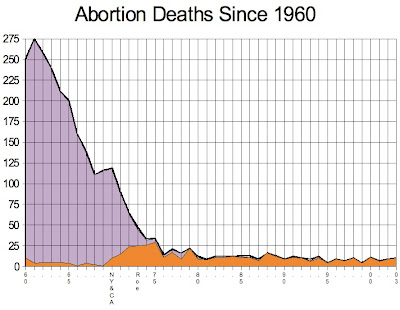
As you can see from the graph below, abortion deaths were falling dramatically before legalization. This steep fall had been in place for decades. To argue that legalization lowered abortion mortality simply isn't supported by the data.

external image Abortion+Deaths+Since+1960.jpg

Sunday, September 09, 2012

Two Deaths and a Ruined Life

On September 9, 1913, 27-year-old Anna Adler, a homemaker, died in Chicago, on the scene of an abortion performed by Dr. Lou. E. Davis that day. Davis was arrested that day, and she was indicted by a Grand Jury on October 15, but the case never went to trial. Davis was also implicated in the 1924 abortion death of 26-year-old homemaker Mary Whitney and the 1928 abortion death of 23-year-old Esther V. Wahlstrom.

In 1921, Roscoe "Fatty" Arbuckle was one of the highest paid men in Hollywood. But on September 5 of that year, Arbuckle's life took a horrible turn nobody could have predicted. An aspiring actress, 25-year-old Virginia Rappe (pronounced ra-PAY), took ill under strange circumstances at a weekend party Arbuckle was holding at a San Francisco hotel. Four days later, she was dead. A Hollywood blackmailer named Maude Delmont accused Arbuckle of raping Virginia and causing her death. He was placed on trial three times before being not only acquitted but also given a formal letter of apology from the jury for the ordeal he'd had to endure. Arbuckle had done nothing to harm the girl. She had taken sick at his party -- which she'd crashed. He'd put her to bed and summoned a doctor for her. For some reason, when Virginia was taken to a hospital on September 8, she was taken not to a legitimate hospital but to external image images?q=tbn:ANd9GcT0LOBV4S8OVk5qPOQtQjpAxtkFXDekxGfd2ZITQAYWbG5rHnramwWakefield Sanitorium, a maternity hospital known for performing quasi-legal abortions. Virginia died the next day, Friday, September 9. The cause of death was listed as peritonitis due to a ruptured bladder due to "external force." Testimony revealed that Virginia had five times availed her self of services at Roth's clinic: four times for abortions, and once to give birth to a baby. This information might seem to be unnecessarily slamming the victim, but turns out to be very relevant. Although Virginia's ruptured bladder was produced as evidence in the trial, her reproductive organs had vanished after the autopsy. The autopsy was performed illegally on site at Wakefield Sanitorium, without consulting the coroner's office. One of the doctors overseeing the autopsy, Dr. Melville Rumswell, was reputed to be an abortionist. Without the uterus and vagina, there was no way of knowing if Virginia had indeed suffered blunt vaginal trauma, which would have made a case against Arbuckle. But sharp instrument trauma would have cleared Arbuckle and pointed the finger at whoever performed a final, eventually fatal, abortion on Virginia Rappe. There is also the mystery of why Delmont directed suspicion toward Arbuckle. She was a blackmailer. Why didn't she milk Arbuckle for money? Why didn't she simply allow the police to investigate the death of the young women? To these questions, we can add two others: Why had Virginia's uterus, ovaries, and vagina been removed and disposed of? And why was Virginia brought to a marginal facility like Wakefield Sanitarium? One theory that answers the mysteries is this: Perhaps Delmont had a hand in arranging an illegal abortion that ruptured Virginia's bladder. When Virginia took ill, perhaps Delmont directed her to the Sanitarium, where the abortion may well have been performed -- where there would be accomplices who would also have a motive to keep the real reason for Virginia's death secret. And after the girl died, perhaps Delmont concocted the rape story to create a scandal that would divert attention away from herself. This is, of course, speculation. But since an abortionist could face murder charges if a patient died -- and since an accomplice likewise would face a prison sentence -- it's the only scenario that explains the otherwise inexplicable behavior of Delmont and whoever got rid of Virginia's uterus and vagina. 

Saturday, September 08, 2012

Two Dead Teens, 50 Years Apart

On September 8, 1923, 16-year-old Madge Bowman died at Chicago's Garfield Park Hospital from an abortion performed there that day. Midwife Kate Seuer and a man named Walter Page were arrested on October 5, but were later cleared by the coroner. Keep in mind that things that things we take for granted, like antibiotics and blood banks, were still in the future. For more about abortion in this era, see Abortion in the 1920s.

Seventeen-year-old Kathy Murphy went to Inglewood Women's Hospital in Los Angeles County for a safe and legal abortion on August 24, 1973. During the days after her abortion, Kathy suffered breathing problems and became semi-conscious, so Inglewood staff transferred her by ambulance to Centinela Hospital on September 7. Later that night, Cetinela transferred Kathy back to Inglewood, where John Dupont pronounced her dead at 1:20 on the morning of September 8. The autopsy found that Kathy had died of sepsis from the abortion; her cervix and uterus were infected, and her cervix covered with greenish-black pus. Other women who died after abortions at Inglewood include Belinda Byrd, Cora Lewis, Lynette Wallace, and Elizabeth Tsuji.

Legalization certainly didn't help the women who trusted their lives to Inglewood Women's Hospital. As you can see from the graph below, abortion deaths were falling dramatically before legalization. This steep fall had been in place for decades. To argue that legalization lowered abortion mortality simply isn't supported by the data.

external image Abortion+Deaths+Since+1960.jpg

Friday, September 07, 2012

Two Safe-n-Legal Abortion Deaths: One Wasn't Resuscitated; the Other Wasn't Pregnant

Twenty-four-year-old Synthia Dennard went to Biogenetics in Chicago for a safe, legal abortion and tubal ligation on September 7, 1989. The surgery was performed by Inno Obasi. Synthia began to hemorrhage during the surgery. A medical investigation later found that Obasi had "failed to summon help in a timely manner; refused to allow trained and skilled paramedics to attend to Synthia; refused to allow paramedics to transport Synthia to a hospital in a timely manner" and otherwise "allowed Synthia to bleed to death." Synthia's survivors had to file a court order to keep the facility from destroying her records. An autopsy revealed that instead of removing a section of Synthia's fallopian tube, Obasi had removed a portion of an artery. The autopsy also revealed that Synthia, mother of two, had not even been pregnant at the time of her abortion.

Tanya Williamson went to Moshe Hachamovitch's abortion facility on September 7, 1996, for the second day of a second-trimester abortion. Hachamovtich estimated that she was almost 14 weeks pregnant. She was doped up on Brevital for the procedure, then moved, still anesthetized and non-responsive, to the recovery room, where the pulse oximeter to measure her blood oxygen was taken off. After about 15 minutes in recovery, her blood pressure and pulse dropped and her breathing became shallow. Her vital signs continued to deteriorate, to the point where her blood pressure was too low to measure with a cuff.. Finally somebody summed Hachamovitch, who examined Tanya in recovery, started a new IV with D5W and Ephedrine, then told the recovery room nurse to do CPR, and somebody to call Emergency Medical Services (EMS). EMS Advanced Cardiac Life Support (ACLS) was dispatched at 2:40 and arrived at 2:41 to find Tanya looking dead, with no pulse, dilated pupils, and a bluish color to her skin.  Although Hachamovitch had the drugs on-site needed to treat Tonya's cardiac arrest, he didn't use them, nor did he use the EKG monitor and cardiac defibrillator that he had on hand. As the medics took over the discovered that the abortion clinic staff had been trying to revive Tanya with broken equipment, causing her to go without oxygen for an extended period. Competent help had arrived too late, and Tonya died.

Tuesday, September 04, 2012

1871: Abandoned by Lover While Dying from Abortion

On Wednesday, August 23, 1871, 22-year-old Mary Russell, who worked at an envelope factory, went to the home of her brother-in-law, William Albright, "a highly respectable gentleman, who is foreman in a printing office." Mary confessed to her family that she was pregnant and sick, and "threw herself upon the mercy of her relatives. They did not cast her off, but instead summoned Dr. Warren A. James and treated her with every possible kindness."

Dr. James had been Mary's family doctor for about four years. When he first saw her, she admitted to an abortion, saying that she'd taken an abortifacient a Dr. Tully had provided to her on August 23.

Dr. James had to leave the city for some reason, and turned the care over to Dr. Jeremiah P. Bliven, a former police surgeon. Bliven quickly became suspicious, and succeeded in urging Mary's family to ask her to come clean.

In the mean time, Mary's health took a turn for the worse. On Sunday, August 27, Bliven went to the police and reported his reasons to suspect an abortion. A coroner's detective was dispatched to the house. He questioned Mary. As she was too week to write, Detective Walker wrote a dying declaration for her based on the information he'd gotten.

Mary had been pregnant for about two months. Two weeks before the interview with Detective Walker, she'd gone to a Mrs. Burns for an abortion. While a housekeeper held her up against a wall, Mrs. Burns had used instruments on Mary, without producing any immediate effect. Burns told Mary that if anybody questioned her, she was to blame the abortion on a Dr. Tully. She then sent Mary home.

Mary took ill immediately "with severe pain in my head, accompanied by vomiting." She expelled her dead baby three or four days later. But she grew sicker and went to her family for care.

Mary reported that the baby's father was Harry Pullen, who had given her $10 to pay for the abortion and then evidently vanished from her life.

In the early morning hours of Monday, September 4, Mary died.

The police quickly went to Mrs. Burns' house and arrested Ann Brice, the housekeeper, and found out from her that Mrs. Burns had gone to her other home in Long Island. Before going after her, the police arrested Mary's lover, Harry Pullen, and Mary's roommate, Nellie Ryan, who had gone with her for the abortion.

Off to Long Island the police went. "They found the abortionist living in an elegant mansion, furnished throughout in the most splendid manner, of which she was the owner, as also of one hundred acres of fine land adjacent to it, all of which was in a high state of cultivation."

Mrs. Burns didn't seem at all alarmed to see the police, and had no evident thought of Mary Russell. Instead, Burns seemed to be operating under the assumption that she was wanted in connection with "the trunk tragedy", which she'd not been involved in. The police allowed Mrs. Burns to operate under this assumption until they had her at the station, at which point they informed her that she was actually being arrested for Mary Russell's death. "Without giving any explanation of her deed, or almost without taking the trouble to deny it, she was taken away to a cell and locked up."

The coroner performed the autopsy on Mary, and confirmed that she'd died of an infection caused by the abortion.


I have no information on overall maternal mortality, or abortion mortality, in the 19th century. I imagine it can't be too much different from maternal and abortion mortality at the very beginning of the 20th Century.

Note, please, that with public health issues such as doctors not using proper aseptic techniques, lack of access to blood transfusions and antibiotics, and overall poor health to begin with, there was likely little difference between the performance of a legal abortion and illegal practice, and the aftercare for either type of abortion was probably equally unlikely to do the woman much, if any, good.

For more on this era, see Abortion Deaths in the 19th Century.

For more on pre-legalization abortion, see The Bad Old Days of Abortion