Thursday, December 20, 2012

1926: Chicago Midwife's Fatal Handiwork

On December 13, 1926, 23-year-old Chicago native Mary Paradowski underwent a criminal abortion.
She died on December 20 at Chicago Hospital.

On January 15, 1927, midwife Josephine Petrova was indicted for felony murder in Mary's death.


Wednesday, December 19, 2012

The Non-Connection Between School Shootings and Abortion

While yes, the slaughter of 3,000 innocent unborn children a day is by far a tragedy of greater magnitude than any school shooting, I take exception with the idea that legalization of abortion is part of the why of school shootings.

Psychopaths who want to go out in what they consider a blaze of glory don't gun down convicts on a roadside work crew. They don't target an inner city gang. They don't shoot up a KKK meeting or a rally of skinheads. They go after the people whose deaths will outrage the community the most: children.

We need to recognize that the outrage over school shootings is a hopeful sign, a sign that contrary to the propaganda of hardcore abortion advocates, the vast majority of Americans do not consider children to be vermin. They value children highly and are devastated when children are slaughtered. They just don't make the connection between the visible child in the playground and the invisible child in the womb.

And even among abortion advocates, there is a profound disconnect in their thinking between the unseen fetus in the womb and the smiling cherub face of a child whose family has an album full of photos. During a National Abortion Federation meeting, members of what amounts to an abortionists' guild expressed total bewilderment that prolifers think they don't like children. They make no connection whatsoever between the child-killing that they devote their lives to and the lives of the baby in the stroller or the second-grader on the playground, any more than a Nazi would make a connection between the Jewish grandmother he's shoving into a mass grave and his own grandmother.

So we need to take this real value that they place on the children that they can see and work with it.

Talk about why it's so heinous to kill children. Why? Because those children had their whole lives ahead of them. They were robbed of Little League games and trips to the zoo; they were robbed of getting their drivers' license and going to the prom. They were deprived of falling in love and getting married and having children of their own.

The younger you are when you're murdered, they grasp, the more of life you're being robbed of.

So, isn't it terrible to rob somebody of every single life experience? Of a single moment of being snuggled over her mother's heart? Of a single moment of warm sun shining on his face?. Of the jingling of car keys and the mushy sweetness of that first bite of banana? The child killed in the womb gets denied even the few life experiences those precious schoolchildren had before their lives were horribly cut short.


We need to start with the profound sense people have that killing children is wrong, make them articulate it, and then ask them, at what point is it no longer wrong? At what point are you not depriving somebody of the rest of their life?

Just ask. And let them stew on it.

But don't make the mistake of thinking that AL shot up kids because our society doesn't value them. The truth is quite the contrary.

Tuesday, December 18, 2012

Two Criminal Deaths and One Illegal Safe and Legal Death

On December 28, 1871, an Illinois coroner's jury was called to investigate the December 18th death of Mrs. Amanda McCoy. Amanda had died at the home of Dr. Fahlbusch, a German woman practicing as a midwife and described as "of good reputation." She was cleared of any suspicion in Amanda's death.
The Coroner's Jury concluded that Amanda had undergone her fatal abortion before coming into the city.

On December 18, 1923, 40-year-old Sophia Hartozinski died at Chicago's County Hospital due to a criminal abortion performed there that day. The coroner identified midwife Mary Roback as having been responsible for Sophia's death.

Keep in mind that things that may seem appalling to us in the early 21st century -- such as performing surgery in one's home -- was not appalling at the time. Things we take for granted, like antibiotics and blood banks, were still in the future. For more about abortion in this era, see Abortion in the 1920s.

external image Illegals.png
Fast forward to the safe and legal era.

Myrtha Baptiste, age 26, had a safe and legal abortion of her 10 week pregnancy performed by Orlando Zaldivar at Woman's Care Clinic December 18, 1982.  Myrtha, a mother of two, arrived at the hospital in critical condition due to delay of transfer by the clinic staff. She bled to death from two uterine perforations. Zaldivar could not be reached for seven hours while hospital staff were struggling to save his patient's life. Since Zaldivar's license was inactive at the time he performed Myrta's abortion, the CDC classified her death as being due to illegal abortion rather than legal abortion. The other deaths at that facility -- Ruth Montero, Shirley Payne, and Maura Morales -- were counted as legal abortion deaths.

Monday, December 17, 2012

Chicago 1914: Fatal Abortion By Unknown Perp

On December 17, 1914, 24-year-old Emma Fertig died at Chicago's West Side Hospital from an abortion performed by an unknown perpetrator.

Note, please, that with overall public health issues such as doctors not using proper aseptic techniques, lack of access to blood transfusions and antibiotics, and overall poor health to begin with, there was likely little difference between the performance of a legal abortion and illegal practice, and the aftercare for either type of abortion was probably equally unlikely to do the woman much, if any, good. In fact, due to improvements in addressing these problems, maternal mortality in general (and abortion mortality with it) fell dramatically in the 20th Century, decades before Roe vs. Wade legalized abortion across America.
For more information about early 20th Century abortion mortality, see Abortion Deaths 1910-1919.

external image MaternalMortality.gif

Sunday, December 16, 2012

Quacks, both Before and After Roe, Killed Multiple Women

On December 6, 1874, midwife Mrs. Johanna White perpetrated an abortion on Mrs. Christine Seifred. Christine had been unfaithful to her husband when he was away in Europe, and when he returned and learned of the pregnancy, he left her. Ten days later, on December 16, Christine died from infection. Police arrested Mrs. White and her assistant, Margaret Smith.

On December 11, 1911, 34-year-old homemaker Mary Thorning underwent an abortion performed by Paulina Bechtel. Mary died on December 16.  Though Bechtel was identified as a midwife in the Homicide in Chicago Database, she was actually a doctor. At that time and place, female obstetricians were often referred to as midwives. Bechtel had already killed Ida Henry and Barbara Shelgren in 1900, In both of those cases she had been indicted but not tried. Bechtel was held by the Coroner's Jury and indicted on January 1, 1912 for Mary's death, but the case never went to trial.

On December 16, 1925, 22-year-old factory worker Bridget Masterson died in her Chicago home from a botched abortion. John O'Malley, the father of Bridget's baby, committed suicide by gas after learning of Bridget's death. He left a note implicating "a lady doctor at 310 W. North Ave." This was the address of Dr. Lucy Hagenow. Hagenow was indicted for felony murder by a grand jury on January 5, 1926. Hagenow, who had already been implicated of the abortion deaths of Louise Derchow, Annie Dorris, Abbia Richards, and Emma Dep in San Francisco, would go on to be linked to over a dozen Chicago abortion deaths: Minnie Deering, Sophia Kuhn, Emily Anderson, Hannah Carlson, Marie Hecht, May Putnam, Lola Madison, Annie Horvatich, Lottie Lowy, Nina H. Pierce, Jean Cohen, Elizabeth Welter, and Mary Moorehead. Keep in mind that things that things we take for granted, like antibiotics and blood banks, were still in the future. In fact, due to improvements in addressing these issued, maternal mortality in general (and abortion mortality with it) fell dramatically in the 20th Century, decades before Roe vs. Wade legalized abortion across America.


Now we move ahead to the days of safe-n-legal abortion.

Barbara Auerbach was 38 years old when she went to a New York hospital for a safe, legal abortion and tubal ligation, performed December 11, 1981. Two days later, she was discharged. On December 16, Barbara was vomiting and suffering from back pain and inability to void her bladder. She was admitted to Princeton Medical Center in Princeton, New Jersey. Doctors there tried in vain to save her life, but she died within three hours of being admitted. The autopsy showed that Barbara had an obstruction of her small bowel, which caused massive infection throughout her body.

On December 15, 1984, Mary Pena underwent a safe and legal abortion at San Vincente Hospital in Los Angeles. Mary had thought that she was 3 months pregnant, but doctors discovered she was at 22-weeks. During the procedure, Mary sustained two cervical lacerations, and because she was bleeding heavily, a hysterectomy was performed in an effort to save her life. The surgery was not successful, and at 1:50 am on December 16, 1984, she died while on the operating table. The Investigator's Report states "Dr. Allred cleared the case with Coroner and body was released to the family picked mortuary ... and services held. When the death certificate was taken to Kern County Health Department they refused to accept it and called the case to Los Angeles Coroner. ... Mortuary in Bakersfield will bring body to this office for autopsy on morning of 12-20-84." Only then was cause of death attributed to exsanguination due to cervical laceration due to therapeutic abortion. The cervix showed two lacerations - a small one that had been sutured and a large unsutured one extending through the full ring of the cervix. Once a cause for the fatal hemorrhage was determined, the death certificate was accepted, and Mary was laid to rest again. San Vicente had been purchased by National Abortion Federation member Familiy Practice Associates Medical Groupshortly before Mary's death. Other patients known to have died after abortion at Allred's facilities include:  Denise Holmes, Patricia Chacon, Josefina Garcia, Lanice Dorsey, Joyce Ortenzio, Tami Suematsu, Deanna Bell, Susan Levy, Christina Mora, Nakia Jorden, Maria Leho, Kimberly Neil, Maria Rodriguez, and Chanelle Bryant.


Venus Ortiz submitted to a 15-week abortion at National Abortion Federation member Eastern Women's Center at the hands of  Dr. Leiber on February 24, 1993. Her family due on the grounds that there was negligence in administering anesthesia to Venus, and then failed to resuscitate her promptly when she stopped breathing. Venus was left in permanent need of respirator, with profound brain damage. Venus remains in a coma/vegetative state. She was hospitalized a little over five months before being transferred to permanent nursing home care. She remained in a vegetative state for the remainder of her life. She died in a Staten Island nusing home on December 16, 1998 at the age of 29. Two other patients, Dawn Ravenelle (only 13 years old) and Dawn Mack, also died of complications of abortions done at Eastern Women's Center.

Prolifers need to learn that criminalizing abortion won't be enough. We will have to close loopholes in the law and demand accountability from authorities, who in the name of abortion rights will ignore quackery whether abortion is legal or not. Prochoicers need to learn that legalizing abortion didn't abolish quackery. Only diligence can keep the quacks in check.

Saturday, December 15, 2012

One Criminal, Two Safe-n-Legal, All Dead

At around 9:10 p.m. On December 15, 1891, Dr. J. M. Ryall was called to the Pittsburgh home of 32-year-old Nancy Hildinger. He found her dead. Her family told Ryall that Nancy had been sick and bleeding from her period. He performed an autopsy. Nancy was a large, muscular woman weighing about 160 lbs. and found her uterus enlarged to about three months size, flabby, inflamed, and marked by an injury caused by some sort of instrument. She had already expelled the fetus. Her lungs were also  congested. The coroner's jury found that Nancy had died at the hands of an unknown abortionist.

Twenty-year-old LaSandra Russ, from Berkley, California, went to Los Angeles to have an abortion on December 13, 1971. She was six weeks pregnant. The abortion was performed at Memorial Hospital of Hawthorne the next day, December 14. LaSandra went into cardiac arrest almost immediately after the abortion. Attempts were made to revive her, but she was finally pronounced dead on December 15, 1971.

"Faye" was 19 years old when she went to the office of Andre Nehorayoff for a safe and legal abortion on December 15, 1979. Nehorayoff failed to record an adequate history or medical exam for Faye. Nehorayoff left Faye in a recovery room at 2:25 p.m., without any monitoring. When somebody finally checked on her an hour later, she was cyanotic (blue) and had no pulse. She was pronounced dead at a hospital. Nehorayoff was also disciplined regarding Patient E, an 18-year-old patient who bled to death after Nehorayoff sent her home in 1983 with a fetal leg still in her uterus.

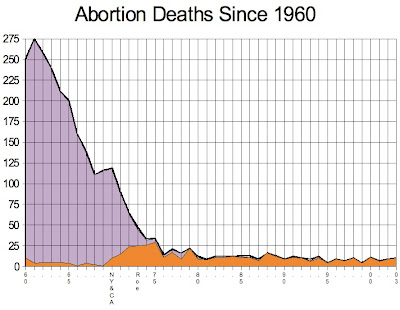
As you can see from the graph below, abortion deaths were falling dramatically before legalization. This steep fall had been in place for decades. To argue that legalization lowered abortion mortality simply isn't supported by the data.

external image Abortion+Deaths+Since+1960.jpg

Friday, December 14, 2012

Four 20th Century Abortion Deaths

On December 14, 1911, 34-year-old mother-of-four Mrs. Ella Kettler died from an abortion that Dr. Robert H. Foster had perpetrated at his practice on December 2. Foster was held by the Coroner's Jury and indicted on December 19, but the case never went to trial.

On December 14, 1916, 19-year-old Eleanor Dillon, who worked as a clerk, died at Chicago's Columbus Hospital from a criminal abortion perpetrated by Dr. M.R. Perlstein that day. Perlstein was arrested December 15, and Michael Schackman and Abraham Kruchersky were held as accessories. Perlstein was acquitted on May 18, 1918.

Walter Hufnagel of Pittsburgh, Pennsylvania, noticed on December 4, 1918, that his wife, 19-year-old Emma Hufnagel, was sick with body aches. The next day he called Dr. C. Barton, who diagnosed the young homemaker with influenza. By December 7, Emma's stepmother, Louise Jackson, was told of Emma's illness and went to visit her. Emma told her mother that, since her period had been about two weeks late, and believing herself to be pregnant, she had used a catheter on herself on November 30. By December 10, Emma's family was so alarmed by her condition that they brought her to Presbyterian Hospital. In spite of doctors' best efforts, Emma died of peritonitis and septicemia on December 14.

Note, please, that with overall public health issues such as doctors not using proper aseptic techniques, lack of access to blood transfusions and antibiotics, and overall poor health to begin with, there was likely little difference between the performance of a legal abortion and illegal practice, and the aftercare for either type of abortion was probably equally unlikely to do the woman much, if any, good. In fact, due to improvements in addressing these problems, maternal mortality in general (and abortion mortality with it) fell dramatically in the 20th Century, decades before Roe vs. Wade legalized abortion across America.

For more information about early 20th Century abortion mortality, see Abortion Deaths 1910-1919.

external image MaternalMortality.gif

Edith Cote was 38 years old when she submitted to a safe and legal abortion in New York. On December 14, 1991, she was unresponsive and was taken to the emergency room at Syosset Hospital. Hospital staff were unable to save Edith's life. Her cause of death was listed on her death certificate as pulmonary amniotic embolism after an induced abortion.

Thursday, December 13, 2012

1996: Bled to Death With her Son in her Arms

First, a little background.

In one session of a National Abortion Federation Risk Management Seminar, a participant indicated that when he pulled bowel (extracted part of a patient's bowel through a perforation in her uterus), his preferred method of treatment (if you can call it that) was to stuff the bowel back through the perforation, administer medications to make the uterus contract and control bleeding, monitor the woman more carefully in recovery, and if she seemed okay, send her home none the wiser.

The moderator was appalled. He pointed out that even if there was no obvious injury to the bowel, it might be bruised and damaged. The recommended procedure is to admit the patient to the hospital and examine her bowel, and observe her for signs of further injury. The moderator then asked how many of the other participants followed this method of stuffing the bowel back in and hoping for the best. Six participants raised their hands to be counted.

Sharon and her son Curtis
I knew it was only a matter of time before one of these bowel-stuffing abortionists killed somebody. That's where the unwitting Sharon Yvonne Hamptlon stepped into the picture. She went to Bruce Steir (rhymes with "fear") at A Lady's Choice Women's Medical Center for a safe, legal abortion on December 13, 1996. She was 20 weeks pregnant.

Steir remained at the facility for about an hour after Sharon's abortion. She was still in the recovery room when he left.

Excerpts from Sharon's mother Doris's statement to the medical board can be found at "...And So I Could Hold You and You Could Go to Sleep". Here are some excerpts:

Maybe around 3:00 pm I took Curtis inside to use the bathroom. I saw a grey haired man dressed in green surgical clothes sitting at a desk. He said, "You know she is far along." I said, "No. I didn't know because she didn't tell me." Then I saw Sharon in the recovery room about 3:30 or 4:00 pm. She looked so bad that I felt scared. She was laying on a lazyboy style chair with an IV in her left arm and a blood pressure cuff on the other. She looked very pale. Her eyes were partially open and I could see only the whites of her eyes as if she were in shock. She was not speaking and her whole body was shaking real hard in big shivers. Her legs were especially bad. The doctor said, "She doesn't react to drugs well." .... A woman came in and said that Sharon didn't need the blankets that were on her already and pulled the blankets off. Other girls in the recovery room were vomiting and the attendant woman told the girls to keep vomiting, that vomiting was good for them at this time. I went back to the waiting room and a Spanish lady came out and said that Sharon would be ready in a few minutes as soon as the IV finished.
Sharon was in the recovery for only about 45 minutes, because at 5:00 pm they came out and said she was ready to leave. I heard someone say that the doctor was real busy and he had to rush out like he was going to the airport, something about him having to go to Sacramento or San Francisco. I saw two women struggling to place Sharon in a wheelchair. Sharon could not walk at all and she was not speaking. She looked very, very pale now.
....
On the way home to Barstow, I stopped at Wendy's to get a sandwich for little Curtis. I tried to wake Sharon but all she said was "Huh, Huh." Then Curtis said, "Mamma, I love you. Do you need anything? Are you okay?" And Sharon said, "Okay. I'll take a drink." Sharon was lying in the backseat of the car and said to Curtis, "Come on back with me Curtis. I love you and so I could hold you and you could go to sleep." She was silent for about one hour. Near Victorville, she said, "I'm so hot. Please let the window down." I opened the window a bit. After that, Sharon was silent forever.
We got home to Barstow and I saw that Sharon, still laying in the back seat was naked from the waist up, having removed her shirt, shoes and socks. I started yelling, "Sharon. Sharon. Wake up," but she didn't and my husband, Ben Hamptlon, said, "Call 911."


According to Nancy Myles, an untrasound technician who was assisting Steir during Sharon's abortion, Steir was having trouble locating and extracting the fetal skull. She said that he looked at her strangely and said, "I think I pulled bowel."

Steir was already on probation with the medical board at the time of Sharon's abortion; he had a history of botching abortions, including causing uterine perforations. He'd been found negligent in six abortion cases, including three in which the woman had to undergo a hysterectomy. One woman had to have a fetal skull removed from a tear in her uterus. Steir surrendered his license in 1997, in the wake of the fallout surrounding Sharon's death.

Pro-choice organizations, including the national leadership of NOW, and the National Abortion Federation and the California Abortion and Reproduction Rights League, rallied around Steir. One supporter stood outside the courthouse with a sign reading, "Abortion doctors are heroes, defend Dr. Bruce Steir." The Feminist Women's Health Center in Chico, with whom he once was affiliated, set up a "defense committee" and raised funds for his legal expenses.

Joseph Durante, who owned the facility, was also on probation with the medical board at the time of Sharon's fatal abortion. He had attempted a late abortion which resulted in the birth of a live but injured infant.

Sharon was a single mother who worked part-time at Burger King while attending community college. Sharon's mother said that she wanted to go off welfare and become a nurse. California taxpayers funded the fatal abortion through Medi-Cal.

Steir eventually plea bargained. He was sentenced to a year in prison, with six months of the sentence suspended in leiu of community service. He was also given five years' probation. At the sentencing hearing, four years after Sharon's death, Sharon's father said he still often pulled his car to the side of the road, looked at his daughter's picture, and wept.

Steir was released after serving only four months of his sentence.

Again, from Doris Hamplton's statement:

I don't know how she heard about Dr. Durante's offices. I think he was recommended by the people at San Bernardino County Social Services or by Dr. Krider. Sharon was on Medi-Cal and had Pacific Care as the Medi-Cal managed care agent. I understand that because Dr. Durante and Dr. Steir were on probation they were not entitled to Medi-Cal payment, but they got it anyway. I understand that their office was not accredited as an ambulatory surgical office, and that it was supposed to be accredited to comply with the law. I had no idea that Dr. Durante and Dr. Steir were on probation with the Medical Board for incompetence and negligence against women patients. I am sure that Sharon did not know either. If I had known, I would never have taken Sharon to such a bad place with such bad doctors. I learned about their records in the newspaper articles.
....
I cry every day for the terrible loss of my daughter, and I am overwhelmed that 3 year old Curtis had his mother taken away forever. My husband, Ben Hamptlon, (father of Sharon), is sick with grief, has terrible head pain, is under the care of a doctor for this and has been taking strong pain medicine since Sharon's death. My prayer is that these doctors be stopped immediately so that no other girl will be killed and that no other family will have to suffer as we have.

Wednesday, December 12, 2012

Two Incorrigible Criminal Abortionists and a Flukey Post-Roe Death

On Monday, December 12, 1892, Emily Anderson, a Chicago widow who kept a boarding house, died of peritonitis from a criminal abortion. Emily, a widow, kept a boarding house. One of Emily's boarders, Henry Gibspen, denied having gotten Emily pregnant but said that he had accompanied her to a doctor at her request, but had stayed at the foot of the stairs. He saw her enter the office of Dr. Lucy Hagenow (pictured), then went home. Gilbspen turned State's evidence against Hagenow, but she was acquitted when the judge instructed the jury to return a not-guilty verdict, concluding on his own that the state had not produced sufficient evidence for a conviction. Hagenow had already been tried multiple times for abortion deaths in San Francisco (Louise Duchow, Annie Dories, Emma Dep, and Abbia Richards) before moving to Chicago, and had already been implicated in the deaths of Minnie Deering and Sophia Kuhn. She went on to be tied to nearly a dozen more Cook County abortion deaths, including  Hannah Carlson, Marie Hecht, May Putnam, Lola Madison, Annie Horvatich, Lottie Lowy, Nina H. Pierce, Jean Cohen, Bridget Masterson, Elizabeth Welter and Mary Moorehead.

On December 12, 1930, 22-year-old Jeanette Reder died from complications of an abortion that had been perpetrated on December 1 by Dr. Emil Gleitsman. Jeanette died December 12. Gleitsman was arrested on December 13, and held for murder by abortion. He was indicted by a grand jury for homicide, but was acquitted on June 15, 1931. The source does not clarify why there was enough evidence to indict Gleitsman, but not enough to convict him. Gleitsman was also indicted for 22-year-old Lucille van Iderstine's abortion death, and was convicted in the death of 21-year-old Mary Colbert in 1933. Jeanette's abortion was typical of illegal abortions in that it was attributed to a physician.

The seedy careers of Lucy Hagenow and Emil Gleitsman stand as a warning to prolifers that simply recriminalizing abortion won't be enough to stop abortionists, not even the biggest quacks, from plying their trade unless the laws have teeth in them and we address the kind of corruption and political game-playing that enabled abortionists to keep killing. We will never be able to rest, because the abortionists and their enablers certainly won't.

Still, abortion deaths should remain rare. During the first two thirds of the 20th Century, while abortion was still illegal, there was a massive drop in maternal mortality, including mortality from abortion. Most researches attribute this plunge to improvements in public health and hygiene, the development of blood transfusion techniques, and the introduction of antibiotics. Learn more here.

external image MaternalMortality.gif

Jumping ahead to the safe and legal era, we have a death that actually appears to be just one of those flukey things. Thirty-year-old Sandra Williams was 11 weeks pregnant when she underwent an abortion on December 12, 1984. She went home following the abortion. Less than twelve hours later, she was dead. Her death certificate noted that she died from a pulmonary embolism.

Tuesday, December 11, 2012

1927: The Infamous Rongetti Case

The first man sentenced to die in Illinois's electric chair was not a typical death row inmate: he was a physician whose patient died from complications of an illegal abortion. Reporters covering the case in Chicago contended that Rongetti was the first doctor in the United States ever sentenced to die over a patient's abortion death.

Dr. Amante Rongetti's death sentence was handed down by a Chicago jury on March 1, 1928. He had been convicted of murder in the December 11, 1927 death of 19-year-old Loretta Enders on November 16.

Rongetti reportedly stood stunned and quiet as the sentence was read, but his wife became hysterical, pushing her way through the courtroom crowd crying, "Let me out."

Many factors disclosed in court helped to seal the jury's verdict:
  • The baby had been born alive; Rongetti left it unattended to die, then threw the body in the furnace. (Rongetti faced an additional charge of manslaughter in the death of the baby.)
  • After Loretta had developed sepsis (blood poisoning) from the abortion, Rongetti refused to provide follow-up care, including possibly life-saving additional surgery, because she had no money to pay him.
  • Not only did Rongetti refuse to provide the care himself, but he prevented Loretta from going elsewhere for fear his practice would be exposed.
  • Rongetti filed a falsified death certificate, claiming that Loretta had died of heart disease.
  • Rongetti refused to allow Loretta's mother to summon a priest to perform last rites, again fearing exposure of his illegal practices.
After the sentence was handed down, Rongetti's attorney, Scott Stewart, immediately filed motion for a new trial. Stuart's bid for a new trial was successful, and the very next year, Rongetti was at large to be implicated in the criminal abortion death of Elizabeth Palumbo, who died May 23 after an abortion performed May 10.

He was tried again for Loretta's death in December of 1929. He was found guilty of manslaughter and sentenced to Joliet.

Loretta's abortion was typical of illegal abortions in that it was performed by a physician.

Monday, December 10, 2012

Two Dead Chicago Teens, Nearly a Century Apart

On December 10, 1914, 13-year-old schoolgirl Ida Kaufman died in a Chicago home after an abortion performed by an unknown perpetrator.

Note, please, that with overall public health issues such as doctors not using proper aseptic techniques, lack of access to blood transfusions and antibiotics, and overall poor health to begin with, there was likely little difference between the performance of a legal abortion and illegal practice, and the aftercare for either type of abortion was probably equally unlikely to do the woman much, if any, good. In fact, due to improvements in addressing these problems, maternal mortality in general (and abortion mortality with it) fell dramatically in the 20th Century, decades before Roe vs. Wade legalized abortion across America.

For more information about early 20th Century abortion mortality, see Abortion Deaths 1910-1919.

external image MaternalMortality.gif

Jumping from the beginning of the century to the end, we observe the death of another Chicago teen.

On December 10, 1998, Nakia Jorden, who would have graduated from Hyde Park High School in 2000, died of anesthesia complications during an abortion at the Albany Medical Surgical Center in Chicago. According to an expert in anesthesia who reviewed Nakia's records, Nakia had a pulse ox reading of only 94% when she was sedated for her abortion. Nakia was not given oxygen, and was not monitored by EKG as appropriate when administering this degree of anesthesia. The greatest fault that the anesthesia expert found was that Albany staff, upon noting a pulse ox reading of only 74%, he did nothing to ensure that she was in fact getting enough oxygen into her lungs. Instead, he administered atropine to increase her heart rate, "which likely delayed the critical intervention of ventilating the patient with oxygen."

Albany also perpetrated the fatal abortions on  Deanna Bell, Maria Leho,and Maria Rodriguez. Other abortion patients who have lost their lives after entrusting them to FPA's California affiliates include  Denise Holmes, Patricia Chacon, Mary Pena, Josefina Garcia, Lanice Dorsey, Joyce Ortenzio, Tami Suematsu, Susan Levy, Christina Mora, Kimberly Neil, and Chanelle Bryant. You can contact Albany here to tell them what you think of the job they're doing.

Sunday, December 09, 2012

1956: The Deadly "Angel of Ashland"

On Saturday, December 8, 1956, 26-year-old Mary Davies of New York City arrived in the Ashland, Pennsylvania office of abortionist Dr. Robert Douglas Spencer. She was seeking an abortion.

As a physician, Spencer was typical of criminal abortionists. What was unusual about him was that rather than sneak the woman in through the back alley, Spencer plied his abortion trade openly.

According to Spencer, Mary was alone, and reported that she'd been bleeding for about two weeks. He didn't examine her, but gave her medication for pain and Ergotrate to stop the bleeding. He told her to return the following day for her abortion.

Mary returned at about 10 AM on the 9th. He administered 13 ccs. of Evipal in a 10% solution to induce anesthesia. "I injected that solution into the vein of the left arm and in ten seconds she was asleep." Spencer said that the next thing he noticed was that Mary wasn't breathing. She also appeared blue. He injected five ccc. of "Metrozol"* into her left leg. She didn't respond, so he gave her an additional five ccs. of "Metrozol", this time injecting the drug into a vein. Mary still did not respond, so Spencer attempted to resuscitate her with oxygen. He called his assistant, Mildred Zettlemoyer, into the room to assist him. With Mary in Zettlemoyer's care, Spencer went to another part of the building to retrieve adrenaline. He gave Mary three injections of adrenaline.

Mary still was not responding, so Spencer had Zettlemoyer call the laboratory assistant, Steve Sekunda, and tell him to come to the office. Spencer put a breathing tube into Mary's throat, but had to work blind because the light on his scope wasn't working. He resumed artificial respiration, "and pulled on her tongue, but got no response." By the time Sekunda arrived, at around 11:30, Spencer had concluded that Mary was dead. The puzzled man concluded "that this patient died in my office from some heart disease."

Dr. Milton Helpern, chief medical examiner for New York City, was among the experts that testified in Spencer's trial for Mary's death. Helpern concluded that Mary had been pregnant, that the pregnancy had been terminated right before her death, and that she'd died from administration of a drug used for anesthesia for performing a D&C. Mary had been in good health prior to her death.

Patricia G. Miller, author of The Worst Of Times, asked another doctor, "Dr. Bert," who had practiced before legalization, to review news reports of Mary's death and speculate as to whether Mary would have died had abortion been legal.

"Dr. Bert" faulted Spencer for not having an assistant while he was administering general anesthesia. "In my view, to give a general anesthetic alone is below good medical care, even in those days." He speculated that Spencer had not had an assistant working with him due to the law against abortion -- an odd speculation, since Spencer was doing abortions quite openly, with at least one member of his staff present in the building. It's also an odd speculation considering how many legal abortionists have had patients die from anesthesia complications, either due to inadequate supervision of the anesthesia process or inadequate resuscitation efforts.

Spencer's widow, Eleanor, told Patricia Miller that her husband had been quite stricken by Mary Davies' death. He continued to perform abortions, however, along with his regular medical practice, up until the trial. He was acquitted on all counts, likely because it was impossible to prove that Mary hadn't either miscarried during those two weeks of bleeding prior to her appointment with Spencer, or been aborted by somebody else. No mention is made of any fetal remains being found in Mary's body or in Spencer's office.

Spencer briefly stopped doing abortions after the trial, "for a month or so," his widow said. But he resumed his business and eventually got entangled with a fellow named Harry Mace who set up a business for himself rounding up abortion patients and bringing them to Spencer. Spencer's widow lamented that Mace flooded Spencer with patients, pressuring him to rush through abortions. Spencer's health began to fail. He was arrested again, due to the attention from Mace's activities, but died before the case went to trial.

Mary Davies is the only woman known to have died from abortion related complications under Spencer's care. Spencer is estimated to have performed between 40,000 and 100,000 abortions.

Bring Out Your Dead (Part 1: The Narrative)

Images are powerful, particularly images of tragedy.

This fact makes images a favorite tool of activists. A picture, as the saying goes, paints a thousand words. A well-chosen image can convey an entire story. It serves as shorthand to convey a useful narrative. The narrative itself might be true or false.

These images, gathered easily from activist web sites, convey a singe overarching narrative. Can you fill in the blank?

"___________ kill women."

If you don't follow political or social-issues news, I'll give you a hint: The images of Becky Bell and Rosie Jimenez are from the web site of the National Organization for Women.

These women's images are used to rally people to the cause of abortion-rights activists. The overarching narrative, in a nutshell, is, "Abortion laws kill women." Each specific image is used to convey a specific piece of that narrative.

The first women, Geraldine "Gerri" Santoro, is the woman in the infamous photo first published in Ms. magazine in 1973. The photo, taken by police, showed Gerri, nude, face-down with her knees under her, on the floor of the motel room where she died on June 8, 1964.  Gerri had arranged the abortion out of fear of a violent estranged husband that the law had failed to protect her from. In 1995, Boston filmmaker Jane Gillooly produced a film, Leona's Sister Gerri, to spell out the narrative in specific detail: Laws banning abortion never  prevented women from seeking abortions; they only forced women to resort to desperate, amateur abortions that inevitably killed them.

The second woman is Rosie Jimenez. On September 26, 1977, 27-year-old Rosie had shown up at the emergency room of McAllen General Hospital in the Texas border town of McAllen, with septic shock. She was put in intensive care, but died on October 3 from renal and cardiac failure caused by complications of a criminal abortion. This criminal abortion cost $5 less than legal abortions being arranged for poor patients by the same Planned Parenthood that had arranged an earlier, tax-funded abortion for Rosie.  The narrative in Rosie's death, put forth not only by abortion-advocacy organizations but also by their supporters at the Center for Disease Control, was that the newly-enacted "Hyde Amendment," banning use of federal tax dollars for any more elective abortion, forces women to forgo the prohibitively expensive safe, legal abortions and instead resort to cheap but dangerous criminal abortions.

The next image is that of Becky Bell, a 17-year-old Indiana girl who died of pneumonia on September 16, 1988. Becky's story is a bit different from those of Gerri and Rosie. There is no doubt whatsoever that Gerri and Rosie had died as a result of botched abortions, however much one might argue about the causal role played by criminal law or funding restrictions. On the other hand, the only abortion connected with Becky's death is a "spontaneous abortion" -- the medical term for a miscarriage. This inconvenient little fact did not stop abortion-rights activists from latching on to the word "abortion" on Becky's autopsy report and using it to convince her parents that she had not simply miscarried while dying of pneumonia, but had instead developed the infection because she had undergone a criminal abortion. The specific narrative put forth using Becky's image is that laws requiring parental involvement in abortions performed on underage girls force teens to resort to deadly illegal abortions.

The final image is that of Savita Halappanavar. Like Becky Bell, Savita did not undergo an induced abortion. Rather, she died in an Irish hospital of massive infection related to a miscarriage during a wanted pregnancy. If the events recalled by her husband are correct, Savita was not given antibiotics until after she had already collapsed from the raging sepsis. Given three days notice prior to publication of the story, Irish abortion-rights organizations latched onto Mr. Halappanavar's recollection that Savita had asked that doctors induce labor to complete the progressing miscarriage, and the doctor refused on the grounds that Ireland, being a Catholic country, would not permit taking any steps to remove or expel the fetus until the heart had stopped beating. Despite the fact that the type of induction Savita reportedly requested is legal in Ireland and sanctioned by the Catholic church, the narrative being attached to Savita's image is that laws against abortion, foisted off on society by the Catholic church, forbid doctors to save women's lives in the face of pregnancy complications.

The fit between the image and the narrative, as we have just seen, does not need to be a snug fit. The most tenuous link between image and narrative is sufficient. And once that link is established, the images are splashed across newspapers, magazines, web sites, posters and banners.

There are some images, however, that must be avoided like the plague, even though they depict women who died due to abortions.
Row 1: Marla Cardamone, Carolina Gutierrez, Diana Lopez,
Karnamaya Mongar, Belinda Byrd
Row 2: Alice Bowlsby, Alexandra Nunez,Sharon Hamplton,
Eva Swan, Laura Smith
Row 3: Tonya Reaves, Eva Shaver, Holly Patterson,
Christin Gilbert, Mary Parks
Row 4: Kris Humphrey, Edrica Goode, Barbara Covington,
Barbara Lofrumento, and Tamiia Russell
These abortion victims won't be featured in anything put out by those who hold themselves up as defenders of women's lives or champions of women's safety. These women's deaths must, at all costs, be ignored. Why?

They simply do not fit the abortion-rights narrative.

Alice Bowlsby, Eva Swan, Eva Shaver, Mary Park, Barbara Covington, and Barbara Lofrumento don't fit the narrative because they died from criminal abortions that would not fit into the modern "unsafe abortion" category. Their abortions were perpetrated by physicians with the same tools, training, and technology that would have been available had abortion been legal. Admitting that such deaths happened prior to legalization would detract from the narrative that pre-legalization abortion was an age of "back alley butchers," of abortions perpetrated by rank amateurs. Admitting that such deaths were happening would open the door to thought about what it was that was making pre-legalization abortions deadly. Those thoughts, leading off the safe path of the "legalization saves women's lives" narrative, threaten the abortion advocacy establishment.

Kris Humphrey, after feeling mistreated by Planned Parenthood staff during an abortion there, opted to go "natural" for her next abortion, and poisoned herself with pennyroyal tea recommended to her by friends who likewise embraced herbal abortions. Looking too closely at Kris's death would also open a can of worms the abortion establishment would prefer kept tightly shut.

But it's the last group of women whose deaths pose the greatest threat to the narrative. Marla Anne Cardamone, Carolina Gutierrez, Diana Lopez, Karnamaya Mongar, Belinda Byrd, Alexandra Nunez, Sharon Hamplton, Laura Hope Smith, Tonya Reaves, Holly Patterson, Christin Gilbert, Edrica Goode,  and Tamiia Russell died from supposedly safe, legal abortions under circumstances that call the claim that legalization improved safety into serious question. Even worse, they raise questions about how much the abortion-rights establishment can really be trusted to look after women's lives.

They must, absolutely must, be hushed up.

Narrative is all.

Saturday, December 08, 2012

Two Beneficiaries of Legalization: Myria McFadden and Magdalena Rodriguez

Both of today's anniversaries concern safe, legal abortions.

Myria McFadden underwent a second-trimester abortion on December 7, 1987, in Washington, DC, performed by Dr. Hazel Tape.  Myria had trouble breathing after the abortion. She suffered heart and lung failure and died the following day at Holy cross Hospital in Silver Spring, Maryland.

On December 8, 1994, 23-year-old Magdalena Rodriguez went to Suresh Gandotra's clinic, El Norte Clinica Medica, for what she thought was a safe, legal second-trimester abortion. Gandotra later said, "I knew I screwed up," when he pulled out bowel instead of fetal parts. Gandotra called a hospital and asked for directions to send Magdalena there by car. The staff at the hospital insisted that Magdalena should be transported by ambulance. They began to assemble an expert team for the expected catastrophic injuries.In the mean time, Gandotra left Magdalena unattended while he did abortions on other patients. After a half-hour delay, he finally called an ambulance. When the ambulance crew arrived, they found Magdalena in ventricular fibrillation, with no pulse, bleeding, and lying on the floor. The ambulance crew was not informed about the hospital that was awaiting this critically injured patient, so they took Magdalena to another hospital, one that was not prepared to treat a patient with her specific injuries. When the surgeon at the hospital opened Magdalena's peritoneum, it was so distended with blood that the operating room was spattered with the escaping blood. Magdalena's uterus was ruptured, with a fetal limb protruding into her abdomen. Her cervix, uterus, bladder, and colon were lacerated. The mangled and partially dismembered fetus was of approximately 30 weeks gestation. As the autopsy describes it, "the body of the baby was not complete when autopsied. Both arms had been cut off; the heart, lungs, liver, and other organs had been cut out, the front of the chest and abdomen were missing, the right femur was fractured, the head was intact except for an area on the scalp which had been taken off from the back of the head." Magdalena bled to death during surgery. At the time of Magdalena's fatal abortion, Gandotra was already a convicted felon who had done time for grand theft, Medi-Cal fraud, forgery in the prescribing of drugs, and aiding in the unlicensed practice of medicine.

Friday, December 07, 2012

1925: Mystery Abortion Kills Chicago Woman

On December 7, 1925, 18-year-old Margaret Zito died at Chicago's West End Hospital from a criminal abortion performed that day. The person responsible for Margaret's death was never identified.

Keep in mind that things we take for granted, like antibiotics and blood banks, were still in the future. For more about abortion in this era, see Abortion in the 1920s.

Thursday, December 06, 2012

1988: Safe, Legal, and Fatal for Florida Teen

Life Dynamics lists 16-year-old Katrina Poole on their "Blackmun Wallsafe, legal abortions.
LDI notes:

  • Katrina's abortion was performed the afternoon of December 5, 1988, in a doctor's office in Jacksonville, Florida.
  • She suffered a perforated cervix and uterus.
  • She died of hemorrhage the following day.

Supporters of legalized abortion would argue that though Katrina's death was indeed tragic, there would be more such tragic deaths were it not for the lifesaving effects of legalization. Is that assertion true? Look for yourself at the numbers:

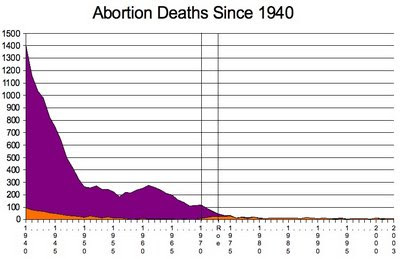
During the 1940s, while abortion was still illegal, there was a massive drop in maternal mortality from abortion. The death toll fell from 1,407 in 1940, to 744 in 1945, to 263 in 1950. The graph below, showing illegal abortion deaths in purple and legal deaths in orange, shows the number of abortion deaths in the US each year from 1940 through 2003. The first state to legalize abortion-on-demand was New York in 1970. The Roe vs. Wade decision in 1973 struck down all the laws in the US criminalizing abortion. Would you conclude that legalization is what we have to thank for the fact that abortion deaths are not as commonplace now as they were in the 1930s? Or do you think there were other factors that did the job, and abortion advocates just claimed credit? Explore the question more here.
external image Abortion+Deaths+Since+1940.jpg

Wednesday, December 05, 2012

Two Deaths Nearly a Century Apart

On December 5, 1905, 19-year-old laborer Mrs. Annie Killhoff died at her home from an abortion performed there that day. Two physicians, Joseph Vassumpaur and Charles Boddiger, were arrested, Vassumpaur as the principle and Boddiger as an accessory. Patrick Dillon was also held as an accessory. The case, however, never went to trial. Annie's abortion was typical of pre-legalization abortions in that it was performed by a physician.

Note, please, that with overall public health issues such as doctors not using proper aseptic techniques, lack of access to blood transfusions and antibiotics, and overall poor health to begin with, there was likely little difference between the performance of a legal abortion and illegal practice, and the aftercare for either type of abortion was probably equally unlikely to do the woman much, if any, good. For more about abortion and abortion deaths in the first years of the 20th century, see Abortion Deaths 1900-1909.


external image Illegals.png
Fast forward nearly a century.

Seventeen-year-old Janice Gumm went to Dimensions Medical Center at 1455 Golf Road in Des Plaines, Illionis, for an abortion on December 5, 1998, to be performed under anesthesia. Her abortionist was Dr. Jesse Chandler, and the anesthesiologist was Dr. Murray Rosenberg of Hospital Anesthesia Group. The suit by Janice's survivors held that Dimensions failed to perform an adequate physical examination prior to the abortion, particularly in that they did not properly assess her increased risks due to the fact that she had asthma. As a result, Janice suffered an anesthesia-related complication that resulted in her death that day.

Tuesday, December 04, 2012

The Patrolman, the Medical Student, and the Dead Woman in the Motel

Queens patrolman Howard Bailey, morgue attendant Victor Genz, and a Texas medical student, Benjamin Lockhart, were arrested in the December 4, 1965 abortion death of Rita Shea, a 33-year-old Long Island woman.

Lockhart confessed to performing the abortion in a motel room near Kennedy airport. After Rita died, her body was put in a car outside her home.

Bailey, a married man, had evidently arranged the abortion to keep his affair with Rita a secret. He paid a portion of the abortion fee, which was between $100 and $300. He had been a 19-year veteran with the police force.

Rita's abortion was a bit unusual in that most pre-legalization abortions were done by physicians. But abortions like hers, performed by people with at least some medical training, were still more common than amateur or self-induced abortions. (See //The Bad Old Days of Abortion//.)

During the 1940s, while abortion was still illegal, there was a massive drop in maternal mortality from abortion. The death toll fell from 1,407 in 1940, to 744 in 1945, to 263 in 1950. Most researches attribute this plunge to the development of blood transfusion techniques and the introduction of antibiotics. Learn more here.
external image Abortion+Deaths+Since+1940.jpg

For more on pre-legalization abortion, see The Bad Old Days of Abortion

Monday, December 03, 2012

Fatal Abortions in 1878, 1917, 1977, 1983, and 1988

Ann Roberts, 25 years old, submitted to an abortion November 29, 1878 in Saint Louis, Missouri. She died of peritonitis on December 3. Before her death, Ann identified William Stapp as her abortionist. Somebody  made out a falsified death certificate and attempted to make burial arrangements, but the coroner was tipped off and convened a jury.

Grace Wolf, a young married woman, traveled from her home in Lansing to the office of Dr. C. Allen Snyder in Dubuque, Iowa, on November 19, 1917. Shortly after leaving, she took ill, and her condition deteriorated until her death on December 3.  Grace had made a dying declaration, written up by an attorney and signed by her, indicating that Dr. Snyder had performed an abortion on her. However, her father was called as a defense witness, and he said that Grace recanted her statement before her death.  The autopsy had found evidence of recent pregnancy and a puncture in Grace's uterus. Dr. Snyder was convicted of manslaughter, but the conviction was overturned on appeal.

On December 2, 1977, 29-year-old Jacqueline Bailey was injected with saline by Dr. Eboreime for an instillation abortion at Pacific Glen Hospital in Los Angeles County. Five hours after Jackie expelled the dead baby, her condition appeared grave. Shortly after midnight, she was transferred to Memorial Hospital of Glendale. Doctors at Memorial performed a hysterectomy in an attempt to save her life. Jackie died just before sunrise on December 3. The autopsy report found that Jackie's uterus had ruptured during the abortion, and that her uterine artery had been lacerated. She had bled to death from her injuries. Two years earlier, Cheryl Tubbs also bled to death from a ruptured uterus caused by a saline abortion at Pacific Glen.

Cora Lewis is one of six abortion deaths currently attributed to Inglewood Women's Hospital (aka Inglewood Women's Clinic) in Los Angeles County. Twenty-three-year-old Cora had her safe and legal abortion at Inglewood on November 4, 1983. Cora developed fever and chills after her abortion, and was finally admitted to a hospital on November 11. She was aggressively treated for pneumonia, including surgery, but died December 3. The coroner attributed her death to pneumonia and lung abscess contributed to by the uterine and cervical inflammation. Other abortion deaths at Inglewood include Yvonne Tanner, Kathy Murphy, Belinda Byrd, Lynette Wallace, and Elizabeth Tsuji.

Abortionist Andre Nehorayoff was disciplined over the abortion death of 18-year-old "Ellen." Nehorayoff performed a safe and legal abortion on November 29, 1983. Nehorayoff did not record an adequate medical history or physical examination. In fact, the medical history section of her chart contains no entries whatsoever. After the abortion, Nehorayoff discharged Ellen from his facility, clearly aware that he had left behind significant fetal tissue. On December 3, Ellen was rushed to an emergency room. She was already in a coma upon admission. An hour and 10 minutes later, she was pronounced dead. At autopsy there was a portion of the fetal left leg protruding from the uterus, and the cause of death was determined to be from hemorrhaging due to the incomplete abortion. Nehorayoff was also disciplined regarding Patient F, whom he left in a recovery room following her abortion on December 15, 1979, without any monitoring. She turned blue and no pulse could be detected. She was pronounced dead at a hospital.

Teresa Causey clutched her mother's hand during her safe and legal abortion by Joe Wesley McDaniel on December 3, 1988. Her mother later said that 17-year-old Teresa's last words were, "Oh, mama, mama, it hurts so much!" Then she lost consciousness on the abortion table. When McDaniel was unable to awaken her, he tried smelling salts, slapped her face, then tried to reach another doctor before finally calling an ambulance. Teresa had two perforations of her uterus and two lacerated veins. She died of massive hemorrhage the day of her abortion. An investigation found that McDaniel had been operating in an unlicensed facility, and that he had broken the law requiring abortions after 13 weeks be done in a hospital. No charges were pressed against McDaniel for Teresa's death, the illegal abortion, or the unlicensed facility.

Sunday, December 02, 2012

Three Deaths Over Nearly a Century

On December 2, 1901, the body of Rose Lefebre was found in the Chicago apartment of Mary Volberding. It appeared that Rose had died from internal hemorrhage caused by an abortion. Volberding was arrested, but she was later exonerated by a Coroner's Jury. However, the coroner's jury recommended that the Board of Health investigate Mrs. Volberding for advertising as a midwife without a license.

On December 5, 1948, Dr. Cyril B. Babb pleaded guilty to performing a fatal abortion on Doris Becker the previous Wednesday in his office. Doris died 20 hours later at the apartment of a friend, Anne Martin. Anne and a bartender, George Kutrones, were held as material witnesses. Babb also admitted to performing 30 other abortions. He was sentenced to 6 1/2 to 12 years in prison for manslaughter and abortion.

Rudy Alston, stage name Floss, got the page as he sat in the waiting room of Brooklyn Women's Medical Pavilion on December 1, 1998. Tommy Boy Records had just signed the young rapper to a contract. Alston never got to share the news with his fiance, 22-year-old Tamika Dowdy. But he would never have a chance. Alston told the New York Post that a doctor had kept walking in and out of the waiting room, "sweating real fierce and pacing. He did that several times, and then he finally came up to me and said that her heart had stopped. Alston rode by her side to the hospital, where she was pronounced dead the following day. According to the NAF web site, Brooklyn Women's Medical Pavilion was a member facility at the time of Tamika's death.