Friday, November 09, 2012

Two Safe and Legal Deaths: Would More Die if Not For Legalization?

Demetrice Andrews, age 22, underwent an abortion on October 17, 1988. She became progressively ill, and was finally admitted to Grady Memorial Hospital in Atlanta. Demetrice suffered multiple organ failure. She died on November 9, 1988. It is ironic that Demetrice was admitted to Grady to be treated for abortion complications. Another woman, Jacqueline Reynolds, died just two years earlier, from complications of anesthesia administered for an abortion performed at Grady.

"Yvonne" Roe is one of the women Life Dynamics notes on their "Blackmun Wall" of women killed by legalized abortion. Yvonne was a 19-year-old student who died from sepsis on November 9, 1999 in Marrero, Louisiana, after undergoing a safe and legal abortion. She had been an All-American cheerleader and a member of the National Honor Society. Life Dynamics cites the Clarion Ledger, November 11, 1999, and indicates that though they have information giving Yvonne's real name, they can not release it due to a confidentiality agreement.

Supporters of legal abortion would argue that while these young women's deaths were sad, even more women would die every year if abortion had not been legalized.  To encourage people to believe this, abortion-advocacy organizations and leaders put forth claims such as: 
  • "The legalization of induced abortion beginning in the 1960s contributed to an 89% decline in deaths from septic illegal abortions during 1950-1973." (Centers for Disease Control ) 
  • "By making abortion legal nationwide, Roe v. Wade has had a dramatic impact on the health and well-being of American women. Deaths from abortion have plummeted, and are now a rarity." (Alan Guttmacher Institute)

The problem is, they're omitting far more than they're saying, and what they do say gives a very false impression as a result.

Let's look at these claims:

"The legalization of induced abortion beginning in the 1960s contributed to an 89% decline in deaths from septic illegal abortions during 1950-1973."

The first legalization of abortion in the US was in 1966, when Mississippi legalized abortion for rape cases. From 1967 through 1970, states began allowing "mental health" abortions approved by hospital committees. In 1970, New York legalized abortion on demand.

Let's zoom in on the period between 1950 and 1973, with a line at 1966 to mark Mississippi's groundbreaking legalization of abortions for rape, another at New York's legalization of abortion on demand, and another at Roe to see how much of the decline can be attributed to legalization:


Actually, I'm sort of bewildered as to why they set their starting point at 1950, 16 years before the first state legalized abortion at all, when the 1950s was a time when abortion mortality was leveling off rather than declining. But regardless of the selection of 1950 rather than 1960 as a starting point for illustrating the supposedly life-saving impact of legalization, clearly abortion deaths had been falling long before the first rather tepid forays into legal abortion in a few states. If legalization had any impact at all, judging from the data, it was to cause a slight blip in the existing downward trend.

 Now let's look at the Alan Guttmacher claim:

"By making abortion legal nationwide, Roe v. Wade has had a dramatic impact on the health and well-being of American women. Deaths from abortion have plummeted, and are now a rarity."

That claim was more vague, and also far less supportable by the data. In fact, it's not even supportable by their own graphic:

I'll add a line at Roe to make this clearer:


Look at the chart below, which shows the number of women dying annually from abortions since 1940. The first vertical line is at 1970 -- when New York became the first state to legalize abortion-on-demand. (It had become de-facto on-demand in California by then as well.) The second is at 1973, when the Roe vs. Wade decision struck down every abortion law in the United States.


 Pointing to Roe as the reason why abortion deaths plummeted starts to look downright delusional when you stand back and look at the data.

What really does account for the dramatic fall in abortion deaths? Two things: antibiotics and blood transfusions.

So you could use actual facts to argue that were antibiotics and blood transfusions not available, even more women would die from abortions. But you can not rationally and honestly claim that legalizing abortion deserves any credit at all for reducing abortion deaths.

Thursday, November 08, 2012

What's the point of an abortion?

In anything a doctor does to/for a patient, there is a desired effect, and there are possible side effects, which might or not be unwelcome.

One that's fairly straightforward is administering pain medication. The goal of the medication is to alleviate the pain. Unwelcome side effects of the medication might include nausea and vomiting. Side effects that might or might not be unwelcome would be sleepiness or giddiness. (Some patients might be desperate for sleep, and others might be fighting to stay awake; some might enjoy the buzz of the giddiness while others might find it annoying because they're trying to be rational.)

Tooth extraction is more complex. The goal might seem simplistic at first. It's to remove the tooth, duh! But nobody goes to a dentist and says, "I do not care for this tooth. Please remove it." The tooth is being extracted for some underlying reason. The patient might be in pain from a large cavity. An abscess at the root of the tooth might be endangering the patient's health. The patient's teeth might be overcrowded, and the tooth is being extracted to make room for orthodontic work. In a dental extraction, the actual loss of the tooth is, when you get right down to it, a side effect. The actual goal of the treatment is the alleviation of pain, the prevention of the expected negative effects of the abscess, or the rearrangement of the teeth for a functional and/or attractive bite.

Abortion, I think, is far more like a tooth extraction than it is like the administration of pain medication. I want people to respond thoughtfully to the questions:

1. What is the goal of an abortion?

2. What side effects are there?  Are these side effects welcome or unwelcome?

Once the discussion gets going I'm going to start building new posts and launching new discussions based on the comments I get.

My initial thoughts.

1. What is the goal of an abortion? It depends on the circumstances. Most of the time the goal is to alleviate the woman's distress at the diagnosis of pregnancy. Sometimes, though, the goal is to alleviate a maternal health problem. Sometimes it is to prevent the live birth of a child with a health problem.

2. What are the side effects? Physical pain from the actual procedure. Increased risk of infertility and /or complications with future pregnancies. Distress at the death of the fetus. Possible immediate complications such as damage to internal organs and structures.

Your thoughts? Please, no flippancy.

Two Abortion Deaths: 19th Century and 20th Century

Mr. and Mrs. William J.F. Bullerman ran "a rather mysterious sort of rookery" in Chicago on November 8, 1879. There, police discovered a woman named Elizabeth Foley seriously ill with septicemia. Police suspected that the abortion had probably been perpetrated by Dr. Franklin Brooks, "who, a few years ago, was awarded six years at Joliet for abortion." They took Mrs. Foley to Cook County Hospital, where she died later that day. To the end, Elizabeth insisted that she'd given birth and that her sister, Mary, and taken the child to their mother's home in Greenbaugh, Wisconsin. Mary denied this, and her employer told police that she'd not been out of town at all. The post-mortem examination showed that Elizabeth had indeed died from an abortion.

Eighteen-year-old Christine Mora underwent a safe, legal abortion at Doctors' Surgical Center in Cypress, California -- an FPA (Family Planning Associates Medical Group) facility -- on November 2, 1994. She was about 17 weeks pregnant and a high school senior.A nurse practitioner inserted laminaria to dilate Christine's cervix. Christine went hom and returned the following day for the abortion. Dr. Thomas Grubbs performed the D&E and sent Christine to recovery.Preparing to leave the clinic, Christine fell while unattended. Grubbs was called to check her, and noticed slurred speech and inappropriate responses. Christine was taken to La Palma Hospital, where she  was admitted to the intensive care unit. Her condition deteriorated until she was finally taken off life support at noon on November 8, and pronounced dead. Christine left an 18-month old child motherless.The autopsy showed acute septicemia and hemorrhage in the brain, along with some small cervical lacerations.Christine wasn't the only young woman to die from abortion at a facility owned by FPA head honcho Edward Campbell Allred. Others include Denise Holmes, age 24, 1970; Patricia Chacon, age 16, 1984; Mary Pena, age 43, 1984; Lanice Dorsey, age 17, 1986; Joyce Ortenzio, age 32, 1988; Tami Suematsu, age 19, 1988; Deanna Bell, age 13, 1992; Susan Levy, age 30, 1992; Nakia Jorden, 1998; Maria Leho, 1999; Kimberly Neil, 2000; Maria Rodriguez, age 22, 2000; and Chanelle Bryant, age 22, 2004.Allred's facilities remain members of the National Abortion Federation despite these deaths.

Tuesday, November 06, 2012

1914: Unknown Perp Leaves Chicago Woman Dead

On November 6, 1914, 25-year-old Genevive Tatar died at Cook County Hospital (pictured) in Chicago from complications of an abortion performed by an unknown perpetrator.

Note, please, that with overall public health issues such as doctors not using proper aseptic techniques, lack of access to blood transfusions and antibiotics, and overall poor health to begin with, there was likely little difference between the performance of a legal abortion and illegal practice, and the aftercare for either type of abortion was probably equally unlikely to do the woman much, if any, good.

In fact, due to improvements in addressing these problems, maternal mortality in general (and abortion mortality with it) fell dramatically in the 20th Century, decades before Roe vs. Wade legalized abortion across America.

For more information about early 20th Century abortion mortality, see Abortion Deaths 1910-1919.

Sunday, November 04, 2012

Abortion Deaths Before and After Roe

On November 4, 1928, 22-year-old Norwegian immigrant Anna Borndal died at the office of Dr. Lou E. Davis of Chicago, from complications of an abortion performed there that day. Davis was held by the coroner for unintentional manslaughter. She was indicted by a grand jury for homicide.

Anna's abortion was typical of illegal abortions in that it was performed by a physician.

Davis had already been implicated in the 1913 abortion death of 27-year-old Anna Adler and the 1924 abortion death of 26-year-old homemaker Mary Whitney. On December 1, 1928, 23-year-old Esther V. Wahlstrom died from an abortion perpetrated by Davis, who was at last convicted for her crime. Clearly, merely criminalizing abortion is not sufficient to make sure that quacks are locked up where they can do no further harm. When Roe falls, it will be incumbent upon prolifers to close up loopholes in the law that allow abortionists to walk free after killing women.

Keep in mind that things that things we take for granted, like antibiotics and blood banks, were still in the future. For more about abortion in this era, see Abortion in the 1920s.

During the first two thirds of the 20th Century, while abortion was still illegal, there was a massive drop in maternal mortality, including mortality from abortion. Most researches attribute this plunge to improvements in public health and hygiene, the development of blood transfusion techniques, and the introduction of antibiotics. Learn more here.
external image MaternalMortality.gif

Moving ahead to our supposedly more enlightened days of legal abortion:

Louchrisser Jackson, a 23-year-old mother of five, was 12 weeks pregnant when she went to Dr. Robert L. Gardner for a safe and legal abortion at Reproductive Services in Dallas on November 4, 1977. After the abortion, Louchrisser began hemorrhaging. Gardner said that he ordered blood for a transfusion, but it didn't arrive so about an hour before her death he attempted to give her a transfusion with his own blood -- which turned out to be an incompatible type.

A private ambulance was called but was not informed of the nature of the transport. In that jurisdiction, private ambulances are only permitted to transport stable patients; they are prohibited from responding to emergency calls. Because the ambulance service had no reason to expect an emergency, they did not respond promptly, nor did they refer the transport to the fire department's ambulance service. When the ambulance crew arrived, Louchrisser had gone into cardiac arrest. The crew, upon discovering that they'd been called for an emergency transport, rushed Louchrisser to the hospital immediately rather than calling for a fire department ambulance.

Louchrisser died that day. Gardner requested that the body be released without an inquiry. Another physician at the hospital learned of the case and requested an inquiry. The autopsy found massive hemmorage of at least two liters of blood, and a "1.8 x 2 cm. ragged perforation in the right lateral wall just above the internal os of the cervical canal. This perforation communicates freely with the retroperitoneal space on the right side. The endometrial surface of the uterus is ragged and hemorrhagic." Death was attributed to "massive retroperitoneal hemorrhage due to perforation of the uterus during a therapeutic abortion."

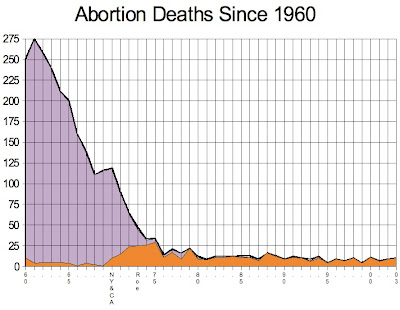
Abortion rights groups will claim that while Louchrisser's death was sad, there would be more abortion deaths like hers were abortion not "safe and legal." But as you can see from the graph below, abortion deaths were falling dramatically before legalization. This steep fall had been in place for decades. To argue that legalization lowered abortion mortality simply isn't supported by the data.

external image Abortion+Deaths+Since+1960.jpg

Saturday, November 03, 2012

1983: Doc Pokes Hole in Woman's Bowel, Prescribes Laxative

Twenty-six-year-old Moris Helen Herron went to Bakersfield, California abortionist William D. Stanley for a tubal ligation in October of 1983. When Stanley examined Helen, he informed her that she was pregnant and asked if she wanted him to perform a safe, legal abortion when he did the tubal ligation.

Helen consented, and on October 23, Stanley operated on her. After Helen went home, she suffered weakness, vomiting, and severe pain. She called Stanley, who instructed her to take a laxative.

Helen developed a high fever, and died on November 3. An autopsy found feces and feculent fluid in Helen's abdominal cavity from a hole in her intestines. Helen's mother, Inez Herron, sued Stanley on behalf of her two surviving children, and Stanley settled out of court for $200,000.

When a local pro-life group wrote to Stanley to chastise him for his treatment of Helen, he wrote back, saying, "Elective abortion refers to termination of a live viable pregnancy upon the request of the mother. I have never performed this service or even offered it." He claimed that he was merely performing a D&C on Helen after a miscarriage.

Thursday, November 01, 2012

Two Safe-n-Legal Deaths from the Early 1990s

On November 1, 1991, 21-year-old Anjelica Duarte underwent an abortion by Dr. Larry Thompson at Women's Place Clinic in Las Vegas, Nevada. According to one of Anjelica's friends, Anjelica had sought an abortion because a doctor had recommended that she delay having another baby for five years due to health problems. Anjelica already had a three-year-old daughter and a one-year-old daughter. After the abortion, Anjelica was kept under observation for several hours, but was not given any care. She was rushed to the hospital by paramedics at 7:30 that evening, but she was dead on arrival. A hospital spokesman said that she had lost 90 percent of her blood; her uterus had been perforated. In reviewing the case, the medical board noted that Thompson did not have adequate equipment for post-operative care, and revoked his license.

Anjelica's was not the only tragic death caused by doctors who recommended (or excused) abortion as a life-saving or health-preserving option for the mother:

  • Allegra Roseberry was pushed into an abortion in order to obtain experimental cancer treatment.
  • Barbara Hoppert died after an abortion recommended due to a congenital heart problem.
  • Christin Gilbert died after an abortion George Tiller holds was justified on grounds of maternal health.
  • Erika Peterson died in 1961 when her doctors obtained her husband's permission to perform a "therapeutic" abortion.
  • "Molly" Roe died in 1975 when her doctors made the dubious decision to perform a saline abortion to improve her chances of surviving a lupus crisis.
"Susan" Roe is one of the women Life Dynamics notes on their "Blackmun Wall" of women killed by legalized abortion. According to Life Dynamics, they obtained confidential information from the CDC and state health officials about this 21-year-old Caucasian woman who died November 1, 1992, after a safe and legal abortion performed in Maine.

Tuesday, October 30, 2012

1923: Chicago Doc Kills Teen Patient

On October 16, 1923, 19-year-old Lydia Nelson died at Chicago's Englewood Hospital from an abortion performed there that day, evidently by Dr. Charles Klinetop. (Note: I was only able to more accurately identify Lydia's date of death today, which means that I missed the actual anniversary. Sorry.)

On January 15, 1924, Klinetop was indicted by a grand jury for felony murder in Lydia's death. Back in 1912, he had been identified by a coroner's jury as the doctor responsible for the abortion death of Minnie Miller.

Lydia's abortion was typical of criminal abortions in that it was performed by a physician.

Keep in mind that things that things we take for granted, like antibiotics and blood banks, were still in the future. For more about abortion in this era, see Abortion in the 1920s.

external image Illegals.png

Sunday, October 28, 2012

1972: Saline Abortion Kills California Teen

Sixteen-year-old Natalie Meyers was brought to San Vicente Hospital in Los Angeles by her mother for a safe and legal abortion on October 21, 1972. Milton Gotlib injected saline into Natalie's uterus on the 21st.
On October 22, Natalie expelled the dead baby but retained the placenta. She had trouble breathing and suffered abdominal pain, so San Vicente staff transferred Natalie to County-USC Medical Center just before midnight.

Natalie was in shock when she arrived at County-USC. She underwent a D&C there, but remained in shock from infection in her uterus. On October 26, a hysterectomy was performed to try to control the infection, to no avail. Natalie was pronounced dead at 9:35AM on October 27.

The autopsy found most of Natalie's internal organs swollen and hemorrhagic. Death was attributed to hyaline membrane disease brought on by the abortion.


Natalie is one of many women to die at one of Edward Allred's facilities. Others known to have died after abortion at Allred's facilities include:


As you can see from the graph below, abortion deaths were falling dramatically before legalization. This steep fall had been in place for decades. To argue that legalization lowered abortion mortality simply isn't supported by the data.

external image Abortion+Deaths+Since+1960.jpg

Friday, October 26, 2012

1929: Doc Indicted for Abortion Death

On October 12, 1929, 33-year-old homemaker Agnes Johnson, a native of Tours, France, underwent a criminal abortion at the Chicago office of Dr. Joseph Stern. On October 26, Agnes died. Stern was arrested that day. On November 1, he was indicted for felony murder by a grand jury.

Agnes's abortion was typical of illegal abortions in that it was performed by a physician.
external image Illegals.png
Keep in mind that things that things we take for granted, like antibiotics and blood banks, were still in the future. For more about abortion in this era, see Abortion in the 1920s.
For more on pre-legalization abortion, see The Bad Old Days of Abortion

Thursday, October 25, 2012

1922: Fatal Handiwork of a Chicago Abortionist/Midwife

On October 25, 1922, 24-year-old homemaker Lillian Hulbert  died at Chicago's St. Anne's Hospital from complications of a criminal abortion performed on her there that day. The coroner identified a Mrs. M.C. Anderson as responsible for Lillian's death. Anderson's profession is given as nurse or midwife.

Wednesday, October 24, 2012

Two Deaths: Illeval vs. Safe and Legal

On October 24, 1917, 24-year-old homemaker Stella Ahern died at her Chicago home from an abortion performed by an unknown perpetrator.

Note, please, that with overall public health issues such as doctors not using proper aseptic techniques, lack of access to blood transfusions and antibiotics, and overall poor health to begin with, there was likely little difference between the performance of a legal abortion and illegal practice, and the aftercare for either type of abortion was probably equally unlikely to do the woman much, if any, good. In fact, due to improvements in addressing these problems, maternal mortality in general (and abortion mortality with it) fell dramatically in the 20th Century, decades before Roe vs. Wade legalized abortion across America.


external image MaternalMortality.gif

Fast forward to June 2 of 1979, when National Abortion Federation member Atlanta Women's Pavillion rose to new levels of incompetence when staff there managed to fatally injure two teenage abortion patients in less than an hour.It all began when 19-year-old Angela Scott stopped breathing in the recovery room. A nurse-anesthetist was administering anesthesia to 14-year-old Delores J. Smith while Dr. Jacob Adams was performing her abortion. The nurse-anesthetist ran to assist in efforts to revive Angela, leaving Delores unattended with her anesthesia drip still running. After staff had resuscitated Angela and loaded her into an ambulance, they returned their attention to Delores, who had gone into cardio-respiratory arrest. Adams had accompanied Angela to the Grady Memorial Hospital, and staff refused to release Deloris to an ambulance until the physician had returned to discharge her. This resulted in a 30-minute delay, during which the ambulance crew was unable to attend to Deloris or begin transporting her.Angela lingered for a week in a coma before dying on June 11. Deloris never regained consciousness and eventually was admitted to a nursing home, where she died of adult respiratory distress syndrome on October 24, 1979, some time after her fifteenth birthday.

Tuesday, October 23, 2012

Planned Parenthood: Pre-Natal Care? Or Something Else?

Check out the Planned Parenthood page about prenatal care:

*What is prenatal care?
*What will happen during my first prenatal care visit?
*How often will I have prenatal care visits?
*What will happen during my follow-up prenatal care visits?
*What is prenatal testing?
*What is an untrasound?
*What is multiple marker screening?
*What is CVS (chorionic villus sampling)?
*What is amniocentesis?

*What changes can I expect during pregnancy?
*How will I know if something is wrong?

I bolded what caught my eye. Notice anything?

To make it more obvious, let's compare that with a web site not associated with an abortion provider:

*What is prenatal care?
*Why do I need prenatal care?
*I am thinking about getting pregnant. How can I take care of myself?
*I'm pregnant. What should I do -- or not do -- to take care of myself and my unborn baby?
*I don't want to get pregnant right now. But should I still take folic acid every day?
*How often should I see my doctor during pregnancy?
*What happens during prenatal visits?
*I am in my late 30s and I want to have a child now. Should I do anything special?
*Where can I go to get free or reduced-cost prenatal care?

On the neutral web site, none of the main points about prenatal care is aimed at finding anything wrong with the baby. On the Planned Parenthood site, five of 11 are geared toward finding something wrong with the baby. Creepy, huh?

A Range of Abortion Deaths, 1913 - 1981

Emma Bickel, a 59-year-old midwife, was charged with second-degree manslaugher in the death of 19-year-old Emily Nohavec of St. Louis. On October 18, 1913, Emily first reported feeling ill. On Monday, October 20, a Dr. Reber was summoned to see her. He diagnosed her with septic peritonitis. The next day, her condition was critical and she was admitted to Rebekah Hospital. There, Dr. Garcia was called in for consultation. Drs. Reber and Garcia pursued an aggressive treatment but despite their efforts, Emily died on October 23.

Also on October 23, 1913, 22-year-old Mary Tureck died in Chicago from an abortion performed by an unknown perpetrator.

On October 23, 1920, 19-year-old Francis Karies died at Chicago's Swedish Covenant Hospital from a criminal abortion that had been performed in Akron, Ohio, by Dr. C. W. Milliken. The coroner recommended Milliken's arrest, but there is no record if any legal action was taken against him for Francis's death. It's not likely that any action was taken, since Milliken was free to perpetrate a fatal abortion on Iva Triplet in Akron the following year.

Keep in mind that things that things we take for granted, like antibiotics and blood banks, were still in the future. For more about abortion in this era, see Abortion in the 1920s.

On October 16, 1936, 26-year-old Katherine DiDonato, mother of two, was admitted to Roosevelt Hospital to be treated for complications of a criminal abortion. Katherine's husband reported that the abortion had taken place three days earlier. Detectives were told that Katherine had bought pills from drug clerk Hyman Kantor, who had then recommended Dr. Aloysius Mulholland to perform an abortion. Katherine died at 2 AM on October 23. Both Mulholland and Kantor were arrested and charged with homicide. Katherine's abortion was typical of pre-Roe abortions in that it was performed by a physician.

During the 1940s, while abortion was still illegal, there was a massive drop in maternal mortality from abortion. The death toll fell from 1,407 in 1940, to 744 in 1945, to 263 in 1950. Most researches attribute this plunge to the development of blood transfusion techniques and the introduction of antibiotics. Learn more here.>

external image MaternalMortality.gif >

Nineteen-year-old Diane Boyd lived in a state institution for the mentally retarded. There, she was beaten and raped in July of 1981, and was later discovered to be pregnant. A safe, legal abortion was arranged for Diane at National Abortion Federation member Reproductive Health Services in St. Louis. Diane's mother signed a consent form. The abortion was performed October 22, 1981. Diane died the on the 24th. >
Abortionist_Robert_Crist_small.jpg

According to suits later filed by Diane's mother, RHS staff and abortionist Robert Crist did not check for possible drug interactions before giving Diane valium and sublimaze. These drugs evidently reacted with Diane's usual medication, thorazine, causing her to stop breathing. Diane's mother said that the clinic lacked heart monitoring equipment or resuscitation equipment.

Diane was not the last woman to die after abortion by Crist. Seventeen-year-old Latatchie Veal bled to death after an abortion by Crist in 1991. Twenty-two-year-old Nichole Williams died of DIC (disseminated intravascular coagulopathy, a clotting disorder) after an abortion by Crist in 1997. Fourteen-year-old Sandra Kaiser committed suicide after a 1984 abortion at RHS, performed without her mother's knowledge or consent.

Monday, October 22, 2012

Doc's Fatal Work in 1914

Dr. F. Waldo Whitney, age 61, was convicted of manslaughter in the October 22, 1914 abortion death of Mrs. Margaret Buetelman. He was sentenced to 2 - 19 1/2 years at Sing Sing.

Note, please, that with general public health issues such as doctors not using proper aseptic techniques, lack of access to blood transfusions and antibiotics, and overall poor health to begin with, there was likely little difference between the performance of a legal abortion and illegal practice, and the aftercare for either type of abortion was probably equally unlikely to do the woman much, if any, good. For more information about early 20th Century abortion mortality, seeAbortion Deaths 1910-1919.
external image Illegals.png

Saturday, October 20, 2012

Abortion Deaths: 1877, 1921, 1971

On October 20, 1877, Nellie Ryan, an unmarried 21-year-old white woman from Turner Junction, Illinois, died in Chicago during a criminal abortion. Amelia Spork, identified as a midwife, was arrested for Nellie's death. Census records and city directories indicate that Mrs. Spork might have been Dr. Emily/Emelie Spork, a Swedish immigrant.

On October 20, 1921, 30-year-old Annie Sczepkowski died at Jefferson Park Hospital in Chicago from complications of an abortion perpetrated by an unknown suspect. Tillie Pawlowski was arrested, but exonerated by the Coroner. Keep in mind that things that things we take for granted, like antibiotics and blood banks, were still in the future. For more about abortion in this era, see Abortion in the 1920s.

During the first two thirds of the 20th Century, while abortion was still illegal, there was a massive drop in maternal mortality, including mortality from abortion. Most researches attribute this plunge to improvements in public health and hygiene, the development of blood transfusion techniques, and the introduction of antibiotics. Learn more here.
external image MaternalMortality.gif

Carole Schaner was 37 years old when she traveled from Ohio to Buffalo, New York, for a safe and legal abortion. Dr. Jesse Ketchum performed a vaginal hysterotomy abortion (like a c-section but with the intention of allowing the baby to die) on October 20, 1971. Carole was 14 weeks pregnant. After the abortion, Carole went into shock, and was taken to a hospital. She was in shock when she arrived. Despite all efforts, Carole died before doctors could even fully assess the extent of her injuries. She left behind four children. The autopsy found that Carole's cervix and uterus had been cut open, and an artery outside her uterus had been cut. It also noted sutures that had evidently been put in by Ketchum in an attempt to repair the damage. The sutures, however, completely closed Carole's cervix, allowing her to continue bleeding from the injured uterus and artery. Carole was the second woman to bleed to death after an outpatient hystertomy abortion performed by Ketchum; Margaret Smith had died four months earlier. Another former criminal abortionist, Milan Vuitch, also had kept his nose clean as a criminal abortionist, then went on to kill two legal abortion patients. Wilma Harris and Georgianna English both died under Vuitch's care. Benjamin Munson, likewise, had a clean record in his criminal abortionist then went on to kill two women in his supposedly safer legal practice -- Linda Padfield and Yvonne Mesteth.

As you can see from the graph below, abortion deaths were falling dramatically before legalization. This steep fall had been in place for decades. To argue that legalization lowered abortion mortality simply isn't supported by the data. And legalization did nothing to help Carole, Margaret, Wilma, Georgianna, Linda, or Yvonne.

external image Abortion+Deaths+Since+1960.jpg

Thursday, October 18, 2012

Four Pre-Legalization Abortion Deaths

In early October of 1883, a widow only identified as  Mrs. O'Connor died from a criminal abortion in Halifax. "Dr. Archibald Lawson, a prominent physician, has fled to avoid arrest."

On October 18, 1920, 30-year-old homemaker Alice Jolly (or Jolli) died at Chicago's Englewood Hospital from a criminal abortion perpetrated by somebody who was never identified. Keep in mind that things that things we take for granted, like antibiotics and blood banks, were still in the future. For more about abortion in this era, see Abortion in the 1920s.

external image Illegals.png

 On October 18, 1939, Miss Alice Corbett, age 28, of Brooklyn, New York, died from complications of an illegal abortion. Dr. Allen F. Murphy was sentenced to 2-10 years in Sing-Sing for Alice's death. Alice's abortion was typical of pre-legalization abortions in that it was performed by a physician.

On October 18, 1942, 23-year-old Harriet Lichtenberg of Brooklyn died in Royal Hospital, the Bronx, from suspected criminal abortion complications. Dr. Henry Katz was indicted for first degree manslaughter in Harriet's death. Harriet's abortion was typical of pre-Roe abortions in that it was performed by a physician.

During the 1940s, while abortion was still illegal, there was a massive drop in maternal mortality from abortion. The death toll fell from 1,407 in 1940, to 744 in 1945, to 263 in 1950. Most researches attribute this plunge to the development of blood transfusion techniques and the introduction of antibiotics. Learn more here.

external image MaternalMortality.gif

Wednesday, October 17, 2012

Doctor's Fatal Work in 1927 Chicago

On October 5, 1927, 31-year-old Auna Arola underwent a criminal abortion in Chicago. She died on October 18. On October 29, Dr. Vincent Tonavena was arrested. He was indicted for felony murder on November 1.

Auna's abortion was typical of illegal abortions in that it was performed by a physician.
external image Illegals.png

Saturday, October 13, 2012

Three Pre-Roe Abortion Deaths: 1936, 1939, 1971

On October 11, 1936, 18-year-old Margie Fraser died in a hospital in her hometown of Helena, Montana from complications of a botched abortion. An inquest was held, with eight witnesses, including four physicians. The inquest determined that Margie had undergone the abortion on October 1 in Butte. A surgical nurse, Gertrude Pitkanen (pictured), was charged with manslaughter on October 15. (I only confirmed the exact date today, and didn't want to wait another year to note Margie's death.)

On October 13, 1939, the body of Barbara Hanson, age 21, was found in a Houston, Texas, motel room. James Carter and George F. Norton pleaded guilty to performing the abortion that killed Barbara, and each received a 5-7 year sentence. Barbara's boyfriend and another man pleaded guilty to accessory charges and were each sentenced to one year.

"Tammy" traveled from Ohio to New York to undergo an abortion under New York's liberal abortion law. Her abortion was performed on September 25, 1971. She was 33 years old. After the abortion, Tammy developed an infection which finally ended her life on October 13, 1971.

Friday, October 12, 2012

Biden's Planned Parenthood Gaffe

At a recent campaign stop in Wisconsin, Vice-President Joe Biden told supporters that Planned Parenthood "under law cannot perform any abortions."


 Really, Mr. Biden? Then how can you explain Planned Parenthood's own "Fact Sheet" noting that they performed over 300,000 abortions in 2010? That's roughly a quarter of the 1.21 million abortions performed annually in the United States.

And how can you then account for the deaths of these women:
  • Edrica Goode This 21-year-old aspiring lawyer went to a Planned Parenthood in Riverside, California, on January 31, 2007, for a second-trimester abortion. Despite clear signs of infection, a nurse practitioner inserted laminaria and sent her home.
  • Diana Lopez This 25-year-old was 19 weeks pregnant when she went to a Planned Parenthood for an abortion on February 28, 2002. Before the day was over, Diana had bled to death.
  • Holly Patterson - This 18-year-old died September 17, 2003, from sepsis caused by a fetus incompletely expelled in a chemical abortion. Holly got the drugs for the fatal abortion at a Planned Parenthood in Hayward, California, on September 10.
  • Tonya Reaves - This 24-year-old (pictured, right) left a one-year-old child motherless when she bled to death after an abortion at a Chicago Planned Parenthood.
  • Vivian Tran -Vivian was 22 years old, and died December 29, 2003, six days into the abortion process. She'd been given abortion drugs on December 23 at the Costa Mesa Planned Parenthood facility.
I'll be charitable and assume that Biden misspoke, and that he meant to say that by law, Planned Parenthood can't bill abortions directly to tax money. But that doesn't change the fact that our tax money is subsidizing the buildings and staff used to perform these abortions. It doesn't change the fact that Planned Parenthood has been caught performing abortions on underage girls at the behest of their sexual abusers. It doesn't change the fact that Planned Parenthood is currently under investigation for massive Medicaid fraud. It doesn't change the fact that Edrica, Diana, Holly, Tonya, Vivian, and Nichole were sadly misled when they trusted Planned Parenthood with their lives. Does Planned Parenthood really deserve to be trusted with our tax dollars?

Thursday, October 11, 2012

Abortion Deaths: 1913, 1926, 1981, and 2000

On October 11, 1913, 28-year-old Frances Odochowski died in Chicago at the scene of an abortion perpetrated that day by Dr. Arthur L. Blunt. Bunt was arrested and held by the Coroner on November 7, and brought before a Grand Jury, but the case never went to trial.

On October 11, 1926, Jeanette Jarrett, a 28-year-old Black woman, died from complications of a criminal abortion performed on her that day. A Black doctor, Roy Shell, was held by the coroner on October 29. On November 1, he was indicted for felony murder. Jeanette's abortion was typical of criminal abortions in that it was performed by a doctor.

Note, please, that with overall public health issues such as doctors not using proper aseptic techniques, lack of access to blood transfusions and antibiotics, and overall poor health to begin with, there was likely little difference between the performance of a legal abortion and illegal practice, and the aftercare for either type of abortion was probably equally unlikely to do the woman much, if any, good. In fact, due to improvements in addressing these problems, maternal mortality in general (and abortion mortality with it) fell dramatically in the 20th Century, decades before Roe vs. Wade legalized abortion across America.

external image MaternalMortality.gif

Sharonda Rowe  had an abortion done in a doctor's office in Washington, DC on October 11, 1981. She suffered lacerations in her vagina and uterus, causing a massive, fatal air embolism.

Detroit Police were called to a private residence on October 11, 2000 to investigate the report of an unresponsive 21-year-old woman shortly after 6 p.m. The young woman was L'Echelle Head. She was transported to Good Samaritan Hospital, where she was pronounced dead at 7:45 p.m. Preliminary reports were that she likely suffered some sort of embolism after an abortion performed at Dayton Women's Health Services.The clinic had been caught operating without a license in 1999. It was inspected on October 27, 1999, to see if a license should be granted. Inspectors found rusty instruments, improperly-marked medications, and a failure to follow sterile technique. The clinic administrators were told they'd have to correct the problems to get a license. The clinic got the license after getting a waiver regarding follow-up care for patients. L'Echelle's obituary indicates that she left behind a daughter, her parents, and three sisters.

Tuesday, October 09, 2012

1916: Chicago Doctor's Fatal Handiwork

Earnest Projahn answered the questions put to him by the deputy coroner during the inquest into the death of his 33-year-old wife, Emily Projahn. The Projahns had four living children; two others had died.

In August and September of 1916 Emily's period did not come. She told her husband of the pregnancy and her plans to get an abortion. since she didn't think they could afford another child on her husband's salary as a firefighter. Ernest testified that he opposed the abortion and "spoke against it all the time." Though he may have made this statement in the hopes of avoiding further legal trouble for his role in the abortion, his remark, "That's the way the wife figured it," suggests that he followed her lead in this matter, however reluctantly. Mr. Projahn eventually came around to his wife's way of thinking and performed the male role of locating the abortionist and accompanying her to the doctor's office on a Friday night in September of 1916.

Emily visited a doctor whom her husband had seen previously, Dr. Clarence W. Mercereau at 4954 Milwaukee Avenue. Dr. Mercereau agreed to do the operation and told them the fee would be $10 and $2 for calling on her afterwards. They paid half the fee that night. Mr. Projahn later explained that the doctor "asked me to be quiet and not say anything more about it. I said I would." The doctor then shut the door and prepared to perform the operation. He had his patient lie in a surgical chair and used an instrument. Mrs. Projahn called the instrument a "womb opener." Her husband described it as "nickel-plated, silver-like" and "ten or twelve inches long." The doctor told her to "stay on her feet until she got sick enough to go to bed."

When they got home that evening, Emily was bleeding. A week later she called Dr. Mercereau, who came to their home and prescribed medicine. He visited her at home twice. After three weeks of chills and fever, she called in a second doctor, who hospitalized her. While at the hospital she told an intern,"My husband and my self came to the conclusion that we had enough children and wanted something done so we would not have to support another."

Emily finally died on October 9.

Though Mercerau was held by the coroner and indicted, the case was stricken off on December 16.


Note, please, that with overall public health issues such as doctors not using proper aseptic techniques, lack of access to blood transfusions and antibiotics, and overall poor health to begin with, there was likely little difference between the performance of a legal abortion and illegal practice, and the aftercare for either type of abortion was probably equally unlikely to do the woman much, if any, good.

In fact, due to improvements in addressing these problems, maternal mortality in general (and abortion mortality with it) fell dramatically in the 20th Century, decades before Roe vs. Wade legalized abortion across America.

For more information about early 20th Century abortion mortality, see Abortion Deaths 1910-1919.

external image MaternalMortality.gif

Saturday, October 06, 2012

1904 & 1937: Illegal Abortion Deaths

On October 6, 1904, Mrs. Mary Lawson died at Passavant Hospital in Chicago, from complications of a criminal abortion. Dr. Alois Rassmussen was sentenced to fifteen years at Joliet for the murder, but was able to get a new trial. In this second trial, he was acquitted.

Eleanor Haynes, age 22, died at Hackensack Hospital in New Jersey on October 6, 1937, after indicating that Dr. P. Ralph McFeely had performed an abortion on her. Eleanor's fiancee claimed no knowledge of an abortion. McFeely, a school and police physician who was also president of the local PTA, said that although he was treating Eleanor for a "minor ailment," he had not performed an abortion. McFeely was not indicted due to lack of evidence. 

During the 1940s, while abortion was still illegal, there was a massive drop in maternal mortality from abortion. The death toll fell from 1,407 in 1940, to 744 in 1945, to 263 in 1950. Most researches attribute this plunge to the development of blood transfusion techniques and the introduction of antibiotics. Learn more here.

external image MaternalMortality.gif


For more on pre-legalization abortion, see The Bad Old Days of Abortion

Thursday, October 04, 2012

The Twat Patrol (profanity alert)

You just can't make this shit up. Abortion-rights activist K. Travis Ballie tweeted this afternoon: “.@NARAL & @NARALColorado as well as a delightful pro-choice vagina, are en route to the debates!”

First let me get my pet peeve out of the way: All the "vagina" clad women indulging in this latest meme are not dressed as vaginas; they're dressed as vulvas. You'd think that they'd at least be able to accurately name the piece of their anatomy they identify with so profoundly.

That said, I wonder who came up with the idea that dressing up like gigantic genitalia would get people to take them seriously.

Let's look at some of the most illustrative examples of the meme:
If you can't identify it, don't dress like it. Or try to dress like it. Not only are they dressed as vulvas, not as vaginas, their costumes look more like giant loops of infected intestine. And what do they mean, anyway, "Don't legislate it?" How would one legislate a vagina (or vulva, depending on whether they're concerned with what they're saying they are or what they're dressed as)?


They've evidently diagnosed Rodney Dangerfield's problem: He didn't go around dressed up in cartoonish genitalia costumes! If only he had, he'd have gotten some respect!
And can't you just see the energy-saving corkscrew-shaped lightbulbs going off over congressional heads as they realize the error of having assumed that female constituents think with their brains, not their crotches? Silly congresscritters!


When you dress up as female genitalia while carrying a huge sign mislabeling the anatomy in question, your message becomes not merely, "I'm a cunt," but "I'm a dumb cunt."


Here's somebody who gets the joke:

Wednesday, October 03, 2012

October 3, 1977: The Death of Rosie Jimenez

In 1976, the Hyde Amendment went into effect, banning the use of Federal funds to pay for abortions except to save the mother from an immediate threat to her life. The measure was named for its author, Congressman Henry Hyde. Abortion advocates had been keening from the moment the Hyde Amendment was up for vote. They painted a ghastly picture of coathanger-impaled women littering the streets as poor women were driven to desperation by lack of "access",

When the Hyde Amendment went into effect, abortion advocates ramped up the hysteria and waited for a death, any death, they could hang around Henry Hyde's neck.On October 3, 1977, the abortion advocacy vultures got what they'd been waiting for: a dead woman they could use as leverage in the fight to once again force taxpayers to fund elective abortions.

On September 26, 1977, 27-year-old Rosie Jiminez had shown up at the emergency room of McAllen General Hospital in the Texas border town of McAllen, with septic shock. She was put in intensive care, but died on October 3 from renal and cardiac failure caused by disseminated intravascular coagulopathy (failure of the blood to clot properly) triggered by gas gangrene from a criminal abortion. She left behind one child.

The initial response of the abortion lobby to news of Rosie's death was little short of euphoric. They had their trophy, their dead woman whose story they could leverage, they hoped, into the restoration of tax money flowing into abortion clinics.

A Voice in the Wilderness

One voice stood out from the crowd: Ellen Frankfort, author of Rosie: the investigation of a wrongful death. Frankfort was disgusted with the bulk of the prochoice movement, who seemed content to make note of the death and then milk it for political gain. She began an investigation into what had led Rosie to her death, and she found a lot that neither the Centers for Disease Control nor abortion advocacy organizations had been willing to look for, since all they'd wanted was political leverage. They weren't looking for the real culprit behind Rosie's death: they'd had a bogeyman in mind even before she'd died, in the form of Henry Hyde.

Off to McAllen Frankfort went, to learn all she could.

The Whole Story

Rosie had already undergone two abortions at taxpayer expense, one performed by her private ob/gyn, the second at a facility Rosie had been referred to by a local Planned Parenthood. In September of 1977, she suspected that she was again pregnant, and consulted with a cousin and a friend, who told her that Medicaid would no longer pay for elective abortions.

Rosie had also gone to her family physician, Dr. Homer, in McAllen for treatment of pain in her sternum. She mentioned that she might be pregnant. He did not arrange for a pregnancy test or discuss her options with her in any way, but simply informed her that Medicaid would no longer pay for abortions, and let it rest at that. A referral seemed to have been in order, either to a prolife center that would help her with the expenses of continuing the pregnancy, or to the local Planned Parenthood, that could arrange an abortion on a sliding scale and could possibly help her tap into private funds for elective abortions. Dr. Homer effectively abandoned his patient.


The week of September 19, Rosie went to Mexico for some sort of injection to cause an abortion. She had the shots at a pharmacy, at $5 each. On September 25, she consulted with her cousin, saying that she wanted to find a cheap abortionist quickly. Rosie's cousin brought her to a lay midwife in McAllen, who charged $120 to insert a catheter into Rosie's uterus. Fifteen minutes later, she sent Rosie home.

Rosie had pain and cramping upon returning home. Over the next 12 hours, she developed an increasing fever, and had nausea, vomiting, chills, dizziness, and increasing vaginal bleeding. The next afternoon, Rosie was unable to get out of bed. She asked a friend to take her to the hospital where in spite of heroic efforts, doctors were unable to save her life.

The Reaction

The doctors reported the death to the CDC, the CDC notified their allies in the abortion lobby, and Rosie's death was quickly trumpeted nationwide as proof that Henry Hyde was a murderer and taxpayers should immediately resume funding elective abortions to prevent another such death.

What is particularly telling in Rosie's death is that prochoice groups had been very successful in spreading the word that public funding for abortion had been cut -- Rosie's friend and cousin, as well as her physician, were well aware of this fact -- but they had pointedly failed to also pass out the word that Planned Parenthood still referred for abortions on a sliding scale, and that private funds were available. It's almost as if the public-relations departments of Planned Parenthood and other abortion-advocacy groups had deliberately increased the odds of a tragedy like Rosie's death in order to provide the corpses needed in order to prop up a drive to restore tax monies to abortion facilities.

Frankfort was particularly disgusted with the response of public health officials, who likewise simply announced Rosie's death and began a call to restore abortion funding, but made no effort to close down the illegal abortion practice where Rosie had undergone her fatal abortion.

Frankfort took it upon herself to orchestrate a sting, with local law enforcement. She coordinated a dramatic raid that put the lay abortionist out of business.

"The FIRST!" Of how many?

And what of the hysteria? Had it been justified? Was Rosie's death the first of a new trend of women dead from being "forced" to resort to criminal abortionists?

There was indeed a small spike in reported illegal abortion deaths after the Hyde Amendment (from 2 in 1976 to 4 in 1977 to 7 in 1978). But there was likewise a spike in reported legal abortion deaths as well -- a far larger spike, from 11 in 1976 to 17 in 1977. (I don't believe that the CDC's reported death numbers are accurate, but they're all we have to work with, and more to the point, abortion supporters place great faith in them.)


Lest abortion rights activists attribute this jump to women having later abortions because they need time to get funds, we'll note that the trend toward earlier abortions continued unabated, as this chart based on one by the Alan Guttmacher Institute shows:


Despite predictions of a surge in carnage from criminal abortions, a study by the Centers for Disease Control, "The Effect of Restricting Public Funds for Legal Abortion," found "no evidence of a statistically significant increase in the number of complications from illegal abortions." In fact, they found that while there was no change in the illegal abortion complications, there was a significant decrease in publicly funded hospitalizations for legal abortion complications in cities where funding was restricted, compared to cities in areas where state or local government picked up the tab for elective abortions.

In other words, cutting funds for elective abortions actually had a measurable positive impact: Fewer women were ending up hospitalized for complications of elective abortions. Which strikes me as a good thing, personally.

The Verdict

So was Rosie's death a fluke? Probably not. The heavy publicity put out by the prochoice movement about how poor women would be "forced" to resort to dangerous criminal abortions probably left Rosie, and some others like her, with the mistaken impression that criminal abortion (rather than birth or even sliding-scale legal abortion) was their only option.

I agree with abortion advocates that the death of Rosie Jiminez was avoidable. But I disagree with them that lack of public funding was to blame. Prochoice organizations had ample opportunity to tout other resources. Prochoice people all around Rosie had opportunities to steer her toward a "safe and legal" abortion, had they chosen to do so. Not a one of them did. And the bigger problem was that nobody ever seemed to entertain the notion that abortion might not be the answer in the first place.

What's additionally puzzling about this whole turn of events is that the facility to which Planned Parenthood referred abortion patients charged only $130 for an abortion for poor women, just $10 more than Rosie paid for the amateur abortion that took her life. It's difficult to believe that a $10 price difference put the legal abortion out of Rosies's reach, especially if we consider that the day before her abortion she'd spent $8 on a cake for a friend's baby shower, and when she died she had a $800 scholarship check in her purse.

Rosie Jimenez remains a poster child of the abortion lobby. Their own role in her death is never acknowledged. Henry Hyde is blamed instead -- in spite of his key role in passing a law that reduced abortion injuries among women like Rosie, and in reducing complications, surely also reduced abortion deaths -- in spite of the abortion lobby's best efforts.

For more abortion deaths, visit the Cemetery of Choice.

PP's "Ask Mitt"

The Planned Parenthood Action Fund has an "Ask Mitt" page purportedly allowing visitors to vote on which question they think Mitt Romney should be forced to answer at the debate. The real reason for the page, of course, is to put forth some assumptions that they hope visitors to the page will assume as facts.

Let's address them, shall we?

Question #1: If you "get rid of" Planned Parenthood, what's the plan for the 3 million people who receive health care there?

This question is actually trying to get the reader to absorb two assumptions as truths:

1. That 3 million people (presumably annually) get health care at Planned Parenthood.
2. That if you take away Planned Parenthood, 3 million people (presumably annually) will be left with no place to get their health care.

Question #2: Why end Title X family planning for 5 million people when every $1 invested saves $3.74 for taxpayers?

The question is trying to get the reader to absorb three assumptions as truths:

1. That Title X funding is the only "family planning" option for 5 million people.
2. That paying for "family planning" is a significant cost-cutting measure for taxpayers.
3. That electing Romney would end Title X funding.

Question #3: If you repeal Obamacare, what happens to the 45 million women who would lose preventive care w/ no co-pays?

Not the clever "w/no co-pays" inserted at the end. What they want the reader to see and absorb as truth is that 45 million women would lose access to preventive care. It would be far less alarming to phrase this as "What happens to the 45 million women who would have to make co-pays on their preventive care?" People who are already making co-pays for their preventive care would say, "Suck it! If I have to make a $15 co pay, you can manage, too!"

There is also the assumption -- meant to be absorbed as truth -- that Obamacare is providing preventive care to 45 million women (presumably annually).

And that doesn't even broach the topic of what Planned Parenthood is qualifying as "preventive care." Do they mean tetanus shots and colonoscopies or do they mean a handful of condoms in anticipation of a hot date?

Question #4: When are you going to address the fact that family planning is an economic issue?

This question wants the reader to absorb two assumptions as truths:

1. That Mitt Romney opposes allowing access to "family planning." (Not wanting to pay for something is not the same as forbidding access unless the a parent is refusing to buy something for a child too young to earn money babysitting.)
2. That "family planning" promotes a strong economy.
Question #5: Is birth control the ONLY health service bosses should be able to deny their employees?
  The assumptions that this question wants the reader to absorb as truths are so absurd that merely pointing them out exposes them as nonsensical:

1. That Mitt Romney would allow employers to somehow keep their employees from getting health care services. (How? Would employees be kept locked in cages so that they couldn't go to doctors, even on their off time?)
2. That specifically Romney would allow employers to somehow keep their employees from getting birth control. (Okay, the employers aren't keeping the workers in cages 24/7, but how are they going to stand between an employee and the condom rack at Rite Aid?

Both of these assumptions, of course, are based on the underlying assumption that refusal to pay for something equals denial of the desired good or service. Of course, this is absurd on its face. You don't gas up your neighbor's car, but that's not denying him access to gasoline.

Your mission, as my readers, is to give me some links that show that the assumptions aren't merely assumptions but are outright falsehoods.

Tuesday, October 02, 2012

I Learn of Two More RU-486 Deaths

Some time in 2008, 29-year-old "Carmen" Roe began a regimen for an RU-486 abortion. She was a Hispanic woman with diabetes. She was given 200 mg of mifepristone orally and 800 units of misoprostol vaginally at 5 weeks of gestation. Despite the documented infection risk, she was not provided with antibiotics. Four days after starting the abortion, Carmen experienced severe cramping, vomiting, and diarrhea. The next day she was admitted to a hospital; her heart was racing and she had abnormal blood test results indicating infection. Exploratory surgery was performed, showing a massive amount of greenish-brown fluid in her abdomen. Parts of her uterus and surrounding tissue were dead and rotting, so a complete hysterectomy was performed. However, in spite of the surgery her blood pressure dropped. She died on the sixth day after the start of the abortion, of massive infection and respiratory distress syndrome.

"Belle" Roe, a 21-year-old white woman, had been in good health when she went to an abortion facility in 2009. She was 7 weeks pregnant and had chosen a chemical abortion. She was given 200 mg of oral mifepristone and 800 μg of vaginal misoprostol. In spite of the known risk of fatal infection, she was not given antibiotics. Six days after beginning the abortion, Belle suffered extreme cramping, diarrhea, and vomiting. The next day she was brought to the hospital with a rapid pulse, low blood pressure, fluid on the lungs, and signs of massive infection. A dilation and evacuation procedure was performed to remove infected tissue from her uterus, and excessive fluids were repeatedly drained. Nevertheless, 12 days after the abortion was initiated, Belle died of severe infection, kidney failure, and a disseminated intravascular coagulopahty (a serious clotting disorder).

Other chemical abortion deaths in the U.S. include Holly Patterson, Wanda Roe Vivian Tran, Cherish Roe, Tara Roe, Chanelle Bryant, Oriane Shevin, and Brenda Vise .

HT: Life News

Monday, October 01, 2012

Five Deaths Over a Century

On October 1, 1908, 21-year-old Mary Rahn died in Chicago from complications of an abortion performed that day. Mrs. Frida Trappe was arrested and held by the coroner's jury on October 14. The case went to trial, but Trappe was acquitted on July 12 0f 1909. Trappe's employment status is recorded as "Outside labor force (incl. criminals)", which may be an indication that she was a professional lay abortionist.

On October 1, 1914, eighteen-year-old Lillie Giovenco died at Wesley Hospital in Chicago from complications of a criminal abortion. Dr. Eva Shaver, Dr. Leopold Pijan, and Dr. John Fernow were held by the coroner in Lillie's death. Lillie's abortion was typical of pre-legalization abortions in that it was performed by a physician. The involvement of Leopold Pijan raises an interesting question to me. A man identified as a "scrub nurse" named Leobaldo Pejuan was sentenced in the 1955 abortion death of Jacqueline Smith in New York. I wonder if they are perhaps the same man. Eva Shaver was prosecuted for the 1915 abortion death of Anna Johnson, which Shaver had tried to disguise as a suicide by shooting the dead woman in the head as she lay on the floor of Shaver's home.

On October 1, 1922, 21-year-old Margaret Sullivan, nee McCarthy, died in her Chicago home from complications of an abortion performed that day. The person or persons responsible were never caught.

Brenda Banks was 35 years old and 13 weeks pregnant when she went to Hillcrest Women's Surgi-Center in Washington, DC, for a safe, legal abortion performed by Llewelyn Crooks on September 30, 1989. Brenda went into shock, and was transported to the hospital by ambulance. Doctors performed an emergency hysterectomy and transfused Brenda with 20 units of red blood cells, to no avail. She died the following day, October 1, 1989. Brenda's uterus had been perforated and several major blood vessels had been cut or severed entirely. On a side note, I have been unable to determine if the Hillcrest where Brenda had her abortion is affiliated with the Hillcrest in Pennsylvania where Kelly Morse had her fatal abortion.

Stacy L. Zallie underwent a safe, legal abortion at the age of 19, in 1999. She didn't tell her family about the abortion, but did mention that she was troubled. She sought psychiatric care, but still kept the abortion a secret. In October of 2000, about a year after her abortion and mere days before she was to serve as a bridesmaid in her brother's wedding, Stacy took her own life. After learning of the abortion and Stacy's unbearable anguish afterward, her parents started the Stacy Zallie Foundation to provide post-abortion care so that nobody else's daughter suffers the fate their daughter did.
The Zallie family takes no stand on abortion, seeking to keep their focus on providing desperately-needed aftercare to suffering women, regardless of politics, creed, or religion.