Sunday, January 13, 2013

Deaths From Both Eras

Minnie Wittenborn died Thursday evening, January 13, 1880 from an abortion perpetrated by an unidentified person. Though Dr. Charles H. McCallister was known to have tended to Minnie after the abortion, he was chastised only for his failure to properly treat Marie by failing to remove the placenta that she had retained.

On January 13, 1911, 27-year-old homemaker Rauka Wilen died at Chicago's Augusta Hospital of peritonitis caused by an abortion. Midwife Mary Rominel was arrested and indicted by a grand jury.

On January 13, 1915, 23-year-old Mrs. Beulah Rehm died at Wesley Hospital after an abortion perpetrated that day at Dr. A.L. Blunt's Chicago practice. Blunt was held by the Coroner but the case never went to trial.

During the first two thirds of the 20th Century, while abortion was still illegal, there was a massive drop in maternal mortality, including mortality from abortion. Most researches attribute this plunge to improvements in public health and hygiene, the development of blood transfusion techniques, and the introduction of antibiotics. Learn more here.

external image MaternalMortality.gif


Jumping ahead to the era of safe, legal abortions:

Christin Gilbert, a 19-year-old woman with Down syndrome, was brought from Texas to George Tiller's Wichita abortion facility for a presumably safe and legal late abortion on January 10, 2005. Like all Tiller late abortion patients, ostensibly so sick that their pregnancies endanger their lives or health, Christin spent the bulk of her time during the abortion process at a motel, in the care of her family, between visits to the facility. On January 12, Tiller's staff diagnosed Christin as being "dehydrated". She was given IV fluids then sent back to the motel. She had numerous episodes of vomiting, and lost consciousness several times. Rather than call an ambulance or take her to the hospital, Christin's family waited until morning and took her to Tiller's clinic. There she went into cardiac arrest. Tiller employee Marguerite Reed called 911, but was vague and "evasive," and claiming falsely that Christin was alert. When the ambulance crew arrived, Dr. LeRoy Carhart was performing CPR on a clinically dead patient, in such an incompetent manner that the EMS workers thought he was a bystander, not a physician.Ambulance staff resuscitated Christin, then transported her to the hospital. She was pumped full of antibiotics to try to treat the underlying sepsis that evidently had caused the cardiac arrest, but to no avail. She died that day of systemic organ failure.Tiller's facility was a member of the National Abortion Federation.

Saturday, January 12, 2013

Women Die When Vigilance Fails

On January 12, 1900, Mrs. Ida Henry, age 26, died at the home she shared with Dr. Paulina Bechtel, from complications of an abortion Bechtel had performed on her there that day. Bechtel was held by the Coroner's Jury. Ida's abortion was typical of pre-legal abortions in that it was performed by a physician. Bechtel was also implicated in the death of Barbara Shelgren shortly thereafter, but was identified as a midwife in that case. According to Leslie Reagan, author of When Abortion Was a Crime, it was common for female physicians to be misidentified as midwives, particularly if they practiced obstetrics. Bechtel went on to kill Mary Thorning in 1911. Sadly, merely having laws on the books intended to lock up quack abortionists is not of itself enough to protect women. We will need to remain vigilant if abortion laws are ever restored.

For for those who think that legalization was the answer, read on.

Former criminal abortionist Milan Vuitch had been operating his clinic without a license for two years when 32-year-old Jeannie English came to him for a safe and legal abortion on January 12, 1980. Vuitch administered general anesthesia for Jeannie, and she never woke up. She was transported to a nearby hospital where she died. Vuitch settled with Jeannie's family for $150,000. When Vuitch was investigated, it was discovered that he kept patients overnight in his home (an unlicensed facility) which he designated "The Annexe." Inspectors also noted repeated violations of medical standards regarding sanitation and anesthesia. Vuitch also admitted during another case that he had lacked hospital admitting privileges since 1963.
Vuitch was also responsible for the 1974 abortion death of 17-year-old Wilma Harris. Vuitch is one of three abortionists I know of who started out as criminal abortionists with clean records -- no patient deaths attributed to them -- who went on to kill two patient by performing the supposedly safer legal abortions. They are Jesse Ketchum (Margaret Smith and Carole Schaner) and Benjamin Munson (Linda Padfield and Yvonne Mesteth).

Shirley Williams was 30 years old when she underwent a safe and legal abortion in January of 1980.She suffered from infection and bleeding after her abortion. On January 12, 1980, she was pronounced dead, from hemorrhage.

Friday, January 11, 2013

Another Seedy NAF Member: Delta Clinic of Baton Rouge

Operation Rescue is covering the latest brouhaha over Delta Clinic of Baton Rouge, Louisiana.

CP For Life gives us a chronology of Delta's doings. I'll tweak it a bit below. Note everything that transpired before Delta appears as a member on the web site of the National Abortion Federation -- supposedly the providers of the highest-quality, safest abortions anywhere in the world.

1981-1990
Numerous lawsuits and injuries to women at the clinic including two deaths linked to abortions at the clinic.

A chronic asthma patient, 27-year-old Sheila Hebert, complained of chest pains and difficulty breathing. She lost consciousness, and staff injected her with adrenaline, but were unable to revive her. She was taken to a nearby hospital where she died..... The suit charged Glidden and Delta staff with failure to monitor the patient in recovery, failing to react properly when her condition was discovered, failing to call 911 promptly, and failing to have adequate emergency equipment available. (East Baton Rouge Parish District Court Case No. 289518)

Ingar Weber died January 26, 1990, in a Louisiana hospital. She had been treated for acute kidney failure after an abortion performed at Delta Women's Clinic in Baton Rouge on January 20, 1990.

1990-1994
Lawsuit by the federal government with Writ of Levy and Writ of Execution for dispensing narcotics illegally.

1994
M.F. suffers incomplete abortion that resulted in hemorrhaging, infection, and a hysterectomy.

K.R. suffered hemorrhaging. It was found out that the remaining portions of the fetus were still inside her, which resulted in infection, surgery, and possible infertility.

1997-1999
Affidavits of Delta employees revealed unbelievable negligence and injury to women who had abortions at the Delta Clinic. Even more startling is the fact that Delta made up the number of abortions performed and never reported any of the injuries that occurred at the clinic. They even admitted that the forms to be submitted to the DHH (Report of Induced Termination of Pregnancy) were pre-printed, with pre-printed question responses checked off and completed prior to seeing any patients.

1998
D.D. suffered perforated uterus, resulting in hemorrhaging, which sent her to the emergency room. She ultimately went into septic shock and an emergency hysterectomy was performed which resulted in her needing a colostomy and long term health care.

1999
Allison Tunnard Witness Affidavit:

"During the term of my employment I was often ordered to help hold down 'second timer' patients in the surgery rooms. .... Recently, there was a rather disturbing event that took place with one of these patients.... I was in the room helping to hold her down when Dr. Whitmore said, `The big mama always does it.' He ... apparently punctured her uterus. .... Whitmore refused to let anyone call 911 because he was afraid the media might find out about it. It was not until four hours later that he allowed one of the workers to call Acadian Ambulance....

The `A B' forms that are required by the Department of Health and Hospitals are never correctly done. Filling them out was my job - and neither Dr. Whitmore or Dr. O'Neill ever fill them out themselves. In fact, the doctors just pre-signed a large stack of the forms at a time, and left them blank for me to fill out on my own time. I filled out each form exactly the same, and never reported complications or difficulties."

1999
L.D. hemorrhaged profusely from a uterine perforation, by 5:45 pm her blood pressure dropped pressure dropped to dangerously low levels. She was noted under ultrasound to having a severe uterine perforation and was bleeding profusely, yet Dr. James Whitmore III did not want to call an ambulance.... A worker finally called the ambulance as her blood pressure was bottoming out. She was transported to the hospital and underwent a total abdominal hysterectomy with transfusion of eight units of packed red blood cells and two units of fresh frozen plasma.

2000
L.P underwent emergency salpingectomy for removal of the left fallopian tube from a large ectopic pregnancy that was not diagnosed when she had a D&C at the Delta Women's Clinic.

2003
L.M.: After repeated attempts and suffering excruciating pain she was sent home. She went to Our Lady of Lourdes Hospital for pain medication. While at the hospital she passed a foot and a leg through her cervical canal. The ultrasound by the ER physician revealed a macerated fetus in her uterus. She had to undergo another D&C to remove the dismembered baby.

2008
Delta first appears on the NAF web site as a member. This screen capture from the Internet Archive shows Delta's membership listed on October 23.


2009
C.K. obtained an abortion at the Delta Clinic. Due to the improper administration of Phenergan, she was forced to undergo the complete amputation of the first two digits of her right hand.

2009-2011
DHH findings: Proceedings against Delta Clinic of Baton Rouge, Inc., State ID: BO0004642; Complaint No. 9AB28180. 128-page report. (I'll briefly summarize the summary.)

Failure to report statutory rape. Failure to provide pre-abortion counseling. Failure to maintain confidentiality of patient records. Completion of patient care records prior to providing the actual care. Failure to properly sterilize and decontaminate equipment. Use of single-dose IVs on multiple patients. Failure to label, measure, and monitor narcotics. Failure to document administration of narcotics to patients.Failure to screen patients for risk factors. Falsification of legal documents.

Note that while all this was going on, Delta was still a member of the National Abortion Federation. This screen capture from the Internet Archive shows Delta listed on June 13:

2011
NAF suspends Delta's membership and stops referring patients there.

One has to wonder why, considering all the disgusting stuff going on before Delta even joined.

Thursday, January 10, 2013

A Midwife's Fatal Work and Two Mystery Abortions

On January 10, 1907, homemaker Ellen White, a 36-year-old Irish immigrant, died of shock and hemorrhage in her Chicago home from an abortion perpetrated about a week before Christmas. A midwife named Emma Watchek was arrested in the death.

On January 10, 1913, 31-year-old homemaker Lizzie Orenstein died at Michael Reese Hospital in Chicago from septicemia caused by an abortion perpetrated by a person who was never identified.

Four years later, on January 10, 1917, 23-year-old clerk Tillie Vrzal died at Chicago's Frances Willard Hospital from peritonitis because of an abortion performed by an unknown perpetrator.

Note, please, that with overall public health issues such as doctors not using proper aseptic techniques, lack of access to blood transfusions and antibiotics, and overall poor health to begin with, there was likely little difference between the performance of a legal abortion and illegal practice, and the aftercare for either type of abortion was probably equally unlikely to do the woman much, if any, good. In fact, due to improvements in addressing these problems, maternal mortality in general (and abortion mortality with it) fell dramatically in the 20th Century, decades before Roe vs. Wade legalized abortion across America.

external image MaternalMortality.gif

Wednesday, January 09, 2013

1918 and the 1980s

On January 9, 1918, 39-year-old Mary Cusack, a widowed homemaker, died at Chicago's West Side Hospital from septicemia caused by an abortion perpetrated that day by Dr. William A. McFarlane. He was indicted on January 15, 1918, but the case never went to trial. Mary was an immigrant from Ireland.

Note, please, that with overall public health issues such as doctors not using proper aseptic techniques, lack of access to blood transfusions and antibiotics, and overall poor health to begin with, there was likely little difference between the performance of a legal abortion and illegal practice, and the aftercare for either type of abortion was probably equally unlikely to do the woman much, if any, good. In fact, due to improvements in addressing these problems, maternal mortality in general (and abortion mortality with it) fell dramatically in the 20th Century, decades before Roe vs. Wade legalized abortion across America.

For more information about early 20th Century abortion mortality, see Abortion Deaths 1910-1919.

external image MaternalMortality.gif

Moving ahead to the era of safe, legal abortions.

Sharon Davis was a 17-year-old high school student, 14 weeks pregnant, when she submitted to an abortion at a hospital in Tucumcari, New Mexico on September 20, 1982. Her uterus and bowel were perforated, and she developed an infection. For over three months, she was treated for her infection before she died on January 9, 1983.

Twenty-five-year-old Rita Goncalves took ill after her safe and legal abortion in late 1983. At some point after her abortion, she was taken to Roger Williams General Hospital in Pawtucket, Rhode Island. There, she died on January 9, 1984, from abortion complications.

Unknown and High-End, Before and After Legalization

On January 8, 1918, 20-year-old homemaker Margaret Balch died in a Chicago home from hemorrhage caused by an abortion perpetrated by a person who was never identified.

Note, please, that with overall public health issues such as doctors not using proper aseptic techniques, lack of access to blood transfusions and antibiotics, and overall poor health to begin with, there was likely little difference between the performance of a legal abortion and illegal practice, and the aftercare for either type of abortion was probably equally unlikely to do the woman much, if any, good. In fact, due to improvements in addressing these problems, maternal mortality in general (and abortion mortality with it) fell dramatically in the 20th Century, decades before Roe vs. Wade legalized abortion across America.

For more information about early 20th Century abortion mortality, see Abortion Deaths 1910-1919.

external image MaternalMortality.gif

Fast forward to the enlightened age of safe, legal abortion.

Tamiia Russell, age 15, died January 8, 2004 after a second trimester abortion at Woman Care Clinic in Lanthrup Village, near Detroit. Taisha Glenn, the sister of Tamiia's 24-year-old "boyfriend", Stacy Glenn, arranged the abortion without notifiying Tamiia's family. Stacy Glenn, according to Frances Russell, Tamiia's mother, is a reputed drug dealer who has not been located since Tamiia's death. He paid the $2000 for the abortion. Taisha, took the girl to five different Detroit area abortion facilities, and was turned away from all five because of how far advanced Tamiia's pregnancy was. One facility reportedly even offered prenatal care and vitamins. Finally Taisha found an abortionist willing to proceed -- WomanCare, a Winthorop Village abortion facility run by abortionist Abraham Alberto Hodari. Despite the fact that the pregnancy was the result of statutory rape, and despite the fact that he had no permission from Tamiia's parents or guardian, as required by Michigan law, the clinic agreed to take the case. Tamiia used an identification card with another woman's picture to claim that she was 19, but according to Tamiia's cousin, the woman in the picture ID looked nothing like Tamiia. Tamiia's presumably safe and legal abortion was begun on January 7, when laminaria was inserted. Laminaria are sticks of seaweed used to dilate the cervix. Staff then sent Tamiia home. Once home, Tamiia confessed to her aunt and mother that she was pregnant and she had begun the abortion. Tamiia's mother said that she called the clinic, and staff told her that the abortion once be carried out once the laminaria are inserted. This is not true; laminaria can be removed and the pregnancy continued, with medical supervision. Based on the false claim that Tamiia had no choice but to go through with the abortion, her mother drove her to WomanCare on January 8 for the actual abortion procedure. Tamiia bled heavily after coming home froom the abortion -- so heavily that the blood soaked a mattress. Tamiia's mother called WomanCare, where staff told her that such bleeding was normal and instructed them not to bring Tamiia to a hospital. Her family ignored this advice and called an ambulance, which rushed the girl to Sinai-Grace Hospital, where she was dead on arrival.

Hodari was also implicated in the safe, legal abortion deaths of Chivon Williams and Regina Johnson.

At the time of Tamiia's death, Womancare was a member of the National Abortion Federation., an organization that promises that all of its members adhere to the highest standards of care.

Sunday, January 06, 2013

Two Historic Chicago Deaths

On January 6, 1905, a young woman was found dead in a ditch near Dunning, Illinois. The body was taken to an undertaking establishment, where it remained until nearly a month later, when the dead woman was identified by her siblings as 28-year-old Ida Vierow. It was determined that she had died January 6, 1905, from an abortion performed in Chicago. Two midwives, Amella Maichrowicz and Anna Becker, were arrested, along with Maichrowicz's husband, Joseph. The Maichrowiczs, who ran an unlicensed hospital in Melrose Park, were arrested near the end of February.


On January 6, 1924, 26-year-old Helen Koss died at Norwegian American Hospital of complications from an abortion perpetrated in Chicago on December 30, 1923, by midwife Emma Morch, who was arrested, and indicted for homicide by a grand jury.

Keep in mind that things that things we take for granted, like antibiotics and blood banks, were still in the future.
 external image Illegals.png

Saturday, January 05, 2013

On This Date in 1930, Sonia Ragins Died in Chicago

On January 5, 1930, bookkeeper Sonia Ragins, age 26, died from an illegal abortion performed at an unknown location by an unknown person. On January 6 the coroner recommended identification and arrest of the guilty party.

Sonia, a Russian immigrant, was married to another Russian immigrant. When the census was taken a few months after Sonia's death, her husband, who worked as a salesman, and the couple's two children, a 5-year-old boy and a 2-year-old girl, were living with Sonia's parents and her brother, sister-in-law, and two young nephews.

Keep in mind that things that things we take for granted, like antibiotics and blood banks, were still in the future. For more about abortion in this era, see Abortion in the 1930s. For more on pre-legalization abortion, see The Bad Old Days of Abortion.

Friday, January 04, 2013

Illegal, Illegal, and Probably Legal. Still Equally Dead

On January 4, 1921, 21-year-old Jennie Chubb died in her Chicago home from complications of an abortion performed that day. The coroner identified Veronica Rypcznski as the person responsible for Jennie's death. Veronica's profession is not mentioned in the source.

On January 4, 1924, Elizabeth Strobel died in Chicago's Columbus Hospital from complications of an illegal abortion performed that day. Mrs. Anna Wenzig, whose profession is not given, was arrested January 15 for Elizabeth's death.

Keep in mind that things that things we take for granted, like antibiotics and blood banks, were still in the future. For more about abortion in this era, see Abortion in the 1920s.

external image Illegals.png
Shirley Payne, age 33, underwent a safe and legal abortion on January 4, 1983 at Woman's Care Center in Miami. She was 16-18 weeks pregnant. Shirley suffered a perforated uterus. When paramedics arrived on the scene, they reportedly found Shirley lying on a couch, bleeding heavily. Shirley arrived at the hospital in critical condition due to delay of transfer. An emergency hysterectomy was performed to try to save Shirley's life, but she bled to death in surgery. Clinic documents were unclear as to who did Shirley's abortion. Ruth Montero, Myrta Baptiste, Maura Morales, and Shirley Payne all died in a clinic owned by Hipolito Barreiro, trained in Argentina and West Africa, but not licensed in U.S. Barreiro was accused of practicing without a license and tampering with witness.

Thursday, January 03, 2013

Two Deaths Over a Hundred Years Apart

An inquest was held in St. Louis, Missouri, regarding the January 3, 1866 death of 23-year-old Aurora Heaton. Finding rural life dull, she moved to the city, eventually taking up with a young man named Isaac McDonald. When her period was late, the couple went to a drug store and bought an abortifacient, which didn't have the desired effect. In correspondence with Isaac, Aurora was very apologetic for "all the trouble and expense" she was causing him, but asked him to go to a doctor and ask about another way of preventing her from facing unwed motherhood. After writing to Isaac, Aurora went to another drug store, where she bought two ounces of oil of cedar, "medicine used as a diuretic and emenagogue for female sickness and for other purposes; sometimes used by women to procure abortion." Aurora took a one-ounce dose on Tuesday night. Some time between 10:00 and 11:00. She went into convulsions, then fell into a coma. She was dead just after midnight. The post-mortem examination found some oil of cedar still in her stomach. Not only were there no signs of sickness in any of Aurora's organs -- there were also no signs of pregnancy.  Neither the use of abortifacients nor abortion deaths of women who weren't actually pregnant were ended with legalization. "Penny" decided to perform an abortion on herself in 1978 using pennyroyal, and Kris Humphrey made the same choice in 1994, both with fatal results. In 1971, "Sandra" took her own life in anguish after an abortion, and in 1989, Synthia Dennard bled to death from an abortion; neither woman had actually been pregnant.

Loretta Morton was 16 years old when she underwent a legal abortion in December of 1983. She was sent home with birth control pills. On January 3, 1984, Loretta was at home, and having trouble breathing. Her mother called for an ambulance. The ambulance crew assessed Loretta, decided she was stable, and left. They were called back ten minutes later because Loretta had lost consciousness. The crew rushed Loretta to a hospital, but attempts to resuscitate her were in vain. Within an hour of having lost consciousness, she was dead. An autopsy showed that she had died from a pulmonary embolism from the abortion.


Wednesday, January 02, 2013

Three Years Off to Tragic Starts: 1918, 1971, & 1978

Margaret Crowe, age 25, died from Dr. Anna Sorenson's dubious care at Chicago's Norwegian Deaconess Hospital, supposedly on January 2, 1918. Sorenson had already managed to kill Emelia Gorman on August 10, 1917, and Mrs. M. Linstrom on November 12 of that year. Sorenson's fatal spree was put to an end with her death in prison while awaiting her trials. I'm unable to determine if Margaret languished so long that she outlived her abortionist, or if the Homicide in Chicago Database has the wrong dates.

external image Illegals.png

"Amy" was 35 years old when she had a legal abortion somewhere in the state of New York on December 24, 1970. She was 14 weeks pregnant. During the abortion, Amy suffered from a massive pulmonary embolism. Efforts to save her life finally failed, and she died on January 2, 1971, leaving behind two children.

Sherry Emry
On January 2, 1978, 26-year-old Sherry Emry's friends went to check on her. She had been ill since she'd had an abortion performed on December 28, 1977 at Water Tower Reproductive Center in Chicago. They found her dead in her bed. The coroner blamed Sherry's death on the fact that Water Tower owner Arnold Bickham threw fetal remains away without a pathology analysis. However, the police found that Sherry had a receipt from Water Tower indicating a $50 discount. They hypothesized that staff might have noted the lack of a fetus in the aspirator, concluded that Sherry hadn't been pregnant, and given her a partial refund.Either way, Bickham should have been alert to the likelihood of an ectopic pregnancy had should have provided his patient with proper life-saving diagnostics and care. Sherry wasn't the only woman to die after abortion in a Bickham facility. Sylvia Moore, age 18, died after Bickham shoved her out the door of his clinic New Years Eve of 1986.

Monday, December 31, 2012

Abortion Homicides, 1917 & 1986

On December 31, 1917, 40-year-old homemaker Victoria Chmileuski died in her Chicago home from an abortion perpetrated by Wilhemena Benn, whose profession is given only as "abortion provider," though she was actually a licensed midwife. Benn was acquitted on March 7, 1918.

Note, please, that with overall public health issues such as doctors not using proper aseptic techniques, lack of access to blood transfusions and antibiotics, and overall poor health to begin with, there was likely little difference between the performance of a legal abortion and illegal practice, and the aftercare for either type of abortion was probably equally unlikely to do the woman much, if any, good. In fact, due to improvements in addressing these problems, maternal mortality in general (and abortion mortality with it) fell dramatically in the 20th Century, decades before Roe vs. Wade legalized abortion across America. For more information about early 20th Century abortion mortality, see Abortion Deaths 1910-1919.

external image MaternalMortality.gif

Fast-forward to the enlightened post-Roe era.

Eighteen-year-old Sylvia Moore underwent a safe and legal abortion at the hands of Arnold Bickham (pictured) on New Year's Eve of 1986 at his Urgent Medical Care Clinic in Chicago. After the abortion, 48-year-old Bickham gave Sylvia repeated injections of Demerol because she was reporting severe abdominal cramps. According to her mother, Sylvia was bleeding, weak, and unable to walk. When Sylvia tried to get to her feet and collapsed, Bickham called her "lazy," put her in a wheelchair, and physically ejected her from his Chicago clinic. Sylvia's mother took her to a nearby hospital, where staff tried in vain to save Sylvia, who had arrived with no pulse and no blood pressure. An emergency hysterectomy was done to remove her lacerated uterus, which still had a plastic instrument embedded in a 6.5 cm laceration. Sylvia also had a 2.2 cm laceration of her vagina. Despite the surgery, she bled to death. The medical examiner was so appalled at Bickham's treatment of Sylvia that he declared the manner of death to be homicide, but no charges were ever filed.

Bickham had already had his license suspended for performing abortions on women who weren't actually pregnant. He also was found negligent in the 1978 abortion death of Sherry Emry.

Sunday, December 30, 2012

Two Criminal Deaths: 1904 & 1924

In late December of 1904, Stella Murgatroyd lay ailing at the home of her parents just outside Jacksonville, Illinois. At first her illness was blamed on pneumonia, but the doctor who treated her recognized the symptoms of a botched abortion and questioned Stella. She made a declaration naming the father of her unborn child, and the doctor who had performed the fatal abortion, just before her death on December 30. The postmotrem examination verified that Stella had indeed died from an abortion.

Note, please, that with overall public issues such as doctors not using proper aseptic techniques, lack of access to blood transfusions and antibiotics, and overall poor health to begin with, there was likely little difference between the performance of a legal abortion and illegal practice, and the aftercare for either type of abortion was probably equally unlikely to do the woman much, if any, good. For more about abortion and abortion deaths in the first years of the 20th century, see Abortion Deaths 1900-1909.

external image Illegals.png

On December 30, 1924, 21-year-old Agnes Nazar, an immigrant from Persia (modern-day Iran), died at Chicago's St. Joseph's Hospital from an abortion performed earlier that day. On January 6, 1925, Rogie Hatal was held by the coroner as the guilty abortionist. Hatal's profession is not listed. Mike Nazar, her husband, was arrested as an accessory, as was Sarah Babian. Hatal was indicted for felony murder on February 15, 1925.

Keep in mind that things that things we take for granted, like antibiotics and blood banks, were still in the future. For more about abortion in this era, see Abortion in the 1920s.

During the first two thirds of the 20th Century, while abortion was still illegal, there was a massive drop in maternal mortality, including mortality from abortion. Most researches attribute this plunge to improvements in public health and hygiene, the development of blood transfusion techniques, and the introduction of antibiotics. Learn more here.

Saturday, December 29, 2012

Resculpting the Unconscious Violinist

Judith Jarvis Thompson's famous "Unconscious Violinist" argument in favor of abortion is posited thus:

You wake up in the morning and find yourself back to back in bed with an unconscious violinist. A famous unconscious violinist. He has been found to have a fatal kidney ailment, and the Society of Music Lovers has canvassed all the available medical records and found that you alone have the right blood type to help. They have therefore kidnapped you, and last night the violinist's circulatory system was plugged into yours, so that your kidneys can be used to extract poisons from his blood as well as your own. The director of the hospital now tells you, "Look, we're sorry the Society of Music Lovers did this to you—we would never have permitted it if we had known. But still, they did it, and the violinist now is plugged into you. To unplug you would be to kill him. But never mind, it's only for nine months. By then he will have recovered from his ailment, and can safely be unplugged from you.

Greater minds than mine have plucked this argument apart. Unstringing the Violinist is an excellent example. But what I want to do is what I did with the forced kidney donation argument: tweak it until it becomes more analogous to pregnancy.

First, to point out the areas where the Unconscious Violinist differs from pregnancy and abortion:

1. The unborn child is not a stranger.
2. Except in rare cases of rape pregnancy, the pregnant woman has engaged willingly in an act that she knew might leave her "hooked up" to her child.
3. Pregnancy does not, except in rare cases, leave a woman confined to bed. She is quite free to go about her business, albeit somewhat awkwardly in the later months.
4. Abortion is not merely "unplugging" the unborn child. It is taking active, usually violent, steps to kill him. He is poisoned or dismembered or stabbed.

So how do we re-draw Jarvis Thompson's picture, incorporating these differences?

First of all, we need to remove the existing emotional relationship between mother and child. The person in the thought experiment will be the father, who has only just found out that he had fathered the child in question.

We would have to put the man in a situation in which he knew he was placing a child at risk of being entirely dependent upon his body for survival. So let's posit that the man was engaging in a hobby that involves the use of chemicals that are fairly safe for adults, but are strongly toxic to a growing child's immature organs. Although he knows that having the chemicals around the house might cause a child to have kidney failure, he chose to have them there, and his child suffers kidney failure as a result.

Somehow we need to make the physical dependency one that does not utterly incapacitate the man. So let's make the child very young and portable, say, a newborn infant. The man does not have to remain in bed for nine months. Rather, he needs to remain connected to the child, but the child can be carried in a snugli. To make it even more like pregnancy, we'll say that the child is sedated the entire time so that crying and such would not interfere with work or social life. The child would just be bulky and awkward to carry around everywhere. The sickness and sedation would temporarily halt the child's growth and development. Once her kidneys have healed, and the sedation is reversed, her growth and development will take up where they had left off, but during the time that the man must carry her around, she will remain the size of a newborn.

Then we need to add the final difference. The man in our thought experiment isn't insisting that he had a right to unplug the infant and leave her to die. He is insisting that he has a right to demand that the doctor kill the child -- either by poisoning her or by dismemberment.

And let's remember -- the father knew from Day One that his hobby involving those chemicals might leave him in that situation, with a baby hooked up to him and utterly dependent upon him for nine months. He indulged in his hobby anyway.

Does it look different now?


From Criminal in 1907 to Safe and Legal in 2003: All Equally Fatal

On December 29, 1907, 19-year-old Marcie Mayer (or Mamie Meyer) died in St. Elizabeth's hospital in Chicago from complications of a criminal abortion. Mary Bing, a midwife, was arrested, tried, and sentenced to Joliet. A man named John Mansfield was also held by the coroner's jury, but acquitted by the judge. Marcie's abortion was atypical in that it was not performed by a physician.

Note, please, that with overall public health issues such as doctors not using proper aseptic techniques, lack of access to blood transfusions and antibiotics, and overall poor health to begin with, there was likely little difference between the performance of a legal abortion and illegal practice, and the aftercare for either type of abortion was probably equally unlikely to do the woman much, if any, good. For more about abortion and abortion deaths in the first years of the 20th century, see Abortion Deaths 1900-1909.


"Beth" was 23 years old when she traveled from Massachusetts to take advantage of New York's liberalized abortion law in 1971. The abortion was initiated by injecting saline into Beth's uterus. But instead of the amniotic sac, the saline went into Beth's bloodstream. Beth immediately began to have seizures and went into a coma. She was pronounced dead on December 29, 1971.

Mary Ann Page was 36 years old when she went into cardiac arrest during an abortion/tubal ligation performed under general anesthesia on December 28, 1977. Both procedures were completed, then Mary Ann was taken to the Intensive Care Unit at St. Luke's Hospital.She was pronounced dead on December 29, 1977.

On December 29, 1987, 31-year-old Sheila Watley had a safe, legal abortion at Concerned Women's Center in Houston, Texas. She was 17 weeks pregnant, and had one child. The abortion was performed by Dr. Richard Cunningham. About four minutes into the procedure, Sheila went into cardio-respiratory arrest. She was pronounced dead later that day. The cause of death was listed as an amniotic fluid embolism, which is when fluid from the uterus gets into the woman's blood stream.

Hoa Thuy "Vivian" Tran, like Holly Patterson, got abortion drugs at a Planned Parenthood. Vivian was 22 years old, and died December 29, 2003, six days into the abortion process. She‘d been given the drugs on December 23 at the Costa Mesa Planned Parenthood facility. The autopsy showed that she died of sepsis. Other women identified as having died of infection deaths after RU-486 deaths in the Los Angeles area: Chanelle Bryant, and Oriane Shevin. Chanelle got her abortion drugs at a Planned Parenthood, and Oriane and Vivian got theirs from National Abortion Federation members.

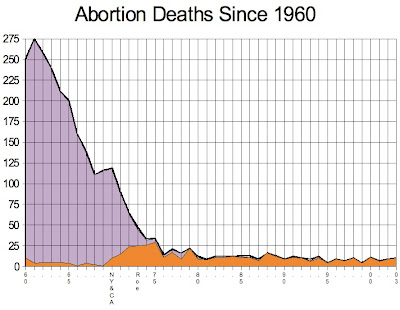
As you can see from the graph below, abortion deaths were falling dramatically before legalization. This steep fall had been in place for decades. To argue that legalization lowered abortion mortality simply isn't supported by the data.

external image Abortion+Deaths+Since+1960.jpg

Friday, December 28, 2012

Unsolved Abortion Death from 1921

On December 28, 1921, Belle Keehn died at the Chicago Lying-In Hospital from an abortion perpetrated by an unknown doctor on or about November 27. Documents are unclear as to how it was determined that the perpetrator was a doctor. The hospital was a reputable facility, not a seedy abortionarium, so Belle would have received superior care as doctors tried to save her life.

Keep in mind that things that things we take for granted, like antibiotics and blood banks, were still in the future. For more about abortion in this era, see Abortion in the 1920s.

external image Illegals.png

Wednesday, December 26, 2012

Mystery Woman Perpetrates Fatal Abortion

Rose Kulamer's husband, John, said that on Saturday, November 30, she'd told him that she'd been to see “a woman in the West End Pgh.” who had used “a rubber tube” to cause an abortion. She was taken to Columbia Hospital in Wilkensbert, Pennsylvania by ambulance on Monday, December 2.

Rose was taken to the operating room, where the dead three- to four-month fetus was removed and her cervix was packed with gauze. The next day surgery was performed to remove the placenta.

Rose's condition fluctuated over the ensuing days. On Christmas morning, Rose seemed fine, but around midnight on Christmas night her doctor was called in because Rose's condition had taken a sudden downturn. He arrived to find that she had vomited and been incontinent in both her bowels and bladder. She was unconscious, with a weak, irregular pulse. Chalfant diagnosed a pulmonary embolism and remained with Rose for about an hour, during which she seemed to be improving. But the next time Chalfant checked on her, she was showing signs of brain damage from an embolism. She held on until about 1 p.m. December 26.

Note, please, that with overall public health issues such as doctors not using proper aseptic techniques, lack of access to blood transfusions and antibiotics, and overall poor health to begin with, there was likely little difference between the performance of a legal abortion and illegal practice, and the aftercare for either type of abortion was probably equally unlikely to do the woman much, if any, good. For more information about early 20th Century abortion mortality, see Abortion Deaths 1910-1919.

external image Illegals.png

Monday, December 24, 2012

Four Christmas Eve Deaths

All of the women whose deaths we commemorate today died from criminal abortions, three of them at the hands of physicians and one at the hands of a surgical nurse who was clearly getting support from a physician.

>On December 24, 1908, 38-year-old homemaker Christina Pearson died in Chicago from compilations of an abortion. Dr. L. A. Mueller was held by the coroner, but for reasons not given in the source document he was not charged.

In 1928, Roy E. Hardesty won an award of $5,000 for the death of his wife, Arretta. At the age of 31, she had sought an illegal abortion and died on Christmas Eve, 1924 as a result, leaving her husband to raise their three children. Arretta paid a physician, John T. Martin, $10 for the abortion, which was performed surgically. After returning home, Arretta expelled the dead fetus and took ill. The surgeon came to her home to provide follow-up care, but within 48 hours, Arretta was dead.

On Christmas day of 1934, the nude body of a young woman was found in a thicket near a highway south of New York City. Laura and Joseph Devine, whose 19-year-old daughter, Loretta Wilson, had been missing since December 19, contacted authorities and were able to positively identify the body. When an autopsy revealed the cause of death as abortion, Loretta's husband of two years indicated that he had not even been aware that Loretta was pregnant. Dr. John H. Becker Jr., who admitted to having examined Loretta on December 17, was charged with homicide in the death. He denied performing the abortion.

Over the years, many details of the Jacqueline Smith case have been lost, and the remaining story often is dismissed as an urban legend. But strange and macabre as the story is, it was all too true. Jacqueline Smith, age 20, moved to New York and took an apartment with two other women early in 1955. Her boyfriend, Thomas G. Daniel, arranged for 46-year-old scrub nurse, Leobaldo Pejuan, to perform an abortion at Daniel's apartment on Christmas Eve. After performing the abortion, Pejuan became alarmed at the young woman's condition, and summoned Dr. Ramiro Morales, who told him that Jackie was dead. Daniel and Pejuan cut Jacqueline's body into pieces and took it to Pejuan's home, and cut into as many as 50 pieces, which they wrapped in Christmas paper and disposed of in trash cans along side streets off Broadway, from 72nd to 80th. On December 30, Jacqueline's father came looking for her, and at first Daniel said she was missing, then that she had committed suicide, but eventually he confessed.

Saturday, December 22, 2012

Late 19th Century Abortion Death, Chicago

On December 22, 1891, a Swedish girl named Tillie Thom was found dead at the office of Dr. Franklin Brooks in Chicago. Tillie had died of an abortion performed that day in Brooks' office. Brooks was found responsible for Tillie's death by Coroner's Verdict.

Tillie's abortion was typical of those before legalization in that it was performed by a physician.

Friday, December 21, 2012

Two Deaths Each Before and After Legalization

On December 21, 1915, 34-year-old Mrs. Anna Hunt died at Chicago's Rhodes Avenue Hospital from complications of an abortion perpetrated that day by an unknown person.

On December 21, 1926, fifteen-year-old Emily Mueller died from complications of a criminal abortion perpetrated somewhere in Chicago on December 11.  Midwife Magdelane Stegeman, alias Motzny, was booked on December 28. The coroner initially cleared Stegeman. She was nevertheless indicted for felony murder by the Grand Jury on February 15, 1927.

Note, please, that with overall public health issues such as doctors not using proper aseptic techniques, lack of access to blood transfusions and antibiotics, and overall poor health to begin with, there was likely little difference between the performance of a legal abortion and illegal practice, and the aftercare for either type of abortion was probably equally unlikely to do the woman much, if any, good. In fact, during the first two thirds of the 20th Century, while abortion was still illegal, there was a massive drop in maternal mortality, including mortality from abortion. Most researches attribute this plunge to improvements in public health and hygiene, the development of blood transfusion techniques, and the introduction of antibiotics. Learn more here.


Denise Holmes, a 24-year-old Australian woman living in Texas, decided to undergo a safe and legal abortion at Avalon Hospital in Los Angeles, California, on her way home for Christmas of 1970. Denise checked into Avalon Hospital (an abortion facility owned by Edward Campbell Allred) on December 21. Denise suffered an amniotic fluid embolism that carried pieces of fetal bone marrow into her lungs. She was pronounced dead by Edward Allred at Avalon at 5pm. Denise is the first confirmed abortion death at an Allred facility, before the National Abortion Federationwas founded, with Allred's Family Planning Associates Medical Group as a member. Other women known to have died after abortion at Allred's facilities include: Patricia Chacon and.Mary Pena, 1984; Josefina Garcia, 1985; Lanice Dorsey, 1986; Joyce Ortenzio and Tami Suematsu, age 19, 1988; Deanna Bell and Susan Levy, 1992; Christina Mora, 1994; Nakia Jorden, 1998; Maria Leho, 1999; Kimberly Neil and Maria Rodriguez, 2000, and Chanelle Bryant, 2004.

On December 20, 1997, 27-year-old Jennifer Halner went to Potomac Family Planning for a safe, legal abortion, to be performed by under general anesthesia. Jennifer was transferred to the recovery room, still unconscious but breathing on her own, at 10:10 a.m. Her blood pressure was normal but her pulse was very rapid. A nurse put an oxygen mask on Jennifer, but removed the cardiac monitor and pulse oximeter. By 10:20, Jennifer was still unconscious. At the nurse's request, the anesthesiologist, without examining Jennifer, ordered an anti-vomiting drug. Five minutes later, the nurse again requested medication for the still-unconscious Jennifer, and the anesthesiologist ordered administration of a drug that is used to reverse the effects of anesthesia -- again, without examining the patient himself. When the nurse checked Jennifer's vital signs, she couldn't find a pulse. Jennifer's pupils were dilated.
The anesthesiologist finally came to check on the patient and began performing CPR, using a pediatric bag-valve mask too small for an adult patient. McLeod, in the mean time, performed two more abortions before going to assist with Jennifer's care. He ordered appropriate drugs administered but did not place a heart monitor on Jennifer. Finally, at around 10:42 a.m., McLeod told somebody to call 911. Paramedics arrived and found Jennifer in cardiac arrest. The medics immediately began appropriate resuscitation, intubating the patient, ventilating her with an adult-sized bag-valve mask, hooking her up to a cardiac monitor, defibrillating her, and administering appropriate drugs. The medics transported Jennifer to Shady Grove Adventist Hospital. After aggressive resuscitative efforts by ER staff, the patient's heart was restored to a stable rhythm, and she was admitted to the Intensive Care Unit. But despite their best efforts, she died at 4:15 a.m. on December 21. McLeod also ran the Hillcrest abortion facility in Harrisburg, Pennsylvania, where Kelly Morse had died in 1996 after being inadequately resuscitated. 

Supporters of legal abortion would assert that Anna and Emily died because abortion was illegal, without any substantiating evidence and in the face of strong evidence that the ordinary risks of all surgery were so much greater at that time that more deaths could naturally be expected. They would also assert that although Denise and Jennifer's deaths were tragic, there would be more deaths were abortion not legal. Again, there is no evidence to support the claim, since the fall in maternal mortality in general, and abortion mortality in particular, had already leveled off after a precipitous drop in the 1930s and 1940s. Legalization, in fact, may have contributed to Jennifer's death by encouraging sloppy medical practice by doctors who no longer had to fear prison for injuring or killing abortion patients.