Showing posts with label Cleveland abortion. Show all posts

Monday, February 06, 2017

From the 1870s Through the 1980s

One of 16 Dead at National Abortion Federation Chain

Seventeen-year-old Laniece Dorsey underwent a safe and legal abortion at a Family Planning Associates Medical Group facility in Orange County, California, on February 6, 1986. FPA is a National Abortion Federation member facility.

Laniece lapsed into a coma, was transferred to a nearby hospital, and died later that day.

The Orange County Sheriff's Department medical examiner blamed the death on cardiorespiratory arrest due to the anesthesia, although he also found "a thick adherent layer of fibrinous material containing moderate numbers of inflammatory infiltrates" in Laniece's uterus.

Laniece wasn't the first or last young woman to die from abortion at a facility owned by FPA head honcho Edward Campbell Allred. Other patients known to have died after abortion at Allred's facilities include


Allred's facilities remain members of the National Abortion Federation despite these deaths.


Scanty Information from Cleveland

Life Dynamics lists 26-year-old billing clerk Kathy Davis on their "Blackmun Wall of safe and legal abortions. Citing Kathy's death certificate, Life Dynamics says that Kathy died at Cleveland Metropolitan General Hospital of heart failure and hypertension following a legal abortion on February 6, 1987.


An Airman's Grief

Elizabeth Hellman was the 35-year-old wife of an Air Force major who had been stationed in Tokyo for over a year. Evidently Betty found the separation lonely, for she became pregnant while he was away.

On January 28, 1952, Betty was admitted to the Tinker Air Force Base hospital in critical condition, suffering from pain and low blood pressure. Her red blood count was very low, and her white count very high, indicating infection. She admitted to having undergone an abortion on January 25.


When questioned by investigators on January 31, Betty said that friends had referred her to a woman named Jane. She was shown a photo and identified the woman in it, 43-year-old Mrs. Jane McDaniel White, as her abortionist. She gave White's address as the place she had gone for the abortion.

Betty said that White had put her off for several days while she got over her fear of undergoing the abortion. She promised White $100, but only paid her $50. White initiated the abortion with some kind of packing and sent Betty home.

Betty became very ill, and called White, who with her daughter came to Betty's home and "scraped her out".

After Betty gave her statement, police raided White's home. White and her daughter, Mrs. S. B. Anderson, Jr., were nowhere to be found. Police eventually tracked the pair down and arrested them for murder and procuring an abortion.

Betty died on February 6, from peritonitis. Her husband had managed to rush home from Tokyo in time to see his wife before she died. An autopsy verified that an abortion had been performed and had caused Betty's death.

The criminal case against White went well until the defense managed to have the Betty's deathbed statement, given on January 31, inadmissible because it couldn't be proved satisfactorily that Betty believed herself to be near death. With the deathbed statement thrown out, the case was dropped.

This had been White's third arrest for abortion charges. She had been convicted in 1947, under the name Jane McDaniel, and sentenced to seven years, but the conviction was thrown out on a technicality based on how advanced the girl's pregnancy had been. A new trial had been scheduled, but it never took place because the main prosecution witness had left the state or died. White was clearly operating as an abortionist, since an operating table, fashioned from an old restaurant table, and surgical instruments had been sized from her home at the time of her arrest -- "enough instruments and medicine to stock a small hospital." She was charged again in 1951 but the main witness had vanished and the case had been dismissed.


Mystery Abortion in Chicago

On February 6, 1919, 22-year-old homemaker Edna Griffith died at Chicago's Passavant Hospital from septic pneumonia initiating from complications of an abortion perpetrated by a person who was never identified.


Fatal Abortion Drugs

A Coroner's Inquest was held regarding the February 6, 1870 death of 22-year-old Mary Donigan. Mary died at the Brooklyn home of Mrs. Bridget Dillon, who testified that she'd known Mary for about 18 years. Mary had come to her home on a Monday afternoon about three weeks before her death, looking very sickly but not complaining of illness. By the time Friday came around, Mary was reporting being sick with diarrhea. Mrs. Dillon gave her some brandy at about 11:00 that night, but all this did was make Mary vomit.

Mary slept until noon the next day. Mrs. Dillon checked on her and found her appearing very ill. Mrs. Dillon offered to empty the slop pail in the room, but Mary said, "No, I've had a baby and it is in there; my mother sent me down to Margaret Farrell's, but she wouldn't keep me, so I thought I would come to you."

Mrs. Dillon looked in the pail and saw the baby, which she described as large -- in keeping with Mary's report of having been pregnant for about eight months. Mary reported that she had paid a doctor $5 for a bottle of medicine -- she refused to name this doctor -- and that she had thrown the bottle "in the water closet." Mrs. Dillon testified that Mary reported having taken the medicine about two or three weeks earlier, and that afterward she'd not felt her baby moving any more.

Mary likewise refused to divulge to Mrs. Dillon the name of her baby's father.

An old woman Mrs. Dillon believed to be Margaret Farrel came to help Mrs. Dillon care for Mary. Mrs. Dillon testified that she'd asked Mrs. Farrel what to do about the baby, and Mrs. Farrel had suggested getting a small box to bury the baby in. Mrs. Dillon went off in search of a box, and returned to Mary's room to find both Mrs. Farrel and the baby gone.

By Monday, Mary was up and dressed and went downstairs against Mrs. Dillon's advice. Mary quickly took ill again, so mrs. Dillon helped her back to her room and dosed her with castor oil. "She was quite exhausted."

Mrs. Dillon went to a druggist and described Mary's symptoms. The druggist provided some powders that she was to give to Mary every hour, but Mary didn't want to take more after the first dose, reporting that they only made her feel worse and blistered her mouth. Mrs. Dillon sent one of her "girls" to consult with the druggist but he had nothing further to offer.

Mary refused the services of either a doctor or a priest. The following morning, Mary had taken such a turn for the worse that Mrs. Dillon sent for both a doctor and a priest. The doctor, Matthew F. Regan, told Mrs. Dillon that Mary was dangerously ill.

Dr. Regan testified that he'd been summoned to a garret room where he found Mary in bed, "suffering from inflammation of the womb and the covering of the bowels." Mary reported being married and having suffered a miscarriage the preceeding Friday. Dr. Regan prescribed some medication and returned on Saturday.

At that time, Mary admitted that she wasn't married, and that she'd not seen a doctor or had any sort of abortion performed. He told her that her condition was very grave, "that I had seen women die who were not so low as she was." Mary identified a Mr. Burdie, who worked in the brick yards in Haverstraw, where Mary lived, as the father of the baby.

When Dr. Regan returned at noon on Sunday to check on Mary, he found her dead.

Dr. A. W. Shepard performed a post mortem examination on Mary and found no signs of instrumentation, but plenty of signs of infection in and around the uterus. He determined that she had died from an abortion.

Sunday, September 25, 2016

A Selection of Physicians, 1892 - 1989

The Infamous Lucy Hagenow Gets her Start in Chicago, 1892

At about 9:00 on the morning of Sunday, September 25, 1892, 30-year-old Sophia Kuhn "died in great agony" at Cook County Hospital in Chicago. She had been brought there by ambulance the previous evening from Dr. Louise Hagenow's practice at 882 West Madison Street.

"That the woman died from the result of a most cruel criminal operation is fairly well established, and an inquest to-day will beyond question reveal the details of what has every appearance of being little less than a butchery."

A poor quality picture of a white woman of late middle age, with sharp features, wearing round spectacles and a sailor-style blouse and hat
Louise "Lucy" Hagenow
Louise Hagenow and Ellen Hellieu were arrested. Sophia's father identified them as responsible for his daughter's death. Sophie, who had been separated from her husband for about two years, had been living with her sister, Mrs. White, at the time of the pregnancy and abortion. Sophie's brother-in-law, William White, said, "My sister-in-law left home about two weeks ago. She was then complaining of being sick and in trouble. I am certain she did not go to Mrs. Hagenow and the other doctors of her own accord. There was a man in the case who must have persuaded her to submit to an operation."

While police were interviewing Hagenow, who also used the name Lucy Hagenow, at her practice, Hellieu "rushed breathless into her apartments. When she saw Dr. Hagenow's interviewer, she exclaimed: 'Don't say anything!' Then she sank exhausted upon a sofa."

Hagenow had already been implicated in the abortion deaths of Louise Derchow, Annie Dories, Abbie Richards, Emma Dep in San Francisco before relocating to Chicago in 1890.

She was implicated in the abortion deaths of Minnie Deering in 1891. Shortly after Sophie's death, Hagenow was again arrested, this time for the abortion death of Emily Anderson. Further abortion deaths associated with Hagenow's Chicago practice include:
More Chicago Physicians, 1925

On September 25, 1925, Faye McGinnis, a 23-year-old clerk, died at her home in Chicago from complications of an abortion performed that day. The coroner identified two physicians, Walter Penningdorf and Walter Voight, as being responsible. For Faye to choose a physician abortionist was common in Chicago in that era, though midwives were a popular choice as well. The doctors were arrested on September 25 and indicted for felony murder on October 15. Faye's husband, Roy McGinnis, was also arrested as an accomplice in his wife's death.

Safe and Legal in 1978

Minnie Lathan is one of the women Life Dynamics identifies on their "Blackmun Wall" as having been killed by a safe and legal abortion. Minnie was 41 when she had an abortion and tubal ligation performed some time in September of 1978. Her uterus was perforated and her colon damaged during the procedure. She developed an infection and was hospitalized at Cleveland Clinic Hospital. She died there on September 25.


The Unsavory Leo Kenneally, 1986
Twenty-two-year-old Liliana Cortez, an immigrant, underwent a safe and legal abortion by Leo Kenneally at his Her Medical Clinic in Los Angeles on September 20, 1986. Other than having asthma, Liliana was in good health when she went for her abortion. After the procedure, she went into cardiac arrest. There was a 40-minute delay until the paramedics arrived to transport Liliana to a hospital. She died five days later.


Liliana's death was ruled a "therapeutic misadventure," which a coroner's spokesman called, "a nice medical term for a mistake." An attorney for Her Medical Clinic said, "If something like this happened at a hospital ... people would just say it was bad luck, one of those flukey things. But ... all of a sudden they make it seem like these (abortion clinics) are terrible places where terrible things happen." Donna Heim and Michelle Thames also died after abortions at Her Medical Clinic.

Septic Shock in Alabama, 1989

Debra Walton was 35 years old when she underwent an abortion in the fall of 1989. On September 24, 1989, about three weeks after the abortion, she was admitted to University Hospital in Birmingham, Alabama. She was in septic shock. Despite efforts to save her, she died the next day, September 25, 1989. Her death certificate does not say where the abortion took place or who performed it.

Wednesday, May 18, 2016

Cleveland, Chicago, and Kansas City from 1883 to 1958

Midwives in Cleveland and Chicago, 1883 and 1904

In early May of 1883, 21-year-old Julia Renacheve left the Cleveland home she shared with her sister and brother-in-law, saying that she was going to the country to visit some friends. Nobody thought anything was amiss until the evening of Tuesday, May 15, when Julia's sister learned that she was at the Garden Street home of midwife Sylvia Webster. She and her husband hurried to the home to find Julia deathly ill. Jacob told police that Julia had said to him, "I am a very sick girl. I have suffered martyrdom." She said that Webster had perpetrated an abortion on her, but begged him to keep it a secret until after her death.

The following day, May 16, Julia's paramour, Charles Seymour married Julia at her bedside. The next day, as Julia's condition continued to deteriorate, her sister came by with a carriage to take her home. Just as they were leaving, Webster gave Julia some medicine, which rather than improve her condition put her into a stupor from which she never recovered.

That Friday, May 18, Julia died. On Saturday, she was buried. Either one of the Weismans spoke up, or somebody else became suspicious, because Julia's body was exhumed and an autopsy was performed, confirming that she had died from abortion complications.

In July of 1883, Webster was put on trial for Julia's death. Seymour turned state's evidence against Webster. The trial resulted in a hung jury on June 15.

The death of Margaret McCarthy in Chicago on May 18, 1904, follows the same pattern as Julia Renacheve Seymour's death. Her paramour, Benjamin Tedrick, brought her to the home of midwife Gertrude Plenz. Several days after the abortion, Margaret was admitted to Mary Thompson Hospital, where she admitted to an abortion before dying. Plenz avoided prison, and three years later was arrested for the abortion death of Sarah Cushing.

A Mystery Abortionist in Chicago, 1925

On May 18, 1925, Della Davis, a 25-year-old Black woman, died in Chicago from an illegal abortion performed that day, leaving behind her husband, Huston. The person responsible for her death was never caught. However, given the plethora of physicians and midwives running abortion practices in Chicago at the time, there is a strong likelihood that she availed herself of one of them.

A Doctor in Kansas City, 1958

Janice Easterbrook, who was 20 years old, lived with her parents, Mr. and Mrs. Ernest Easterbrook in Arcadia, Nebraska. Two doctors in Nebraska had already told them that Janice was pregnant, and the family traveled to Kansas City, Missouri for a third opinion from Dr. William M. Korth. With lab tests and an exam, he confirmed that Janice was about 3 to 3 1/2 months pregnant. Korth later testified that there had been no signs of either health problems that would prevent Janice from carrying to term, or that anybody had tried to tamper with the pregnancy. With this confirmation of pregnancy, the Easterbrooks went to 49-year-old Dr.Harry Werbin's office to try to arrange an abortion. He was closed for the day so they returned the next morning, May 16, 1958.

The receptionist greeted them and made an appointment for them to meet with Werbin at 11:30 that morning. The Easterbrooks told Werbin that they wanted him to do "whatever was necessary to keep her from having the baby."

Werbin took Janice into his office to examine her, then consulted with her parents, explaining that he charged $100 per month of pregnancy, so the charge for Janice's abortion would be $300. The parents asked Werbin if the abortion would be dangerous, but he assured them that he wasn't having any "bad luck," and that a day or two after the abortion Janice would be able to continue on a trip through the Ozarks with her family. Mr. Easterbrook handed $300 to his wife, who handed the $300 to their daughter, who handed it to the doctor.

Werbin took her back into his private office. About ten or fifteen minutes later, Janice emerged, not seeming ill, but with some blood drops on her shoes. Werbin took her back into his office, and instructed her mother to go down to the drug store and buy some Kotex. When Mrs. Easterbrook returned with the Kotex, the parents asked Werbin if Janice should go to the hospital, and he said, "No. Let's leave the hospitals out of it. I know how to take care of it, and what to do." He gave Janice some medication, and gave her parents one of his cards, on which he'd written the name of the U-Smile Motel on Highway 40.

Janice returned with her family on Saturday morning, May 17, per Werbin's instructions. Werbin took her back into his office for about fifteen minutes. When Janice emerged, she was crying and told her parents, "He hurt me." That evening at the motel, Janice began to vomit violently. Her mother called Werbin, who demurred at first, but came to check on his patient once her mother insisted. He came back and forth to the motel several times, spending more and more time on each visit, staying there most of Saturday night. Janice was sick and in a lot of pain, and Mrs. Easterbrook again suggested taking Janice to a hospital. Werbin reassured the parents that it was not uncommon for women to be in Janice's condition after an abortion. He used a curved instrument about ten inches long to remove some tissue from her vagina.

On Sunday morning, Janice got up to use the toilet, where she passed a mutilated fetus about six inches long. Her parents summoned Werbin, who summoned criminal abortionist Dr. Richard Mucie to assist him at about 11:00 a.m. Janice's parents were alarmed that she appeared blue and was breathing rapidly. Werbin and Mucie held a quiet conversation that the parents couldn't overhear, then Mucie picked Janice up and carried her out to Werbin's car, telling her parents to caravan with them to Independence Hospital.

After driving about six miles east, Werbin did a U-turn, and the Easterbrooks lost him in traffic. Werbin went to General Hospital, where he met Joseph L. Connors, a non-physician and deputy coroner, at about 3:10 p.m., telling him that the dead woman in his car was a patient he'd been called to treat at the U-Smile for hemorrhage.

Mucie testified that Werbin had called him in to assist in treating a botched self-induced abortion at the motel, and that Werbin had performed a curretage to remove tissue, while Mucie had given her medications to stimulate circulation. Mucie concluded that Janice had died from an embolism, possibly air or a clot lodged in the heart or lungs. He said that the reason they'd not taken Janice to Independence Sanitarium was that Independence wasn't friendly to osteopaths.

The Jackson County Coroner, Dr. Hugh H. Owens, performed the autopsy that afternoon, May 18, and found ample evidence of a pregnancy and an abortion performed with instruments. Janice's uterus had been perforated, and Owens concluded that she had bled to death. Werbin was found guilty of manslaughter and sentenced to two years. His sentence was upheld on appeal.

Saturday, February 06, 2016

The Full Spectrum of Abortion Deaths, 1870 - 1987

1870: A Fatal Abortifacient from an Unknown Source

A Coroner's Inquest was held regarding the February 6, 1870 death of 22-year-old Mary Donigan. Mary died at the Brooklyn home of Mrs. Bridget Dillon, who testified that she'd known Mary for about 18 years. Mary had come to her home on a Monday afternoon about three weeks before her death, looking very sickly but not complaining of illness. By the time Friday came around, Mary was reporting being sick with diarrhea. 

Mary slept until noon the next day. Mrs. Dillon checked on her and found her appearing very ill. Mrs. Dillon offered to empty the slop pail in the room, but Mary said, "No, I've had a baby and it is in there; my mother sent me down to Margaret Farrell's, but she wouldn't keep me, so I thought I would come to you."

Mrs. Dillon looked in the pail and saw the baby, which she described as large -- in keeping with Mary's report of having been pregnant for about eight months. Mary reported that she had paid a doctor $5 for a bottle of medicine -- she refused to name this doctor -- and that she had thrown the bottle "in the water closet." Mrs. Dillon testified that Mary reported having taken the medicine about two or three weeks earlier, and that afterward she'd not felt her baby moving any more.


Mrs. Dillon consulted with some other women, as well as a pharmacist, about caring for Mary. The druggist provided some powders that she was to give to Mary every hour, but Mary didn't want to take more after the first dose, reporting that they only made her feel worse and blistered her mouth. Mary refused the services of either a doctor or a priest. In early February, Mary had taken such a turn for the worse that Mrs. Dillon sent for both a doctor and a priest. The doctor, Matthew F. Regan, testified that he'd been summoned to a garret room where he found Mary in bed, "suffering from inflammation of the womb and the covering of the bowels." Mary reported being married and having suffered a miscarriage the preceding Friday. Dr. Regan prescribed some medication and returned on Saturday.

At that time, Mary admitted that she wasn't married, and that she'd not seen a doctor or had any sort of abortion performed. He told her that her condition was very grave, "that I had seen women die who were not so low as she was." Mary identified a Mr. Burdie or McBurdie, who worked in the brick yards in Haverstraw, where Mary lived, as the father of the baby. When Dr. Regan returned at noon on Sunday to check on Mary, he found her dead. Dr. A. W. Shepard performed a post mortem examination on Mary and found no signs of instrumentation, but plenty of signs of infection in and around the uterus. He determined that she had died from an abortion.


1895: A Doctor at a Lying-In Hospital

In April of 1895, a reporter who was at the Detroit business of undertaker Frank Gibbs kicked a coffin that was in a corner of the room. Gibbs scolded, "Here, don't kick that coffin. There's a body in it, and I've got $100 for keeping it." The reporter went to the health department. When the undertaker got wind of this, he hastily had the body buried at Potter's Field. 

An investigator went to Gibbs' establishment and found a death certificate for a woman named Myrtle Cook. The cause of death was given as pneumonia, and it was signed by Dr. J. D. Seaman. The health department ordered the just-buried body to be immediately exhumed and brought to another undertaking establishment for an autopsy. The cause of death was determined to be abortion. After an intensive investigation -- including a second disinterment for verification -- the woman was identified as Emily Hall, a young woman who had been brought to the area from her home in Birmingham, England, by Jonathan Bell, a Church of England clergyman who had gotten her pregnant. Shortly after Christmas Emily had told her parents that she had been hired as a lady's traveling companion and that they probably wouldn't hear from her until spring.


Emily had instead traveled directly to Detroit and checked into the Alice B. Lane Lying-in Hospital on January 23 for an abortion. All of the  arrangements, including paying the $50 fee, had been made prior to her arrival, and on January 27 Dr. D. J. Seaman performed the abortion that eventually took Emily's life. Women who were at the hospital to give birth had been instructed to say that "Myrtle" had given birth to a live baby that had been placed with a foster family. The police recovered the baby's body, which had been buried in the back yard. 

When arrested, the defendants -- Seaman and Lane -- refused to even enter a plea. Seaman's first trial ended in a hung jury, a second trial produced a conviction which Seaman had overturned, and a third trial ended with Seaman convicted of manslaughter and sentenced to ten years.

1919: An Unknown Perpetrator

On February 6, 1919, 22-year-old homemaker Edna Griffith died at Chicago's Passavant Hospital from septic pneumonia initiating from complications of an abortion perpetrated by a person who was never identified.

1952: A Professional Lay Abortionist


Elizabeth "Betty" Hellman was the 35-year-old wife of an Air Force major who had been stationed in Tokyo for over a year. Evidently Betty found the separation lonely, for she became pregnant while her husband was away. On January 28, 1952, Betty was admitted to the Tinker Air Force Base hospital in critical condition. She admitted to having undergone an abortion on January 25. When questioned by investigators on January 31, Betty said that friends had referred her to a woman named Jane. She was shown a photo and identified the woman in it, 43-year-old Mrs. Jane McDaniel White, as her abortionist. She gave White's address as the place she had gone for the abortion. She promised White $100, but only paid her $50. White initiated the abortion with some kind of packing and sent Betty home. Betty became very ill, and called White, who with her daughter came to Betty's home and "scraped her out".

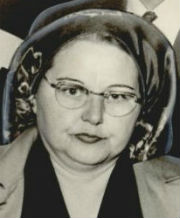
Headshot of a plump, dark-haired, middle-aged white woman wearing early 1950s style eyeglasses, hat, and hair wtyle
Jane McDaniel Wite
After Betty gave her statement, police raided White's home. White and her daughter, Mrs. S. B. Anderson, Jr., were nowhere to be found. Police eventually tracked the pair down and arrested them for murder and procuring an abortion. White, who had been arrested twice in the past several years for abortion charges, insisted that she'd told Betty she "was not in the business" but did treat her for ptomaine poisoning, which she believed was what was causing Betty's vomiting.  White admitted to having no medical training, and said that she "had no right" to diagnoses whether or not Betty was pregnant, but she was qualified to diagnose the ptomaine poisoning because she'd had a bout of it herself.

Betty died on February 6, from peritonitis. Her husband had managed to rush home from Tokyo in time to see his wife before she died. An autopsy verified that an abortion had been performed and had caused Betty's death.

The criminal case against White went well until the defense managed to have the Betty's deathbed statement declared inadmissible because it couldn't be proved satisfactorily that Betty believed herself to be near death. With the deathbed statement thrown out, the case was dropped. White was, however, clearly operating as an abortionist, since an operating table, fashioned from an old restaurant table, and surgical instruments had been sized from her home at the time of her arrest -- "enough instruments and medicine to stock a small hospital." 

1986: A Prestigious Chain of Abortion Facilities

Seventeen-year-old Laniece Dorsey underwent a safe and legal abortion at a Family Planning Associates Medical Group facility in Orange County, California, on February 6, 1986. Laniece lapsed into a coma, was transferred to a nearby hospital, and died later that day. The Orange County Sheriff's Department medical examiner blamed the death on cardiorespiratory arrest due to the anesthesiaLaniece wasn't the first or last young woman to die from abortion at a facility owned by FPA head honcho Edward Campbell Allred. Other patients known to have died after abortion at Allred's facilities include Denise HolmesPatricia ChaconMary PenaJosefina GarciaJoyce OrtenzioTami SuematsuDeanna BellSusan LevyChristina MoraTa Tanisha WessonNakia JordenMaria LehoKimberly NeilMaria Rodriguez, and Chanelle Bryant. The FPA facilities remain members of the National Abortion Federation despite these deaths.

1987: Safe and Legal in Cleveland

Life Dynamics lists 26-year-old Kathy Davis on their "Blackmun Wall of deaths caused by safe and legal abortionsCiting Kathy's death certificate, Life Dynamics says that Kathy died at Cleveland Metropolitan General Hospital of heart failure and hypertension following a legal abortion on February 6, 1987.