Safe and Legal in Oregon, 1984
Loretta Morton was 16 years old when
she underwent a legal abortion in December of 1983. She was sent home
with birth control pills. On January 3, 1984, Loretta was at home, and having trouble breathing. Her mother called for an ambulance. The ambulance crew assessed Loretta, decided she was stable, and left.
They were called back ten minutes later because Loretta had lost
consciousness.
The crew rushed Loretta to a hospital, but attempts to resuscitate her
were in vain. Within an hour of having lost consciousness, she was dead. An autopsy showed that she had died from a pulmonary embolism from the abortion.
A Fatal Abortifacient, 1866
An inquest was held in St. Louis, Missouri, regarding the January 3, 1866 death of 23-year-old Aurora Heaton.
Aurora had lived in a rural area wiht her mother and stepfather until about six weeks prior to her death. She moved to St. Louis, as did "a young Scotchman named Isaac McDonald," with whom Aurora had evidently been keeping company prior to the move. Aurora told Isaac that she believed that she was pregnant, so he bought something at a drug store and gave it to her prior to returning to college.
The two corresponded, with Aurora's lamentation that the abortifacient drugs hadn't done their job. She went to a pharmacy and bought oil of cedar, another folk abortifacient. She took a one-ounce dose during the evening of January 2. Later that night she went into convulsions. She died shortly after midnight.
A postmortem examination found the poison still in her stomach -- and that contrary to her beliefs, Aurora had not actually been pregnant.
Showing posts with label abortifacients. Show all posts
Showing posts with label abortifacients. Show all posts
Tuesday, January 03, 2017


Wednesday, September 14, 2016
From Colonial Times to the 1990s.
A Drawn-Out Colonial-Era Abortion
Sarah Grosvenor, age 19, died in Pomfret, Connecticut on September 14, 1742 after an abortion perpetrated by Dr. John Hallowell. Sarah wanted to marry the baby's father, Amasa Sessions, but he pressured her to go through with an abortion.
Beginning in mid-July, Sarah tried abortifacients given to her by a seedy local doctor named John Hallowell. The abortifacients only succeeded in making her ill. Hallowell gave various concoctions to Sarah over several a period of about two weeks before finally using instruments on August 2. Two days later, Sarah expelled a dead baby, a girl about half the size of a full-term newborn. Sarah's sister buried the baby in the woods. Sarah seemed to rally at first, but became progressively more ill, finally dying on September 14.
Chicago Abortions in the 1920s
The Notorious Dr. Lucy Hagenow
On September 14, 1925, 19-year-old Elizabeth Welter died in the Chicago office of Dr. Lucy Hagenow from complications of an abortion performed that day. Elizabeth, who worked as a clerk, had gone to Chicago from her home of Sturgeon Bay, Wisconsin, a few weeks before her death.
Lawrence Vail was identified by the coroner as responsible for the pregnancy, and the coroner recommended his arrest. The coroner also recommended the arrest of Dr. Hagenow. However, because Vail refused to give a statement, police were unable to gather enough evidence to arrest her.
Like many
physicians, especially female physicians, Hagenow was a popular Chicago
abortionist. Elizabeth was one of the last Chicago abortion deaths
attributed to Dr. Lucy Hagenow, aka Dr. Louise Hagenow. The others
include:
A Lay Abortionist With a Physician Accomplice
On September 14, 1928, 20-year-old Stella Wallenberg, a bindery worker, died from a criminal abortion performed in Chicago. Loretta Rybicki, identified as a "massaguer", was held by the coroner for murder by abortion. Dr. Nicholas Kalinowski was held as an accessory. Rybicki was indicted for felony murder on November 15.
It was not unusual for a lay abortionist to have a physician as an accomplice. Such physicians would do things such as train the lay abortionist, supply instruments and drugs, and provide aftercare if a woman suffered complications.
Safe and Legal in Philadelphia
Rhonda Rollinson, age 32, underwent a safe, legal abortion by Dr. Jay I. Levin at Malcom Polis's Philadelphia Women's Center September 3, 1992. The abortion attempt was unsuccessful. Rhonda was then sent home, with instructions to return on September 12 to try again.
Rhonda experienced such severe pain, dizziness, fever, and discharge that on September 10 she sought emergency care at a hospital. She was suffering "severe non-cardiogenic pulmonary edema consistent with adult respiratory distress syndrome." Doctors did a laparoscopy, dilation and evacuation, abdominal hysterectomy, and splenectomy, to no avail. Rhonda died on September 14. The autopsy revealed a perforation from her vagina into the uterine cavity, sepsis, disseminated intravascular coagulopathy, non-bacterial thrombotic endocarditis, pulmonary infarctions, and dysplastic kidney.
The suit filed by Rhonda's survivors also charged the facility and Polis with hiring Levin despite his lack of competence, failure to properly supervise his work, violation of applicable laws and regulations, lack of informed consent, failure to give proper post-operative instructions, and failure "to respond to the requests of [Rhonda] and her family for post-operative medical advice."
Sarah Grosvenor, age 19, died in Pomfret, Connecticut on September 14, 1742 after an abortion perpetrated by Dr. John Hallowell. Sarah wanted to marry the baby's father, Amasa Sessions, but he pressured her to go through with an abortion.
Beginning in mid-July, Sarah tried abortifacients given to her by a seedy local doctor named John Hallowell. The abortifacients only succeeded in making her ill. Hallowell gave various concoctions to Sarah over several a period of about two weeks before finally using instruments on August 2. Two days later, Sarah expelled a dead baby, a girl about half the size of a full-term newborn. Sarah's sister buried the baby in the woods. Sarah seemed to rally at first, but became progressively more ill, finally dying on September 14.
Chicago Abortions in the 1920s
The Notorious Dr. Lucy Hagenow
On September 14, 1925, 19-year-old Elizabeth Welter died in the Chicago office of Dr. Lucy Hagenow from complications of an abortion performed that day. Elizabeth, who worked as a clerk, had gone to Chicago from her home of Sturgeon Bay, Wisconsin, a few weeks before her death.
Lawrence Vail was identified by the coroner as responsible for the pregnancy, and the coroner recommended his arrest. The coroner also recommended the arrest of Dr. Hagenow. However, because Vail refused to give a statement, police were unable to gather enough evidence to arrest her.
 |
| Dr. Lucy Hagenow |
- 1891: Minnie Deering
- 1892: Sophia Kuhn and Emily Anderson
- 1896: Hannah Carlson
- 1899: Marie Hecht
- 1905: May Putnam
- 1906: Lola Madison
- 1907: Annie Horvatich
- 1925: Lottie Lowy, Nina H. Pierce, Jean Cohen, and Bridget Masterson
- 1926: Mary Moorehead
A Lay Abortionist With a Physician Accomplice
On September 14, 1928, 20-year-old Stella Wallenberg, a bindery worker, died from a criminal abortion performed in Chicago. Loretta Rybicki, identified as a "massaguer", was held by the coroner for murder by abortion. Dr. Nicholas Kalinowski was held as an accessory. Rybicki was indicted for felony murder on November 15.
It was not unusual for a lay abortionist to have a physician as an accomplice. Such physicians would do things such as train the lay abortionist, supply instruments and drugs, and provide aftercare if a woman suffered complications.
Safe and Legal in Philadelphia
Rhonda Rollinson, age 32, underwent a safe, legal abortion by Dr. Jay I. Levin at Malcom Polis's Philadelphia Women's Center September 3, 1992. The abortion attempt was unsuccessful. Rhonda was then sent home, with instructions to return on September 12 to try again.
Rhonda experienced such severe pain, dizziness, fever, and discharge that on September 10 she sought emergency care at a hospital. She was suffering "severe non-cardiogenic pulmonary edema consistent with adult respiratory distress syndrome." Doctors did a laparoscopy, dilation and evacuation, abdominal hysterectomy, and splenectomy, to no avail. Rhonda died on September 14. The autopsy revealed a perforation from her vagina into the uterine cavity, sepsis, disseminated intravascular coagulopathy, non-bacterial thrombotic endocarditis, pulmonary infarctions, and dysplastic kidney.
The suit filed by Rhonda's survivors also charged the facility and Polis with hiring Levin despite his lack of competence, failure to properly supervise his work, violation of applicable laws and regulations, lack of informed consent, failure to give proper post-operative instructions, and failure "to respond to the requests of [Rhonda] and her family for post-operative medical advice."
Thursday, July 21, 2016
An Assortment of Perpetrators Over More Than a Century
Abortifacients From a Druggist Husband, 1886
On July 21, 1886, Mrs. Fred Winkleman was found dead in her Cincinnati home from a botched abortion. The last survivor of the Miller family, she had a small fortune of $13,000 which she had given over to Fred at their marriage four months earlier. Winkleman was arrested and freed on $5,000 bail. Police believed that Fred, a 26-year-old druggist, had intended his wife's death in order to have free use of the money. The scant news coverage seems to indicate that Fred had perpetrated the abortion himself. A headline in the Louisville (KY) Courier-Journal, "Poisoned His Bride," is the only indication of the means of the abortion. I've also been unable to determine whether he was ever prosecuted.
Midwives in Chicago, 1907
On July 21, 1907, 21-year-old homemaker Madeline Paffrath died at German American Hospital in Chicago. Before her death she took an oath with her hand on the Bible, vowing never to divulge the names of the two women who had perpetrated an abortion on her. Madeline's husband, John W. Paffrath, did not have so charitable a view of the women who had brought about his wife's death. He named Agnes Schustzner (Harcone Scheutner, according to the Homicide in Chicago Interactive Database) as one of the two perpetrators. Other witnesses, saying that Schustzner was drunk at the time of the abortion, named Alice Gustafson as the first to attempt an abortion on Madeline. The coroner's jury held the two above-named midwives, along with midwife Alice Rastone.
An Amateur Abortionist, 1916
Late in the evening of July 21, 1916, 21-year-old Roy Hinterliter
showed up at the sanitarium in Olney, Illinois with a young woman, Miss
Elizabeth Radcliffe, slumped over onto his lap in his buggy. Elizabeth,
age 17, was immediately pronounced dead. It was eventually learned that
she had died at a rural trysting spot near a bridge, where
investigators found signs of a struggle. Imprints of Elizabeth's hands
and Hinterliter's feet were found in the sand. After Elizabeth had died,
Hinterliter had loaded her body into the buggy and ridden into town
with her.
An autopsy confirmed pregnancy, but showed no external signs of violence and all her reproductive organs appeared normal. However, upon cutting open her heart, air escaped. One news report stated that the doctor "found the heart so filled with air that it made a hissing like a plugged rubber ball when a pin was stuck into it." There was so much air in Elizabeth's brain that it floated when placed in water. There were no lung lesions to explain the air in Elizabeth's bloodstream.
Two boys were spotted in town trying to hide a package. They were arrested, and told police that Hinterliter had asked them to get rid of the contents of the package -- a catheter with the plunger missing. They said that they had been with Hinterliter in the drug store when he'd bought it. He had told them that a doctor had told him how to use it. It eventually came out that Hinterliter had taken out the plunger and instead blown into the catheter -- with which he had accidentally punctured a vein. Thus he blew a quantity of air directly into Elizabeth's blood stream. She would have died almost instantly.
Hinterliter was sentenced to prison for Elizabeth's death.
Profession Unknown, 1923
On July 21, 1923, 28-year-old Mrs. Mary Federowicz died at Chicago's St. Mary's Hospital from complications performed that day. Mrs. Anna Mithnewicz, whose profession was not given, was identified by the coroner as the person responsible, but no arrest was made. It's likely that Mary had availed herself of one of the many physicians or midwives who practiced abortion in Chicago at the time.
Planned Parenthood, 2012
 Tonya Reaves, age 24, was rushed to Northwest Memorial Hospital in
Chicago and pronounced dead at 11:20 p.m. on Friday, July 21, 2012. She was taken there from the Planned Parenthood facility at 18 S.
Michigan Avenue, which advertises abortions up to 18 weeks. Tonya had
undergone a D&E abortion, which indicates that she was likely
between 14 and 18 weeks pregnant, although a misdiagnosis of fetal age
might be the underlying cause of the injury.
Tonya Reaves, age 24, was rushed to Northwest Memorial Hospital in
Chicago and pronounced dead at 11:20 p.m. on Friday, July 21, 2012. She was taken there from the Planned Parenthood facility at 18 S.
Michigan Avenue, which advertises abortions up to 18 weeks. Tonya had
undergone a D&E abortion, which indicates that she was likely
between 14 and 18 weeks pregnant, although a misdiagnosis of fetal age
might be the underlying cause of the injury.
The Centers for Disease Control published back in 1983, "Deaths from hemorrhage associated with legal induced abortion should not occur." In every hemorrhage death they investigated, "Lack of adequate postoperative monitoring or treatment of hemorrhagic shock" was a factor. Tonya's death was no exception. Her abortion was performed at 11:00 a.m., but she remained at the facility for hours until finally an ambulance was called, taking her to the hospital at 4:30 p.m. At 5:30 p.m., doctors performed an ultrasound, followed by another D&E procedure, though it is unclear whether they were removing retained tissue or aborting a second fetus. Tonya had continued pain and bleeding, so a second ultrasound was performed, revealing a uterine perforation. It is unclear whether this was a perforation from the initial D&E at Planned Parenthood or from the follow-up at the hospital.
Regardless of the source of the perforation, Tonya was returned to surgery, where “an uncontrollable bleed was discovered.” She was pronounced dead at 11:20 p.m. The CDC's article noted, "Deaths from hemorrhage can be eliminated by preventing uterine trauma during abortion and by rapidly diagnosing and treating hemorrhage if it occurs." Planned Parenthood, for some reason, failed to prevent the uterine trauma and failed to rapidly diagnose and treat Tonya's hemorrhage. The abortion giant has a lot of explaining to do.

On July 21, 1886, Mrs. Fred Winkleman was found dead in her Cincinnati home from a botched abortion. The last survivor of the Miller family, she had a small fortune of $13,000 which she had given over to Fred at their marriage four months earlier. Winkleman was arrested and freed on $5,000 bail. Police believed that Fred, a 26-year-old druggist, had intended his wife's death in order to have free use of the money. The scant news coverage seems to indicate that Fred had perpetrated the abortion himself. A headline in the Louisville (KY) Courier-Journal, "Poisoned His Bride," is the only indication of the means of the abortion. I've also been unable to determine whether he was ever prosecuted.
Midwives in Chicago, 1907
On July 21, 1907, 21-year-old homemaker Madeline Paffrath died at German American Hospital in Chicago. Before her death she took an oath with her hand on the Bible, vowing never to divulge the names of the two women who had perpetrated an abortion on her. Madeline's husband, John W. Paffrath, did not have so charitable a view of the women who had brought about his wife's death. He named Agnes Schustzner (Harcone Scheutner, according to the Homicide in Chicago Interactive Database) as one of the two perpetrators. Other witnesses, saying that Schustzner was drunk at the time of the abortion, named Alice Gustafson as the first to attempt an abortion on Madeline. The coroner's jury held the two above-named midwives, along with midwife Alice Rastone.
An Amateur Abortionist, 1916
 |
| Elizabeth Radcliffe and Roy Hinterliter |
An autopsy confirmed pregnancy, but showed no external signs of violence and all her reproductive organs appeared normal. However, upon cutting open her heart, air escaped. One news report stated that the doctor "found the heart so filled with air that it made a hissing like a plugged rubber ball when a pin was stuck into it." There was so much air in Elizabeth's brain that it floated when placed in water. There were no lung lesions to explain the air in Elizabeth's bloodstream.
Two boys were spotted in town trying to hide a package. They were arrested, and told police that Hinterliter had asked them to get rid of the contents of the package -- a catheter with the plunger missing. They said that they had been with Hinterliter in the drug store when he'd bought it. He had told them that a doctor had told him how to use it. It eventually came out that Hinterliter had taken out the plunger and instead blown into the catheter -- with which he had accidentally punctured a vein. Thus he blew a quantity of air directly into Elizabeth's blood stream. She would have died almost instantly.
Hinterliter was sentenced to prison for Elizabeth's death.
Profession Unknown, 1923
On July 21, 1923, 28-year-old Mrs. Mary Federowicz died at Chicago's St. Mary's Hospital from complications performed that day. Mrs. Anna Mithnewicz, whose profession was not given, was identified by the coroner as the person responsible, but no arrest was made. It's likely that Mary had availed herself of one of the many physicians or midwives who practiced abortion in Chicago at the time.
Planned Parenthood, 2012
The Centers for Disease Control published back in 1983, "Deaths from hemorrhage associated with legal induced abortion should not occur." In every hemorrhage death they investigated, "Lack of adequate postoperative monitoring or treatment of hemorrhagic shock" was a factor. Tonya's death was no exception. Her abortion was performed at 11:00 a.m., but she remained at the facility for hours until finally an ambulance was called, taking her to the hospital at 4:30 p.m. At 5:30 p.m., doctors performed an ultrasound, followed by another D&E procedure, though it is unclear whether they were removing retained tissue or aborting a second fetus. Tonya had continued pain and bleeding, so a second ultrasound was performed, revealing a uterine perforation. It is unclear whether this was a perforation from the initial D&E at Planned Parenthood or from the follow-up at the hospital.
Regardless of the source of the perforation, Tonya was returned to surgery, where “an uncontrollable bleed was discovered.” She was pronounced dead at 11:20 p.m. The CDC's article noted, "Deaths from hemorrhage can be eliminated by preventing uterine trauma during abortion and by rapidly diagnosing and treating hemorrhage if it occurs." Planned Parenthood, for some reason, failed to prevent the uterine trauma and failed to rapidly diagnose and treat Tonya's hemorrhage. The abortion giant has a lot of explaining to do.

Saturday, February 06, 2016
The Full Spectrum of Abortion Deaths, 1870 - 1987
1870: A Fatal Abortifacient from an Unknown Source
A Coroner's Inquest was held regarding the February 6, 1870 death of 22-year-old Mary Donigan. Mary died at the Brooklyn home of Mrs. Bridget Dillon, who testified that she'd known Mary for about 18 years. Mary had come to her home on a Monday afternoon about three weeks before her death, looking very sickly but not complaining of illness. By the time Friday came around, Mary was reporting being sick with diarrhea.
Mary slept until noon the next day. Mrs. Dillon checked on her and found her appearing very ill. Mrs. Dillon offered to empty the slop pail in the room, but Mary said, "No, I've had a baby and it is in there; my mother sent me down to Margaret Farrell's, but she wouldn't keep me, so I thought I would come to you."
Mrs. Dillon looked in the pail and saw the baby, which she described as large -- in keeping with Mary's report of having been pregnant for about eight months. Mary reported that she had paid a doctor $5 for a bottle of medicine -- she refused to name this doctor -- and that she had thrown the bottle "in the water closet." Mrs. Dillon testified that Mary reported having taken the medicine about two or three weeks earlier, and that afterward she'd not felt her baby moving any more.
Mrs. Dillon consulted with some other women, as well as a pharmacist, about caring for Mary. The druggist provided some powders that she was to give to Mary every hour, but Mary didn't want to take more after the first dose, reporting that they only made her feel worse and blistered her mouth. Mary refused the services of either a doctor or a priest. In early February, Mary had taken such a turn for the worse that Mrs. Dillon sent for both a doctor and a priest. The doctor, Matthew F. Regan, testified that he'd been summoned to a garret room where he found Mary in bed, "suffering from inflammation of the womb and the covering of the bowels." Mary reported being married and having suffered a miscarriage the preceding Friday. Dr. Regan prescribed some medication and returned on Saturday.
At that time, Mary admitted that she wasn't married, and that she'd not seen a doctor or had any sort of abortion performed. He told her that her condition was very grave, "that I had seen women die who were not so low as she was." Mary identified a Mr. Burdie or McBurdie, who worked in the brick yards in Haverstraw, where Mary lived, as the father of the baby. When Dr. Regan returned at noon on Sunday to check on Mary, he found her dead. Dr. A. W. Shepard performed a post mortem examination on Mary and found no signs of instrumentation, but plenty of signs of infection in and around the uterus. He determined that she had died from an abortion.
1895: A Doctor at a Lying-In Hospital
In April of 1895, a reporter who was at the Detroit business of undertaker Frank Gibbs kicked a coffin that was in a corner of the room. Gibbs scolded, "Here, don't kick that coffin. There's a body in it, and I've got $100 for keeping it." The reporter went to the health department. When the undertaker got wind of this, he hastily had the body buried at Potter's Field.
An investigator went to Gibbs' establishment and found a death certificate for a woman named Myrtle Cook. The cause of death was given as pneumonia, and it was signed by Dr. J. D. Seaman. The health department ordered the just-buried body to be immediately exhumed and brought to another undertaking establishment for an autopsy. The cause of death was determined to be abortion. After an intensive investigation -- including a second disinterment for verification -- the woman was identified as Emily Hall, a young woman who had been brought to the area from her home in Birmingham, England, by Jonathan Bell, a Church of England clergyman who had gotten her pregnant. Shortly after Christmas Emily had told her parents that she had been hired as a lady's traveling companion and that they probably wouldn't hear from her until spring.
Emily had instead traveled directly to Detroit and checked into the Alice B. Lane Lying-in Hospital on January 23 for an abortion. All of the arrangements, including paying the $50 fee, had been made prior to her arrival, and on January 27 Dr. D. J. Seaman performed the abortion that eventually took Emily's life. Women who were at the hospital to give birth had been instructed to say that "Myrtle" had given birth to a live baby that had been placed with a foster family. The police recovered the baby's body, which had been buried in the back yard.
When arrested, the defendants -- Seaman and Lane -- refused to even enter a plea. Seaman's first trial ended in a hung jury, a second trial produced a conviction which Seaman had overturned, and a third trial ended with Seaman convicted of manslaughter and sentenced to ten years.
1919: An Unknown Perpetrator
On February 6, 1919, 22-year-old homemaker Edna Griffith died at Chicago's Passavant Hospital from septic pneumonia initiating from complications of an abortion perpetrated by a person who was never identified.
1952: A Professional Lay Abortionist
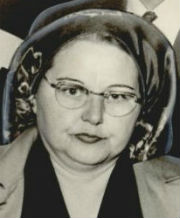
Elizabeth "Betty" Hellman was the 35-year-old wife of an Air Force major who had been stationed in Tokyo for over a year. Evidently Betty found the separation lonely, for she became pregnant while her husband was away. On January 28, 1952, Betty was admitted to the Tinker Air Force Base hospital in critical condition. She admitted to having undergone an abortion on January 25. When questioned by investigators on January 31, Betty said that friends had referred her to a woman named Jane. She was shown a photo and identified the woman in it, 43-year-old Mrs. Jane McDaniel White, as her abortionist. She gave White's address as the place she had gone for the abortion. She promised White $100, but only paid her $50. White initiated the abortion with some kind of packing and sent Betty home. Betty became very ill, and called White, who with her daughter came to Betty's home and "scraped her out".
After Betty gave her statement, police raided White's home. White and her daughter, Mrs. S. B. Anderson, Jr., were nowhere to be found. Police eventually tracked the pair down and arrested them for murder and procuring an abortion. White, who had been arrested twice in the past several years for abortion charges, insisted that she'd told Betty she "was not in the business" but did treat her for ptomaine poisoning, which she believed was what was causing Betty's vomiting. White admitted to having no medical training, and said that she "had no right" to diagnoses whether or not Betty was pregnant, but she was qualified to diagnose the ptomaine poisoning because she'd had a bout of it herself.
Betty died on February 6, from peritonitis. Her husband had managed to rush home from Tokyo in time to see his wife before she died. An autopsy verified that an abortion had been performed and had caused Betty's death.
The criminal case against White went well until the defense managed to have the Betty's deathbed statement declared inadmissible because it couldn't be proved satisfactorily that Betty believed herself to be near death. With the deathbed statement thrown out, the case was dropped. White was, however, clearly operating as an abortionist, since an operating table, fashioned from an old restaurant table, and surgical instruments had been sized from her home at the time of her arrest -- "enough instruments and medicine to stock a small hospital."
 1986: A Prestigious Chain of Abortion Facilities
Seventeen-year-old Laniece Dorsey underwent a safe and legal abortion at a Family Planning Associates Medical Group facility in Orange County, California, on February 6, 1986. Laniece lapsed into a coma, was transferred to a nearby hospital, and died later that day. The Orange County Sheriff's Department medical examiner blamed the death on cardiorespiratory arrest due to the anesthesia. Laniece wasn't the first or last young woman to die from abortion at a facility owned by FPA head honcho Edward Campbell Allred. Other patients known to have died after abortion at Allred's facilities include Denise Holmes, Patricia Chacon, Mary Pena, Josefina Garcia, Joyce Ortenzio, Tami Suematsu, Deanna Bell, Susan Levy, Christina Mora, Ta Tanisha Wesson, Nakia Jorden, Maria Leho, Kimberly Neil, Maria Rodriguez, and Chanelle Bryant. The FPA facilities remain members of the National Abortion Federation despite these deaths.
1987: Safe and Legal in Cleveland
Life Dynamics lists 26-year-old Kathy Davis on their "Blackmun Wall of deaths caused by safe and legal abortions. Citing Kathy's death certificate, Life Dynamics says that Kathy died at Cleveland Metropolitan General Hospital of heart failure and hypertension following a legal abortion on February 6, 1987.
A Coroner's Inquest was held regarding the February 6, 1870 death of 22-year-old Mary Donigan. Mary died at the Brooklyn home of Mrs. Bridget Dillon, who testified that she'd known Mary for about 18 years. Mary had come to her home on a Monday afternoon about three weeks before her death, looking very sickly but not complaining of illness. By the time Friday came around, Mary was reporting being sick with diarrhea.
Mary slept until noon the next day. Mrs. Dillon checked on her and found her appearing very ill. Mrs. Dillon offered to empty the slop pail in the room, but Mary said, "No, I've had a baby and it is in there; my mother sent me down to Margaret Farrell's, but she wouldn't keep me, so I thought I would come to you."
Mrs. Dillon looked in the pail and saw the baby, which she described as large -- in keeping with Mary's report of having been pregnant for about eight months. Mary reported that she had paid a doctor $5 for a bottle of medicine -- she refused to name this doctor -- and that she had thrown the bottle "in the water closet." Mrs. Dillon testified that Mary reported having taken the medicine about two or three weeks earlier, and that afterward she'd not felt her baby moving any more.
Mrs. Dillon consulted with some other women, as well as a pharmacist, about caring for Mary. The druggist provided some powders that she was to give to Mary every hour, but Mary didn't want to take more after the first dose, reporting that they only made her feel worse and blistered her mouth. Mary refused the services of either a doctor or a priest. In early February, Mary had taken such a turn for the worse that Mrs. Dillon sent for both a doctor and a priest. The doctor, Matthew F. Regan, testified that he'd been summoned to a garret room where he found Mary in bed, "suffering from inflammation of the womb and the covering of the bowels." Mary reported being married and having suffered a miscarriage the preceding Friday. Dr. Regan prescribed some medication and returned on Saturday.
At that time, Mary admitted that she wasn't married, and that she'd not seen a doctor or had any sort of abortion performed. He told her that her condition was very grave, "that I had seen women die who were not so low as she was." Mary identified a Mr. Burdie or McBurdie, who worked in the brick yards in Haverstraw, where Mary lived, as the father of the baby. When Dr. Regan returned at noon on Sunday to check on Mary, he found her dead. Dr. A. W. Shepard performed a post mortem examination on Mary and found no signs of instrumentation, but plenty of signs of infection in and around the uterus. He determined that she had died from an abortion.
1895: A Doctor at a Lying-In Hospital
In April of 1895, a reporter who was at the Detroit business of undertaker Frank Gibbs kicked a coffin that was in a corner of the room. Gibbs scolded, "Here, don't kick that coffin. There's a body in it, and I've got $100 for keeping it." The reporter went to the health department. When the undertaker got wind of this, he hastily had the body buried at Potter's Field.
An investigator went to Gibbs' establishment and found a death certificate for a woman named Myrtle Cook. The cause of death was given as pneumonia, and it was signed by Dr. J. D. Seaman. The health department ordered the just-buried body to be immediately exhumed and brought to another undertaking establishment for an autopsy. The cause of death was determined to be abortion. After an intensive investigation -- including a second disinterment for verification -- the woman was identified as Emily Hall, a young woman who had been brought to the area from her home in Birmingham, England, by Jonathan Bell, a Church of England clergyman who had gotten her pregnant. Shortly after Christmas Emily had told her parents that she had been hired as a lady's traveling companion and that they probably wouldn't hear from her until spring.
Emily had instead traveled directly to Detroit and checked into the Alice B. Lane Lying-in Hospital on January 23 for an abortion. All of the arrangements, including paying the $50 fee, had been made prior to her arrival, and on January 27 Dr. D. J. Seaman performed the abortion that eventually took Emily's life. Women who were at the hospital to give birth had been instructed to say that "Myrtle" had given birth to a live baby that had been placed with a foster family. The police recovered the baby's body, which had been buried in the back yard.
When arrested, the defendants -- Seaman and Lane -- refused to even enter a plea. Seaman's first trial ended in a hung jury, a second trial produced a conviction which Seaman had overturned, and a third trial ended with Seaman convicted of manslaughter and sentenced to ten years.
1919: An Unknown Perpetrator
On February 6, 1919, 22-year-old homemaker Edna Griffith died at Chicago's Passavant Hospital from septic pneumonia initiating from complications of an abortion perpetrated by a person who was never identified.
1952: A Professional Lay Abortionist
 |
| Jane McDaniel Wite |
Betty died on February 6, from peritonitis. Her husband had managed to rush home from Tokyo in time to see his wife before she died. An autopsy verified that an abortion had been performed and had caused Betty's death.
The criminal case against White went well until the defense managed to have the Betty's deathbed statement declared inadmissible because it couldn't be proved satisfactorily that Betty believed herself to be near death. With the deathbed statement thrown out, the case was dropped. White was, however, clearly operating as an abortionist, since an operating table, fashioned from an old restaurant table, and surgical instruments had been sized from her home at the time of her arrest -- "enough instruments and medicine to stock a small hospital."

Seventeen-year-old Laniece Dorsey underwent a safe and legal abortion at a Family Planning Associates Medical Group facility in Orange County, California, on February 6, 1986. Laniece lapsed into a coma, was transferred to a nearby hospital, and died later that day. The Orange County Sheriff's Department medical examiner blamed the death on cardiorespiratory arrest due to the anesthesia. Laniece wasn't the first or last young woman to die from abortion at a facility owned by FPA head honcho Edward Campbell Allred. Other patients known to have died after abortion at Allred's facilities include Denise Holmes, Patricia Chacon, Mary Pena, Josefina Garcia, Joyce Ortenzio, Tami Suematsu, Deanna Bell, Susan Levy, Christina Mora, Ta Tanisha Wesson, Nakia Jorden, Maria Leho, Kimberly Neil, Maria Rodriguez, and Chanelle Bryant. The FPA facilities remain members of the National Abortion Federation despite these deaths.
1987: Safe and Legal in Cleveland
Life Dynamics lists 26-year-old Kathy Davis on their "Blackmun Wall of deaths caused by safe and legal abortions. Citing Kathy's death certificate, Life Dynamics says that Kathy died at Cleveland Metropolitan General Hospital of heart failure and hypertension following a legal abortion on February 6, 1987.
Saturday, January 16, 2016
Three Illegal Abortions
A Media Circus in 1889
An inquest was held into the January 16, 1889 death of 22-year-old Kitty Cody, a young Oyster Bay woman, in Brooklyn. Frank P. Dudgeon had set Kitty up in Mrs. Anyon's house at 85 West Eighty-Ninth Street. Kitty took sick there. Mrs. Anyon, testified that Dudgeon had sent a box to Kitty, along with "a letter from him explaining the use of the contents of the box." The box evidently contained abortifacients. Kitty died at the apartment of Mrs. M. A. Harriman at 124 Flatbush Avenue.
The inquest was a circus, "held in the Supervisor's chamber, which was literally packed with spectators. It was replete with dramatic incidents, with some of which the crowd expressed its sympathies with the prosecution by breaking into applause." Mrs. Harriman attended the inquest with her daughter, Mrs. Clara Fernald. Dr. Charles F. Hall and Mrs. M. A. Flarriman were found to be complicit in concealing the commission of an abortion.
The prosecutor's office concluded that Kitty, provided with the abortion drugs, had attempted an abortion, then used an instrument provided to her to perform a self-induced abortion. On May 21, she had gone to a doctor who cared for her until hospitalizing her on June 6. While hospitalized she'd said something that had led to the belief that Dr. Charles Singley had perpetrated an abortion. Singley, when arrested, said that Kitty was trying to blackmail him. His only contact with her had been, he said, when she'd come to his office for treatment for a pelvic abscess. He'd treated her, she'd paid her $2, and left. This had been about a month prior to seeking care from the doctor who had hospitalized her.
Dudgeon married Kitty the day before her death. He was tried as an accessory to manslaughter in Kitty's death, but in April of 1889 "escaped conviction by a disagreement of the jury, which stood eight to four for conviction of manslaughter in the first degree." He was released on $10,000 bail, which he was able to pay himself in cash. In fact, so prosperous was Dudgeon that he managed to arrange a lavish birthday banquet for himself while he was in jail. However, in July of 1890, the DA of Kings County dismissed the indictment.
Early 20th Century Chicago
On January 16, 1901, 20-year-old Jennie Mallard died at St. Elizabeth's Hospital in Chicago from an abortion performed several weeks earlier. She signed a statement about three hours later incriminating Dr. Margaret Simmons, who was arrested and held in the death. Simmons would neither confirm nor deny the allegation. Simmons' profession is listed as nurse or midwifein the Homicide in Chicago database, but at that time and in that place, female obstetricians were often referred to as midwives. On the 1900 Census, she is listed as a physician.
Jennie Martin, a 28-year-old homemaker married to Frank Martin, died January 16, 1906 from sepsis caused by a criminal abortion. Though the Homicide in Chicago Database says she died at Wesley Hospital in Chicago, her death certificate indicates that she died at her home at 3555 Vincentles Avenue. My best guess is that she was died at the home but was taken to the hospital by family members who were in shock, and then the hospital reported the suspicious death to the police. Dr. William F. Brineywas held by the coroner's jury. Jennie's abortion is typical of pre-legalization abortions in that it was performed by a doctor.
An inquest was held into the January 16, 1889 death of 22-year-old Kitty Cody, a young Oyster Bay woman, in Brooklyn. Frank P. Dudgeon had set Kitty up in Mrs. Anyon's house at 85 West Eighty-Ninth Street. Kitty took sick there. Mrs. Anyon, testified that Dudgeon had sent a box to Kitty, along with "a letter from him explaining the use of the contents of the box." The box evidently contained abortifacients. Kitty died at the apartment of Mrs. M. A. Harriman at 124 Flatbush Avenue.
The inquest was a circus, "held in the Supervisor's chamber, which was literally packed with spectators. It was replete with dramatic incidents, with some of which the crowd expressed its sympathies with the prosecution by breaking into applause." Mrs. Harriman attended the inquest with her daughter, Mrs. Clara Fernald. Dr. Charles F. Hall and Mrs. M. A. Flarriman were found to be complicit in concealing the commission of an abortion.
The prosecutor's office concluded that Kitty, provided with the abortion drugs, had attempted an abortion, then used an instrument provided to her to perform a self-induced abortion. On May 21, she had gone to a doctor who cared for her until hospitalizing her on June 6. While hospitalized she'd said something that had led to the belief that Dr. Charles Singley had perpetrated an abortion. Singley, when arrested, said that Kitty was trying to blackmail him. His only contact with her had been, he said, when she'd come to his office for treatment for a pelvic abscess. He'd treated her, she'd paid her $2, and left. This had been about a month prior to seeking care from the doctor who had hospitalized her.
Dudgeon married Kitty the day before her death. He was tried as an accessory to manslaughter in Kitty's death, but in April of 1889 "escaped conviction by a disagreement of the jury, which stood eight to four for conviction of manslaughter in the first degree." He was released on $10,000 bail, which he was able to pay himself in cash. In fact, so prosperous was Dudgeon that he managed to arrange a lavish birthday banquet for himself while he was in jail. However, in July of 1890, the DA of Kings County dismissed the indictment.
Early 20th Century Chicago
On January 16, 1901, 20-year-old Jennie Mallard died at St. Elizabeth's Hospital in Chicago from an abortion performed several weeks earlier. She signed a statement about three hours later incriminating Dr. Margaret Simmons, who was arrested and held in the death. Simmons would neither confirm nor deny the allegation. Simmons' profession is listed as nurse or midwifein the Homicide in Chicago database, but at that time and in that place, female obstetricians were often referred to as midwives. On the 1900 Census, she is listed as a physician.
Jennie Martin, a 28-year-old homemaker married to Frank Martin, died January 16, 1906 from sepsis caused by a criminal abortion. Though the Homicide in Chicago Database says she died at Wesley Hospital in Chicago, her death certificate indicates that she died at her home at 3555 Vincentles Avenue. My best guess is that she was died at the home but was taken to the hospital by family members who were in shock, and then the hospital reported the suspicious death to the police. Dr. William F. Brineywas held by the coroner's jury. Jennie's abortion is typical of pre-legalization abortions in that it was performed by a doctor.
Subscribe to:
Comments (Atom)