Showing posts with label back-alley abortion. Show all posts

Wednesday, November 20, 2019

Referred to her Death: Karnamaya Mongar

 Just When Life Seemed Safe 

Headshot of a middle-aged Bhutanese woman with her hair pulled back and a faint smile on her face
Karnamaya Mongar
At the age of 41, Karnamaya Mongar had survived nearly 20 years in a refugee camp in Nepal. What she was unable to survive was a visit to an American abortion clinic.

Karnamaya, her husband, Ash, their three children and one grandchild arrived in the United States on July 19, 2009 as part of a resettlement program. 
Karnamaya was more than 18 weeks pregnant when went to a clinic in Virginia for an abortion. But the Virginia clinic, and another in Washington, D.C., did not do abortions that late in the pregnancy. One of the clinics referred Karnamaya to Kermit Gosnell's Women’s Medical Society in Philadelphia because Gosnell had a reputation for performing abortions regardless of gestational age.

Karnamaya went with her daughter to the Gosnell's clinic on November 18, 2009. That afternoon,
Latosha Lewis, who had completed a medical assistant course but had never been certified, conducted the clinic’s version of a “pre-examination,” which was so scanty it didn't even involve weighing the patient. Falsified informed consent forms were added to Karnamaya's file.  

After the "pre-examination" was done and the paperwork was completed, Randy Hutchins, a part-time physician’s assistant who worked without State Board of Medicine approval, inserted laminaria to dilate Karnamaya’s cervix and administered Cytotec to soften it. Hen then told Karnamaya to return the next day to complete the abortion.

Drugged Up

Kermit Gosnell's Philadelphia
"house of horrors" where
Karnamaya Mongar was drugged to
death by unqualified staff.
Karnamaya arrived at the clinic on November 19 around 2:30 p.m., accompanied by her daughter and her daughter's mother-in-law. At the front desk, Tina Baldwin gave Karnamaya her initial medication – Cytotec to soften the cervix and to cause contractions; and Restoril, a drug that causes drowsiness.  After giving Karnamaya the medicine, Baldwin told her to wait in the recovery area until the doctor arrived to perform the abortion.

Lynda Williams and Sherry West, who were without any medical-related qualifications medicated Karnamaya in the “recovery room” while she waited for Gosnell.

Karnamaya's daughter, Yashoda Gurung, told the Grand Jury that she waited with her mother in the recovery room for several hours. During that time, between 3:30 and 8:00 p.m., her mother was given five or six doses of oral medicine and repeated injections into an IV line in her hand.  As usual at Gosnell's clinic, no equipment was available to ensure proper monitoring of vital signs.
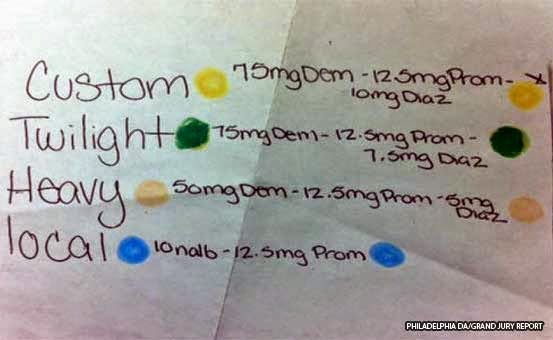

A handwritten, hand-colored chart of names for anesthesia concoctions and the amount of each drug to go in each
Anesthesia chart drawn up by 15-year-old
Gosnell employee Ashley Baldwin
Yashoda did not know what drugs her mother was given, but typically employees gave repeated injections of the concoction of sedative drugs that Gosnell referred to as a “twilight” dose. Each of these “twilight” doses, repeated a number of times at the discretion of the unlicensed workers, consisted of 75 milligrams of Demerol, 12.5 milligrams of promethazine, and 7.5 milligrams of diazepam.

The standard practice was for Gosnell's untrained staff to give repeated doses of sedative and pain-killing drugs to the patients, without regard to a woman's size or weight, whenever it was deemed necessary by the untrained staff. For example, if the woman started moaning, she was presumed to be in pain, and would be given another dose of drugs. Karnamaya, at only 4'11" in height and 110 lb. in weight, would have been endangered by a dose appropriate for an average-sized women, much less by the massive doses administered at Women's Medical Society.

A little before 8:00 p.m., West and Williams sent Karnamaya's daughter to another waiting area. She was left there, with no idea what was happening to her mother until the ambulance arrived after 11 p.m.

Williams helped Karnamaye into the procedure room, put her on the table, and drugged her again, this time with the clinic's "custom" dose of 75 mg. of Demerol, 12.5 mg. of promethazine, and 10 mg. of diazepam. The heavily drugged patient was then left, unattended and with no monitoring equipment, alone in the procedure room.

Cardiac Arrest

Kermit Gosnell mugshot
Sherry West told detectives that, some time after sedating Karnamaya, Williams came out of the procedure room, yelling for help. West said that when she later entered the procedure room, Gosnell was there trying to perform CPR on Karnamaya. Lynda Williams summoned Eileen O’Neill , an unlicensed medical school graduate who worked at the clinic, from her second-floor office.

O'Neill told the Grand Jury that she thought Karnamaya was already dead by the time she got to the procedure room, but she took over administering CPR because Gosnell wasn't doing it correctly. Gosnell, meanwhile, left to retrieve the clinic’s only “crash cart” (the emergency kit to treat a cardiac arrest) from the third floor. After returning with the kit, however, Gosnell did not use any of the drugs in it to try to save Karnamaya's life. Instead he just looked through them and seemed pleased that they were up to date. He seemed purely interested in keeping outsiders from finding out that the crash cart had been nowhere near the procedure room while patients were being sedated.

O’Neill testified that Gosnell told her not to administer Narcan, a drug that could have reversed the effects of the Demerol. She said that Gosnell told her it would not work on Demerol. O’Neill also said that she tried to use the defibrillator to revive Karnamaya, but that the paddles did not work.

Emergency Services

One of Gosnell's filthy
procedure rooms
It was after 11 p.m. – long after O’Neill had decided that Karnamaya was dead and returned to her office – that Lynda Williams finally asked Ashley Baldwin to call 911. Ashley then went into the procedure room and found Gosnell alone with his dead patient. He told Ashley to turn in the pulse oximeter, which they should have been using all along to monitor Karnamaya's pulse and blood oxygen. This surprised Ashley, since Gosnell knew that the pulse oximeter had been broken for months.

Emergency personnel arrived at 11:13. They found Karnamaya lifeless in the procedure room and Gosnell just standing there, not doing anything. The paramedics immediately intubated Karnamaya to give her oxygen, and started an intravenous line to administer emergency medications, since for some reason clinic staff had removed the IV line they'd been using all day to drug their patient. They also failed to tell the paramedics about the drugs they had administered.

Color photograph showing a railed entrance to a door blocked by a heavy security gate with a large lock. Three security barred windows are to the right of the door.
The locked back door to Women's Medical Society
The medics were able to restore weak heart activity. But getting Karnamaya to the ambulance was
 needlessly and dangerously time-consuming because the emergency exit was locked. Gosnell sent Ashley to the front desk to look for the key, but she could not find it. Ashley told the grand jury that a firefighter needed to cut the lock, but “It took him [20 minutes]… because the locks is old.” Karnamaya's daughter and friend ran outside, crying, and witnessed this. After cutting the locks, responders had to waste even more time struggling to maneuver through the cramped hallways that could not accommodate a stretcher.

When the ambulance arrived at the hospital shortly after midnight, Karnamaya had no heartbeat, no blood pressure, and was not breathing. After  aggressive resuscitation efforts, doctors were able to restore a weak heartbeat. Karnamaya was then sent to the Intensive Care Unit, where she remained on life support until family members could make the trip from Virginia to say good-bye. She was pronounced dead at 6:15 p.m. on November 20. She had died of a massive overdose of Demerol.


Monday, April 24, 2017

Doctors, a Midwife, and "Uncle Billy"

Oklahoma, 1937: A Midwife's Fatal Handiwork

A glamorous headshot of a beautiful young woman with short, dark hair looking over her shoulder into the camera with her large, wide-set eyes
Merl Williams
On April 24, 1937, Merl Williams of Watonga, Oklahoma, died of peritonitis. She was 21 years old, a worker in a poultry packing plant. Her death was attributed to a botched abortion.

A midwife, 57-year-old. Cordelia Moore, was charged with abortion murder. An investigation found evidence that Moore, formerly a registered nurse, had perpetrated hundreds of abortions in her home in Longdale, Oklahoma.

After her arrest, Moore "unworriedly set her glasses on the end of her nose and continued her quilting in the county jail." Her husband, John, actually got up in his cell and jigged when a jaunty tune came on the radio.

W. C. Mouse, a railroad engineer, testified that he had taken Merl to Moore's 3-room farm house on April 11, not knowing the reason for the visit. He said only that he had heard Merl ask Moore, "Will it be dangerous?" The state also gathered 14 additional witnesses in the case against Moore, including women swearing under oath that Moore had done abortions on them. The prosecutors were also investigating the possible abortion death of a married woman a few years previously.

Cordelia Moore was tried for the crime; her husband, John, was arrested but released. I have been unable to determine that outcome of any trial in Merl's death.


Oklahoma City, 1932: Two Docs' Deadly Spree

Poor qualilty profile shot of a middle-aged white man with eyeglasses.
Dr. J. W. Eisiminger
Virginia Lee Wyckoff, a University of Oklahoma student, age 21, died from complications of an abortion on April 24, 1932 Hers was one of a string of deaths in the city that year. Dr. J.W. Eisiminger, an osteopath, was tried and convicted of murder in Virginia's death. He admitted to having treated her in his office on April 3, but said that he didn't believe she was pregnant. Nevertheless, Virginia spent several days in a private home where Eisiminger kept recovering abortion patients under the care of Mrs. Luther Bryant Price. Dr. Richard Thacker, who had an abortion patient of his own die on April 24, 1932, also used Mrs. Price's home as a recovery center for his abortion patients.

Virginia was transferred from Mrs. Prices's home to Oklahoma City General Hospital, where she died of septicemia, first having told doctors there that Eisiminger had performed the fatal abortion.. A deathbed statement absolving Eisiminger was proven to be a forgery.

Eisiminger was sentenced to life in prison after pleading guilty to murder in her abortion death. The sentence was later reduced to 15 years.
A white man of about 60 years of age, with a very high forehead, large nose, and grim facial expression
Dr. Richard Thacker
Thacker's trial for the April 15, 1932 abortion death of Ruth Hall brought out testimony concerning the death April 24 death of 25-year-old Lennis May Roach and of other patients, including Robbie Lou Thompson, and Nancy Lee.

Mrs. Roach had come to Thacker's office several times, he admitted. Thacker said that she had been in poor health and emaciated, and had a white discharge, indicative of infection, from her vagina. She also, Thacker said, had pains in her abdomen. Thacker said that he treated her with a tonic and with antiseptic tampons.

He adamantly denied that he had performed an abortion on her. However, other witnesses, including Mrs. Roach's husband, testified that Thacker had indeed performed an abortion on Mrs. Roach, causing her death. Thacker was only prosecuted for Ruth Hall's death and was sentenced to life in prison. This is probably why he wasn't prosecuted for any of the other deaths. He died in prison in 1937.


Chicago, 1920: An Unidentified Perpetrator

On April 24, 1920, Emma Shanahan died at Chicago's St. Anthony Hospital from an abortion perpetrated by a person who was not identified. Most abortionists in Chicago in that era were doctors or midwives, which makes it likely that Emma availed herself of one of these trained medical professionals.


 Hannibal, Illinois, 1893: Racist Coverage of an Abortion Death

An article on the death of 19-year-old Emma Hub underscores the racism of the time. It begins, "Uncle Billy Nickens, a well-known colored character of Hannibal [Illinois], was arrested there yesterday charged with causing the death of Emmy Hub by a criminal operation."

Emma was the daughter of Jacob Hub, a German shoemaker living just south of the Hannibal city limits. Jacob had expelled his daughter from the house due to "her wild habits", so she had moved in with a painter named Mathew Seoville.  Around April 15 of 1893, Emma took ill, and was tended by a Dr. Ebbits. Ebbits suspected an abortion and refused to treat Emma until she admitted to it. "She continued to grow worse until death relieved her suffering at 1 a.m. yesterday" -- that being April 24.

Emma had told Mathew Seoville and his wife that she had gone to Nickens' house, where he had used instruments on her to cause an abortion. She said that a girl from Illinois was also there for an abortion. Mathew had pressed Emma to write up a declaration.

The fatal abortion was reportedly Emma's second; the previous had been performed the previous October. She also had given birth to a child about two years earlier.  The article notes that Nickens was arrested, adding, "The negro has been brought up on similar charges before, but always managed to clear himself."

Saturday, April 22, 2017

Chicago Doctors and Midwives, 1910-1923

Many physicians and midwives plied their trade as abortionists in early 20th century Chicago.

On April 22, 1923, 30-year-old Daisy Singerland died at Chicago's Robert Burns Hospital from complications of a criminal abortion performed earlier that day.  On June 1, 54-year-old Dr. James W. Lipscomb was indicted for felony murder in Daisy's death. I have been unable to determine the final outcome of the case.

On February 19, 1920, one of those midwives, 40-year-old Mary Simkus, evidently perpetrated an abortion on 28-year-old homemaker Sophia Krawczyk in the Krawczyk home.  After the abortion, Sophie took ill. Eventually she was taken to Cook County Hospital, where she died from sepsis on April 22.  Simka was indicted for Sophie's death, but for reasons I have been unable to determine the case never went to trial.

"Phyllis," identified in the source document as "Mrs. M.," was 46 years old when she had an abortion performed by a physician in Chicago on or around April 4, 1910.  The abortion was followed by pain, fever, and hemorrhage. On April 18, about two weeks after the abortion, she was admitted to Cook County Hospital with a pulse of 102, respirations of 24, and fever of 102. She was in a stupor upon admission, with her tongue dry and furred. Her abdomen was distended and tender. Her liver was enlarged. The lower lobe of her right lung had sounds indicating the presence of fluid.  That evening, Phyllis became delirious and had to be restrained to her bed. Staff were unable to record a pulse for her, but her temperature had risen to 102.4 and her respirations were a racing 50 per minute.  Phyllis died on April 22 from peritonitis and septic pneumonia.

Thursday, April 13, 2017

Two Different Stellas, Two Different Decades

Safe and Legal in California, 1968

Stella Saenz, age 42, was one of the growing number of safe-and-legal abortion deaths that were to soon almost completely replace illegal abortion deaths in the United States over the coming decade.

Stella had arranged for a legal abortion in the spring of 1968. At that time, California allowed legal abortions, but only in hospitals.

On April 11, she was admitted to Los Angeles County General Hospital with sepsis.  Doctors administered penicillin. Stella went into anaphylactic shock; neither she nor the doctors had realized that Stella was allergic to penicillin.  Doctors tried to treat both the infection and Stella's reaction to the penicillin, to no avail. She died on April 13.

The California Department of Public Health classified Stella's death as both a drug reaction death and a legal abortion death.


One of Louise Achtenberg's Many Victims

On April 13, 1909, Stella Kelly Lowery, age 28, died of septicemia at a hospital in Chicago, from an abortion that had been perpetrated around March 5. Stella, a waitress, was divorced and was identified by her maiden name in the Homicide in Chicago Interactive Database.

Louise Actenberg, age 59, sometimes identified as a doctor and sometimes as a midwife, was charged with murder by abortion by a coroner's jury. Achtenberg was also implicated in the 1907 abortion death of Dora Swan and the 1909 abortion deaths of Stella and of Florence Wright. In 1918, at the age of 69, she was arrested for performing an abortion on Miss Ruth G. Pickling,[1] but acquitted, going on to be arrested for the 1920 abortion death of Violet McCormick and the 1924 death of Madelyn Anderson. I can find no record that she was ever incarcerated, which is hardly surprising, given how hospitable Chicago has typically been to the many doctors and midwives who perpetrated abortions in the city.

Wednesday, April 05, 2017

Another Chicago Doctor's Abortion Business, 1927

On the morning of April 5, 1927, Arhne Reynolds died at the Chicago office of Dr. Louis Ginsburg from an abortion performed on her there that day. Ginsburg was arrested on April 18, and indicted for felony murder on May 15.

So far I have been unable to determine the outcome of the case.

Arhne's abortion was typical of illegal abortions in that it was performed by a physician.

Keep in mind that things that things we take for granted, like antibiotics and blood banks, were still in the future. For more about abortion in this era, see Abortion in the 1920s

During the first two thirds of the 20th Century, while abortion was still illegal, there was a massive drop in maternal mortality, including mortality from abortion. Most researches attribute this plunge to improvements in public health and hygiene, the development of blood transfusion techniques, and the introduction of antibiotics. Learn more here.


Graph showing the maternal mortality rate at about 850 in 1800, dropping to 700 around 1910, jumping to around 800 in 1920, falling at about a 45 degree angle until 1940, then plummeting sharply until 1950, where it begins to level off before sitting just above 0 from around 1978 onward


Saturday, February 18, 2017

Doctors' Work Over a Century Ago

Injured While Her Abortionist Was Awaiting Trial

On February 18, 1916, Beulah Hatch, age 24, died at Mercy Hospital in Denver. Dr. Bennett Graff, already out on bond while awaiting trial for the February 2 abortion death of Ruth Camp, was believed to have perpetrated the abortion that likely killed Beulah. Both women, in fact, were in Mercy Hospital at the same time, which means that Beulah's abortion must have been perpetrated prior to Ruth's death.

Beulah had gone to Denver about six weeks prior to her death, installing herself in a rooming house and then entering Graff's care. He had her removed to the Panama rooming house, where he had offices. She remained there at the rooming house until her condition deteriorated to the point where somebody sent for her husband. Mr. Hatch summoned the family physician, Dr. Andrews, who came to Denver from Longmont. He examined Beulah and had her transferred to the hospital. Once she was there, Andrews transferred her to the care of a local physician, T. Mitchell Burns, who attended her until her death.

The Physician-Fiance

A Victorian-era portrait of a beautiful, elagant-looking young white woman with dark hair, pearl drop earrings, and a lace collar
Kittie O'Toole
At about 2:00 p.m. on February 18, 1883, 28-year-old Irish immigrant Kittie O'Toole died at the office of Dr. C. H. Orton, her betrothed, in Milwaukee.

Orton attributed Kittie's death to an epileptic seizure. Orton's neighbors, however, found the death suspicious and demanded an investigation.

The coroner's jury found Orton culpable for two murders -- of Kittie and of her unborn baby -- for having perpetrated a fatal abortion.

Orton, a widower more than 60 years of age, was a prominent politician and a doctor of longstanding in the community, which makes it interesting that in late April a municipal court judge suddenly dismissed all of the charges against Orton.

Wednesday, February 08, 2017

The Spectrum of Illegal Abortion Deaths

Self-Induced in Pittsburgh, 1919

On February 8, 1919, Ruth Fragale, a 20-year-old clerk, died at her home in Pittsburgh, Pennsylvania. Her mother and her sister said that Ruth had taken ill on Sunday, February 2, but had insisted that she was not sick enough to need a doctor. Because Ruth had gotten much sicker, her mother sent for Dr. Thomas C. VanHorne on February 4. He was caring for her, with her mother and her sister by her side, when she told him that she'd used instruments on herself to try to cause an abortion on February 1 and 2 after an attempt about two weeks earlier had failed. VanHorne continued to attend to Ruth daily until peritonitis finally killed her, leaving her husband, Frank, widowed. 

Strangely enough, self-induced abortion attempts like Ruth's were far more common in Pittsburgh records than in Chicago, where the majority of fatal abortions were perpetrated by doctors or midwives, as we shall see from the next case.

A Typical Chicago Abortion, 1934

Dr, Lou E. Davis
Dr. Lou E. Davis was tried three times for the February 8, 1934 abortion death of 27-year-old Gertrude GaesswitzThe first trial resulted in a hung jury, the second in an overturned conviction. Davis was acquitted in the third trial. Davis was implicated in five other Chicago abortion deaths:

An Abortion-Rights Group Cites its Sources

Raisa Trytiak
Unlike most abortion-rights sources, the Seattle Civil Rights & Labor History project cites sources for its assertions and thus wins my admiration.  In the case of  Raisa Trytiak, they cite the Seattle Times (February 8 & 9, 1967, Seattle Post-Intelligencer (February 9 & 10, 1967), and the Everett Herald (May 23, 1967). They even include a clipping from the Seattle Post-Intelligencer's February 10, 1967 issue, which noted that Black was held after failing to post $10,000 bail on charges of manslaughter for both Raisa and her unborn child. Raisa was a key punch operator in Seattle First National Bank. For some reason she turned to a neighbor and family friend, 61-year-old Jack Blight, when she wanted to arrange an abortion. Blight was a construction worker. He attempted to abort Raisa's six-month unborn baby, causing a fatal bubble of air in Raisa's blood stream. There were mysterious marks on Raisa's neck indicating strangulation as well, but the news coverage, the web site says, never explained them. Blight entered a guilty plea to manslaughter in Raisa's death and admitted to dumping her body, but for some reason was sentenced only to probation rather than to prison. 

Raisa's decision to turn to a lay abortionist was unusual. Two independent sources -- Nancy Howell Lee and Planned Parenthood -- concluded that prior to legalization, 90% of women found doctors to do their abortions. Lee further found that even when women resorted to non-physicians, they more often than not went to a nurse, midwife, or other person with medical training. More typical of criminal abortions is the one that took the life of 19-year-old Nancy Ward in Kansas City the very same day Raisa Trytiak died.

A Typical Pre-Roe Abortion

Nancy Ward
In November of 1967, Nancy, a student at the University of Oklahoma, told her boyfriend, Fred Landreth, that she was pregnant and wanted an abortion. Fred contacted his father for help. On January 30, 1968, Fred's father contacted osteopath Dr. Richard Mucie at his ear, nose, and throat clinic in Kansas City and made arrangements for the abortion.

On February 7, Nancy and Fred flew from Oklahoma to Kansas City and visited Mucie at his clinic. Mucie examined Nancy while Fred waited, then told the couple that he would contact them at their hotel. The two had dinner and went to a show, then went to the hotel. At 11 p.m., Mucie called and arranged to pick Nancy and Fred up and drive them to his clinic. He took Nancy back for the back room while Fred waited in the outer office. About 20 to 30 minutes later, Mucie, dressed in a surgeon's gown, returned to the front office and asked Fred for money, $400, before starting the procedure. At about 7:30 on the morning of February 8, Mucie came out and asked Fred if he wanted to come back and see Nancy.

Dr. Richard Mucie
Fred went with Mucie into the office and saw Nancy lying on a couch with a cover over her. Fred said, "Hello," to her. She smiled and moved her hand. Mucie told Fred that Nancy was still sedated. Fred went back to the waiting room to nap. He was awakened at about 11:30 that morning by Mucie's porter. Mucie told Fred that Nancy had suffered a heart attack and was in shock and had been taken to the hospital. He told Fred that he would come back for him, then went back into his office. Fred went looking for him and followed the sound of his voice to a back room, where Mucie was lying on a cot, talking on the phone and saying something to the effect of needing to call the coroner and filling out a death certificate.

Stunned, Fred went back to the waiting area. Mucie came out a few minutes later, told him that Nancy had died, and that they needed to stick to the story that the couple had been traveling through Kansas City and had called him because Nancy had started to have chest pains. It was around that time that the ambulance arrived. The driver and attendant found Nancy on a cot. Mucie told them that she still had a pulse, and instructed them to take her to Osteopathic Hospital and administer oxygen en route. The ambulance driver and attendant lifted Nancy and found that she was already stiff. The doctor at the hospital concluded that Nancy been dead about four hours. He called Mucie, who told him that he'd been treating Nancy for about two weeks for a heart condition. Nancy's body was taken to the morgue, where a detective observed the autopsy, noting needle marks on her arms, buttocks, and left breast and taking custody of the uterus and the skull and upper spine of a fetus of roughly 4 1/2 to 5 months gestation still in the uterus. Most of the remainder of the fetus, consisting of a shoulder blade, upper arm and shoulder joint, and part of a collar bone, was found in the trash at Mucie's clinic.

The autopsy found abundant evidence of the abortion, including stains from antiseptic on Nancy's upper thighs and genital area, a 1/2 inch tear in Nancy's uterus. The condition of her uterus, heart, and other organs indicated that she had gone into shock and died at the clinic at about 9 a.m. February 8, in spite of Mucie's attempts to resuscitate her. She had bled to death.

Mucie was convicted on June 8, 1968, of performing an abortion "not necessary to preserve the life" of the mother. Illegal abortion at that time carried a penalty of 3-5 years, with the sentence to be increased in cases where the mother died. Mucie served 14 months then was released on parole. Parole was set to expire on July 27, 1977. His medical license was revoked on May 4, 1971. After Roe v. Wade overturned Missouri's abortion law, Mucie successfully appealed his conviction and got his license restored under a ruling that made Roe retroactive in Missouri. He was released from probation and his record expunged of the manslaughter-abortion conviction.

*****

Ruth Fragale death certificate

Saturday, October 01, 2016

Medical Complications and a Suicide After Abortions

Three Early 20th Century Chicago Abortion Deaths

On October 1, 1908, 21-year-old Mary Rahn died in a Chicago hospital from complications of an abortion performed that day. Mary was a Chicago native, a single woman who did housework for a living. She was the daughter of German immigrants. her father was a glassmaker, her mother a homemaker. She had three older brothers. Midwife Frida Trappe was arrested and held by the coroner's jury on October 14. The case went to trial, but Trappe was acquitted on July 12 0f 1909. Trappe's employment status is recorded as "Outside labor force (incl. criminals)", which may be an indication that she was a professional lay abortionist.

On October 1, 1914, eighteen-year-old Lillian Giovenco died at Wesley Hospital in Chicago from complications of a criminal abortion. Dr. Eva Shaver, Dr. Leopold Pijan, and Dr. John Fernow were held by the coroner in Lillie's death. Shaver had been identified as the abortionist by Lillie's husband, Frank. The coroner concluded that the fatal abortion had been preformed on September 5 in a medical facility that my source describes as "Abortion place". It was most likely Shaver's practice in her Chicago home. Eva Shaver convicted in Lillie's death, appealed, and was granted a new trial while under indictment for the 1915 abortion death of Anna Johnson, which Shaver had tried to disguise as a suicide by shooting the dead woman in the head as she lay on the floor of Shaver's home.


On October 1, 1922, 21-year-old bookkeeper Margaret Sullivan died in her Chicago home on Peck Street from hemorrhage and infection caused by an abortion performed at an undetermined time and place. The person or persons responsible were never caught and it is thus impossible to learn if Margaret went to one of the many physician-abortionists or midwife-abortionists practicing in Chicago at the time.

Safe and Legal in Washington, DC, 1989

Brenda Banks was 35 years old and 13 weeks pregnant when she went to Hillcrest Women's Surgi-Center in Washington, DC, for a safe, legal abortion. The abortion was performed by Llewelyn Crooks on September 30, 1989.

Brenda went into shock, and was transported to the hospital by ambulance. Doctors performed an emergency hysterectomy and transfused Brenda with 20 units of red blood cells, to no avail. She died the following day, October 1, 1989. Brenda's uterus had been perforated and several major blood vessels had been cut or severed entirely.

Her survivors were unable to collect damages from Crooks and Hillcrest because Crooks' insurance company was insolvent, and Hillcrest carried no insurance. I have been unable to determine if the Hillcrest where Brenda had her abortion is affiliated with the Hillcrest in Pennsylvania where Kelly Morse had her fatal abortion.


Suicide in New Jersey, 2001

A smiling young white woman with long, straight blond hair, dressed in white graducation cap and gown
Stacy Zallie
Stacy Zallie, then a 19-year-old college student, wanted to become an elementary school teacher. Though she loved children and wanted to become a mother, she went to  Steven Chase Brigham's "American Medical Services" in Cherry Hill, New Jersey on July 6, 2001 for an abortion. There, Stacy was provided with a "Fact Sheet on Surgical Abortion" which did not address the risks of major depression or suicide but merely recommended that a patient should talk to a counselor or psychiatrist if she thought she needed help.

She kept the abortion a secret from her family, but they noticed behavior changes. Her parents arranged psychiatric care after Stacy took an overdose of pills. Four months later, without saying why, Stacy quit going to therapy and resumed her drinking binges. On October 1, 2002, mere days before she was to serve as a bridesmaid in her brother's wedding, Stacy took her own life after at least three failed prior attempts at suicide.

After learning of the abortion and Stacy's unbearable anguish afterward, her parents started the **Stacy Zallie Foundation** to provide post-abortion care so that nobody else's daughter suffers the fate their daughter did. The Zallie family takes no stand on abortion, seeking to keep their focus on providing desperately-needed aftercare to suffering women, regardless of politics, creed, or religion.


Abortion is associated with an increase in all forms of violent death: accident, homicide, and suicide. Other post-abortion suicides include:

  • "Sandra Roe," age 18, who killed herself using an unidentified means in April of 1971
  • Sandra Kaiser, age 15, who threw herself off an overpass into traffic in November of 1984
  • Carol Cunningham, age 21, who shut herself in her garage, ran her car, and died from the exhaust fumes in August of 1986
  • Arlin della Cruz, age 19, who hanged herself in the woods near her house in October of 1992
  • Haley Mason, age 22, who overdosed on pills and alcohol in April of 2001
  • Laura Grunas, age 30, who fatally shot her baby's father and then herself in August of 2006

Monday, August 15, 2016

1909: A Teen Dead, a Doctor Implicated

On August 15, 1909, Lillian Swing, age 15, died in Chicago from an abortion performed on August 9.

Dr. Hamilton Shaver and his wife were held by the coroner's jury. The source document doesn't indicate that the case went to trial.

Monday, June 27, 2016

Typical Abortion Deaths, 1929 and 1934

Both of today's deaths are from typical criminal abortions in that they were perpetrated by physicians.

On June 24, 1929, 19-year-old homemaker Winifred Garver underwent an abortion at the office of Dr. Anna Schultz, aka Rollins. Schultz was assisted by Dr. James White. Winifred died on June 27 at Woodlawn Hospital. Winifred was white; both her abortionist and the assistant were Black. On June 27, both physicians were held by the coroner. Schultz was indicted for felony murder by a grand jury on October 6, 1930.

A bald, middle-aged white man wearing round, black-rimmed eyeglasses
Dr. Guy Brewer
Hermione Fowler, a 20-year-old coed at the Oklahoma A&M University, died at her Red Oak, Oklahoma home on June 27, 1934, nine days after an abortion perpetrated by noted local philanthropist Dr. Guy E. Brewer. Hermoine was one of six women to die after abortions perpetrated by Brewer. Doris Jones, a 20-year-old mother of two, died April 11, 1935. Ruby Ford died on April 1, 1934. Wanda Lee Gray, age 20, Myrtle Rose, age 21, and Elizabeth Shaw, age 23, evidently died in early June of 1935.

Brewer entered guilty pleas and served six concurrent four-year sentences. The most likely reason that Brewer's punishment was so light for the deaths of six women was how popular he was in town for his benevolence toward young men. He ran a home for them to live in while he put them through college. So beloved was Brewer that one victim's husband was fired from his job in retaliation for reporting Brewer to the police.

Sunday, May 01, 2016

A Gruesome Tale, A Midwife's Work, and a Back-Alley Doctor

A Gruesome Family Secret from 1916

A poor-quality portrait from a newspaper showing a young white woman with large eyes and fine features, and thick dark hair
Maud Tabor Virgo
In November of 1915, Maud Tabor of Lawton, Michigan became the fifth wife of undertaker-turned-real estate salesman Joseph Virgo, who reportedly told Maud that he didn't want any children. The two of them had known each other for years and had been romantically involved prior to the wedding. But afterward, Joe and Maud evidently didn't hit it off very well, because on February 1, she returned home to Lawton, leaving her husband and her married name behind.

On May 1, 1916, a few months after the death of her father, 46-year-old Maud vanished. Stories circulated in town that Maud had gone to a western ranch for her health, that Maud was teaching in Salt Lake City, and that she was out west scouting out valuable mining property. Suspicions arose, since Maud had not taken leave of anybody and nobody got a letter or post card from her. Sarah refused to discuss the topic with neighbors, who dismissed this refusal as part of Sarah's eccentric personality.

Eventually her brother Walter began to tell people that Maud had died while out of town.

On November 20, 1919, Maud's sister, Florence, noticed that there was something under a pile of old shingles in the basement of the family home. She moved some shingles aside and saw that the object was a trunk. Grabbing it by the handle, she started to drag it into the middle of the cellar only to have the end pull off. Protruding from the end of the trunk was a human foot.

A sketch from a newspaper showing two white men opening a trunk containing what appears to be crumpled cloth
Opening the trunk
Florence immediately fled to a neighbor's house. The neighbor summoned the police, who opened the trunk and found a dead woman, clad in a white shirtwaist, black skirt, and white stockings. Doctors and undertakers examining the body found it to be in a remarkable state of preservation. It had, in fact, been embalmed. Even though the nose was missing, there was little doubt that the face was that of Maud. 

Both Walter and their mother were arrested. Sarah Tabor gave multiple stories about how Maud had died and about why she had kept the body in a trunk in the basement. The only consistent item was the date of death: May 1, 1916.

Investigators worked at untangling the tales and eventually concluded that either Maud's mother or her estranged husband had perpetrated an abortion on her, using chloroform as an anesthetic, and Maud had died during the process. They also arrested Virgo. 

Eventually Walter Tabor told police that his mother had confessed to him that she had perpetrated the abortion herself.  Eventually, Maud's mother was the only person tried in the case. Her first trial resulted in a hung jury after 36 hours of deliberation. They were stuck at a vote of 8 to 4 in favor of conviction. The second was dismissed due to lack of evidence. She had spent nearly all of her wealth on attorneys in order to keep her freedom. 

A Midwife in Chicago, 1925

On May 1, 1925, 26-year-old Mary Sayers died at a Chicago residence from a criminal abortion performed on her that day. Midwife Edna Marie Dietrich was arrested the following day.

A Stereotypical Back Alley Doctor, Kentucky, 1928

On Saturday, April 14, 1928, Dr. T. D. Goodman was called to see a young woman named Bessie Kouns. He found her in a great deal of pain, with considerable swelling and tenderness of the lower abdomen. He treated her for several days,  but her condition was not improving so on the 17th he had her admitted to Stephenson Hospital in Ashland, Kentucky. There, her condition continued to deteriorate. On April 24, the peritonitis had caused bowel obstruction, requiring surgery. Prior to the surgery, which Bessie did not expect to survive, she made a deathbed statement to Dr. Stephenson.

She told Stephenson that at 7:00 on a Saturday evening, she had gone to 60-year-old Dr. Henry C. Dorroh's office to keep an appointment for an abortion. Dorroh had been drinking and didn't at first recognize her. She reminded him of the appointment. He cussed and told her to get on the table. He approached her with an instrument that he dropped on the floor, then picked up and used on her. He "nearly killed her", Stephenson testified that Bessie said. Stephenson's testimony was supported by Mr. Watt Prichard, who was present at the time Bessie made her declaration.

Despite the surgery, Bessie died from septic peritonitis on May 1 at the age of 29.

When the case went to trial, Dorroh insisted that he had treated Bessie in February, but only for gonorrhea, and that the treatment might had caused an abortion had Bessie indeed been pregnant. The expert testimony was that the described treatment would indeed be appropriate for gonorrhea, but testimony was divided on whether it would cause an abortion.  Dorroh was found guilty by a jury that included six women, but his conviction was later set aside and a new trial ordered.