Showing posts with label Philadelphia abortion. Show all posts

Wednesday, November 20, 2019

Referred to her Death: Karnamaya Mongar

 Just When Life Seemed Safe 

Headshot of a middle-aged Bhutanese woman with her hair pulled back and a faint smile on her face
Karnamaya Mongar
At the age of 41, Karnamaya Mongar had survived nearly 20 years in a refugee camp in Nepal. What she was unable to survive was a visit to an American abortion clinic.

Karnamaya, her husband, Ash, their three children and one grandchild arrived in the United States on July 19, 2009 as part of a resettlement program. 
Karnamaya was more than 18 weeks pregnant when went to a clinic in Virginia for an abortion. But the Virginia clinic, and another in Washington, D.C., did not do abortions that late in the pregnancy. One of the clinics referred Karnamaya to Kermit Gosnell's Women’s Medical Society in Philadelphia because Gosnell had a reputation for performing abortions regardless of gestational age.

Karnamaya went with her daughter to the Gosnell's clinic on November 18, 2009. That afternoon,
Latosha Lewis, who had completed a medical assistant course but had never been certified, conducted the clinic’s version of a “pre-examination,” which was so scanty it didn't even involve weighing the patient. Falsified informed consent forms were added to Karnamaya's file.  

After the "pre-examination" was done and the paperwork was completed, Randy Hutchins, a part-time physician’s assistant who worked without State Board of Medicine approval, inserted laminaria to dilate Karnamaya’s cervix and administered Cytotec to soften it. Hen then told Karnamaya to return the next day to complete the abortion.

Drugged Up

Kermit Gosnell's Philadelphia
"house of horrors" where
Karnamaya Mongar was drugged to
death by unqualified staff.
Karnamaya arrived at the clinic on November 19 around 2:30 p.m., accompanied by her daughter and her daughter's mother-in-law. At the front desk, Tina Baldwin gave Karnamaya her initial medication – Cytotec to soften the cervix and to cause contractions; and Restoril, a drug that causes drowsiness.  After giving Karnamaya the medicine, Baldwin told her to wait in the recovery area until the doctor arrived to perform the abortion.

Lynda Williams and Sherry West, who were without any medical-related qualifications medicated Karnamaya in the “recovery room” while she waited for Gosnell.

Karnamaya's daughter, Yashoda Gurung, told the Grand Jury that she waited with her mother in the recovery room for several hours. During that time, between 3:30 and 8:00 p.m., her mother was given five or six doses of oral medicine and repeated injections into an IV line in her hand.  As usual at Gosnell's clinic, no equipment was available to ensure proper monitoring of vital signs.
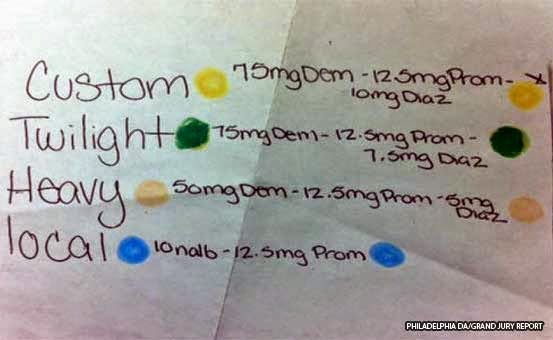

A handwritten, hand-colored chart of names for anesthesia concoctions and the amount of each drug to go in each
Anesthesia chart drawn up by 15-year-old
Gosnell employee Ashley Baldwin
Yashoda did not know what drugs her mother was given, but typically employees gave repeated injections of the concoction of sedative drugs that Gosnell referred to as a “twilight” dose. Each of these “twilight” doses, repeated a number of times at the discretion of the unlicensed workers, consisted of 75 milligrams of Demerol, 12.5 milligrams of promethazine, and 7.5 milligrams of diazepam.

The standard practice was for Gosnell's untrained staff to give repeated doses of sedative and pain-killing drugs to the patients, without regard to a woman's size or weight, whenever it was deemed necessary by the untrained staff. For example, if the woman started moaning, she was presumed to be in pain, and would be given another dose of drugs. Karnamaya, at only 4'11" in height and 110 lb. in weight, would have been endangered by a dose appropriate for an average-sized women, much less by the massive doses administered at Women's Medical Society.

A little before 8:00 p.m., West and Williams sent Karnamaya's daughter to another waiting area. She was left there, with no idea what was happening to her mother until the ambulance arrived after 11 p.m.

Williams helped Karnamaye into the procedure room, put her on the table, and drugged her again, this time with the clinic's "custom" dose of 75 mg. of Demerol, 12.5 mg. of promethazine, and 10 mg. of diazepam. The heavily drugged patient was then left, unattended and with no monitoring equipment, alone in the procedure room.

Cardiac Arrest

Kermit Gosnell mugshot
Sherry West told detectives that, some time after sedating Karnamaya, Williams came out of the procedure room, yelling for help. West said that when she later entered the procedure room, Gosnell was there trying to perform CPR on Karnamaya. Lynda Williams summoned Eileen O’Neill , an unlicensed medical school graduate who worked at the clinic, from her second-floor office.

O'Neill told the Grand Jury that she thought Karnamaya was already dead by the time she got to the procedure room, but she took over administering CPR because Gosnell wasn't doing it correctly. Gosnell, meanwhile, left to retrieve the clinic’s only “crash cart” (the emergency kit to treat a cardiac arrest) from the third floor. After returning with the kit, however, Gosnell did not use any of the drugs in it to try to save Karnamaya's life. Instead he just looked through them and seemed pleased that they were up to date. He seemed purely interested in keeping outsiders from finding out that the crash cart had been nowhere near the procedure room while patients were being sedated.

O’Neill testified that Gosnell told her not to administer Narcan, a drug that could have reversed the effects of the Demerol. She said that Gosnell told her it would not work on Demerol. O’Neill also said that she tried to use the defibrillator to revive Karnamaya, but that the paddles did not work.

Emergency Services

One of Gosnell's filthy
procedure rooms
It was after 11 p.m. – long after O’Neill had decided that Karnamaya was dead and returned to her office – that Lynda Williams finally asked Ashley Baldwin to call 911. Ashley then went into the procedure room and found Gosnell alone with his dead patient. He told Ashley to turn in the pulse oximeter, which they should have been using all along to monitor Karnamaya's pulse and blood oxygen. This surprised Ashley, since Gosnell knew that the pulse oximeter had been broken for months.

Emergency personnel arrived at 11:13. They found Karnamaya lifeless in the procedure room and Gosnell just standing there, not doing anything. The paramedics immediately intubated Karnamaya to give her oxygen, and started an intravenous line to administer emergency medications, since for some reason clinic staff had removed the IV line they'd been using all day to drug their patient. They also failed to tell the paramedics about the drugs they had administered.

Color photograph showing a railed entrance to a door blocked by a heavy security gate with a large lock. Three security barred windows are to the right of the door.
The locked back door to Women's Medical Society
The medics were able to restore weak heart activity. But getting Karnamaya to the ambulance was
 needlessly and dangerously time-consuming because the emergency exit was locked. Gosnell sent Ashley to the front desk to look for the key, but she could not find it. Ashley told the grand jury that a firefighter needed to cut the lock, but “It took him [20 minutes]… because the locks is old.” Karnamaya's daughter and friend ran outside, crying, and witnessed this. After cutting the locks, responders had to waste even more time struggling to maneuver through the cramped hallways that could not accommodate a stretcher.

When the ambulance arrived at the hospital shortly after midnight, Karnamaya had no heartbeat, no blood pressure, and was not breathing. After  aggressive resuscitation efforts, doctors were able to restore a weak heartbeat. Karnamaya was then sent to the Intensive Care Unit, where she remained on life support until family members could make the trip from Virginia to say good-bye. She was pronounced dead at 6:15 p.m. on November 20. She had died of a massive overdose of Demerol.


Sunday, November 20, 2016

Death Came Just When Life Seemed Safe

 Just When Life Seemed Safe 

Headshot of a middle-aged Bhutanese woman with her hair pulled back and a faint smile on her face
Karnamaya Mongar
At the age of 41, Karnamaya Mongar had survived nearly 20 years in a refugee camp in Nepal. What she was unable to survive was a visit to an American abortion clinic.

Karnamaya, her husband, Ash, their three children and one grandchild arrived in the United States on July 19, 2009 as part of a resettlement program. 
Karnamaya was more than 18 weeks pregnant when went to a clinic in Virginia for an abortion. But the Virginia clinic, and another in Washington, D.C., did not do abortions that late in the pregnancy. One of the clinics referred Karnamaya to Kermit Gosnell's Women’s Medical Society in Philadelphia because Gosnell had a reputation for performing abortions regardless of gestational age.

Karnamaya went with her daughter to the Gosnell's clinic on November 18, 2009. That afternoon,
Latosha Lewis, who had completed a medical assistant course but had never been certified, conducted the clinic’s version of a “pre-examination,” which was so scanty it didn't even involve weighing the patient. Falsified informed consent forms were added to Karnamaya's file.  

After the "pre-examination" was done and the paperwork was completed, Randy Hutchins, a part-time physician’s assistant who worked without State Board of Medicine approval, inserted laminaria to dilate Karnamaya’s cervix and administered Cytotec to soften it. Hen then told Karnamaya to return the next day to complete the abortion.

Drugged Up

Kermit Gosnell's Philadelphia
"house of horrors" where
Karnamaya Mongar was drugged to
death by unqualified staff.
Karnamaya arrived at the clinic on November 19 around 2:30 p.m., accompanied by her daughter and her daughter's mother-in-law. At the front desk, Tina Baldwin gave Karnamaya her initial medication – Cytotec to soften the cervix and to cause contractions; and Restoril, a drug that causes drowsiness.  After giving Karnamaya the medicine, Baldwin told her to wait in the recovery area until the doctor arrived to perform the abortion.

Lynda Williams and Sherry West, who were without any medical-related qualifications medicated Karnamaya in the “recovery room” while she waited for Gosnell.

Karnamaya's daughter, Yashoda Gurung, told the Grand Jury that she waited with her mother in the recovery room for several hours. During that time, between 3:30 and 8:00 p.m., her mother was given five or six doses of oral medicine and repeated injections into an IV line in her hand.  As usual at Gosnell's clinic, no equipment was available to ensure proper monitoring of vital signs.


A handwritten, hand-colored chart of names for anesthesia concoctions and the amount of each drug to go in each
Anesthesia chart drawn up by 15-year-old
Gosnell employee Ashley Baldwin
Yashoda did not know what drugs her mother was given, but typically employees gave repeated injections of the concoction of sedative drugs that Gosnell referred to as a “twilight” dose. Each of these “twilight” doses, repeated a number of times at the discretion of the unlicensed workers, consisted of 75 milligrams of Demerol, 12.5 milligrams of promethazine, and 7.5 milligrams of diazepam.

The standard practice was for Gosnell's untrained staff to give repeated doses of sedative and pain-killing drugs to the patients, without regard to a woman's size or weight, whenever it was deemed necessary by the untrained staff. For example, if the woman started moaning, she was presumed to be in pain, and would be given another dose of drugs. Karnamaya, at only 4'11" in height and 110 lb. in weight, would have been endangered by a dose appropriate for an average-sized women, much less by the massive doses administered at Women's Medical Society.

A little before 8:00 p.m., West and Williams sent Karnamaya's daughter to another waiting area. She was left there, with no idea what was happening to her mother until the ambulance arrived after 11 p.m.


Williams helped Karnamaye into the procedure room, put her on the table, and drugged her again, this time with the clinic's "custom" dose of 75 mg. of Demerol, 12.5 mg. of promethazine, and 10 mg. of diazepam. The heavily drugged patient was then left, unattended and with no monitoring equipment, alone in the procedure room.

Cardiac Arrest

Kermit Gosnell mugshot
Sherry West told detectives that, some time after sedating Karnamaya, Williams came out of the procedure room, yelling for help. West said that when she later entered the procedure room, Gosnell was there trying to perform CPR on Karnamaya. Lynda Williams summoned Eileen O’Neill , an unlicensed medical school graduate who worked at the clinic, from her second-floor office.

O'Neill told the Grand Jury that she thought Karnamaya was already dead by the time she got to the procedure room, but she took over administering CPR because Gosnell wasn't doing it correctly. Gosnell, meanwhile, left to retrieve the clinic’s only “crash cart” (the emergency kit to treat a cardiac arrest) from the third floor. After returning with the kit, however, Gosnell did not use any of the drugs in it to try to save Karnamaya's life. Instead he just looked through them and seemed pleased that they were up to date. He seemed purely interested in keeping outsiders from finding out that the crash cart had been nowhere near the procedure room while patients were being sedated.

O’Neill testified that Gosnell told her not to administer Narcan, a drug that could have reversed the effects of the Demerol. She said that Gosnell told her it would not work on Demerol. O’Neill also said that she tried to use the defibrillator to revive Karnamaya, but that the paddles did not work.

Emergency Services

One of Gosnell's filthy
procedure rooms
It was after 11 p.m. – long after O’Neill had decided that Karnamaya was dead and returned to her office – that Lynda Williams finally asked Ashley Baldwin to call 911. Ashley then went into the procedure room and found Gosnell alone with his dead patient. He told Ashley to turn in the pulse oximeter, which they should have been using all along to monitor Karnamaya's pulse and blood oxygen. This surprised Ashley, since Gosnell knew that the pulse oximeter had been broken for months.

Emergency personnel arrived at 11:13. They found Karnamaya lifeless in the procedure room and Gosnell just standing there, not doing anything. The paramedics immediately intubated Karnamaya to give her oxygen, and started an intravenous line to administer emergency medications, since for some reason clinic staff had removed the IV line they'd been using all day to drug their patient. They also failed to tell the paramedics about the drugs they had administered.

Color photograph showing a railed entrance to a door blocked by a heavy security gate with a large lock. Three security barred windows are to the right of the door.
The locked back door to Women's Medical Society
The medics were able to restore weak heart activity. But getting Karnamaya to the ambulance was
 needlessly and dangerously time-consuming because the emergency exit was locked. Gosnell sent Ashley to the front desk to look for the key, but she could not find it. Ashley told the grand jury that a firefighter needed to cut the lock, but “It took him [20 minutes]… because the locks is old.” Karnamaya's daughter and friend ran outside, crying, and witnessed this. After cutting the locks, responders had to waste even more time struggling to maneuver through the cramped hallways that could not accommodate a stretcher.

When the ambulance arrived at the hospital shortly after midnight, Karnamaya had no heartbeat, no blood pressure, and was not breathing. After  aggressive resuscitation efforts, doctors were able to restore a weak heartbeat. Karnamaya was then sent to the Intensive Care Unit, where she remained on life support until family members could make the trip from Virginia to say good-bye. She was pronounced dead at 6:15 p.m. on November 20. She had died of a massive overdose of Demerol.

SOURCE: Grand Jury Report.


Wednesday, November 16, 2016

A Fake Clinic, a Midwife, and a Dentist

2002: Death at a Fake Clinic

A woman identified as "Patient A" (I'll call her "Adelle"), was 26 years old and had a history of anemia and sickle cell disease. Dr. Mi Yong Kim did not order proper lab studies, document an appropriate history, or perform a proper exam on Adelle before performing a safe and legal abortion on her on November 16, 2002. Kim administered 25 mg of Versed to Adelle, in response to her reports of pain, over a 10-minute period, without giving the medicine time to take effect.

At the end of the abortion, Kim noted that Adelle's pulse oximeter reading was only 70%, an alarming finding. Kim thought she found a pulse, did not assess whether or not Adelle was breathing, and simply ordered her staff to give Adelle oxygen by mask and call 911 but nobody made any actual attempt to resuscitate her. The ambulance crew arrived and transported Adelle to the hospital, where she was declared dead from possible air embolism.

The board did not suspend or yank Kim's license, instead noting that she was making improvements in her quality of care. She was instead placed under stipulations regarding her use of anesthesia in her office and her record-keeping. Kim called her office "Landmark Women's Center", giving the impression that it was a clinic.


1905: A Chicago Midwife

On November 16, 1905, 18-year-old Dorothy Spuhr died in County Hospital in Chicago from an abortion performed on November 13.  Midwife Julia Gibson, aka Timmons, was arrested and held by the coroner's jury. Gibson went on to perpetrate a fatal abortion on Bessie Braun the following year.

1882: A Philadelphia Dentist

Elizabeth "Lizzie" Holstein, age 23, originally worked as a house servant in Wilmington, Delaware before moving to Philadelphia. In June of 1882, she and her beau, Willard Kauffman, traveled to her family's home in Milton, Delaware, to ask for her parents' permission to marry. She returned to Philadelphia, where she continued a job as a family servant until October 30, when she moved in with her aunt, Mrs. Maggie Rust, on Moyamensing Avenue.

Lizzie returned briefly to her employer's home on November 7 to retrieve some of her clothing. At the time she was suffering with a fever and chills. She corresponded with her parents about her illness, and they traveled to Philadelphia to be with her. Lizzie's condition seemed to be improving over Friday and Saturday, but on Sunday, but Lizzie relapsed. Her condition steadily deteriorated over Monday. On Tuesday evening she spoke to her aunt and confessed that she was ailing from the effects of an abortion Kaufman had paid for. It had been perpetrated on October 7 by the dentist who had made her false teeth. Mrs. Rusk asked Elizabeth to be more specific, and she replied, "George Buchanan, at Fifth and Pine Streets." Lizzie also made a deathbed statement to Dr. Samuel D. Marshall, who attended to her in her final sickness, identifying "Dr. Buchanon" as her abortionist Dr. Marshall thought that Lizzie was referring to John Buchanan, an evidently well-known local criminal who had been convicted of some crime having to do with issuing bogus diplomas. John Buchanon was George Buchanan's father.

In spite of all that Dr. Marshall could do, Lizzie died on November 16 from cumulative blood loss. Lizzie's parents knew nothing about the pregnancy or the abortion until after her death. Dr. Marshall notified the coroner's office. An investigation eventually led to the arrest and conviction of George Buchanan, who was quickly granted a new trial. I have been unable to determine if the trial actually took place and, if so, what the outcome was.

Thursday, October 13, 2016

A Mix of Lethal Abortions, 1838-1971

A Philadelphia Physician, 1838

A Philadelphia boarding house owner named Mary Kingsley reported that on October 4, 1838, a Dr. Henry Chauncey appeared at breakfast time. "He made me make some tea of a powder that looked like black pepper." The tea was given to 21-year-old Elizabeth "Eliza" Sowers, who until the previous May had been a worker at a paper mill in Manayunk, NJ. She'd been brought to the boarding house -- one of unsavory reputation -- by Chauncey the day before.

At around 2:00 the following morning, Eliza called to the boarding house owner. "She said she was very bad. She said, 'I won't take any more of that doctor's medicine; it will kill me.'"

Chauncey returned later, performing some sort of procedure upon Eliza with something "which shined and looked like a knitting needle," according to the owner of the boarding house. Chauncey said that Eliza was "the most difficult person he had ever operated on. Said the medicine he gave her was too powerful, and had acted too quick."

Eliza died on October 13 from the ministrations of Dr. Chauncey. Chauncey and Nixon arrived at Eliza's family home that evening to say that she had died of "impacted bowels." A second doctor, William Armstrong, had signed a death certificate to that effect.

Eliza's brother was having none of it. He demanded that Eliza's body be exhumed and examined, revealing the real cause of her death.

The three men went to trial using a defense based on attacking the reputations of Eliza, her family, her fiance, and the woman who ran the boarding house. Armstrong and Nixon won acquittals, and Chancey was convicted only of malpractice, not the double murder of Eliza and her unborn baby.

Self-Induced in Chicago, 1908

Nineteen-year-old "Cathy," identified in the source as "Miss R," used a catheter on herself to abort a six-week pregnancy. She went to a doctor for aftercare, and the physician packed her uterus with gauze.

Two days later, on September 25, 1908, she was admitted to Cook County Hospital. Her condition wasn't alarming. Her pulse of 90, respirations of 24, and temperature of 99.6 indicated a mild infection. Her uterus was enlarged and tender. Upon examination, a doctor was able to put two fingers through Cathy's dilated cervix, and noted "blood clots" in the uterus.

The next day, Cathy's condition was very much the same, if not slightly improved with a pulse of 80, respirations of 28, and temperature of 99.4. She was subjected to a uterine curettage, followed by irrigation and packing.

All the surgery did was make things worse. The localized infection had, through the scraping of the uterus, become a generalized case of toxemia. Cathy's condition deteriorated over the course of 17 days until her death on October 13.


A Lay Abortionist in Boston, 1939

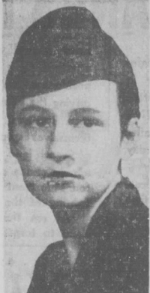
A black-and-white headshot of a young white woman, her hair pulled back and wearing a military-style hat
Barbara Hanson
On October 13, 1939, the body of Barbara Hanson, age 21, was found in a Boston motel room. Barbara had checked into the motel herself under an assumed name the previous day. At about 2:00 a.m., other guests at the motel complained to management about loud noises, described in some accounts as screams, coming from the room.

A hotel employee detective went to the room and found Barbara dead on the bed. She was tentatively identified by the I.D. found in her purse. The identification was verified by her uncle.

Police found fingerprints on four empty cocktail glasses and an open bottle on the bedside table.

Four men were in the room with her: I. Bernard Gannon, age 23, James Carter, 27, Raymond Fermino, 26, and George F. Norton, 26. Reports say that one of them admitted on the spot to having perpetrated an abortion on Barbara, but the reports to not specify which one.

An autopsy showed that immediately after the abortion, Barbara had suffered a fatal heart attack. Barbara's father, Frederick S. Hanson, a Penn State building engineer, went to New York to claim her body. When questioned by reporters, he said, "I just received worth that Barbara had passed on. I don't know any of the circumstances."

After their trial started, James Carter and George F. Norton pleaded guilty to performing the abortion that killed Barbara, and each received a 5-7 year sentence. Bernard Gannon, who was the baby's father, and Raymond Fermino each pleaded guilty as accessories and were sentenced to one year.

Safe and Legal in New York, 1971

"Tammy" traveled from Ohio to New York to undergo an abortion under New York's liberal abortion law. Her abortion was performed on September 25, 1971. She was 33 years old.

After the abortion, Tammy developed an infection which finally ended her life on October 13, 1971.

The 1970 liberalization of abortion had made New York an abortion mecca until the Roe vs. Wade Supreme Court ruling that abortionists could legally set up shop in any state of the union. In addition to "Tammy," these are the women I know of who had the dubious benefit of dying from the newfangled safe-and-legal kind of abortion in pre-Roe New York:


  • Pearl Schwier, July, 1970, cardiac arrest during abortion
  • Carmen Rodriguez, July, 1970, salt solution intended to kill the fetus accidentally injected into her bloodstream
  • Barbara Riley, July, 1970, sickle-cell crisis triggered by abortion recommended by doctor due to her sickle cell disease
  • "Amanda" Roe, September, 1970, sent back to her home in Indiana with an untreated hole poked in her uterus
  • Maria Ortega, October, 1970, fetus shoved through her uterus into her pelvic cavity then left there
  • "Kimberly" Roe, December, 1970, cardiac arrest during abortion
  • "Amy" Roe, January, 1971, massive pulmonary embolism
  • "Andrea" Roe, January, 1971, overwhelming infection
  • "Sandra" Roe, April, 1971, committed suicide due to post-abortion remorse
  • "Anita" Roe, May, 1971, bled to death in her home during process of outpatient saline abortion
  • Margaret Smith, June, 1971, hemorrhage from multiple lacerations during outpatient hysterotomy abortion
  • "Annie" Roe, June, 1971, cardiac arrest during anesthesia
  • "Audrey" Roe, July, 1971, cardiac arrest during abortion
  • "Vicki" Roe, August, 1971, post-abortion infection
  • "April" Roe, August, 1971, injected with saline for outpatient abortion, went into shock and died
  • "Barbara" Roe, September, 1971, cardiac arrest after saline injection for abortion
  • Carole Schaner, October, 1971, hemorrhage from multiple lacerations during outpatient hysterotomy abortion
  • "Beth" Roe, December, 1971, saline injection meant to kill fetus accidentally injected into her bloodstream
  • "Roseann" Roe, February, 1971, vomiting with seizures causing pneumonia after saline abortion
  • "Connie" Roe, March, 1972, cardiac arrest during abortion
  • "Julie" Roe, April, 1972, holes torn in her uterus and bowel
  • "Robin" Roe, May, 1972, lingering abortion complications
  • "Roxanne" Roe, May, 1972, given overdose of abortion sedatives
  • "Danielle" Roe, May, 1972, air in her bloodstream

Wednesday, September 14, 2016

From Colonial Times to the 1990s.

A Drawn-Out Colonial-Era Abortion

Sarah Grosvenor, age 19, died in Pomfret, Connecticut on September 14, 1742 after an abortion perpetrated by Dr. John Hallowell. Sarah wanted to marry the baby's father, Amasa Sessions, but he pressured her to go through with an abortion.

Beginning in mid-July, Sarah tried abortifacients given to her by a seedy local doctor named John Hallowell. The abortifacients only succeeded in making her ill. Hallowell gave various concoctions to Sarah over several a period of about two weeks before finally using instruments on August 2. Two days later, Sarah expelled a dead baby, a girl about half the size of a full-term newborn. Sarah's sister buried the baby in the woods. Sarah seemed to rally at first, but became progressively more ill, finally dying on September 14.

Chicago Abortions in the 1920s

The Notorious Dr. Lucy Hagenow

On September 14, 1925, 19-year-old Elizabeth Welter died in the Chicago office of Dr. Lucy Hagenow from complications of an abortion performed that day. Elizabeth, who worked as a clerk, had gone to Chicago from her home of Sturgeon Bay, Wisconsin, a few weeks before her death.

Lawrence Vail was identified by the coroner as responsible for the pregnancy, and the coroner recommended his arrest. The coroner also recommended the arrest of Dr. Hagenow. However, because Vail refused to give a statement, police were unable to gather enough evidence to arrest her.


Headshot of a white woman in late middle-age, with unkempt dark hair and a scowling, unpleasant facial expression
Dr. Lucy Hagenow
Like many physicians, especially female physicians, Hagenow was a popular Chicago abortionist. Elizabeth was one of the last Chicago abortion deaths attributed to Dr. Lucy Hagenow, aka Dr. Louise Hagenow. The others include:

Hagenow had set up shop in the more abortion-genial Chicago after being repeatedly prosecuted for abortion deaths in San Francisco. The first young woman, Louise Derchow, died in 1886. Annie Dories and Abbie Richards died in 1888. There were two other fishy deaths -- Emma Dep, whose abortion death Hagenow sloughed off as having been self-induced, and Franz Krone, an elderly man whose cash and valuables vanished as he died in Hagenow's hospital.

A Lay Abortionist With a Physician Accomplice

On September 14, 1928, 20-year-old Stella Wallenberg, a bindery worker, died from a criminal abortion performed in Chicago. Loretta Rybicki, identified as a "massaguer", was held by the coroner for murder by abortion. Dr. Nicholas Kalinowski was held as an accessory. Rybicki was indicted for felony murder on November 15.

It was not unusual for a lay abortionist to have a physician as an accomplice. Such physicians would do things such as train the lay abortionist, supply instruments and drugs, and provide aftercare if a woman suffered complications.

Safe and Legal in Philadelphia

Rhonda Rollinson, age 32, underwent a safe, legal abortion by Dr. Jay I. Levin at Malcom Polis's Philadelphia Women's Center September 3, 1992. The abortion attempt was unsuccessful. Rhonda was then sent home, with instructions to return on September 12 to try again.

Rhonda experienced such severe pain, dizziness, fever, and discharge that on September 10 she sought emergency care at a hospital. She was suffering "severe non-cardiogenic pulmonary edema consistent with adult respiratory distress syndrome." Doctors did a laparoscopy, dilation and evacuation, abdominal hysterectomy, and splenectomy, to no avail. Rhonda died on September 14. The autopsy revealed a perforation from her vagina into the uterine cavity, sepsis, disseminated intravascular coagulopathy, non-bacterial thrombotic endocarditis, pulmonary infarctions, and dysplastic kidney.

The suit filed by Rhonda's survivors also charged the facility and Polis with hiring Levin despite his lack of competence, failure to properly supervise his work, violation of applicable laws and regulations, lack of informed consent, failure to give proper post-operative instructions, and failure "to respond to the requests of [Rhonda] and her family for post-operative medical advice."

Thursday, July 07, 2016

Two Ordinary Abortion Deaths and an Abortion Lobby Poster Child

A Chicago Doctor, 1941

On July 7, 1941, 27-year-old mother of two Emma Laisure went to the office of Dr. Nathaniel H. Schaffner in Chicago. Her husband, Earl, had made the arrangements and paid Schaffner $40 for an abortion. Emma died at Schaffner's office before he could even complete the abortion. Earl said that Schaffner warned him to "say nothing about it to anyone." Schaffner kept Emma's body for 8 hours, evidently waiting for Earl to come for it, before finally taking it to the family home.

To compound the tragedy, Emma died on the couple's seventh wedding anniversary.

Schaffner insisted during his trial that though Earl had offered him $40 to perpetrate the abortion, he had refused and Emma had shown up later, in severe pain, and died of a heart condition before he could even finish examining her. The jury didn't believe him. Schaffner was convicted of murder and sentenced to 14 years in prison. He appealed his sentence but it was upheld in 1943.

An Atypical Death Embraced by the Abortion Lobby 

Headshot of a young Black woman wearing a blouse and jacket, eyeglasses, and hair styled in a laite 1940s coif
Vivian Campbell
I was originally very skeptical about a story told on the National Organization for Women web site. They said that Vivian Campbell was a recently-separated 24-year-old mother of two when she discovered she was pregnant. NOW indicated that Vivian sent her children to stay with her parents while she obtained some sort of illegal abortion. NOW provided no details of the abortion, but did say that Vivian asked for her estranged husband, who came to the hospital only after she had died of peritonitis on May 6, 1950.

I decided to check the story out when I was able to visit the archives of the Allegheny County Coroner's Office in Pittsburgh. What I found left me totally bewildered as to why NOW and other abortion advocacy organizations using Vivian's story didn't bother to do any research.They certainly would have hit pay dirt. The details paint a poignant picure.

Vivian worked for the IRS, her age was 27, and her death took place at 7:05 p.m. on Friday, July 7, 1950.

Her estranged husband, Edward L. Cambpell, told the coroner's jury that on the evening of Thursday, June 22, he got a call at work. He was to go to the Elks Hall to pick up a package from Vivian and deliver it to the children. When Edward arrived, he noticed Vivian sitting at a table, drinking, with two men. Edward ordered a beer, and the bartender gave him the package. Though Vivian did approach the bartender to verify delivery of the package, she didn't speak at all to Edward.

On Wednesday, June 28, Edward spoke with Vivian's grandmother, Mrs. Jordon, who told him that Vivian was very sick. He called Vivian's home but the woman who answered, Miss Daniels, said that Vivian was too sick to speak to him. He told Miss Daniels to get a doctor and whatever else Vivian needed.

On Friday, June 30, Dr. John C. Reed was called in and cared for Vivian. He returned the next day, July 1, and talked to Vivian about his conclusion that she'd undergone an abortion. She admitted to taking a large amount of castor oil, but said she'd taken it for a cold. Dr. Reed told Vivian that she needed to go to the hospital, and her friends drove her to McKeesport Hospital, where she was admitted at 11:30 a.m, suffering from abdominal pain and distention, and moderate vaginal discharge but no bleeding. Her admission notes indicate that she had already expelled the fetus and most of the placenta, but might have retained some tissue. Her vital signs were alarming, with a pulse of 120 and respiration 26 and shallow. Her blood pressure was 118/70, within normal limits. She had some deep tenderness of the abdomen. She appeared to be slightly dehydrated.

Her doctor prescribed medications for her. Edward visited Vivian at the hospital at about 3:30 that afternoon and found her very sick. He consulted with Dr. Reed, who said that Vivian had gangrene and was in very serious condition. He called her from time to time to check in on her. Finally on Friday, July 7, Edward got a call at about 4:30 p.m. from Vivian's family, telling him to hurry to the hospital. He found his estranged wife unconscious, and remained at her side until her death that evening. At no point, Edward said, had Vivian said anything to him about the abortion.

According to Vivian's death certificate, she had suffered a ruptured bowel during the abortion attempt, causing the peritonitis that killed her.

Safe and Legal in Pennsylvania, 1982

On July 2, 1982, 23-year-old Darlene Wood was put under anesthesia for a second trimester abortion at Temple University Hospital. The abortionist was Renga Rajan; the anesthesiologist was William Stevenson-Smith. Darlene was given nitrous oxide by face mask. She started coughing after the procedure began.

After the abortion was completed, she was admitted to the respiratory intensive care unit, where she was diagnosed with primary pulmonary hypertension. Over the next several days, Darlene experienced increasing respiratory distress. She was given medication to maintain her blood pressure. But on July 7, Darlene went into cardie-respiratory arrest. She was pronounced dead at 2:50 p.m. The administrator of Darlene's estate contended that the lack of appropriate medical and anesthetic clearance was a substantial factor in her death.

Rajan was also successfully sued for the 1987 abortion death of Iris Velazquez.

Sunday, June 19, 2016

Abortion, Murder, and Suicide

The abortion deaths commemorated today connect to other tragedies: a suicide and a murder


An Abortion and a Murder in 1908

On June 19, 1908, undertaker Thomas Graham went to the house of William C. Patterson in West Philadelphia. There he picked up the body of Patterson's 27-year-old sister-in-law, Elizabeth "Bess" Alexander Geis. The young woman, Graham was told, had died that day of Bright's disease. Elizabeth's brother, Leslie Alexander, knew that Bess had not died from Bright's disease. He went to the police, telling them that she had died from a botched abortion and demanding that they arrest Dr. William H. Heck, who had cared for Elizabeth during her final illness.

Police questioned Heck, who said that he had given Bess some medication, then came back the next morning and found that her condition had deteriorated. "I did what I could for her," he said, "but when I was called four and a half hours later she was dead. I was told that a child had been born before she passed away." Supporting the idea that Bess had died from an abortion, her body had been removed from the Haasz and taken to undertaker Sarah Elliot, who had already buried the baby under the name Elizabeth A. Wilson, child of Fred Wilson and Elizabeth Alexander Wilson. "in an obscure corner of the Franklin Cemetery." Elliot sent Bess's body to another undertaker, George Graham, who buried Bess in Mt. Moriah Cemetery.

The investigation was complicated, and in some ways derailed, on June 26, when Wilson died after drinking poisoned ale that had been sent to him via an express office. Police theorized that Bess's husband, Frederick Geis, Jr., had poisoned Heck in revenge for having caused his wife's death. However, after sorting through testimony and dates, it became clear that the poisoned ale had been purchased before Bess's death.


A Typical Chicago Abortion, 1922


On June 19, 1922, homemaker Veronica Maslanka, a 26-year-old Polish immigrant, died in her Chicago home from complications of an abortion performed there that day. The coroner identified midwife Mary Pesova as the person responsible for Veronica's death. Since there were many midwives in addition to physicians practicing abortion in Chicago at the time, Veronica's abortion was typical of those perpetrated in that era.

An Abortion and a Suicide, 1927

Headshot from a news clipping showing a white man with short dark hair and fine features, weaing a bow tie
Dr. George Slater
On Friday, June 18, 1927, Dr. George F. Slater admitted 20-year-old Anna Mae Smith to a Chicago hospital, saying that she was suffering from appendicitis. The next day, Anna died from after telling a police detective-- as well as her husband and sister -- that Slater had perpetrated an abortion on her.
A police officer went to Slater's home the following morning to inform him of Anna Mae's death and to deliver a summons to appear at an inquest. Slater calmly breakfasted with his family, sent his kids off to Sunday school, then went into the bathroom and took poison, dying in his wife's arms after telling her to look after the children. Mrs. Slater told police that he was innocent of the abortion charge and that she was certain he had killed himself over some financial problems.
This was not the first time Slater had been implicated in an abortion death. He had been held in 1922 for the abortion death of Delia Campbell and had been indicted by a grand jury for homicide on May 1, 1926 for the 1925 abortion death of 23-year-old Helen Bain.
 

1928: The First of Two Deaths Attributed to Dr. Mike Roberson

Dr. Mike Roberson was convicted and sentenced to two to five years for the abortion death of 23-year-old Miss Irma Louise Robinson, a schoolteacher from Raleigh, North Carolina. A man named M. H. Davis said that he'd paid Roberson $50 to for the abortion, perpetrated in Roberson's office on June 1, 1928. The pair had made a total of four trips to arrange the abortion, Davis said, and he had waited in the waiting room of Roberson's practice while Irma had gone back to have the abortion done. He was there, he said, when Roberson gave Irma aftercare instructions and sent her to the home of Mrs. E. E. Forsythe, who was paid $40 to care for Irma as she recovered. The next day, Irma became seriously ill and was taken to the hospital where her condition deteriorated until she died on June 19. Two doctors who examined Irma said she'd died of blood poisoning from an incomplete abortion.
Roberson was either not tried a second time or was not convicted in the second trial, because he was free in 1932 to be implicated in the abortion death of Myrtle Gardner.


*******

Elizabeth Geis original death certificate: