Thursday, October 19, 2023

October 19, 1990: One of Hachamovitch's Many Dead Patients

Nineteen-year-old Christina Goesswein ("Patient A" in medical board documents) was almost 23 weeks pregnant when she went to the office of Dr. Moshe Hachamovitch on October 17, 1990. The first part of the three-day abortion procedure was started that day. She was sent home and told to return the following day to have her cervix dilated even further for the abortion, which would take place on the 19th.

She came back on the 18th and had more laminaria inserted then returned home. That evening, her boyfriend called the doctor's office because Christina was having cramping. He was told to give her pain medicine. Christina's boyfriend called again several hours later because he felt that she was running a fever, but Christina told Dr. Hachamovitch's employee who was taking call that evening that she was okay.

Early in the morning of the 19th, the boyfriend called the employee again because Christina was experiencing heavy bleeding, cramping and vomiting. Christina stated that she felt that she was in labor. The employee instructed Christina to go to Hachamovitch's office where she and the doctor would meet her.

They all met at the office some time between 3:00 and 4:00 a.m. After arriving at there, Christina lost control of her bowels. Hachamovitch then delivered her 24-week fetus in one piece.

Because Christina was not recovering as she should have, Dr. Hachamovitch decided to admit her to an area hospital, but before this could be done, Christina quit breathing and her heart stopped. Somebody called 911 at about 4:20 a.m., and Dr. Hachamovitch began CPR. Christina was taken to a Bronx hospital where she was pronounced dead at 6:11 a.m. on October 19, due to an amniotic fluid embolism.

Hachamovitch's license was suspended over his false documentation regarding administration of oxygen, and the Christina's blood loss. The medical board also found a plethora of faults in Hachamovitch's treatment of his patient, including:
  • His record-keeping was dangerously inadequate.
  • He failed to ensure that Christina got immediate medical care when she was displaying life-threatening complications, instead arranging for her to travel and meet him at his practice.
  • He continued with an abortion in an outpatient setting even after observing for himself how dangerous Christina's condition was.
  • He didn't have any qualified staff assisting with the risky task of anesthetizing his patient.
  • He failed to promptly notice that Christina had sopped breathing and failed to resuscitate her properly.
Christina wasn't the only patient to lose her life due to Hachamovitch's unwillingness or inability to manage his practice. Two other patients, Tanya Williamson in 1996 and Luz Rodriguez in 1986, had died of malpractice under his care. Three patients died after abortions in clinics he owned and managed elsewhere -- Lisa Bardsley and Lou Ann Herron in Arizona and Jammie Garcia in Texas.


Sources: New York State Board For Professional Medical Conduct No. 93-127; State Board of New York Statement of Charges September 16, 1992; "History of trouble at clinics," Arizona Republic, January 17, 1999; United States Court of Appeals for the Second Circuit Docket No. 97-9065; "Clinic head faces complaints," Arizona Republic July 15, 1998; U.S. Court of Appeals for the Second Circuit - 159 F.3d 687 (1998)

October 19, 1954: A Naturopath in Texas

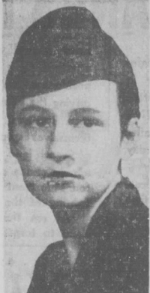
Sylvia Redman
Dr. Sylvia Redman (pictured), a 57-year-old woman who had a license to practice naturopathy in Texas, signed a written confession on October 20, 1954 regarding the death of 27-year-old homemaker Betty Jean Ledel the previous day. 

Redman' confession said that Betty came to her Fort Worth practice, Nature Foods & Clinic at 2836 Hemphill on October 8, saying that she thought she was pregnant. Betty asked her "if I could help her get rid of the baby. I told her the danger of everything and she said she was not afraid. I told her I would rather her to go somewhere else and have the baby stopped in twenty four hours, because my work is slow. I do it by shooting a little air up into the womb. (uterus) By going through the cervix into the uterus, where the embryo is carried. She told me she wanted me to do it." Redman complied, repeating the process daily. 

On October 19, Betty again went to Redman. Her husband and one of their two young children waited outside in the car. Redman took Betty upstairs, "laid her on a table used for females," and inserted a canula into Betty's uterus. She pushed five syringes full of air into Betty's uterus and asked Betty if she could feel it. Betty said that she could, a little. "And she looked up at me and said I feel choky, and then she passed out." Redman also noticed that Betty was bleeding vaginally.

Redman said, "I used artificial respiration. I picked her up in my arms and laid her on the floor. And I slung water at her to try to revive her, and then I had a lady downstairs to call an ambulance. The ambulance came and got her and took her to Harris Hospital where Betty was pronounced dead on arrival, leaving 7-year-old David and 2-year-old Cathy without a mother.

Redman threw away the instruments but police quickly found them and got a confession. An autopsy verified that Betty had indeed been pregnant, and blamed her death on the introduction of air into her uterus to produce abortion. The six or seven week old embryo was intact and undamaged. Betty's blood vessels had air in them, and one of her lungs had collapsed. The examiner concluded that she had died from an air embolism.

Redman seemed to have a mixed reputation in the area. She was charged with practicing medicine without a license in October of 1945, but by 1947 was in good standing, with the newspaper reporting that she had returned after a study of endo-nasal and aural therapy at Philadelphia College of Neuropathy and Naturopathy. 

Redman's jury deliberated slightly under two and a half hours before finding her guilty of murder by abortion. She was sentenced to confinement in the penitentiary for four years, a far cry from the death penalty she could potentially have faced. Her appeal was denied and she was paroled in May of 1957.


Sources:

October 19, 1910: Work of a Likely Lay Abortionist

Pelagia Usoraki, age 32, died on October 19, 1910 in a Chicago residence after an abortion perpetrated in Chicago by  Rosalie Tomajoski on October 13. Tamojosky, who was indicted by a grand jury for murder in Pelagia's death, is identified in the Homicide in Chicago Interactive Database as an "abortion provider."

October 19, 1918: Doctor Reports Abortion Death

Russian immigrant Anna Kelson, age 20, died at her Chicago home on North Talman Avenue on October 19, 1918. Dr. Virginia Johnson, who had been called in to care for Anna, supposedly for influenzal pneumonia. She found a nurse attending to Anna but did not get the nurse's name. Dr. Johnson determined that Anna had died from an abortion and reported the death to the police.

Wednesday, October 18, 2023

October 18, 1939: Doctor Sentenced to Sing-Sing

On October 18, 1939, Miss Alice Corbett, age 28, of Brooklyn, New York, died at Murray Hill Hospital in Manhattan. The young telephone operator's death was attributed to "acute gangrenous and suppurative endometritis," that was "diffuse" and "generalized" and caused by a uterine perforation during an illegal abortion. 

An investigation determined that 48-year-old Dr. Allen F. Murphy had perpetrated the fatal abortion at his office at 159 West 87th Street in Queens. Murphy was sentenced to 2-10 years in Sing-Sing for Alice's death. 

I can't find prison records for Murphy, so it's possible that he got his conviction overturned.

According to census records, Murphy was born in Ohio in 1893, son of Benjamin and Lillie Murphy. He remained in Cincinnati, Ohio, until at least 1920. He lived in rural Kentucky through most of the 1930s. After relocating to New York, Murphy worked as a physician for a steamboat company. He died at the age of 70 in Columbus, Ohio on January 17, 1963.

Alice's abortion was typical of pre-legalization abortions in that it was performed by a physician.

Sources: 

October 18, 1920: Another Poorly-Documented Chicago Death

On October 18, 1920, 30-year-old homemaker Alice Jolly died at Chicago's Englewood Hospital from a criminal abortion perpetrated by somebody who was never identified.

October 18, 1942: Death Reveals Abortion Ring

 On October 10, 1942, a young woman calling herself "Hannah Gold" went to the practice of 51-year-old Dr. Henry Katz of 1105 Jerome Avenue in the Bronx. Immediately after performing an abortion, Katz realized that something had gone wrong so he summoned an obstetric surgeon. This doctor promptly admitted "Hannah" to Royal Hospital in the Bronx and notified the police.

The police arrested Katz the following day on suspicion of abortion and released him on $500 bail. (Around $9,000 in 2020) Katz denied any involvement.

"Hanna's" condition deteriorated and she died on October 18 from infection.

It wasn't until May Lichtenberg identified the body that authorities learned the dead woman's real name, Harriet Lichtenberg. Harriet, age 23, had been a college student living at 1379 St. John's Place in Brooklyn. She had married a soldier the previous August. Authorities did not release his name but believed that he was stationed in Camp Shelby, Mississippi.

Katz had immigrated to the US from Hungary in 1913 and had graduated from Long Island Medical College. He was questioned intensely and told police the names of over a dozen other doctors in the Bronx who sent a total of about ten abortion patients to him every week. Katz charged $50 to $100 per abortion (c. $900 - $1,800 in 2022) and brought in between $25,000 and $50,000 a year from abortions alone. He provided kickbacks to the doctors who referred women to him.

Police rounded up twenty doctors at hospitals, offices, and homes all over the city, but their names were not released to the press. They were questioned regarding their involvement in sending patients to Katz, and released pending further action. One of them said he'd stopped referring patients to Katz after the attack on Pearl Harbor because he'd concluded that, "After our country went to war, to my mind anybody who had anything to do with abortions was unpatriotic. I considered they were traitors." 

Sixty women were also arrested and questioned about the abortion ring. 

Katz was originally charged with homicide. He pleaded guilty to first degree manslaughter in the Bronx County, New York court on June 4, 1943. In court Judge James M. Barrett admitted that Katz' case was one of the most difficult to come before him. He sentenced Katz to a one to four year sentence in Sing Sing.

One bizarre note: Though police found that a score of other doctors were feeding patients into Katz's abortion business, his receiving note at Sing Sing says that he had no accomplices. Evidently nobody else was ever charged.

Harriet's abortion was typical of pre-Roe abortions in that it was performed by a physician. 

During the 1940s, while abortion was still illegal, there was a massive drop in maternal mortality from abortion. The death toll fell from 1,407 in 1940, to 744 in 1945, to 263 in 1950. Most researches attribute this plunge to the development of blood transfusion techniques and the introduction of antibiotics.

Watch Who Were the 20 Other Doctors? on YouTube.

Sources: 

Tuesday, October 17, 2023

October 17, 1927: A Typical Pre-Roe Abortion Death

According to the Homicide in Chicago Interactive Database, on October 5, 1927, 31-year-old Auna Arola underwent a criminal abortion in Chicago. She died on October 17. On October 29, Dr. Vincent Tonavena was arrested. He was indicted for felony murder on November 1. Auna's abortion was typical of illegal abortions in that it was performed by a physician.

Abortion rights groups will blame the deaths Auna, and of Minnie Darage who died on the same date in 1882, on the legal status of abortion at the time. These activists forget that all surgery, including induced abortion, was riskier in the pre-legalization days. As the 20th century progressed, all maternal mortality, including abortion mortality, fell as medical care improved. Antibiotics and blood transfusions -- along with overall better health due to increasing prosperity -- deserve the credit for falling mortality, which was hardly caused retroactively by the 1973 Roe vs. Wade Supreme Court ruling striking down all the nation's abortion laws.

Chart of US maternal mortality rates in the 20th century. The rate plumets from over 800 per 100,000 live births in 1900 to fewer than 100 in 1960 -- 13 years before the Roe vs Wade abortion decision that abortion-rights groups credit with reducing maternal mortality in general, and abortion mortality in particular.
US maternal mortality rates, with Roe vs. Wade marked with vertical line.
No doubt there was quackery prior to legalization -- but such quackery persists today. Removing the threat of jail for any but the most egregious behavior does not provide motivation to run a tight ship. Three erstwhile criminal abortionists that I know of -- Benjamin Munson, Milan Vuitch, and Jesse Ketchum -- didn't lose a single abortion patient until after legalization made them less fearful of repercussions and thus far more careless. Each went on to kill two legal abortion patients, not out of simple surgical complications, but due to appalling quackery.

If abortion-rights groups were as concerned with women's lives as they are about the Holy Grail of "access," women could only benefit. If only half of the effort put into investigating and trying to shut down prolife pregnancy help centers were put into investigating and trying to shut down seedy abortion mills, only abortionists would suffer. Women would benefit. Whose side are they really on?

It's time we got real about how little is different between illegal and legal abortion practice: the main difference is how much risk of being shut down or sent to prison the safe-and-legal abortionist faces.

Watch Mystery Abortions from Chicago on YouTube.

October 17, 1882: Abortion by Unidentified Perpetrator

 Minnie Darage, age 20, went to Dr. J.C. Berry in Chicago around the 12th of October, 1882. He confirmed her fear that she was pregnant. "She went away and was taken sick soon afterward." Berry attended to her until her death on October 17, which he attributed to septic peritonitis due to an abortion. Her family hadn't know she was pregnant and had no clue as to who the father of Minnie's baby might be. The police did not believe that Dr. Berry had perpetrated the fatal abortion. (untitled clippingChicago Tribune, October 19, 1882)

Watch Mystery Abortions from Chicago on YouTube.

Monday, October 16, 2023

October 16, 1936: Doctor Charged With Killing Mom of Two

 On October 16, 1936, 26-year-old Katherine DiDonato, mother of two, was admitted to Roosevelt Hospital to be treated for complications of a criminal abortion. Katherine's husband, who was left to raise their two children alone, reported that the abortion had taken place three days earlier. 

Detectives were told that Katherine had bought pills from drug clerk Hyman Kantor, who had then recommended Dr. Aloysius Mulholland to perform an abortion. Katherine died at 2:00 AM on October 23. 

Both Mulholland and Kantor were arrested and charged with homicide. Mulholland had previously been charged with the 1931 abortion death of Jane Merrill. He finally went to prison in 1943 on charges related to a number of abortions not fatal to the mothers. He reportedly committed up to 10 abortions a day for which he charged $100 to $300, or a little over $1,500 to $4,600 in 2020 dollars. This meant that he could make the equivalent of  $46,000 in a single day. 

(Sources: "Doctor Arrested for Woman's Death," Brooklyn Times Union, October 23, 1936; "Dr. Mulholland Guilty Of Abortion Charges," Sunday News, December 19, 1943; "2 Doctors Taken In Abortion Raids," NY Daily News, April 8, 1943; Sing Sing receiving blotter)

October 16, 1954: The Second Victim of Dr. James Unosawa in Seattle

 Martha Alit, a 40-year-old mother of nine, underwent an abortion on October 16, 1954 at the Seattle office of 64-year-old Dr. James Unosawa. She died on the scene.

Rather than report the death, Unosawa recorded Martha's death as due to natural causes and sent her body to a funeral establishment without notifying the coroner.

Born and wed in Juneau, Alaska, Martha had lived in Seattle for twenty years with her Filipino husband, Felicisimo. 

Felicisimo was away on Coast Guard duty when his wife sought the services of Unosawa, an osteopath known to perform abortions.  

Unosawa was charged with manslaughter, abortion, and unlawful removal of a human body, then released on $5,000 bail.

Unosawa had served time in prison after an earlier fatal abortion in 1946. He was convicted again of manslaughter in Martha's death, but the Supreme Court reversed the decision two years later, holding that the prosecution had not disproved his claim that he was trying to save her life. He would be arrested for a third time in 1963, after another patient required emergency hospitalization. Convicted, he was granted probation after agreeing to stop practicing medicine. 

Unosawa's previous victim was identified as Beulah LeClair, who had died in 1946.

HT: "When Abortion was Illegal (and Deadly)," Seattle Civil Rights & Labor History Project

Watch Abortion Conviction Overturned on YouTube.

Sources:

October 16, 1974: Hospital Abortion Proves Fatal in California

 Maria Lira was a college student when she went to Riveria Hospital in Los Angeles on October 14, 1974, to undergo an abortion. After she'd been discharged, Maria had problems and returned. Staff performed a D&C, then discharged her again. That night, she went to the emergency room due to excessive bleeding.

She was sent to Torrance Memorial Hospital for treatment, where she died on October 16. The autopsy found a decomposing fetus in her uterus, which had caused infection and DIC (disseminated intravacsular coagulopathy), which prevented clotting, causing the hemorrhage that killed Maria.

October 16, 1923: Apparent Lay Abortionists in Chicago

On October 2, 1923, 16-year-old homemaker Loretta Schranz underwent a criminal abortion somewhere in Chicago. 

On October 16, she died at Chicago Hospital from complications of that abortion.

Ethel Davis and Lena Rumenstein were held by the coroner in Loretta's death. Their professions were not listed on my source document. 

Davis was indicted by a grand jury for felony murder on November 15.

October 16, 1923: Second (or Third?) Dead Patient for Dr. Charles Klinetop

Based on the Homicide in Chicago Interactive Database, I'd previously posted that on October 30, 1923,  19-year-old  Mrs. Lydia Nelson died at Chicago's Englewood Hospital from an abortion performed there that day, evidently by Dr. Charles Klinetop. However, my follow up research found that Lydia had died on October 16.

However, a newspaper indicates that Klinetop was actually held to a grand jury on October 30, and that Lydia had died three weeks earlier. She had entered the hospital on October 14 when her husband had become alarmed at her condition. Prior to her death she had signed a statement that Klinetop had perpetrated the abortion at his office on October 8.

A woman named Emma Sales came to the inquest and smacked Klinetop in the face, saying that about a year earlier her daughter, Harriet Grimm, had died from an abortion perpetrated by Klinetop.

Klinetop maintained his innocence, saying that he had treated Lydia once, in her home, and had done nothing unethical.

On January 15, 1924, Klinetop was indicted by a grand jury for felony murder in Lydia's death. He had also been implicated in the 1917 death of Edna Lamb and the 1912 death of Minnie Miller.

According to census records, Klinetop decided to relocate to Pasadena, California.

Sources:

October 16, 1922: Self-Induced in Illinois

On September 20, 1922, Dr. E. L. Caddick, a staff surgeon at St. Mary's Hospital in Quincy, Illinois, was called in to perform an emergency appendectomy on 18-year-old Corinne Comstock of Palmyra. During the surgery, he noticed "the condition of the patient" -- though whether this was alluding to her pregnancy or post-abortion complications is unclear.

After the surgery, Caddick spoke to Corinne , who admitted that she had attempted an abortion.

Her condition deteriorated for nearly a month until Corinne 's death the night of Monday, October 16. An inquest was held the following night at White Funeral Home and found her cause of death to be blood poisoning brought on by the attempted abortion.

Investigators found that Corinne had been "keeping steady company" with a married man who lived near her in Palmyra. It had been common knowledge that he had been planning to divorce his wife.

Corinne's mother, Mrs. Mina Nixon, said that Corrine had first taken ill the Monday after a September 16 visit to the Palmyra Fair. Corinne left behind her mother, sisters Mary and Nora Comstock, brothers Lee and Gilbert Comstock, half brothers Sylvester, George, and Ralph Nixon, and half sisters Sylvia and Ruth Nixon.

Sources:

Sunday, October 15, 2023

October 15, 1926: Chicago Doctor Admits to Fatal Abortion

On October 15, 1926, 23-year-old homemaker Ethel Horner, a Chicago native, died at Chicago’s Jackson Park Hospital from an abortion performed earlier that day.

Theresa Feltz, a mother of five, admitted that she had taken Ethel to the Chicago office of 55-year-old Dr. Albert Peacock, who was arrested the following day. On November 15, 1926, he was indicted for felony murder.

Peacock, who told police, “I’m too old to go through with a trial,” when they arrested him, admitted to the abortion but insisted that it had been medically necessary. He was kept under close watch after making remarks indicating that he might kill himself.

Ethel’s husband, Robert Horner, said that he’d been unaware that his wife was arranging an abortion.

I've been unable to learn anything of the outcome of the case.

Ethel’s abortion was typical of criminal abortions in that it was performed by a doctor.

Watch Was the Deadly Abortion Legal? on YouTube.

Sources:

Friday, October 13, 2023

October 13, 1971: Liberalized Opportunity for Death

 "Tammy" traveled from Ohio to New York to undergo an abortion under New York's liberal abortion law. Her abortion was performed on September 25, 1971. She was 33 years old. After the abortion, Tammy developed an infection which finally ended her life on October 13, 1971.

The 1970 liberalization of abortion had made New York an abortion mecca until the Roe vs. Wade Supreme Court ruling that abortionists could legally set up shop in any state of the union. 

In addition to "Tammy," these are the women I know of who had the dubious benefit of dying from the newfangled safe-and-legal kind of abortion in pre-Roe New York:

  • Pearl Schwier, July, 1970, cardiac arrest during abortion
  • Carmen Rodriguez, July, 1970, salt solution intended to kill the fetus accidentally injected into her bloodstream
  • Barbara Riley, July, 1970, sickle-cell crisis triggered by abortion recommended by doctor due to her sickle cell disease
  • "Amanda" Roe, September, 1970, sent back to her home in Indiana with an untreated hole poked in her uterus
  • Maria Ortega, October, 1970, fetus shoved through her uterus into her pelvic cavity then left there
  • "Kimberly" Roe, December, 1970, cardiac arrest during abortion
  • "Amy" Roe, January, 1971, massive pulmonary embolism
  • "Andrea" Roe, January, 1971, overwhelming infection
  • "Sandra" Roe, April, 1971, committed suicide due to post-abortion remorse
  • "Anita" Roe, May, 1971, bled to death in her home during process of outpatient saline abortion
  • Margaret Smith, June, 1971, hemorrhage from multiple lacerations during outpatient hysterotomy abortion
  • "Annie" Roe, June, 1971, cardiac arrest during anesthesia
  • "Audrey" Roe, July, 1971, cardiac arrest during abortion
  • "Vicki" Roe, August, 1971, post-abortion infection
  • "April" Roe, August, 1971, injected with saline for outpatient abortion, went into shock and died
  • "Barbara" Roe, September, 1971, cardiac arrest after saline injection for abortion
  • Carole Schaner, October, 1971, hemorrhage from multiple lacerations during outpatient hysterotomy abortion
  • "Beth" RoeDecember, 1971, saline injection meant to kill fetus accidentally injected into her bloodstream
  • "Roseann" Roe, February, 1971, vomiting with seizures causing pneumonia after saline abortion
  • "Connie" Roe, March, 1972, cardiac arrest during abortion
  • "Julie" Roe, April, 1972, holes torn in her uterus and bowel
  • "Robin" Roe, May, 1972, lingering abortion complications
  • "Danielle" Roe, May, 1972, air in her bloodstream

October 13, 1838: The Doctor at the Boarding House

 Elizabeth "Eliza" Sowers was born in Bucks County, Pennsylvania, in 1817. At the age of around 20, she moved in with the family of Mr. Nixon, superintendent of the paper mill where she was working on the banks of the Schuylkill river.

In 1837, Eliza began keeping company with a young man named Charles Cornman, who lived near Norristown. The couple planned to marry.

Then, in 1838, Eliza learned that she was pregnant.

A Philadelphia boarding house owner named Mary Kingsley reported that on October 4, 1838, a Dr. Henry Chauncey appeared at breakfast time. "He made me make some tea of a powder that looked like black pepper." The tea was given to 21-year-old Elizabeth "Eliza" Sowers, who until the previous May had been a worker at a paper mill in Manayunk, NJ. She'd been brought to the boarding house -- one of unsavory reputation -- by Chauncey the day before.

At around 2:00 the following morning, Eliza called to the boarding house owner. "She said she was very bad. She said, 'I won't take any more of that doctor's medicine; it will kill me.'"

Chauncey returned later, performing some sort of procedure upon Eliza with something "which shined and looked like a knitting needle," according to the owner of the boarding house. Chauncey said that Eliza was "the most difficult person he had ever operated on. Said the medicine he gave her was too powerful, and had acted too quick."

Eliza died on October 13, at around 2:30 in the afternoon, from the ministrations of Dr. Chauncey. Chauncey and Nixon arrived at Eliza's family home that evening to say that she had died of "impacted bowels." A second doctor, William Armstrong, had signed a death certificate to that effect.

Eliza's brother was having none of it. He demanded that Eliza's body be exhumed and examined, revealing the real cause of her death.

The three men went to trial using a defense based on attacking the reputations of Eliza, her family, her fiancé, and the woman who ran the boarding house. Armstrong and Nixon won acquittals, and Chancey was convicted only of malpractice, not the double murder of Eliza and her unborn baby.

Testimony of Susan Sowers, given Tuesday morning, January 8, 1839: Eliza had moved in with the Nixons about the middle of May. While living there she helped Mrs. Nixon with the housework. Prior to that she had lived at Mr. Buddy's for about two weeks. Prior to that she worked at the Exstein's Paper Mill,, where Nixon was superintendent. She went back to live with her mother and sister for a few weeks in Manayunk, then left home on the afternoon of Wednesday, October 3, looking "well and hearty." She brought with her 2 dresses, 2 petticoats, a pair of corsets, 2 chemises, 3 pair of stockings, a merino handkerchief and a merino shawl, together with 20 dollars of her own money, 5 dollars that my sister Catharine sent with her, and a dollar which Mrs. Buddy sent with her."

"She said she was going to the city to see Miss Lafferty and Mrs. Drake's family. I first heard of her death on the 13th of October, on a Saturday night; between the time she left home and the time she died, we had heard nothing of her. At that time I was not at home, but at Mr. Rambo's. 

On Saturday night, about candle light, Mr. Nixon came to tell me of her death. He came in and said, "Susan! I want to see you." 

I said, "What do you want me for, Nixon?"

He told me to come and see. 

When we got out of the house he didn't speak for about 3 minutes. "Susan," says he, "there is sad news for you."

Says I, "What in the world is it, Nixon?" 

He said Eliza was dead. 

"Oh!," says I, "Nixon, it' can't be. Where is she?"

He said, "She is in town."

N: Eliza has not been regular for some time. I expect that was the cause of her death.

S: That can't be the cause of her death.

Nixon introduced Susan to Dr. Chauncey, who shook hands with her and said he was there to inform her of Eliza's death.

S: Oh, doctor! Is it true that she is dead?

C: Yes, she is dead.

Susan asked where Eliza was, and Chauncy said that she was at his house. 

S: Is anything done? Is she laid out?

C said no, he left her as she died. She had come to his house on Friday, saying she was on her way home from visiting friends. He said that she was unwell so he advised her to stay the night. That night at around 7:00 she was taken ill with severe pain in her bowels. He sat up with her all night and never left her until her death at around 4 am. She had died, Chauncey said, of inflammation of the bowels.

S: Oh, doctor! If I could only have got to see her before she died."

C said that only due to Nixon did he know where to go to notify the family. Before she died, Chauncy said, Eliza said that she wanted to see her mother, brothers and sisters. Chauncy told Susan that she had lost a fine and beautiful sister, then began crying. He said that he had done all in his power to save her, even calling in Dr. Armstrong, a "first rate doctor in the city" "for fear there would be some hard thoughts." 

Susan asked about Eliza's possessions. Chauncy said that he hadn't had anything with her, just about $15 in cash.

Mr. Nixon and Mr. Buddy brought Eliza's body to the family home. Susan found it odd that Eliza was wearing her white stockings and a chemise but was otherwise just wrapped in a coarse sheet. The clothing that Chauncy sent with Eliza's body -- two dresses, a pair of stockings, a chemise, and a petticoat -- weren't Eliza's. The stockings had blood on them. Eliza's money was missing.

Nixon came to the house on Sunday morning, asking about funeral arrangements. 

Eliza was buried at 10:00 the morning of Monday, October 15.

That evening, Nixon came to the house to speak to Susan. Nixon told Susan that he had recommended that Dr. Chauncy to Eliza. Susan summoned her brother, Isaac. They had a vague conversation with Nixon. Nixon gave Susan ten dollars.

Early Wednesday morning Nixon returned to the house


Sources:

October 13, 1908: Self-Induced in Chicago

Nineteen-year-old "Cathy," identified in the source as "Miss R," used a catheter on herself to abort a six-week pregnancy. She went to a doctor for aftercare, and the physician packed her uterus with gauze.

Two days later, on September 25, 1908, she was admitted to Cook County Hospital. Her condition wasn't alarming. Her pulse of 90, respirations of 24, and temperature of 99.6 indicated a mild infection. Her uterus was enlarged and tender. Upon examination, a doctor was able to put two fingers through Cathy's dilated cervix, and noted "blood clots" in the uterus.

The next day, Cathy's condition was very much the same, if not slightly improved with a pulse of 80, respirations of 28, and temperature of 99.4. She was subjected to a uterine curettage, followed by irrigation and packing.

All the surgery did was make things worse. The localized infection had, through the scraping of the uterus, become a generalized case of toxemia. Cathy's condition deteriorated over the course of 17 days until her death on October 13.

October 13, 1939: A Lay Abortionist in Boston

A black-and-white headshot of a young white woman, her hair pulled back and wearing a military-style hat
Barbara Hanson

On October 13, 1939, the body of Barbara Hanson, age 21, was found in a Boston motel room. Barbara had checked into the motel herself under an assumed name the previous day. At about 2:00 a.m., other guests at the motel complained to management about loud noises, described in some accounts as screams, coming from the room.

A hotel employee detective went to the room and found Barbara dead on the bed. She was tentatively identified by the I.D. found in her purse. The identification was verified by her uncle.

Police found fingerprints on four empty cocktail glasses and an open bottle on the bedside table.

Four men were in the room with her: I. Bernard Gannon, age 23, James Carter, 27, Raymond Fermino, 26, and George F. Norton, 26. Reports say that one of them admitted on the spot to having perpetrated an abortion on Barbara, but the reports to not specify which one.

An autopsy showed that immediately after the abortion, Barbara had suffered a fatal heart attack. Barbara's father, Frederick S. Hanson, a Penn State building engineer, went to New York to claim her body. When questioned by reporters, he said, "I just received worth that Barbara had passed on. I don't know any of the circumstances."


After their trial started, James Carter and George F. Norton pleaded guilty to performing the abortion that killed Barbara, and each received a 5-7 year sentence. Bernard Gannon, who was the baby's father, and Raymond Fermino each pleaded guilty as accessories and were sentenced to one year.

Wednesday, October 11, 2023

October 11, 1936: An Infamous Montana Abortionist

Portrait of abortionist Gertrude Pitkanen
Gertrude Pitkanen
The mantra among abortion-rights organizations is that before legalization, the world of abortion was a world of rusty coat hangers and untrained quacks. Frankly, it's an insult to the abortion-minded women of yesteryear to assume that they were all so mentally unhinged or utterly mindless. The vast majority sought out professionals of the same caliber they'd go to for any other cause. 

On October 11, 1936, 18-year-old Margie Fraser died in a hospital in her hometown of Helena, Montana from complications of a botched abortion she had sought from Gertrude Pitkanen (pictured).

Pitkanen had completed nurse's training at Cook County Hospital in Chicago and became one of the first surgical nurses at St. James Community Hospital, Butte, Montana. There, she assisted her husband, Dr. Gustavus Pitkanen. Dr. Pitkanen was an abortionist until he was jailed for sedition in 1917, whereupon Gertrude, trained by him and well-versed in surgical procedures, took over the locally-tolerated abortion business.

October 11, 2000: Authorities' Trust Allows Deadly Abortion

 Dayton Women's Health Services had been caught operating without a license in 1999. It was inspected on October 27, 1999, to see if a license should be granted. Inspectors found rusty instruments, improperly-marked medications, and a failure to follow sterile technique. The clinic administrators were told they'd have to correct the problems to get a license. The clinic got the license after getting a waiver regarding follow-up care for patients. 

The authorities evidently made a bad choice in trusting so shoddy a place to provide care to patients. 

A little less than a year later, October 11, 2000, Detroit police were called to a private residence on to investigate the report of an unresponsive 21-year-old woman shortly after 6 p.m. The young woman was L'Echelle R. Head, AKA L'Echelle Hall. 

L'Echelle was transported to Good Samaritan Hospital, where she was pronounced dead at 7:45 p.m.

Preliminary reports were that she likely suffered some sort of embolism after an abortion performed Dayton Women's Health Services.

A December, 2000 inspection found that a nurse at Dayton Women's Health Services had pre-signed blank post-operative sections on patient records -- a fact that was discovered only because the patients in question hadn't actually shown up for their abortions at all. 

L'Echelle's obituary indicates that she left behind a daughter, her parents, and three sisters.

Watch Trusting the Untrustworthy on YouTube.

Sources:

October 11, 1981: Fatal Abortion in a DC Doctor's Office

Life Dynamics lists 17-year-old Sharonda Rowe on their "Blackmun Wall" of women who died from safe and legal abortions. 

According to LDI, Sharonda had an abortion done in a doctor's office in Washington, DC on October 11, 1981. 

She suffered lacerations in her vagina and uterus, causing a massive, fatal air embolism. 

LDI Source: District of Columbia Certificate of Death, File, 81-6576

October 11, 1926: Doctor Indicted

On October 11, 1926, Jeanette Jarrett, a 28-year-old Black woman, died from complications of a criminal abortion performed on her that day. A Black doctor, Roy Shell, was held by the coroner on October 29. On November 1, he was indicted for felony murder.

Abortion-rights groups dismiss post-legalization deaths with a flippant assertion that "all surgery has risks," but do not accept that the same was true prior to legalization. Surgery was riskier then, so abortion was riskier as well. As the 20th century progressed, all maternal mortality, including abortion mortality, fell as medical care improved. Antibiotics and blood transfusions -- along with overall better health due to increasing prosperity -- deserve the credit for falling mortality, which was hardly caused retroactively by the 1973 Roe vs. Wade Supreme Court ruling striking down all the nation's abortion laws.

Chart of US maternal mortality rates in the 20th century. The rate plumets from over 800 per 100,000 live births in 1900 to fewer than 100 in 1960 -- 13 years before the Roe vs Wade abortion decision that abortion-rights groups credit with reducing maternal mortality in general, and abortion mortality in particular.
US maternal mortality rates, with Roe vs. Wade marked with vertical line.

No doubt there was quackery prior to legalization -- but such quackery persists today. Removing the threat of jail for any but the most egregious behavior does not provide motivation to run a tight ship. Three erstwhile criminal abortionists that I know of -- Benjamin Munson, Milan Vuitch, and Jesse Ketchum -- didn't lose a single abortion patient until after legalization made them less fearful of repercussions and thus far more careless. Each went on to kill two legal abortion patients, not out of simple surgical complications, but due to appalling quackery.

If abortion-rights groups were as concerned with women's lives as they are about the Holy Grail of "access," women could only benefit. If only half of the effort put into investigating and trying to shut down prolife pregnancy help centers were put into investigating and trying to shut down seedy abortion mills, only abortionists would suffer. Women would benefit. Whose side are they really on?

It's time we got real about how little is different between illegal and legal abortion practice: the main difference is how much risk of being shut down or sent to prison the safe-and-legal abortionist faces. 

Note, please, that with overall public health issues such as doctors not using proper aseptic techniques, lack of access to blood transfusions and antibiotics, and overall poor health to begin with, there was likely little difference between the performance of a legal abortion and illegal practice, and the aftercare for either type of abortion was probably equally unlikely to do the woman much, if any, good. In fact, due to improvements in addressing these problems, maternal mortality in general (and abortion mortality with it) fell dramatically in the 20th Century, decades before Roe vs. Wade legalized abortion across America.


October 11, 1913: Doctor Arrested But Not Prosecuted

 On October 11, 1913, 28-year-old Frances Odochowski, a married woman, died in Chicago at the scene of an abortion perpetrated that day by Dr. Arthur L. Blunt. Bunt was arrested and held by the Coroner on November 7, and brought before a Grand Jury, but the case never went to trial. 

Tuesday, October 10, 2023

October 10, 1939: Death at a New York Hospital

 According to New York death records, a 21-year-old waitress named Eileen Lowney Creitz died on October 10, 1939 at a Brooklyn hospital Her death was attributed to "septic endometritis, peritonitis & septicemia" from a criminal abortion.

Eileen has been born around 1918 to Edward and Anna Lowney. She left behind a husband, Herbert, and was buried at St. Charles Cemetery.

I've been unable to find any other information about Eileen.

Watch on YouTube.

October 10, 1970: Fetus Shoved Through Hole in Uterus

 Twenty-three-year-old Maria Hernandez Ortega, a citizen of Guatemala, had been living in the United States with her husband, Luis, for eight months in October of 1970. They'd lived in Queens until mid-August, when they had relocated to Boston.

Maria and Luis traveled back to New York and stayed with a friend so that Maria could take advantage of New York's new law legalizing abortion on demand.

The abortion, a suction curettage, was performed by Dr. Armida Zepeda in her New York office at about 5 p.m. on October 10. 

Zepeda had estimated the pregnancy to be two months. After trying for about 20 minutes, she was unable to extract the fetus. She concluded that Maria had not been pregnant after all, and sent her home. Maria and Luis returned to the friend's apartment.

At 10:00 that night, Maria died in her friend's home. It turned out that she had actually been at least four months pregnant, not two months. Zepeda had pushed the fetus through the uterine wall into Maria's abdominal cavity. Maria had bled to death.

Maria's death was the tenth known abortion death in New York City since abortion had been legalized on July 1. City officials attributed four of those deaths to criminal abortions, but news coverage did not elaborate on how they distinguished between legal and illegal abortions. Public health officials reviewing the situation decided to forbid any more abortions to be performed in doctors' offices, though they could still be performed in outpatient clinics.

Sources: 

Monday, October 09, 2023

October 9, 1916: Chicago Firefighter Left to Raise Four Children Alone

 Earnest Projahn answered the questions put to him by the Cook County deputy coroner during the inquest into the death of his 33-year-old wife, Emily. The Projahns had four living children; two others had died.

In August and September of 1916 Emily's period did not come. She told her husband of the pregnancy and her plans to get an abortion, since she didn't think they could afford another child on her husband's salary as a firefighter. 

Ernest testified that he opposed the abortion and "spoke against it all the time." Though he may have made this statement in the hopes of avoiding further legal trouble for his role in the abortion, his remark, "That's the way the wife figured it," suggests that he followed her lead in this matter, however reluctantly. Mr. Projahn eventually came around to his wife's way of thinking and performed the male role of locating the abortionist and accompanying her to the doctor's office on a Friday night in September of 1916.

Emily visited a doctor whom her husband had seen previously, Dr. Clarence W. Mercereau, at 4954 Milwaukee Avenue in Chicago. Dr. Mercereau, a graduate of Bennett Medical College in Chicago,  agreed to do the operation and told them the fee would be $10 and $2 for calling on her afterwards. They paid half the fee that night. 

Earnest later explained that the doctor "asked me to be quiet and not say anything more about it. I said I would." The doctor then shut the door and prepared to perform the operation. He had his patient lie in a surgical chair and used an instrument. Earnest  called the instrument a "womb opener." He described it as "nickel-plated, silver-like" and "ten or twelve inches long." The doctor told her to "stay on her feet until she got sick enough to go to bed." 

When they got home that evening, Emily was bleeding. A week later she called Dr. Mercereau, who came to their home and prescribed medicine. He visited her at home twice. After three weeks of chills and fever, she called in a second doctor, who admitted her to Albert Burns Hospital. While at the hospital she told an intern, "My husband and my self came to the conclusion that we had enough children and wanted something done so we would not have to support another."

Emily finally died on October 9.

Though Mercerau was held by the coroner and indicted, the case was stricken off on December 16.

Note, please, that with overall public health issues such as doctors not using proper aseptic techniques, lack of access to blood transfusions and antibiotics, and overall poor health to begin with, there was likely little difference between the performance of a legal abortion and illegal practice, and the aftercare for either type of abortion was probably equally unlikely to do the woman much, if any, good.

In fact, due to improvements in addressing these problems, maternal mortality in general (and abortion mortality with it) fell dramatically in the 20th Century, decades before Roe vs. Wade legalized abortion across America.

external image MaternalMortality.gif


Sources: 

Saturday, October 07, 2023

October 7, 1963: All We Need to Know is The Abortion Was Illegal

On October 7, 1963, 21-year-old Ann Hartman Keenan died at Wyandotte General Hospital near Detroit. Her cause of death is identified on her death certificate as as "Subarachnoid hemorrhage (a brain bleed) following septic (massively infected) criminal recent abortion with septic thromboembolism pneumonia  (a clot getting into her lungs and causing septic pneumonia) and hepatitis with focal necrosis (spots of dead tissue) of liver."  

Ann Keenan was the sister of Mitt Romney's brother-in-law, Loren Keenan. During the 2012 Presidential election, Obama supporters dug into the past, and the story of Ann's tragic death went viral. The meme was that Romney's current pro-life stand would "let [her] die again." His change of stand to one of opposition to abortion was painted as opportunistic and based entirely on polling, not personal conviction. Romney's opponents, clearly, can not grasp that a mature adult can come to very different conclusions than he might have as a 16-year-old boy. 

The coverage was pretty thorough, including quotes from Ann's friends and relatives and an image of part of her death certificate

Much was also made of the fact that her parents had requested that memorial funds be given to Planned Parenthood. Never mind the women who died after abortions at Planned Parenthood. Never mind that Roselle OwensTonya ReavesVivian TranDiana LopezElise KalatCree Erwin-Sheppard, Edrica Good, and Alyona Dixon ended up dead after trusting Planned Parenthood. Go ahead and give your money to a place where women die the same kinds of death Ann died. It's legal. So it's okay.

Exactly who perpetrated the fatal abortion doesn't seem to pique the interest of those who want to hang her death around her distant-relative-by-marriage's neck. There was a lot of speculation but no facts were offered. For all the Keenan keeners know, Ann could have had an abortion performed by a reputable doctor in a clean office. Around 90% of women who sought abortions before legalizations did. At some level I think they don't want to know, precisely because of that possibility. The abortion was illegal, and that's why she died. Full stop as far as the abortion lobby cares.

Friday, October 06, 2023

October 6, 1904: Doctor Wins Acquittal on Appeal

On October 6, 1904, 33-year-old Mrs. Mary Lawson died at Passavant Hospital in Chicago, from complications of a criminal abortion. 

Dr. Alois Rassmussen, an allopath, was sentenced to fifteen years at Joliet for the murder, but was able to get a new trial. In this second trial, Rassmussen was acquitted. 

Sources: Homicide in Chicago Interactive Database, Illinois death index

Saturday, September 30, 2023

September 28, 2022: Another Planned Parenthood Patient Dies

In December of 2021, 24-year-old Alyona Kenna Dixon of Pahrump NV gave birth to a baby boy, whom she and her husband, Michael Dixon, named Wesley. 

In August of 2022, Alyona went to a doctor for a checkup and was found to be just over 8 weeks pregnant.

Though Alyona loved children, and hoped one day to operate a play center, she did not feel ready to add the child she was carrying to her family. Thus, on September 22, 2022, Alyona went to a Planned Parenthood for an abortion. 

According to a doctor who later reviewed the case, Alyona was "determined to be an appropriate candidate for elective termination of pregnancy with mifepristone followed 24-48 hours later by misoprostol intravaginally." The doctor further noted, "She was appropriately counseled about the risks of the medical abortion and was discharged home."

Three days later Alyona was suffering vaginal bleeding and sharp lower abdominal pain. The following day, still troubled by her symptoms, she went to the Dignity Health's St. Rose Dominican Blue Diamond emergency room in Las Vegas. She reported vaginal bleeding and sharp pain in her lower abdomen. Dr. Hayden Maag treated Alyona, but did not perform a pelvic exam or consult with an ob/gyn. He discharged her on September 26.

Alyona went to a different hospital the next day -- Desert View Regional Medical Center -- at around 11:15 the following evening, September 27. The admitting physician noted “abdominal pain, vomiting and diarrhea, severe dehydration, acute renal failure, leukocytosis, sepsis, lactic acidosis, hypokalemia, sinus tachycardia, metabolic acidoses, pulseless electrical activity, respiratory failure.” The doctor treated her and her symptoms were improving. 

Doctors planned to transfer Alyona to Summerlin Hospital Medical Center, but her condition deteriorated. Her pulse elevated to 150 and she struggled to breathe. Doctors sedated her and intubated her to try to provide more oxygen. However, during the process she started vomiting and her heart stopped. In spite of attempts to resuscitate, Alyona was pronounced dead at 5:32 the next morning, September 28.

The Clark County Coroner's Office stated that her cause of death was "complications from septic abortion."

Her husband, Michael, sued Maag and Dignity Health on behalf of himself and their infant son Wesley. In an email to the Los Vegas Review-Journal, hospital spokesman Gordon Absher said, "While we share in the grief over the loss of any patient, Dignity Health policy does not permit us to comment on matters of pending litigation."

"We believe the evidence will show that defendants should be held accountable for Alyona's preventable and tragic death," the family's attorney, Mark Rouse, said. "We have alleged that had the sepsis been treated when she presented to Dignity Health they would have saved her life."

Dr. Hany Atallah, who had reviewed the case, noted that Maag had failed to rule out sepsis. 

Michael's father, Ian Dixon, said that Alyona was an angel with a heart of gold. "It just was all so sudden. ... To see her die in 24 hours. That's how long it took." Ian said that the family didn't even get a chance to properly say goodbye.

Ian said that Alyona had been a loving stepmother to Michael's two children from a previous relationship.

It's unclear why Planned Parenthood was not included in the suit, especially since Alyona was instructed to administer the second abortion drug vaginally -- which is known to increase the risk of fatal infection.

Alyona's death breaks Planned Parenthood's pattern of fatalities among young black women: Edrica Goode in 2007, Tonya Reaves in 2012, Cree Erwin-Shephard in 2016, and Roselle Owens in 2009.

Other Planned Parenthood deaths that I know of are Elise Kalat (race unknown) in 1987, Irene Stevenson (race unknown) and Diana Lopez (Hispanic) in 2002, and Holly Patterson (white) and Vivian Tran (Asian) in 2003.

Sources: