On January 23, 1925, 34-year-old Kate Radochouski died at Chicago's Lakeside Hospital from complications of an abortion performed that day. The Homicide in Chicago database says that she died at the scene of the crime, and that there was an arrest on February 11. But there is no name given for the person arrested. No perpetrator was ever identified.
Monday, January 23, 2023


January 23, 1929: A Lay Abortionist in Chicago
As was the case nationwide before legalization, the majority of Chicago's illegal abortionists were midwives or physicians, though there were the occasional lay abortionists such as Katherine Bajda, identified as a homemaker in the Homicide in Chicago Interactive Database. Despite not being a medical professional, Bajda benefited from Chicago's catch-and-release system of dealing with deadly abortionists.
On January 23, 1929, 22-year-old Edna Vargo died in Chicago from an abortion performed that day, Bajda was held by the Coroner on February 14. On March 15, she was indicted for felony murder in Edna's death. Three days later, while free to ply her trade, Bajda got caught with 25-year-old abortion patient Violet Diancalana dead in her home.Source:
- "Woman Accused in Girl's Death Tries Suicide," Chicago Daily Tribune, February 18, 1929

Sunday, January 22, 2023
January 22, 1980: Abortion Staff Actually Follow Emergency Protocols
 |
| Vanessa Gill Preston |
Dr. Curtis Wayne Boyd, proud member and co-founder of the prestigious National Abortion Federation, once told his fellows at a meeting that he'd decided to take up abortion because his wife had nearly died while he was in medical school after the couple had arranged an illegal abortion. He'd actually started out in the 1960s performing criminal abortions.
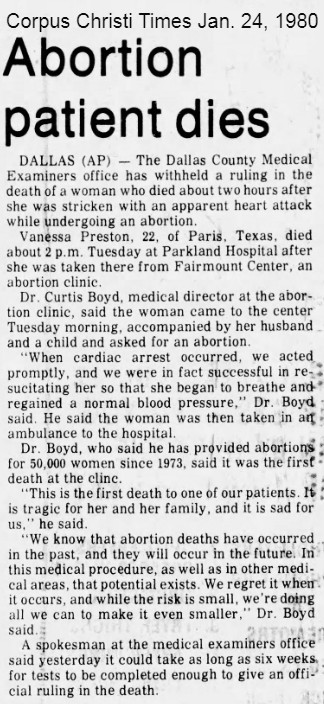
Vanessa, a day-care worker, went with her husband to Curtis Boyd's Fairmount Center in Dallas on January 22, 1980 for a 16-week abortion. During the procedure, Vanessa suffered multiple vaginal punctures -- not the kind of injury likely to prove fatal. However, before Boyd could remove the placenta, Vanessa went into a grand mal seizure and then into cardiac arrest.
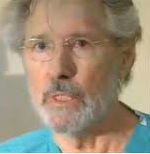 |
| Curtis Boyd |
During exploratory surgery at the hospital at Parkland Hospital, during which 24 units of blood were administered to try to stop her circulatory system from collapsing, Vanessa died.
An autopsy revealed that Vanessa's uncontrollable bleeding had been caused by an amniotic fluid embolism (AFE - amniotic fluid in the mother's bloodstream) and disseminated intravascular coagulopathy (DIC - a blood clotting disorder) during the abortion. When Boyd's staff resuscitated Vanessa, they caused a small laceration of her liver. This is typical in even properly performed CPR, and is not usually life-threatening.
However, because of the DIC, Vanessa's blood couldn't clot, and she bled to death from the liver laceration.
However, because of the DIC, Vanessa's blood couldn't clot, and she bled to death from the liver laceration.
Since second-trimester evacuation abortions were still new at the time, Boyd and his staff didn't realize that there was a risk of DIC. To Boyd's credit, he reported Vanessa's death to the Centers for Disease Control and wrote a medical journal article warning other abortion practitioners that DIC could occur during second-trimester evacuation abortions.
News coverage of Vanessa's death reports that in the 17-year period since Roe vs. Wade, Boyd's clinic was the site of the abortion deaths of more than 50,000 unborn babies, an average of just under 3,000 babies every year.
Evidence is that Boyd's quality of care did eventually deteriorate over the years. His late-term abortion clinic in New Mexico has been accused of providing substandard care resulting in the death of Keisha Marie Atkins in 2017, a departure from Vanessa's death where, if you assume he meant well in killing the unborn child of a pastor and his wife, he didn't screw anything up.
Watch When All Efforts Fail on YouTube.
Sources:
- “Fatal embolism during legal induced abortion,” Atrash, Cheek, Hogue, American Journal of Obstetrics and Gynecology, 162:4, April 1990, p. 986-90
- “Fatal Pulmonary Embolism During Legal Induced Abortion in the United States from 1972-1985,” Lawson, Herschel W., MD, Atrash, Hani K., MD, MPH, Franks, Adele L., MD, American Journal of Obstetrics and Gynecology, Vol. 162, No. 4, April 1990, p. 986-990.
- Texas Certificate of Death # 07018
- "Abortion patient dies," Corpus Christi (TX) Times, January 24, 1980
- Texas Autopsy Report No. 0190-80- 0095
- "Woman Dies in Abortion," Waco Tribune-Herald, January 24, 1980
- "Examiners withhold death ruling," McKinney Courier-Gazette, January 25, 1980



January 22, 1900: A Habitually Deadly Doctor

Dr. Paulina Bechtel, identified as a midwife in the Homicide in Chicago Interactive Database, was arrested and held by Coroner's Jury and indicted of homicide by a grand jury, but the case was thrown out by Judge Holdom.
Bechtel had already been tried in the October 3, 1895 abortion death of Mrs. Kittie Bassett. She had only just been implicated in the abortion death of Ida Henry earlier in January of 1900. She was later implicated in the abortion death of Mary Thorning in 1911.
January 22, 1972: Safe and Legal Thanks to Ronald Reagan
In June of 1967, then-Governor Ronald Reagan signed a bill legalizing abortion in California. The earlier law, passed in 1861, had allowed abortion only if intended to save the mother's life. The 1967 law allowed abortions in case of the mother's purported physical or mental health or for young teens pregnant through rape or incest. The mental health provision essentially allowed abortion on demand, since the woman could simply assert that she would kill herself were she not permitted the abortion. No actual mental health assessment was necessary. Abortions had to be performed by qualified physicians in an accredited hospital and could only be performed up to 20 weeks. The bill also allowed the establishment of dedicated abortion hospitals.
One of the beneficiaries of the new law was 26-year-old Kathryn Strong. On January 21, 1972, she went to Civic Center Hospital in Oakland, California for a legal abortion that was to be performed by Dr. Harold Van Maren. I have not been able to determine the grounds for Kathryn's abortion. During the procedure, her uterus was perforated. According to her medical records, she suffered extensive hemorrhage and shock. She died the following day, leaving behind a three-year-old son. It's difficult to judge if Kathryn's death was due to malpractice, since perforation was a known complication which could happen even if the abortion were performed with care, but, of course, could also be caused by carelessness.
January 22, 1925: Yet Another Hagenow Victim
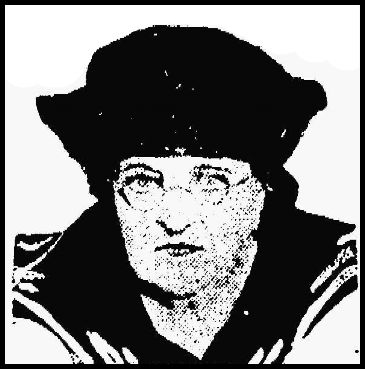 |
| Lucy Hagenow |
For some reason Hagenow, though a known abortionist, was cleared in Jean's death.
Hagenow had already been implicated of the abortion deaths of Louise Derchow, Annie Dorris, Abbia Richards, and Emma Dep in San Francisco, then relocated to Chicago.
Hagenow later noted that Chicago was corrupt and thus a genial environment for criminal abortionists. There she was connected to over a dozen abortion deaths, including Minnie Deering, Sophia Kuhn, Emily Anderson, Hannah Carlson, Marie Hecht, May Putnam, Lola Madison, Annie Horvatich, Nina H. Pierce, Elizabeth Welter, Bridget Masterson, Lottie Lowy, and Mary Moorehead. Hagenow was typical of criminal abortionists in that she was a physician.
Watch Why Was Hagenow Cleared? on YouTube.
Saturday, January 21, 2023
January 21, 1961: An Unsuccessful Cover-Up
 On January 21, 1961, 52-year-old Dr. Mandel M. Friedman contacted a Queens undertaker, asking him to arrange burial for 23-year-old Vivian Grant of the Bronx, New York. He provided a death certificate indicating that she had died from pulmonary thrombosis. The undertaker notified the medical examiner, who determined that although Vivian had not been pregnant, Friedman had attempted to perform an abortion on her, causing her death. Friedman was charged with homicide and falsifying a death certificate.
Vivian, whose real surname was Greczka, had gotten a job as an editor for Dell Publishing Company just three weeks prior to her death. She went to her boyfriend on January 13 with the news that she was pregnant. He offered to marry her, but she declined.
The young man picked Vivian up at her home at 10:00 and drove her to the doctor's office on the morning of January 21. They arrived shortly after 11:00. The boyfriend paid $800 for the abortion. He left Vivian with the doctor. When he returned at 2 p.m., Friedman told him that Vivian had died, and returned the abortion fee.
An autopsy showed that air bubbles had entered Vivian's blood stream during the abortion attempt, which triggered clotting problems, causing her to bleed to death. In other words, her death was simply a case of all surgery having risks.

Friedman was originally questioned and released before his arrest at 6:00 a.m. on January 23.
Friedman said that he had treated Vivian four times in the past for shortness of breath and heart problems, but had disposed of all of his records for 1960 and thus could not produce evidence that he'd provided the care.
The scandal of Vivian's death came as a shock to patients that Friedman had cared for during his 22-year career.
Friedman resurfaced late the following year, while still awaiting trial in Vivian's death. He was charged with homicide in the September 11, 1962 death of Barbara C. Covington, age 35, a Florida socialite.
Friedman resurfaced late the following year, while still awaiting trial in Vivian's death. He was charged with homicide in the September 11, 1962 death of Barbara C. Covington, age 35, a Florida socialite.
Watch Back-Alley Days: Failed Cover-Up on YouTube.
Sources:
- "Doctor Held in Abortion Death," New York Daily News, January 24, 1961
- "Upstanding Doc Held In Fatal Abortion Try," New York Daily News, January 24, 1961
- "Abortion Attempt Fatal; Doctor Held," New York Daily News, February 12, 1961


January 21, 1919: Two Physicians Implicated
On January 21, 1919, 26-year-old homemaker Wanda Skrzypzak died at Chicago's St. Elizabeth's Hospital from an abortion believed to have been perpetrated by Dr. Michael Rozumski and Dr. John P. Wojtaleiwicz. The doctors were held by the Coroner for intentional manslaughter by abortion on January 22, and were indicted on February 15, but the case never went to trial. There were allegations of police corruption associated with the case.
January 21, 1926: An Indictment but No Follow-Through

On January 26, the coroner pushed for the arrest of Peter Krakowski as the principal and Mary Sprochi as an accessory. Krakowski's profession is not given. On February 15, Krakowski was indicted for felony murder.
According to death records, Victoria was born to Joseph and Salome Paczkowski in Kamoinka, Poland around 1888. She left behind a husband named Joseph.
January 21, 1899: Midwife Implicated Two Years Later

Authorities got their answer in August of 1901 when Caroline's sister-in-law, Annie Robinson, lay dying from a botched abortion. She named midwife Teresa Muenster of North Clark Street not only as the abortionist responsible for her own impending death, but as responsible for Caroline's death as well.

Given the plethora of doctors and midwives openly advertising abortions in Chicago, it's bizarre that Annie would entrust herself to the woman who had killed her sister-in-law.
Muenster was born around 1841 in Holsten Schleswig, which would have made her nearly 60 years old at the time of the women's deaths. She had been practicing in Chicago for about thirty years.
Watch First in the Family on YouTube.
Sources:
- "Held for Woman's Death," Chicago Tribune, August 19, 1901
- "Midwife is Held on Serious Charge," The Inter-Ocean, August 19, 1901
- "Midwife Held Without Bail," The Inter-Ocean, August 20, 1901


Friday, January 20, 2023
January 20, 1974: Lack of Follow-Up Care Proves Fatal
Twenty-one-year-old Linda Fondren had a safe and legal abortion performed by Mohammad Pourtabib at Pre-Birth in Chicago on New Years Day, 1974. She suffered bleeding, but Pourtabib did not provide follow-up care. Linda was taken by ambulance to Michael Reese Hospital, in shock and needing emergency care. They would not admit her, but instead sent her to Cook County Hospital, where doctors performed an emergency hysterectomy.
Linda remained hospitalized at Cook County. On January 16, doctors tried to drain fluids from Linda's chest and inadvertently punctured her spleen. Linda died on January 20 from "hemoperitoneum with splenic rupture following hysterectomy and earlier dilatation and curettage." She left behind a small child.
Her survivors sued.
According to immigration records, Pourtabib was born in Tehran, Iran in 1942 and became a US citizen in 1980. I haven't been able to determine how long he was in the US before performing Linda's fatal abortion. His immigration form was signed by people who had only known him since July of 1975.
- "12 dead after abortions in state's walk-in clinics," Chicago Sun-Times 11-19-78
- Cook County Circuit Court Case No. 74L 12514
- Death Certificate No. 601804

January 20, 1910: Nurse or Midwife Implicated

Source:
January 20, 1971: Fatal Infection Leaves Six Children Motherless

"Andrea" was 26 years old when she underwent a newly legalized abortion at a New York City abortion facility on January 12, 1971.
After her abortion, Andrea contracted an infection. Her system was unable to fight the infection, and she died on January 20, 1971, leaving behind six children.
In addition to “Andrea,” these are the women I know of who had the dubious benefit of dying from the newfangled safe-and-legal kind of abortion in pre-Roe New York:
- Carmen Rodriguez, July, 1970, salt solution intended to kill the fetus accidentally injected into her bloodstream
- Barbara Riley, July, 1970, sickle-cell crisis triggered by abortion recommended by doctor due to her sickle cell disease
- Pearl Schwier, July, 1970, anesthesia complications
- "Amanda" Roe, September, 1970, sent back to her home in Indiana with an untreated hole poked in her uterus
- Maria Ortega, October, 1970, fetus shoved through her uterus into her pelvic cavity then left there
- "Kimberly" Roe, December, 1970, cardiac arrest during abortion
- "Amy" Roe, January, 1971, massive pulmonary embolism
- "Sandra" Roe, April, 1971, committed suicide due to post-abortion remorse
- "Anita" Roe, May, 1971, bled to death in her home during process of outpatient saline abortion
- Margaret Smith, June 1971, hemorrhage from multiple lacerations during outpatient hysterotomy abortion
- "Annie" Roe, June, 1971, cardiac arrest during anesthesia
- "Audrey" Roe, July, 1971, cardiac arrest during abortion
- "Vicki" Roe, August, 1971, post-abortion infection
- "April" Roe, August, 1971, fever and shock after Saline abortion
- "Barbara" Roe, September, 1971, cardiac arrest after saline injection for abortion
- "Tammy" Roe, October, 1971, massive post-abortion infection
- Carole Schaner, October, 1971, hemorrhage from multiple lacerations during outpatient hysterotomy abortion
- "Beth" Roe, December, 1971, saline injection meant to kill fetus accidentally injected into her bloodstream
- "Roseann" Roe, February, 1971, vomiting with seizures causing pneumonia after saline abortion
- "Connie" Roe, March, 1972, cardiac arrest during abortion
- "Julie" Roe, April, 1972, holes torn in her uterus and bowel
- "Roxanne," May, 1972, convulsions and death at start of abortion
- "Robin" Roe, May, 1972, lingering abortion complications
- "Danielle" Roe, May, 1972, air in her bloodstream
Sources:
- "Maternal Mortality Associated With Legal Abortion in New York State: July 1, 1970 - June 30, 1972," Berger, Tietze, Pakter, Katz, Obstetrics and Gynecology, 43:3, March 1974, 325
January 20, 1846: Forced Abortion in a House of Ill Repute
Mary Ackerly of White Plains, New York, was the uneducated daughter of Sutton Ackerly, a shoemaker, and his disreputable wife Martha.. From the time she was around 9 years old, Mary's family had begun sending her to live with other families, for reasons that are presumed to be understood by newspaper readers of the time. Mary didn't take well to her peripatetic life, it seems, since she rarely stayed with one family longer than a few months.
In 1845, at the age of 19, Mary went to work in the home of Mrs. C. Nelson, near Sing-Sing. Mrs. Nelson had a married son, Henry (called "Harry"), a highly prosperous farmer who lived nearby in Somers. In early December, Harry convinced Mary to go to Manhattan with him, promising that if she made the trip he would pay her the $27 that he owed her. That's about $1,080 in 2023 dollars.
Harry had other plans for the young woman who was about four and a half months pregnant with his child.
A Trip to New York

The two arrived aboard the steamer Croton late on Friday evening, December 12. Harry was dressed as the respectable, comfortable man he was. Mary was clad in the shabby clothing of her own social class. Nelson was unlikely to have entered into a truly romantic affair with the uneducated young woman. It's more likely that he was paying her for sexual assignations and owed her the money for these exchanges.
After disembarking, Nelson and Mary were joined by a small, unassuming man in his early 30s, clad in a large overcoat with the collar pulled up to hide his face. This man had also been aboard the Croton but had avoided the couple during the trip. The man was Dr. Seth Shove of Bedford, New York. Shove and Nelson spoke briefly then parted ways.
Nelson brought Mary to a "house of ill fame" at 174 Broom Street. The mistress of the house was Mrs. Brewster. A cook, Mary Ann Murray, and a chambermaid, Sarah Canine, lived there as well, along with three boarders who made a living as prostitutes: Mary Kearney, Josephine Lee, and Emma Lee. They plied their trade with lively champagne dinner parties at the house.
Nelson and Mrs. Brewster seemed to know each other and spoke briefly before Nelson handed off his young charge to the mistress. Mrs. Brewster saw Mary to a small back room on the first floor and left her there.
Ambushed by Nelson and Shove
On the night of December 14, 1845, one of the women who lived at the brothel told Mary that somebody was up in the attic room to see her. When Mary got upstairs she found Nelson, along with Dr. Shove. The room, furnished with a bed, was lit only by the single candle that Nelson held.
Nelson told Mary that Shove was there to perform an abortion on her. Mary said that she tried to get out of the room, but Nelson and Shove had locked the door, pushed her onto the bed, and blown out the candle. Mary didn't see what instrument the appropriately-named Shove used on her, but what he did was incredibly painful. Mary told her mother that she had screamed for help but nobody came. Shove finished what he was doing then he and Nelson left.
The Baby Born Alive
After her ordeal was over, Mary returned to the downstairs back room. Mary Kearney said that in the evening of Tuesday, December 15, Mary went into labor. Dr. Conning came to the house to attend to Mary, delivering the baby about 2:00 in the morning of the 16th. Conning, evidently believing the infant to be dead, placed it on a marble-topped table. Seeing the baby move its hand and foot, Miss Kearney placed the child in a warm place by the stove hearth, where it died about half an hour later.
Other than doctors attending her from time to time, Miss Kearney said, Mary Ackerly had no visitors after the birth and death of her baby. After the night of the abortion, Mary never saw Harry Nelson again. Mary sickened and suffered wretchedly during the ensuing weeks, her condition deteriorating.
Mary's Wretched End
During the first week of January, 1846, the chambermaid, Sarah Canine, accompanied Mary on a boat trip back to her family home in Sing Sing. Over the ensuring days, Mary had a dark red, foul-smelling vaginal discharge, and frequent bouts of vomiting.
At Mary's request, she was visited by a minister every other day who prayed with her and urged her to clear her conscience. As it became clearer to Mary that she wasn't going to recover, she wept and told her mother all about her pregnancy and the abortion. Mary pleaded with her mother to send for Dr. Shove, believing that his knowledge of what he'd done to her would aid him in providing life-saving care. Shove wouldn't come to attend to his patient but instead sent the family a bill for the abortion.
Dr. William Belcher, the family's usual doctor, tended to Mary three times before her death. Dr. Belcher made it plain to Mary that she was dying, and she told him the same story she had told her mother about Harry Nelson, Dr. Shove, the unfamiliar house she'd been taken to, and the forced abortion. She was dead by around 6:00 on the morning of January 20.
Belcher and another doctor performed an autopsy, finding multiple adhesions around Mary's uterus. There were no signs of injury inside the uterus or vagina, but there were injuries causing fecal impaction and large abscesses around the bowel and bladder. Her uterus was enlarged and showed signs of recent pregnancy.
Dr. Shove's Trial

When Shove went to trial for Mary's death, an assortment of doctors testified that they'd known him well and respected him professionally. Some had seen Shove perform surgery and considered him to be skilled. The doctors also testified that for an abortion, the patient would have to be cooperative in order to carry it out. Both hands would be needed, so a doctor would not have spare hands to hold down a struggling patient. Mary's injuries, as described by Dr. Belcher, were not consistent with those that would happen if a qualified doctor was doing an abortion procedure. At no point did there seem to be the issue raised, nor answered, as to whether Mary's injuries were consistent with a skilled surgeon attempting to perform an abortion on a struggling woman.
As the jury went to deliberate whether Shove should be convicted of murder, manslaughter, or neither, they had to take into account:
- whether Mary had been "quick with child," meaning that she had been able to feel the baby move and know that the baby was alive
- whether she had gone to New York for the purpose of an abortion
- whether she had consented to the abortion
- whether Shove had indeed been the person who had perpetrated it
Much of this hinged on how much credibility the jury would give to the testimony of Mary's mother and of Dr. Belcher regarding what she had told them as she lay dying. Shove's attorney had brought forth many witnesses against the character of both Mary and her mother. Mary was described as a thief, a prostitute, and an arsonist. Both women were described of being of bad moral reputation and as utterly untrustworthy.
The judge told the jury that Martha Ackerly's credibility had been completely impeached, and hence, by implication, that they could discount anything she'd said. The judge also indicated that though Mary ordinarily would be considered of such bad character that they could dismiss her testimony as well, they could choose to give credibility to what she said on her deathbed under the presumption, common at the time, that people about to meet their Maker would want to do so having confessed all of their sins before doing so.
Some testimony also seemed to hinge on whether somebody had paid Mary's parents to make themselves scarce after Mary's death. The implication seems to be that the Ackerly family had been trying to blackmail Shove. Martha Ackerly said that Shove had given Mary some money, wages that had been due to her.
The defense arguments -- that Shove can't have been the one who had perpetrated the abortion because it had been done so sloppily, and that after all he was respectable and Mary and her family were disreputable and thus couldn't be believed -- worked. Shove was acquitted. The verdict was greeted with "a perfect thunder of applause" from the men in the courtroom who blamed Mary for her own death.
The Court of Public Opinion

Watch Forced Abortion in a House of Ill Repute on YouTube.
Sources:
- "Henry G. Nelson, Another Seducer," Brooklyn Evening Star, February 7, 1846
- "The Abortion Case in Which Dr. Shove Stands Indicted for Murder," Brooklyn Daily Eagle, October 17, 1846
- "Case of Dr. Shove, Indicted for Murder," Brooklyn Evening Star, October 19, 1846
- "Acquitted," The Public Ledger, October 21, 1846
- "Trial for Murder in Procuring Abortion," The Daily Delta, October 28, 1846
- "The Brothel on the Page: Print, Prostitution, and Blame in Antebellum America," dissertation by Michael Gawlick, March 21, 2017


Thursday, January 19, 2023
January 19, 1993: Owner of Fake Clinic Kills Woman, Tries to Ditch the Body
Like the deaths of Jacqueline Smith and Barbara Lofrumento, the story of 27-year-old Angela Nieto Sanchez involves an illegal abortion and an attempt to hide the body. The difference is that Angela believed that she was entrusting herself to a safe, legal abortion clinic.
Angela and the Children at the Fake Clinic
On January 19, 1993, Angela went to Clinica Feminina de la Comunidad with two of her four children: 12-year-old Maria and her little brother, identified in one source as 2-year-old Victor and in another as 3-year-old Martin.
Angela's family is adamant that Angela, who was one month pregnant, wasn't seeking an abortion. They said that she was excited about the pregnancy and was hoping it would be a girl so Maria would have a sister. Angela's sister Celia said that someone from the facility had called Angela, telling her to come in for a consultation about the pregnancy.
As an illegal alien who worked as a maid, Angela wasn't entitled to medical assistance to pay for a $2,000 hospital abortion, but would have been able to afford a $300 clinic abortion. According to prosecutors, she paid $280 in cash up front.
Bewildered Children
Maria and her little brother waited for their mother in the lobby. A clinic staffer approached Maria and suggested that she take the car and drive her brother home. Maria protested that she was too young to drive. The children continued to wait for their mother.
At around noon, another staffer, later identified as Irsema Mendoza, took the children to lunch at a nearby fast-food joint. When they returned to the clinic, Angela's car was gone, and Maria was told that her mother had gone to another clinic. The children continued to wait, but when their mother failed to appear Maria finally called her uncle, Hemiberto Sanchez, who took them home with him.

A Ghastly Scene
By 10:00, Angela's family was frantic. They began calling hospitals and searching the neighborhood for their missing loved on. Maria's aunt Celia and two friends took the girl to the clinic to look for the missing woman. When they arrived, they saw Angela's car. Maria jumped out of her aunt's pickup truck and ran to the car.
"I saw them dragging something from the clinic," Maria tearfully testified at trial two years later. "I asked where my mother was. [One of the two women] said she didn't know. Then I saw it was my mother. I saw her drop my mother's legs."
Maria asked two women what had happened to her mother, and they told her, "She's dead."
Sobbing, Maria clung to and kissed her mother's body while the two women from the clinic told Celia that a man had shoved Angela from a car and they were just now picking her up. One of the women was Alicia Ruiz Hanna, age 32, who operated the facility. Hanna told Maria and Cecelia that Angela had just come knocking on the clinic window, then collapsed.
Celia put her sister's stiffened body in the back of her truck and flagged down a policeman, who led her and Maria to a hospital. There, Celia was told that her sister had been dead for several hours.
The Clinic Owner's Story
Hanna was arrested and brought to Orange County Jail. In a taped interview, she told police, "I did not do anything bad. I was there for her. I'm innocent." She said that she did not attempt to perform an abortion but had only discussed the option with Angela.
She said that Angela left the clinic. Several hours later, Hanna said, a man drove up to the clinic driveway with Angela's unconscious body in the car then fled the scene. She said that she'd been dragging Angela's body out of the car to provide aid when the woman's relatives arrived.
"She was really cold, and I was trying to pull her out." She added, "I didn't know if she had fainted or she was dead. I never touched a dead body before."
When police noted that Hanna didn't seem distressed over Angela's death, she insisted that she had cried along with Maria. "You were crying for yourself," the investigator told her. "We've been here for hours and you've shown no remorse."
"What do you want me to do," Hanna retorted, "cry so that you think it's my fault? Come on. Give me a break."
Hanna was released after an original decision not to prosecute. After a six month investigation, prosecutors decided to charge her with murder. It took a month for police to track her down and take her into custody.
The Truth Comes Out
Hanna gave conflicting stories, even in court. She testified that getting the results of a positive pregnancy test, Angela had insisted that she wanted an abortion. Hanna said that she'd told Angela that she was not licensed to perform abortions and suggested that she go to another clinic or return on a day when a doctor would be available. Hanna claimed that Angela had been insistent that she was having trouble with her boyfriend and couldn't take off work another day for an abortion.
Hanna, who had been passing herself off as a doctor and performing abortions at the facility, had given Angela Valium to calm her and an injection to induce abortion. Angela vomited, foamed at the mouth, and went into a seizure, then stopped breathing. Hanna said that she'd run down the hall and got Narcan, which she injected in the hopes that it would reverse the effects of the Valium. Hanna and her staff attempted to revive her. However, the clinic's emergency equipment wasn't operative and the oxygen tank was empty. Even if she had been trained and had known what she was supposed to do, Hanna would have been unable to revive her patient.
One of Hanna's employees even tried to call 911 to summon first responders, who were less than a mile away at a fire station. Hanna told her employee, "No, I'll save her -- we'll get in trouble" and hung up the phone. Hanna feared that she would go to jail and lose her children if it was discovered that she was running the clinic illegally. She did, however, make a call to her husband and ask him to bring another oxygen tank. "I was not thinking straight," Hanna later testified. "In my mind I still had hope of bringing her back to life."
Once it became clear that Angela was dead, Hanna decided to await and opportunity to put Angela's stiffening body into the trunk of her own car and have a former employee help her to abandon the vehicle in Tijuana.
How Hanna Turned her Hand to Abortion
Hanna's clinic had been tied up with abortionist Dr. Nicholas George Braemer. Hanna had opened a business, under the name of C.J. Professional Management Co., on February 4, 1992, as a limited partnership with Braemer. Braemer said that he'd run a "family planning practice" there for four or five months, up until May or June, having sublet the space from Hanna, who was also running Family Health and Weight Control Center at the location. "When I disassociated with the clinic, I expected my name would go off the door because the name is registered to me." He made a formal complaint to the medical board about the lack of a name change after his departure from the facility. However, the clinic itself was evidently never licensed.
Hanna had originally used doctors to perform the abortions but eventually started doing them herself as a cost-cutting measure.
"A Wolf in Sheep's Clothing"
 |
| Alicia Ruiz Hanna in court |
Prosecutor Rick King characterized Hanna as "a wolf in sheep's clothing. She's very attractive, has a very soothing voice. The clientele she reached out to -- who were mostly illegal aliens looking for guidance -- she would counsel them, which many times resulted in them having abortions done by her."
"When it came down to Alicia Hanna's hide or the victim's hide, the victim was going to lose," King said. "There was a conscious decision made by Alicia Hanna, and the conscious decision was: 'I'm not going to get caught.'"
In December 1994, Hanna was convicted of second-degree murder for Angela's death. Jury foreman Charles Buezis said that the jury had no trouble finding Hanna guilty. "There really wasn't a lot of sympathy for her." The jurors especially didn't appreciate Hanna's efforts to blame the victim by claiming that Angela was high on drugs when she arrived at the clinic. Another juror said of Hanna, "She was her own worst enemy."
When she heard the verdict, Hanna covered her face and wept.
Hanna was also found guilty of performing abortions illegally on Angela and on two other women who survived. Hanna admitted to having performed an additional six or eight illegal abortions by injecting them with Methergine, a drug used to induce contractions and cause an abortion.
During the sentencing hearing, a representative of the family read letters from Angela's mother and daughter. "I'm destroyed emotionally. I will never forget these horrible crimes," said Maria, then aged 14. The prosecutor asked for the maximum sentence, asserting that Hanna had showed "conscious disregard for human life" in her failure to summon the nearby help.
Hanna's public defender asked that the charge be reduced because she hadn't tried to kill the victim. "She was wrong in practicing medicine without a license, but that's involuntary manslaughter, not murder." He stressed Hanna's attempts to revive Angela. "She did what she could. A person who is a murderer doesn't want to save the life of their victim."
She was sentenced to 15 years to life for Angela's death and another 16 months for the related charges. She appealed her sentence but it was upheld by the US Supreme Court in January of 2000.
As for Angela Sanchez's four motherless children, they were taken in by family members in Mexico.
Sources:
- "No charges in death," San Bernardino County Sun, January 23, 1993
- "Death at abortion clinic prompts arrest," North County Blade Citizen, August 1, 1993
- "Video Shown in Abortion Clinic Trial," Los Angeles Times, November 18, 1994
- "Jury Hears Daughter of Victim," Los Angeles Times, November 22, 1994
- "O.C. Woman Admits Lying About Death at Clinic," Los Angeles Times, November 29, 1994
- "D. A. Says Clinic Owner Wanted to Save Self, Not Patient," Los Angeles Times, November 30, 1994
- "Abortion Clinic Owner Called 'Wolf in Sheep's Clothing'," Los Angeles Times, December 9, 1994
- "Hanna Guilty of Murder," Los Angeles Times, December 13, 1994
- "Abortionist Convicted of Killing Client," Los Angeles Times, December 13, 1994
- "Pregnant woman dies at abortion clinic as 4 (sic) children wait," Hattiesburg American, December 17, 1994
- "Illegal abortion kills women while children wait," The Press-Democrat, December 17, 1994
- "Illegal abortionist convicted of killing woman," The Sacramento Bee, December 17, 1994
- "Unlicensed abortionist convicted of murder," The Missoulian, December 17, 1994
- "Clinic Operator Sentenced for Murder," Los Angeles Times, January 28, 1995
- "Santa Ana Clinic Owner's Murder Conviction Stands," Los Angeles Times, January 11, 2000


January 19, 1930: Second Woman Victim of Abortionist Dentist
Lillian "Lila" Morris, age 19, of Elkins, New Mexico, died on January 19, 1930 in the Ruidoso summer home of Roswell, New Mexico dentist Milton A. Grissom.

Sources:
- "Dentist Denies Charge," (El Paso, TX) Evening Post, April 28, 1930
- "Second Doctor Under Arrest in Girl Death," (El Paso, TX) Evening News, April 29, 1930
- "Dr. Walker is Charged Second Degree Murder in Girl's Death," Roswell (NM) Daily Record, April 29, 1930


January 19, 1930: Second Self-Induced Abortion Proves Fatal
 Anna Fitzgerald, a 19-year-old married woman, died on January 19, 1930 at St. Joseph's Hospital in Lancaster, Pennsylvania. She had been admitted by Dr. H. F. Myers after her family had summoned him to attend to the ailing young woman.
Her death certificate gave her cause of death as "Septic pelvic peritonitis from suppurative endometritis which was caused by induced abortion performed by party unknown."
After an investigation, the authorities decided that the abortion had been self-induced.
Anna had been hospitalized for several weeks a little more than a year previously for a self-induced abortion.
After an investigation, the authorities decided that the abortion had been self-induced.
Anna had been hospitalized for several weeks a little more than a year previously for a self-induced abortion.
Watch Second Self-Induced Abortion on YouTube.
Sources:
Sources:
- Death certificate
- "Girl Responsible For Her Death," Lancaster (PA) Intelligencer Journal, January 23, 1930

January 19, 2008: Woman's Organs Mangled in Fatal Abortion
 |
| Reginald Sharpe |
Dr. Reginald Sharpe has a history of malpractice, including the death of a 26-year-old patient at 3:30 p.m. on January 19, 2008. After poking around online I learned that she was a young Black woman named Chloe.
According to the Michigan Medical Board Administrative Complaint, Chloe (identified as "Patient 1") went to Sharpe's clinic, Sharpe Family Planning, in Detroit for an abortion on January 11, 2008.

Sharpe performed an ultrasound and determined that Chloe was about 15 weeks pregnant. He administered 5 mg of Midazolam and 10 mg of Nubain intravenously at around 11:25 a.m., along with lidocaine.
Shortly after Sharpe started the abortion, Chloe began to have seizures and developed respiratory distress. Unlike many safe-and-legal abortionists, who just charge ahead to finish the abortion even if the patient stops breathing, Sharpe stopped the abortion and called 911. However, he failed, like so many abortionists, to provide appropriate resuscitation.
Chloe suffered cardiac arrest on the way to St. John's Hospital in Detroit, but medics were able to restore a heartbeat. However, Chloe languished in the hospital and finally died on the 19th.
Sharpe admitted to the medical board that he had perforated Chloe's uterus and she had begun to bleed internally. He either failed to determine, or failed to report, what Chloe's death certificate indicates: that Sharpe had not merely perforated her uterus. Once the instruments were inside her pelvic cavity he had managed to cut a uterine blood vessel and lacerate her intestines and her liver.

Since Chloe did not die the day of the abortion it's likely that she developed an infection that turned fatal.
Sharpe continued to botch abortions after the one that killed Chloe. The same documents that cover Chloe's death also describe four additional injured patients:
- "Patient 2" underwent a 19-week abortion at Sharpe's hands on August 5, 2011. Sharpe transferred her to a hospital because of the amount of pain she was experiencing. An ultrasound found that the fetal head was protruding from the woman's uterus. The damage to her uterus was so extensive that she required a hysterectomy.
- "Patient 3" underwent a two-day procedure starting February 27, 2014. She was about 23 weeks pregnant. Sharpe perforated her uterus and sent her to the hospital. Sharpe had poked holes in the woman's uterus and pushed fetal parts into her abdominal cavity. As with his other injured patients, Sharpe had kept grossly inadequate patient records. He had also failed to properly monitor this patient and had no qualified person present to assist with the anesthesia. Fortunately the injuries to this woman's uterus could be repaired, though it's impossible to know if this damage will have an impact on future childbearing.
- "Patient 4"went to Sharpe for a two-day procedure starting June 16, 2014. She was about 22 or 23 weeks pregnant. The documents don't indicate that the patient was injured, but do note that Sharpe put the patient under anesthesia without a trained professional to assist, had scanty and sloppy documentation, and failed to monitor the woman while she was sedated.
- "Patient 5" went to Sharpe for an abortion on December 31, 2014. This patient, named Bianca, later sued Sharpe. She was about 16 weeks pregnant. Again, Sharpe's documentation was sloppy and incomplete. Sharpe spent about an hour trying to complete an abortion before the patient's cervix was adequately dilated. Bianca cried and screamed in pain and two nurses held her legs in the air so that Sharpe could work. Bianca begged Sharpe to let her rest and provide pain medicine Sharpe resumed the abortion about an hour and a half later and was still unable to complete the abortion. He had to admit Bianca to the hospital where other doctors completed the abortion and repaired uterine perforations and extensive damage that cost the woman about two-thirds of her bladder. She had to have stents put in her kidneys. She required multiple follow-up procedures to address the damage to her urinary tract.


Sharpe had also been disciplined by the medical board for his ill-treatment of patient R. C. (I'll call her "Rachel.") who had a nightmarish experience on March 2, 2005. Sharpe started to perform what was supposed to be a 23-week abortion but was having difficulty. He gave up, sent Rachel to the recovery room, then left the facility. Nobody with medical training was there to attend to the patient. Rachel screamed in pain so loudly that her mother demanded to be allowed to see her and ended up attending her daughter as she delivered the dead baby. Rachel's mother called for an ambulance. Sharpe spoke the the medics over the phone, said he'd be there shortly, and demanded that they not transport his patient to a hospital. Because of fear of a confrontation with Sharpe, medics loaded Rachel up and drove her to a nearby parking lot to begin assessing her before proceeding to a hospital. The baby had actually been of 27 weeks gestation.
As far as I know, Sharpe is still practicing.
Sharpe's clinic also got in trouble in the summer of 2008 for dumping medical waste in with the normal garbage. Investigators found bloody gauze, gloves, and a curette tube in the trash. ("Livonia abortion clinic cited," Detroit Free Press, June 27, 2008)

Watch At Least He Called an Ambulance on YouTube.
Subscribe to:
Posts (Atom)