Tuesday, June 30, 2009

Anniversary: Staff blow off concerned boyfriend, teen bleeds to death

Seventeen-year-old Jennifer Suddeth underwent a safe and legal abortion performed by Frank Robinson on June 30, 1982.

On the drive home, Jennifer bled heavily, alarming her live-in boyfriend, John Fredzess. Fredzess called the clinic repeatedly over a period of four hours after their return home, but staff would not put the call through to Robinson. One nurse admonished Fredzess to "be realistic" about how severely Jennifer was bleeding. By that time, Jennifer had bled through two pairs of sweat pants, two blankets, and a towel. At last the hysterical young man was able to contact Robinson, who insisted that the bleeding was normal and instructed Fredzess to stop calling.

When Jennifer went into convulsions, Fredzess called an ambulance. Parmedics arrived at the home to find Jennifer already dead. Police interviewed the weeping and hysterical Fredzess, then pressed charges against Robinson for involuntary manslaughter in Jennifer's death. Although Robinson beat the rap, the state of California nevertheless counted Jennifer's death as due to illegal abortion.

For more abortion deaths, visit the Cemetery of Choice:


To email this post to a friend, use the icon below.

Anniversary: Mother of two bleeds to death

Kendra McLeod, mother of two, underwent an abortion at a clinic in Chapel Hill, North Carolina, on June 12, 1998.

She bled heavily after the abortion. The day after her abortion, she sought help at an emergency room. She had fainted three times by the time she got into the ER.

Doctors at the hospital transfused Kendra with nine units of blood and performed surgery to try to save her life, to no avail. She died on June 30, at the age of 22.

Her family lost a lawsuit against the hospital. Documents do not note if the family sued the abortion provider.

For more abortion deaths, visit the Cemetery of Choice:


To email this post to a friend, use the icon below.

Sunday, June 28, 2009

1900: Abortion by midwife proves fatal

On June 28, 1900, Mrs. Andre Jorgenson died on the scene from an illegal abortion. Mrs. Anna Pihlgren, whose occupation is listed as nurse or midwife, was arrested and held by the Coroner's Jury. Andre Pihlgren was held as an accessory.

Note, please, that with routine public health issues such as doctors not using proper aseptic techniques, lack of access to blood transfusions and antibiotics, and overall poor health to begin with, there was likely little difference between the performance of a legal abortion and illegal practice, and the aftercare for either type of abortion was probably equally unlikely to do the woman much, if any, good. For more about abortion and abortion deaths in the first years of the 20th century, see Abortion Deaths 1900-1909.


For more on pre-legalization abortion, see The Bad Old Days of Abortion

To email this post to a friend, use the icon below.

Saturday, June 27, 2009

Anniversary: Two doctors, one dead woman

On June 24, 1929, 19-year-old Winifred Garner underwent an abortion at the office of Dr. Anna Schultz, aka Rollins. Schultz was assisted by Dr. James White. Winifred died on June 27.

On June 27, both physicians were held by the coroner. Schultz was indicted for felony murder by a grand jury on October 6, 1930.

Winifred's abortion was typical of illegal abortions in that it was performed by a physician.

Keep in mind that things that things we take for granted, like antibiotics and blood banks, were still in the future. For more about abortion in this era, see Abortion in the 1920s.


For more on pre-legalization abortion, see The Bad Old Days of Abortion

To email this post to a friend, use the icon below.

Friday, June 26, 2009

Michael Jackson Moonwalk Tribute


Rest in peace.

Michael Jackson 911 call makes doc look questionable

Transcript of the call

Here's what leaps out at me: The doctor was attempting CPR on the bed; the medic had to tell the caller that the patient belonged on the floor.

Anybody who has had professional grade CPR training is taught that the patient needs to be on a firm surface. If a patient needs CPR, he will usually be put on a spine board before being put on the gurney in order to give a firm surface to perform CPR.

There are other aspects of the situation I find very fishy. Jermaine Jackson said that the doctor worked on Michael for about fifteen minutes before having somebody call 911. But somebody who has been trained will call 911 first, if a phone is at all available, because CPR only helps the patient hold on until he can be defibrillated.

Also, he said that medics worked on Michael for about 45 minutes prior to transport. Again, that's weird. With a cardiac arrest -- or even suspected heart attack -- you load and go. You don't dick around for three quarters of an hour.

I have serious suspicions that the doctor in question is the key to why Jackson is dead.

What if the government ran health care?

Which death outraged the champions of women's lives?

Pamela Colson, age 31, was 12 weeks pregnant when friends drive her to Women's Medical Services in Pensacola, Florida, for a safe and legal abortion on June 26, 1994.

Pamela bled heavily during the drive home. According to her friends, Pamela became unresponsive, so they stopped at a motel. Two passers-by did CPR while Pamela's friends called for an ambulance. Pamela was taken to a hospital where she died after an emergency hysterectomy.

Her autopsy showed: bloodstained fluid in chest and peritoneal space, and "extensive hematoma formation in the pelvic area with the peritoneum denuded from the left gutter area caudually." The surgeon who performed an emergency hysterectomy, trying to save Pamela's life, had removed her uterus at the site of the laceration "so that the laceration was a portion of the incision made to remove the uterus." Her uterus showed extensive hemorrhage and blood clots. Her uterine artery was also injured. Several of Pamela's ribs were fractured, apparently during attempts to resuscitate her; this is common in even properly performed CPR.

The cause of death was given as "irreversible shock from blood loss due to a perforated uterus occurring at the time of an elective abortion." William Keene was tentatively identified as having performed the abortion.

Pamela's fatal abortion was performed at the clinic where abortionist David Gunn was shot dead. But unlike Gunn's death, Pamela's death didn't raise so much as an eyebrow among the champions of women's lives. It took the death of a man to do that. Along with the fact that a dead abortionist is a "Man bites dog" story, whereas abortionists killing women is considered just part of the business.

Thursday, June 25, 2009

Anniversary: Woman dead, doctor shunned

On June 25, 1911, 20-year-old Mrs. Anna L. Mueller died from a criminal abortion performed by Dr. George Lotz. Lotz was arrested July 5. He was indicted for felony murder.

There is no record that he served time for the crime, but Leslie Reagan indicates that he was expelled from the Chicago Medical Society after admitting guilt in Anna's death.

Anna's abortion was typical of pre-legalization abortions in that it was performed by a physician.

Note, please, that with overall public health issues such as doctors not using proper aseptic techniques, lack of access to blood transfusions and antibiotics, and overall poor health to begin with, there was likely little difference between the performance of a legal abortion and illegal practice, and the aftercare for either type of abortion was probably equally unlikely to do the woman much, if any, good. For more information about early 20th Century abortion mortality, see Abortion Deaths 1910-1919.


For more on pre-legalization abortion, see The Bad Old Days of Abortion

To email this post to a friend, use the icon below.

Wednesday, June 24, 2009

Upping the Creepy Ante: God "rejoices" over abortion

God “Rejoices” over Abortions Says Episcopal Priestess

I think she's pushing it.

Swedish parents experimenting on child

Swedish parents keep 2-year-old's gender secret

Pop's parents decided that societal influenced gender roles would be a drag on their child, so they're raising Pop as an it, rather an a he or a she:

“We want Pop to grow up more freely and avoid being forced into a specific gender mould from the outset,” Pop’s mother said. “It's cruel to bring a child into the world with a blue or pink stamp on their forehead.”

The child's parents said so long as they keep Pop’s gender a secret, he or she will be able to avoid preconceived notions of how people should be treated if male or female.

Pop's wardrobe includes everything from dresses to trousers and Pop's hairstyle changes on a regular basis. And Pop usually decides how Pop is going to dress on a given morning.

Although Pop knows that there are physical differences between a boy and a girl, Pop's parents never use personal pronouns when referring to the child – they just say Pop.

"I believe that the self-confidence and personality that Pop has shaped will remain for a lifetime," said Pop's mother.


I doubt that people will have no preconceived notions about Pop because of what his or her parents are doing. They're going to have one serious preconceived notion: That Pop is a freak. Better to avoid the child altogether than get into all sort of clumsiness.

But Pop's parents are right about one thing: Treating their kid like a sociological experiment will no doubt shape the kid's personality for a lifetime.

A lifetime of therapy.

So what do you think? Do parents have an inherent right to treat their kid like a lab rat just to try to prove a point?

Which abortions were unsafe abortions?

Today is the anniversary of three abortion deaths that I know about.

Johanna died at St. Elizabeth's Hospital in Chicago, from complications of an abortion performed that day.

Annie traveled from New Jersey to New York for a first-trimester abortion. Shortly after she was given anesthesia, Annie went into cardiac arrest, and attempts to revive her failed. She left behind three children.

Thirty-six-year-old Lillie died in Dr. Albert C. Davis's Chicago office from compliations of an abortion that had been performed on June 20.

  • Which of these deaths were from "unsafe abortion"?
    All of them.
    One of them.
    Two of them.
    None of them.

    For more abortion deaths, visit the Cemetery of Choice:


    To email this post to a friend, use the icon below.
  • Comment abortions

    I've become annoyed with a couple of the people who are commenting here, so until I decide otherwise, I'm just going to nuke anything they say without reading it. It's my blog. It's my right.

    Tuesday, June 23, 2009

    "But they've already made up their minds"

    Supposedly there's no need for informed consent prior to an abortion because women who come in for abortions have already made up their minds.

    Now, just imagine for a moment a plastic surgeon. Mary comes in asking for breast enhancement. The doctor just hands her a bunch of paperwork to sign, "Here are the risks, swelling, infection, yada yada yada", then does the breast enhancement. Has he done his job?

    Isn't it his responsibility to find out why the patient thinks that this surgery is what is right for her? Maybe she thinks her husband will stop cheating on her with his large-breasted secretary if Mary gets her breasts made as big. Maybe Mary is having bad luck on the dating scene and she's convinced that larger breasts will help her find true love. Maybe Mary's boyfriend taunts her for being "flat chested" and she thinks that this surgery will win his respect. Mary can have any of a number of unrealistic expectations about what this surgery will mean for her. Isn't it the doctor's responsibility to make sure that Mary's expectations about this surgery are realistic? That she really understands what she's getting into? Doesn't she need to know the downsides? And I mean fully know them -- not just be handed a list of possible complications.

    A plastic surgeon who just operates on all comers would be considered a quack. It's his job to make sure the patient's expectations about what this surgery will do for her are realistic.

    Not so with abortion. She asked for it and that's all he needs to know.

    Nobody assesses her for risk factors for poor psychological adjustment and informs her if she is at high risk for being traumatized by the abortion experience. The risk factors are well known; but nobody screens for them and nobody informs the woman of what risk factors she has and what the possible negative outcomes may be.

    Nobody informs her of the risk that she might not be able to carry a future pregnancy to term -- despite decades of evidence linking abortion to future pregnancy complications. Instead, she's assured repeatedly that she can have a baby later, when the time is right.

    And nobody tells her that ambivalence, even rejection of the pregnancy, are normal early on and that they pass when the mother has a chance to bond with the unborn baby. This used to happen at around "quickening", when the mother felt the baby move. Now it often happens earlier, with an ultrasound or a chance to hear the baby's heartbeat. She's not told that her feelings of being unable to cope are normal and typically self-limiting.

    Imagine if any other surgery was being performed, on a self-referral basis, on patients suffering from a temporary condition that they're not told is temporary. And I don't mean that women don't know pregnancy is temporary. I mean they don't know that the feeling of being unable to cope -- which is why they're seeking abortion -- is temporary.

    If a patient stung by a stone fish begged a doctor to amputate his arm, and the doctor complied without telling that patient that the pain of a stone fish sting will fade in time and he'll be glad to still have his arm, that doctor would probably not only have his license yanked, he'd probably be charged with assault against the patient.

    But doctors, 4,000 times a day in the United States alone, let women think that their normal and self-limiting distress is permanent and that the only way to escape it is abortion. They perform irreversible surgery which can do the patient real, lasting harm.

    And this is considered somehow noble and responsible.

    Monday, June 22, 2009

    Don't they mean, "Trust abortionists"?

    Got this email from NARAL:

    You've heard of wearing your heart on your sleeve. Well, in honor of Dr. George Tiller's work, we want you to wear yours on your wrist.

    Dr. Tiller often wore a button that simply read, “Trust Women.” To honor his message and as a symbol of your pro-choice values, NARAL Pro-Choice America is launching a “Trust Women” wristband campaign.

    Donate today and get your “Trust Women” wristbands.


    Aside from the very fact that abortion is proof positive that some women can't be trusted, at least not with the lives of their unborn children in times of stress, is NARAL's real agenda about trusting women?

    NARAL doesn't trust women at all. They don't trust that women are strong enough to handle information about the unborn children they're carrying. They don't trust that women are strong enough to cope with the stresses of pregnancy and motherhood. (They seem to think that the moment a woman is in a less-than-ideal situation she'll turn into Susan Smith, strap her kids into the carseats and push them into the lake.) They don't trust the women who regret their abortions and try to warn others that it's not the simple, put-it-all-behind-you solution. They don't trust the women who run prolife pregnancy centers.

    Who they really are about trusting is abortionists. Trust abortionists to judge how much information a patient can handle. Trust abortionists to judge whether a minor's parents should be notified. Trust abortionists to decide when to protect patient safety and when to protect the bottom line, cutting corners and endangering women's lives and health.

    I wish the abortion lobby would be honest about whose interests they're really protecting. And it's not the interests of stressed out, frightened, pregnant women in crisis.

    Anniversary: Doc ignores allergy, kills patient

    Thirty-two-year-old Kelly Morse of Vermont traveled with her husband to Hillcrest Women's Medical Center in Harrisburg, Pennsylvania, for an abortion on June 19, 1996. Dr. Delhi Elmore Thweatt, Jr., performed the abortion.

    Five days earlier, Kelly had come to Hillcrest and had been evaluated by Dr. Earl McLeod, who had diagnosed her as eight weeks pregnant.

    Because the waiting room of the clinic was so crowded, Kelly's husband waited for her outside.

    Even though Kelly had notified Hillcrest staff that she had asthma and was allergic to the "caine" medications, including Lidocaine, Thweatt administered 12 cc's of 1 percent Lidocaine to Kelly at about 11 a.m.

    Kelly immediately had trouble breathing. A licensed practical nurse got Kelly's inhaler from her purse and helped her to use it, but Kelly reported that it was not helping. She became very agitated because of her difficulty in drawing breath.

    Thweatt continued with the abortion, completing it in about four minutes, and spent some time providing ineffectual care to Kelly before having an ambulance summoned.

    The suit filed by Kelly's husband noted, "As Mrs. Morse's dyspnea (difficulty breathing) and cyanosis [turning blue due to lack of oxygen] continued to worsen, Defendant Thweatt improperly administered Epinephrine subcutaneously instead of intravenously...." This measure would do nothing to assist a patient in Kelly's condition.

    "No one started an IV. No respiration rate was recorded, no pulse was checked and no blood pressure was measured. No EKG was applied. No cardiac monitoring was conducted. No pulse oximeter was applied. No intubation or emergency tracheotomy was performed. No oxygen was administered. Kelly continued to agitate in fear, desperately gasping for air, and remained blue in color. Defendant Thweatt just stood there with a stethoscope in hand and listened to Kelly's breathing and wheezing progressively worsen."

    "As Plaintiff choked and gasped for air, none of the Defendants, took steps to immediately dispatch an ambulance. In fact, the ambulance was not summoned until 11:24 a.m., or 10 minutes after Plaintiff violently choked, gasped, wheezed, and discolored to a blue-black appearance from respiratory arrest and hypoxia."

    Paramedics arrived within five minutes of the call, just as a staff member was running outside to summon Kelly's husband.

    Kelly's husband reported that he went in with the ambulance crew to find his wife, naked and blue-black from lack of oxygen, lying on a table that was halfway out of the examination room into the hallway.

    The paramedics put a breathing tube into Kelly, properly administered medications, and performed CPR as they transported Kelly to nearby Polyclinic Medical Center, where she was admitted to the Intensive Care Unit.

    Her condition continued to deteriorate, and she was pronounced dead on June 22.

    Court documents in the case indicate that Hillcrest advertised Thweatt as being a Board-certified ob/gyn, yet "Defendant Thweatt failed the Ob/Gyn Board certification examination not once, not twice, but on three consecutive attempts...Defendant Thweatt failed his Board certification exam even after a fourth attempt, following his deposition of July 27, 1997."

    On April 20, 1999, Thweatt and Hillcrest settled out of court with Kelly's husband. Her two children, a boy and a girl, were left motherless.

    The Pennsylvania Medical Board and Maryland Medical Board show no disciplinary actions against Thweatt, who lives in Maryland.

    For more abortion deaths, visit the Cemetery of Choice:


    To email this post to a friend, use the icon below.

    1928: Abortion in doc's office proves fatal

    On June 22, 1928, 31-year-old Rose Hannover died at the office of Dr. Lester I. Ofner from complications of an abortion performed there that day. Ofner was held by the coroner on July 28. On November 28, he was acquitted. The source doesn't indicate why.

    Rose's abortion was typical of illegal abortions in that it was attributed to a doctor.

    Keep in mind that things that things we take for granted, like antibiotics and blood banks, were still in the future. For more about abortion in this era, see Abortion in the 1920s.


    For more on pre-legalization abortion, see The Bad Old Days of Abortion

    To email this post to a friend, use the icon below.

    Sunday, June 21, 2009

    What late abortion supporters hope you never know

    Is Late-Term Abortion Ever Necessary

    Mary L. Davenport, M.D., FACOG (Fellow of the American College of Obstetricians and Gynecologists) reiterates what I've been saying:

    1. The Supreme Court invented post-viability abortions in Roe and Doe.

    2. Most late abortions are done for the same reasons as earlier abortions; they're just done later.

    3. A lot of doctors are referring women for abortions without telling the women that there are other, less drastic treatment options.

    4. If you do need to end a pregnancy after viability, the standard of care is to do it by delivering a live baby, either by inducing labor or via c-sections.

    5. A lot of parents are given incomplete information when being urged to abort after a prenatal diagnosis.

    6. Even a lethal condition in an unborn baby can leave the possibility of live birth and a meaningful, if short, time with the child.

    Saturday, June 20, 2009

    Anniversary: Erstwhile back-alley butcher kills patient

    Milan Vuitch was a hero among abortion advocates. He had deliberately been arrested performing criminal abortions so that he could challenge the Washington, DC abortion law, and he succeeded in changing the way the law was enforced, effectively nulifying it.

    On June 15, 1974, seventeen-year-old Wilma Harris of West Virginia went to Vuitch's Laurel Clinic for a safe and abortion. Five days later, she was dead.

    During interrogatories, Vuitch said that anesthesiologist Strahil Nacev described Wilma as "so quiet" during the abortion. Although he had begun a vacuum abortion, Vuitch said that the fetus had been too big to pass through the suction tube. He said he used instruments to remove the remaining fetal parts.

    Although the abortion was done at around 2:00 PM, Vuitch didn't trasfer Wilma to a properly equipped hospital until after midnight. Wilma's family sued, claiming that Vuitch and his staff had allowed Wilma to lapse into a coma and lie unattended for 12 hours before transferring her to the hospital. The suit also claimed that Vuitch and his staff falsified records to cover their tracks.

    The family won a judgment on December 23, 1976, but the settlement was sealed by court order.

    Georgianna English also died after an abortion by Milan Vuitch.

    Vuitch isn't the only aborionist who kept his nose clean as a criminal abortionist, only to kill two patients after legalization. Jesse Ketchum managed to kill Margaret Smith and Carole Schaner in a four-month period after New York put out a welcome mat for carpetbagging abortionists in 1970. Benjamin Munson of South Dakota killed Linda Padfield and Yvonne Mesteth.

    For more abortion deaths, visit the Cemetery of Choice:


    To email this post to a friend, use the icon below.

    Anniversary: Midwife's skill leaves woman dead

    On June 20, 1929, 28-yaer-old Jennie Kuba died at Chicago hospital from an abortion performed there that day by midwife Mary Zwieniczak.

    Zwienczak was arrested July 13. The grand jury handed down an indictment of homicide.

    The coroner also recommended the arrest of Dr. Joseph Mienczak, who assisted Zwieniczak, as an accessory. It was common for non-physician abortionists to have a doctor who provided training, equipment, and medications, and who would provide aftercare if a woman suffered complications -- much like the arrangement that the abortion lobby is currently pursuing of allowing non-physicians to practice abortion as long as they have physician back-up.


    For more on pre-legalization abortion, see The Bad Old Days of Abortion

    To email this post to a friend, use the icon below.

    Thursday, June 18, 2009

    Sorry, Tlaloc, this guy screwed up. As did the jury.

    Benjamin Munson was tried for manslaughter in the abortion death of 28-year-old Linda Padfield in 1973. Munson had performed the safe and legal abortion on Linda on June 15 at his South Dakota abortion facility. He discharged her, and she later was hospitalized. She finally died of massive infection on June 18.

    A pathologist found the remains of a five-month fetus in Linda's uterus, missing a leg, arm, part of its skull and part of its torso. The retained fetus caused the massive infection that had killed Linda.

    Munson sued to enjoin prosecution, but the case went to court nevertheless.

    The prosecution focused on the fact that infection will inevitably result from that much retained tissue. The Attorney General commented, "You take a three-inch leg off something, you have to know that there's more in there than just the leg."

    The defense, however, argued that infection is an accepted risk of abortion, and that the state couldn't prove that Munson meant to harm Linda. The jury bought it, and Munson was aquitted. He later became a member of the National Abortion Federation (NAF). In 1985, he sent a teenage patient, Yvonne Mesteth, home with retained tissue. She, like Linda Padfield, died of infection. Again Munson was prosecuted for manslaughter, and again he beat the rap.

    For the benefit of those readers who happen to be Tlaloc, here's one where I think the jury had their heads right up their asses -- just like the Tiller jury. As the prosecutor said, "You take a three-inch leg off something, you have to know that there's more in there than just the leg." Munson left more of the fetus in Linda's body than he took out. And it wasn't like this was a tiny first-trimester fetus that gets pureed in the process of being removed, where it might be tough to tell if a part you can't find in the petri dish is still in the uterus, or was shredded beyond recognition while being removed. Given the condition and age of Linda's fetus, this was a D&E abortion, where you reach in and grab parts and pull them off. If you've pulled off one arm and one leg, logic tells you there's still another arm and another leg in there. If you only get a chunk of skull and torso, logic tells you there's got to be more of the skull and torso still in there. Munson had to have known he was leaving more fetus in there than he was taking out. And he had to have known he'd taken off enough of the fetus that it was quite dead and going to rot, with the attendant risk to Linda of infection and hemorrhage.

    What reason could Munson have had for leaving the bulk of the mutilated fetus in Linda's uterus? It does say in every text and article about performing abortions that you're supposed to make sure you get the entire fetus, along with all of the placenta, out of the uterus, because of the risk of potentially fatal infection and hemorrhage, so this isn't like Tiller where there's really no book that specifically says, "Three days in a motel room with a rotting fetus in your uterus isn't recommended for women suffering X complication of pregnancy." The books were all on the prosecutor's side here. The medical journals were all on the prosecutor's side here. But evidently Munson got a jury of people disposed to forgive reckless endangerment. Maybe they were habitual drunk drivers themselves and figured it'd be bad karma to slap somebody else for being reckless with somebody else's life. Maybe they were all, like Tlaloc, inclined to figure that whatever an abortionist does, since he's an abortionist he must have had a very good reason for doing it. Whatever the case, their failure to hold Munson accountable for what he did to Linda Padfield left him free to kill Yvonne Mesteth. Nice work, jurors.

    On another tack, Munson is the third former criminal abortionist I've learned of who had a clean record -- no patient deaths -- as a criminal abortionist, only to go on to kill two patients in his legal practice. The others are Milan Vuitch (Georgianna English and Wilma Harris) and Jesse Ketchum (Margaret Smith and Carole Schaner).

    For more abortion deaths, visit the Cemetery of Choice:


    To email this post to a friend, use the icon below.

    1972: A flukey thing? Malpractice? We don't know.

    "Sara" underwent a second trimester abortion in New York City in May of 1972. She was 18 weeks pregnant.

    She had problems with retained tissue, so three weeks after the abortion she had a D&C to remove the tissue.

    Sara had developed infection from the retained tissue, and on June 18, 1972, the infection took her life. She left one child motherless.

    For the benefit of those readers who happen to be Tlaloc, note that I am not asserting that Sara's doctor did anything that constituted malpractice or lawbreaking. If we give him the benefit of the doubt and assume that he really did think a dead baby is a good thing, we don't have enough information to say he went about killing Sara's baby in a particularly inexcusable way. We don't even know which technique he used to pass judgment on that decision. We don't know why he didn't get all of the tissue out of Sara's uterus. We don't know why he didn't notice that he hadn't removed the entire fetus and all of the placenta. We don't know why it took three weeks for anybody to notice the retained tissue. We don't know why the attempts to correct the problem were ineffectual. And, Tlaloc, you will note that in all the years that I've blogged Sara's death on the anniversary of that sad event, I've not called her doctor a quack or a butcher, I've not demanded that his license be yanked, I've not said he belongs in jail.

    Evidently, Tlaloc, I'm capable of giving even an abortionist the benefit of the doubt if I don't have evidence that he did anything wrong other than make the perfectly legal judgment that a dead baby is a good thing. And I've conceded that there are no doubt some doctors that really do agree with you that dead babies are just as good as live ones, and often far superior.

    For more abortion deaths, visit the Cemetery of Choice:


    To email this post to a friend, use the icon below.

    Wednesday, June 17, 2009

    Those "life saving" Tiller abortions of "fetuses with fatal abnormalities"

    I've spent a little more time looking at the Kansas abortion reports Kathy provided links to in a response to a post. Now, not all of these abortions were Tiller abortions, because in two reported cases, a doctor in another state did a post-22 week abortion on a Kansas woman and reported it to the Kansas health department. These doctors gave no reason for stating that the patient's baby wasn't viable. But since Tiller was The Late Abortionist, it's a pretty safe bet that by far the bulk of the reported post-22-week abortions were his.

    First, let's look at the claim that Tiller was doing abortions to save the woman's life. I went through all the data, from 1998 through 2008. In exactly ZERO cases did a Kansas doctor, including Tiller, report doing an abortion after 22 weeks because the woman's life was in danger. Not a single one of these third trimester abortions was done even ostensibly to save the mother's life. Which, of course, makes sense, since it's nonsensical to check a moribund woman into a motel rather than a hospital.

    There was room on the form to indicate what the mother's health condition was. There is no indication that any doctor, including Tiller, ever reported a specific reason for believing the mother was in danger of an "irreversible impairment" of a bodily function. The only reason ever given was a generic one, "Gestational and diagnostic information provided by the referring physician and other health care professional(s) as well as examination and interview of the patient by attending physician." Not once did any doctor, including Tiller, ever indicate "diabetes" or "cancer" or "toxemia" or "pre-eclampsia" or any other medical condition giving him a reason to believe that the patient was in danger.

    In the case of an admittedly viable fetus, the form also asks if the risk of "irreversible impairment" to the mother was physical or mental. There is no record that any reporting doctor classified the risk of "irreversible impairment" to be either physical or mental. The closest any doctor, including Tiller, ever came to giving a condition that the woman was suffering was "medical emergency", which was reported on 1 of 301 abortions in 1999. This might have actually been an emergency abortion performed in a hospital, either in Kansas, or on a Kansas resident in another state.

    The question about how it was determined that the fetus was non-viable was open-ended. It appears that if a doctor listed a reason once, that reason would remain as a possibility on future reports, even if doctor reported zero in subsequent years.

    In that 11 year period, doctors reported that 2,968 of the third-trimester fetuses aborted were viable. They reported that 181 of them were too young to be viable. They reported specific diagnoses as to why 15 fetuses weren't viable. And they just used "professional judgment" with no diagnosis to state that 1,894 of those third-trimester babies were "not viable".

    So, of 5,058 third trimester abortions in that 11-year period:

    2,968, or 59%, were admittedly viable babies.
    15, or .3%, had some specific condition that would make a doctor believe they weren't viable.
    181, or 3.5%, were too young to be viable
    1,894, or 37%, were just in the doctor's "professional judgment", not viable. Not that there was anything specific wrong with the baby. Not that the baby had immature organs, a genetic abnormality, or something serious wrong with heart or lungs or kidneys.

    And of the 15 babies where a doctor, possibly Tiller, actually reported an unfavorable prenatal diagnosis, the reasons were:

    "Ultrasound -- Extreme immaturity of heart and lungs" - 1 in 1999 (Could this baby's heart and lungs have matured if given more time to gestate?)
    "Hypoplastic Left Heart, Chromosome abnormality" - 1 in 1999, 1 in 2002, 1 in 2004 (Hypoplastic left heart is treatable with surgery, though pretty intensive and risky surgery; The doctor(s) didn't indicate what the concurrent chromosome abnormality was)
    "0 Apgar score; mother had severe oligohydramnios; fetus had poly/multicystic kidney disease" - 1 in 1999, 1 in 2005 (The polycystic kidney disease is typical fatal, but how he could say a fetus has a 0 Apgar score is mystifying, since this is a measure of a newborn's wellness)
    "Diagnosis by genetic specialist with no amniotic fluid and other abnormalities" - 1 in 1999 (No amniotic fluid typically is indicative of severe kidney problems)
    "Extreme Immaturity of Organs" - 3 in 2001 (Could these babies' organs have matured if they'd have been given more time to gestate?)
    "Anencephaly" - 1 in 2002
    "Hypoplastic L Heart determined by Level 2 ULS and perinatology consultation" - 1 in 2002
    "Trisomy 22 Hydrocephaly" - 1 - in 2002
    "Not Stated" - 1 in 2003, 1 in 2004 (Performed out of state on Kansas resident)

    Why were there specific diagnoses only give for 15 babies? Were these aborted by other doctors who were filling out their forms honestly? Were they the only cases in which Tiller had a patient with a patient whose baby actually did have a condition considered "incompatible with life" rather than Down syndrome or other "quality of life" diagnoses, for which he'd just make a vague statement about "professional judgment"?

    Tiller took these answers to his grave.

    A maternal-fetal specialist comments on Tiller's practice

    Kathy fetched this statement as a response to a troll who has been defending Tiller's practice of keeping his supposedly deathly ill third-trimester patients in a motel room for three days with their recently-killed babies rotting inside them. Thanks, Kathy!

    1) Dr. George Tiller was a family practice doctor. He had NO training in high risk pregnancies, fetal or maternal problems.

    2) There is no need after 23-24 weeks to ever perform an abortion in the way that Dr. Tiller did, to save or protect maternal life or health in any way. If life or health is threatened all trained obstetricians and maternal-fetal medicine physicians can and would simply deliver the baby and place the baby in a neonatal intensive care unit. It happens every day, many times, all over the United States .

    3) Sometimes before 23-24 weeks (rarely) a pregnancy has to be delivered because the mother’s life is clearly in danger. In this case, the labor can be induced, the baby delivered and the baby will not survive because of the early gestational age, but this can be done without intent of killing the baby.

    4) The only reason abortions were done by Dr. Tiller was because the mother did not want a LIVING baby born. He induced their labor and delivered the baby, almost always killing the baby first, before inducing the labor, to achieve the real purpose for which woman came to him: they did not want to deliver a living baby.

    5) If a mother’s life or health was really at risk from her pregnancy it would at least border on malpractice, if not be frank malpractice, for a family practice doctor without any special training in high risk obstetrics to induce the labor in such a woman in the outpatient setting. This alone should make it clear to anyone familiar with medical practice that none of the abortions he did were MEDICALLY necessary, at least not with the need to kill the baby before delivery.

    You won’t find any “authoritative” voice that will say exactly what you are looking for. It would be like looking for an authoritative source that says if you jump out of an airplane and want to survive you need a parachute. In other words, it is so obvious, and there is no other way it is normally done, that you don’t need an authoritative source to state this in so many words. Any one in medicine who works in obstetrics would have to admit this.

    On the other hand, every single text book on obstetrics or maternal-fetal medicine can be scoured and you will not find any description stating that killing a fetus before delivery is necessary to save the life or health of the mother, in any circumstance. This should be evidence enough. . ...

    Nathan Hoeldtke, MD for the Pro-Life Maternal-Fetal Medicine Group.


    Dr. Hoeldke's credentials:

    Dr. Hoeldtke is a physician with Mid-South Perinatal Associates who specializes in caring for women with a high-risk pregnancy.

    He received his fellowship training in Maternal-Fetal Medicine and completed residency training in obstetrics and gynecology at Madigan Army Medical Center in Washington.

    He received his medical degree from the University of Washington School of Medicine and a bachelor’s degree from Seattle Pacific University.

    Most recently, he held the position of Medical Director, Maternal-Fetal Medicine, Department of Obstetrics and Gynecology at Tripler Army Medical Center, Honolulu, Hawaii.

    He is a fellow of the American College of Obstetricians and Gynecologists and a member of the Society for Maternal-Fetal Medicine.

    Dr. Hoeldtke has published numerous articles and abstracts relating to the field of Maternal-Fetal Medicine.


    You can search Dr. Hoeldke's mentions in the American Journal of Obstetrics and Gynecology compared with Dr. Tiller's.

    Dr. Hoeldtke's Tennessee physician profile. Hawaii doesn't give as much information.

    ADDENDUM: Kathy also graciously provided this link to the Kansas health department's abortion report. If you scroll down on the 2008 report, for example, you'll find 192 of these abortions after 22 weeks were done on fetuses the doctor (presumably Tiller, since he was the guy who did them) determined were viable, compared to 131 in which he said they weren't viable. If you look at how it was determined that the fetus was not viable, Tiller always just checked ""It is the professional judgment of the attending physician that there is a reasonable probability that this pregnancy is not viable." A reasonable probability. In not a single case did he check "Ultrasound - Extreme immaturity of heart and lungs". In not a single case did he check "Hypoplastic Left Heart, Chromosome abnormality". In not a single case did he check "0 Apgar score; mother had severe oligohydramnios; fetus had poly/multicystic kidney disease". In not a single case did he check "Diagnosis by genetic specialist with no amniotic fluid and other abnormalities". In not a single case did he check "Extreme Immaturity of Organs". In not a single case did he check "Anencephaly". In not a single case did he check "Hypoplastic L Heart determined by Level 2 ULS and perinatology consultation". In not a single case did he check "Trisomy 22 Hydrocephaly". NOT ONE TIME IN 2008 did Tiller even determine that there was anything specific wrong with one of the third-trimester babies he aborted that gave him any reason to believe the baby had no chance of survival. He just generically checked off that in his "professional judgment" there was "a reasonable probability that the pregnancy is not viable".

    That needs to be said again: The vast majority of third-trimester fetuses are viable. Tiller did not check at ANY time in 2008 that there was a SPECIFIC DIAGNOSIS that led him to believe that ANY fetus he was aborting wasn't viable. And in 192 of 323 third trimester abortions (59% - over half) he flat out admitted flat out that he knew the fetus was perfectly viable.

    It's as if he flipped a coin to decide if he'd check the box for "fetus viable" versus "fetus not viable". When he checked "not viable", he never, never once, gave a specific reason that a baby of viable gestational age was, in his "professional judgment", not actually viable.

    What about 2007? He thought 6 fetuses were too young to be viable. For the remaining 119, he gave no reason for thinking they weren't viable. And not a single "life of the mother" abortion.

    In 2006, six too young, the remaining 141, he gave no specific reason to think they weren't viable. Not a single "life of the mother" abortion.

    I need to leave for work now. I will definitely revisit this later.

    Tuesday, June 16, 2009

    Anniversary: Erstwhile back-alley butcher kills patient

    Twenty-five-year-old Margaret Louise Smith traveled from Michigan to New York for a safe and legal abortion because she had been exposed to rubella. Her abortionist, Jesse Ketchum, had run a criminal abortion practice in Michigan, before carpetbagging to Buffalo when New York legalized abortion on demand.

    Ketchum performed a vaginal hysterotomy on Margaret at 10:30 the morning of June 16, 1971. Margaret was then left virtually unattended until her boyfriend retured at 2:00. He found Margaret unresponsive, and begged Ketchum and his staff to do something.

    Paramedics were summoned, but they were unable to revive Margaret. She was taken to a hospital across the street from Ketchum's office, where she was pronouced dead on arrival.

    Margaret's vagina had been sutured, but a laceration in her uterus and cervix had not been repaired. She had bled to death.

    Ketchum was charged with criminally negligent homicide in Margaret's death. Before his case went to trial, he performed a similar abortion on Carole Schaner of Ohio. Carole suffered similar injuries had bled to death in her motel room after Ketchum discharged her.

    Ketchum was convicted on October 26, 1973, despite the fact that renouned abortionist Milan Vuitch (who had challenged the District of Columbia abortion law) testified on his behalf.

    Vuitch himself, like Ketchum, had kept his nose clean as a criminal abortionist, then gone on to kill two legal abortion patients. Wilma Harris and Georgianna English both died under Vuitch's care. Benjamin Munson, likewise, had a clean record in his criminal abortionist then went on to kill two women in his supposedly safer legal practice -- Linda Padfield and Yvonne Mesteth.

    For more abortion deaths, visit the Cemetery of Choice:


    To email this post to a friend, use the icon below.

    Anniversary: Young wife leaves child motherless after abortion

    On June 16, 1989, 19-year-old Margaret Paula Clodfelter died in a Virginia hospital from complications suffered during a safe and legal abortion. Dr. William Fitzhugh had done the abortion at Richmond Medical Center For Women on June 2, 1989.

    After she was discharged from the clinic, Margaret had pain and bleeding. She called the facility to consult with them, but they did not tell her that she needed any further care.

    On June 4, she sought treatment at a hospital, where she was diagnosed with retained fetal tissue and a perforated uterus. She underwent a D&C.

    She developed infection, so doctors performed a hysterectomy. Their efforts were in vain.

    Margaret left behind a husband and a one-year-old son.

    For more abortion deaths, visit the Cemetery of Choice:


    To email this post to a friend, use the icon below.

    Anniversary: Newark woman bleeds to death

    A 20-year-old Newark college student, identified in prolife sources as "Jane Doe of Newark", underwent a safe and legal abortion by Dr. Steven Berkman at Metropolitan Medical Associates on June 16, 1993. She was in the second trimester of pregnancy.

    Jane reportedly felt dizzy in recovery. Berkman examined her, noted that she had a perforated uterus, and had her taken to a hospital by ambulance. She died in surgery, leaving her four-year-old son motherless.

    "We are intensely investigating this matter," said an attorney for Jane's family. "We know something occurred that shouldn't have. We had a healthy 20-year-old go into that clinic and not come out. And I think a delay had something to do with it." Her medical chart showed the injury occurring at 10 a.m., but the ambulance wasn't summoned until two hours later.

    Berkman said that there was no delay in transporting Jane to the hospital. He also said he did not believe she died from blood loss. The Bergen County Medical Examiner found that Jane had died from hemorrhage from a perforated uterus. He ruled the death accidental.

    Jane Roe is "Tracy" on Life Dynamics' "Blackmun Wall".

    For more abortion deaths, visit the Cemetery of Choice:


    To email this post to a friend, use the icon below.

    Monday, June 15, 2009

    Searches

  • Third trimester abortions -- Probably everything you wanted to know, including why women are having them.

  • Abortion in the 1950s -- with an emphasis on mortality, since that's the focus of the blog. Also abortion in the 1930s and the 1940s.

  • Abortion videos -- quite a collection

  • People wanted fetuses at six weeks, 18 weeks, and 20 weeks; I included information about aborting them as well.

  • Abortion deaths of all sorts

    And finally --

  • Self-induced miscarriage -- which is a conscience-salving way of saying "self-induced abortion"
  • Anniversary: Mom finds teen dead on bathroom floor

    On June 15, 1984, 14-year-old Germaine Newman's mother found her lying dead on the bathroom floor.

    Germaine had undergone a safe, legal abortion at 22 weeks of pregnancy the day before, at the hands of Dr. E. Wyman Garrett in Newark, New Jersey. After returning home, Germaine had suffered from vomiting, abdominal pain, and a high fever.

    An autopsy found that Germaine's abdomen was full of pus and adhesions. The cause of death was abdominal infection and perforation of the uterus.

    When the New Jersey medical board investigated Dr. Garrett, they noted that he had illegally altered Germaine's medical records.

    For more abortion deaths, visit the Cemetery of Choice:


    To email this post to a friend, use the icon below.

    Sunday, June 14, 2009

    Hydatidiform mole

    Somebody came to the blog looking for information about hydatidifom mole. So this seems like a good time to bring up an old post. This can perhaps clarify to some people that yes, it really is about preventing the deaths of fetuses, and not about preventing women from evacuating unwanted tissue from their wombs.

    Two common prochoice euphamisms for the fetus destroyed by abortion -- "products of conception" and "pregnancy tissue" -- realy do accurately apply in those unusual circumstances when there is no fetus present in a pregnancy. The two conditions in which a woman shows all the symptoms of pregnancy but is not sheltering a new human being are gestational trophoblastic disease (GTD) and blighted ovum.

    In GTD, the conception results in what is called a "hydatidiform mole." This is a cluster of tissue with an appearance somewhat similar to a bunch of grapes. Researchers aren't 100 percent in agreement as to what causes hydatidiform moles, but the current theory is that they are caused by double genetic input from the male. There are three basic ways hydatidiform moles are believed to form:
    • A sperm fertilizes an ova with no genetic material in it, so the sperm reproduces its chromosomes, making a mole that has two identical sets of haploid chromosomes from the male.
    • Two sperm fertilize an ova with no genetic material in it, producing a diploid mole with two different sets of chromosomes from the male.
    • Two sperm fertilize an apparently normal ova, causing a mole with three sets of chromosomes in stead of two. This produces a "partial mole," with molar tissue and a fetus with lethal abnormalities.

    As an aside, it is the formation of molar pregnancies that makes geneticists, such as Jerome Lejeune, believe that plans to enable two homosexual men to have biological children by replacing the genetic material in an ova with the genetic material from their sperm are doomed to failure.

    Hydatidiform moles usually are expelled naturally by the mother's body before twenty weeks of pregnancy. Sometimes they will cause potentially life-threatening symptoms and need to be removed by suction. Also, sometimes the abnormal cells can invade the uterus, causing hemorrhage. They can also become cancerous.

    In blighted ovum, a placenta and amniotic sac form, but there is no fetus in the sac. Some researchers seem to believe that a blighted ova is caused by the same abnormal conception process that causes hydatidiform moles. Others say that they are two different kinds of abnormalities.

    A blighted ova tends to be expelled naturally by the mothers body in the very early weeks of pregnancy. I've not seen any indication that they become invasive or cancerous, like hydatidiform moles.

    For a while there was a trend among abortion defenders to claim that the existence of hydatidiform moles proves that life can not begin at conception. After all, they argue, here's a hydatiform mole, with its own genetic makeup, and it's not a person. So since conception sometimes produces this blob of tissue that is obviously not a person, life can't begin at conception. We could use the same logic (if you can call it logic) to disprove the prochoice claim that life begins at birth. Some babies are stillborn. So sometimes at birth you don't get a live person; you get a little corpse. Does this prove that babies aren't alive? Hardly.

    More to the point, you can ask an abortion advocate when his life began, and when he says, "At birth," you can point to the existence of six billion other people on the planet and say that his life can't have begun at birth if birth can produce six billion currently living entities that are not him. An entity's existence begins when that entity comes into existence, and at conception we have either a blighted ovum, a hydatidiform mole, or a new human being.

    (And let's not squabble about twins. Conjoined twins Abby and Britty Hensel have just one body, but are two people, so I see no reason one body can't be two people before birth as well -- or why we can't recognize twinning as a form of asexual reproduction, which human beings are capable of doing only at a very early age.)

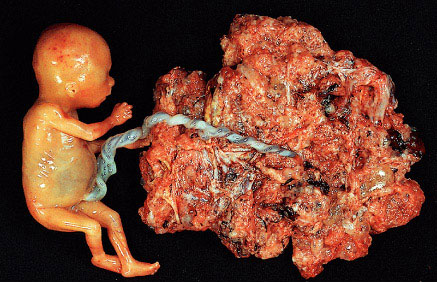
    Actually, the existence of hydatidiform moles underscores the prolife position. One need only compare a fetus with a molar pregnancy of the same gestation age to see very clearly the difference between "pregnancy tissue" and a viable embryonic human being. In fact, even in a partial mole, there is a clear difference between the doomed fetus, which is recognizably a fetus, and the molar tissue, as in this illustration:

    For those of you with a strong stomach, here are a removed mole and an aborted fetus, for your comparison:


    You can see that the mole really is just a blob of tissue, but that no matter how throughly shredded the embryo is, you can still see recognizable human body parts, such as arms, legs, hands, feet, and face. And even more to the point, if you leave the hydatidiform mole to itself, it will never develop into an organism, because it never was an organism to begin with. It will not differentiate into organs and organ systems. It has no capacity to do so. An embryo does.

    Nowhere is the difference between a hydatidiform mole and a viable fetus more vividly demonstrated than in those rare pregnancies in which a woman has a twin pregnancy -- one hydatidiform mole and one normal fetus. So far, there seem to only have been about 30 of these cases reported. The mole is much larger than the fetus, and of course has no organs, limbs, or behaviors. Sadly, although some doctors have tried to manage these pregnancies in ways that save the fetus, they tend to miscarry before the fetus is old enough to live outside the womb. Some do carry to viability, and are not associated with a high number of birth defects.

    Now, if prolifers really just had their knickers in a twist about what was being done to women's bodies, we'd object just as much to the destruction of hydatidiform moles as we do to the destruction of fetuses. We'd be just as outraged if a woman took chemicals to expel a blighted ovum as if she was taking them to cause the death of an embryo. But we're not. We're simply not interested. It's a medical matter, between a woman and her doctor, to decide how best to deal with a molar pregnancy or a blighted ovum, just as it's a medical matter, between a woman and her doctor, to decide how to deal with a fetus or embryo who has died but has not been naturally expelled.

    It's the killing of a new human being that we object to, not the removal of unwanted tissue from the uterus.

    Pressing charges was a mistake

    This kid provided them with the world's most awesome mascot for a measly $360 worth of materials and no charge for labor. They should have simply slapped a trademark on it and thanked the kid.

    And I bet he's gonna end up with job offers out of this.

    (And yeah, he should have BOUGHT some barrels, or asked for some, but still...)

    Protect children from needless suffering: Winds of Hope

    Winds of Hope is a Swiss organization founded by Bertrand Piccard and Brian Jones, who had completed the first successful round-the-world nonstop balloon journey. They chose as their cause the prevention and treatment of something I'd never heard about until today: noma.

    Noma is a true horror of a disease. It's no longer seen in the developed world, but plagues the poverty stricken villages of west Africa. Caused by poor nutrition and inadequate hygiene, noma attacks the soft tissues of the face. It is most commonly seen in small children between the ages of 2 and 6.

    If identified quickly, noma can be treated with a simple disinfecting mouthwash, preventing disfigurement and death. If caught in a more progressive stage, it can still be treated with the sort of antibiotics we in the developed world take for granted. If allowed to progress, it is fatal in up to 80% of cases, and leaves the survivors with devastating facial disfigurement.

    The goal of Winds of Hope is to train local health care workers so that they in turn can educate parents. In this way, noma can be prevented by improved oral hygiene, or identified and treated before it causes damage to the child's face.

    Saturday, June 13, 2009

    How to fry your brain

    Okay -- here's one where the sound does NOT go with the visuals. Not that there's a mixup or the sync is off. It's just -- well, a bunch of middle-aged white guys playing to THAT audience can NOT sound that cool. Not in this universe.


    I'd never seen so much as a picture of these guys before today. As God is my witness, I always thought they were black.

    A Tiller patient expresses her regret

    My Darkest Hour

    We already had a son. He was almost two years old. We were ecstatic to be having another baby. The whole time I was pregnant I was envisioning what it would be like to have 2 beautiful babies. I couldn’t wait!

    ... When I was about 31 weeks pregnant, my obstetrician sent me for a series of tests. .... Finally, after about two weeks we were told the most devastating news. Our precious daughter had a chromosomal abnormality and would probably not live long, if she lived at all. If she did survive, she would suffer terribly and need numerous surgeries to correct the muscular and skeletal problems she would inevitably have. She would also be severely mentally disabled.

    We were devastated. I was totally numb. I believe that I went into shock. I distinctly remember the perinatologist wanting to discuss our “options”. I thought she would tell us what doctors needed to be in the delivery room. Instead she suggested a “choice” I didn’t even know existed. She proposed that we go to Kansas to terminate the pregnancy. I felt like I was in the Twilight Zone. My first reaction was “noooooo!!!!!!!”. Of course I didn’t speak this out loud- I couldn’t speak at all. I just sat there with this evil seed planted in my brain.

    It was quite plain to infer what the doctors wanted us to do. .... They couldn’t answer with certainty what exactly was in store for our little girl; they just knew it would be a life filled with pain. Did we really want this kind of life for our cherished little girl? Time was of the essence. You see I was due any day and we had to make a decision immediately. I can hardly remember any details from the moment we left the doctors’ office until the fateful flight to Kansas where our beloved daughter was destroyed. ....

    .... I have no doubt that those two doctors who sent me to Kansas felt they were doing what was best. .... While I was in Kansas I came in contact with Evil. Everything about the clinic was deceptive. The pictures they take and the way they try so hard to make what you’re doing seem like your losing your baby naturally. ....


    A similar story of regret from the UK is here.

    Cara chose an induction abortion because she believed the doctors when they told her there was no chance of her baby surviving.

    No way to treat a human being

    Prostitute Dies After Being Held in Scorching Outdoor Prison Cell

    I don't care if she was a serial murderer or a drug kingpin, you simply don't do that to people. The fact that she was serving a short sentence for non-violent charges, was not causing problems, and had mental illness that made her more vulnerable only makes an already unacceptable situation even more appalling.

    This is an example of what Wolf Wolfensberger calls "deathmaking". When devalued people are put in situations that make them likely to die.

    Late abortions: A retrospective of posts

    A lot of folks are being drawn to my blog looking for information on third-trimester abortions in the wake of the murder of George Tiller.

    This is a topic I've blogged a lot about, so for your convenience I'll pull together a retrospective of those posts. I'll also bring in posts about Tiller. They're grouped by topic, with posts in multiple categories if they fit in more than one.

    TILLER:

  • What proportion of Tiller's late abortions were for fetal indications?: Tiller himself indicated that the number was 8%.
  • An analysis of those "medically necessary" Tiller abortions: Dr. Paul McHugh is interviewed about his review of Tiller's patient files.
  • The measure of a "hero": An overview of Tiller and the late abortions he did.
  • The Death They Didn't Mourn: Christin Gilbert, mentally disabled teenager, loses her life thanks to Tiller's bad habits and worthless staff.
  • Which is safer for the mother?: A side by side comparison of late abortion versus obstetric care for pregnancy complications
  • Which is safer for the mother?: A side by side comparison of a Tiller late abortion versus obstetric care for pregnancy complications
  • Tiller's Defense: Larry Said I Could: A look at what Tiller admitted on the stand in his trial
  • Tiller Trial: The Plot Thickens: Words from Kristin Neuhaus, the disgraced erstwhile abortionist who rubber-stamped post-viability abortions for Tiller
  • Tiller Getting Favorable Jury: Jurors were dismissed for being "too prolife" but not for being "too prochoice"
  • A Credible Claim?: A complaint filed by a Tiller patient
  • One That Got Away: A child that had been scheduled to die at Tiller's facility returned to plead for other children's lives
  • Them mean old prolifers help woman avoid unwanted abortion: Prolifers brought Tiller patient next door for real help
  • Read Complaints Against Tiller and Associates: Including a summary of the 30 illegal abortion charges based on his own patient records

    REASONS THIRD TRIMESTER ABORTIONS ARE DONE:
  • Why are women having third trimester abortions?: Examples of women facing pressure from health care professionals to abort when the women themselves don't want to.
  • An analysis of those "medically necessary" Tiller abortions: Dr. Paul McHugh is interviewed about his review of Tiller's patient files.
  • Examples of late abortions: Mostly fatal cases from my files.
  • What proportion of Tiller's late abortions were for fetal indications?: Tiller himself indicated that the number was 8%.
  • Obama, McCain, and "Health": A look at the real "health" reasons behind most late abortions

    WHO DOES LATE ABORTIONS:
  • Post Viability Abortions in Your State: A look at who is advertising late abortions online
  • Planned Parenthood Admits to Live Births: Which means they're doing post-viability abortions
  • 1988: NAF Member Kills Teen: Note Karpen's response to the fact that the prolifers outside were helping patients who'd changed their minds
  • Accountability at Last for Pendergraft?: Florida's notorious late term abortionist faced criminal charges
  • Parents Lied to Save Preemie: With list of abortion mills that would gladly have killed a baby that age or older
  • New (to me) Article on Midtown Hospital: An infamous Georgia abortion hospital with a history of routinely performing illegal third trimester abortions

    ON VIOLENCE AGAINST ABORTIONISTS:
  • Response to the Tiller Murder: Is somebody who kills an abortionist being "wise as serpents, innocent as doves"?
  • Abortion Vigilantism Worksheet: Link to an excellent teaching tool in Biblical ethics

    REJECTING LATE ABORTION:
  • Excellent article, sure to send the kind and loving abortion fanatics into an apoplexy: Link to an article about women who rejected abortion after a grave prenatal diagnosis
  • Why are women having third trimester abortions?: Examples of women facing pressure from health care professionals to abort when the women themselves don't want to.
  • 93 Days of Love: Link to the story of Baby Faith, a little girl with anencephaly
  • One That Got Away: A child that had been scheduled to die at Tiller's facility returned to plead for other children's lives
  • Them mean old prolifers help woman avoid unwanted abortion: Prolifers brought Tiller patient next door for real help
  • Joyful Anniversary for a Happy Mommy: It wasn't the end of the world after all
  • Parents had to Fight for Baby's Short Life: The gymnastics of avoiding an unwanted abortion

    HOW LATE ABORTIONS ARE DONE:
  • Which is safer for the mother?: A side by side comparison of a Tiller late abortion versus obstetric care for pregnancy complications
  • Applauding a Child's Death: Audio from Dr. Martin Haskell's presentation on how he does late abortions, with video by Priests for Life illustrating what he's describing
  • Tools of the Trade: Sopher Forceps: A description of a specialized tool for taking apart fetuses in the second and third trimester, and how that tool is used by guys including Tiller abortionist LeRoy Carhart
  • Too Cruel for Killers, Just Right for Babies: A drug used by many late term abortionists is considered "cruel and unusual" when used to execute murderers
  • Just For Comparison: VERY GRAPHIC, with photos of a living preemie, then aborted babies of similar size

    LIVE BIRTHS FROM LATE ABORTIONS:
  • This Baby Won't Stop Breathing: William Waddill strangles a baby in front of multiple witnesses -- then beats the murder rap
  • Why the Sudden Interest: The killing of a liveborn infant after an abortion seizes public attention
  • Planned Parenthood Admits to Live Births:
  • A Fetus With Attitude: A survivor of a late abortion speaks out
  • A Question About Born Alive Babies and Criminal Charges: Why aren't these cases always prosecuted?
  • Another Born-Alive Baby: A baby was injured for life by a post-viability abortion attempt
  • Another Fetus With Attitude: Melissa Ohden tells her story
  • More Born Alive Babies: Links to stories about abortion survivors
  • More Born Alive Babies and their Fates: Further examples of babies that survived attempts to kill them in-utero
  • Obama and the Born Alive Babies: A graphic look at live births following late abortions
  • More on Baby Rowan: His mother's story

    MISCELLANEOUS LATE ABORTION LINKS:
  • Shanda's Abortion Nightmare: Sent to the hospital in a car with her fetus hanging out of her vagina
  • Data Collection Suggestion: How to fill in the gaps in our knowledge about post-viability abortions
  • Can We Really? Tell Me the Truth: Reflecting on a Dostoyevsky quote and third-trimester abortions
  • Obama Comments, I Respond: A response to Obama's contention that late term abortionists simply never make mistakes
  • Third Trimester Abortions and the Law: Where they're legal and for what reasons
  • Answering a Question: A reminder that Martin Haskell made a video of himself doing a partial-birth (D&X) abortion, and that Mark Crutcher will pay any disgruntled abortion clinic employee big bucks if they fork one over
  • Where Does Obama Say He Supports 3rd Trimester Abortion?: At Planned Parenthood
  • Jill Stanek and FactCheck's Faulty "Facts": Was FactCheck ill-informed, or deliberately misleading>
  • Search: Abortions for Health Reasons: Explores how ill-defined "health" is in statistics about why women abort
  • Obama, Babies, and the Benefit of the Doubt: A look at Obama's assumption that late term abortionists never make mistakes
  • Who Needs Hope When You Have These Guys?: Abortion for "fetal indications" -- shutting the door on all hope
  • One That Got Away: A child that had been scheduled to die at Tiller's facility returned to plead for other children's lives">Astonishing new levels of abortion advocacy cluelessness

    Finally, courtesy of Spanish TV, see what these late abortions look like in real life:

    The difference between these abortions and Tiller abortions is that Tiller's staff chased the patient off to the bathroom to push her baby into a toilet and leave it there for staff to either clean up for photos, or dispose of in the crematorium that Tiller had on site. Or both.
  • 1925: Two docs, dead woman

    On June 13, 1925, 24-year-old Betty Fisher died in the Chicago office of doctors August Goetz and Henry Gautsen from an abortion performed that day.

    The doctors were acquitted on October 16. The source does not indicate why.

    Betty's abortion was typical of criminal abortions in that it was attributed to a physician.

    Keep in mind that things that things we take for granted, like antibiotics and blood banks, were still in the future. For more about abortion in this era, see Abortion in the 1920s.


    For more on pre-legalization abortion, see The Bad Old Days of Abortion

    To email this post to a friend, use the icon below.

    Friday, June 12, 2009

    1922: Abortion by midwife kills Chicago woman

    On June 12, 1922, Mrs. Louise Huse, age 30, died at Chicago's Mid West Hospital from a criminal abortion performed there that day.

    On June 16, midwife Agnes Tholl was arrested on the recommendation of the coroner.

    Keep in mind that things that things we take for granted, like antibiotics and blood banks, were still in the future. For more about abortion in this era, see Abortion in the 1920s.


    For more on pre-legalization abortion, see The Bad Old Days of Abortion

    To email this post to a friend, use the icon below.

    1902: Journey to death

    In June of 1902, Irene Wengel traveled to Tampa, Florida, where she was met by her cousin, J. Carl Christian. Christian had arranged for her to stay at the home of Dr. Frederick N. Weightnovel for an abortion. Christian visited Irene many times during her stay at Weightnovel‘s home. Two days after her arrival, Irene asked Christian to telegraph to Waycross for her trunk.

    Testimony about days and dates is evidently jumbled. The abortion was reportedly performed June 6, which was a Friday. But Irene‘s cousin reported that he visited her on a Wednesday, about a week before her death, and she‘d told him that Weightnovel had performed the abortion the previous night, and that she‘d be ready to go home the following Tuesday. The only date we can perhaps rely upon is the date of Irene's death: June 12.

    Dr. B. G. Abernathy was called in to attend to Irene after the abortion. Abernathy testified that Irene told him she‘d come to Weightnovel about two weeks earlier, that she did well the first day or two after the abortion, but that she became very sick and rapidly declined.

    Abernathy diagnosed her Irene suffering from blood poisoning caused by retained placenta. Abernathy asked Weightnovel for a curette so that he could perform a D&C, and Weightnovel provided one. Abernathy also returned to his own house to get some other instruments. At some point Weightnovel asked Abernathy to send a telegram to Irene‘s parents.

    State‘s witness Frank Middaugh testified that on the night Irene died, he‘d heard the cries of a girl calling, "Doctor, doctor," from Weightnovel‘s house. Middaugh also testified that he saw Weightnovel sitting in a lighted window, fanning himself.

    An undertaker testified that he‘d been summoned to remove Irene‘s body, and was asked to do so quietly and discreetly to keep the news of Irene‘s death secret.

    Officer Carter, who arrested Weightnovel, testified that when he made the arrest, Weightnovel picked up a bundle of women‘s clothing, which he rolled up and tried to toss under a table. Carter saw that the clothing was stained and took the clothing into evidence.

    Weightnovel was convicted of manslaughter in Irene‘s death.

    Irene's abortion was typical of pre-legalization abortions in that it was performed by a physician.

    Note, please, that with issues such as doctors not using proper aseptic techniques, lack of access to blood transfusions and antibiotics, and overall poor health to begin with, there was likely little difference between the performance of a legal abortion and illegal practice, and the aftercare for either type of abortion was probably equally unlikely to do the woman much, if any, good. For more about abortion and abortion deaths in the first years of the 20th century, see Abortion Deaths 1900-1909.


    For more on pre-legalization abortion, see The Bad Old Days of Abortion

    To email this post to a friend, use the icon below.

    Thursday, June 11, 2009

    1979: The quality of NAF care falls short

    On June 11, 1979, 19-year-old Angela Scott died at Grady Memorial Hospital. The events that led to her death -- and also claimed the life of another teen -- began on June 2.

    Angela was in the recovery room after her safe, legal abortion at National Abortion Federation member Atlanta Women's Pavillion. Somebody noticed that she wasn't breathing.

    A nurse-anesthetist was administering anesthesia to 14-year-old Delores Smith while Dr. Jacob Adams was performing her abortion. The nurse-anesthetist ran to assist in efforts to revive Angela, leaving Delores unattended with her anesthesia drip still running.

    After staff had resuscitated Angela and loaded her into an ambulance, they returned their attention to Delores, who had gone into cardio-respiratory arrest. Adams had accompanied Angela to the hospital, and staff refused to release Dolores to an ambulance until the physician had returned to discharge her. This resulted in a 30-minute delay, during which the ambulance crew was unable to attend to Delores or begin transporting her.

    Angela lingered for a week in a coma before dying on June 11. Delores never regained consciousness and eventually was admitted to a nursing home, where she died of adult respiratory distress syndrome on October 24, 1979, some time after her fifteenth birthday.

    A 19th Century Abortion Death

    Emma Post, "about twenty years of age, daughter of one of our most respectable citizens, was sudeced by a young man living at Belleville." He called on her at the family home for about a year before learning that she was pregnant.

    He convinced her to leave Brooklyn with him. She told her family that she was going to visit somebody in Dover. Instead, "she was kept in two houses of ill repute in this city." From there she was taken to Boston, where she submitted to a surgical abortion. She was spirited off to Newburyport on Wendesday. On Thursday, June 11, 1857, she "paid the forfeit of such acts, dying in excrutiating agony."

    Her baby's father, F.R. Kickason, was arrested, as was Dr. Lewis Dix, believed to have performed the abortion.


    For more on pre-legalization abortion, see The Bad Old Days of Abortion

    To email this post to a friend, use the icon below.

    Wednesday, June 10, 2009

    Adult stem cells restore vision to blind man

    Crashing Through

    There are so many things I could say about this book, about the psychology of blindness and of getting sight restored. But mostly it's a compelling read that I couldn't put down.

    A bit of vicarious aggrandizing

    Read all about it!

    LeRoy Carhart said that he was misunderstood when he said that the shooting of his old boss was like the assassination of Rev. Dr. Martin Luther King Jr. It wasn't that he was comparing a guy who made a living stabbing babies in the heart with huge syringes to a man devoted to a nonviolent civil rights struggle. No! He wasn't directly comparing Tiller to King.

    He was comparing the significance of the events. And he went on to clarify. What he meant to say that Tiller's murder was as significant as the murder of Dr. King -- and as the bombing of Pearl Harbor!

    So shooting a seedy quack abortionist is of massive historical significance!

    Look, LeRoy, I know the guy was your friend, and he gave you a job when you couldn't keep your renovated muffler shop open. But that doesn't put his murder up there with the assassination of Lincoln or anything, okay?

    Take your meds, LeRoy!

    P.S. And isn't he flat out inviting every loser who wants to feel significant to just shoot an abortionist?

    Another winner of the coveted Illogic Awards

    Dr. Tiller's Murder: Tragic, Not Senseless

    Ted Rall tells his fellow abortion supporters that they need to learn to talk TO prolifers, not PAST them. While he blunders on with his unquestioned assumptions in exactly the way he's telling his fellows not to. And most telling is his idiotic presumption that prolifers "prioritize the fetus over the mother."

    How is saying "These lives are of equal value" prioritizing one over the other?

    And I'm gonna say this again about the "bodily integrity" argument: If the right to bodily integrity is paramount, that's actually an argument against abortion:

    1. The fetus is "commandeering" the mother's body temporarily; the mother is seeking permanent action against the fetus. A "demand" for a temporary stay of execution is much more reasonable than a demand that the other party die.

    2. The fetus actually needs the mother's body for his very survival; the mother's claim isn't a survival claim but a claim of simple personal preference. The fetus's bodily integrity claim in abortion is absolute, for if he is denied his rights in this case he has no further possibility of bodily integrity; the mother's bodily integrity claim is partial, since she can go about her business while pregnant.

    3. The fetus is not in that situation from an act of his volition; the mother is. Negating the fetus' bodily integrity rights is to say that the person who creates a conflict should automatically have precedence over the rights of the person who her actions have placed in the conflict situation in the first place. Generally responsibility falls on the person whose prior acts created the bad situation, who is expected to make due compensation to the person that her actions have harmed.

    If a right to bodily integrity is absolute, the fetus' claims of a right to bodily integrity clearly trump the mother's, since his need is temporary, based on a greater need, and due to a situation that the mother's actions placed in in to begin with.

    Georgia abortionists try to leverage Tiller death

    Clinic Asks to Keep
    Abortion Case Closed


    It seems seedy abortionists have found yet another silver lining in the dark cloud of George Tiller's murder: They're hoping to use it as leverage to get a judge to keep evidence of their wrongdoing from the public, lest it spark another shooting.

    It reminds me of that scene in Liar, Liar when Jim Carrey's client had knocked over an ATM at gunpoint and wants "legal advice" -- Carrey screams at him, "Stop breaking the law, asshole!"

    Advice that would make life much easier for all abortionists. Though "Stop killing babies, asshole!" would be even better advice.

    Tuesday, June 09, 2009

    A very good question, Dr. Hern

    Of Tiller's late term abortion mill: "What doctor, what reasonable doctor would work there?"

    The trouble is, Hern wasn't reflecting on Tiller's appalling practice of keeping supposedly deathly ill women in motel rooms for three days with their newly-killed babies rotting inside them -- something no reasonable doctor would do. He was referring to "the violence" that poor hapless Tiller had to endure from those mean old people who think that a live baby is preferable to a dead one.

    Oh, well. The good news is, Tiller's mill will be permanently closed. LeRoy Carhart will have to go back to his converted muffler shop, Shelley Sella will have to go back to whatever rock she crawled out from under, and Kristin Neuhaus can go on unemployment, I suppose, since nobody in Kansas but Tiller would send any work her way. But I agree wholeheartedly with Troy Newman:

    Troy Newman ... called the announcement that the clinic would close permanently "a bittersweet moment." ....

    "Operation Rescue was just two months away from getting Tiller's medical license revoked, and that would have accomplished the same goal," Newman said in an e-mail.

    A complaint before the State Board of Healing Arts, which licenses and regulates doctors in Kansas, alleged that Tiller violated a state law that required him to obtain a second opinion from an independent physician. It also accused Tiller of engaging in unprofessional or dishonorable conduct.

    A spokeswoman for the board has said since Tiller's death that the case likely would be closed.


    Again, secrets we had long prayed would come into the light were taken into the grave, thanks to that idiot Roeder. Schizophrenia is no excuse for either evil or stupidity, and he's guilty of both -- committing murder, and screwing up the investigation into exactly what went on behind closed doors in Wichita.

    What proportion of Tiller's late abortions were for fetal indications?

    You can go here and hear him say for himself what his ratio was of healthy fetuses to babies with "anomalies" --

    We have some experience with late terminations: about 10,000 patients between 24 and 36 weeks and something like 800 fetal anomalies between 26 and 36 weeks in the past 5 years.


    Why he only counted the "fetal anomalies" between 26 and 36 weeks, and all "late terminations" as between 24 and 36 weeks is a bit bewildering. Was it a misspeak, and he meant to say 24 weeks both times? 26 weeks both times? Did he only bother to tabulate a "fetal anomaly" if the baby was older than 25 weeks?

    We can't know. He's dead and can't tell us. But we can do simple math. 800 out of 10,000 is 8%.

    Tiller said it himself. About 8% of his late term abortion patients were for "fetal anomalies".

    The rest? An analysis of the 30 cases Phil Kline brought charges on revealed women who were "demoralized".

    From Tiller's own lips again:

    [Y]ou may be here because of some of your own issues of survival. You may have issues of domestic violence: rape, incest, spouse abuse, or child abuse.

    ....

    You may have some issues of age yourself. You may be 9, 10, 11, 12, 13, 14, 15 years of age. On the other hand, you may be at the end of the other spectrum of fertility. You may be 40, 45, 50, 55, or even 60 years of age.

    There may be some issues of poverty such as homelessness. You may have some occupational issues. You may have some financial issues.

    But, for whatever reason that you are here... we find that there are many reasons why women find that continuing the pregnancy will cause substantial and irreversible impairment of their physical health, their mental health, their emotional health, their family health, age of the patient, safety and well-being... for whatever reason that you are here, welcome to Wichita, and thank you for the opportunity to be helpful to you.


    Tiller did state that some of his patients were there for third-trimester abortions for reasons of their own health:

    You may have issues of your own health. You may have some serious disease process: cancer, lymphoma, diabetes, high blood pressure, heart disease, or any one of a number of the other medical problems that can afflict women of child bearing age.


    To which I'd say again what I said before -- what doctor in his right mind would keep an already ill patient for three days in a motel room, attended by a layperson, with her recently-killed baby rotting inside her and adding the risk of sepsis to her already fragile health? All of these conditions which Tiller names can be treated close to the woman's home, with the mother safely ensconced in a fully-equipped hospital where medical staff are monitoring her day and night, with access to any medical technology that might be needed to deal with an emergency. Any woman in good enough health to face three days in a motel room with her baby rotting inside her, sticks of seaweed wicking vaginal bacteria into her uterus, and her friend or family member monitoring her condition, before delivering her macerated fetus into a basement toilet is certainly in good enough health to deliver a live baby in a hospital near home. If any of Tiller's patients really were seriously ill, he was inexcusably playing Russian roulette with their lives to make a few thousand dollars from their misery. If they weren't that ill, he was inexcusably lying about what sort of business he was in.

    This is the stalwart hero of "reproductive rights".

    Monday, June 08, 2009

    Why are women having third trimester abortions?

    We really don't know the breakdown of what proportion of late abortions are for social reasons and what proportion are for "fetal indications". (The idea that they're necessary to protect the mother's life or health is nonsensical -- any obstetrician worth his diploma can induce labor or do a c-section if a pregnancy past the point of fetal viability is endangering the mother; and no obstetrician worth his diploma would prescribe three days in a motel room with your mom while your recently lethally-injected baby rots inside you.)

    Of the proportion done due to "fetal indications", there is also no breakdown of whether the diagnosis was verified, or indeed if the mother had been given any diagnosis by a medical professional at all. "Fetal indications" counts come purely from surveys, and can include anything from lethal conditions such as anencephaly, to minor and correctable conditions such as an extra finger, to merely the suspicion that something about the baby might be less than perfect.

    But I'd like to look at the most sympathetic lot of late-abortion patients: Women who have been given a serious prenatal diagnosis.

    And I'd like to address something that's rarely brought up: Are these women really aborting because they've been given accurate information by an unbiased medical professional? Were they given a chance to get a second opinion? Were they given information about carrying to term? Were they given a chance to get past the shock of the diagnosis before making the irreversible decision to abort?

    Nobody is collecting information on this. So all I can give is a few anecdotes of the pressure women are placed under to abort after an unfavorable diagnosis.

  • Elizabeth was given nothing but grim tales to try to convince her to abort her baby with anencephaly. She resisted, and had seven precious minutes to lavish love on her son.

  • Jaime's doctor didn't even ask her what she wanted -- she simply sent her upstairs in the hospital and initiated an abortion, which fortunately didn't go off as the doctor planned. The baby survived the attempted abortion, and later lived for 52 hours of love.

  • Jennifer's doctors kept insisting that her unborn baby was doomed, and repeatedly pushed her to abort and get it over with. She rejected their advice, and though her son had health problems they were not lethal.

  • Dawn's doctor repeatedly urged her to abort. Her daughter was born with health problems, but none that were fatal.

  • Lori was repeatedly encouraged by multiple doctors to abort her baby. Her child is alive and in the process of three steps of surgery to correct his heart defect.

  • Even though Shannon made it clear to her doctor that she was going to give birth, he kept calling to remind her that she still had the option to abort her child with Down syndrome.

  • John and his wife were repeatedly pressured to abort their baby with Down syndrome.

  • Kathy had doctors, family members, and her husband all pushing for abortion.

  • Kelly was told that her baby was "like a doorknob" and that she should just abort to get out of the "bad situation". Another doctor likewise pushed her to just abortion and be done with it. But she resisted, and had a year to love her baby.

  • Lori faced so many doctors insisting that she abort, that she had to threaten to simply show up in the emergency room when she was in labor in order to get care. Her daughter has some problems, but none incompatible with life.

  • Michael and his wife were urged strongly to abort by both the doctor and the genetic counselor. Though their son does have health problems, they are not at all incompatible with life.

  • Shellie had to change doctors to find somebody who would support her in carrying her baby to term.

  • Michele's treatment team asked her again every week if she really didn't want to abort her baby. She treasured her chance to hold her daughter before she died.

  • Every doctor Donna consulted urged her to abort her baby. The first doctor even told her flat out, "You must terminate." She resisted, and is grateful for the hour she had with her son.

  • A genetic counselor tried to simply schedule Stephanie for an abortion, without even giving her a chance to consider her options. Even after tests came back showing fewer problems than doctors originally believed, they still kept pushing for abortion. While her child did indeed have problems, they were nowhere near as severe as she'd been led to believe by those pushing for an abortion.

  • Nancy's doctor pushed hard for an abortion, as soon as possible. It turned out that Nancy's baby was perfectly healthy.

  • Sandi's doctor refused to treat her when she refused an abortion. Her child turned out to have far less severe health problems than the doctor believed.

  • Carolyn's doctor offered to do an abortion the day she got the diagnosis, with no time taken to weigh options. Her daughter turned out to be perfectly healthy.

  • Michelle was given repeated grim prognoses by different doctors, all urging her to abort. Though her daughter has problems, they're not incompatible with life.

  • Erin's doctor gave her a grim prognosis and strongly urged her to abort. Doctors, family, friends, and even a Mormon bishop chimed in, favoring abortion. A last-ditch religious consult resulted in a decision to continue the pregnancy -- resulting in the birth of a little girl with problems, but none of them deadly.

  • Irene was browbeaten with a grim picture of what her baby's life would be if she didn't abort. Though their daughter has many problems, they feel blessed with her.

  • Everybody JoAnn consulted agreed -- her baby was doomed, and she should spare him suffering by just aborting him. When she resisted, her doctor said she should speak with a counselor -- a counselor at an abortion clinic. She finally had to switch doctors. She treasures the hour and a half she got to spend with her son.

  • A perinatologist gave Carolyn a litany of the horrors that he said would face her child if she didn't abort. She braved it out, and has a beautiful daughter whose condition is not nearly as severe as she'd been led to believe.

  • Everybody was urging Jessica to abort, from medical professionals to family and friends. Though her daughter was later stillborn, Jessica was grateful that she let her life out her natural life.

  • Laurie was urged to "induce and get it over with", but she resisted, and was able to spend precious time with her child.

  • Amy and Rob's perinatologist told them that they had no choice but to abort their baby. They refused, and treasured the short time they were able to spend with their daughter.

  • Terry and Courtney's doctor was stunned when they rejected abortion. The parents faced pressure until the pregnancy had passed the cut-off for abortion in their state. Once she was born, they cherished the 52 minutes they got to spend lavishing her with love.

  • A geneticist told Alessandra that her baby was just "a miscarriage that should have happened" and pressed for abortion. Alessandra refused, and her daughter spent her short life being showered with love.

  • Medical professionals dehumanized Christine's unborn baby, treating her just as "a fetus with a defect". When she and her husband rejected abortion, they were gaped at "as if we were from another planet". Everybody was pushing abortion, as if they were daft to pass up the opportunity. They were even referred for a religious consult with somebody urging abortion. But they persevered, and got to take their daughter home and have precious weeks with her.

  • Cat had to switch medical teams to escape the pressure to abort. Her daughter has health problems but is a lively child.

  • Anissa was given a dismal prognosis and pressure to abort. She resisted, and has a cherished son with only minor delays and a few health issues.

    I think that prolife and prochoice have common ground on this: Parents ought not to be emotionally beaten up by medical professionals trying to get them to abort, and they especially ought not to be subjected to attempts to get them to abort immediately after getting a diagnosis, before they even have time to absorb the information.

    Here is a story from George Tiller's patients who did end up going through with an abortion after a fetal diagnosis:

  • LaDonna was rushed by her local doctor into aborting, and later reflected, "I am no longer grateful for Dr tiller 'helping me' he didn't help me at all. I wish now I would of had the courage to deliver my little girl and let her get even just one breath of air before she passed... to let her see my face just once before she passed. I will never have that chance now and I will always have to live with the decision I made and the nightmares of what happened to me in Kansas."

    How many of Tiller's "fetal indications" patients were only there because they'd been frightened, browbeaten, or misled by doctors? We'll never know. The parents for whom the prognosis was wrong will never know themselves, since they killed all hope when they allowed Tiller to perform the lethal injection.

    Choosing abortion after a prenatal diagnosis is choosing the way of despair. It guarantees that there will be a tragic outcome, removing forever any hope that the diagnosis or prognosis might not have been as grim as doctors originally believed.

    Consider this: When a doctor is making a prognosis, he is doing what the TV weatherman does every day -- predicting the future. Would you stake your child's life on a weather forecast? Probably not. Then what sense does it make to stake your child's life on any other professional's best guess?

    Perinatal hospice is a better way: it offers support for the family of a baby diagnosed with a serious problem before birth, while leaving open the door of hope.
  • Abortion Vigilantism Worksheet

    Abortion Vigilantism Worksheet

    An excellent teaching tool in Biblical ethics.

    HT: ProLifeBlogs

    A stark contrast

    Yesterday I was watching a marathon of "Untold Stories from the E.R." with my mom. These are true tales, reenacted and with commentary from doctors, nurses, and family members.

    One memorable case was the 7-months pregnant woman brought in by her husband. She was in horrible pain. The doctor suspected an aortic tear -- a fear that was confirmed. The woman was in danger of bleeding to death unless they transferred her immediately to a hospital equipped to do the surgery she needed.

    Through the whole thing, the woman was pleading, "No matter what, SAVE MY BABY!"

    She wasn't indifferent to whether she herself lived or died; she just wanted to make it abundantly clear that the baby was to be the first priority, and that her own life was to be the secondary concern. Promising to do everything he could to save her baby, the E.R. doctor rode along in the ambulance -- just in case the woman died and the only hope for the baby was a post-mortem c-section.

    Watching this reenactment, hearing the commentary of the doctors involved, I couldn't help but be struck by the contrast between this drama and the drama that played out weekly at George Tiller's late term abortion mill -- where the very first step Dr. Tiller took was a lethal injection to make absolutely sure that no matter what, the baby wouldn't survive. Where the mothers' greatest fear wasn't that their babies would die, but that their babies might live.

    The woman featured in "Untold Stories" survived and even thrived, as did her baby. A happy ending that left many of the doctors involved misty-eyed as they spoke about it.

    You have to wonder what happened to the portion of American people who have gotten to the point where those doctors would have seemed just as noble -- perhaps even more so -- had they been striving to make sure that the baby didn't survive. And had they stuck the woman in a motel room with her mom because it's cheaper that way.

    Anniversary: One of a dozen

    The survivors of 32-year-old Joyce Ortenzio filed suit against Edward Allred, his Family Planning Associates Medical Group (FPA), the San Vicente Hospital FPA facility, and abortionist Ruben Marmet.

    Joyce went to San Vicente for laminaria insertion by Marmet on June 7, 1988. Later, Marmet performed a safe and legal abortion, but did not remove all of the fetal parts from Joyce's uterus.

    The next day, June 8, Joyce was found dead in her home.

    The cause of death was an overdose of the drug amitriptyline, infection from fetal parts that were not removed during the abortion and septic shock.

    Joyce left three children motherless.

    Joyce is one of many women to die at this National Abortion Federation facility.

    Other women known to have died after abortion at Allred's facilities include:


    I suspect that the reason the deaths appear in clusters is because those are years that researchers checked for lawsuits, rather than that these are all the women and girls who died at Allred facilities. Anybody with the time and resources to do so could probably uncover other deaths Allred and his staff have managed to sweep under the carpet.

    For more abortion deaths, visit the Cemetery of Choice:


    To email this post to a friend, use the icon below.

    Sunday, June 07, 2009

    Two criminal anniversaries

    On June 7, 1924, 27-year-old Anna Strazynski died at her Chicago home from an illegal abortion performed that day. The perpetrator was never identified.

    On June 7, 1929, 20-year-old Viola Koepping died at the office of Dr. Albert West of Chicago, from an abortion evidently performed there that day. West was held by the coroner on June 21. West was indicted by a grand jury for felony murder on April 21, 1930.


    For more on pre-legalization abortion, see The Bad Old Days of Abortion

    To email this post to a friend, use the icon below.

    Saturday, June 06, 2009

    2000: Sudden abortion death in Brooklyn

    Nicey Washington was 26 years old when she underwent a safe and legal abortion at Ambulatory Surgery Center in Brooklyn, New York, on June 6, 2000.

    Her heart stopped after the abortion. She was rushed to Lutheran Hospital at about 11 a.m. Attempts to revive her failed, and she was declared dead at around noon.

    As of the time of the last article I could find on Nicey's death, the Medical Examiner's office hadn't determined the exact cause of death, but suspected a botched abortion.

    The state health department would not provide information due to confidentiality concerns, but added, "We are actively investigating this particular case."

    For more abortion deaths, visit the Cemetery of Choice:


    To email this post to a friend, use the icon below.

    1984: Child left motherless by safe, legal abortion

    A chronic ashtma patient, 27-year-old Sheila Hebert went to Delta Women's Clinic in Baton Rouge for a safe and legal abortion on June 6, 1984. Shortly after the abortion, Sheila complained of chest pains and difficulty breathing. She lost consciousness, and staff injected her with adrenaline, but were unable to revive her. She was taken to a nearby hospital where she died.

    The coroner attributed the death to "cardiorespiratory arrest due to acute ashtmatic bronchitis" after "surgical termination of pregnancy.

    A suit filed anonymously against Richardson Glidden and Delta Women's Clinic raised these issues in the death of a patient in 1984. The suit and news article therefore probably describe the same case; any minor discrepancies are probably justust errors in reporting. "Jane Doe" was 27 years old. The suit was filed on behalf of her 10-year-old motherless son, "Minor A". Jane was the couple's only daughter. She was aborted by Glidden at Delta on June 5, 1984. Afterward, she was "placed in a post-operative room where she developed an acute asthma condition and expired." Emergency personnel arrived within 3 minutes of getting the call, but found the young woman blue, cool, and essentially lifeless. Efforts to revive her, both at Delta and at the ICU proved unsuccessful. The suit charged Glidden and Delta staff with failure to monitor the patient in recovery, failing to react properly when her condition was discovered, failing to call 911 promptly, and failing to have adequate emergency equipment available.

    For more abortion deaths, visit the Cemetery of Choice:


    To email this post to a friend, use the icon below.

    Anniversary: The Death of a Poster Child

    Geraldine "Gerri" Twerdy Santoro is the woman in the infamous photo used by abortion advocates to illustrate the horror of illegal abortion. The photo, taken by police, was possibly lifted from the files of New York City Medical Examiner Milton Helpern, who local police had called in for help in solving the crime. The photo showed Gerri, nude, face-down with her knees under her, on the floor of the motel room where she died. Ms. Magazine first published the photo in 1973, and abortion advocates continue to use the phcture in posters. And in 1995, Boston filmmaker Jane Gillooly produced a film, "Leona's Sister Gerri," to rally people behind the cause of readily available abortion, on PBS, at taxpayer expense.

    An icon in death, who was Geraldine Santoro in life?

    Born Aubust 16, 1935, Gerri's best friend from high school described her as fun-loving, given to playing hookey and getting sent to the principal's office for mischief. Gerri wanted to beat an engaged friend to the altar, so she got married at age 18 to Salvatore "Sam" Santoro, three or four weeks after she had met him at a bus stop.

    But Santoro was abusive. Gerri's sister reported often seeing her covered with bruises, and seeing the children beaten with a belt. Santoro reportedly blamed the abuse on sinus problems that gave him headaches that made him irritable, so he moved his little family to California. But the abuse continued. Gerri's daughter later recounted hearing her mother screaming, going into the bedroom, and seeing her father atop Gerri, his hands around her throat. So in 1963, Gerri left Sam Santoro and took their two daughers to live on her family's farm in Coventry, Connectucut.

    She got a job at Mansfield State Training School. There she met Clyde Dixon, a 43-year-old married man who worked with her. Gerri spoke to her sister of one day marrying Dixon, fantasizing about how her children could play in his yard and have their own room. The two had an affair, and Gerri got pregnant.

    This was in 1964. Sam Santoro announced he was coming from California to visit his daughters. Gerri, 28 years old and six and a half months pregnant, reportedly feared for either for her life, or that she would lose custody of her children.

    Gerri asked a friend for some ergot, ostensibly for a another friend. But evidently nothing came of this. Her sister realized Gerri was pregnant, and Gerri asked her, too, for some ergot. But Leona didn't think this was safe and dissuaded her sister from pursuing this avenue. Leona said she managed to pull together about $700 or $750 for Gerri, thinking Gerri could go someplace far way, to an organization like Catholic Charities, to get help.

    On June 8, Gerri and Clyde Dixon checked into a motel in Norwich, Connecticut under aliases. The plan was for Dixon, using surgical instruments and a medical textbook he'd gotten from a co-worker at Mansfield State Training School, to perform an abortion. The co-worker had access to the instruments and book because his wife was a physician.

    Dixon started the abortion by inserting a catheter into Gerri's uterus. However, Gerri began to hemorrhage. Dixon abandoned her, leaving her to bleed to death. Her body was discovered by a maid the following morning.

    Lorena had to go to the hospital to identify her sister's body. The family told the children that their mother had been hit by a car.

    Dixon had fled the state. Three days later, out of gas and out of money, he turned himself into police in Morgantown, West Virginia. He pleaded nolo contender to manslaughter and conspiracy to commit abortion, and was sentenced to a year and a day to three years. Police officers who worked the case called this term "negligible". The man who had provided the instruments was also arrested.

    It wasn't until after Ms. published the photo that Gerri's daughter, Joannie Griffith, then 17, was shown the picture by her aunt and told the truth of her mother's death. She was outraged at how Ms. was using the photo, saying, "How dare they flaunt this? How dare they take my beautiful mom, my beautiful, beautiful mom, and put this in front of the public eye. And who gave them permission. I was pissed."

    The headline in Ms. was "Never Again." Never again, they said, would women die from dangerous abortions as Gerri had died, because the Supreme Court had handed down Roe vs. Wade.

    And with that, mainstream feminist interest in women's needless abortion deaths was layed to rest. Only twice since Roe have I noted mainstream feminists upset over a woman's death from abortion. The first time was in 1977, when Rosie Jimenez died from an illegal abortion after being told that the taxpayers would not pay for any more elective abortions for her. The second was in 1988, when Becky Bell died of pneumonia shortly after miscarrying -- and her death was presented, against all evidence to the contrary, as a death from an illegal abortion.

    Women continue to die horrible deaths. They were already dying horrible deaths from legal abortions even before Roe.

    But those deaths aren't politically useful. It's hard to make much of a political or social case for how much of a blessing "safe and legal" abortion is when

  • A hemorrhaging patient is left in the care of an untrained receptionist
  • A National Abortion Federation member allows his receptionist to administer general anesthesia
  • The clinic whose data was used to "prove" the safety of outpatient abortion charts a dead patient as "pink, alert, responsive"
  • A National Abortion Federation member calls a 13-year-old girl's fatal abortion "uneventful"
  • A teenager dies after being browbeaten into an unwanted abortion at a prestigious women's hospital
  • A teenager dies clutching her mother's hand, moaning, "Oh, mama, mama, it hurts so much!"
  • A teenager chokes to death on her own vomit on the abortion table
  • A mentally disabled teen is kept in a motel room for three days with her fetus rotting inside her
  • A young refugee suffers multiple amputations before dying of a septic abortion
  • A teenage abortion patient is left unattended for 12 hours
  • A woman's cries for help go unheeded as she bleeds to death in a clinic recovery room
  • A young mother dies in a clinic where you could write your name in the dust
  • A homeless woman is found dead in a car
  • Everybody passes the buck when a woman is left paralyzed and mute
  • Planned Parenthood sends a patient home to bleed to death
  • A teenager awakes screaming in the night and collapses in her mother's arms
  • A young mother bleeds to death in front of her three children
  • A dying teenager is shoved out the door on New Years Eve
  • A woman bleeds to death in a filthy clinic
  • A mother finds her teenage daughter dead on the bathroom floor
  • A teenage girl screams in the car all the way to the hospital
  • A school counselor arranges a secret abortion for a 13-year-old girl who is left unattended to lapse into a coma
  • A 16-year-old's aunt sneaks her off for a fatal abortion
  • An abortionist shoves a mutilated 32-week fetus halfway through a woman's uterine wall, then leaves her unattended while he does other abortions
  • A woman is injected with poison to kill her fetus then sent home to fend for herself
  • Doctors lie to a cancer patient to convince her to abort
  • An abortionist operating in the basement of a used car lot uses overdoses of Lidocaine as makeshift general anesthesia
  • A sexual predator's sister arranges a fatal abortion
  • A clinic owner passing herself off as a doctor tries to stuff her dead patient into the trunk of her own car
  • A clinic fatally injures two teenagers nearly simultaneously
  • A "hand-holder" was assisting with general anesthesia
  • A young child is found in a motel room with her dead mother
  • A young man's pleas for help for his hemorrhaging girlfriend are dismissed out of hand

    None of those deaths sparked any outrage from the self-appointed advocates for women's lives and safety. But they remain in a lather over Gerri Santoro, shouting "Never again!"
  • 1907: Woman dead, midwife blamed

    On June 6, 1907, Mrs. Julia Williamson, age 29, died at her Chicago home from complications of an abortion performed there that day.

    A midwife named Emily Redemski was held by the coroner's jury, but acquitted by a judge for reasons not given in the source document.

    Julia's abortion was unusual in that it was not performed by a physician.

    Note, please, that with issues such as doctors not using proper aseptic techniques, lack of access to blood transfusions and antibiotics, and overall poor health to begin with, there was likely little difference between the performance of a legal abortion and illegal practice, and the aftercare for either type of abortion was probably equally unlikely to do the woman much, if any, good. For more about abortion and abortion deaths in the first years of the 20th century, see Abortion Deaths 1900-1909.


    For more on pre-legalization abortion, see The Bad Old Days of Abortion

    To email this post to a friend, use the icon below.

    Thursday, June 04, 2009

    An analysis of those "medically necessary" Tiller abortions

    The assertions that the abortions Tiller was infamous for were performed on women whose lives were in danger have begun to fade. As they should, as people ponder the utterly nonsensical idea that any woman could face a life-threatening or health-threatening pregnancy complication for which the safest course of action is to strenuously avoid all inpatient care at fully-equipped hospitals and to instead spend three days at the La Qunita attended by your mom or boyfriend.

    That said, let's look at exactly what justification there was for these abortions.

    Kansas law only allows third-trimester abortions (post-viability abortions done on fetuses who could have been delivered alive) for two reason:

    “(1) The abortion is necessary to preserve the life of the pregnant woman; or (2) a continuation of the pregnancy will cause a substantial and irreversible impairment of a major bodily function of the pregnant woman.”

    Now, these reasons are clearly bogus in the first place, since a pregnant woman whose life or health is in danger in the third trimester would need care in a fully-equipped hospital, not in the La Quinta. There's no medical reason not to do an emergency c-section or delivery in a hospital, where the mother will be attended by medical professionals. There can be no medical reason to have her spend three days in a motel attended by her husband, partner, sister, parents, or friends. But the Supreme Court, in Doe v. Bolton created a "health" need for post-viability abortions. The "need" is a judicial one, not a medical one, invented by men in black robes, not doctors in white coats. Up until Roe and Doe, there was no such thing as a post-viability abortion. I can't stress that enough: Up until Roe and Doe, an abortion by definition was the termination of a pregnancy prior to fetal viability.

    That said, Dr. Paul R. McHugh, who reviewed the redacted medical records on George Tiller's post-viability abortions, explores the reasons given as justification:


    Highlights: Interviewer reviews Dr. McHugh's impressive qualifications. Dr. McHugh explains that Attorney General Kline asked him to review the records to "confirm or reject the idea" that the women were "in danger of suffering a substantial and irreversible impairment if the pregnancies continued -- impairment of a psychiatric kind." He did not think those records supported the claim that the women would suffer any substantial and irreversible impairment, as spelled out in Kansas law. The question he was asked was did he, an independent psychiatrist, concur with the idea that an abortion was necessary to prevent substantial and irreversible psychiatric damage.

    Dr. McHugh indicated that he looked for evidence of the following: Where the records adequate to develop a diagnosis? Did the diagnoses represent a substantial and irreversible impairment? Would an abortion resolve the problem? Were these adequate psychiatric justifications?

    He pointed out that the records were redacted, since names and identifying information were removed. He was to look at the quality and adequacy of the examinations done to determine a psychiatric justification for abortion. The interview establishes that Dr. McHugh was the state's expert witness, and that he wrote an affidavit of his findings.

    As a side note, I'd like to point out that Paul Morrison, who replaced Phil Kline, never contacted Dr. McHugh to follow through on the case. Dr. McHugh was not called on to testify when Tiller finally went to trial. And, what's more, Paul Morrison never addressed the issue of whether or not the abortions in question were medically justified according to Kansas law. He stuck to one narrow point: Was Dr. Neuhaus, who signed off on all of the abortions, sufficiently "independent" under the law? Whether or not the records substantiated the claim that the abortions were medically justified was never addressed in court.

    What were some of the reasons given by the mothers for these late-term abortions? These abortions were done at 26 to 30 weeks. I address the issue of accuracy in estimating gestational age, and the potential these babies had for survival, here. In a nutshell, assuming that Tiller's estimates of these babies' ages were 100% accurate (odds are against that but we'll assume), they had at least an 80% chance of survival if delivered live via emergency c-section or labor induction, as is the standard of care for treating women with third-trimester pregnancy complications.

    So what did Dr. McHugh find were the reasons for these supposedly compelling, health-preserving late term abortions?

    "The mothers were expressing ... great senses of distress and worry about their future. They were tearful, and preoccupied that only an abortion would help them. They said that they were sad and frightened, and they spoke about fears that their future life would be changed. They expressed ideas that they were not being given adequate support, and that they felt that the abortion would help them."

    The interviewer asks him to summarize his findings. Dr. McHugh says these records were "very inadequate psychiatric records." He described them as being very brief, lacking a patient history, lacking detail. "There was no clear work of -- in those records that would be construed of capable of giving you a full picture of the mental condition of these women. They highlighted certain kinds of things that .... were sometimes of a most trivial sort, from saying that 'I won't be able to go to concerts' or 'I won't be able to take part in sports'" to a reluctance to surrender the child for adoption or concern about the child's future. "At no time could you see and understand the future of these individuals and in what way they could be seen as full people, people capable of being helped in this situation. Rather, they were highlighted for certain kinds of -- well, preoccupations and concerns." Dr. McHugh pointed out, "I could pick out only bits and pieces of this. This is not a -- None of them represented a full psychiatric history."


    Highlights: Interviewer asks for Tiller's justifications. "He had mostly social reasons for thinking that the late term abortions were suitable. That the children ... would not thrive. That the woman would have her future re-directed. That they wouldn't get a good education after they had a child. That they would be always guilty in some way about having that child. That they had been abused already and that this -- to have the baby would be another form of abuse. These ... are not psychiatric ideas... These were social ideas. .... There was nothing to back these things up in a substantial way."

    Dr. McHugh also stressed the lack of follow-up planning, no follow-up care of any sort, including a lack of a psychiatric aftercare plan. There were also no explorations of alternative treatments other than abortion. "You couldn't even begin to try to get a true picture of the person." He noted again that some of the justifications included concerns about attending the prom, or concerts, or sporting events. Dr. McHugh also noted that attending concerts and sporting events, or pursuing an education, are things many people pursue after having a baby.

    "Occasionally you would hear someone say their suicidal ideation would increase." Dr. McHugh noted that "being pregnant and being the mother of a child up to age one actually reduces the suicide risk to women from three to eight-fold." He also noted that abortion and miscarriage are known to increase suicide risk. There was nothing in the records to indicate why Tiller felt that these women's situations ran so far contrary to the established patterns of suicide risk.

    Dr. McHugh again noted the paucity of information on these cases, and the lack of proper psychiatric work-ups. "These cases have not been studied thoroughly. And the diagnoses that have been made, such as depression, adjustment disorder and the like -- those are not substantial and permanently impairing conditions. Those are conditions we psychiatrists deal with all the time." He points out that most psychiatric practice involves helping patients to overcome these diagnoses "and restoring people to their mental health. We do that all the time."

    Dr. McHugh says, "I think that these young women were all in a demoralized state of mind. You -- These diagnoses become almost interchangeable, at least on the evidence that's produced here. They're all fundamentally demoralized young women and what they needed was support, help, care, and long-term treatment for the situation that they had, in which they felt abandoned, so that they could once again feel, as they should feel, that their future is rich."

    The interviewer asked if it wasn't a breach of medical care to lack follow-up plans. Dr. McHugh says, "It relates to my concern about these records as not being adequate, either in what they brought to the case, or what they propose for the case other than the abortion. And I had to ask myself, looking at these records, is any person who comes to this clinic ever found not to be appropriate on psychological or psychiatric grounds for abortion?"

    The interviewer asked if Tiller ever rejected a patient. Dr. McHugh said he'd seen no such records. "I'm saying that looking at these records, and what they were employed to do, I can't imagine that anyone wouldn't satisfy those criteria." He added, "From these records -- anybody could have gotten an abortion if they wanted one."

    "When I look at the records, as far as I can tell, all these young women were very similar in the sense that they were all demoralized. And what other diagnostic term you wanted to give it was almost interchangeable on the basis of these records. They were discouraged -- fearful, worried young women who needed support, and would express a variety of ideas in that context to win what they were looking for. And that's -- that's the way to understand these people in my opinion. And a thorough psychiatric examination, and a thorough and adequate psychiatric plan was needed by them, and was not received -- here, anyway."


    Highlights: She asked about Tiller's training in psychiatry and psychology. Dr. McHugh says he doesn't know, though he does understand Tiller worked in pathology for a while and was not a psychiatrist. And he stresses that he wasn't called upon to judge Tiller's qualifications, just to review the records and their adequacy as far as psychiatric evaluations and psychiatric treatment planning.

    The psychiatric assessments justifying the abortions evidently were being done by Tiller, and each file included a letter from a second doctor who expressed "her" opinion -- indicating that it was always the same doctor (Likely Dr. Kristen Nuehaus) -- seconding Tiller's opinion that the woman would indeed suffer a substantial and irreversible impairment of a bodily function, psychiatrically, should they not have abortions. Dr. McHugh noted, "that letter did not come with the kind of pages of psychiatric study, evaluation, biographical details, understanding of the person on which -- from that record you could confirm that opinion." He noted, "At least from the record,that second opinion ... rested upon an encounter with the young woman and a statement of her present state of mind. So it was an opinion derived in much the same way, from the statements of the patients themselves of how distressed they were." He noted that the letters were not highly detailed, but a letter was "brief, symptom-only based, and unsubstantiated in its prognosis on the basis of a rich detailed study of the young woman and her potentials."

    He looks at the lack of any review of the woman's situation, or her resources. "One wonders looking at this why some consideration isn't being made to employ them for the benefit of these patients." He notes that the impression one gets from reviewing the cases is, "These young women came here for an abortion, and the effort on the part of the psychiatric assessment was to support that -- that idea that an abortion is appropriate rather considering the alternatives, the risks and benefits of this to this person in a life."

    The interviewer asked if any of the files showed sufficient psychiatric evidence to justify an abortion. Dr. McHugh saw none. They were all based on the "present state of mind of being distressed" and the social idea that the patient's opportunities might be lessened if they bore their children.

    Dr. McHugh felt that the records were inadequate to perform a diagnosis, and very inadequate to understand the women in question. He picked up that they were "discouraged" and "demoralized" and "disheartened" and a psychiatric diagnosis of depression seemed very inadequate to him. The records were so inadequate that they did not, in his opinion, support the diagnoses given, nor of any other diagnosis. He felt that no psychiatrist would consider them adequate records to make a diagnoses or make a psychiatric plan. And, he noted, despite the paucity of information on which to base a psychiatric plan, these files were in fact being used to make a psychiatric plan -- to perform an abortion as a treatment for the diagnoses in question.

    The interviewer went through the diagnoses given and asked did they constitute permanent and irreversible impairments, and Dr. McHugh indicated no, and that furthermore these conditions, if the diagnoses were correct, are treatable in pregnancy.


    Highlights: "How would you summarize ... Tiller's findings that justify these late term abortions?" McHugh noted, "All I can carry away from this is that by these criteria, is that no person that would want an abortion -- a late-term abortion --would be turned away from that. So I presume that the idea here is to justify that surgical procedure. That -- And these records on a psychiatric basis do not justify that."

    The interviewer asked about the social reasons Tiller used. Dr. McHugh referred to his notes. Tiller claimed that a patient would end up uneducated -- which is a social prediction, not a medical prognosis. That the patient feared occupational setbacks or family disapproval.

    Dr. McHugh said, "I don't mean to say that if you do lose out in your education that that's not harm, but it's a social harm, and those kinds of things should be treated in a social fashion. And by supporting the individual, re-moralizing her, giving her her strengths ... she then, as we know, independently can demand the kinds of support ... that she would be entitled to!"

    Dr. MrHugh quoted one of Tiller's notes justifying one of these third-trimester abortions: "If she was forced to carry to term, she would end up as an uneducated person without occupational skills and have multiple other pregnancies. ... All of those things are social predictions! .... I'm saying, and we psychiatrists would say, will be avoided if you can get this person once again to feel what she's entitled to feel, that she is an independent individual with rights.... If you teach her that the only thing that can be done here is that this viable human being has to be killed in order for her to have anything in her future, that's a lesson, that's a social lesson, that may well... take from her the sort of sense that she can overcome hurdles that life brings her."

    He points out that this sort of defeatist attitude toward women in any other context would be treated with the appropriate scorn.

    Dr. McHugh expressed a sense that Tiller was reinforcing the patients' views of themselves as powerless and incapable, with no promise and no strengths, that Tiller was underscoring and reinforcing a sense of hopelessness.

    Dr. McHugh says, "Doctors are supposed to give hope to people, and give support to people, and they have to believe that there is such hope to be found in them. And usually ... that kind of hopeful attitude comes out of taking the full history of the person, noticing not simply what life has imposed upon her, but what she has brought to life, what her strengths are. If we approach a psychiatric problem as though there are only deficits rather assets for a person, we will never have an optimistic and future-oriented therapy for people. We've got to see their assets as well as their vulnerabilities.... And those don't come across in these records."

    He adds, "By the records, anyway, what is being looked at is the state of mind of the woman right at the time, in which the issues of the stressing aspects of her present context are emphasized, and her strengths, her assets, the things that she brought, and, by the way, our capacity to open up for her and broader her horizons as to what can happen in the future for her is neglected. It's as though, from the records .... one has the idea that the purpose of this visit is to justify an abortion, rather than the purpose of this visit is to have a full psychiatric understanding of this person and see all of the alternative ways that she could approach her life."


    The interviewer then reinforced that these are viable fetuses, late in pregnancy. "These are the very kinds of little babies that are being taken care of in ICUs all around our country. .... To eliminate them is a serious business. .... There's no psychiatric reasons for that."

    Dr. McHugh notes that "There is no psychological condition for which abortion is the cure."

    The interviewer asked why Dr. McHugh chose to speak out. He noted that he was invited to this situation by an Attorney General, and that psychiatry was being called in to justify these abortions. "This is not a full psychiatric practice that we are seeing here. Rather, psychiatric terms are being employed to justify doing a procedure." He sees speaking out as "speaking out for my discipline."

    Dr. McHugh said, "These records are not adequate records for the support of a serious decision for abortion, and that they do not represent psychiatry at its best, and psychiatry at its best should be employed when serious decisions are being made."

    "The people of Kansas have written these laws," Dr. McHugh stressed. "'Viable fetuses should not be aborted unless there is a substantial and irreversible condition that the pregnancy will produce.' Well, when a psychiatric diagnosis is brought forth, I think that the people should understand that that requires a heck of a lot more than I found in these records. That's what I' here and that's what I'm trying to report."

    And the narrator recaps.

    The things Dr. McHugh brought forth are in keeping with what investigators found when they researched abortion lobby claims that late abortions are done only in desperate situations where either mother or baby had a terrible diagnosis. In fact, what Dr. McHugh describes being done in Kansas to get around laws against post-viability abortions is highly reminiscent of the rubber-stamping psychiatrists used to do to enable women to get around laws banning elective abortions prior to legalization.

    As this woman's testimony bears out that these abortions are not being done to address women's critical health issues, and also, Tiller is not reporting statutory rape. She was only 14 years old.


    She describes pushing her baby out into a toilet, which was the standard way the abortions were done at Tiller's facility.

    You can hear Michelle Arnesto's unedited testimony about her illegal late-term abortion at Tiller's mill here. And there are summaries of other cases here. The cases, in a nutshell, are 26 weeks for Anxiety Disorder Not Otherwise Specified or Adjustment Disorder with mixed anxiety and depressed mood; 29 weeks with no reason given for declaring the fetus "non-viable"; 28 weeks for Major Depressive Disorder Single Episode, 28 weeks with no note on the mother's medical condition, 28 weeks for Major Depressive Disorder Single Episode, etc. And -- often -- no medical justification given at all.

    Even one of Tiller's friends pointed out, in a marvel of understatement, "Some of his practices are hard to defend."

    Amen to that.

    Is there an excuse for such behavior?

    Vandalism. Harassment. Firebombing. Why is this happening more and more?

    "A lot of activists are frustrated. They've exhausted the legal means, and they've decided to take it to the next level," said [John Doe], a press officer with [Activist Group X], which acts as a mouthpiece for the [X] movement but claims no direct affiliation with the [activists] themselves.

    "As with any social justice movement, when met with resistance from the state, violence becomes inevitable. There is nothing unique about this movement."


  • What activists are being excused for "taking it to the next level" due to frustration?
    Antiabortion activists
    Animal rights activists

    So? Click here to learn more. And ask yourself if both of the groups I've mentioned in the quiz are getting the same kind of coverage in the press when somebody espousing their views commits a crime.
  • I thought poverty caused crime

    Suspect in Kansas Abortion Doctor's Killing Had $10

    The guy's total assets were $10 and a 16-year-old car. He was unable to hold down a job. He had untreated schizophrenia.

    All of these situations are used by the Left to excuse all manner of crime.

    Unless the crime victim is an abortionist. Then all bets are off. Poverty isn't a factor. Unemployment isn't a factor. Mental illness isn't a factor. It's Bill O'Reilly's fault! (The new default person to blame for all ills now that Bush is out of office.)

    A fairly even handed look at Tiller

    Common Ground on Late-Term Abortion: Anguish

    They omitted some salient points:

    1. There was no mention of the degree to which women facing prenatal diagnoses are often pushed into abortion against their own inclinations.

    2. There was no mention of the failure to ensure that women really did get proper treatment for their mental health issues eitehr before or after their abortions.

    3. There was no mention of women's regret that they'd gone to Tiller and hadn't given their babies a chance at life.

    4. No mention of Sarah Brown, left blind, paralyzed, and mentally retarded by one of Tiller's attempts at a "compassionate" late abortion.

    5. No mention of the fact that YES, some of the patients did give some pretty trivial reasons, like cheerleading or wanting to go to a concert, for aborting.

    But refreshingly evenhanded overall.

    Wednesday, June 03, 2009

    Examples of late abortions

    Lately a lot of news outlets have been asserting that Tiller's Wichita facility was one of only three places where you could get your unborn baby killed after 21 weeks. And most also implied, if not said outright, that these abortions are only done for compelling health reasons, or because the baby has some condition "incompatible with life".

    Well, I'm gonna go through my cases -- most of which were also fatal to the mother -- for cases after 21 weeks.

    22 weeks
  • Dawn Mendoza, elective abortion, died of embolism.
  • Latachie Veal, elective abortion, bled to death
  • "Anita", elective abortion, bled to death
  • Germaine Newman, elective abortion, septic abortion death
  • Mary Pena, elective abortion, bled to death
  • "Thelma", seriously injured in elective abortion
  • "Erica", elective abortion, died of embolism
  • "Brandy", nearly died from elective abortion

    23 weeks
  • Lou Anne Herron, bled to death from elective abortion
  • Mother of "Phoenix Doe", ended up giving birth to new-term infant during supposed 23-week elective abortion
  • Christella Forte, died of complications of elective abortion
  • Christina Goesswein, died from elective abortion
  • "Brittany", retained fetal skull from elective abortion
  • Lynn McNair, died from embolism, elective abortion
  • Allegra Roseberry, died from abortion allegedly necessary to get into cancer program

    24 weeks
  • "Pamela", died from abortion for pre-eclampsia
  • "Anne", injured in elective abortion

    25 weeks
  • Denise Montoya, died from elective abortion

    26 weeks
  • "Millie", injured in elective abortion
  • "Nicholette", changed mind partway through elective abortion, gave birth to baby that died of prematurity

    28 weeks
  • "Shanda", injured in elective abortion
  • Mary, elective abortion, baby born alive then strangled

    30 weeks
  • Magdalena Rodriguez, bled to death, elective abortion

    35 weeks
  • "Beverly", died from abortion because baby had anencephaly
  • 1975: Mother of four bleeds to death

    Sandra Chmiel was a pretty young mother of four when she went to Biogenetics Ltd. in Chicago for a safe and legal abortion on June 3, 1975. Even though 35-year-old Sandra was more than 12 weeks pregnant, the Biogenetics doctor chose to ignore the Illinois law that required abortions after 12 weeks to be performed in hospitals.

    Within hours of her abortion, Sandra had bled to death from a punctured uterus. Biogenetics (which had been the target of at least 30 malpractice suits) claimed that their doctor was only repairing damage Sandra had done to herself in an attempted self-induced abortion. However, Biogenetics settled the case with Sandra's survivors for $75,000.

    Brenda Benton and Synthia Dennard also died after abortions at Biogenetics.

    Biogenetics's owner Kenneth Yellin was gunned down outside his facility in an apparent gangland slaying in 1979.

    (NOTE: The current Biogenetics company in Chicago is not affiliated with any abortion facility and was in no way associated with Sandra's death.)

    For more abortion deaths, visit the Cemetery of Choice:


    To email this post to a friend, use the icon below.

    A macabre tale from the past

    Like the Jacqueline Smith case in the previous decade, the strange events surrounding the death of 19-year-old Barbara Lofrumento have become almost an urban legend. But the tale of Barbara's tragic death and its aftermath is all too true.

    Barbara, a 19-year-old college student, informed her parents that she was pregnant. Mr. and Mrs. Lofrumento cast about for a reputable abortionist and were referred by an acquaintance to Dr. Harvey Lothringer. Lothringer, a Princeton graduate, examined Barbara on June 2, 1962, and assured the parents that although Barbara's pregnancy was 5 months advanced, there was no danger. He arranged to pick up Barbara and her mother, Rose, and took them to his office, which was in his home in a wealthy section of Queens.

    This was typical of the "back alley abortion" -- a reputable physician would make sneaky arrangements to do abortions at the site of their legitimate practices, taking the woman in "through the back alley" rather than the front door. In fact, by far the bulk of criminal abortion were performed by doctors.

    They arrived just after 3 AM on the 3rd. While Mrs. Lofrumento waited, Lothringer sent Barbara into a room where she removed her underwear and reported feeling unwell from the injection Lothringer had given her. Lothringer then took Barbara into his office and left Mrs. Lofrumento in his waiting room.

    At about 5 AM, Lothringer told Mrs. Lofrumento that Barbara was all right, but that she needed some oxygen. Sources disagree as to what happened next. Milton Helpern says that at 7 AM, Lothringer told Rose that Barbara was resting quietly, and that she should go home and get some rest. The New York Times says that Lothringer told Rose that he was going to hospitalize Barbara for a minor complication. Both sources indicated that Lothringer instructed Rose to return later to get her daughter.

    Lothringer sent Mrs. Lofrumento to Grand Central Station, where he had arranged for her husband to pick her up and take her home. Instead, the couple went straight to Lothringer's home, where they found no sign of Lothringer or their daughter. They went home and repeatedly called Lothringer, getting no answer.

    The next morning they returned to Lothringer's home, where they found several patients waiting outside. No one had seen Lothringer. Mr. Lofrumento waited for several hours, then went home, and contacted the police to report Barbara missing.

    Sources diverge again on what happened next.

    According to Milton Helpern, later that day, Lothringer called a policeman who was a friend of his, telling him that he was away on business and asking him to call Roto-Rooter about the stopped-up toilet and to let them into the house.

    The New York Times, on the other hand, said that Lothringer's father discovered that the drains were clogged, and called somebody to come attend to them.

    Whoever called the worker in, the man found the toilet backed up, partially flooding the bathroom, and more water in the basement. Investigating the main house drain, the worker found the source of the problem -- pieces of bone and flesh. Somebody called the police, and an investigator took the tissue to be examined.

    Soon the authorities had workers digging up the sewer lines from Lothringer's house. They found pieces of Barbara, her clothing, and her baby. The largest fragments were only a few inches long. Barbara had been dismembered and flushed down the garbage disposal and the toilet. Barbara's parents identified the clothing fragments, and Barbara's orthodontist identified a section of jaw with the teeth still in it along with several isolated teeth.

    Lothringer, who had already been under surveillance for suspected abortion activities, appeared to have fled the country, accompanied by a Cuban-born former stewardess who was serving as his receptionist. Lothringer was well-to-do, with reports circulating that he kept as much as a million dollars cash in safe deposti boxes. An international manhunt was launched, with Lothringer first being traced to the area of his family's hunting lodge about 60 miles from Montreal. Eventually he was extradited from Andorra, where he was discovered in 1962.

    Lothringer told police that Barbara had developed an air embolism. He had tried to dispose of her body, he said, to keep his receptionist from being implicated. He plead guilty to second-degree manslaughter in Barbara's death and was sentenced to 2 to 8 years. Barbara's mother reportedly screamed and fainted when she heard of what she considered a light sentence; Barbara's father called it "discount justice." But Lothringer's lawyer reported receiving numerous calls from Lothringer's woman patients, in support of the doctor.

    Lothringer's medical license was revoked. He served four years in prison, and in 1968 he was releaed on parole.

    Lothringer petitioned the medical board in 1972 to get his license restored, but the request was denied. In 1973, after Roe vs. Wade was handed down, Lothringer tried again, and this time he succeeded. On October 17, 1973, he was put ono a five-year probationary status and given his license back.

    The New York Times said, "State officials said that records explaining why Dr. Lothringer's license was restored were in archives and not readily available."

    Lothringer practiced psychiatry with no disciplinary actions or trouble until 1996, when he was working as a prison doctor. He ordered that the antidepressent 17-year-old Nancy Blumenthal was taking be disconintued, on the ground that the girl complained that the medication made her violent. Despite pleas by Nancy's mother, Nancy was not put on any other medication to address her depression. A month later, she hanged herself in her cell.


    For more on pre-legalization abortion, see The Bad Old Days of Abortion

    Tuesday, June 02, 2009

    The measure of a "hero"

    Tiller's supporters are defending his "hero" status, insisting that he only did those late abortions on women who, in keeping with Kansas law, had compelling "health" reasons, severe enough that continuing the pregnancy would pose a threat to their lives or their bodily integrity.

    First of all, the idea of a "health" indication for a third-trimester abortion is fatuous. The standard of care for over fifty years has been to do one of three things:

    1. Stop trying to halt premature labor (which the mother's health problem will often trigger) and just allow the baby to be born.
    2. Perform an emergency c-section.
    3. Induce labor.

    These are the procedures that a conscientious physician will perform, usually trying to time decisions to maximize the survival chances of the baby while minimizing risks to the mother. This is the standard of care -- a standard that any woman with a real health problem late in pregnancy deserves.

    It's totally nonsensical to claim that it benefits the mother's health in any way to perform an additional procedure, either before or during the termination of the pregnancy, to achieve a dead fetus. In Tiller's practice, the additional procedure was an injection of digoxin (the drug used in lethal injections) into the baby's heart. What possible health benefit does the mother gain by having a long needle jammed through her abdomen into her uterus?

    You can further gauge how nonsensical the idea that Tiller's patients had compelling health issues when you remember that Tiller's facility is an outpatient facility. The woman, accompanied by a friend or family member, travels to the outpatient facility. For two or three days, she stays in a motel room with her companion, making a daily visit to the outpatient facility to have procedures done to force her cervix open. What possible medical problem can she have where a doctor would prescribe spending three days in a motel room with a companion who has no medical training? Why, if the woman's health is in danger, would she not be in a hospital, with 24-hour medical supervision? Why, if the woman's health is already fragile, would you add the sepsis risk involved in spending three days with her baby's corpse rotting inside her uterus?

    When the woman has health problems late in pregnancy, the only logical reason to take extra steps to kill the fetus before you get it out -- is to kill the fetus. There's nothing that benefits the mother's health to subject her to the extra invasive fetocidal process.

    Now, lest you think I'm making all this up:

    Here are some examples of Tiller's abortions, two women's stories and a listing of the counts of illegal abortion originally filed by A.G. Kline.

    Of the 30 original criminal complaints filed against Tiller, they were based on a review of patient records. The compelling medical reasons given in Tiller's records for these third-trimester abortions were:

  • Anxiety Disorder Not Otherwise Specified or Adjustment Disorder With Mixed Anxiety and Depressed Mood: 1
  • Major Depressive Disorder, Single Episode: 9
  • Fetus "non-viable" but with no record of how non-viability was determined: 2
  • Acute Stress Disorder: 2
  • Anxiety Disorder Not Otherwise Specified: 1
  • No medical basis documented: 14

    (In one case the PDF of the complaint was blurred so I was unable to determine what, if any, medical justification Tiller claimed for selling the abortion.)

    Now, what were these abortions like for the women going through them?

    Here are excerpts from one woman's story:

    Michelle Berge, (now Michelle Armesto), received an abortion at Women's Health Care Services ,,, while she was 18 years of age and in her 24th week of pregnancy. ....

    The patient ... did not want the abortion and only reluctantly went along after days of intense pressure and threats from her mother and father where she was caused to fear the loss of their love and permanent expulsion from their family. She received further pressure to abort from a WHCS employee during a phone call that the patient's mother had arranged.

    The patient and her mother ... arrived approximately one-and-a-half to two hours later for her appointment. Upon arrival, she was placed immediately into a group with several other women also receiving late-term abortions, who were in the process of watching a video about the Tiller abortion legacy.

    From there, without having spoken to anyone or signed any paperwork, including a medical history and consent forms, the patient was taken to a room with an ultrasound machine. She asked to see the viewing screen but was prevented from doing so by the clinic worker who performed her ultrasound. At approximately 11:10 AM, Tiller employee abortionist Shelley Sella, using the ultrasound imaging to guide her, administered a digoxin injection through the patient's abdomen that was supposed to go into her baby's heart. ....

    After receiving the injection, the patient was sent to the receptionist to fill out her medical hisotry and consent forms, which were signed at 11:50 AM, 40 minutes after the abortion process was begun and drugs administered. There was no effort before the injection to insure that the patient was over 18, or that she suffered from any kind of condition that would meet the legal requirement of "substantial and irrerversible impairment," either physically or mentally, for an abortion after 21 weeks. ....

    In the three to four minutes that she spent with Tiller during her three-day stay, he told her that if one of his children were in her situation, he would have her get an abortion as well. Another clinic worker told the patient that if she had the baby, her life would be over and that she would never be ale to go to college.

    The patient, a Catholic convert, believes she was given false information at the clinic by a Unity Church minister who told her that abortions were accepted by the Catholic Church, which she later discovered was not true. ....

    The patient delivered at the abortion clinic on the third day of the procedure. She refused to deliver her baby into a toilet bowl, as ordered by clinic workers. She felt that pushing her baby into a toilet was a demeaning and grossly inappropriate thing to ask her to do. Instead she delivered her dead baby on the floor next to the commode, a sight that still haunts her to this day. ....

    Earlier this year, the patient requested her medical records from Women's Health Care Services and was shocked to larn that her 24-week baby had been diagnosed as "not viable" by Sella. The patient .... had no reason to believe, and had been given no reason to believe, that her baby was anything but healthy. No basis was givn on which the determination of non-viability was made.


    Here are excerpts from the other woman's story:

    .... I think I was so grateful to him [abortionist George R. Tiller] because he was able to terminate a pregnancy for me becaues I couldn't face the results of that pregnancy.

    .... I was newly married had a new home .... We were beyond elated to be having this baby we loved her from the minute we found out she was coming. .... It wasn't until the 23rd of December that it was noticed that there was something wrong during a routine ultrasound. ..... It was then, after a bunch of tests, that they were able to tell me that our daughter, whom we were expecting in less then a month, more then likely had Complete Trisomy 22, a condition incompatable with life.

    .... I was then faced with two decision: I could wait and deliver at any time and watch my child expire before my eyes while I stood there helplessly and did nothing, or I could go see this doctor in Wichita who would terminate my pregnancy for me so that I would not have to go through that. I was distraught. I didn't know what to do and I let others sway me into going to see him. ....

    Now most of my trip to Kansas is a blur. This is because from the time you arrive at Dr. Tiller's clinic, you are on some form of drugs. You're in a daze. Though I remember a lot, there is a lot I don't remember. I will never however forget the day I was given the digoxin shot through my stomach into the heart of my baby. It took me 45 minutes to calm down enough so that Dr. Tiller and one of his nurses (sic) could come in to do this. I was hysterical because after this there was no turning back. By telling them I was ready for them to come in and do it, I was telling them that it was okay to kill my daughter. They sedated me and then did it.

    ..... I woke up and my baby was dead. After that I was given a prescription for a drug called "Pentazocine," ....

    I was then sent to have laminaria packed up into me. While inserting the laminaria they broke my water "accidentally." I was then shipped off to the La Quinta where my labour began. .... My contractions were less then 5 minutes apart. My mother, who was with me at the time, called down to Edna's room. (-Ed. Note: This is Tiller employee Edna Roach.] Edna told my mom to give me 2 pills, then one every hour. .... After a few hours I was to the point wehre I was begging my mother for no more pills. I was in excruciating pain and I was vomiting from the pills. ....

    I remember saying I needed to go to a hospital I didn't care about Dr. Tiller's clinic. I needed another doctor. My mom was crying and she ran into the hall. When she opened the door. the man in the next room heard me crying and screaming. He was a doctor. I thought I was saved! Turns out the doctor in the next room was [Tiller abortionist] Dr. [LeRoy] Carhart. He had just arrived and checked into the hotel. He came in and examined me. Immediately he called Edna and the exchanged some harsh words and he said I needed to go to the clinic NOW.

    I had to be carried out to the van. .... At this piont, [my mother and I] were both, like, what did we get ourselves into? What kind of clinic is this? I left the hotal at 5:15 am by the time I got to Dr. TIller's clinic (they brought me in through [Tiller's private] garage) they registered me, undressed me, sedated me, and I delivered my child. It was 6 am, 45 minutes [after I arrived at the clinic.] ....

    Now when you first get to teh clinic you get a check list of things you can ask for, [for example] the baby blanket, hand and foot prints, pictures, etc. I asked for these things and they told me they would mail them to me. I was hysterical. I just needed somethign to hold onto. I threw a fit in a waiting room (a waiting room I had never seen before). It was FULL of people. All of a sudden, they brought me my stuff. It seemed to me as soon as my abortion was over they couldn't wait to get rid of me. ....

    Now my story is almost over, but there is a little more to it. The prescription I was given there had a refull on it, but it cost 75 dollars US to fill this so I figured I would wait until the next day when I got home to refill this prescription .... So I had been home for 2 days and had not slept. I was vomiting I had nosebleeds, the shakes, the sweats, and uncontrollable spasms. I thought this was because of stress, so I went to see my doctor and he wanted to run tests. I agreed. On my way out his door I remembered my prescription so I gave it to him and asked for the refill. He looked at me with a very strange look on his face and asked me to sit down. He explained to me that this drug was illegal in Canada and he could not give it to me, and that basically it was synthetic heroine (sic). And he couldn't believe the amount of milligrams in eachpill. I then explained to him that I was told to take 2 then one every hour. He then did a quick blood test and it confirmed that the levels of pentazocine in my system now -- let alone 2 days ago -- should have killed me. I was not having all these symptoms from stress. They were my body's way of trying to detox me.

    Am am no longer grateul for Dr. Tiller "helping me." He didn't help me at all. I wish now I would [have] had the courage to deliver my little girl and let her get even just one breath of air before she passed, to let her see my face just once before she passed. I will never have that chance now and I will always have to live with the decison I made and the nightmares of what happened to me in Kansas. All I have now is my little 6 lb. 2 oz. daughter's ashes in a tiny silver engraved box in my living room. I have a small box of picturs and footprints and a receiving blanket with green goop on it that I can't bring myself to wash because I think it will wash her away. I still cry every day and I miss her every day. Dr. Tiller didn't help me. He robbed me and I let him. Women need to know what goes on there. ....


    Listen to this psychiatrist discuss the "health" reasons that are used to justify late-term abortions at George Tiller's practice, and what conscientious care of those women would have constituted.

    Look over the evidence and still insist Tiller was some sort of hero.
  • A prochoicer who GETS IT!

    A Really Long Post About Abortion and Reasoning By Historical Analogy That is Going to Make Virtually All of My Readers Very Angry At Me

    HT: Thoughts of a Regular Guy

    Why the analogy to slavery, or Hitler? It's inflammatory, and rarely advances the debate. Such analogies too often degenerate into "Hitler was a vegetarian too, you tofu-eating Nazi!!!*"

    But in this case, I think the analogy to slavery is important, for two reasons. First of all, it was the last time we had an extended, society-wide debate about personhood. And second of all, as now, there were structural political reasons that it was much harder--nearly impossible--to change slavery through the existing political process.

    Listening to the debates about abortion, it seems to me that really broad swathes of the pro-choice movement seem to genuinely not understand that this is a debate about personhood, which is why you get moronic statements like "If you think abortions are wrong, don't have one!" If you think a fetus is a person, it is not useful to be told that you, personally, are not required to commit murder, as long as you leave the neighbors alone while they do it.


    Read it all!

    And keep in mind, the vast majority of prolifers -- even those who figure the murder was an instance of "good riddance to bad rubbish" -- believe shooting Tiller was wrong. That the killer should be positively identified by a proper trial and punished according to the law. Because society is based on justice, not on vigilantism and not on killing people just because you find their presence troubling.

    We can recognize what Tiller did as abominable and still not want him to have been gunned down, just as opponents of capital punishment can recognize what a death-row inmate did as abominable and still not want him to be executed.

    Monday, June 01, 2009

    The death they didn't mourn

    All the keening surrounding the murder of abortionist George Tiller stands in stark contrast to the silence when he and his staff killed Christin Gilbert, a mentally disabled teenager.

    Christin was 19 years old when her parents brought her to Tiller. She was 28 weeks pregnant. Her baby had a greater than 90% chance of survival had it been delivered. And Christin was in good health. Kansas law required that post-viability abortions only be done if necessary to prevent the death or the woman, or if continuing the pregnancy would cause permanent loss of a bodily function. Again, Christin was in good health.

    Like all Tiller's third-trimester abortion patients, Christin spent most of the time at a motel, attended by her family. When she lost consciousness after the expulsion of her dead baby, her family loaded her up and took her back to Tiller's facility. While the abortionist du jour, LeRoy Carhart, was performing CPR, Tiller staffer Marguerite Reed told the 911 dispatcher that Christin was awake and conscious and talking. When medics arrived, they mistook Carhart for a bystander because of the amateurish attempts he was making to resuscitate his patient.

    Christin Gilbert died of multiple organ failure caused by massive infection.

    The rich, politically-connected abortion magnate whose cavalier practices and incompetent staff killed her? He didn't even get chided by the state. And he's being eulogized as a hero.

    Not to Christin. And not to anybody who cares about girls like Christin.

    Tiller's death gives Carhart the chance to upgrade

    Partial-Birth Abortion Practitioner LeRoy Carhart Will Run George Tiller's Center

    Carhart ran a shabby, run-down abortion mill in Nebraska -- in a building that appears to be an old muffler shop.

    Taking over Tiller's prime real estate is definitely a step up in the world for Carhart.

    But will it now deteriorate to where it's as run down and seedy as Carhart's Bellview location? Only time will tell.

    Recognizing an aberration

    Whenever an abortionist kills a patient, the response of the abortion lobby is to dismiss the death as an aberration. These deaths happen about ten times a year. (That the CDC admits to.)

    No matter how heinous the malpractice -- having a "hand holder" assist with general anesthesia, shoving a hemorrhaging patient out the door in a wheelchair to bleed to death, massively overdosing a patient then leaving her unattended to lapse into a coma -- we're told that we're not to let these "few bad apples" color our opinion of abortion practitioners in general. Think of the hundreds of abortionists who didn't kill patients this year!

    But when an abortionist gets shot, the perspective changes. Suddenly the act of JUST ONE PERSON is a reflection of the roughly 160 million other people who object to abortion. His actions are representative. All those antichoicers are JUST LIKE HIM. We're not to look at the actions of the 160 million prolifers who have done nothing violent. We're only to look at this one guy. He's representative.

    Ten dead patients a year aren't a sign that abortionists are sloppy.

    One dead abortionist every ten years, however, is a sign that prolifers are violent.

    Which is just the sort of logic I'd expect from the movement that asserts that you honor motherhood by killing babies.

    Does anybody have data on abortion motivated murder?

    The first murder of an abortionist in ten years for apparent abortion-related motives has abortion advocates screaming about how it's the anti-abortion rhetoric that led to this murder.

    So, for the last ten years, the tally of murders committed on the grounds that abortion is never acceptable: 1

    "Prochoice" rhetoric is that abortion is a fundamental right of women. That "forced parenthood" is an evil and a violence done against the person. That an abortion only removes tissue, it does not kill. That there is no rational reason to object to abortion. That abortion is liberating. That abortion is good for women and families.

    How many men have killed women based on this rhetoric? Murder is the most common cause of death among pregnant women. What percentage of those murders were fueled by proabortion rhetoric about how benign abortion is, how reasonable, how there's no reason to object, how it is freeing?

    Can anybody get the data and do the math? I'd guess that it's in the thousands for the past ten years.