Showing posts with label anesthesia deaths. Show all posts

Saturday, May 13, 2017

Safe and Legal in New York

"Roxanne" was 17 years old when she decided to take advantage of New York's new abortion law, and traveled there from Michigan to have a first-trimester abortion in a doctor's office. The doctor gave her sedatives and local anesthesia to begin the abortion on May 13, 1972. But before the abortion could be started, Roxanne started to have convulsions and went into cardiac arrest.  Roxanne was taken to an area hospital, but she was declared dead on arrival.  An investigation into the case revealed that the doctor had exceeded the recommended dose of the local anesthesetic.

The 1970 liberalization of abortion had made New York an abortion mecca until the Roe vs. Wade Supreme Court ruling that abortionists could legally set up shop in any state of the union. In addition to "Roxanne," these are the women I know of who had the dubious benefit of dying from the newfangled safe-and-legal kind of abortion in pre-Roe New York:
  • Pearl Schwier, July, 1970, cardiac arrest during abortion
  • Carmen Rodriguez, July, 1970, salt solution intended to kill the fetus accidentally injected into her bloodstream
  • Barbara Riley, July, 1970, sickle-cell crisis triggered by abortion recommended by doctor due to her sickle cell disease
  • "Amanda" Roe, September, 1970, sent back to her home in Indiana with an untreated hole poked in her uterus
  • Maria Ortega, October, 1970, fetus shoved through her uterus into her pelvic cavity then left there
  • "Kimberly" Roe, December, 1970, cardiac arrest during abortion
  • "Amy" Roe, January, 1971, massive pulmonary embolism
  • "Andrea" Roe, January, 1971, overwhelming infection
  • "Sandra" Roe, April, 1971, committed suicide due to post-abortion remorse
  • "Anita" Roe, May, 1971, bled to death in her home during process of outpatient saline abortion
  • Margaret Smith, June 1971, hemorrhage from multiple lacerations during outpatient hysterotomy abortion
  • "Annie" Roe, June, 1971, cardiac arrest during anesthesia
  • "Audrey" Roe, July, 1971, cardiac arrest during abortion
  • "Vicki" Roe, August, 1971, post-abortion infection
  • "April" Roe, August, 1971, injected with saline for outpatient abortion, went into shock and died
  • "Barbara" Roe, September, 1971, cardiac arrest after saline injection for abortion
  • "Tammy" Roe, October, 1971, massive post-abortion infection
  • Carole Schaner, October, 1971, hemorrhage from multiple lacerations during outpatient hysterotomy abortion
  • "Beth" Roe, December, 1971, saline injection meant to kill fetus accidentally injected into her bloodstream
  • "Roseann" Roe, February, 1971, vomiting with seizures causing pneumonia after saline abortion
  • "Connie" Roe, March, 1972, cardiac arrest during abortion
  • "Julie" Roe, April, 1972, holes torn in her uterus and bowel
  • "Robin" Roe, May, 1972, lingering abortion complications
  • "Danielle" Roe, May, 1972, air in her bloodstream
Sources: 
  • "Maternal Mortality Associated With Legal Abortion in New York State: July 1, 1970 - June 30, 1972," Berger, Tietze, Pakter, Katz, Obstetrics and Gynecology, 43:3, March 1974, 324.
  • "Maternal deaths associated with paracervical block anesthesia," Berger, Tyler, Harrod, American Journal of Obstetrics and Gynecology, 118:8, April 1974, 1142-43.

Thursday, July 07, 2016

Two Ordinary Abortion Deaths and an Abortion Lobby Poster Child

A Chicago Doctor, 1941

On July 7, 1941, 27-year-old mother of two Emma Laisure went to the office of Dr. Nathaniel H. Schaffner in Chicago. Her husband, Earl, had made the arrangements and paid Schaffner $40 for an abortion. Emma died at Schaffner's office before he could even complete the abortion. Earl said that Schaffner warned him to "say nothing about it to anyone." Schaffner kept Emma's body for 8 hours, evidently waiting for Earl to come for it, before finally taking it to the family home.

To compound the tragedy, Emma died on the couple's seventh wedding anniversary.

Schaffner insisted during his trial that though Earl had offered him $40 to perpetrate the abortion, he had refused and Emma had shown up later, in severe pain, and died of a heart condition before he could even finish examining her. The jury didn't believe him. Schaffner was convicted of murder and sentenced to 14 years in prison. He appealed his sentence but it was upheld in 1943.

An Atypical Death Embraced by the Abortion Lobby 

Headshot of a young Black woman wearing a blouse and jacket, eyeglasses, and hair styled in a laite 1940s coif
Vivian Campbell
I was originally very skeptical about a story told on the National Organization for Women web site. They said that Vivian Campbell was a recently-separated 24-year-old mother of two when she discovered she was pregnant. NOW indicated that Vivian sent her children to stay with her parents while she obtained some sort of illegal abortion. NOW provided no details of the abortion, but did say that Vivian asked for her estranged husband, who came to the hospital only after she had died of peritonitis on May 6, 1950.

I decided to check the story out when I was able to visit the archives of the Allegheny County Coroner's Office in Pittsburgh. What I found left me totally bewildered as to why NOW and other abortion advocacy organizations using Vivian's story didn't bother to do any research.They certainly would have hit pay dirt. The details paint a poignant picure.

Vivian worked for the IRS, her age was 27, and her death took place at 7:05 p.m. on Friday, July 7, 1950.

Her estranged husband, Edward L. Cambpell, told the coroner's jury that on the evening of Thursday, June 22, he got a call at work. He was to go to the Elks Hall to pick up a package from Vivian and deliver it to the children. When Edward arrived, he noticed Vivian sitting at a table, drinking, with two men. Edward ordered a beer, and the bartender gave him the package. Though Vivian did approach the bartender to verify delivery of the package, she didn't speak at all to Edward.

On Wednesday, June 28, Edward spoke with Vivian's grandmother, Mrs. Jordon, who told him that Vivian was very sick. He called Vivian's home but the woman who answered, Miss Daniels, said that Vivian was too sick to speak to him. He told Miss Daniels to get a doctor and whatever else Vivian needed.

On Friday, June 30, Dr. John C. Reed was called in and cared for Vivian. He returned the next day, July 1, and talked to Vivian about his conclusion that she'd undergone an abortion. She admitted to taking a large amount of castor oil, but said she'd taken it for a cold. Dr. Reed told Vivian that she needed to go to the hospital, and her friends drove her to McKeesport Hospital, where she was admitted at 11:30 a.m, suffering from abdominal pain and distention, and moderate vaginal discharge but no bleeding. Her admission notes indicate that she had already expelled the fetus and most of the placenta, but might have retained some tissue. Her vital signs were alarming, with a pulse of 120 and respiration 26 and shallow. Her blood pressure was 118/70, within normal limits. She had some deep tenderness of the abdomen. She appeared to be slightly dehydrated.

Her doctor prescribed medications for her. Edward visited Vivian at the hospital at about 3:30 that afternoon and found her very sick. He consulted with Dr. Reed, who said that Vivian had gangrene and was in very serious condition. He called her from time to time to check in on her. Finally on Friday, July 7, Edward got a call at about 4:30 p.m. from Vivian's family, telling him to hurry to the hospital. He found his estranged wife unconscious, and remained at her side until her death that evening. At no point, Edward said, had Vivian said anything to him about the abortion.

According to Vivian's death certificate, she had suffered a ruptured bowel during the abortion attempt, causing the peritonitis that killed her.

Safe and Legal in Pennsylvania, 1982

On July 2, 1982, 23-year-old Darlene Wood was put under anesthesia for a second trimester abortion at Temple University Hospital. The abortionist was Renga Rajan; the anesthesiologist was William Stevenson-Smith. Darlene was given nitrous oxide by face mask. She started coughing after the procedure began.

After the abortion was completed, she was admitted to the respiratory intensive care unit, where she was diagnosed with primary pulmonary hypertension. Over the next several days, Darlene experienced increasing respiratory distress. She was given medication to maintain her blood pressure. But on July 7, Darlene went into cardie-respiratory arrest. She was pronounced dead at 2:50 p.m. The administrator of Darlene's estate contended that the lack of appropriate medical and anesthetic clearance was a substantial factor in her death.

Rajan was also successfully sued for the 1987 abortion death of Iris Velazquez.

Monday, April 11, 2016

Deadly Docs, Pre- and Post-Legalization

Oklahoma, 1935: Husband Fired from Job for Reporting Deadly Abortion Doctor

Headshot clipped from a newspaper, showing a bald, middle-aged white man in 1/4 profile, looking grimly into the camera through round dark-rimmed eyeglasses
OkGuy E. Brewer
Doris Jones, a 20-year-old mother of two, died April 11, 1935, from complications of a criminal abortion perpetrated on April 3. Dr. Guy E. Brewer, a 53-year-old bachelor known for his benevolence toward college students, was fingered as the culprit by Doris' husband, Victor. Brewer was a quiet, small-town doctor in Garber, Oklahoma and immensely popular for his benevolence in putting local young men through college. 

Doris' 22-year-old husband, Victor, a grocery clerk, had not known about the abortion until after Doris took ill. He reported the deadly abortion to police, whereupon his employer retaliated by firing him. Victor at least had the company of other bereaved families whose loved ones had died from abortions perpetrated by Brewer. Hermoine Fowler, a 20-year-old coed, died in June of 1934. Ruby Ford died on April 1, 1934. Wanda Lee Gray, age 20, Myrtle Rose, age 21, and Elizabeth Shaw, age 23, evidently died in early June of 1935.

Brewer pleaded guilty to all six deaths but only got a slap on the wrist -- six four-year sentences, to run concurrently.

Texas, 1984: Out on Bail for Murder, Abortion Doc Lets Patient Die

Headshot clipped from a newspaper, showing a round-faced middle-aged white man with short dark hair, wearing a jacket and tie and very large aviator-style sunglasses
Raymond Showery
Abortionist Raymond E. Showery (pictured) was out on bail appealing a murder conviction when he performed the safe, legal abortion that killed 28-year-old Mickey Apodaca. Mickey, a divorced mother of four, went to Showery's Southside Medical Center in El Paso for an abortion on April 11, 1984. She was about 19 weeks pregnant, and her abortion began some time after 2:00 p.m. Showery's defense team said that Mickey was not bleeding excessively immediately after her abortion, which they say took between 45 minutes to an hour to perform, but that a nurse discovered the hemorrhage, and Mickey was taken into the operating room for a transfusion. However, Showery would not provide Mickey's records to the Grand Jury on the grounds that they might incriminate him. It turns out that during the abortion, Showery had torn a hole in Mickey's uterus and severed a uterine artery. Mickey hemorrhaged for two hours before she was transferred to a hospital, where she died during an emergency hysterectomy. Showery was held pending $1 million dollars bail while awaiting trial for manslaughter in Mickey's death. While he was in prison, local pro-choicers rallied outside with signs asserting that Showery was "a good man" and that he "helps the poor." The fact that he helped Mickey Apodaca straight into an early grave was lost on them.

New Jersey, 1991: Sloppy Anesthesia Practices Lead to Lingering Death for Teen

On April 6, 1991, "Terri," age 34, had an abortion at a doctor's office in the 1100 block of Summit Avenue in Union City, New Jersey. A nurse called the police saying that they needed emergency help for an unconscious patient. According to the police report, the doctor had already left the facility when the nurse called for help. Terri was taken to the hospital and placed on life support. She was pronounced dead on April 11, 1991.

Thursday, November 20, 2014

A Referral to a House of Death

Just When Life Seemed Safe 

Headshot of a middle-aged Bhutanese woman with her hair pulled back and a faint smile on her face
Karnamaya Mongar
At the age of 41, Karnamaya Mongar had survived nearly 20 years in a refugee camp in Nepal. What she was unable to survive was a visit to an American abortion clinic.

Karnamaya, her husband, Ash, their three children and one grandchild arrived in the United States on July 19, 2009 as part of a resettlement program. 
Karnamaya was more than 18 weeks pregnant when went to a clinic in Virginia for an abortion. But the Virginia clinic, and another in Washington, D.C., did not do abortions that late in the pregnancy. One of the clinics referred Karnamaya to Kermit Gosnell's Women’s Medical Society in Philadelphia because Gosnell had a reputation for performing abortions regardless of gestational age.

Karnamaya went with her daughter to the Gosnell's clinic on November 18, 2009. That afternoon,
Latosha Lewis, who had completed a medical assistant course but had never been certified, conducted the clinic’s version of a “pre-examination,” which was so scanty it didn't even involve weighing the patient. Falsified informed consent forms were added to Karnamaya's file.  
 
After the "pre-examination" was done and the paperwork was completed, Randy Hutchins, a part-time physician’s assistant who worked without State Board of Medicine approval, inserted laminaria to dilate Karnamaya’s cervix and administered Cytotec to soften it. Hen then told Karnamaya to return the next day to complete the abortion.

Drugged Up

Kermit Gosnell's Philadelphia
"house of horrors" where
Karnamaya Mongar was drugged to
death by unqualified staff.
Karnamaya arrived at the clinic on November 19 around 2:30 p.m., accompanied by her daughter and her daughter's mother-in-law. At the front desk, Tina Baldwin gave Karnamaya her initial medication – Cytotec to soften the cervix and to cause contractions; and Restoril, a drug that causes drowsiness.  After giving Karnamaya the medicine, Baldwin told her to wait in the recovery area until the doctor arrived to perform the abortion.

Lynda Williams and Sherry West, who were without any medical-related qualifications medicated Karnamaya in the “recovery room” while she waited for Gosnell.

Karnamaya's daughter, Yashoda Gurung, told the Grand Jury that she waited with her mother in the recovery room for several hours. During that time, between 3:30 and 8:00 p.m., her mother was given five or six doses of oral medicine and repeated injections into an IV line in her hand.  As usual at Gosnell's clinic, no equipment was available to ensure proper monitoring of vital signs.


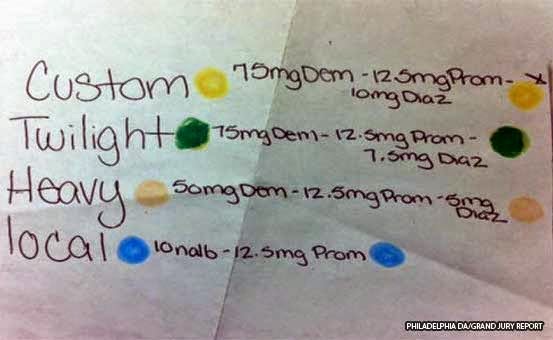
A handwritten, hand-colored chart of names for anesthesia concoctions and the amount of each drug to go in each
Anesthesia chart drawn up by 15-year-old
Gosnell employee Ashley Baldwin
Yashoda did not know what drugs her mother was given, but typically employees gave repeated injections of the concoction of sedative drugs that Gosnell referred to as a “twilight” dose. Each of these “twilight” doses, repeated a number of times at the discretion of the unlicensed workers, consisted of 75 milligrams of Demerol, 12.5 milligrams of promethazine, and 7.5 milligrams of diazepam.

The standard practice was for Gosnell's untrained staff to give repeated doses of sedative and pain-killing drugs to the patients, without regard to a woman's size or weight, whenever it was deemed necessary by the untrained staff. For example, if the woman started moaning, she was presumed to be in pain, and would be given another dose of drugs. Karnamaya, at only 4'11" in height and 110 lb. in weight, would have been endangered by a dose appropriate for an average-sized women, much less by the massive doses administered at Women's Medical Society.

A little before 8:00 p.m., West and Williams sent Karnamaya's daughter to another waiting area. She was left there, with no idea what was happening to her mother until the ambulance arrived after 11 p.m.


Williams helped Karnamaye into the procedure room, put her on the table, and drugged her again, this time with the clinic's "custom" dose of 75 mg. of Demerol, 12.5 mg. of promethazine, and 10 mg. of diazepam. The heavily drugged patient was then left, unattended and with no monitoring equipment, alone in the procedure room.

Cardiac Arrest

Kermit Gosnell mugshot
Sherry West told detectives that, some time after sedating Karnamaya, Williams came out of the procedure room, yelling for help. West said that when she later entered the procedure room, Gosnell was there trying to perform CPR on Karnamaya. Lynda Williams summoned Eileen O’Neill , an unlicensed medical school graduate who worked at the clinic, from her second-floor office.

O'Neill told the Grand Jury that she thought Karnamaya was already dead by the time she got to the procedure room, but she took over administering CPR because Gosnell wasn't doing it correctly. Gosnell, meanwhile, left to retrieve the clinic’s only “crash cart” (the emergency kit to treat a cardiac arrest) from the third floor. After returning with the kit, however, Gosnell did not use any of the drugs in it to try to save Karnamaya's life. Instead he just looked through them and seemed pleased that they were up to date. He seemed purely interested in keeping outsiders from finding out that the crash cart had been nowhere near the procedure room while patients were being sedated.

O’Neill testified that Gosnell told her not to administer Narcan, a drug that could have reversed the effects of the Demerol. She said that Gosnell told her it would not work on Demerol. O’Neill also said that she tried to use the defibrillator to revive Karnamaya, but that the paddles did not work.

Emergency Services

One of Gosnell's filthy
procedure rooms
It was after 11 p.m. – long after O’Neill had decided that Karnamaya was dead and returned to her office – that Lynda Williams finally asked Ashley Baldwin to call 911. Ashley then went into the procedure room and found Gosnell alone with his dead patient. He told Ashley to turn in the pulse oximeter, which they should have been using all along to monitor Karnamaya's pulse and blood oxygen. This surprised Ashley, since Gosnell knew that the pulse oximeter had been broken for months.

Emergency personnel arrived at 11:13. They found Karnamaya lifeless in the procedure room and Gosnell just standing there, not doing anything. The paramedics immediately intubated Karnamaya to give her oxygen, and started an intravenous line to administer emergency medications, since for some reason clinic staff had removed the IV line they'd been using all day to drug their patient. They also failed to tell the paramedics about the drugs they had administered.

The medics were able to restore weak heart activity. But getting Karnamaya to the ambulance was
 needlessly and dangerously time-consuming because the emergency exit was locked. Gosnell sent Ashley to the front desk to look for the key, but she could not find it. Ashley told the grand jury that a firefighter needed to cut the lock, but “It took him [20 minutes]… because the locks is old.” Karnamaya's daughter and friend ran outside, crying, and witnessed this. After cutting the locks, responders had to waste even more time struggling to maneuver through the cramped hallways that could not accommodate a stretcher.

When the ambulance arrived at the hospital shortly after midnight, Karnamaya had no heartbeat, no blood pressure, and was not breathing. After  aggressive resuscitation efforts, doctors were able to restore a weak heartbeat. Karnamaya was then sent to the Intensive Care Unit, where she remained on life support until family members could make the trip from Virginia to say good-bye. She was pronounced dead at 6:15 p.m. on November 20. She had died of a massive overdose of Demerol.