Showing posts with label women's medical society. Show all posts

Monday, January 05, 2015

The Kermit Gosnell Debacle: January, 2002

Why you can't believe state officials if they say there's no problems at an abortion clinic, from the Grand Jury Report on Kermit Gosnell:

The state Department of Health failed to investigate Gosnell’s clinic even in response to complaints.


According to DOH witnesses, sometime after 1993, DOH instituted a policy of inspecting abortion clinics only when there was a complaint. In fact, as this Grand Jury’s investigation makes clear, the department did not even do that.

Janice Staloski, one of the evaluators of Gosnell’s clinic in 1992, 10 years later was the Director of DOH’s Division of Home Health – the unit that is inexplicably responsible for overseeing the quality of care in abortion clinics. In January 2002, an attorney representing Semika Shaw, a 22-year-old woman who had died following an abortion at Gosnell’s clinic, wrote to Staloski requesting copies of inspection reports for any on-site inspections of the clinic conducted by DOH. Staloski wrote to the attorney that no inspections had been conducted since 1993 because DOH had received no complaints about the clinic in that time.

Except that it had. In 1996, another attorney, representing a different patient of Gosnell’s, informed Staloski’s predecessor as director of the Home Health Division that his client had suffered a perforated uterus, requiring a radical hysterectomy, as a result of Gosnell’s negligence. The Home Health director discussed this patient with DOH Senior Counsel Kenneth Brody, and the complaint report was documented in records turned over to the Grand Jury. It was surely available to Staloski when she inaccurately told the attorney in January 2002 that DOH had received no complaints regarding Gosnell’s clinic.

Not documented in the records turned over to the Grand Jury was a second complaint registered between 1996 and 1997. This one was hand-delivered to the secretary of health’s administrative assistant by Dr. Donald Schwarz, now Philadelphia’s health commissioner. Dr. Schwarz, a pediatrician, is the former head of adolescent services at Children’s Hospital of Philadelphia and was the directing physician of a private practice in West Philadelphia. For 17 years, he treated teenage girls from the West Philadelphia community. Occasionally, he referred patients who wanted to terminate their pregnancies to abortion providers. Gosnell’s clinic was originally included as a provider in the referral information that Dr. Schwarz gave to his patients. He and his physician partners noticed, however, that patients who had abortions at Woman’s Medical Society were returning to their private practice, soon after, infected with trichomoniasis, a sexually transmitted parasite, that they did not have before the abortions.

When this happened repeatedly, Dr. Schwarz sent a social worker to talk to people at Gosnell’s facility. Based on the social worker’s visit to Women’s Medical Society, Dr. Schwarz stopped referring patients to the clinic. He also hand-delivered a formal letter of complaint to the office of the Pennsylvania Secretary of Health. Dr. Schwarz told the Grand Jury that he does not know what happened to his complaint. He never heard back from DOH. And the department did not include it in response to the Grand Jury’s subpoena requesting all complaints relating to Gosnell's’ clinic. We know that no inspection resulted.

We are very troubled that state health officials ignored this respected physician’s report that girls were becoming infected with sexually transmitted diseases at Gosnell’s clinic when they had abortions there. If Dr. Schwarz’s complaint did not trigger an inspection, we are convinced that none would.

We also do not understand how a report of this magnitude was not at least added to Gosnell’s file at the state department of health. It suggests to us that there may have been many more complaints that were never turned over to the Grand Jury.

We heard testimony from DOH officials who should have been aware of Dr. Schwarz’s complaint – Kenneth Brody and Janice Staloski, at the least. Yet they made no mention of it to the Grand Jury. Did they remember the complaint and choose to exclude it from their testimony? Is ignoring complaints of this seriousness so routine at DOH that they honestly do not remember it? Or did the secretary of health never even forward it on for action? Of these possible explanations, we are not sure which is the most troubling.

Sunday, December 14, 2014

NAF's Failures Since 2004 Raise Troubling Questions

National Abortion Federation logo
Yesterday I addressed the failings of the National Abortion Federation after the December 14-15, 2009 site visit that revealed to a NAF representative how bad things were inside Kermit Gosnell's clinic, the Women's Medical Society. NAF did nothing to address the clear danger to women's bodies and lives beyond denying Gosnell's membership application.

But the National Abortion Federation's culpability in the Gosnell fiasco goes back earlier than that. It goes back to the day Gosnell and Leroy Brinkley first started discussing whether he would become an employee of Brinkley's Atlantic Women's Services, a National Abortion Federation member clinic in Delaware.

A modern brick building with a landscaped yard and parking area
Atlantic Women's Medical Services
According to USA Today,  Delaware state records indicate that Gosnell was working at Atlantic Women's Medical Services as early as 2004. This means that patients that specifically should have been protected from the likes of Gosnell by the National Abortion Federation had been handed off to him by a member clinic for five years prior to the site visit. These patients would have been handed off to Gosnell indefinitely were it not for a totally unrelated drug raid that closed the Women's Medical Society down in 2010.

Since as early as 2004, women such as the mother of Baby Boy A would walk into that highly reputable clinic, which would collect their money and turn them over to Gosnell. He'd start their abortions at the NAF clinic, then send them to his clinic to finish. Those women would end up doped within inches of their lives by untrained people and left to moan on blood-stained recliners amid the fleas and cat feces.

Does the National Abortion Federation do nothing to ensure that the quality of doctors who work at their member clinics is at least marginal? "Better than Gosnell" isn't that high a bar to clear. Do they have no policy guidelines for vetting doctors? Do they have no mechanism for checking on the backgrounds of the doctors that their clinics use before admitting those clinics as members? Do they not periodically verify the quality of doctors their clinics use in order to ensure ongoing quality of care in those member clinics?

Screenshot of the content quoted in this post
Screenshot of NAF membership requirements
Click to enlarge.
According to their web site, they do. They state (emphasis in original):
  • NAF sets the standards for abortion care in the U.S. and Canada. Therefore, NAF member facilities are required to participate in periodic quality assurance site visits. Currently, NAF’s Clinical Services Department conducts Quality Assurance and Improvement (QAI) visits with prospective members prior to their acceptance into NAF and on a regular basis thereafter.
  • We will also ask for specific information about the individual medical personnel working at your facility. The Physician’s Questionnaire must be completely filled out for each full- or part-time employee who provides abortion care. Questions regarding date of birth, social security number, and DEA number are required for the National Practitioners Data Bank, which NAF uses as part of its certification process. All information is held in the strictest confidence and will be redacted, at your request, once the application process is complete.
  • Each year, NAF publishes Clinical Policy Guidelines (CPGs). All NAF Provider Members adhere to these evidence-based clinical standards. A copy of the CPGs will be sent with your membership package and a CPG compliance form is attached to the application.
Mugshot of Kermit Gosnell, showing a balding man of about 60 years of age
Whatever they might have in writing, in actual practice the National Abortion Federation clearly does not have even a remotely adequate mechanism to ensure that their member clinics only use doctors who can be trusted to provide their patients with at least minimal quality of care. Either that, or Gosnell met their standards. Neither possibility inspires confidence.

One could legitimately argue that NAF has no responsibility for the patients of non-member providers, but they do have a responsibility toward the patients of their own member clinics. Regarding Gosnell, they failed miserably for at least six years, and would have failed for far longer if left to their own devices. Further, it wasn't until 2011, a year after the raid that exposed the conditions inside Gosnell's clinic for all the world to see, that NAF finally expelled all of Leroy Brinkley's clinics from their ranks. For an additional year, they had entrusted women to the care of a man who had demonstrated either an inability or an unwillingness to protect his own patients from somebody like Gosnell.

How many Gosnellesque doctors are currently working at National Abortion Federation facilities? How many women who are trusting NAF with their bodies and lives are being handed off to appalling quacks? Will NAF get to work ferreting these guys out and expelling those that hire them from their ranks?

Considering the "at least they're better than the Women's Medical Society" quality of an abundance of NAF member clinics, I sincerely doubt it.

Saturday, December 13, 2014

The National Abortion Federation and Kermit Gosnell

Mugshot of a balding man about 60 years of age
Dr. Kermit Gosnell
After the death of Karnamaya Mongar in 2009, quack abortionist Kermit Gosnell applied to become a member of the National Abortion Federation
(NAF).  According to their web site, "The mission of the National Abortion Federation is to ensure safe, legal, and accessible abortion care, which promotes health and justice for women."  (emphasis in the original)

NAF's actions with regard to Kermit Gosnell illustrate exactly how dedicated this organization truly is to the "safe" part of "safe, legal, and accessible abortion care." Their dedication to "accessible" can not be doubted, given their willingness to allow Gosnell to continue his practice without let or hindrance even after one of their inspectors had seen his clinic with her own eyes. The National Abortion Federation has shown such dedication to "accessible" in the past.

In 1991, when 60 Minutes was investigating an abortion mill where one woman had been allowed to die and another left incapacitated, Barbara Radford, then-president of the National Abortion Federation, defended the head-in-the-sand attitude the organization took toward safety issues by saying, "We want to make sure that women have choices when it comes to abortion services, and if you regulate it too strictly, you then deny women access to the service."

Judging by the organization's actions, or rather lack thereof, regarding Gosnell, the "choices when it comes to abortion services" NAF wants women to have includes the quality of services provided by practitioners like Kermit Gosnell and facilities like his Women's Medical Society. The NAF evaluator testified to the Grand Jury about what she observed during the site visit on  December 14 and 15, 2009:

A slightly triangular 3-story red-brick building at a city intersection
Women's Medical Society
{S]he found that the facility was packed with so much “stuff, kind of crowded and piled all over the place,” that she couldn’t find a space to put her small overnight bag. She found the facility’s layout confusing, and was concerned that patients could not find their way around it or out of it. She was also concerned that there were plants everywhere, including in the procedure room and rooms designated as “labs.”
Most alarming was the bed where Gosnell told her out-of-state patients were allowed to spend the night. These patients were unattended and it was difficult to locate the bathroom facilities and the exits. Such a practice does not meet NAF protocols.

The NAF evaluator watched a few first-trimester procedures. She noticed that no one was monitoring or taking vital signs of patients who were sedated during procedures. She asked Gosnell about the pulse oximeter that should have been used for monitoring, but he told her it was broken. Apparently, Karnamaya Mongar’s death a month earlier had not caused Gosnell to obtain equipment that worked.

The evaluator did not observe Gosnell’s practice of allowing unlicensed workers to sedate patients when he was not at the facility, as she was there only when Gosnell was there. Such a practice would not comply with NAF standards. The evaluator did note, however, that while she was talking to Gosnell in his office, a patient appeared to have been sedated by one of the staff. Such an action does not comport with NAF standards either. The evaluator cautioned Gosnell that he should make sure he was complying with state requirements because many states – including Pennsylvania – do not allow unlicensed workers to administer IV medication.

Handwritten chart listing"Custom: 75mg Dem - 12.5MgProm - 10 mgDiaz, etc.
Clinic anesthesia chart created
by 16-year-old employee
The level of medication administered was also troubling to the evaluator. She testified that Gosnell’s own description of the effects of his routine second-trimester dose – that the patient would feel no pain at all – was a description of deep sedation. She added: “that … would really not be a safe situation … for him to be handling himself.” She explained that when deep sedation or general anesthesia is administered, NAF standards not only require that the doctor performing the procedure be present when the anesthesia is administered, they also require that another doctor or an anesthesiologist administer the sedation and monitor the patient. Instead, Gosnell had Lynda Williams, Sherry West, and his other unlicensed workers routinely administer anesthesia without proper supervision or appropriate monitoring of patients.

The evaluator explained to the Grand Jury, as did several medical experts, that because everyone reacts differently to anesthesia, a doctor has to be prepared for a patient to slip into a level of sedation beyond that intended. In cases in which Gosnell’s objective was deep sedation, therefore, he should have been prepared for the patient to react as if under general anesthesia. Significantly, it is not uncommon for patients under general anesthesia to lose the ability to breathe on their own. Gosnell’s clinic – without the drugs, staff, or equipment necessary to monitor, resuscitate, or assist his patients in breathing – was not even close to meeting NAF standards or any other standard of care. The evaluator noted that Pennsylvania requires that anesthesia be administered only by licensed personnel, a regulation that Gosnell failed to follow even during the NAF review.
 
Consent form
Click to enlarge.

Aside from these life-threatening practices, the evaluator noted numerous deficiencies in the clinic’s recordkeeping, including no notation of RH blood-typing and no record of sedation medications administered or the level of sedation. The clinic’s consent procedures also failed to meet NAF standards. Even with the evaluator watching, patients were not being informed of the risks of the medications, the sedation, or the procedure itself.


The evaluator testified that during the “counseling” she witnessed, a patient was told that Pennsylvania requires a 24-hour waiting period between when a patient is counseled and when the abortion can be performed. After stating the requirement, however, the counselor, according to the evaluator, said: “Okay, well. When do you want to come back for the abortion? Do you want to come back at 8 p.m.?” When the patient’s mother said, “but I thought we had to wait 24 hours,” the staff person responded, “if you want to come back at 8 p.m., you can come back at 8 p.m.”

Patient confidentiality is another important standard for NAF, and another that Gosnell flagrantly violated. The evaluator was troubled to find:

Throughout the office, there were patient charts everywhere. On desks, on this – the area in that upstairs sleeping area by the sleeping room. There were piles and piles and piles of medical records. That was – if that were in an area that was closed off and nobody had access to it, charts being stored there weren’t a big deal, but if there were patients in the sleeping room, who had to leave there to go to the restroom, they had full access to all of these people’s medical information if they wanted to look through it, it was very, very concerning to me.
When asked if she had ever seen anything like the conditions and practices she observed at Gosnell’s clinic in any of the roughly one hundred clinics she has visited in the United States, Canada, and Mexico, the evaluator answered: “No.”

Based on her observations, the evaluator determined that there were far too many deficiencies at the clinic and in how it operated to even consider admitting Gosnell to NAF membership. On January 4, 2010, she wrote to Gosnell informing him of NAF’s decision and outlining the areas in which his clinic was not in compliance. The evaluator told the Grand Jury that this was the first time in her experience that NAF had outright rejected a provider for membership. Usually, if a clinic is able to fix deficiencies and come into compliance with the standards, NAF will admit them. Gosnell’s clinic, however, was deemed beyond redemption.

Gosnell's application was denied. This was the only case in the evaluator's knowledge in which an abortion facility's application was outright rejected, with most facilities being allowed to remedy any defects. While noting that they had no legal burden to do so, the Grand Jury questioned why an organization which supposedly exists to ensure access to safe abortion care for women did not report the gross inadequacies of the Women's Medical Society to the authorities.

A modern red-brick building with some landscaping and a parking lot
Atlantic Women's Medical Service
This failure to report is hardly the beginning, though, of the National Abortion Federation's doings with Gosnell. In fact, Gosnell had been working part time for years at a National Abortion Federation clinic in Delaware. Women, such as the mother of Baby Boy A, would walk into that highly reputable clinic, which would collect their money and turn them over to Gosnell. He'd start their abortions at the NAF clinic, then send them to his clinic to finish. Those women would end up doped within inches of their lives by untrained people and left to moan on blood-stained recliners amid the fleas and cat feces. Given the blithe indifference of Pennsylvania authorities to the conditions at Gosnell's clinic, NAF's failure to report had no real impact on the fact that Gosnell was able to remain open. If a detailed and alarming report from a former employee could be blown off in its entirety, a heads-up from NAF would no doubt have been greeted with a resounding, "Meh." Reporting Gosnell's clinic to officials, however, was not the only action NAF could have taken to protect women from appallingly unsafe abortion practitioners. National Abortion Federaton logoThe first actions they failed to take were both years earlier and ongoing. Those inactions are in regard to Atlantic Women's Medical Service, the NAF member clinic where Gosnell worked part-time. Does the National Abortion Federation do nothing to ensure that the quality of doctors who work at their member clinics is at least adequate? Do they have no policy guidelines for vetting doctors? Do they have no mechanism for checking on the backgrounds of the doctors their clinics use before admitting those clinics as members? Do they not verify the quality of doctors their clinics use periodically in order to ensure ongoing quality of care in those member clinics?  Whatever they might have in writing, clearly in actual practice they do nothing to ensure that their member clinics only use doctors who can be trusted to provide their patients with at least minimal quality of care.
Further inactions follow the site inspection and the rejection of Gosnell's application. Why was there no word put out, at least among their member clinics, to beware of Gosnell? Why were National Abortion Federation member clinics not instructed to immediately sever any existing ties they might have with Gosnell and to blacklist him as a future employee?
Karnamaya Mongar
The final inaction is a broader issue. If NAF feared public knowledge of the conditions inside Gosnell's facility, could they not at least have put out word to referral sources that might send women to Kermit Gosnell? Karnamaya Mongar had been referred to her death by another abortion facility.  Desiree Hawkins, one of the patients whose baby's feet ended up in a jar on Gosnell's shelf, was referred to Gosnell by Hagerstown Reproductive Health Services. The Grand Jury Report noted:  

Gosnell [relied] on referrals from other areas where abortions as late as 24 weeks are unavailable. More and more of his patients came from out of state and were late second-trimester patients. Many of them were well beyond 24 weeks. Gosnell was known as a doctor who would perform abortions at any stage, without regard for legal limits. His
patients came from several states, including Delaware, Maryland, Virginia, and North Carolina, as well as from Pennsylvania cities outside the Philadelphia area, such as Allentown.
Surely significantly fewer women would have been subjected to the horrors and risks of Gosnell's practice if referrals from other clinics had dried up. The National Abortion Federation had a chance to protect at least those women who were getting referrals from those clinics, yet failed to take any action toward that end.

If one is convinced that late abortions are beneficial to women there are, after all, other abortion facilities in the area that clinics could have sent women to. There is one clinic each in New Jersey and New York that take patients to 24 weeks and one in Maryland that takes patients who are even past 26 weeks. Granted, two of those facilities are documented not to be exemplary, but "better than Gosnell" is not a high bar. Surely it was a goal that the National Abortion Federation could have urged other clinics to aim for and a goal the clinics in question could easily have attained.
So far, nobody has asked the National Abortion Federation what excuses they can possibly have.

Thursday, November 20, 2014

A Referral to a House of Death

Just When Life Seemed Safe 

Headshot of a middle-aged Bhutanese woman with her hair pulled back and a faint smile on her face
Karnamaya Mongar
At the age of 41, Karnamaya Mongar had survived nearly 20 years in a refugee camp in Nepal. What she was unable to survive was a visit to an American abortion clinic.

Karnamaya, her husband, Ash, their three children and one grandchild arrived in the United States on July 19, 2009 as part of a resettlement program. 
Karnamaya was more than 18 weeks pregnant when went to a clinic in Virginia for an abortion. But the Virginia clinic, and another in Washington, D.C., did not do abortions that late in the pregnancy. One of the clinics referred Karnamaya to Kermit Gosnell's Women’s Medical Society in Philadelphia because Gosnell had a reputation for performing abortions regardless of gestational age.

Karnamaya went with her daughter to the Gosnell's clinic on November 18, 2009. That afternoon,
Latosha Lewis, who had completed a medical assistant course but had never been certified, conducted the clinic’s version of a “pre-examination,” which was so scanty it didn't even involve weighing the patient. Falsified informed consent forms were added to Karnamaya's file.  
 
After the "pre-examination" was done and the paperwork was completed, Randy Hutchins, a part-time physician’s assistant who worked without State Board of Medicine approval, inserted laminaria to dilate Karnamaya’s cervix and administered Cytotec to soften it. Hen then told Karnamaya to return the next day to complete the abortion.

Drugged Up

Kermit Gosnell's Philadelphia
"house of horrors" where
Karnamaya Mongar was drugged to
death by unqualified staff.
Karnamaya arrived at the clinic on November 19 around 2:30 p.m., accompanied by her daughter and her daughter's mother-in-law. At the front desk, Tina Baldwin gave Karnamaya her initial medication – Cytotec to soften the cervix and to cause contractions; and Restoril, a drug that causes drowsiness.  After giving Karnamaya the medicine, Baldwin told her to wait in the recovery area until the doctor arrived to perform the abortion.

Lynda Williams and Sherry West, who were without any medical-related qualifications medicated Karnamaya in the “recovery room” while she waited for Gosnell.

Karnamaya's daughter, Yashoda Gurung, told the Grand Jury that she waited with her mother in the recovery room for several hours. During that time, between 3:30 and 8:00 p.m., her mother was given five or six doses of oral medicine and repeated injections into an IV line in her hand.  As usual at Gosnell's clinic, no equipment was available to ensure proper monitoring of vital signs.


A handwritten, hand-colored chart of names for anesthesia concoctions and the amount of each drug to go in each
Anesthesia chart drawn up by 15-year-old
Gosnell employee Ashley Baldwin
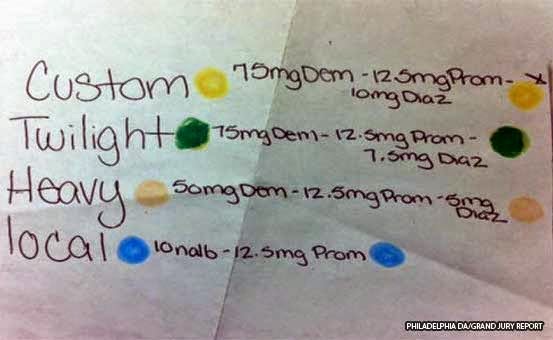
Yashoda did not know what drugs her mother was given, but typically employees gave repeated injections of the concoction of sedative drugs that Gosnell referred to as a “twilight” dose. Each of these “twilight” doses, repeated a number of times at the discretion of the unlicensed workers, consisted of 75 milligrams of Demerol, 12.5 milligrams of promethazine, and 7.5 milligrams of diazepam.

The standard practice was for Gosnell's untrained staff to give repeated doses of sedative and pain-killing drugs to the patients, without regard to a woman's size or weight, whenever it was deemed necessary by the untrained staff. For example, if the woman started moaning, she was presumed to be in pain, and would be given another dose of drugs. Karnamaya, at only 4'11" in height and 110 lb. in weight, would have been endangered by a dose appropriate for an average-sized women, much less by the massive doses administered at Women's Medical Society.

A little before 8:00 p.m., West and Williams sent Karnamaya's daughter to another waiting area. She was left there, with no idea what was happening to her mother until the ambulance arrived after 11 p.m.


Williams helped Karnamaye into the procedure room, put her on the table, and drugged her again, this time with the clinic's "custom" dose of 75 mg. of Demerol, 12.5 mg. of promethazine, and 10 mg. of diazepam. The heavily drugged patient was then left, unattended and with no monitoring equipment, alone in the procedure room.

Cardiac Arrest

Kermit Gosnell mugshot
Sherry West told detectives that, some time after sedating Karnamaya, Williams came out of the procedure room, yelling for help. West said that when she later entered the procedure room, Gosnell was there trying to perform CPR on Karnamaya. Lynda Williams summoned Eileen O’Neill , an unlicensed medical school graduate who worked at the clinic, from her second-floor office.

O'Neill told the Grand Jury that she thought Karnamaya was already dead by the time she got to the procedure room, but she took over administering CPR because Gosnell wasn't doing it correctly. Gosnell, meanwhile, left to retrieve the clinic’s only “crash cart” (the emergency kit to treat a cardiac arrest) from the third floor. After returning with the kit, however, Gosnell did not use any of the drugs in it to try to save Karnamaya's life. Instead he just looked through them and seemed pleased that they were up to date. He seemed purely interested in keeping outsiders from finding out that the crash cart had been nowhere near the procedure room while patients were being sedated.

O’Neill testified that Gosnell told her not to administer Narcan, a drug that could have reversed the effects of the Demerol. She said that Gosnell told her it would not work on Demerol. O’Neill also said that she tried to use the defibrillator to revive Karnamaya, but that the paddles did not work.

Emergency Services

One of Gosnell's filthy
procedure rooms
It was after 11 p.m. – long after O’Neill had decided that Karnamaya was dead and returned to her office – that Lynda Williams finally asked Ashley Baldwin to call 911. Ashley then went into the procedure room and found Gosnell alone with his dead patient. He told Ashley to turn in the pulse oximeter, which they should have been using all along to monitor Karnamaya's pulse and blood oxygen. This surprised Ashley, since Gosnell knew that the pulse oximeter had been broken for months.

Emergency personnel arrived at 11:13. They found Karnamaya lifeless in the procedure room and Gosnell just standing there, not doing anything. The paramedics immediately intubated Karnamaya to give her oxygen, and started an intravenous line to administer emergency medications, since for some reason clinic staff had removed the IV line they'd been using all day to drug their patient. They also failed to tell the paramedics about the drugs they had administered.

The medics were able to restore weak heart activity. But getting Karnamaya to the ambulance was
 needlessly and dangerously time-consuming because the emergency exit was locked. Gosnell sent Ashley to the front desk to look for the key, but she could not find it. Ashley told the grand jury that a firefighter needed to cut the lock, but “It took him [20 minutes]… because the locks is old.” Karnamaya's daughter and friend ran outside, crying, and witnessed this. After cutting the locks, responders had to waste even more time struggling to maneuver through the cramped hallways that could not accommodate a stretcher.

When the ambulance arrived at the hospital shortly after midnight, Karnamaya had no heartbeat, no blood pressure, and was not breathing. After  aggressive resuscitation efforts, doctors were able to restore a weak heartbeat. Karnamaya was then sent to the Intensive Care Unit, where she remained on life support until family members could make the trip from Virginia to say good-bye. She was pronounced dead at 6:15 p.m. on November 20. She had died of a massive overdose of Demerol.

Thursday, October 09, 2014

State officials and seedy abortion mills

On October 9, 2002, the Professional Underwriters Liability Insurance Company reported to theState Board of Medicine that it had paid a $400,000 settlement to the family of Semika Shaw, a 22- year-old who died following an abortion at Kermit Gosnell’s "house of horrors" in March of 2000. The report noted that, “Autopsy report indicated perforation of cervix into uterus. Heirs alleged our insured improperly performed the termination procedure and failed to diagnose post-op uterine perforation resulting in sepsis and death.” The Department had received a detailed complaint the previous December informing them of appalling conditions and about the patient's death.

The October 9 report wasn't even logged  in as “received” by the  “Complaints Office” until December 6, 2002. 

In January if 2003, the Pennsylvania Medical Professional Liability Catastrophe Loss Fund reported to the Department of State that it had paid an additional $500,000 to the family, thus reminding Department employees of the situation.

The file showed no further activity until January 2, 2004 – when a one-page printout of Gosnell’s license information is stamped “received” by the complaints office.

The next action recorded in the file is a “Prosecution Evaluation,” dated April 29, 2004, in which Mark Greenwald, a prosecuting attorney for the Board of Medicine purportedly summarizes the case concluding that no action was necessary. This is all it said:
Brief Factual Summary: The file was opened as a result of a Medical Malpractice Payment Report. The underlying malpractice case involved the death of a 22 year old female following the termination of her 5th pregnancy. Following a seemingly routine procedure on 3/1/02, the patient was taken to the ER at the University of Pennsylvania with complaints of pain and heavy bleeding. The patient underwent surgery but the surgeon was unable to locate any perforation and the patient died from infection and sepsis. Although the incident is tragic, especially in light of the age of the patient, the risk was inherent with the procedure performed by Respondent [Gosnell] and administrative action against respondent’s license is not warranted. RECOMMENDATION: Z-02, Prosecution not Warranted

Greenwald’s supervisor, Charles J. Hartwell, the Senior Prosecutor-in-Charge at the Department of State’s Bureau of Professional and Occupational Affairs, reviewed Greenwald’s “evaluation” and approved it on May 14, 2004.  On that same date, the Department closed the case on the complaint brought to them in December of 2001 by former Gosnell employee Marcella Stanley Choung informing them:
  • that Gosnell was using her and other unlicensed workers to administer IV anesthesia
  • that they were administering this anesthesia when neither Gosnell nor anybody else qualified to supervise anesthesia was at the clinic
  • that two sickly, vomiting, flea-infested cats had run of the clinic, including the procedure rooms
  • that the autoclave for sterilizing instruments was broken
  • that Gosnell re-used single-use instruments
  • that Gosnell would perform forced abortions on underage girls at their parents' request
  • about the death the previous year of Semika Shaw
  • about the "pill mill" Gosnell was running from the clinic
  • that one patient and another employee would be willing to talk to them and verify what she was telling them
 Their entire investigation into Choung's complaint had consisted of three phone calls, none of them to the people Choung said could substantiate her claims. There was no visit to the clinic and no request to review patient files. The complaint was not even forwarded to the Department of Health, which was responsible for licensing and inspecting clinics.

Not that this would have accomplished anything: The DOH had first inspected and given a 12-month license to Gosnell's clinic in 1979, in spite of numerous and alarming shortcomings, and didn't review the clinic again until 1989, when it was again permitted to stay open in spite of multiple shortcomings that clearly endangered patients. They repeated this type of review in 1992, again approving the facility in spite of appalling conditions, and in 1993 they reported that previous deficiencies had been corrected, despite continuing deplorable conditions,because of a new politically-motivated policy not to inspect abortion clinics unless they'd gotten a complaint.


Custom: 75mg Dem - 12.5mg Prom. 10mg Diaz. Twilight: 75mg Dem - 12.5mg Prom 7.5mg Diazz. Heavy: 50mg Dem - 12.5mg Prom. 5mg Diaz. Local: 10nalb - 12.5mg Prom
Drug dosage chart created c. 1995 by 15-year-old
Ashley Baldwin for use by other staff
at Gosnell's clinic.
They did not enter the clinic again until they were invited to do so by the DEA and Philadelphia DA for the drug raid in 2010. In the 16 years since the new head-in-the-sand policy, they had failed to investigate after receiving at least 6 serious complaints including two reports of patient deaths.

And in spite of this egregious example of state official repeatedly and deliberately turning a blind eye in spite of substantial evidence, abortion-rights advocates continue to insist that if a state authority gives an abortion facility an all-clear, then all is well regardless of how well substantiated any outside reports might be. And in states that try to pass and enforce laws cleaning up seedy abortion clinics, abortion-rights advocates continue to play Pollyanna and fight in favor of abortion practitioners to be as nasty as they wanna be. I've dubbed this "access uber all" mentality "the Compton-Carr Effect" after its most eloquent advocate, Janis Compton-Carr of the Florida Abortion Council.

"In my gut, I am completely aghast at what goes on at that place. But I staunchly oppose anything that would correct this situation in law."  Prochoice activist Janis Compton-CarrUntil citizens -- especially prochoice citizens -- start holding abortion-rights groups, politicians, bureaucrats, and even media accountable, appalling conditions will continue to be permitted, and women will continue to suffer and die.

It's about time women's lives became at least as worthy of preservation as "abortion access."