According to the National Organization for Women
web site, Ruth Friedl was a married, 27-year-old mother of two.
NOW's site said that pregnancy was life-threatening for Ruth, but they
don't specify why, nor do they say why she was denied an abortion, since
there were always exceptions made for abortions deemed necessary to
save the mother's life. NOW says that Ruth
drank ergot apiol, an herbal abortifacient, on August 21, 1929. That
night, according to NOW, Ruth collapsed at the dinner table in front of
her husband and children, and died on the spot. I'd welcome any verifying information on Mrs. Friedl's death. If NOW's story is true, Ruth's abortion was unusual in that it was self-induced rather than performed by a doctor, as was the case with perhaps 90% of criminal abortions.
On August 21, 1923, 32-year-old Catherine Stange died in Denver of septicemia due to an abortion blamed on Dr. Daniel R. Lucy. This was quite the scandal, since in addition to being a doctor, Lucy was a city councilman.
His high position
also meant that he was given warning of his pending arrest for second
degree murder, to give him time to arrange bail.
Lucy's only comment
to the press after being told of the charge against him was to note
that he was not surpirsed, that this was what he had expected from the
coroner's jury. He was later acquitted of the charges.
Keep in mind that
things that things we take for granted, like antibiotics and blood
banks, were still in the future. For more about abortion in this era,
see Abortion in the 1920s.
Tuesday, August 21, 2012
Monday, August 20, 2012
Chicago: Three Typical Pre-Roe Deaths
On August 20, 1880, Miss Mary Faulkner, a white woman formerly of Ottawa, Canada, died at the office of Dr. Thomas J. Cream during the commission of an illegal abortion. Cream, a white physician, and Mrs. Mackey, a Black nurse, were arrested in the death.
On August 20, 1913, 20-year-old Emma Witte died in Chicago from an abortion perpetrated that day at the office of Dr. Otis M. Walker. Emma reportedly went to Walker's office early Wednesday morning. Dr. Charles L. West was summoned there to administer chloroform. He didn't linger, but returned late that afternoon he found Emma evidently lifeless, with Walker desperately attempting to revive her. She was rushed to St. Anthony's Hospital but declared dead on arrival. Walker was indicted by a Grand Jury that day, but the case never went to trial. News coverage made mention of a letter from John Nakin that was found in her room, but the significance of the letter was not explained.
On August 20, 1918, 28-year-old secretary Alma Heidenway died at 329 South Ashland Avenue in Chicago from an abortion performed that day by Dr. J. A. Stough. Stough, along with Fred Cordray and Alice J. Kennedy, were held by the Coroner on September 5. Eunice Magill was 'brought back from Forest Park." Stough and Cordray were acquitted on May 29, 1919. The others never went to trial for Alma's death.
Note, please, that with overall public health issues such as doctors not using proper aseptic techniques, lack of access to blood transfusions and antibiotics, and overall poor health to begin with, there was likely little difference between the performance of a legal abortion and illegal practice, and the aftercare for either type of abortion was probably equally unlikely to do the woman much, if any, good.
In fact, due to improvements in addressing these problems, maternal
mortality in general (and abortion mortality with it) fell dramatically
in the 20th Century, decades before Roe vs. Wade legalized abortion
across America.

Sunday, August 19, 2012
Five 20th Century Abortion Deaths
| Cook County Hospital, 1914 |
Elise Stone went to the practice of Dr. A. H. Yates on August 15, 1917, for a "criminal operation." Elise remained there for three or four days before being sent home, where she died. On her death certificate, her death was attributed to "congestive chill." But concerned citizens complained to the County Attorney, A.G. Nichols. Nichols ordered Elise's body exhumed and an autopsy performed; thus the real cause of her death was discovered. Yates would go on to perpetrate the fatal abortion on Katherine Cross later that year.
Ruth Haught, a 30-year-old widow, died at University Hospital in Hobart, Oklahoma, on August 19, 1937, of blood poisoning from an apparent self-induced abortion.
"Dawn" was 29 years old and 7 weeks pregnant when she underwent a legal abortion at a hospital in August of 1972.Local anesthesia was administered and a suction abortion was performed. After the abortion, Dawn went into convulsions. Doctors at the abortion hospital, and at another hospital, attempted to resuscitate her, to no avail. Doctors believed that she might have been given an overdose of local anesthetic. Strangely, during the autopsy, the medical examiner found a significant amount of blood in Dawn's abdominal cavity, but no evidence of a uterine perforation.
Documents regarding Tami Suematsu, age 19, alleged that she underwent a safe and legal abortion by Vern Wagner at Riverside Family Planning Center August 19, 1988. Tami went into bronchial spasm and asthma-related respiratory failure then cardiac arrest. She was transported to a hospital, but died shortly after arrival. Riverside Family Planning was a Family Practice Associates Medical Group facility. Other women known to have died at FPA facilities include: Denise Holmes, age 24, 1970; Patricia Chacon, age 16, 1984; Mary Pena, age 43, 1984; Josefina Garcia, age 37, 1985; Lanice Dorsey, age 17, 1986; Joyce Ortenzio, age 32, 1988; Deanna Bell, age 13, 1992; Susan Levy, age 30, 1992; Christina Mora, age 18, 1994; Nakia Jorden, 1998; Maria Leho, 1999; Kimberly Neil, 2000; Maria Rodriguez, age 22, 2000; and Chanelle Bryant, age 22, 2004.
Saturday, August 18, 2012
1901: Chicago Doc's Fatal Effort
Homemaker Annie Robinson, age 28, died at her Chicago home on August 18,
1901, from an abortion performed there that day. She left her husband,
George W. Robinson, a cashier at a streetcar company, to care for their
two small children. Dr. Muenster was arrested that day, and she was held
by the Coroner's Jury.
Mrs. Robinson's abortion was typical of pre-legalization abortions in that it was performed by a physician.
Note, please, that with ordinary public health issues such as doctors not using proper aseptic techniques, lack of access to blood transfusions and antibiotics, and overall poor health to begin with, there was likely little difference between the performance of a legal abortion and illegal practice, and the aftercare for either type of abortion was probably equally unlikely to do the woman much, if any, good. For more about abortion and abortion deaths in the first years of the 20th century, see Abortion Deaths 1900-1909.
Mrs. Robinson's abortion was typical of pre-legalization abortions in that it was performed by a physician.
Note, please, that with ordinary public health issues such as doctors not using proper aseptic techniques, lack of access to blood transfusions and antibiotics, and overall poor health to begin with, there was likely little difference between the performance of a legal abortion and illegal practice, and the aftercare for either type of abortion was probably equally unlikely to do the woman much, if any, good. For more about abortion and abortion deaths in the first years of the 20th century, see Abortion Deaths 1900-1909.
Friday, August 17, 2012
Abortion Deaths: New York, 1971; Miami, 1978
"Vicki" is one of the women Life Dynamics identifies on their "Blackmun Wall" as having been killed by a safe and legal abortion. She was 23 years old when she underwent an abortion in New York state, taking advantage of the liberalized abortion law. She was 20 weeks pregnant.
Saline
was injected into her uterus to begin the abortion. The next day, she
began to show signs of infection. She expelled her dead fetus but her
condition did not improve. On August 17, 1971 she died of sepsis. Some of the other women who died because of New York abortionists' careless enthusiasm for saline abortions during the pre-Roe period include:Carmen Rodriguez, age 31,"Roseanne" Roe, "Anita" Roe, age 23, "April" Roe, age 17, "Barbara" Roe, age 35, "Becky" Roe, age 18, "Beth" Roe, age 23, "Colleen" Roe, age 21, "Julie" Roe, age 14, and "Sara" Roe, age 18.
Marina Deschapell, age 34, went to the Miami abortion facility at 620 SW 1st Street for a safe and legal six to eight week abortion on August 17, 1978. Eduardo F. Elias administered Valium and Xylocaine for the abortion. Immediately after the procedure, Elias noticed that Marina was not breathing. He initiated CPR and an emergency team was summoned. The ambulance crew found Marina with no signs of life. Although the medical examiner did not attribute Marina's death directly to the abortion, police noted that the clinic, owned by Luis Barquet, was not equipped with any emergency equipment other than an air bag.
Wednesday, August 15, 2012
1909:Doc's Work Kills Chicago Teen
On August 15, 1909, Lillian Swing, age 15, died in Chicago from an abortion performed on August 9.
Dr. Hamilton Shaver and his wife were held by the coroner's jury. The source document doesn't indicate that the case went to trial.
Note, please, that with general public health issues such as doctors not using proper aseptic techniques, lack of access to blood transfusions and antibiotics, and overall poor health to begin with, there was likely little difference between the performance of a legal abortion and illegal practice, and the aftercare for either type of abortion was probably equally unlikely to do the woman much, if any, good. For more about abortion and abortion deaths in the first years of the 20th century, see Abortion Deaths 1900-1909.
Dr. Hamilton Shaver and his wife were held by the coroner's jury. The source document doesn't indicate that the case went to trial.
Note, please, that with general public health issues such as doctors not using proper aseptic techniques, lack of access to blood transfusions and antibiotics, and overall poor health to begin with, there was likely little difference between the performance of a legal abortion and illegal practice, and the aftercare for either type of abortion was probably equally unlikely to do the woman much, if any, good. For more about abortion and abortion deaths in the first years of the 20th century, see Abortion Deaths 1900-1909.
Sunday, August 12, 2012
1970: One of Five Patient Deaths at California Abortion Hospital
Sara Franki Lint, a 22-year-old coed, submitted to a safe and legal abortion at San Vicente Hospital
in Los Angeles, California, on August 11, 1970. Adolpho Zlotolow, who
operated San Vicente (an abortion facility) said that Sara went into
ventricular fibrillation soon after the abortion was initiated by either
Albert Kapstrom or Milton Gotlib.
The technique being used on Sara, hysterotomy,
was one with a known high maternal mortality rate. San Vicente staff
treated Sara for an hour before transferring her to Midway Hospital down
the street, where she died at 4:57am on August 12. The autopsy found
yellow fluid in Sara's heart, frothy tan fluid in her lungs, and a
seven-inch male fetus in Sara's uterus.
San Vicente was where Oriane Shevin, Natalie Meyers, Joyce Ortenzio, Laniece Dorsey, and Mary Pena underwent their fatal abortions. It was bought out by Family Planning Associates Medical Group.
Friday, August 10, 2012
Incorrigible Quacks, Pre and Post Roe
On August 10, 1917, 29-year-old Emelia Gorman died at Chicago's
St. Mary's Hospital from a criminal abortion perpetrated that day by Dr.
Anna Sorenson. Although Sorenson was indicted by a Grand Jury on September 1, she remained free to perform fatal abortions on Mrs. M. Linstrom in November and Margaret Crowe
in January of the following year. Sorenson was finally arrested on
January 15, and her killing spree came to an end when she herself died
in prison while awaiting trial.
So, sadly, merely criminalizing abortion won't be enough to protect women from quackery unless we tighten the laws to make sure the quacks are quickly identified and locked up for life. They're incorrigible.
Let's jump ahead to the safe-n-legal days.
Center for Reproductive and Sexual Health ("CRASH") was the model abortion clinic -- a published review of their earliest patient records, published by Bernard Nathanson, played a key role in "proving the safety of legal outpatient abortion."
On August 10, 1988, 19-year-old K.B. (due to confidentiality, the public record documents do not give the patient's name) was given anesthesia for a safe, legal 14-week abortion. Since Life Dynamics calls her "Kelly" on their "Blackmun Wall" of women killed by abortion, I will refer to her as Kelly as well.
Shortly after the procedure, she showed signs of distress, but emergency measures were not instituted for almost an hour. Kelly was transported to Cabrini Medical Center where she was pronounced dead from complications of anesthesia. After Kelly's death, the health department investigated and found a mystery: Kelly's chart listed her post-operative condition as "pink, responsive, alert," even though she had gone into full cardio-respiratory arrest by the time indicated on the assessment. They learned that the note had been entered into the chart before the abortion was even performed.
The inspectors noted that CRASH "did not employ proper monitoring equipment or procedures," "had no working EKG machine," and didn't have a cardiac defibrillator. They noted that no one on staff was qualified to perform CPR. No one on staff was qualified to administer anesthesia, and they did not use proper procedures or equipment. Anesthesia was administered "by eye," with no means of accurately measuring the dose. Dosage was estimated to be twice that recommended in the procedure manual.
The operating rooms were found to be ill-lit, and there was no soap or paper towels at the scrub sink. The scrub sinks were stained, the walls and floors dirty, trash was stored in the scrub room. There were red make-up stains on the oxygen masks and nitrous oxide masks, dusty tubing on the suction machines, and blood on the wheels of the operating table.
CRASH had no documentation verifying the credentials or qualifications of medical director David Gluck. Gluck had been previously convicted of felony charges related to the sale of 48,000 Diluadid tablets to pay off gambling debts. His license had actually been revoked two months before K.B.'s death, but had been restored by judicial stay. There was no evidence at the investigation two weeks after Kelly's death that Gluck had reviewed her chart, or the charts of 18 other patients identified as having suffered complications.
The state closed CRASH for 60 days, but it never re-opened. Dr. Gluck went on to perform the fatal abortion on Alerte Desanges in 1994.
Clearly, legalization didn't do anything to keep quacks from practicing. It just reduced the intensity of their legal headaches when they killed patients.
So, sadly, merely criminalizing abortion won't be enough to protect women from quackery unless we tighten the laws to make sure the quacks are quickly identified and locked up for life. They're incorrigible.
Let's jump ahead to the safe-n-legal days.
Center for Reproductive and Sexual Health ("CRASH") was the model abortion clinic -- a published review of their earliest patient records, published by Bernard Nathanson, played a key role in "proving the safety of legal outpatient abortion."
On August 10, 1988, 19-year-old K.B. (due to confidentiality, the public record documents do not give the patient's name) was given anesthesia for a safe, legal 14-week abortion. Since Life Dynamics calls her "Kelly" on their "Blackmun Wall" of women killed by abortion, I will refer to her as Kelly as well.
Shortly after the procedure, she showed signs of distress, but emergency measures were not instituted for almost an hour. Kelly was transported to Cabrini Medical Center where she was pronounced dead from complications of anesthesia. After Kelly's death, the health department investigated and found a mystery: Kelly's chart listed her post-operative condition as "pink, responsive, alert," even though she had gone into full cardio-respiratory arrest by the time indicated on the assessment. They learned that the note had been entered into the chart before the abortion was even performed.
The inspectors noted that CRASH "did not employ proper monitoring equipment or procedures," "had no working EKG machine," and didn't have a cardiac defibrillator. They noted that no one on staff was qualified to perform CPR. No one on staff was qualified to administer anesthesia, and they did not use proper procedures or equipment. Anesthesia was administered "by eye," with no means of accurately measuring the dose. Dosage was estimated to be twice that recommended in the procedure manual.
The operating rooms were found to be ill-lit, and there was no soap or paper towels at the scrub sink. The scrub sinks were stained, the walls and floors dirty, trash was stored in the scrub room. There were red make-up stains on the oxygen masks and nitrous oxide masks, dusty tubing on the suction machines, and blood on the wheels of the operating table.
CRASH had no documentation verifying the credentials or qualifications of medical director David Gluck. Gluck had been previously convicted of felony charges related to the sale of 48,000 Diluadid tablets to pay off gambling debts. His license had actually been revoked two months before K.B.'s death, but had been restored by judicial stay. There was no evidence at the investigation two weeks after Kelly's death that Gluck had reviewed her chart, or the charts of 18 other patients identified as having suffered complications.
The state closed CRASH for 60 days, but it never re-opened. Dr. Gluck went on to perform the fatal abortion on Alerte Desanges in 1994.
Clearly, legalization didn't do anything to keep quacks from practicing. It just reduced the intensity of their legal headaches when they killed patients.
Wednesday, August 08, 2012
The CDC's Abortion Death Numbers, and What They Mean
The 2008 CDC Abortion Surveillance Summary has been released. The most recent year for which they present abortion deaths is 2007.
Some visitors mistakenly assume that the Cemetery of Choice (COC) includes all abortion deaths in the United States since legalization. As you can see by comparing the number the CDC counted with the number I was able to verify, this is hardly true. Even the CDC's slipshod and spotty efforts uncover more abortion deaths than I can, since I lack access to confidential medical documents that the CDC can review.
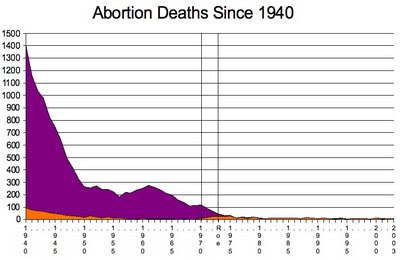
Those who claim that the number of abortion deaths would be higher were abortion not "safe and legal" would do well to review abortion mortality numbers since 1940. I marked vertical lines at 1970 (when New York and California became the first states to legalize abortion on demand) and 1973 (when Roe vs. Wade legalized abortion on demand nationwide).
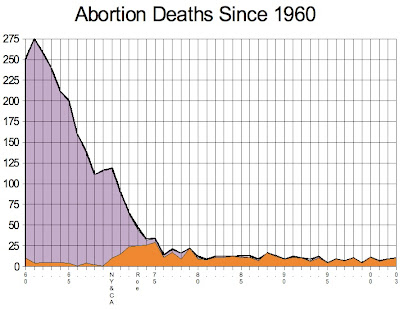
If you're having a hard time spotting it, I'll zoom in a bit on abortion deaths since 1960. Note that I marked New York and California's legalization and Roe vs. Wade for you:
As you can see, legalization did absolutely nothing to change the existing steep downward trend in annual abortion death. Instead, legal abortion deaths started replacing illegal abortion deaths.
Abortion rights advocates who try to claim that legalizing abortion reduces maternal deaths either have never looked at the data, or are deliberately being misleading.
Every woman's death is a tragedy for her and her loved ones. Brushing off legal abortion deaths as being unworthy of notice or concern treats these women's deaths as insignificant and betrays a lack of real concern for the lives of women walking into supposedly safe legal abortion facilities every day.
We should address abortion quackery, not shrug it off.
Some visitors mistakenly assume that the Cemetery of Choice (COC) includes all abortion deaths in the United States since legalization. As you can see by comparing the number the CDC counted with the number I was able to verify, this is hardly true. Even the CDC's slipshod and spotty efforts uncover more abortion deaths than I can, since I lack access to confidential medical documents that the CDC can review.
| Year | CDC | COC | ||||
| 2012 | -- | 1 | ||||
| 2011 | -- | 0 | ||||
| 2010 | -- | 1 | ||||
| 2009 | -- | 3 | ||||
| 2008 | -- | 0 | ||||
| 2007 | 6 | 2 | ||||
| 2006 | 7 | 3 | ||||
| 2005 | 7 | 4 | ||||
| 2004 | 8 | 2 | ||||
| 2003 | 10 | 4 | ||||
| 2002 | 10 | 4 | ||||
| 2001 | 7 | 2 | ||||
| 2000 | 11 | 5 | ||||
| 1999 | 4 | 3 | ||||
| 1998 | 9 | 6 | ||||
| 1997 | 7 | 4 | ||||
| 1996 | 9 | 5 | ||||
| 1995 | 4 | 2 | ||||
| 1994 | 12 | 8 | ||||
| 1993 | 7 | 6 | ||||
| 1992 | 10 | 9 | ||||
| 1991 | 12 | 8 | ||||
| 1990 | 9 | 7 | ||||
| 1989 | 13 | 15 | ||||
| 1988 | 16 | 15 | ||||
| 1987 | 9 | 11 | ||||
| 1986 | 11 | 16 | ||||
| 1985 | 12 | 10 | ||||
| 1984 | 12 | 10 | ||||
| 1983 | 12 | 8 | ||||
| 1982 | 12 | 8 | ||||
| 1981 | 9 | 9 | ||||
| 1980 | 10 | 8 | ||||
| 1979 | 22 | 8 | ||||
| 1978 | 16 | 7 | ||||
| 1977 | 21 | 7 | ||||
| 1976 | 13 | 6 | ||||
| 1975 | 33 | 11 | ||||
| 1974 | 32 | 18 | ||||
| 1973 | 44 | 8 | ||||
| 1972 | 63 | 18 |
Those who claim that the number of abortion deaths would be higher were abortion not "safe and legal" would do well to review abortion mortality numbers since 1940. I marked vertical lines at 1970 (when New York and California became the first states to legalize abortion on demand) and 1973 (when Roe vs. Wade legalized abortion on demand nationwide).
If you're having a hard time spotting it, I'll zoom in a bit on abortion deaths since 1960. Note that I marked New York and California's legalization and Roe vs. Wade for you:
As you can see, legalization did absolutely nothing to change the existing steep downward trend in annual abortion death. Instead, legal abortion deaths started replacing illegal abortion deaths.
Abortion rights advocates who try to claim that legalizing abortion reduces maternal deaths either have never looked at the data, or are deliberately being misleading.
Every woman's death is a tragedy for her and her loved ones. Brushing off legal abortion deaths as being unworthy of notice or concern treats these women's deaths as insignificant and betrays a lack of real concern for the lives of women walking into supposedly safe legal abortion facilities every day.
We should address abortion quackery, not shrug it off.
1975: Antiquated, Needlessly Risky Abortion Kills California Woman
On August 6, 1975, 29-year-old Cheryl Tubbs underwent a saline abortion at Pacific Glen Hospital in Los Angeles County. She experienced heavy vaginal bleeding after this safe, legal abortion, so she was transferred to White Hospital on the evening of August 7.
Cheryl continued to bleed profusely, and twice went into cardiac arrest. Staff performed a paracentesis on her to remove blood and fluids from her abdomen. About an hour after midnight, staff could no longer detect any blood pressure. For an hour they tried heart massage, to no avail. Cheryl was pronounced dead at 2:30AM on August 8.
An autopsy revealed that Cheryl's uterus had ruptured during the abortion, spilling blood and uterine material into her abdomen. She had bled to death.
Two years later, Jackie Bailey also bled to death from a ruptured uterus caused by a saline abortion at Pacific Glen.
Saline abortion was hardly a pleasant experience. The abortionist would remove as much amniotic fluid as he could using a needle and syringe. He would then replace the amniotic fluid with a concentrated saline (salt) solution that would poison and kill the fetus. The woman would then go into labor and expel the fetus.
Saline abortions became very popular in Japan following WWII. Within the Japanese medical community, however, word quickly spread: this method was unsatisfactory. Too many women were being injured and killed. Over 70 papers were published in the Japanese medical community reporting hazards of saline abortions, including at least 60 maternal deaths. The Japanese Obstetrical and Gynecological Society condemned the technique, and it was quickly abandoned. But the Japanese abortionists kept news of the trouble among themselves -- until Western nations discovered instillation abortions and embraced them with great enthusiasm.
Two Japanese doctors, Takashi Wagatsuma and Yukio Manabe, broke the silence. Wagatsuma wrote, "It is, I think, worthwhile to report its rather disastrous consequences which we experienced in Japan." Manabe wrote, "It is now known that any solution placed within the uterus can be absorbed rather rapidly into the general circulation through the vascular system of the uterus and placenta. Thus any solution used in the uterus for abortion must be absolutely safe even if given by direct intravenous injection. ... A solution deadly to the fetus may be equally toxic and dangerous to the mother. ... In spite of the accumulating undesirable reports, the use of hypertonic saline for abortion is still advocated and used ... in the United States and Great Britain. I would like to call attention to the danger of the method and would perdict the further occurrence of deaths until this method is entirely forgotten in these countries."
As western abortionists gained experience with saline abortions, other grim reports arose. A British study published in 1966 found that the saline would enter the mother's bloodstream and cause brain damage. Swedish researchers noticed an unacceptably high rate of complications and deaths. Sweden and the Soviet Union abandoned saline abortion as too dangerous for women in the late 1960s.
For whatever reasons, American abortionists were deaf to these warnings. When New York had completely repealed its abortion law, doctors had tremendous leeway in abortion practice. In New York City in particular, it became popular to inject the woman with the saline in the office, then send her home with instructions to report to a hospital when she went into labor. This was, to say the least, a highly irresponsible way to use an abortion technique that was risky even when performed in a hospital under close medical supervision. Women started dying from these reckless saline abortions.
Women were also already dying in California as well, even though the law there still required abortions to be done in hospitals.
After Roe v Wade was handed down, saline and other instillation abortions spread to other areas of the country, despite the dismal goings-on in New York and California, and of course more women died.
US abortionists showed no alarm over these deaths. Even as late as the 1990's, the American College of Obstetricians and Gynecologists, and abortionists such as Don Sloan and Warren Hern, were describing saline and other instillation abortions in such terms as "a low-risk procedure."
Statistics show, however, that abortionists did gradually move away from saline instillation abortions, albeit more slowly in New York City than in the rest of the country.
Since the problem of maternal deaths from instillation abortions had been long documented, this factor probably only had a minor impact on the move away from saline and other instillation abortions. One important factor was financial: although suction and D&C were adequate procedures for first-trimester abortions, they were inadequate for killing and removing the larger second-trimester fetuses. But the uterus was not large enough to perform instillation abortions until 16 weeks. This left a 4-week "grey period" during which women could change their minds about aborting.
There was also the problem of starting a suction or D&C abortion only to discover that the pregnancy was already in the second trimester. Necessity is the mother of invention, and abortionists who found themselves dealing with second-trimester fetuses that had already been damaged had to come up with ways to remove these fetuses quickly and without alarming the patient. Thus evolved the Dilation and Evacuation (D&E) procedure that remained popular for mid-trimester abortions for over a decade.
D&E was cheaper than instillation abortions, which required at least an overnight hospital stay. It also had the advantage of producing fewer live births, the "dreaded complication" no abortionist wanted to face.
In spite of all the problems, abortionists still performed 366 instillation abortions in the US in 2010, the most recent year for which numbers are available.
Cheryl continued to bleed profusely, and twice went into cardiac arrest. Staff performed a paracentesis on her to remove blood and fluids from her abdomen. About an hour after midnight, staff could no longer detect any blood pressure. For an hour they tried heart massage, to no avail. Cheryl was pronounced dead at 2:30AM on August 8.
An autopsy revealed that Cheryl's uterus had ruptured during the abortion, spilling blood and uterine material into her abdomen. She had bled to death.
Two years later, Jackie Bailey also bled to death from a ruptured uterus caused by a saline abortion at Pacific Glen.
Saline abortion was hardly a pleasant experience. The abortionist would remove as much amniotic fluid as he could using a needle and syringe. He would then replace the amniotic fluid with a concentrated saline (salt) solution that would poison and kill the fetus. The woman would then go into labor and expel the fetus.
Saline abortions became very popular in Japan following WWII. Within the Japanese medical community, however, word quickly spread: this method was unsatisfactory. Too many women were being injured and killed. Over 70 papers were published in the Japanese medical community reporting hazards of saline abortions, including at least 60 maternal deaths. The Japanese Obstetrical and Gynecological Society condemned the technique, and it was quickly abandoned. But the Japanese abortionists kept news of the trouble among themselves -- until Western nations discovered instillation abortions and embraced them with great enthusiasm.
Two Japanese doctors, Takashi Wagatsuma and Yukio Manabe, broke the silence. Wagatsuma wrote, "It is, I think, worthwhile to report its rather disastrous consequences which we experienced in Japan." Manabe wrote, "It is now known that any solution placed within the uterus can be absorbed rather rapidly into the general circulation through the vascular system of the uterus and placenta. Thus any solution used in the uterus for abortion must be absolutely safe even if given by direct intravenous injection. ... A solution deadly to the fetus may be equally toxic and dangerous to the mother. ... In spite of the accumulating undesirable reports, the use of hypertonic saline for abortion is still advocated and used ... in the United States and Great Britain. I would like to call attention to the danger of the method and would perdict the further occurrence of deaths until this method is entirely forgotten in these countries."
As western abortionists gained experience with saline abortions, other grim reports arose. A British study published in 1966 found that the saline would enter the mother's bloodstream and cause brain damage. Swedish researchers noticed an unacceptably high rate of complications and deaths. Sweden and the Soviet Union abandoned saline abortion as too dangerous for women in the late 1960s.
For whatever reasons, American abortionists were deaf to these warnings. When New York had completely repealed its abortion law, doctors had tremendous leeway in abortion practice. In New York City in particular, it became popular to inject the woman with the saline in the office, then send her home with instructions to report to a hospital when she went into labor. This was, to say the least, a highly irresponsible way to use an abortion technique that was risky even when performed in a hospital under close medical supervision. Women started dying from these reckless saline abortions.
Women were also already dying in California as well, even though the law there still required abortions to be done in hospitals.
After Roe v Wade was handed down, saline and other instillation abortions spread to other areas of the country, despite the dismal goings-on in New York and California, and of course more women died.
US abortionists showed no alarm over these deaths. Even as late as the 1990's, the American College of Obstetricians and Gynecologists, and abortionists such as Don Sloan and Warren Hern, were describing saline and other instillation abortions in such terms as "a low-risk procedure."
Statistics show, however, that abortionists did gradually move away from saline instillation abortions, albeit more slowly in New York City than in the rest of the country.
Since the problem of maternal deaths from instillation abortions had been long documented, this factor probably only had a minor impact on the move away from saline and other instillation abortions. One important factor was financial: although suction and D&C were adequate procedures for first-trimester abortions, they were inadequate for killing and removing the larger second-trimester fetuses. But the uterus was not large enough to perform instillation abortions until 16 weeks. This left a 4-week "grey period" during which women could change their minds about aborting.
There was also the problem of starting a suction or D&C abortion only to discover that the pregnancy was already in the second trimester. Necessity is the mother of invention, and abortionists who found themselves dealing with second-trimester fetuses that had already been damaged had to come up with ways to remove these fetuses quickly and without alarming the patient. Thus evolved the Dilation and Evacuation (D&E) procedure that remained popular for mid-trimester abortions for over a decade.
D&E was cheaper than instillation abortions, which required at least an overnight hospital stay. It also had the advantage of producing fewer live births, the "dreaded complication" no abortionist wanted to face.
In spite of all the problems, abortionists still performed 366 instillation abortions in the US in 2010, the most recent year for which numbers are available.
Sunday, August 05, 2012
Why I'm Not Trying to Convert ProChoicers
I realize that saying this makes me sound like a heretic, but what I do with this blog is not intended to convert prochoicers to the prolife cause.
I can just hear the response: WTF?!?!
Hear me out.
The goal of this blog is to protect women:
That's a lovely goal, but it doesn't help the roughly 3,300 women and girls walking into abortion facilities tomorrow. They are at risk right now. And it's those women and girls that this blog is here for.
So today, fellow prolifer, I'm not talking to you. I want to talk to procohoicers who hear stories about abortion injuries, and coerced abortions, and seedy abortion mills, and are horribly dismayed, but don't know what to do to address those problems without having to switch sides on an issue that they have strong convictions about.
I'm talking to prochoicers who wish that they could make abortion just go away.
Here's where I reassert: I don't want to convert you.
"Yeah, right," many of you are thinking.
But I am 100% truthful. I do not want to convert you from prochoice to prolife, for a very practical reason: If you convert, you become utterly powerless to address the problems.
If a prolifer tries to shut down a seedy abortion mill, she gets blown off. After all, she wants every abortion facility shut down. Her motives are automatically suspect. The assumption is that she'll say anything to get any abortion facility closed, so she must be lying or taking things out of context or blowing things out of proportion. If she gets other prolifers to join her, then it becomes seen as an evil conspiracy. The prochoice citizens join the abortion-rights establishment in circling the wagons and protecting the place from what they naturally view as an unwarranted attack.
If prochoicers, on the other hand, are the ones waving around medical board documents and copies of health department inspections, and are the ones getting injured or abused women to speak out, their motives aren't called into question. Their concerns are taken seriously. Yes, unless it turns out to be as hideous a place as Kermit Gosnell's "house of horrors," there will still be hardcore abortion-rights advocates that will defend the place, but a lot of the wind will be taken out of their sails if they know that they're being carefully watched by their own constituency.
This is why I don't want you, the prochoice citizen, to convert. If you become prolife, you become just another antichoice nutcase who is only saying those bad things because you want to end abortion. If you remain prochoice, you keep your credibility and your power to take action and to protect women against abuses, coercion, injury, and death -- which is why you identify as prochoice in the first place..
I can just hear the response: WTF?!?!
Hear me out.
The goal of this blog is to protect women:
- From unwanted abortions
- From abortion injuries
- From quackery and death
That's a lovely goal, but it doesn't help the roughly 3,300 women and girls walking into abortion facilities tomorrow. They are at risk right now. And it's those women and girls that this blog is here for.
So today, fellow prolifer, I'm not talking to you. I want to talk to procohoicers who hear stories about abortion injuries, and coerced abortions, and seedy abortion mills, and are horribly dismayed, but don't know what to do to address those problems without having to switch sides on an issue that they have strong convictions about.
I'm talking to prochoicers who wish that they could make abortion just go away.
Here's where I reassert: I don't want to convert you.
"Yeah, right," many of you are thinking.
But I am 100% truthful. I do not want to convert you from prochoice to prolife, for a very practical reason: If you convert, you become utterly powerless to address the problems.
If a prolifer tries to shut down a seedy abortion mill, she gets blown off. After all, she wants every abortion facility shut down. Her motives are automatically suspect. The assumption is that she'll say anything to get any abortion facility closed, so she must be lying or taking things out of context or blowing things out of proportion. If she gets other prolifers to join her, then it becomes seen as an evil conspiracy. The prochoice citizens join the abortion-rights establishment in circling the wagons and protecting the place from what they naturally view as an unwarranted attack.
If prochoicers, on the other hand, are the ones waving around medical board documents and copies of health department inspections, and are the ones getting injured or abused women to speak out, their motives aren't called into question. Their concerns are taken seriously. Yes, unless it turns out to be as hideous a place as Kermit Gosnell's "house of horrors," there will still be hardcore abortion-rights advocates that will defend the place, but a lot of the wind will be taken out of their sails if they know that they're being carefully watched by their own constituency.
This is why I don't want you, the prochoice citizen, to convert. If you become prolife, you become just another antichoice nutcase who is only saying those bad things because you want to end abortion. If you remain prochoice, you keep your credibility and your power to take action and to protect women against abuses, coercion, injury, and death -- which is why you identify as prochoice in the first place..
Sunday, July 22, 2012
Update on Planned Parenthood's Latest Victim
The latest patient to die from the care at Planned Parenthood has been identified.
Tonya Reaves, age 24, was rushed to Northwest Memorial Hospital in Chicago and pronounced dead at 11:20 p.m. on Friday, July 21, 2012.
She was taken there from the Planned Parenthood facility at 18 S. Michigan Avenue, which advertises abortions up to 18 weeks. Tonya had undergone a D&E abortion, which indicates that she was likely between 14 and 18 weeks pregnant, although a misdiagnosis of fetal age might be the underlying cause of the injury.
Tonya was engaged to be married and had a little son, Alvin, who had just celebrated his first birthday. Her FaceBook page shows a vibrant, smiling young woman having fun on vacation with her family and friends.
Tonya's twin sister, Toni, told CBS Chicago, "We were born the same day. She was my other half." She expressed her bewilderment and shock:
"It happened so fast. She was just fine one day and then the next day she was gone. We’re just trying to figure out what happened… what happened."
Since the Centers for Disease Control said that, given the tools available to a modern abortion facility, there's no legitimate reason for a woman to bleed to death from abortion injuries, Planned Parenthood has a lot of explaining to do.
"Woman Dies Following Abortion At Planned Parenthood Clinic," CBS Chicago, July 21, 2012
"Family Seeks Answers After Woman's Death Following Abortion," CBS Chicago, July 21, 2012
"Woman Dies After Abortion at Planned Parenthood Clinic," Chicago Sun-Times, July 22, 2012
Tonya Reaves, age 24, was rushed to Northwest Memorial Hospital in Chicago and pronounced dead at 11:20 p.m. on Friday, July 21, 2012.
She was taken there from the Planned Parenthood facility at 18 S. Michigan Avenue, which advertises abortions up to 18 weeks. Tonya had undergone a D&E abortion, which indicates that she was likely between 14 and 18 weeks pregnant, although a misdiagnosis of fetal age might be the underlying cause of the injury.
Tonya was engaged to be married and had a little son, Alvin, who had just celebrated his first birthday. Her FaceBook page shows a vibrant, smiling young woman having fun on vacation with her family and friends.
Tonya's twin sister, Toni, told CBS Chicago, "We were born the same day. She was my other half." She expressed her bewilderment and shock:
"It happened so fast. She was just fine one day and then the next day she was gone. We’re just trying to figure out what happened… what happened."
Since the Centers for Disease Control said that, given the tools available to a modern abortion facility, there's no legitimate reason for a woman to bleed to death from abortion injuries, Planned Parenthood has a lot of explaining to do.
"Woman Dies Following Abortion At Planned Parenthood Clinic," CBS Chicago, July 21, 2012
"Family Seeks Answers After Woman's Death Following Abortion," CBS Chicago, July 21, 2012
"Woman Dies After Abortion at Planned Parenthood Clinic," Chicago Sun-Times, July 22, 2012
Saturday, July 21, 2012
Two Chicago Deaths from the Early 20th Century
On July 21, 1907, homemaker Madeline Paffrath died at German American Hospital
in Chicago. She was approximately 21 years old. The coroner's jury
determined that she had died from an abortion performed. They held two
midwives -- Alice Rastone
and Hacrone Schuetner -- responsible. Another woman, Alice F.
Gustafson, whose profession is given as "abortion provider" was also
arrested. Mrs. Paffraths' abortion was unusual in that it was not performed by a physician.
On July 21, 1923, 28-year-old Mrs. Mary Federowicz died at Chicago's St. Mary's Hospital from complications performed that day. Mrs. Anna Mithnewicz, whose profession was not given, was identified by the coroner as the person responsible, but no arrest was made.
Woman Bled to Death on Friday from Abortion at Chicago PP
An unidentified 24-year-old woman I'll call "Bella" Roe was rushed to
Northwest Memorial Hospital in Chicago and pronounced dead at 11:20
a.m. on Friday, July 21, 2012.
She was taken there from the Planned Parenthood facility at 18 S. Michigan Avenue, where she had just undergone a D&E abortion, which indicates that she was likely between 14 and 20 weeks pregnant.
"Woman Dies Following Abortion At Planned Parenthood Clinic," CBS Chicago, July 21, 2012
She was taken there from the Planned Parenthood facility at 18 S. Michigan Avenue, where she had just undergone a D&E abortion, which indicates that she was likely between 14 and 20 weeks pregnant.
"Woman Dies Following Abortion At Planned Parenthood Clinic," CBS Chicago, July 21, 2012
Friday, July 20, 2012
Two Pre-Roe Abortion Deaths
On July 18, 1918, 18-year-old Margaret Smith, an unmarried clerk, died at Allegheny General Hospital in Pittsburgh. The coroner determined that she had died of septicemia from a self-induced abortion.
Note, please, that with overall public health issues such as doctors not using proper aseptic techniques, lack of access to blood transfusions and antibiotics, and overall poor health to begin with, there was likely little difference between the performance of a legal abortion and illegal practice, and the aftercare for either type of abortion was probably equally unlikely to do the woman much, if any, good. In fact, due to improvements in addressing these problems, maternal mortality in general (and abortion mortality with it) fell dramatically in the 20th Century, decades before Roe vs. Wade legalized abortion across America.

Barbara Riley was 23 years old when she chose abortion. She had a history of sickle cell anemia and three previous term pregnancies -- two live births and a stillborn child. She was in her first trimester of pregnancy when she underwent the abortion on July 11, 1970 at Harlem Hospital. The abortion had been recommended by hospital staff because Barbara had a history of sickle cell disease. The abortion would probably have been recommended as beneficial to Barbara's health, under New York's old abortion law; the new law just meant that they didn't need to leally justify going ahead with it. But instead of improving, Barbara's health deteriorated. Her blood started to break down. Nine days after the abortion, July 20, Barbara died. The other women I've identified as dying from sickle cell crisis triggered by an abortion are Margaret Davis andBetty Hines.
Note, please, that with overall public health issues such as doctors not using proper aseptic techniques, lack of access to blood transfusions and antibiotics, and overall poor health to begin with, there was likely little difference between the performance of a legal abortion and illegal practice, and the aftercare for either type of abortion was probably equally unlikely to do the woman much, if any, good. In fact, due to improvements in addressing these problems, maternal mortality in general (and abortion mortality with it) fell dramatically in the 20th Century, decades before Roe vs. Wade legalized abortion across America.

Barbara Riley was 23 years old when she chose abortion. She had a history of sickle cell anemia and three previous term pregnancies -- two live births and a stillborn child. She was in her first trimester of pregnancy when she underwent the abortion on July 11, 1970 at Harlem Hospital. The abortion had been recommended by hospital staff because Barbara had a history of sickle cell disease. The abortion would probably have been recommended as beneficial to Barbara's health, under New York's old abortion law; the new law just meant that they didn't need to leally justify going ahead with it. But instead of improving, Barbara's health deteriorated. Her blood started to break down. Nine days after the abortion, July 20, Barbara died. The other women I've identified as dying from sickle cell crisis triggered by an abortion are Margaret Davis andBetty Hines.
Thursday, July 19, 2012
Abortion Deaths -- Prevented by Legalization?
Very little is on record about the death of 17-year-old Gertrude Wynants. According to the New York Times, Gertrude died on July 19, 1925, of a criminal abortion. Mrs. Margaret Shott Higgens, age 23, was indicted for manslaughter in Gertrude's death.
In late July of 1941, Mrs. Agnes Pearson of White Plains, New York died at Grasslands Hospital in New York of suspected complications from an abortion. Dr. Nathan Schwartz and Dr. Samuel Schwartz (not related) were charged with manslaughter in Agnes' death. The charges were dismissed in 1946. Agnes's abortion was typical of pre-Roe abortions in that it was performed by a physician. During the 1940s, while abortion was still illegal, there was a massive drop in maternal mortality from abortion. The death toll fell from 1,407 in 1940, to 744 in 1945, to 263 in 1950. Most researches attribute this plunge to the development of blood transfusion techniques and the introduction of antibiotics. Learn more here.


Carmen Rodriguez was 31 years old when she underwent a 14-week saline abortion at Lincoln Hospital in New York City. She had a history of rheumatic heart disease and two previous live births. After the saline was injected, it got into Carmen's blood stream. This caused acute pulmonary edema -- fluid accumulation in the lungs -- and Carmen went into a coma from which she never recovered. She died on July 19, 1970, leaving behind a husband along with her children. After Carmen's death, a militant Puerto Rican group, The Young Lords, swung into action. They pointed out that doctors at Lincoln Hospital knew that Carmen had heart problems and failed to take proper precautions -- a very valid claim. After all, saline abortions had long been known to be risky to the woman's heart. What responsible physician would choose to perform an abortion on a heart patient, using a technique that has been documented as potentially causing heart-damaging electrolyte imbalances? The Young Lords distributed leaflets in the neighborhood of the hospital, denouncing Carmen's death as "murder". For 12 hours, the group occupied an administration building connected with the hospital, denouncing the hospital as "a butcher shop that kills patients". Merle Goldman, spokeswoman of an abortion advocacy organization, did not share The Young Lords' outrage. Ms. Goldman said she hoped that Carmen's death wouldn't deter other women from undergoing abortions. She touted abortion's reputed safety and stressed that her group was lobbying against proposed health department regulation of abortion practice. New York City Chief Medical Examiner Milton Helpern, on the other hand, expressed concern that ill-equipped and poorly-staffed freestanding legal abortion facilities were posing a danger to women.
Betty Hines, a native of Tennessee, was 21 years old when she was checked into Doctors Hospital in California for a safe, legal abortion to be performed by Dr. A. Mitchell on July 19, 1971, who had been her physician for three or four years. Betty was eight weeks pregnant. There didn't seem to be anything wrong during the procedure. Betty was transferred to the recovery room, when she suddenly went into cardio-respiratory arrest. Mitchell theorized that perhaps Betty had died because of a bad vial of Inovar, because the next patient who was injected from that vial also went into cardiac arrest but was successfully resuscitated.Betty's autopsy, however, found no trave of Inovar in her system. A toxicology check was also done on the vial of medication, and found nothing wrong with the Inovar. Betty's death was attributed to massive intravascular sickling due to underlying sickle cell disorder. Other women who died of sickle cell crisis triggered by abortion include Margaret Davis and Barbara Hoppert.
Sunday, July 15, 2012
A Typical Death, 1921
On July 14, 1921, 23-year-old Mrs. Edna Rohner died at Illinois Masonic
Hospital in Chicago from an abortion perpetrated by Dr. Otto Klemmick.
He was held by the coroner and tried, but acquitted on June 12, 1923.
Friday, July 13, 2012
1921: A Typical Abortion Death
On July 14, 1921, 23-year-old Mrs. Edna Rohner died at Illinois Masonic Hospital in Chicago from an abortion perpetrated by Dr. Otto Klemmick. He was held by the coroner and tried, but acquitted on June 12, 1923.
Tuesday, July 10, 2012
Three Tragedies, 1926, 1934, 1998
On July 13, 1926, a laborer on his way to work stumbled across a grisly
find: the dismembered remains of a young woman, tossed along the side of
a lonely road between two cemeteries near Boston. The dismemberment was
expertly done, indicating that the killer might be a skilled
surgeon. Nearly twenty families of missing women contacted the morgue in the
first hours after the body was found, but the descriptions of their
loved ones did not fit the victim. By July 15, the young woman had been positively identified as
20-year-old Edith Green, who had been an attendant at the Boston
Psychopathic Hospital.
Police concluded that 21-year-old James V. Ford was the "sweetheart" responsible for Edith's pregnancy. Ford admitted to police that he had arranged for an abortion to be performed on Edith by Dr. Thomas E. Walsh. Edith had died on July 10. Ford said that Walsh had asked for his help in disposing of Edith's body, but that he had refused. Walsh and his wife were charged with murder in Edith's death.
In 1934, pretty Marian Mills was the 19-year-old "campus sweetheart" of Neal Myers, a 21-year-old pharmacy student. On July 10, Marian died in the apartment of Mrs. Hazel Brown, the cook for Myers' fraternity house and "the only person of mature age in the house during the 24 tragic hours preceding the girl's death." Myers was charged with murder, and could have faced life in prison if convicted. Mrs. Brown said that Myers had loved Marian and had wanted to marry her. Marian, on the other hand, insisted that her parents would never accept Myers. Brown said that Marian had taken "a harmless drug" and that this was the only attempt that she personally knew of to abort the baby. But evidently Marian had found an abortionist, or had done something herself more drastic than just take mild abortifacients, because doctors who examined her said that some sort of instruments had been used in the abortion that had caused her death.
Virginia Wolfe, age 33, went to Methodist Women's and Children's Hospital on July 6, 1998, to have a suction abortion performed by Dr. Lillian Jones. JoDuring the procedure, she punctured Virginia's uterus and bladder. Virginia suffered massive hemorrhage, losing so much blood that her heart stopped. Doctors repaired her bladder and removed her uterus, but Virginia's brain had already been damaged by the lack of oxygen. She was pronounced dead on July 10, 1998.
Police concluded that 21-year-old James V. Ford was the "sweetheart" responsible for Edith's pregnancy. Ford admitted to police that he had arranged for an abortion to be performed on Edith by Dr. Thomas E. Walsh. Edith had died on July 10. Ford said that Walsh had asked for his help in disposing of Edith's body, but that he had refused. Walsh and his wife were charged with murder in Edith's death.
In 1934, pretty Marian Mills was the 19-year-old "campus sweetheart" of Neal Myers, a 21-year-old pharmacy student. On July 10, Marian died in the apartment of Mrs. Hazel Brown, the cook for Myers' fraternity house and "the only person of mature age in the house during the 24 tragic hours preceding the girl's death." Myers was charged with murder, and could have faced life in prison if convicted. Mrs. Brown said that Myers had loved Marian and had wanted to marry her. Marian, on the other hand, insisted that her parents would never accept Myers. Brown said that Marian had taken "a harmless drug" and that this was the only attempt that she personally knew of to abort the baby. But evidently Marian had found an abortionist, or had done something herself more drastic than just take mild abortifacients, because doctors who examined her said that some sort of instruments had been used in the abortion that had caused her death.
Virginia Wolfe, age 33, went to Methodist Women's and Children's Hospital on July 6, 1998, to have a suction abortion performed by Dr. Lillian Jones. JoDuring the procedure, she punctured Virginia's uterus and bladder. Virginia suffered massive hemorrhage, losing so much blood that her heart stopped. Doctors repaired her bladder and removed her uterus, but Virginia's brain had already been damaged by the lack of oxygen. She was pronounced dead on July 10, 1998.
Monday, July 09, 2012
One Illegal, Two Legal, and an Unusual Prosecution
On July 9, 1916, 27-year-old homemaker Mina Malletti died at Chicago's Washington Park Hospital from complications of a abortion performed that day by an unknown perpetrator.
Luz Rodriguez was 40 years old when she went to Moshe Hachamovitch's abortion clinic in the Bronx for a first-trimester abortion on July 5, 1986. She bled heavily after the abortion. Just before she was to be discharged, she stopped breathing. Staff summoned an ambulance, which took Luz to a hospital. Efforts to resuscitate her were successful, but she remained hospitalized. Four days later, July 9, she died. The autopsy found that she had bled to death from an incomplete abortion.Hachamovitch was also either direction responsible for the deaths of Jammie Garcia , Lisa Bardsley, Christina Goesswein, Tanya Williamson, and Lou Ann Herron., or he owned and was supposed to properly supervised the facilities where they were fatally injured.
Guadalupe Negron, age 33, went for a safe, legal abortion at Metro Women's Center in Queens, New York, on July 9, 1993. After Dr. David Benjamin had performed Guadalupe's abortion, she was moved to the recovery room and left unattended for over an hour. When paramedics arrived, they found Guadalupe naked and bloody, with a nurse screaming and trying to revive her in a small, unventilated room with an inadequate oxygen tank and no necessary equipment such as a blood pressure cuff. They also noted that Benjamin had inserted a breathing tube into Guadalupe's stomach instead of her trachea, causing stomach fluids to travel up the tube, into her mouth, and down into her lungs. The autopsy report found that in trying to extract a 20-week fetus, Benjamin had lacerated Guadalupe's cervix and punctured her uterus, leaving a tear over 3 inches long. She hemorrhaged and went into shock and cardiac arrest. Authorities determined that Benjamin had initiated the risky procedure without having first examined the patient. One of the paramedics told a reporter, "I wouldn't take my dog there (Benjamin's clinic)." New York newspapers covering Benjamin's murder trial discovered that the Iranian immigrant had a long history of malpractice and had changed his name from Elias Bonrouhi to David Benjamin in order to cover up his record. The told reporters that they were appalled by Benjamin's arrogance, lack of remorse, and lack of appreciation of how badly he had bungled the case. because of the egregiousness of Benjamin's behavior, he was charged with manslaughter. The jury forewoman said, "It was quite a quick decision. The pictures of his clinic were disgusting. The inside was very unsanitary." She and the other jurors also noted that, "Throughout the trial, his lawyer said Dr. Benjamin didn't know the woman had died. But when we listened to the tape, we clearly heard his wife say, 'She's dead! She's dead!'" Abortion activist Bill Baird attended the trial with Benjamin's wife and her mother, and denounced the sentence as "a public stoning, and said that the judge who sentenced his fellow abortionist was incapable of compassion or mercy.
Luz Rodriguez was 40 years old when she went to Moshe Hachamovitch's abortion clinic in the Bronx for a first-trimester abortion on July 5, 1986. She bled heavily after the abortion. Just before she was to be discharged, she stopped breathing. Staff summoned an ambulance, which took Luz to a hospital. Efforts to resuscitate her were successful, but she remained hospitalized. Four days later, July 9, she died. The autopsy found that she had bled to death from an incomplete abortion.Hachamovitch was also either direction responsible for the deaths of Jammie Garcia , Lisa Bardsley, Christina Goesswein, Tanya Williamson, and Lou Ann Herron., or he owned and was supposed to properly supervised the facilities where they were fatally injured.
Guadalupe Negron, age 33, went for a safe, legal abortion at Metro Women's Center in Queens, New York, on July 9, 1993. After Dr. David Benjamin had performed Guadalupe's abortion, she was moved to the recovery room and left unattended for over an hour. When paramedics arrived, they found Guadalupe naked and bloody, with a nurse screaming and trying to revive her in a small, unventilated room with an inadequate oxygen tank and no necessary equipment such as a blood pressure cuff. They also noted that Benjamin had inserted a breathing tube into Guadalupe's stomach instead of her trachea, causing stomach fluids to travel up the tube, into her mouth, and down into her lungs. The autopsy report found that in trying to extract a 20-week fetus, Benjamin had lacerated Guadalupe's cervix and punctured her uterus, leaving a tear over 3 inches long. She hemorrhaged and went into shock and cardiac arrest. Authorities determined that Benjamin had initiated the risky procedure without having first examined the patient. One of the paramedics told a reporter, "I wouldn't take my dog there (Benjamin's clinic)." New York newspapers covering Benjamin's murder trial discovered that the Iranian immigrant had a long history of malpractice and had changed his name from Elias Bonrouhi to David Benjamin in order to cover up his record. The told reporters that they were appalled by Benjamin's arrogance, lack of remorse, and lack of appreciation of how badly he had bungled the case. because of the egregiousness of Benjamin's behavior, he was charged with manslaughter. The jury forewoman said, "It was quite a quick decision. The pictures of his clinic were disgusting. The inside was very unsanitary." She and the other jurors also noted that, "Throughout the trial, his lawyer said Dr. Benjamin didn't know the woman had died. But when we listened to the tape, we clearly heard his wife say, 'She's dead! She's dead!'" Abortion activist Bill Baird attended the trial with Benjamin's wife and her mother, and denounced the sentence as "a public stoning, and said that the judge who sentenced his fellow abortionist was incapable of compassion or mercy.
Sunday, July 08, 2012
Legalization No Help at All
On July 8, 1929, 26-year-old Frances Rogers died from a criminal abortion. The source summary says that the abortion was done in an unknown
location, but the description of the offense says that she died at the
scene of the crime. The person responsible was never identified.
Keep in mind that things that things we take for granted, like antibiotics and blood banks, were still in the future. For more about abortion in this era, see Abortion in the 1920s. For more on pre-legalization abortion, see The Bad Old Days of Abortion.
Fast-forward to our safe, enlightened days.
Junette Barnes, a 27-year-old mother of four, had a tubal ligation on June 16, 1988. One week after this operation, she found out that she had been pregnant at the time of the surgery, and was still pregnant. She saw her family physician, Dr. Ted Shields on July 8, 1988, and he performed a safe, legal abortion on her at Surgicare Outpatient Center in Victoria that day. During the abortion, he perforated her uterus and cut an artery and several veins. Junette was transferred to a hospital, where she died of during emergency surgery.
Keep in mind that things that things we take for granted, like antibiotics and blood banks, were still in the future. For more about abortion in this era, see Abortion in the 1920s. For more on pre-legalization abortion, see The Bad Old Days of Abortion.
Fast-forward to our safe, enlightened days.
Junette Barnes, a 27-year-old mother of four, had a tubal ligation on June 16, 1988. One week after this operation, she found out that she had been pregnant at the time of the surgery, and was still pregnant. She saw her family physician, Dr. Ted Shields on July 8, 1988, and he performed a safe, legal abortion on her at Surgicare Outpatient Center in Victoria that day. During the abortion, he perforated her uterus and cut an artery and several veins. Junette was transferred to a hospital, where she died of during emergency surgery.
Saturday, July 07, 2012
1950 & 1982: Equally Dead, Not Equally Remembered
I was originally very skeptical about the story told on the National Organization for Women
web site. They said that Vivian Campbell was a recently-separated
24-year-old mother of two when she discovered she was pregnant. NOW
indicated that Vivian sent her children to stay with her parents while
she obtained some sort of illegal abortion. NOW provided no details of
the abortion, but did say that Vivian asked for her estranged husband,
who came to the hospital only after she had died of peritonitis on May
6, 1950. I decided to check the story out when I was able to visit the archives
of the Allegheny County Coroner's Office in Pittsburgh. What I found
left me totally bewildered as to why NOW and other abortion advocacy
organizations using Vivian's story didn't bother to do any research.They
certainly would have it pay dirt, verifying the fact that Vivian did indeed die from complications of an illegal abortion -- evidently self-induced with castor oil. This was unusual, since the majority of pre-legalization abortions were done by physicians, but typical abortions don't make good PR for those promoting legalization.
Legal abortion deaths, on the other hand, slide under the radar of the self-appointed champions of women's lives. On July 2, 1982, 23-year-old Darlene Wood was put under anesthesia for a second trimester abortion at Temple University Hospital. The abortionist was Renga Rajan; the anesthethesiologist was William Stevenson-Smith. Darlene was given nitrous oxide by face mask. She started coughing after the procedure began. After the abortion was completed, she was admitted to the respiratory intensive care unit, where she was diagnosed with primary pulmonary hypertension. Over the next several days, Darlene experienced increasing respiratory distress. She was given medication to maintain her blood pressure. But on July 7, Darlene went into cardio-respiratory arrest. She was pronounced dead at 2:50 p.m. The administratrix of Darlene's estate contended that the lack of appropriate medical and anesthetic clearance was a substantial factor in her death. Rajan was also successfully sued for the 1987 abortion death of Iris Velazquez.
Friday, July 06, 2012
Abortion Deaths, 1930 & 1970
On July 6, 1930, Mary Tulis, age 34, died in Chicago from complications of an abortion performed that day. Marie La Montagne, who lived at the scene, was fingered in the abortion. Dr. O.W. Sommer of Francis Willard Hospital had been brought to the
scene by somebody when it became apparent that Mary had peritonitis. Neither Montagne nor Sommer is mentioned in the coroner's verdict.
Pearl Schwier, age 42, was 20 weeks pregnant when she sought a safe, legal abortion under New York state's new law, at St. Luke's hospital in New York City. She was brought into the operating room on July 6, 1970 for a hysterotomy abortion, which is simply a c-section in which the intention is to allow the baby to die rather than to deliver him or her alive. It was performed under general anesthesia. About 45 minutes into the procedure, Pearl had a reaction to the anesthesia and died.
As you can see from the graph below, abortion deaths were falling dramatically before legalization. This steep fall had been in place for decades. To argue that legalization lowered abortion mortality simply isn't supported by the data.
Pearl Schwier, age 42, was 20 weeks pregnant when she sought a safe, legal abortion under New York state's new law, at St. Luke's hospital in New York City. She was brought into the operating room on July 6, 1970 for a hysterotomy abortion, which is simply a c-section in which the intention is to allow the baby to die rather than to deliver him or her alive. It was performed under general anesthesia. About 45 minutes into the procedure, Pearl had a reaction to the anesthesia and died.
As you can see from the graph below, abortion deaths were falling dramatically before legalization. This steep fall had been in place for decades. To argue that legalization lowered abortion mortality simply isn't supported by the data.
Thursday, July 05, 2012
A Typical Early 20th Century Death
Homemaker Rosa May Swope of Canton, Illinois, died in mid-July of 1901 of
complications of a botched abortion. Both her husband, George W., who
was a coal miner, and Dr. F.D. Smith of Astoria, Illinois, were
arrested. Smith denied having performed the abortion, saying that he'd
been summoned in early July to attend to Mrs. Swope, and had found her
"suffering greatly and in an abortive condition, though whether from
drugs or otherwise is not known." Smith said that Dr. D. W. Bottorf had
performed the abortion in question.
Note, please, that with overall public health issues such as doctors not using proper aseptic techniques, lack of access to blood transfusions and antibiotics, and overall poor health to begin with, there was likely little difference between the performance of a legal abortion and illegal practice, and the aftercare for either type of abortion was probably equally unlikely to do the woman much, if any, good. For more about abortion and abortion deaths in the first years of the 20th century, see Abortion Deaths 1900-1909.

For more on pre-legalization abortion, see The Bad Old Days of Abortion.
Note, please, that with overall public health issues such as doctors not using proper aseptic techniques, lack of access to blood transfusions and antibiotics, and overall poor health to begin with, there was likely little difference between the performance of a legal abortion and illegal practice, and the aftercare for either type of abortion was probably equally unlikely to do the woman much, if any, good. For more about abortion and abortion deaths in the first years of the 20th century, see Abortion Deaths 1900-1909.
For more on pre-legalization abortion, see The Bad Old Days of Abortion.
Wednesday, July 04, 2012
Historic Deaths, Perps Professions Unknown
"The community around Oyster Bay are greatly excited over an abortion case that has been brought to light."
The woman, Miss Bertram, was engaged to a New York man. The wedding was to take place on July 4, 1875. But Miss Bertram became pregnant before the wedding. She purchased an abortifacient which didn't have the effect she desired, so she took some other sort of abortifacient. This second abortifacient did the job, leading to the birth of a near-term infant, which was buried in a potato patch. Miss Bertram, however, took ill and died a few days later. The physician who was attending her declared the cause of death to be the abortion. Miss Bertram's fiance denied being the father of the dead baby. "There is a suspicion entertained of another young man". Police began an investigation into who he might be, and into who sold Miss Bertram the fatal drugs.
On July 4, 1913, Russian immigrant 33-year-old Mary Goldstein died in Chicago from an abortion perpetrated by Minnie Bernstein. Bernstein is identified only as "abortion provider", so she might have been a lay abortionist. She was held by the Coroner, and indicted by the Grand Jury for felony murder on September 1, but the case never went to trial.
Note, please, that with overall public health issues such as doctors not using proper aseptic techniques, lack of access to blood transfusions and antibiotics, and overall poor health to begin with, there was likely little difference between the performance of a legal abortion and illegal practice, and the aftercare for either type of abortion was probably equally unlikely to do the woman much, if any, good.
In fact, due to improvements in addressing these problems, maternal mortality in general (and abortion mortality with it) fell dramatically in the 20th Century, decades before Roe vs. Wade legalized abortion across America.

For more on pre-legalization abortion, see The Bad Old Days of Abortion
The woman, Miss Bertram, was engaged to a New York man. The wedding was to take place on July 4, 1875. But Miss Bertram became pregnant before the wedding. She purchased an abortifacient which didn't have the effect she desired, so she took some other sort of abortifacient. This second abortifacient did the job, leading to the birth of a near-term infant, which was buried in a potato patch. Miss Bertram, however, took ill and died a few days later. The physician who was attending her declared the cause of death to be the abortion. Miss Bertram's fiance denied being the father of the dead baby. "There is a suspicion entertained of another young man". Police began an investigation into who he might be, and into who sold Miss Bertram the fatal drugs.
On July 4, 1913, Russian immigrant 33-year-old Mary Goldstein died in Chicago from an abortion perpetrated by Minnie Bernstein. Bernstein is identified only as "abortion provider", so she might have been a lay abortionist. She was held by the Coroner, and indicted by the Grand Jury for felony murder on September 1, but the case never went to trial.
Note, please, that with overall public health issues such as doctors not using proper aseptic techniques, lack of access to blood transfusions and antibiotics, and overall poor health to begin with, there was likely little difference between the performance of a legal abortion and illegal practice, and the aftercare for either type of abortion was probably equally unlikely to do the woman much, if any, good.
In fact, due to improvements in addressing these problems, maternal mortality in general (and abortion mortality with it) fell dramatically in the 20th Century, decades before Roe vs. Wade legalized abortion across America.

For more on pre-legalization abortion, see The Bad Old Days of Abortion
Tuesday, July 03, 2012
Midwife in 1917, Doctor in 1929
On July 3, 1917, 31-year-old homemaker Helen Skoza died at Chicago's Henroten Hospital from an abortion perpetrated by Elizabeth Schade. Schade never went to trial for Helen's death, and went on to kill Fern Strecker in 1926.
Dorothy Schultz, age 19, graduated from high school in June of 1929, and was planning to move from her family home in Tomah, Wisconsin to take a government job in Washington, DC. In mid-June, her mother brought her to Dr. W. B. Parke in Camp Douglas for an abortion, performed June 19 for $150. Parke insisted that Dorothy's concerned parents leave her at his home overnight for the abortion. Her parents took her home the next day, but she became ill with chills. After several days they summoned Parke, who boiled some instruments to sterilize them before performing a procedure to clean out Dorothy's uterus. Neither this care, nor continuing care over the next several days, improved her condition, so her parents called in another doctor, Dr. Winter, who found Dorothy delirious with a 105 degree fever. At first she seemed to improve under his care, but she developed pneumonia and died on July 2. Parke expressed his condolences to the family, refunded the abortion fee, and paid them an additional $850. His efforts to convince a jury that he had merely been caring for Dorothy after a self-induced abortion failed, and he was convicted of second-degree manslaughter.
Note, please, that with overall public health issues such as doctors not using proper aseptic techniques, lack of access to blood transfusions and antibiotics, and overall poor health to begin with, there was likely little difference between the performance of a legal abortion and illegal practice, and the aftercare for either type of abortion was probably equally unlikely to do the woman much, if any, good.
In fact, due to improvements in addressing these problems, maternal mortality in general (and abortion mortality with it) fell dramatically in the 20th Century, decades before Roe vs. Wade legalized abortion across America.
For more information about early 20th Century abortion mortality, see Abortion Deaths 1910-1919.
Dorothy Schultz, age 19, graduated from high school in June of 1929, and was planning to move from her family home in Tomah, Wisconsin to take a government job in Washington, DC. In mid-June, her mother brought her to Dr. W. B. Parke in Camp Douglas for an abortion, performed June 19 for $150. Parke insisted that Dorothy's concerned parents leave her at his home overnight for the abortion. Her parents took her home the next day, but she became ill with chills. After several days they summoned Parke, who boiled some instruments to sterilize them before performing a procedure to clean out Dorothy's uterus. Neither this care, nor continuing care over the next several days, improved her condition, so her parents called in another doctor, Dr. Winter, who found Dorothy delirious with a 105 degree fever. At first she seemed to improve under his care, but she developed pneumonia and died on July 2. Parke expressed his condolences to the family, refunded the abortion fee, and paid them an additional $850. His efforts to convince a jury that he had merely been caring for Dorothy after a self-induced abortion failed, and he was convicted of second-degree manslaughter.
Note, please, that with overall public health issues such as doctors not using proper aseptic techniques, lack of access to blood transfusions and antibiotics, and overall poor health to begin with, there was likely little difference between the performance of a legal abortion and illegal practice, and the aftercare for either type of abortion was probably equally unlikely to do the woman much, if any, good.
In fact, due to improvements in addressing these problems, maternal mortality in general (and abortion mortality with it) fell dramatically in the 20th Century, decades before Roe vs. Wade legalized abortion across America.
For more information about early 20th Century abortion mortality, see Abortion Deaths 1910-1919.
Monday, July 02, 2012
1900 Abortion Kills Patient, Midwife
On July 2, 1900, Mrs. Sarah Bonda, age 20, died at her home as a result of a criminal abortion performed on her there that day. When police arrested Mrs. Martha Heisig, a midwife, in connection with the death, she committed suicide.
Note, please, that with overall public health issues such as doctors not using proper aseptic techniques, lack of access to blood transfusions and antibiotics, and overall poor health to begin with, there was likely little difference between the performance of a legal abortion and illegal practice, and the aftercare for either type of abortion was probably equally unlikely to do the woman much, if any, good. For more about abortion and abortion deaths in the first years of the 20th century, see Abortion Deaths 1900-1909.
Sunday, July 01, 2012
Four Abortion Deaths, 1882 - 1981
On Saturday, July
1, 1882, Gussie Ellergood of Carlisle, Illinois, died in a St. Louis
hospital. She had been admitted the previous Wednesday after having
taken sick. Her death was due to a botched abortion. Gussie was a
servant working in the home of Dr. Edgar Park. She made a deathbed
statement naming Dr. R. McWilliams as her abortionist, though McWilliams denied any knowledge of her.
On July 1, 1936, Madell Williams died in a Rocky Mount, North Carolina hospital, from peritonitis caused by a criminal abortion. Melton Baker, a man she had been associating with for about 18 months, was found guilty of arranging the fatal abortion, and was sentenced to 3 - 5 years in prison. His conviction was upheld on appeal.
"Audrey" was 44 years old when she underwent a first-trimester abortion in New York on July 1, 1971, now legal under New York's liberalized abortion law. During the abortion she went into cardiac arrest. Attempts to revive her failed; she died that day, leaving three children motherless.
Sheryl Cottone was 23 years old when she underwent a first trimester abortion in June of 1981. She was rushed to Veteran's Memorial Hospital in Waukon, Iowa, on July 1. She was pronounced dead on arrival. An autopsy found that she had died from an embolism that lodged in her heart.
On July 1, 1936, Madell Williams died in a Rocky Mount, North Carolina hospital, from peritonitis caused by a criminal abortion. Melton Baker, a man she had been associating with for about 18 months, was found guilty of arranging the fatal abortion, and was sentenced to 3 - 5 years in prison. His conviction was upheld on appeal.
"Audrey" was 44 years old when she underwent a first-trimester abortion in New York on July 1, 1971, now legal under New York's liberalized abortion law. During the abortion she went into cardiac arrest. Attempts to revive her failed; she died that day, leaving three children motherless.
Sheryl Cottone was 23 years old when she underwent a first trimester abortion in June of 1981. She was rushed to Veteran's Memorial Hospital in Waukon, Iowa, on July 1. She was pronounced dead on arrival. An autopsy found that she had died from an embolism that lodged in her heart.
Subscribe to:
Posts (Atom)