Thursday, March 07, 2013

In Any Century, Abortion Kills Women

Gloria Small, a 43-year-old mother of six, went to Ronald Tauber (who was later arrested for sex crimes against children) for a safe ane legal abortion. Despite Gloria's obesity, asthma, chronic lung disease, and family history of high blood pressure, Tauber elected to perform the 15-week abortion at his Orlando Birthing Center on March 7, 1978. Gloria's uterus was punctured during the abortion. She died despite an emergency hysterectomy. The medical examiner said that Gloria's medical history should have precluded performing an abortion in an outpatient setting. A court-appointed panel found Tauber negligent in Gloria's death. Because Tauber's license was suspended the month Gloria died; this means that if the Centers for Disease Control counted Gloria's death at all, they would have tabulated it as a death from an illegal abortion, since they count abortions as legal only if they are performed by a physician with an active license.

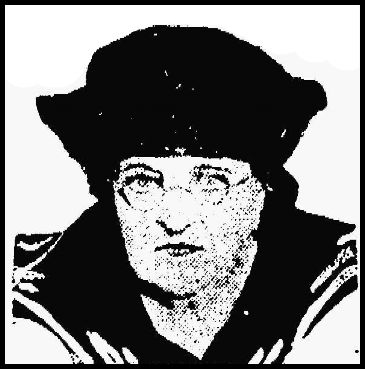
Ephraim Northcott, relative of the more infamous Gordon Northcott, perpetrator of the "Wineville Chicken Coop Murders," was the abortionist convicted in the March 7, 1919 abortion death of Red Cross nurse Inez Reed (pictured), whose body had been discovered dumped in a ravine. Northcott, at the age of 49, had opened a maternity home, intended to provide a cover for a business perpetrating abortions on more advanced pregnancies. This made him a promising person to approach -- though Inex didn't need to seek him out herself. Another doctor that she had approached about an abortion had referred her. Northcott was arrested on June 26, and found guilty of second-degree murder and sentenced to San Quentin.

The March 7, 1913 death of Edna Frederickson was tangled up in a tale of murder and intrigue. Edna was employed at a Chicago candy shop for $2 per week, and turned her wages over to her mother. Wanting to have some money for herself, and unhappy at home, Edna turned to a co-worker at the candy company, a married woman who went by the names of Lillie Dearborn and Kitty Young. Dearborn took Edna to the Dreamland Dance Hall, "and Edna soon began to earn more money." Evidently through a connection she made at Dreamland, Edna became pregnant. George Ringler Jr., who was responsible for Edna's pregnancy, was first sought aboard a steamer where he worked as a machinist, but for some unexplained reason he was not aboard when the ship sailed. A German newspaper clipping about Edna's death was found in the pocket of George Dietz, a murder victim. Also in Dietz's pocket was the business card of Dr. Eva Conheim. Eventually, Dietz's widow, Augusta, was implicated in his murder, and beyond the clipping and business card, no connection was ever made between Dietz and Edna.

On March 7, 1908, unmarried seamstress Nellie Shuff, age 26, of New Berlin, Illinois, died at Wesley Hospital in Chicago. The coroner's jury determined that she died from complications of an abortion that had been perpetrated at a home on Forest Avenue. Johanna White, whose profession was not given, was arrested, tried, and sentenced to Joliet for the death.

On April 15, 1880, medical student Vincent Height perpetrated an abortion on 20-year-old Mary Maber, who was a servant in the Peekskill, New York boarding house where Height lived. Height was believed to have been the father of Mary's baby. The abortion was committed in New York City, but did not have the desired effect, so Height set Mary up in room rented at the home of Mrs. Gaillard in Peekskill on April 20. Height visited with Mary on the 21st, and then returned on the 22nd and spent about 15 minutes alone with her. The next day, Mary took ill the next day, and continued to worsen over the weekend, taking to her bed on Monday, the 26th. Height visited Mary daily, bringing a minister to Mary's room on Thursday to marry the couple at Mary's bed, where she remained ailing, attended by Height, who had called in Dr. Snowden and Dr. Mason to consult regarding Mary's care. Mary languished for nearly a year, finally dying on March 7, 1881.

Antoinette Fennor died of peritonitis March 7, 1875, from an abortion perpetrated about February 26 by Mrs. Catherine Maxwell. Jennie Gale and John Betts were accessories. All three were arrested. Betts's sister-in-law testified that she had seen Antoinette at the hotel, but only twice had seen Betts even speak to her. She was seen, Mrs. Betts said, "in company with another gentleman." She denied any knowledge that her brother-in-law and Antoinette had "an intimacy." 

Wednesday, March 06, 2013

"Don't Put Yourself in the Hands of Quacks," and More Quackery Pre and Post Legalization

"Don't go out and put yourself in the hands of quacks, dear. There are plenty of places that don't care about women like we do."Betty EasonOwner, Dadeland  Family Planning Center 
Chatoor Bisal Singh did an abortion on 38-year-old Ellen Williams at Miami's notorious Dadeland abortion clinic on March 2, 1985. On March 4, Ellen returned, doubled over and rocking back and forth in pain. Dadeland owner Betty Eason gave her some tea, then called Singh, who arrived four hours later. Singh examined Ellen, then turned her over to Nabil Ghali, a known quack and sex offender, who performed a second D&C and sent Ellen home with a bottle of antibiotics. On March 5, Ellen was rushed by ambulance to Coral Reef Hospital, where she was rushed into surgery. She died in the intensive care unit on March 6. The autopsy revealed that she had uterine and bowel perforations, causing the peritonitis that killed her. Singh told the Miami Herald that he didn't usually work at Dadeland, but was "strapped for cash" and agreed to fill in for Robert Kast while he was away. Singh described himself as "not an abortionist, just an honest, easygoing guy looking for something temporary. After Ellen's death, Singh quit working at Dadeland, saying, "It was a bad month." It certainly was: the same day he'd performed the first abortion on Ellen Williams, Singh also did an abortion on a woman who afterward hemorrhaged and passed a portion of her fetus. When she returned with it to the clinic, staff told her it was "a blood clot," but a hospital later verified that it was a 16-week fetal head.

A 16-year-old girl underwent a safe and legal second-trimester saline abortion on August 26, 1969. A journal article on her death identifies her as "F.S." I'll call her "Felicia." Felicia developed an infection and symptoms of meningitis after her abortion. She continued to be treated for ten days before she was transferred to another hospital in San Francisco for further treatment. Doctors performed two heart valve replacements on Felicia, and had scheduled her for yet another before she died on March 6, 1970. The cause of death was severe congestive heart failure and pneumonia.

Beatrice Fern Fisher, age 36, lived about 17 miles from Seattle. In March of 1945, Beatrice informed her husband that she was pregnant, and that she intended to return to Seattle for an abortion to be performed by the woman who'd done a previous abortion for Beatrice. Her husband wasn't happy with the plan, but left the matter to his wife. On March 5, Beatrice took her four-year-old daughter, mother-in-law, and $100 in cash and drove to Seattle to seek her former physician. When they arrived at "Dr. T's" office, Dr. T was not available, but his nurse gave Beatrice the name of Dr. Frank C. Hart, along with the address of his office. Beatrice and her companions went to Hart's office, where she remained while her mother-in-law took the little girl shopping. Beatrice took sick on the way home, so they went to her in-laws' home so she could rest before going home. The following morning, Beatrice told her husband that she was returning to Dr. Hart to have "blood clots" removed. She took her daughter and mother-in-law with her again. Beatrice's mother-in-law told Hart that she was very concerned about Beatrice. Fisher told her, "This is no place for relations and children. Meet her downstairs in the lobby." Upon returning about 20 minutes later, the mother-in-law found a crowd gathered in the lobby. She approached the group and found Beatrice lying dead. Her uterine wall had been damaged, allowing a clot to work its way into Beatrice's lung, killing her. >On March 7, Hart was arrested. He showed authorities through his premises and gave instruments into evidence. He was convicted of abortion and manslaughter in Beatrice's death and died in prison in 1948.

During the 1940s, while abortion was still illegal, there was a massive drop in maternal mortality from abortion. The death toll fell from 1,407 in 1940, to 744 in 1945, to 263 in 1950. Most researches attribute this plunge to the development of blood transfusion techniques and the introduction of antibiotics. Learn more here.

external image MaternalMortality.gif

On March 6, 1928, Lucille Smith, a 24-year-old store clerk and homemaker, died at Chicago's Burrows Hospital from complications of an abortion performed that day at the office of midwife Emma Schulz. Schulz was indicted for felony murder on April 1, 1929. The following year, Schulz was arrested after the death of 23-year-old Gladys Schaffer. These deaths predate the development of the antibiotics and blood products that began saving lives in the upcoming decades.

Dr. C.W. Milliken was charged with performing a fatal abortion on Florence Cobb. Ohio records indicate that Florence died on March 6. It was a month for Milliken -- or, more to the point, for his patients. Iva Triplett died under his care on March 9.Milliken was held on $10,000 bail in each case, Iva's and Florence's. An earlier patient, 19-year-old Francis Karies, had died in Chicago in 1920 after undergoing an abortion at Milliken's Ohio practice.

Tuesday, March 05, 2013

Modern Anesthesia Mishap, Two Historic Deaths

Gwendolyn Cliett, age 29, was about to undergo a safe, legal abortion and tubal ligation at Presbyterian Hospital in Philadelphia on March 5, 1980. She was 8 to 10 weeks pregnant. Before the procedure could be done, Gwendolen reacted to the anesthesia and died.

On March 5, 1907, Mrs. Ella Brunswick, age 24, died at St. Elizabeth's hospital in Chicago from complications of a criminal abortion performed that day. In a deathbed statement, Ella implicated a 35-year-old midwife named Kunigundi Hardman.

On March 5, 1900, Mrs. Alice Koester died in German Hospital from complications of an illegal abortion evidently performed there that day by Maria Janke. Janke was arrested March 10, and held by Coroner's Jury on March 11. She was sentenced by Judge Clifford to Joliet Penitentiary. Janke's employment status is listed as "professional", but nothing more specific is indicated to clarify why she would be performing an illegal abortion in a hospital.

Note, please, that with overall public health issues such as doctors not using proper aseptic techniques, lack of access to blood transfusions and antibiotics, and overall poor health to begin with, there was likely little difference between the performance of a legal abortion and illegal practice, and the aftercare for either type of abortion was probably equally unlikely to do the woman much, if any, good. For more about abortion and abortion deaths in the first years of the 20th century, see Abortion Deaths 1900-1909.

Monday, March 04, 2013

Pet Peeve: Pro-Lifers Going Nuts Over Every Ambulance

I'm not going to post links to any specific stories because I don't want to encourage people who do this.

Pro-lifers really need to stop treating it as a breaking news story every time an ambulance pulls up to an abortion facility.

Calling an ambulance is not a sign of quackery. Trust me. I've been an EMT.

1. The person being loaded into the ambulance might not be a patient. People -- often elderly abortionists -- work at abortion facilities. Patients are accompanied by friends and/or family members. Even if the person on the gurney is a young woman, she might still be a staff member or somebody who accompanied a patient.

2. The person being loaded into the ambulance might not be all that seriously sick or injured. Doctors will often send a patient (who might not be an abortion patient; see #1) to the hospital by ambulance as a precaution if symptoms indicate that there might be a problem that the facility is ill-equipped to deal with.

3. An ambulance-worthy patient situation might not be the facility's fault. Women have shown up for abortions with some serious pre-existing conditions. There was a case in I believe Mississippi in which a woman showed up in an advanced state of pregnancy with symptoms of pre-eclampsia. The facility in question gave her RU-486 and sent her home. The responsible thing to do would have been to immediately call an ambulance -- which would have sent the prolifers into a tizzy of speculation and accusations of malpractice even though it would have just been the facility dealing appropriately with a pre-existing condition. A woman might also develop a complication that is an inherent risk of abortion or anesthesia for which calling an ambulance is totally appropriate.

Calling an ambulance is not a sign of quackery, or a sign that the facility is dangerous, or even that a woman has necessarily suffered an abortion complication. It could simply be a sign that the facility is simply following responsible protocols should a patient be in danger at any point, be it during the initial physical examination, during the abortion, or while in recovery. Yes, we'd prefer that they not be doing abortions. But it's not a sign that they're doing them carelessly if they call an ambulance just to be on the safe side.

So when that ambulance pulls up, by all means document the situation. But wait until you know what's going on before concluding that the staff had screwed up. And remember that we are to praise whatever is praiseworthy. If it turns out that Acme Reproductive Services called an ambulance because the patient Dr. Quacksalot sent to them actually has an ectopic pregnancy that is ready to rupture, they should be praised for doing right for that patient, not raked over the coals for suspected quackery.

Sunday, March 03, 2013

Abortion Deaths: Who Benefitted from Legalization?

Sixteen-year-old Patricia Chacon underwent a safe and legal second-trimester abortion at the hands of either Edward Allred or Leslie Orleans at Allred's Avalon Hospital in Los Angeles on the morning of March 3, 1984. Patricia retained fetal tissues, so she was scheduled for a second procedure that afternoon to complete the abortion. Allred claimed that Patricia died of an embolism during the second surgery.  Patricia's parents claim that the child bled to death while left unattended.An autopsy found numerous catgut sutures in Patricia's vagina and hemorrhage in her uterus. Death was attributed to disseminated intravascular coagulopathy (a clotting disorder) due to abortion-induced amniotic fluid embolism (amniotic fluid in the bloodstream). Patricia's parents sued Allred and Orleans for their daughter's death.Avalon Hospital was part of Edward Allred's Family Planning Associates Medical Group, a National Abortion Federation member facility. Patricia is one of many women to die at one of Edward Allred's facilities. Others known to have died after abortion at Allred's facilities include Denise Holmes, Mary Pena, Josefina Garcia, Laniece Dorsey, Joyce Ortenzio, Tami Suematsu, Susan Levy, Deanna Bell, Christine Mora, Ta Tanisha Wesson, Nakia Jorden, Maria Leho, Kimberly Neil, Maria Rodriguez, and Chanelle Bryant.

While we know much about Family Planning Associates Medical Group, I have been unable to uncover much about Dr. James R. Struble, who was indicted in Chicago for the March 3, 1916 abortion death of 43-year-old Augusta Bloom. Augusta had been taken to Norwegian Deaconess Hospital but in spite of the care she received there she died of septic peritonitis.  Two years earlier, Struble had been implicated in the abortion death of 24-year-old Frances Fergus.

I am unable to see how Patricia, Denise, Mary, Josefina, Laniece, Joyce, Tami, Susan, Deanna, Christine, Ta Tanisha, Nakia, Maria Leho, Kimberly, Maria Rodriguez, and Chanelle fared any better than did Augusta and Frances, though Allred and Orleans certainly fared better than Struble, since there was no threat of prison for them.

Saturday, March 02, 2013

A Chicago Death from the Early 20th Century

On March 1, 1919, 22-year-old Jeanette Ruff died in her Chicago home from an abortion performed by an unknown perpetrator.

Note, please, that with overall public health issues such as doctors not using proper aseptic techniques, lack of access to blood transfusions and antibiotics, and overall poor health to begin with, there was likely little difference between the performance of a legal abortion and illegal practice, and the aftercare for either type of abortion was probably equally unlikely to do the woman much, if any, good. In fact, due to improvements in addressing these problems, maternal mortality in general (and abortion mortality with it) fell dramatically in the 20th Century, decades before Roe vs. Wade legalized abortion across America.

For more information about early 20th Century abortion mortality, see Abortion Deaths 1910-1919.

external image MaternalMortality.gif

What Advantage to Dying from a Safe, Legal Abortion?

Jammie Garcia, age 15, underwent a safe, legal abortion performed by John Coleman at Mosche Hachamovitch's A to Z abortion facility on February 18, 1994. Four days later she was admitted to the Intensive Care Unit of a Houston hospital, with spiking fever, chills, nausea, pain, respiratory distress, a distended abdomen, low blood oxygen levels, and foul-smelling discharge. Her condition deteriorated until her death on March 2. The autopsy found that Jammie's body was wracked with abscesses, spreading infection that had entered her body through the damage the abortion had done to her uterus. After Jammie's death, the state inspected A to Z.  Staff were inadequately trained in how to sterilize instruments. The administrator was evidently aware that the autoclave used to sterilize instruments was not functioning properly. As for the instruments themselves, they were dirty and in poor condition. Legalization, and the promise of state oversight, had done nothing to ensure that Jammie would never be subjected to an unsafe abortion. As for Hachamovitch, I know that at least six abortion patients are known to have died either under Hachamovitch's direct care or under the care of an employe at one of his clinics. Tanya Williamson was inadequately monitored in recovery and allowed to lapse into respiratory arrest. Luz Rodriguez bled to death in 1986. Christina Goesswein was brought her to Hachamovitch's office at 4 a.m. to treat grave complications. Lisa Bardsley bled to death on the way home from her safe, legal abortion at one of Hachamovitch's facilities in Arizona. Lou Anne Herron's pleas for help went unheeded as she bled to death in Hachamovitch's Arizona abortion clinic.

Sixteen-year-old Erica Richardson was brought to Dr. Gene Crawford by her aunt on March 1, 1989 for a safe, legal abortion. Erica's aunt reported that Crawford left the girl unattended for four hours after her abortion, then at 11PM carried her to the car and instructed her aunt to take her home.Erica's aunt, a nurse, instead took the girl to a hospital. Erica died of an embolism (foreign matter or air in the bloodstream) shortly after midnight on March 2.Erica's mother had not known that her daughter was going to have an abortion. I can only imagine the family and personal turmoil caused by this deadly secret.

Elizabeth Tsuji, a 21-year-old Cal State student, underwent a safe and legal 8-week abortion at a Planned Parenthood on November 11, 1977. She called the clinic in December to report that she was still not menstruating, but staff assured her that the abortion had been successful. On February 1, 1978, Elizabeth confirmed that she was indeed still pregnant, five months along. The Planned Parenthood clinic referred her to Inglewood General Hospital for a saline abortion. That evening, she packed a nightgown and told her family she was going to spend the night at a friend's house. That was the last time they saw her alive. Elizabeth underwent the abortion on February 2, and died that day. Two autopsies were performed, neither of which could find a definitive cause of the young woman's death. Abortionist Morton Barke was somehow involved, although documents aren't clear what his role was. Barke also worked at the unsavory San Vicente Hospital. He is known to have been a partner at Inglewood and to have been involved in the deaths of Yvonne Tanner and Lynette Wallace. Other women who met their deaths at Inglewood include Kathy Murphy, Cora Lewis, and Belinda Byrd.

I am very curious as to the advantage Jammie, Tanya, Luz, Christina, Lisa, Lou Anne, Erica, Elizabeth, Yvonne, Lynette, Kathy, Cora, and Belinda had over the supposedly less fortunate women who preceded them in death.

On Saturday, February 16, 1918, Nikola Wojnovvich said, his 26-year-old wife, Mary, seemed unwell after dinner, very unstable on her feet. Nikola asked her what was wrong, and she said that perhaps she had caught cold. She asked him to help her to bed. He sent for Dr. Zabaranko, who examined her and prescribed some medication.Over the ensuing days, Mary's condition continued to worsen, so on February 21, Zabaranko sent her to  Pittsburgh's South Side Hospital, where Dr. S. A. Beddall admitted her for treatment for “incomplete abortion and pelvic peritonitis due to self inflicted abortion at home 2 weeks ago.”After Mary's death, at about 2:00 on the morning of Saturday, March 2, Dr. Henry Klinzing jotted a note to the coroner on a prescription pad saying that Mary, a homemaker and Croatian immigrant, had made a deathbed statement to him on March 1, saying “she inserted a stick of wood into the uterus to bring on menstruation feeling she was pregnant. From this she developed a pelvic peritonitis and subsequently a septic pneumonia from which she died.”

On March 2, 1914, 32-year-old Hannah Olson, a homemaker, died in Chicago, on the scene of an abortion performed that day by an unknown perpetrator.

Abortionist Lucy "Louise" Hagenow
On March 2, 1906, Miss Lola Madison, a stenographer from Salt Lake City, Utah, died from an abortion at Passavant Hospital in Chicago. She was 28 years old. Lola had gone to Chicago on the advice of a friend and made straight for Lucy Hagenow's practice, where she remained for several days. Somehow, her sister learned where Lola was and went to check on her. She found Lola seriously ill, and had her brought to the hospital before notifying the police. The building where Lola said she had her abortion was Hagenow's medical practice. A police officer took  Hagenow to Lola's hospital room on the afternoon of February 20. He asked Lola, "Do you know this woman?" To which Lola replied, "Oh, yes, that is the doctor." Hagenow was arrested and held by the coroner's jury March 3. Because of technical issues with the indictment, the case was dropped on July 22, 1907. Hagenow, who had already been implicated of the abortion deaths of Louise Derchow, Annie Dorris, Abbia Richards, and Emma Dep in San Francisco, would go on to be linked to over a dozen Chicago abortion deaths, including: Hannah Carlson, Sophia Kuhn , Emily Anderson, Marie Hecht, May Putnam, Annie Horvatich, Lottie Lowy, Nina H. Pierce, Jean Cohen, Bridget Masterson, Elizabeth Welter, and Mary Moorehead. Clearly the authorities were not taking sufficient action to keep this dangerous abortionist away from the women she victimized; abortion-related bribery was exposed all over the city of Chicago and might explain Hagenow's ability to remain free for most of the years of her adult life.

Note, please, that with overall public health issues such as doctors not using proper aseptic techniques, lack of access to blood transfusions and antibiotics, and overall poor health to begin with, there was likely little difference between the performance of a legal abortion and illegal practice, and the aftercare for either type of abortion was probably equally unlikely to do the woman much, if any, good. In fact, due to improvements in addressing these problems, maternal mortality in general (and abortion mortality with it) fell dramatically in the 20th Century, decades before Roe vs. Wade legalized abortion across America.


For more on pre-legalization abortion, see The Bad Old Days of Abortion

Thursday, February 28, 2013

Your Tax Dollars at Work and Other Abortion Deaths

Diana and her children
Diana Lopez, age 25, was 19 weeks pregnant when she went to a Planned Parenthood for a safe and legal abortion on February 28, 2002. Before the day was over, Diana had bled to death. She left two sons, 4-year-old Frankie and 2-year-old Fabian, motherless. The taxpayers of California paid for the fatal abortion, courtesy of Medi-Cal. After the abortion, Diana had been rushed by ambulance to County Women‘s Hospital, where a hysterectomy was performed and Diana was given five units of whole blood in a futile attempt to save her life. Diana‘s autopsy noted that Diana had hemorrhaged from a perforation of her cervix. A lawsuit filed by Diana's widower says that Diana‘s abortion was rushed through in only six minutes, although Planned Parenthood‘s own web site says such a procedure should take 10 to 20 minutes.
Abortionist Maltzer
The family‘s attorney also noted that in 2000, the same Planned Parenthood rushed another woman though a similar 6-minute abortion, lacerating the patient‘s cervix, rupturing her uterus, perforating her sigmoid colon and causing the loss of 2 liters of blood. Planned Parenthood also delayed three hours before transferring the patient to a hospital. Fortunately, this patient survived her ordeal. The medical board took no action against Diana‘s abortionist, Dr. Mark Maltzer, either. However, the California Department of Health Services investigated the facility and cited Planned Parenthood for a variety of violations including keeping incomplete records, not reporting adverse outcomes, and not following their own policies for administering medications.The fact that the Planned Parenthood has made "corrections" to satisfy the state does not satisfy Diana‘s family. "It was wrong. It was wrong," said Judy Lopez, Diana‘s older sister. "She was healthy. She was fine."

Andrea Corey was 31 years old when she was referred by nearby Planned Parenthood to Southern Tier Women's Services in New York for a safe and legal abortion. Andrea, who worked as a secretary and bookkeeper, was sent home after her abortion, but she had retained tissue that caused clostridium perfringens septicemia ("gas gangrene"). She died at Rutland Regional Medical Center on February 28, 1993.

Human Life International mentions that abortionist Angel Acevado Montalvo was charged with manslaughter in two cases of maternal deaths from safe and legal abortion, including the February 28, 1992 death of Diane Adams. The other death was of of Rosael Rodriguez.

On Monday, January 6, 1930, "Mike" brought 17-year-old "Eudroa" from Wellinton, Kansas, to Wichita to seek an abortion at the hands of Dr. Charles C. Keester. They knew his name and looked him up in the phone book to find him. The couple told Keester that the girl was pregnant and wanted "an operation to get rid of the condition." Keester put her in some sort of reclining exam chair and examined her, then used instruments on her as Mike stood at her head and observed. Keester then helped Eudora from the chair and sent the couple to a hotel half a block away, where Keester kept his patients -- much the same way late-term abortion doctors currently keep their patients in motels. Mike paid $40 in cash and took Eudora to the hotel, where they registered as a married couple. On the 9th, Mike tried to contact Keester because Eudora was unwell, much as Jennifer Marbelli's family had been unable to reach LeRoy Carhart when she was ailing after her abortion. Mike wasn't able to reach Keester until January 10, when he went to the hotel, examined Eudora, and used some instruments to treat her. On Saturday, Eudora seemed better. On Sunday at about 2:30, Keester visited the hotel and said that Eudora was well enough to go home. Mike took Eudora to his mother's home in Wellington, telling her about the abortion. On Monday night, Eudora took ill. Mike told Eudora's sister what had happened, and the family summoned Dr. McGrew, who examined Eudora and recommended that she be taken to a hospital. She was admitted the next morning, January 14. She was suffering peritonitis. Dr. Van Deventer was summoned on January 23, and he and McGrew examined Eudora. They found her in grave shape, and summoned Dr. Snyder. Snyder performed surgery on January 31, with Dr. McGrew assisting with anesthesia, to try to save Eudora's life. McGrew testified later that Eudora's abdomen had been full of abscesses. Eudora's condition continued to deteriorate. On February 4, she was given a blood transfusion. On the evening of Feb 5 or 6, she asked everybody but her stepmother to leave the room. She said, "Mother, I am going to die. What Dr. Keester did to me is going to kill me." She then told of the trip to Wichita and the abortion. On February 12 Eudora became irrational, but she continued to linger until her death on February 28. Keester was convicted of manslaughter in Eudora's death, and his appeal was denied. UPDATE: I have since identified Eudora as Rena Armstrong.

On February 28, 1918, 27-year-old Mrs. Catherine Lurandowski died at Chicago's County Hospital from an abortion perpetrated by Katerine Eichenberg on November 20 of 1917.Eichenberg, whose profession is given only as "abortion provider", was also noted as "known to police" and operating sometimes under the alias of Ekowski.

On February 28, 1914, 23-year-old homemaker Martha Kwasek died at St. Elizabeth Hospital in Chicago from septicemia caused by an abortion performed by an unknown perpetrator.


Wednesday, February 27, 2013

Two Deaths Before Roe

"Roseanne" is one of the women Life Dynamics identifies on their "Blackmun Wall" as having been killed by a safe and legal abortion. Roseanne was in the second trimester of pregnancy when she chose safe and legal abortion, permissible under New York's liberalized abortion law, in 1971. She was 37 years old, had had four children. She was infused with saline for the abortion. Two days later, she began vomiting and having siezures. She aspirated some of the vomit and developed pneumonia. The pneumonia took its toll. Roseanne died on February 27 from the pneumonia and anoxic brain damage.

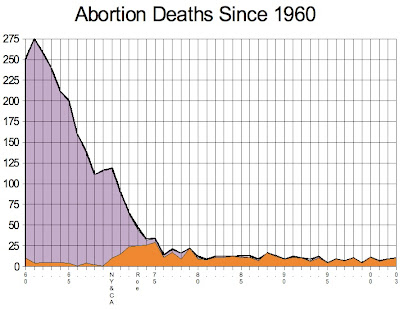
As you can see from the graph below, abortion deaths were falling dramatically before legalization. This steep fall had been in place for decades. To argue that legalization lowered abortion mortality simply isn't supported by the data.

external image Abortion+Deaths+Since+1960.jpg

On February 27, 1926, 36-year-old Anna Wilger died in her home from complications of an abortion performed that day.Theresa Struhala was indicted for felony murder in Anna's death. Struhala's profession is not listed, but she was on the 1920 census as a midwife. John Wilger, whose relationship to Anna was not disclosed, was booked as an accomplice, but was later released.

Tuesday, February 26, 2013

Deaths from the 1920s

On February 6, 1924, Ida Cantor performed an abortion on Wanda Szidzewicz. Wanda developed septicemia after the abortion, and went to a Massachusetts hospital on February 11. She was treated there until her death on February 26. The jury found that Cantor used improperly sterilized instruments in the abortion. A key part of the prosecution's case was a deathbed statement by the injured woman.

Dr. Richard Thacker
Marie Epperson, just 19 years old, was an early victim of Oklahoma City abortionists J.W. Elsiminger and Richard E. Thacker. Marie died February 26, 1929. Her brother had told authorities about the abortion. The doctors lay low for a while, then were implicated, sometimes together and sometimes singly, in a total of eight abortion deaths, most of them taking place in the spring of 1932: Isobel F. Ferguson (Elsiminger and Thacker), Ruth Hall (Elsiminger and Thacker), Virginia Lee Wyckoff (Eisiminger), Lennis May Roach (Elsiminger and Thacker), Nancy Joe Lee (Thacker), Robbie Lou Thompson (Thacker).

Monday, February 25, 2013

A "Trunk Mystery" and Two Other Criminal Deaths

On February 25, 1918, 34-year-old homemaker Mary Mayer died at Presbyterian Hospital in Pittsburgh.
The coroner found that she had died of septicemia following a self-induced abortion.

Dr. Lillian Hobbs (pictured) was convicted of murder in the 1916 abortion death of 21-year-old Alda Christopherson. The testimony of John K. McDonald, who was granted immunity in exchange, was crucial in the case. He was the father of Alda's aborted baby. Depending on whose testimony you believe, the whole sordid story began either on February 21, or six weeks earlier. All testimony agreed that Alda and John had visited Hobbs' practice. John insisted that Hobbs had perpetrated the fatal abortion. Hobbs, a known abortionist, insisted that she'd merely been treating Alda for complications of an abortion she'd attempted to perform on herself with a button hook.  Between Alda's death and the trial, Hobbs had been indicted for the 1917 abortion death of Ellen Matson. The jury evidently thought that Hobbs' story didn't hold water, since they found her guilty and she was sentenced to 14 years in prison. She appealed, protesting that it was inappropriate to bring up the death of Ellen Matson as evidence of her practice as a criminal abortionist, since Ellen died nearly two years after Alda's death and thus her abortion wasn't evidence of prior criminal behavior. The appeal succeeded. The conviction was overturned and a new trial ordered. However, Hobbs' conviction and sentencing for Ellen Matson's death rendered this rather a moot point. Hobbs was also implicated, but never tried, for the 1917 abortion death of Ruth Lemaire.

Jennie Clark's body was found stuffed into a trunk in Lynn, Massachusetts on February 27, 1879. The trunk, lodged in shallow, icy water, was weighted down with several bricks and two empty champagne bottles. Dr. Caroline C. Goodrich, a Boston woman, was arrested as the abortionist. Dr. Daniel F. Kimball, who lived in the same house, was arrested as an accessory. Mr. Allen N. Adams, at whose house Jennie lived and worked as a servant, was arrested as secondary accessory, as were a mother and daughter living in the house where Jennie had died. Adams was said to be the person who arranged the fatal abortion. An investigation indicated that on February 12, 1879, Jennie left her home in the Highlands. She was seen shortly thereafter going into the home of Dr. Goodrich. The abortion was evidently perpetrated at Goodrich's practice. Jennie left on February 15 and went to the home where the mother and daughter cared for her. She delivered her dead fetus and seemed to be on the mend. She took a sudden turn for the worse and died on February 25. The guilty parties packed up the body into the trunk and dumped it.

Two Early 20th Century Chicago Deaths

Today's anniversaries have this much in common: They died in Chicago hospitals, and very little information is available regarding these tragedies.

On February 9, 1913, 30-year-old milliner Elizabeth Spalding died at Rhodes Avenue Hospital in Chicago of septicemia caused by an abortion perpetrated that day by midwife Caroline Sandberg. Sandberg was tried but acquitted on July 9.

On February 24, 1919, 37-year-old homemaker Thea Newman died at Chicago's Norwegian American Hospital after an abortion perpetrated by a person whose identify was never revealed.

Note, please, that with overall public health issues such as doctors not using proper aseptic techniques, lack of access to blood transfusions and antibiotics, and overall poor health to begin with, there was likely little difference between the performance of a legal abortion and illegal practice, and the aftercare for either type of abortion was probably equally unlikely to do the woman much, if any, good.

In fact, due to improvements in addressing these problems, maternal mortality in general (and abortion mortality with it) fell dramatically in the 20th Century, decades before Roe vs. Wade legalized abortion across America.

For more information about early 20th Century abortion mortality, see Abortion Deaths 1910-1919.

external image MaternalMortality.gif

Sunday, February 24, 2013

New Bride Dead at Doctor Husband's Hands and Three Other Pre-Legalization Deaths

On February 14, 1943, Amelia Cardito, 34-year-old mother of 4, underwent an illegal abortion at the office of Dr. Anthony Renda. Amelia died nine days later in a New York hospital. Renda, author of three books on obstetrics, may have been a smart doctor, but he was a stupid crook. He implicated himself when he called police to complain that Amelia's widower, James, was shaking him down for $2,500 to cover hospital and funeral expenses. Police were able to observe Renda paying Cardito $1,000. Cardito didn't face any extortion charges, but Renda was sentenced to 7 years in Sing-Sing for Amelia's death. Amelia's abortion was typical of pre-legalization abortions in that it was performed by a physician.

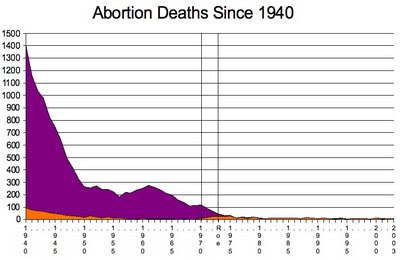
During the 1940s, while abortion was still illegal, there was a massive drop in maternal mortality from abortion. The death toll fell from 1,407 in 1940, to 744 in 1945, to 263 in 1950. Most researches attribute this plunge to the development of blood transfusion techniques and the introduction of antibiotics. Learn more here.
external image Abortion+Deaths+Since+1940.jpg


On February 23, 1928, 26-year-old waitress Martha Watson, a Wisconsin native, died in Chicago from an illegal abortion. The person or persons responsible were never identified or prosecuted.

On February 23, 1917, 28-year-old Miss Bertha Dombrowski, who worked as a maid, died at Chicago's Garfield Park Hospital from a uterine perforation caused by an abortion performed by an unknown perpetrator.

Newlywed Helen Long died at her Chicago  home on February 23, 1916. Two doctors who had been providing care to her contacted the police. It seems that Helen and her husband, physician Lester Long, were dismayed by gossip about Helen's premature baby bump, so Lester had made three attempts to ward off the impending embarrassment, getting rid of the baby but also killing his wife. News coverage painted a pathetic picture of the young man, so distraught at his wife's death that it took the police five minutes to calm him down enough to tell him he was under arrest. He reportedly was seen while in jail pacing his cell, weeping and crying out, "Can she live? Can she live?" Lester was held by the Coroner and indicted by a Grand Jury on March 15, but the case never went to trial.

Note, please, that with overall public health issues such as doctors not using proper aseptic techniques, lack of access to blood transfusions and antibiotics, and overall poor health to begin with, there was likely little difference between the performance of a legal abortion and illegal practice, and the aftercare for either type of abortion was probably equally unlikely to do the woman much, if any, good. For more information about early 20th Century abortion mortality, see Abortion Deaths 1910-1919.

Friday, February 22, 2013

A Typical Pre-Legalization Death

On February 21, 1929, 26-year-old Virginia Clark died of complications of a botched, illegal abortion. G. W. Wilbanks and W. A. N. Jones were charged with murder in her death. Wilbanks was convicted of involuntary manslaughter, and the following information comes from the Westlaw commentary on his appeal.

Virginia was treated prior to her death by a Dr. McArthur, who testified as to her dying declaration. He said that Virginia told him that when she learned that she was pregnant, she told the man responsible that "something would have to done about it." He made arrangements for an abortion to be performed by a doctor. The paramour brought the doctor to Virginia, and he used medicine and instruments on her. The procedure was so painful that Virginia asked him to stop, so the doctor administered chloroform. According to Dr. McArthur, Virginia told him that this abortion "was what had butchered her up and was killing her."

Virginia didn't tell her mother, Mrs. Goodwyne, about the abortion. Mrs. Goodwyne testified, "She (Virginia Clark) said that she went to the theatre [in Atlanta] or something, and it seemed like there was something broke, and she said she thought she wouldn't be able to get back to the hotel, but she did."

Wilbanks tried to get his conviction overturned on the grounds of the difference between what Virginia told her mother, and what she told Dr. McArthur as she lay dying.

Virginia's abortion was typical of illegal abortions in that it was performed by a physician.

external image Illegals.png

Thursday, February 21, 2013

A Confession about Carhart and Jennifer Morbelli

I had a conversation with a friend many years ago. He said he wasn't going to be able to leave town for a while because he had jury duty and was stuck at the courthouse every day "until we convict this guy."

I scolded him. "You haven't even heard all the evidence yet! How can you have made up your mind?"

Eddie told me, "The dude is unemployed. He's been unemployed for years. But he's sitting there in a $500 suit and $300 shoes and a $700 watch. He didn't buy those with unemployment checks. Of course the dude is dealing drugs!"

"But," I said, "Your job isn't to conclude that he's a drug dealer. Your job isn't to determine that in general he's just a guilty guy. It's to determine whether or not he committed the particular offense being brought before you."

Candid outdoor shot of an overweight middle-aged man with his hair going white in the front. He is wearing a suit and tie.
When I heard of Jennifer Morbelli's death, I was like my friend looking at the defendant in that courtroom. Of course LeRoy Carhart is guilty! The question is, "Guilty of what?" 

I have to be honest. I was crushed when the medical examiner found Jennifer Morbelli's cause of death to be amniotic fluid embolism (AFE) and disseminated intravascular coagulopathy (DIC). AFE is rare, almost impossible to see coming, and stunningly lethal even with the best of care.

It wasn't what I wanted the medical examiner to find.

I wanted the medical examiner to find something more in keeping with all the nasty things abortionists have been caught doing -- something so glaringly appalling that there would be no making excuses any longer. I wanted desperately for the medical examiner to find a smoking gun, something that could be held up before the world as proof that the abortion glitteratzi don't vet their heroes beyond, "Hey, he does late abortions and says all the right things about why."

But the cause of death was AFE/DIC. It's possible, therefore, that the abortion lobby's perception is, in this case, correct -- that (conceding that he meant well in doing the abortion) Carhart did nothing wrong. And there's something wrong in me in that I hate that.

I leaped onto the story with both feet, ready to slam Carhart with blame, ready to assume he'd been spectacularly incompetent and/or negligent. And I'm pissed off.  I'm like my friend in the courtroom looking at that perp. Come on! Look at the guy! He's clearly guilty!

What the hell is wrong with me, that a lack of spectacular incompetence and/or negligence is a source of disappointment?

I feel like I have too much in common with the vultures who perched waiting until Rosie Jimenez died. Just waiting for a corpse I could hang around the necks of the evil-doers. Waiting for a chance to pounce and scream, "SEE? This is what you people do! You KILL WOMEN!"

And I'm running away from being angry with myself. I don't want to be angry with myself. I don't want to remind myself to think the best of people and to start with the assumption that Jennifer had just been a victim of the truth that all surgery has risks. That would involve .. I can't even make myself say "Thinking the best of Carhart." I don't want to have a single positive thought about Carhart.

I'm embarrassed and ashamed of how eagerly I wanted to just slam Carhart. I was more invested in wanting to smack down Carhart's admirers than I was in finding out the truth.

I wanted so badly for this to break trust between Carhart and his supporters. Instead it made us seem even less trustworthy.

Part of me still screams out, "It's unfair! They don't vet their heroes." I'm outraged that their faith in him appears vindicated. That our distrust of him appears utterly baseless.

I'm pissed off that facts and truth seem to be so much at odds here. How can facts ever allow that man to come out smelling like roses? I feel betrayed. I feel like I was set up -- even as I know that I walked into it all of my own free will rather than waiting for all the facts to come out.

So here I sit, simultaneously ashamed and outraged. Ashamed that I wanted him to have done wrong, rather than being relieved that -- in this case at least -- he evidently didn't. And hey, maybe he cleaned up his act! Maybe Christin Gilbert's death made him decide to be more careful in the future. Wouldn't that be a good thing? Shouldn't I be happy?

Yet I'm not. I seem to have Carhart Derangement Syndrome.Just like the liberals who don't want to believe a single non-hideous thing about George W. Bush or Sarah Palin, I don't want to believe a single non-hideous thing about LeRoy Carhart.

I'm so at war with myself here it's not funny.

I'd like to conclude with wisdom, to say that I've learned the error of my ways and will be more careful to vet my conclusions in the future. Which (I hope) I will. I've done it in other situations. Why should it be so hard to do it in situations where the abortionist is somebody that I hold a special grudge against, and who is a particular darling of the abortion lobby?

I'd be so much more credible, after all, if I consistently said, "Okay, we know that a woman died, but let's remember we don't have all the facts yet. Maybe she died of food poisoning or  bee sting or something."

At any rate, pray for me.


Wednesday, February 20, 2013

Abortion Deaths: What Has Changed?

When 23-year-old Stacy Ruckman had just gotten a new job when she went to Scott Barrett for a safe and legal abortion on February 20, 1988. Unfortunately, she didn't know how he anesthetized his patients at Central Health Center for Women in Springfield, Missouri. Barrett had developed the technique of deliberately overdosing his patients with lidocaine, a local anesthetic, in order to effectively render them unconscious. From time to time, Barrett's assistants said, a woman would stop breathing, but Barrett would be able to resuscitate her. He failed in Stacy's case. Her father requested an autopsy, which found toxic concentrations of Lidocaine in Stacy's blood. An expert who testified later estimated that, based on how fast the body metabolizes Lidocaine, the amount in her system at the time of the abortion could have been as high as 16 ug/ml, over ten times the therapeutic dose.

On February 20, 1927, 23-year-old Angenita Hargarten died in her home from an abortion performed there that day. Midwives Anna Trezek and Frances Raz were held by the coroner, Trezek as the principal and Raz as her accomplice.

Ada Williams, about 27 years old, was living in Denver in early 1916 when she got a letter from her mother in Nebraska. Nearly 50, Ada's mother was going to give birth soon and feared that she might die in childbirth, so she asked Ada to come to her. Ada, pregnant herself, decided to have an abortion before she left in order to facilitate the journey. With her husband, Thomas, she went to Dr. Noble O. Hamilton (pictured) for the abortion. Over the course of several days she sickened, finally taking to her bed, where she labored and delivered a dead three-month fetus. She sent for Hamilton, who wrapped the dead baby in paper and burned it in the stove. He gave aftercare instructions and left. As Ada's condition deteriorated, Hamilton called in another doctor but at kept the abortion a secret from him. This second doctor got Ada to tell him the truth. He admitted her to a hospital, where she died of sepsis the evening of Sunday, February 20. When convicted and sentenced to ten to eleven years, Hamilton swore his innocence.

The Homicide in Chicago Interactive Database indicates that on February 20, 1916, 19-year-old Bertha Carlson died at South Park Hospital in Chicago from complications of a criminal abortion.

Mrs. Ida Prochnow, a 35-year-old German-born homemaker, died in St. Elizabeth's Hospital in Chicago on February 19, 1906, from septicemia caused by an abortion performed earlier that day. Midwife Maggie or Madaline Motgna was arrested in the death.

Note, please, that with overall public health issues such as doctors not using proper aseptic techniques, lack of access to blood transfusions and antibiotics, and overall poor health to begin with, there was likely little difference between the performance of a legal abortion and illegal practice, and the aftercare for either type of abortion was probably equally unlikely to do the woman much, if any, good. In fact, due to improvements in addressing these problems, maternal mortality in general (and abortion mortality with it) fell dramatically in the 20th Century, decades before Roe vs. Wade legalized abortion across America.

external image MaternalMortality.gif
An inquest was held in the February 20, 1856 death of Catharine DeBreuxal. A witness testified that Catharine suffered "a violent hemorrhage" at Dr. Cobel's house, where she had remained for a few days. The medical examiner concluded that Catharine had died from an infection. "An effort was made by the defense to show that the deceased was a woman's bad character; but the evidence on that point was not admitted on account of its irrevalence." The coroner's jury called for the arrest of Cobel, as well as of Francis Legoupil, as an accessory.

Tuesday, February 19, 2013

Legal and Illegal, Sixty Years Apart

Magnolia Thomas was a 35-year-old mother of two when she went to Hedd Surgi-Center in Chicago for a safe, legal abortion, performed by Rudolph Moragne on February 19, 1986. Moragne failed to note that the fetus was growing in Magnolia's fallopian tube, rather than in her uterus. After Magnolia was discharged from the clinic, the undiagnosed ectopic pregnancy ruptured, and Magnolia was rushed to the hospital. There, doctors did everything they could to save her, but she died from blood loss and shock on February 19, 1986. Another patient, Diane Watson, died of anesthesia compliations after she'd undergone a safe, legal abortion by Moragne at Hedd.

On February 19, 1916, homemaker Mary Peckman, age 24, died in Chicago from complications of a criminal abortion. She refused to name her killer.

Monday, February 18, 2013

Three Historic Criminal Deaths

On February 18, 1916, Mrs. Beulah Hatch, age 24, died at Mercy Hospital in Denver. Dr. Bennett Graff, already out on bond while awaiting trial for the February 2 abortion death of Ruth Camp, was believed to have perpetrated the abortion that likely killed Beulah. Both women, in fact, were in Mercy Hospital at the same time, which means that Beulah's abortion must have been perpetrated prior to Ruth's death.

At about 2:00 p.m. on February 18, 1883, Kittie O'Toole died at the office of Dr. C. H. Orton in Milwaukee. Ortin was convicted of double murder -- of Kittie and of her unborn baby -- for having perpetrated the fatal abortion.

In August of 1859, the two Calkins sisters, age 16 and 18, moved to Brooklyn to live in the boarding house of Mrs. Young. The elder, Cordelia Calkins, took up with the landlady's son, Charles, "which resulted in the girl's ruin and death." In mid February, 1860, Cordelia discovered that she was pregnant, and prevailed upon Charles to help arrange an abortion. Charles asked his brother William to buy a bottle of oil of tansy. Cordelia started a regimen of the tansy, while Charles made "other efforts of abortion", which succeeded in making her very sick. "For several days she was confined to her bed, suffering the most intense physical pain." Cordelia's condition continued to deteriorate. Dr. H.W. Fowler, who had an office nearby, was summoned. He found out about the abortion attempt and administered witch-hazel and ginger tea to finish off the abortion, thinking that this would save Cordelia's life. "The decoction, however, while it added to her sufferings, did not answer the purpose for which it had been administered, and after lingering in great agony till Sunday afternoon, death came to her release." Don't blame the legal status of abortion for Cordelia's decision to go herbal -- some women continue to embrace herbal abortion. (DO NOT TRY THIS AT HOME!)

Sunday, February 17, 2013

Four Criminal Deaths, 1890 - 1239

On February 16, 1929, Mrs. Ruth Weir, of East Orange, New Jersey, died at Orange Memorial Hospital of sepsis contracted through a criminal abortion. Dr. Maurice Sturm was arrested when Ruth implicated him in a deathbed statement. Sturm admitted to performing the abortion, but insisted that it had not been illegal because it was necessary to save Ruth's life. The District Attorney claimed that Sturm failed to keep proper records, including concealing names and appointments of patients. Sturm, who was later acquitted of the manslaughter charge in Ruth's death, alleged during his trial that a judge had demanded bribe money from him to dismiss the case, but that $1000 he had given the judge was a gift and not part of the bribe money. This case raises several important points we would do well to remember:
  • The majority of criminal abortions were performed by physicians, not amateurs.
  • If the doctor thought the abortion was necessary to save the mother's life, all he had to do to protect himself from prosecution was keep adequate records.
  • When an abortionist killed a patient before legalization, the law would look at him closely and not shrug the death off as unimportant.

On February 16, 1925, 28-year-old homemaker Agnes Crowe died in Chicago's West Side Hospital from a criminal abortion performed that day. The coroner indicated that a female midwife was responsible for Agnes' death, but did not name the guilty party.

The testimony E. G. Noah gave to the Allegheny County coroner's jury did little to clarify the circumstances surrounding the death of his 34-year-old wife, Helen Noah. He testified about bleeding, a catheter, and things his wife had told him and that he had observed over the course of several days prior to finally summoning an ambulance and admitting her to Pittsburgh's Presbyterian Hospital on February 9. There she was treated for massive infection until her death at 2:58 p.m. On February 16, 1917. Evidently the coroner's jury was able to make enough sense of Mr. Noah's testimony to conclude that Helen died of “Puerpueral Septicemia Following Self Inflicted Abortion.”

On February 16, 1890, Mrs. Mary Keegan died from complications of an illegal abortion performed that day. Mary died at the location where the abortion was perpetrated. Mrs. Annie Schneider was arrested and held by the Coroner's Jury. She is described as employed in an unidentified profession.

Friday, February 15, 2013

Four Deaths Over the Decades

Doris Grant, age 32, was admitted by W. W. Williams to Doctor's Hospital in Los Angeles for a safe and legal abortion February 11, 1971. After the abortion, Doris was bleeding, and her fallopian was tube removed due to ectopic pregnancy. Her bleeding persisted. On February 15, an emergency hysterectomy was performed to attempt to stop the bleeding. Doris went into cardiac arrest and died during surgery.

Wealthy college students Nina Harding (pictured, left) and Logan Pierce suddenly ran away to Chicago and were married in a private ceremony. They took up lodging in a small furnished room. Four days later, late in the evening of Valentine's Day of 1925, Logan took a gravely ill Nina the Chicago Lying-In Hospital and promptly disappeared, leaving her to die the following night, alone but for the strangers who had fought in vain to save her life. Warrants were quickly issued for the arrest of the flighty husband, and for notorious Chicago abortionist Dr. Lucy Hagenow.  Hagenow, who had already been implicated of the abortion deaths of Louise Derchow, Annie Dorris, Abbia Richards, and Emma Dep in San Francisco, and the Chicago abortion deaths of Minnie Deering, Sophia Kuhn, Emily Anderson, Hannah Carlson, Marie Hecht, May Putnam, Lola Madison, Annie Horvatich, Lottie Lowy, Jean Cohen, Bridget Masterson, Elizabeth Welter, and Mary Moorehead.

On May 28, 1920, Dr. E. Anderson was convicted of manslaughter in the death of Mrs. Margaret Ann Marts. He was a practicing physician in Kansas City, Missouri. On January 19, 1920, the family physician, Dr. Davis, was called to examine Mrs. Marts. She'd stopped menstruating about six weeks earlier, had concluded that she was pregnant, and had attempted to perform an abortion on herself with a catheter. She said that if Dr. Davis didn't do an abortion, she'd find somebody else who would because she'd rather die than give birth again. In  order to divert Mrs. Marts away from the idea of trying to abort, he told her that she wasn't pregnant. Refusing to do the abortion is right, as would be pointing out to his patient the evils inherent in the act, but a flat out lie is not ethical.. On January 20, Mrs. Marts placed a call to the home of her some friends who came over to assist and found a Dr. Anderson in the kitchen preparing his instruments. (Home surgery was not uncommon then.) One of the women helped with administering the chloroform. Four days later, Dr. Davis was called in to examine Mrs. Marts, who had taken to her bed and was expelling a foul-smelling mix of blood and pus. Dr. Davis found damage to her uterus, clearly from an abortion, and treated her for her infection. She was taken to the hospital on January 24 or 25. She told her husband that she was sure she was dying, and that  she was sorry she'd gone to Anderson. For some reason she was discharged from the hospital Mrs. Marts died in her home on February 15, 1920. Anderson  was tried for Mrs. Marts' death. The jury found him guilty, and he was fined $500.

On February 15, 1917, 28-year-old homemaker Marie Benzing died at Chicago Union Hospital from septicemia caused by an abortion perpetrated that day by Dr. Helen Dugdale. Dugdale was arrested on February 18 and indicted by a Grand jury on March 15, but the case never went to trial.

Thursday, February 14, 2013

Two Valentine's Day Tragedies for Social Opposites

On February 14, 1942, socialite Florence Nimick Schnoor, age 24, died at St. Joseph's Hospital in New York of what the coroner called a "brutal and inept" illegal abortion.Florence, grand-niece of Andrew Carnegie and heiress to a Pittsburgh steel fortune, had eloped with Richard H. Schnoor, sergeant-at-arms of the New York State Assembly, one week earlier. The couple had met the previous September at "a fashionable Greenwich tavern." After their elopement, they'd moved into Florence's rooms at The Maples. Her husband reported that he had taken her to White Plains so she could catch a train to New York for a day's shopping. Later that morning, she called and asked him to pick her up at the station. He found her obviously ill and asking for a doctor. He took her straight to the hospital, where she died three hours later.Doctors reported that Florence refused to discuss her case at all, much less implicate the abortionist, despite pleas from her husband. Investigators contacted all 200 people whose names were in Florence's address book, but were unable to gain any clues as to who perpetrated the fatal abortion. All they were able to piece together is that Florence paid $40 for the abortion.Florence's husband was not implicated in her death; police believed that he had not even known Florence was pregnant.

During the 1940s, while abortion was still illegal, there was a massive drop in maternal mortality from abortion. The death toll fell from 1,407 in 1940, to 744 in 1945, to 263 in 1950. Most researches attribute this plunge to the development of blood transfusion techniques and the introduction of antibiotics. Learn more here.
external image Abortion+Deaths+Since+1940.jpg


Edrica Goode went to a Planned Parenthood in Riverside, California, on January 31, 2007, for a safe, legal second-trimester abortion. She was a little over 14 weeks pregnant. A nurse there inserted laminaria to dilate Edrica's cervx, although Edrica had symptoms of a vaginal infection, at the time. Laminaria are sticks of seaweed that absorb moisture and expand, so they would wick any bacteria or viruses from the vagina into the uterus. Edrica, who had not told her family about the abortion, did not return to the facility to have the laminaria removed and the abortion completed because her mental state had deteriorated overnight. She had became feverish, her mother said. She became mentally "confused and disoriented," not knowing what day it was, and started acting aggressively. She also began vomiting. Planned Parenthood's patient profile for Edrica said that they mailed Edrica two letters telling her that she had to return and have the laminaria removed, but Edrica's mother said that the letters never arrived. She does indicate that Planned Parenthood called, but that Edrica was too sick to take the calls. Edrica's family took her to Riverside County Regoinal Medical Center on February 4. A blood test there revealed the pregnancy to the physicians, but the hospital did not perform a pelvic exam because at the time Edrica was unable to consent to the examination due to confusion and inappropriate speech. Edrica was treated in the medical ward for five days, then transferred to a psychiatric unit, which promptly sent her back to the medical unit to have them check her for possible sepsis. There, her condition continued to deteriorate. After Edrica's boyfriend told her family about the visit to Planned Parenthood, staff at the hospital performed a pelvic examination and discovered the laminaria, along with some gauze. Edrica miscarried that day, and died the next day, Valentine's Day.

Edrica is the third known death among Planned Parenthood patients in California in the last four years. Holly Patterson, 18, died of an infection after an RU-486 abortion in 2003. Diana Lopez, 25, bled to death in 2002 after her cervix was punctured during the procedure.

Wednesday, February 13, 2013

Three Historic Deaths: 1858, 1897, and 1929

When Jemima Beneway's family and friends saw her off at the Poughkeepsie train station on February 4, 1858, they thought she was going to Norwich, Connecticut to get married. Little did they know that she'd return in a coffin on February 15. Her friends reported their suspicions to the authorities, who conducted an inquest and determined that Jemima had died on February 13 from an abortion arranged by her lover, John Olmstead, and perpetrated by Dr. Milton Gray. However, given the state of medicine, the treatments Gray provided during Jemima's final illness are probably what really killed her.

On January 13, 1897, 28-year-old Oxford Mills school teacher Clara Belle "Belle" Sutliff had been in her sickbed since mid-winter, so she sent for Dr. F. E. Cook. Once alone with Cook, she explained how she had come to her illness. Two years earlier she had gone to Dr. Lacy Kindred Bobo to be treated for measles. Bobo, a married man, began an affair with Belle when she came to his office to pay her bill. In the late fall of 1896, Belle told Bobo that she was pregnant. He had used both drugs and an instrument to try to cause an abortion. Cook began treating Belle, admonishing her not to take any more of the abortifacients, which Will stashed in his trunk. As the days passed, Belle doubted she would recover and decided to tell her story in a 16-page declaration naming Bobo both as the father of her baby and the father of her mortal illness. Despite treatment by two doctors, Belle's condition deteriorated. In her final days she had a nurse caring for her, and Belle again told her story. Gradually, Belle’s organs failed one by one, and her heart stopped at 2:15 a.m. on February 12. Nurse Mary Chapman was with her till the end, as were her brother and sister. In spite of the evidence and Bobo's admission that he was indeed having an affair with Belle, he was popular in the community and hired a large prestigious legal team and was acquitted.

Anna Fazio, age 20, underwent an illegal abortion performed about February 2, 1929, at the Chicago home of midwife Marie Zwienczak. Anna died on February 13. Zwienczak was arrested March 1, as recommended by the coroner. Stephanie Paczkiewicz was booked on February 23 as an accessory, but was not mentioned in the verdict. Zwienczak was indicted for homicide by a grand jury. She was tried, and was sentenced on June 20 to 14 years at Joliet Penitentiary.