Showing posts with label fatal illegal abortion. Show all posts

Monday, June 03, 2013

The Ghoulish Work of Dr. Harvey Lothringer

Barbara Lofrumento
Like the Jacqueline Smith case in the previous decade, the strange events surrounding the death of 19-year-old Barbara Lofrumento have become almost an urban legend. But the tale of Barbara's tragic death and its aftermath is all too true.

In June of 1962, Barbara, a 19-year-old college student, informed her parents that she was pregnant. The baby's father proposed marriage, but Barbara's parents, Dominick and Rose Lofrumento, thought this was not a wise choice. Instead, they cast about for a reputable abortionist and were referred by an acquaintance to Dr. Harvey Lothringer. Lothringer, a Princeton graduate, examined Barbara on June 2 and assured the parents that although Barbara's pregnancy was 5 months advanced, there was no danger. He arranged to pick up Barbara and her mother and took them to his office, which was in his home, a lavish 13-room house in a wealthy section of Queens.

This was typical of the "back alley abortion" -- a reputable physician would make sneaky arrangements to do abortions at the site of their legitimate practices, taking the woman in "through the back alley" rather than the front door. In fact, by far the bulk of criminal abortion were performed by doctors.

Barbara and her mother arrived just after 3 AM on the 3rd, and Mrs. Lofrumento made a payment of $500. Lothringer then took Barbara into his office and left Mrs. Lofrumento in his waiting room.

At about 5 AM, Lothringer told Mrs. Lofrumento that Barbara was all right, but that she needed some oxygen. Sources disagree as to what happened next. Milton Helpern says that at 7 AM, Lothringer told Rose that Barbara was resting quietly, and that she should go home and get some rest. The New York Times says that Lothringer told Rose that he was going to hospitalize Barbara for a minor complication. Both sources indicated that Lothringer instructed Rose to return later to get her daughter.

Dr. Harvey Lothringer
Lothringer sent Mrs. Lofrumento to Grand Central Station, where he had arranged for her husband to pick her up and take her home. Instead, the couple went straight to Lothringer's home, where they found no sign of Lothringer or their daughter. They went home and repeatedly called Lothringer, getting no answer.

The next morning they returned to Lothringer's home, where they found several patients waiting outside. No one had seen Lothringer. Mr. Lofrumento waited for several hours, then went home, and contacted the police to report Barbara missing. How her whereabouts were discovered is indeed gruesome.

Somebody had called Roto-Rooter about clogged drains at the house. Whoever called the worker in, the man found the toilet backed up, partially flooding the bathroom, and more water in the basement. Investigating the main house drain, the worker found the source of the problem -- pieces of bone and flesh. Somebody called the police, and an investigator took the tissue to be examined.

Soon the authorities had workers digging up the sewer lines from Lothringer's house. They found pieces of Barbara, her clothing, and her baby. The largest fragments were only a few inches long. Barbara had been dismembered with a scalpel and a power saw and flushed down the garbage disposal and the toilet.

Lothringer, who had already been under surveillance for suspected abortion activities,* appeared to have fled the country, accompanied by Theresa Carillo, a Cuban-born former stewardess who was serving as his receptionist. Lothringer was well-to-do, with reports circulating that he kept as much as a million dollars cash in safe deposit boxes. An international manhunt was launched, with Lothringer first being traced to the area of his family's hunting lodge about 60 miles from Montreal. Eventually he was extradited from Andorra, where he was discovered in 1962.

Lothringer told police that Barbara had developed an air embolism. If so, Barbara's death would have been due to a normal risk of the procedure rather than due to any quackery on Lothringer's part. He had tried to dispose of her body, he said, to keep his receptionist from being implicated. He plead guilty to second-degree manslaughter in Barbara's death and was sentenced to 2 to 8 years. Barbara's mother reportedly screamed and fainted when she heard of what she considered a light sentence; Barbara's father called it "discount justice." But Lothringer's lawyer reported receiving numerous calls from Lothringer's woman patients, in support of the doctor.**

I'm not sure how, in a Post-Roe America, we could prevent abortionists from trying to cover up their crimes by disposing of the body. After all, if you're facing murder charges, additional charges for abuse of a corpse are not going to deter you.

*Greater effort put into gathering evidence on Lothringer's abortion practice might have enabled the police to lock him up before he killed Barbara.
**It's interesting that some women are so eager to defend abortionists who kill women. Many in the illegal era refused on their death beds to name the person responsible. Even in the modern safe-n-legal era, women have been known to start legal defense funds for deadly abortionists. The lives of women who remain vulnerable to these deadly abortionists for some reason isn't as important to abortion advocates as is the freedom of the doctor.


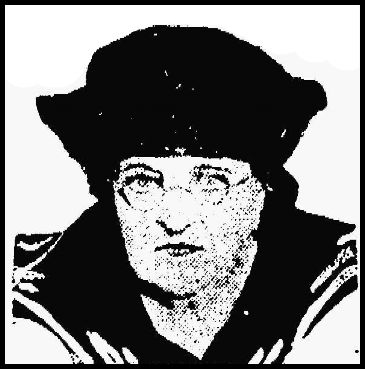
Sunday, June 02, 2013

Getting Away With Murder: The Lessons of Lucy Hagenow

At an early hour yesterday morning coroner Stanton, acting under the advice of Health Officer Barger, had the body of Abbia Richards, who died on June 2d, and was buried two days later, exhumed and taken to the Morgue, where an autopsy revealed the fact that a criminal operation had been performed.--“A Suspicious Case,” Daily Alta California, Wednesday, August 29, 1888*
A Mysterious Death Prompts an Investigation
 
Abortionist Lucy "Louse" Hagenow
A death certificate signed by Dr. Xavier Dodel stated that 28-year-old Abbia (or Abbie) Richards died on June 2, 1888, at 12 Nineteenth Street, San Francisco -- the "maternity hospital" of Dr. Louise Hagenow.

Dodel gave the cause of death as peritonitis and filed it with undertaker Theodore Dierks. Health Office officials, however, found the whole thing suspicious. They visited Dierks, who at first refused to discuss the matter but who finally said that at about 10 p.m. on June 2, a man identifying himself as Mr. Richards had come to the undertaking establishment, saying that he needed to arrange a burial for his wife, who had died at Hagenow's hospital several hours earlier.

During the ensuing inquest, which took place in late August, Hagenow and Dodel were brought to the morgue from the city prison, where they were being held for the June 26 abortion death of Anna Doreis.  Another young woman, Emma Dep, had also at Hagenow's maternity home shortly before the inquest into Abbia's death got underway.

Hagenow admitted that Abbia had died at her practice but denied having perpetrated an abortion. Dodel admitted that he had signed the death certificate, but made vague references to two other doctors that he refused to name as having had some involvement somehow.

The man who had  presented himself as Abbia Richards' husband was just a clerk with no connection to the dead woman, who had assumed the name of Richards in order to arrange the burial.

As the investigation went on, a creepy and conflicting picture emerged.

A man named William E. Moorcroft, identified as "the guardian of the deceased Abbie Richards," told the coroner that his ward had been only 19 years of age, not 28. She had become sick in Port Costa and gone to San Francisco, where her guardian had "supported her as well as he was able to." However, suspicions had been raised that Moorcroft had been "criminally intimate with her and responsible for her condition when placed in the hands of Mrs. Hagenow."

Hagenow accomplice
Dr. Xavier Dodel
Dr. G. M. Terrill "stated that he was visited one night by a man whom he now knows to be Moorecroft, who desired him to go to Mrs. Hagenow's hospital and see a girl who was very sick." Moorecroft wanted two doctors to examine the girl, so Dr. John Morse was called in to assist.

Morse and Terrill saw Dodel there, with Abbia "in a dying condition." They advised Hagenow to give her stimulants, but didn't examine her.

Special Officer Holbrook of the Society of the Prevention of Cruelty to Children testified that on several occasions they'd had cause to investigate Moorecroft's treatment of his ward. In 1887, Abbia had come to him saying that "her guardian was going to Port Costa and wanted her to go with him as his mistress. The society took care of her for a while, but she soon disappeared," and the next Holbrook heard, Abbie was living with Moorecroft again. 

Had Abbie been removed from Morecroft's guardianship, any abuse would have been stopped and the entire tragedy prevented.

Since things were getting hot in San Francisco, Hagenow relocated to Chicago, which had a more congenial attitude toward abortionists. 

She drummed up business with thinly veiled advertisements in Chicago daily papers, a typical one reading, "Dr. Louise Hagenow; licensed physician; expert; twentyseven years; female diseases; a new scientific, painless method; no operation; good results; 330 East Division street, near Wells; 10 to 4, 7 to 8."

Her ads brought her steady business, and she was implicated in the abortion deaths of Minnie Deering in 1891, Sophia Kuhn and Emily Anderson in 1892, Hannah Carlson in 1896, and Marie Hecht. in 1899. A brief hiatus ensued beginning April 30, 1900, when Hagenow was sentenced to one year to life in prison for Marie Hecht's death. She was paroled after serving only a year, and during her next period of freedom was held to the grand jury eleven times for patient deaths, including making headlines for a death a year from 1905 to 1907:  May Putnam, Lola Madison, and Annie Horvatich.

Lucy "Louise" Hagenow

On December 17, 1907, Annie Horvatich's death finally won Hagenow a trip to Joliet. Though Hagenow "pleaded innocence in the same hysterical manner that had characterized her actions many times when taken before the authorities for similar offenses," she was sentenced to twenty years, a sentence that lead the Rockford Gazette to declare, "Death Trail is Ended."


In her jail cell and pressed by reporters, Hagenow snapped, "Yes, I've been arrested before -- what's that to you? Yes, I've served time in Joliet -- why do you blame me for these things? If these fool girls would take care of themselves they wouldn't have these things done, would they? There's lot of midwives in Chicago making a living the way I do. I've been performing operations for fifty years. Since I got out of prison this last time, though, business is booming. Everybody's doing it -- no one wants babies; they come to us -- it's our business to help them."

The sigh of relief was premature.


Hagenow was freed from Joliet on October 29, 1917, having served less than half of her sentence. She went straight back to business, landing 22-year-old Pauline Albrecht in the hospital fighting for her life.


Hagenow victim
Nina Pierce
Then, suddenly in 1925, it was as if something snapped and Hagenow began making up for lost time. Five young women lost their lives at Lucy Hagenow's hands that year: Lottie Lowy, Nina Pierce, Jean Cohen, Bridget Masterson, and Elizabeth Welter. Hagenow followed up in 1926 with her final patient death: Mary Moorehead. That makes a total of 17 abortion deaths I could positively identify for which Hagenow was implicated in some way. 


Though she was sentenced to prison for the death of Mary Moorehead, when she appealed the Supreme Court of Illinois ordered a new trial in 1929. The judge, noting that there was no new evidence, dismissed the case, telling Hagenow, "You had better make your peace with God, Lucy Hagenow. I do not think your months on earth are many."

Hagenow, the Associated Press noted, was nearly deaf and "may not have heard. She muttered something, and shambled laboriously from the room."


As near as I can determine, Hagenow died September 26, 1933, in Norwood Park, Cook County, Illinois. Her occupation on her death record was given as "midwife."


How the Authorities Failed Women

Kermit Gosnell
Had San Francisco courts locked Hagenow up for life after the first verified death, Anna Doreis, at least 14 women would have been spared. If Chicago courts had locked her up for life after Minnie Deering's death, at least 13 Chicago women's lives would have been spared. But just as a see-no-evil attitude permitted Kermit Gosnell to ply his deadly trade in Philadelphia for decades of the safe-n-legal era, a lenient attitude toward abortion in Chicago let Lucy Hagenow ply her trade.

Unless the Compton-Carr Effect is broken -- that Access Uber Alles mentality that considers dead women an acceptable price to pay for the availability of abortion -- women will suffer and die regardless of abortion's legal status. We need to have laws in place that holds people accountable for failing to report abortionists, and to demand justice when these butchers kill.

*Many abortion-rights activists claim that illegal abortion deaths were grossly under-reported because the doctor would simply lie on the death certificate. While it is true that they would lie, we need to keep in mind that because killing a woman during an abortion was murder, and covering up an abortion death was also a crime. Undertakers, doctors, nurses, public health officials, and cemetery workers reported abortion deaths to authorities frequently, as did friends and family members of the dead women. Whether they reported these deaths out of a desire to avoid prosecution or as a cry for justice, that their allegations were taken seriously is underscored by the practice of exhuming the bodies and holding inquests. Abortion deaths are much easier to hide in the safe-n-legal era because killing an abortion patient is no longer a crime unless the abortionist is guilty of spectacular malpractice.

Thursday, June 23, 2011

Anniversary: Well, all surgery has risks, right?

Cora A. Burke was a 20-year-old who had been widowed about five months. She had a four-year-old son and lived in her own home along with her child and her parents. She'd recently become engaged. She'd been in good health up until the events that began to unfold on June 21, 1899.

In May of 1899, Cora told Mrs. Martha Johnson that she was about six weeks pregnant and wanted to find a good doctor to perform an abortion. Mrs. Johnson introduced Cora to Dr. R. J. Alcorn who had been practicing medicine in Kootenai County, Idaho, for a short time. Dr. Alcorn was living in the boarding house Mrs. Johnson operated with Mr. E.J. Abbey. Finding a doctor to perform an illegal abortion was common prior to legalization.

Cora went to Dr. Alcorn's room about two days after they were introduced. Mr. Abbey listened from an adjoining room, and heard Cora say that the instrument Dr. Alcorn was using was hurting her.

On the night of Tuesday, June 21, Dr. Alcorn asked Mr. T.J. Rundell to help him carry a table into his office, which was at the back of a drug store in the town of Harrison. Rundell's curiosity was piqued, and he asked Alcorn if he was going to "dissect a stiff." Alcorn told him no, he was going to perform an operation on somebody from across the river.

Rundell decided to snoop, so he returned at 10:00 PM and saw Cora go through the drug store into Alcorn's office. Rundell then slipped around to the back of the building, where he could peer into Alcorn's office around an ill-hung window blind. The following is what Rundell says he observed.
  • Alcorn stood beside the chair where Cora was sitting, supporting her head with one hand. He had a small vial containing a dark liquid, and was holding a cloth to Cora's face. Cora seemed to fall into a deep sleep, whereupon Alcorn picked her up and lay her on the table.
  • Alcorn removed Cora's undergarments and positioned her for the surgery. He examined her internally, inserted a speculum, then inserted a probe about a foot long into her body, causing a flow of blood which he blotted up with a cloth. From time to time, Alcorn applied the cloth to Cora's face again. The entire procedure took about an hour and a half.
  • Cora was awakened, and Alcorn helped her to set her clothing to rights and sent her on her way.
At about 4 PM the next day, Alcorn was called to tend to Cora, who was in a lot of pain. He examined her and found her uterus to be inflamed and bleeding. He prescribed ergot, to be given one-half teaspoon each half-hour for three doses, then every hour afterward for 18 hours. Cora's mother asked Alcorn about her daughter's condition. Alcorn told her, "She caught a bad cold. She does not flow enough when she has her monthlies. I will give her something to make her flow."

Over the ensuing days, Alcorn visited Cora five times, the last time about two hours before she died on Friday afternoon, June 23. Her feet and hands were cold, her fingers blue, her lips purple. Alcorn told Cora's mother that she was doing well and would be up soon. Alcorn immediately took a train to Washington state, returning about 10:00 on the following Sunday morning. The next day he again left the state, this time going to Montana, where he was arrested and returned to Kootenai county.

While Cora was ill, she passed a lot of blood and clots. Mrs. Knight, who visited Cora during her illness, testified, "I helped dress her after she was dead. Her clothing and bedclothing were saturated with blood. A quilt was doubled up under her four thicknesses, and it was clear through the quilt. It was clots of blood. I observed an odor in connection with it. There was too great a quantity to have come from the ordinary menstruation. Much greater in quantity."

At about 6:00 PM on the 21st, William Ketchum called Alcorn to visit Mrs. Ketchum, but Alcorn told him, "Well, I don't know. I am expecting a miscarriage here any minute. I can go over there, and come back, if it does not make any difference to them." So he went to Ketchum's home to attend to Mrs. Ketchum.

Kootenai County sheriff F. H. Bradbury testified, "He told me that he never had anything to do with this girl, Cora Burke; that he began in the daytime an operation on a man for stricture, and did not complete it; and that he took him in the back room of the drug store and completed the operation in the evening. He gave me this statement after I had warned him not to make any statement to me. This was on the train between here and Missoula."

Alcorn testified on is own behalf, saying that Cora had attempted to do an abortion on herself with "a hair dart," which had punctured the wall of her uterus and broken off, leaving about 1 1/2 inches. Rundell said that he'd used a speculum and piston syringe to remove the foreign body from Cora's uterus.

The physicians called as expert witnesses on the case all agreed that Cora died of septicemia or blood poisoning. They also agreed that ergot itself would be enough to cause an abortion.
Alcorn's defense also raised the possibility that Cora hadn't actually been pregnant, but the court concluded that Cora had believed herself to be pregnant, had sought an abortion, and had undergone a procedure intended to cause an abortion, which was enough to demonstrate the intent of the defendant to kill a fetus, especially in the light of Alcorn's statement that he was expecting a patient to miscarry.

Alcorn was charged with murder, convicted of manslaughter, in Cora's death.

I have no information on overall maternal mortality, or abortion mortality, in the 19th century. I imagine it can't be too much different from maternal and abortion mortality at the very beginning of the 20th Century.

Note, please, that with overall public issues such as doctors not using proper aseptic techniques, lack of access to blood transfusions and antibiotics, and overall poor health to begin with, there was likely little difference between the performance of a legal abortion and illegal practice, and the aftercare for either type of abortion was probably equally unlikely to do the woman much, if any, good.

For more on this era, see Abortion Deaths in the 19th Century.

For more on pre-legalization abortion, see The Bad Old Days of Abortion

Sunday, June 19, 2011

Two Chicago deaths

On June 19, 1922, 26-year-old Veronica Maslanka died in her Chicago home from complications of an abortion performed there that day. The coroner identified midwife Mary Pesova as the person responsible for Veronica's death. Since in-home health care (including some surgery) was normal at that period, the legal status of abortion probably didn't change the location, or the method, chosen by Veronica and Pesova. And since the abortion lobby is now pushing for midwives, nurses, and physician assistants to be legally permitted to perform abortions, the choice of practitioners is within the realm of what is considered adequate. Thus, it's difficult to blame Veronica's death on the illegality of abortion.

On June 18, 1928, 20-year-old Anna Mae Smith underwent an abortion at the Chicago office of Dr. George F. Slater. The next day, Anna died there from complications. Anna's abortion -- performed by a physician in his private practice -- is a common scenario today, and thus didn't really differ in any way from what would be normal for a legal abortion. What is dramatically unusual is that Dr. Slater, upon learning of Anna Mae's death, committed suicide at his home by taking poison. The source doesn't indicate if Slater's suicide was due to remorse or fear of prosecution.


Keep in mind that things that things we take for granted, like antibiotics and blood banks, were still in the future. For more about abortion in this era, see Abortion in the 1920s.


During the first two thirds of the 20th Century, while abortion was still illegal, there was a massive drop in maternal mortality, including mortality from abortion. Most researches attribute this plunge to improvements in public health and hygiene, the development of blood transfusion techniques, and the introduction of antibiotics. Learn more here.


For more on pre-legalization abortion, see The Bad Old Days of Abortion