Sunday, April 16, 2023

Top Ten Signs That an Abortion Facility Isn't Safe

Abstracting thousands of abortion injury cases has taught me a few patterns about how to spot a seedy clinic or quack abortionist. Please remember, though, that you enter any abortion facility at your own risk. Just because you don't notice any of these signs doesn't mean the place is necessarily safe. It's just that these particular signs should set alarm bells ringing in your head about the place. You'll probably want to investigate further or go someplace else. An easy place to start is the AbortionDocs website, where they gather any and all documentation they can find about abortion practices and practitioners. Good, bad, or indifferent -- if it's connected to the person or place, AbortionDocs will share it. This can't guarantee safety, but it can at least warn you away from places that have documented problems.

Some of these things might seem so outrageous you'd wonder how anyplace could operate doing these things. And you might marvel that women don't just turn around and walk out when they see some of these things. All I can say to that is that I've seen the documentation myself. These kinds of things do, indeed, happen. The mantra of "safe and legal" has led to a false sense of security. Many women dismiss their fears about the clinic or the doctor because they assume that somebody must be overseeing the place, or it wouldn't be operating openly. This is not necessarily the case.

In the order you're most likely to notice them:

1. The person who answers the phone when you call for an appointment verifies your pregnancy and tells you how many weeks pregnant you are.

You can't make diagnoses over the phone, for one thing. And even professional pregnancy tests, much less the ones you buy in the grocery store, can give false positives. For another thing, even with an examination, a practiced doctor can be several weeks off in his estimate of how far a pregnancy has progressed. In facilities that pay the doctor on a sliding scale according to how advanced the pregnancy is, the final determination of his pay is typically made after the abortion, by comparing a fetal foot to a chart. If that kind of accuracy is necessary to determine how much to pay the doctor, how can they do your informed consent and counseling based on a guess made over the phone?

2. The prolifers outside are handing out copies of lawsuits against the facility or the doctor.

This one shouldn't need any elaboration, but women will walk into clinics, copies of malpractice suits in hand and climb on the table anyway. This is probably because by the time they get to the clinic for their appointment, they've gotten into a "Let's just get this over with" mindset and have turned off their emotions and critical thinking skills. Therefore, it's a good idea to bring a companion along who is watching out for your safety. Give him or her the materials the prolifers hand you, with a promise to get you out of there if the place seems unsafe.

3. You are asked for payment in full up front, before any examination or counseling has been done.

As I said in #1, nobody can really verify how far advanced the pregnancy is without an ultrasound -- unless, of course, the abortion is over and they're measuring a fetal foot. How can they answer your questions about risks, the fetus, and the procedure if they don't know how far advanced your pregnancy actually is?

4. You get vague, reassuring answers to your questions.

This might not mean quackery; it might just mean paternalism. But either way, you're being deprived of your right to make an informed decision. Any discussion of risks that doesn't cover failed abortion, hemorrhage, infection, and post-abortal syndrome (the uterus filling with clots immediately after the abortion) at a minimum is trying to gloss over risks and just sell the abortion. If questions about emergencies don't bring out what hospital you'd be taken to and what ambulance service they'd call, odds are nobody will know what to do if there is an emergency. And if you ask questions about the fetus and get answers that don't jibe with what you've seen on pregnancy websites such as BabyCenter, Parents, or What to Expect, they're not being honest with you. How can you trust them with your life if they won't give you truthful answers to simple questions?

5. You hear other patients moaning and/or screaming.

Obviously this place isn't using adequate pain management. Where else might they be skimping?

6. The facility appears dirty and/or disorganized.

A small, cluttered room with a toilet near a portable dishwasher
Combination patient bathroom
and "sterilization room" at
Krishna Rajanna's Affordable
Medicine Clinic

Abortion is a surgical procedure with inherent risks. If they're not keeping the waiting room, counseling area, rest rooms, and hallways clean and sanitary, they're probably not keeping the scrub room, procedure rooms, and other critical areas clean and sanitary either.

7. They can't describe the qualifications of the staff that are attending to you. 

Some places might have a doctor on staff -- on paper. That doesn't mean that the person doing your abortion has ever had any medical training at all. And in places where the doctor is such a quack the staff don't trust him, they might start doing medical procedures themselves because it seems safer that way. If the person about to do your abortion can't answer, "Where did you go to medical school?" as fast as you'd answer, "Where did you go to high school?" he or she might not have gone to medical school at all. The time to find out is before that person sticks sharp instruments into your body. Also, don't take it for granted that the person about to administer anesthesia knows what he or she is doing. Abortion clinics have been caught letting a "hand holder," a receptionist, and a janitor administer anesthesia. If the person standing at your head about to administer drugs can't say that he or she is an anesthesiologist or CRNA -- and say where he or she went to school, you might wind up being yet another anesthesia coma or death. Don't assume that just because the place is operating openly the staff are actually qualified.

8. They don't monitor you in the recovery room. 

Lou Ann Herron:
Pleas for help brushed off

They at the very least should be putting a pulse oximeter on your finger and checking your vital signs every ten to fifteen minutes. There should also be a nurse in the room. Ask for the person's qualifications. If you're not being monitored and you're not sure the recovery room is overseen by a nurse, be ready to call 911 to get help for yourself if you start to become alarmed at your symptoms. Women have died right in the recovery room because their pleas for help were ignored or handled by somebody who didn't know what to do.

10. When you call for follow-up, you can't get through to a human being that will listen to you and take you seriously.

Especially in facilities that rely on "circuit riders," there might not be anybody on staff who has a clue how to deal with complications. The phone might ring to an answering machine. If you are concerned about your symptoms and you can't reach a person, or you feel like you're being brushed off, seek care elsewhere regardless of what papers they asked you to sign before your abortion. When in doubt, go to the emergency room and bring any paperwork you have from the facility. Delays while trying to reach somebody who can and will direct you to proper aftercare can lead to disaster or death.

Watch the companion video on YouTube.

Saturday, April 15, 2023

April 15, 1997: Texas Teen's Complication Not Noticed

Sixteen-year-old Maureen Cortez Espinoza underwent a safe, legal abortion at a doctor’s office in San Antonio on March 28, 1997. During the abortion, the doctor punctured Maureen’s uterus, but didn’t note this in her medical records or say anything to her about it, indicating that he simply didn’t notice. Maureen was sent home.

On April 3, she went to the emergency room at Northeast Baptist Hospital. Over the ensuing days, doctors there performed two surgeries to try to save her life, but to no avail. She died on April 15, 1997.

Abortion rights organizations would assert that, while tragic, Maureen’s death was just a case of “all surgery has risks.” But since roughly 90% of abortions before legalization were done by doctors, the same “all surgery has risks” logic still would have applied.

Life Dynamics, not citing any specific source, determined the name of the dead girl.

Watch Abortion Death of Texas Teen on YouTube.

Source:

“M.E.’s office verifies teen died from legal abortion,” San Antonio Express-News, Apr. 24, 1997

Friday, April 14, 2023

April 14, 1932: Third of Eight Deaths in only Two Months

Dr. Richard Thacker
On April 14, 1932, 21-year-old Isabelle Ferguson died of suspected abortion complications. Two physicians in the University of Oklahoma area, J. W. Eisiminger and Richard E. Thacker, were suspected in the case.

Though both doctors were suspected, only Thacker was charged with murder. Isabelle's widower, Samuel Ferguson, sued Thacker for $10,000. The couple's first wedding anniversary had been on April 6, between the abortion and Isabelle's death. 

Samuel held that Thacker, assisted by his wife, Ida, perpetrated the abortion in their office in the Terminal Building in Oklahoma City on March 25. Mr. Ferguson said that after the Thackers had injured Isabelle, they had taken her to their home and "refused her the right to go to a hospital when she became dangerously ill."

Isabelle left behind a six-month-old daughter.

Both Thackers, husband and wife, fled the city and were sought by police. They were eventually apprehended, but as far as I can tell there was no prosecution in Isabelle's death. This is likely because Thacker was already in hot legal water for another abortion deaths.

Thacker and Eisiminger were not ordinary doctors who just did abortions on a few patients. They were abortionists, and quack abortionists at that. Singly or as a pair they were implicated in a string of deaths:
Thacker was sentenced to life in prison for Ruth Hall's death. His attorney announced an immediate motion for an appeal, on the grounds that Thacker's other abortions should not have been admitted as testimony. The appeal failed. Thacker died in prison on April 1, 1937 from a heart attack.

Watch A Sudden Rash of Abortion Deaths on YouTube.

Sources:

April 14, 1930: Why Was Dr. Paulsen's Case Thrown Out?

Mamie Ethel Crowell, age 20, was a telephone operator living on Belmont Avenue in Chicago.

Mamie died on April 14, 1930, possibly in the office of Dr. Hans Paulsen at 4779 Lincoln Avenue, from an abortion performed on her that day. Two days later, Paulsen was booked for manslaughter by abortion. 

The father of the baby, Uriah Denniston, was booked as accessory. 

Paulson was held by the Coroner for murder by abortion. Denniston wasn't mentioned in the verdict. 

On September 1, the indictment was quashed. The source notes "Circumstances suggesting judicial corruption."

Sources: Homicide in Chicago Interactive Database, Illinois US Deaths and Stillbirths Index 1916-1947

Thursday, April 13, 2023

April 13, 1909: Early in Deadly Abortionist's Career

According to the Homicide in Chicago Interactive Database, on April 13, 1909, Stella Kelly, a 28-year-old waitress, died of septicemia at a hospital in Chicago, from an abortion that had been perpetrated around March 5. Through an online search I learned that Stella was divorced from her husband, Nathan Lowry, and had resumed using her maiden name.

Louise Achtenberg, age 59, sometimes identified as a doctor and sometimes as a midwife, was charged with murder by abortion by a coroner's jury. 

Stella wasn't the first woman to die at Achtenberg's hands, nor was she the last. Achtenberg was also implicated in the 1907 abortion death of Dora Swan, the 1909 abortion death of Florence Wright, the 1920 abortion death of Violet McCormick, and the 1924 death of Madelyn Anderson. 

I can find no record that she was ever incarcerated, which is hardly surprising, given how hospitable Chicago has typically been to the many doctors and midwives who  perpetrated abortions in the city.

Unfortunately, when the Cemetery of Choice wiki was closed down, I lost access to my original source documents for Stella's death.

Watch One of Six Dead of Louise Achtenberg on YouTube.

Tuesday, April 11, 2023

April 11, 1984: Fatal Abortion by Doc Out on Bail

Abortionist Raymond E. Showery was out on bail appealing a murder conviction when he performed the safe, legal abortion that killed 28-year-old Mickey Jean Apodaca on April 11, 1984.

Mickey, a divorced mother of four, told her ex-husband, Gary, that she was pregnant around mid-March and asked for a loan to pay for the costly abortion. Gary said that although she indicated that she wanted the money for an abortion, she never discussed the details with him, nor why she had made that choice.

The couple had met when attending Ysleta High School. They had married in 1973 and divorced in 1980.

Mickey went to Showery's Southside Medical Center in El Paso on March 17 to look into arranging an abortion. The appointment was scheduled for April 11. The reason for the delay isn't mentioned.

Mickey arrived at 8:30 that morning. By that time, she was about 19 weeks pregnant. She wasn't brought back to the procedure room until 2 p.m. Showery spent 45 minutes to an hour performing the abortion.

During the abortion, Showery tore a 2 1/2 inch hole in Mickey's uterus and severed a uterine artery. However, Showery didn't detect the injury and sent Mickey to the recovery room. A nurse later noticed that Mickey was hemorrhaging. Showery took Mickey back to the procedure room and ordered a transfusion. It wasn't until 5 pm that anybody called an ambulance. Mickey had hemorrhaged for at least an hour before she was transferred to Providence Memorial Hospital, where she died at around 9 p.m. during an emergency hysterectomy.

A grand jury handed down an indictment for involuntary manslaughter in Mickey's death. They determined that Showery had inadequately trained staff assisting him, had not properly repaired the hole he had torn in Mickey's uterus, and delayed transfer to a hospital.  

Otela Conn, who had been one of Mickey's neighbors for several years told the El Paso Herald Post, "She was such a sweet little girl. I really liked her. When she had [her youngest] baby, she was so happy and she was saying she thought she might like to have more. And she was good to those kids. She did the best she could for them. I just can't believe she'd have an abortion."

Showery was held pending $1 million dollars bail while awaiting trial in Mickey's death. While he was in prison, local pro-choicers rallied outside with signs asserting that Showery was "a good man" and that he "helps the poor." The fact that he helped Mickey Apodaca straight into an early grave was lost on them.

The charges were dropped in 1987, though Showery remained incarcerated, serving a 15-year sentence for the murder of the baby.

Watch Mickey's Misplaced Trust on YouTube.

Sources:

April 11, 1991: Scant information on New Jersey death

On April 6, 1991, "Terri," age 34, had an abortion at a doctor's office in the 1100 block of Summit Avenue in Union City, New Jersey. A nurse called the police saying that they needed emergency help for an unconscious patient. According to the police report, the doctor had already left the facility when the nurse called for help. Terri was taken to the hospital and placed on life support. She was pronounced dead on April 11, 1991.

Unfortunately, I lost my source document for Terri's death when the Cemetery of Choice wiki closed. I am able to verify the death of a woman of Terri's age in that area on that date.

Monday, April 10, 2023

April 10, 1924: Mystery Death in Wyoming

All I have is a single card to commemorate the April 10, 1924 death of 34-year-old Mrs. Katherina Mueller. She died in Rock Springs, Sweetwater County, Wyoming of septicemia following a self-induced abortion.

Watch Just One Card on YouTube

Saturday, April 08, 2023

April 8, 1928: Woman Collapses at Work, Dies from Criminal Abortion

On April 8, 1928, 26-year-old clerk Mildred Jakobsen, a Chicago native and daughter of Norwegian immigrants, "took sick" at work. She died there before she could be taken to a hospital. 

On May 4, the Cook County coroner concluded that Mildred had died from complications of a criminal abortion, and recommended the identification and arrest of the person or persons responsible. 

Nobody was ever held accountable for Mildred's death.

Watch Woman Collapses and Dies at Work on YouTube.

Friday, April 07, 2023

April 7, 1896: A Cry in the Night

On the evening of Monday, April 6, 1896, Tillie Karcher heard moaning in the flat of seamstress Millie Meyers, just upstairs of her at 415 Bushwick Avenue in Brooklyn. She listened again and heard a young female voice crying out, "Oh, let me go home to my mama!"

Alarmed, Mrs. Karchner sought out a policeman on his rounds, who went to the apartment and found a young woman there, ailing and alone. The girl gave her name as Mrs. Emily Scott and said that her husband, Ollie Scott, was a fireman on a Fulton ferry.

The policeman found prescription bottles in the room, so he copied the information from them and went to the pharmacy that had prepared them. The pharmacist said that the medicines were common ones used in treating fevers.

The policeman considered all these goings-on to be fishy, so he reported the situation to the precinct captain, who began an investigation to identify and round up everybody involved in the young woman's suspicious illness.

Around 5:30 on Tuesday afternoon, April 7, the young woman said that she was going to die soon, told the police that her real name was Emily Binney and gave them her address on Rutledge Street in Williamsburg, Brooklyn.

Emily's turn for the worse sent the police rushing for the coroner, leaving the ailing girl in the care of Minnie Meyer. The coroner arrived to find that Miss Meyer had abandoned Emily, leaving her to die alone in the intervening half hour.

Meyer was eventually apprehended and admitted that she'd helped 20-year-old Emily to seek out the abortion services of 33-year-old midwife Mary Schott and had herself been engaged to look after the patient.

A police officer went to the Fulton ferry house and managed to identify "Ollie Scott" as Arthur Robbins, who was arrested when he showed up at Meyer's flat to look for Emily at 10:00 that evening.

While the suspects were being questioned, Minnie said that Emily's baby had been born alive on March 21. Upon hearing that, Robbins burst into tears and told police that about four hours after the child's birth he had wrapped the baby in newspapers weighted down with a piece of iron and thrown it out a porthole in the ferry. He couldn't say if the baby had still been alive when it was tossed into the river.

Arthur Robbins then admitted that he had gone with Emily and Minnie to arrange for Mrs. Schott to perform an abortion.

Minnie Meyer was found guilty of manslaughter. I've been unable to determine the outcome of the case against the midwife.

Watch A Cry in the Night on YouTube.

Sources:

Thursday, April 06, 2023

April 6, 1906: Malpractice Prompts Midwife's Suicide Attempt

SUMMARY: On April 6, 1906, 22-year-old homemaker Bessie Braun died in Chicago from an abortion perpetrated by midwife Julia Gibson.

Michael Reese Hospital
The Wards at Michael Reese Hospital

Were there really wards full of women dying from botched septic abortions in the days before legalization? Dr. Julius Lackner of Michael Reese Hospital in Chicago reflected on what he saw there from 1900 to 1914. Five hundred women were treated at this charity hospital for septic abortions — both criminal abortions and miscarriages — during those fifteen years. Of those 500 women, there were only four deaths.

I have verified that two of them were indeed criminal abortion patients: Lizzie Orenstein and Bessie Braun.

Bessie's Death

Bessie, a 22-year-old homemaker, mother of two, and immigrant from Austria, died at Michael Reese on April 6, 1906. Both verbally and in writing, Bessie named midwife Julia Gibson as the person who had perpetrated the abortion, for a $5 fee, on March 20. It was hardly surprising that Bessie’s abortion had been perpetrated by somebody with medical training, since the majority of Chicago abortions in that era were done by either doctors or midwives, who ran thinly veiled advertisements in the newspapers.

Bessie’s husband, Abraham, testified at the inquest. He said that he had not known anything about an abortion until Bessie became seriously ill on Sunday, though she remained at home until Thursday, when she finally was hospitalized.

He also said that prior to her death, Bessie told him that she had written the guilty midwife’s name and address on a piece of paper which was in the bed at their home. Abraham found the paper and turned it over to authorities during the inquest.

Attempted Suicide

Gibson, who had been at Bessie’s bedside during the declaration, was being escorted out of the hospital by police when she asked to go to the women’s dressing room in the hospital basement. She was permitted to go in while a police officer stood guard outside the door.

The officer soon heard a shot, then forced the door and found Gibson lying on the floor suffering from a self-inflicted gunshot wound to the chest. She was admitted to the hospital for treatment and was kept both under arrest and under suicide watch. As she lay near death, Gibson confessed her guilt. She later recovered.

Not Her First Dead Patient

Gibson had previously been indicted for the November, 1905 abortion death of 18-year-old Dorothy Spuhr, who had died at County Hospital.

Watch Midwife Attempts Suicide, Admits Guilt on YouTube.

Sources:


Wednesday, April 05, 2023

April 5, 2001: Haley's Post-Abortion Journey Ends Tragically

 Dear Lord,

I sit here alone with my thoughts wondering if you will ever forgive me. Why do I continue to fail you? I'm failing you because I‘m turning away from the precious gift of having a child. A child. A breathing, living, beautiful life that I created but too selfish to accept from you. Will you still love me as a child of yours? Will I still love me after today?
Haley‘s journal - Oct. 23, 2000

On April 5, 2001, Donetta Robben‘s 22-year-old niece didn't show up for work. Her friend Rosa drove over to check on her, and her car wasn't there. Rosa called the girl‘s father, Edwin. Had she gone home to visit her family?

Edwin later said he just knew that his daughter was dead. He called the Omaha police, and he called his daughter's landlord. They went to the apartment. They found her body.

Though the coroner estimated that the young woman had been dead for several days, all official documents, and the young woman‘s tombstone, use the April 5th date. So will I.

In telling her niece's story, Donetta decided to use the name ‘Haley Mason‘ rather than her niece‘s real name. In respect for the family‘s desire to grieve privately, I‘m using the name Donetta uses. Likewise, I use the pseudonyms Donetta uses for friends and family members.

The official ruling was that Haley‘s death was an accidental overdose. Her family was stunned as the investigators spoke with them, revealing the discoveries made while looking into the young woman‘s death. Isolated words echoed in their minds: death, journals, death, pills, death, drinking, death, hurt, death, abortion...

Abortion?

Abortion.

The answers to how Haley went from happy-go-lucky college student to suicide statistic weren't in the official reports. They were found in Haley‘s journals, where she poured her heart out in the final months of her life.

The story of how Haley died begins when she fell in love with Todd. She found out she was pregnant and told him. He wanted her to get an abortion.

A two story building. The bottom story is brick, with dark brickwork depicting an old jalopy. A huge business sign points to stairs beside the building.
LeRoy Carhart's clinic in Belleview, Nebraska
Haley was a student at the University of Nebraska. She worked two jobs to meet her expenses. Unmarried, without much money, and with a disapproving boyfriend, Haley saw abortion as her only option. She made her appointment at the Bellevue, Nebraska practice of  Dr. Leroy Carhart. It was late October of 2000.

Haley wrote of Todd‘s attitude: "I must let him abandon me. He doesn't care about me. I know he‘s only agreed to pay for it to ease his own guilt."

Haley found the abortion stressful: the wait, the sounds, the crude and uncaring behavior of the doctor. Haley had been told to arrive at the clinic at 7:00 in the morning, but it was ten hours before she was finally on the table, ready for the abortion. Carhart walked into the room, clad in a dirty coat and glasses so smeared that Haley‘s friend, who had accompanied her, wondered how he could even see through the lenses.

Candid outdoor shot of an overweight middle-aged man with his hair going white in the front. He is wearing a suit and tie.Haley, in her fog of medication, tried to make a joke. "Don‘t hurt me down there?" she said. 

"Be still and I won‘t," Carhart replied.

While performing the vacuum abortion, Carhart spouted profanities. He told Haley and her friend that he was tired. He‘d been speaking in California the day before, and had just flown into Omaha that morning.

After the abortion, Haley felt violated, as if she‘d been raped. She also experienced continued spotting into January. She'd not been given a follow-up appointment, and didn't know if the bleeding was normal or not. She didn't want to go to another doctor, because she‘d have to tell him about the abortion, and that was just too painful to talk about. The bleeding was a constant reminder of the death of her unborn baby.

Haley told few people about the abortion: three close friends and two relatives. But she didn't tell them of her struggle to cope with the emotional pain. She kept telling herself that she‘d done the best thing. But she started punishing herself, and pushed away anybody who tried to love her. She didn't feel that she deserved their love.

Haley longed for a knight in shining armor to rescue her from the prison of her grief, but she no longer felt comfortable with men. She had to get drunk to be able to endure sex. And even then, it reminded her of the abortion. Todd came by at early hours, looking for sex. Haley submitted, but her heart wasn't in it. She no longer felt loved. She felt used.

The drinking got worse. Hot baths and quick jogs provided temporary relief from the anguish, but it always returned.

Finally, Haley could stand it no more.

First, she drank plenty of numbing alcohol. Then, she went into her living room and grabbed a precious photo of her late mother and maternal grandfather. Next, a bottle of vodka. A bottle of aspirin. An old prescription bottle of Benadryl. Haley washed the drugs down with the vodka, leaving the three bottles next to the photograph.

She went into the bedroom. She put her rosary around her neck. She set an empty holy water bottle on her dresser. She opened her journal to the day of the abortion. She lay down, head on her pillow, looking for the  rest she couldn't find any more in living, leaving her family to sort out their own pain. 

Other post-abortion suicides include:
  • Carol Cunningham, age 21, who shut herself in her garage, ran her car, and died from the exhaust fumes in August of 1986
  • Arlin della Cruz, age 19, who hanged herself in the woods near her house in October of 1992
  • Laura Grunas, age 30, who shot her baby’s father and then herself in August of 2006
  • “Sandra Roe,” age 18, who killed herself using an unidentified means in April of 1971
  • Sandra Kaiser, age 15, who threw herself off an overpass into traffic in November of 1984
  • Stacy Zallie, age 20, who committed suicide in October of 2002

Tuesday, April 04, 2023

April 4, 1985: First of Two Deaths at Hands of Gambling Addicted Doctor

Mary Bradley, an Alabama resident, was 41 and a mother of four when she underwent a 20-week abortion at the hands of Dr. George Wayne Patterson in March of 1985.

Soon after, Mary was losing blood. She was admitted to the University of South Alabama Medical Center in Mobile and her bleeding was described as “abnormal” and “uncontrollable”. Doctors performed a hysterectomy on March 28, 1985 in an attempt to save Mary, but she had developed a blood clotting disorder and respiratory problems as a result of the abortion. She died on April 4, 1985.

Like a disproportionate number of women who die in safe and legal abortions, Mary was black.

Less than a year after he killed Mary and her baby, Patterson k

George Wayne Patterson

illed another abortion patient, Janyth Caldwell.

Patterson was shot to death in 1993 near his car outside of an X-rated movie theater. At first, abortion-rights groups treated Patterson's death as martyrdom for one who provided "vital reproductive health care." They never mentioned the two dead women. Police confirmed later that the killer, Winston McCoy, was a violent felon who was on parole after serving time for a violent home robbery and sexual assault. Patterson's killing had been a botched robbery attempt. News coverage revealed that Patterson was a rather unsavory character who had accumulated tens of thousands of dollars in debts to illegal bookies. His name gradually vanished from the Rolls of the Holy Martyrs among the prochoice.

Watch Deadly Doc Dies Deplorably on YouTube.

Sources:

  • Alabama Certificate of Death # 85-10613
  • Alabama Department of Forensic Sciences Autopsy Report # 27(A)-85-31536
  • Circuit Court for Monroe County, Alabama Case, CV-85-54

Monday, April 03, 2023

April 3, 1935: The Second of Dr. Justin Mitchell's Known Deaths

A youngish white man with a high forehead and dark hair, facing the camera, with a pale colored jacket and dark necktie
Dr. Justin Mitchell
On February 12, 1936, Dr. Justin Mitchell, age 57, of Chicago was convicted of manslaughter in the April 3, 1935 abortion death of 32-year-old Mary Nowalowski.  Eleven days before his conviction, another of Mitchell's patients, Alice Haggin, died from abortion complications. Two years earlier, Mitchell had been implicated in the abortion death of Mary Schwartz.
According to death records, Mary was an assembler at a Western Electric factory.

The prime witness in Mary's case was milk wagon driver Stephen Zakes. He and Mary were planning a wedding for the upcoming May.  On March 27, Stephen brought Mary to the Chicago office of Dr. Victor J. Neale. He then met with the couple together, telling them that Mary was between two and two and a half months pregnant. Mary began to cry and ask Neale, "What will I do?"

Stephen testified that Neale had referred them to Dr. Justin Mitchell; Neale insisted that he had simply told them they could go to some busy corner and find an abortionist.

Stephen and Mary went to Mitchell's office on the evening of Friday, March 29. Mitchell examined Mary and confirmed that she was pregnant. She was at least eight weeks along, Mitchell said, and if she returned the following morning at 8:00 he would perform an abortion. The fee would be $50. He assured them that there was no danger for Mary to undergo the procedure.

Stephen Zakes went to Mitchell's office at around 11:00 the morning of Saturday, March 30 to see how Mary was doing after the abortion. "She will be all right, she is in a little pain right now." Stephen went to see Mary himself and found her to be in excruciating pain, unable to even sit up. Mitchell insisted to him, "They are all weak after an operation of that kind."

Stephen escorted Mary home. She was weak and chilly. They stopped at a drug store for coffee and toast, then walked to a cab stand where Mary became violently ill. After Stephen took Mary home, she immediately took to her bed. Dr. Neale was summoned to examine her. Neale provided morphine for Mary's pain before leaving. Stephen remained with her until about 1:00 in the morning on Sunday, March 31.

Somebody brought Dr. G. M. Redman to Mary's home between 4:00 and 5:00 that morning. He found Mary in such grave shape that he immediately took her to his car and drove her to the hospital.

Mary was given medicine to contract her uterus but she continued to bleed so Redman contacted the coroner's office then performed a curretage of Mary's uterus. Her cervix had already been damaged, showing tearing and pus. During the curretage, Redman retrieved the head of Mary's fetus along with retained portions of the placenta.

Redman's care notwithstanding, Mary died on Wednesday, April 3. A postmortem examination concluded that Mary's uterus had developed gangrene due to the abortion, and that she had died of hemorrhage and septic shock.

Watch Abortion Doctor's Second Dead Patient on YouTube.

Sources: 

Sunday, April 02, 2023

April 2, 1943: Physician Accused in Woman's Death

On April 2, 1943, a 31-year-old domestic servant named Ellen Haro died at Illinois Masonic Hospital in Chicago. Before her death from a criminal abortion, she identified a doctor whose name was not given in news coverage.

For some reason the inquest was started in early April but put off until April 23.

Watch Who Was the Abortion Doctor?  on YouTube.

"Physician Hunted After Abortion Victim's Death," Chicago Daily Tribune, April 4, 1943

April 2, 1912: A Chicago Midwife?

On April 2, 1912, 25-year-old homemaker Elizabeth Jorgeson died from an abortion perpetrated that day by Katie Sauer, whose profession is not given. Sauer was held by the Coroner's Jury and indicted by a Grand Jury on November 30. The case never went to trial.

An article in the Chicago Inter-Ocean from the year before Elizabeth's death identifies a Chicago woman named Katie Sauer as a midwife. I am working to verify if the midwife and the abortionist are the same person. If the Katie Sauer implicated in Elizabeth's death is indeed this midwife, that would be typical. Abortions in Chicago in that era were most often perpetrated by either doctors or midwives.

Saturday, April 01, 2023

April 1, 1934: One of Six Clustered Victims of Dr. Guy Brewer

B&W 1/4 profile of a stern-faced, bald, middle-aged white man with round, dark eyeglasses
Dr. Guy E. Brewer
Ruby Ford, a 26-year-old homemaker, died on April 1, 1934, 11 days after an abortion committed on March 20 "at the combination bachelor dwelling and office" of Dr. Guy E. Brewer, a beloved philanthropist in the small town of Graber, Oklahoma. So popular was Brewer that the husband of one of his six abortion victims was fired from his job in retaliation for reporting the death to the police.

Brewer had graduated from the University of Louisville in 1906 and had been practicing medicine in Garber for 21 of the 29 years he had been a physician. He supported young men during their university studies, maintaining houses for them to live in. Those he had educated over the years rushed immediately to his defense. Though Brewer had spent many long years helping boys and young men, his impact on women's lives was evidently lightning-fast.

I believe that Ruby was the first woman to die under Brewer's dubious care. The other dead patients are:
  • Hermoine Fowler, a 20-year-old coed, who died in June of 1934
  • Doris Jones, a 20-year-old mother of two, who died in April of 1935
  • Wanda Lee Gray, age 20, who died around 1935
  • Myrtle Rose, age 21, whose death date I've been unable to determine
  • Elizabeth Shaw, age 23, whose death date I've been unable to determine
Brewer entered guilty pleas and was sentenced to six four-year sentences, to run concurrently, for the six abortion deaths.


Source:

Thursday, March 30, 2023

March 30 and 31, 1930: One Doctor, Two Days, Two Deaths

Yearbook photo of a smiling young white woman with bobbed hair, wearing a print dress
Gladys Anderson
During an inquest into the March 30, 1930 death of Gladys Anderson, an 18-year-old freshman at the University of Illinois, word came that Cleo Hinton, a 24-year-old stenographer from Champaign, Illinois, had also died from a botched abortion. Both deaths were linked to Dr. Thomas Eade.

Cleo died in a Champaign hospital on March 31 due to peritonitis caused by an abortion. Eade was charged with murder in her death but was acquitted. Nevertheless the medical board was not satisfied and investigated to see if the evidence of his complicity was enough to revoke his license. 

Eade told the state medical board that when Cleo had come to him on March 23, he believed that she was suffering from intestinal influenza which could not have been caused by an abortion.


Wednesday, March 29, 2023

March 29, 2015: Christi Stile Dies After Nearly 22 Years in a Vegetative State

Planned Parenthood referred 17-year-old Christi to an unsafe clinic for an abortion that left her brain damaged. It took her nearly 22 years to die.It took her 21 years, 8 months, and 28 days to die.

Christi Stile was only 17 when she came home from roller skating with a friend. She looked shaken and distressed, but when her parents asked her what was wrong, she said that she had just had harsh words with somebody and didn't want to talk about it. Kay and Fred Stile gave the incident no more thought for a long, long time.

Four months later, Christi came to her mother and said that she was pregnant. She was crying, saying that she just couldn't have this baby; it would kill her. In retrospect, Kay said that this is what one should expect from a 17-year-old girl. But at the time, although Fred and Kay disapproved of abortion, Kay agreed to drive Christi to her abortion appointment at Aurora's Mayfair Women's Center.

To make a sad situation even sadder, the abortion was scheduled for the day after Christi's 18th birthday, July 1, 1993. Even though they'd been referred to Mayfair by a Planned Parenthood, Kay and Christi were nervous. Was abortion really safe? Kay went with Christi for the informed consent session and asked about safety. She was reassured that the only risk was of heavy bleeding, and that the clinic had everything on hand to deal with that situation should it arise. Kay felt reassured.

Kay stayed in the waiting area as Christi went back for her abortion. Suddenly, the demeanor of the staff changed. There was something wrong, Kay was sure. She was also sure that Christi was the patient who was in some sort of trouble. Kay questioned a staffer, who told her that Christi had experienced a minor complication and that she was being taken to the hospital for observation. Purely routine -- she would be discharged tomorrow. There was no cause for alarm, Kay was assured. Christi was fine; they were just being cautious.

Kay rushed to the hospital in a near panic. When she was arrived, staff told her that she couldn't see Christi until she calmed herself. Steeling her nerve, Kay steadied herself and was led to a patient's bedside.

The girl in the bed was unconscious, stuck full of tubes. Her face was swollen and distorted.

"That's not my daughter," Kay told them. But a nurse handed her a plastic bag containing Christi's jewelry. The girl in the bed was Christi.

Kay had to do the hardest thing she'd ever done in her life: call her husband and tell him he didn't have his daughter any more. She was alive, but she was no longer the same Christi.

Fred and Kay later learned what had happened at Mayfair. Abortionist Ronald Kuseski, not an anesthesiologist, had administered sedatives to Christi through her IV. After the abortion, he looked up to find Christi pale, with bluish lips, and no pulse or respiration. Her heart had stopped. Paramedics were summoned, who managed to restore Christi's pulse and respiration before rushing her to the hospital.


A thin, middle-aged white man sits at the bedside of a disabled young woman, looking into her face and holding her hand
Fred and Kay provided care for 22 years
The clinic had no record of Christi's vital signs being recorded during the abortion. Although Kuseski's attorney insisted that the clinic had a "crash cart" to deal with cardiorespiratory arrest, Kay says that Kuseski had told her that the clinic had no "crash cart." The medical board investigation found that Kuseski didn't have pulse oximetery equipment in place for Christi's abortion. Kuseski denied any misconduct during Christi's abortion. The Medical Board sent him a "Letter of Admonition" telling him to adhere to "Anesthesia Monitoring Guidelines" in the future, and to attend CPR and Advanced Cardiac Life Support training.

Perhaps out of concern that Fred and Kay might blame Christi's boyfriend for what had happened to her, Christi's friend told them what had really happened the night she and Christi had gone skating. Christi had been so upset not because she'd had a tiff with a friend, but because an acquaintance had raped her behind the rink.


Standing at Christi's bedside during the filming of Christi's Choice, a documentary video about the family's ordeal, Fred Stile commented that had Christi had her baby instead of having the abortion, he'd be changing diapers on his grandchild instead of on his incapacitated daughter. The baby, of course, would have long since been out of diapers by the time the video was released.

Christi finally died of her lingering complications on March 29, 2015, at the age of 39. Her baby would have been 21 years old. 
 

Tuesday, March 28, 2023

March 28, 2014: Lack of "TRAP" Law Kills Woman

Abortion-rights groups have been fighting to halt laws that would treat abortion clinics like ambulatory surgical centers. The abortion lobby insists that regulations such as size of doorways and hallways and elevators are just nit-picky and have nothing to do with women's well-being. What they don't want you to know is why these size requirements are included in ambulatory surgery center regulations. If a patient is having a life-threatening emergency, EMS workers need to be able to get the patient onto a gurney and perform resuscitation efforts while moving the patient from the procedure room into the ambulance.

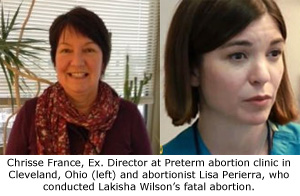
On this date in 2014, 22-year-old Lakisha Wilsondied because a clinic was not laid out to allow easy access by an ambulance gurney.

A smiling young Black woman, with bright jewelry and clothing, casually-coiffed hair, and a radiant smile
Lakisha Wilson
Operation Rescue obtained the autopsy report. Lakisha went to Preterm Clinic in Cleveland, Ohio on March 21, 2014. She was 19.4 weeks pregnant. Further investigation by Operation Rescue reveals further details on the pathetic excuse for treatment Lakisha received at the clinic, as well as how the substandard conditions in the clinic contributed to Lakisha's death. After the safe, legal abortion, performed by Lisa Perierra, she began bleeding heavily because her uterus had become soft (atony). 

The procedure rooms at Preterm are on the third floor of the building. When emergency medical services arrived, the elevator was malfunctioning. They were delayed in getting the gurney to Lakisha due to this problem. When they entered the room, where Lakisha still lay on the abortion table with her legs in the stirrups, they found her abortionist, Dr. Lisa Perriera, trying to resuscitate her with a pediatric-sized Ambu-Bag. The IV for administering medications had been torn loose somehow by clinic staff. 

EMS began working to revive Lakisha, who had no pulse and was not breathing. The medics were able to get her heart going but were hampered in their further resuscitation efforts because the elevator was too small to properly accommodate the gurney; Lakisha had to be taken into the elevator in a seated position that did not provide adequate access to her airway. 
Several house later she was finally taken to Chase University Medical Center, where she was placed on life support and pronounced dead on March 28.

Here is video, with 911 audio, of an ambulance call two years before Lakisha's death. This patient, like Lakisha, was hemorrhaging due to uterine atony. In this patient's case, the elevator wasn't working at all. Fortunately, she survived.


Saturday, March 25, 2023

March 25, 1941: Woman's Body Found on Country Road

Addie Wilson, age 48, was indicted for manslaughter and abortion conspiracy in connection with the death of 25-year-old Marie Swift. Marie's body was found on a country road on March 25, 1941.

Herman Ward, Marie's fiancé, was indicted for abortion and conspiracy.

Addie Wilson's 16-year-old son, Clarence, was held as a material witness.

Watch When Men Were Held Accountable on YouTube.

Source:
  • "Indict Two in Death of Girl Found Dead in MD," Lancaster (PA) Intelligencer Journal, April 18, 1941

Tuesday, March 14, 2023

March 14, 2004: Long Lingering Death

Nina Gaston was left incapacitated after an abortion performed by Dr. Youl Choi in January of 1988.

She finally died of her injuries in 2004. A check of Social Security death records found the exact date as March 14.

Nina had gone to Choi's facility for a safe, legal abortion on January 2, 1988. According to a lawsuit later filed on her behalf, Choi's clinic did not have proper emergency equipment on site. Staff did not properly monitor Nina while administering a paracervical block for the abortion. She went into cardiac arrest. Staff failed to detect the cardiac arrest in a timely manner, then did not have the necessary skills to perform CPR properly. They did not intubate Nina or use oxygen. Even worse, they stopped their efforts to resuscitate Nina before emergency services arrived. 

As a result of these failures, Nina was left comatose in a nursing home, where she remained for 16 years until her death.

Choi had also performed the fatal abortion on Angel Dardie.

Source: Georgette Baker vs. Youl Choi