Saturday, February 04, 2023

February 4, 1939: Was Hattie's Abortion Really Self-Induced?

All the information I have about Hattie Scott Johnson comes from New York death records.

Hattie was a 26-year-old Black homemaker who died on February 4, 1939 in Harlem Hospital. Her cause of death was sepsis from an abortion "said to have been self induced." 

I can't rule out the possibility that Hattie's abortion was written off as self-induced because, since she was Black, nobody thought it was worth the bother to investigate any further. 

Watch Was Hattie's Abortion Really Self-Induced? on YouTube.

Friday, February 03, 2023

February 3: Forced Abortion Turns Fatal for Teen

 George Strugnall, a roofer and father of eight, told police the story of how his 16-year-old daughter Mary lost her life:

[Twenty-two-year-old Vernon] Keyser met my daughter a year ago. She was only 15 then and just out of grammar school, so my wife and I did all we could to discourage his attentions. He worked in his father's machine shop a few doors from our house and used to stop and see Mary every night. Sometimes he took her out.
A week ago my youngest boy, Raymond, 9 years old, was run over by a truck and his leg broken. Last Tuesday [January 29] my wife and I went to the People's hospital to see him, leaving Mary alone. When we returned, Mary was gone.
Keyser, the baby's father, told police:
About three months ago Mary said she was in trouble and asked me to help her. I didn't know what to do until a few weeks ago. I met Dr. [J. A.] Harter, who said he would take care of the case for $150 if I brought Mary to his office.
On Tuesday, when her parents were away, I took Mary to Dr. Harter's home. She was frightened and began to struggle, but the doctor's brother [Irving Harter] and I held her on a table while the operation was performed. Five hours later I took her to the home of a Mrs. Irma McMullen, 7037 Clarmont avenue.
Mary's condition deteriorated, so to avert any suspicion he continued to stop at the Strugnell home daily asking after Mary.

On Friday, February 1, Harter told Keyser that he couldn't do anything more for Mary and suggested that he consult with Dr. J. A. Goodhart of South Kedqie Avenue. Goodhart immediately ordered that Mary be admitted to the county hospital.

Per Harter's instructions as to "the simplest way out of it," Keyser persuaded Mary to lie and say that she had done the abortion herself. She died on February 3.

Dr. Harter was originally sought both at his office on West 63rd Street and his home on West Marquette Road, without success. Eventually he was captured and tried for homicide, but acquitted. His brother Irvine was charged as an accessory. Keyner was charged with rape and accessory to murder.

February 3, 1924: Did a Doctor Dump Adeline's Body?

On February 3, 1924, the nearly-nude body of a young woman was found in the Ohio River near Pittsburgh, Pennsylvania. She was identified as Adeline Podvansik, age 24.

An autopsy found that Adeline, a sales clerk, had died from acute endocarditis and puerperal (related to pregnancy) sepsis.

Two brothers, Maurice and David Rapport, were freed on $5,000 bail each in connection with the death. Maurice had been Adeline's employer. Dr. S. M. Black of Carnegie, PA, described by the Lancaster (PA) Intelligencer Journal as "a prominent surgeon," was at large. 

His attorney offered to have Black turn himself in if Black could be released on $10,000 bond. Mrs. C. B. Morgan, alleged custodian of the "hospital" where the abortion was perpetrated, was arrested.

Watch Woman's Body Found in River on YouTube.


Sources:

February 3, 2006: Death at the Good Kind of Fake Clinic

 Like many abortion "clinics", Dr. Romeo Ferrer's private practice, Gynecare Center, would look to the untrained eye like an outpatient clinic. A patient making an appointment there would likely believe she was in a licensed clinic, not a doctor's office. (Their website, in fact, described the facility as "a modern, clean clinic designed to provide quality healthcare for women and girls of all ages in the Maryland area," even though, as the medical board noted, the facility was only a private doctor's office and not licensed as a clinic.)


Denise Crowe, was 21 years old, dropped her 3-year-old son off with a babysitter and drove to Ferrer's clinic-looking office for an abortion on February 3, 2006. She had $800 to pay for the procedure. She was 16 weeks pregnant.

"She thought she'd just have it done and nobody would know," her mother, Stephanie White, later told the Baltimore Sun.

Ferrer started the abortion, a D&E abortion, at about 1:00 p.m., using ultrasound to help him visualize the baby as he dismembered it. Twenty-five minutes later, Ferrer was still pulling fetal parts out of his patient, and administered 20 units of pitocin via an IV solution. Five minutes later, he added 125 mg of Demerol and 5 mg of midazolam (Versed, a short-acting sedative and amnesia-producing medication). Because "pt. was still reacting to pain", Ferrer administered additional doses of Demerol and midazolam. It wasn't until 1:45 that Ferrer completed the abortion.

Denise was moved to the recovery room, where at 1:47 a "surgical assistant" noticed signs of cyanosis (blue coloring) in Denise's fingernails. A nurse assistant was unable to get a blood pressure or pulse reading on Denise, and told Ferrer. He gave a verbal order for 0.4 mg Narcan, which was administered by the nurse assistant. Narcan is a drug to counteract narcotics.

Romeo Ferrer
At 1:50, Ferrer began efforts to resuscitate Denise, including performing CPR, and having an assistant perform CPR while he administered intracardiac epinephrine. Staff called 911 while Ferrer continued resuscitation efforts, maintaining an open airway with the non-professional method of head tilt and chin lift. Ferrer did not use an airway or endotracheal tube, as is customary with professionally-administered CPR.

The medics arrived to find Denise still unresponsive and without a pulse. The medics used an oxygen mask and additional drugs as they transported Denise to Anne Arundel Medical Center. There, emergency room staff continued the attempts to resuscitate her, to no avail. She was pronounced dead at 2:57 p.m.

The autopsy found no underlying physical reason for Denise's heart to have stopped. The cause of death was given as "Meperidine intoxication" (an overdose of Demerol).


The National Abortion Federation defended Ferrer, with spokeswoman Melissa Fowler telling the Annapolis Capital that abortion is safe due to "specialized quality care provided by clinics like Gynecare Center." This indicates that Gynecare was a National Abortion Federation member.


Watch Ferrer's Fake Clinic on YouTube.

Thursday, February 02, 2023

February 2, 1916: Denver Doc's First Known Death

 On February 2, 1916, Ruth Camp died from complications of an illegal abortion performed in Denver, Colorado. Dr. Bennett Graff was found guilty of murder in Ruth's death, and sentenced to 11 - 13 years in prison. Graff protested "stoutly" and appealed the conviction. While awaiting trial in Ruth's death, another woman, Beulah Hatch, died at Denver's Mercy Hospital, and blame was placed on Graff for that death as well. Graff was found guilty of murder in Ruth's death, and sentenced to 11 - 13 years in prison, but won a new trial when a witness came forward and placed the responsibility for the abortion on a lay practitioner and asserted that Graff was merely attempting life-saving aftercare for Ruth.

February 2, 1978: Planned Parenthood Referral Ends in Death

Elizabeth Tsuji, a 21-year-old Cal State student, underwent a safe and legal 8-week abortion at a local Planned Parenthood on November 11, 1977. She called the clinic in December to report that she was still not menstruating, but staff assured her that the abortion had been successful.

On February 1, 1978, Elizabeth confirmed that she was indeed still pregnant, five months along. The Planned Parenthood clinic referred her to Inglewood General Hospital for a saline abortion.

In spite of its name and licensing status, Inglewood was actually an abortion hospital. And it already had problems. A young woman named Kathy Murphy had died in 1973 of sepsis from an abortion at Inglewood. Lynette Wallace died in 1975 after her doctor at Inglewood failed to diagnose her ectopic pregnancy and simply performed an abortion and discharged her. Still, this was only two dead women -- hardly enough to alarm anybody about a high-volume abortion facility. I don't know if the Planned Parenthood staff even knew about these deaths before they referred Elizabeth.

Trusting the referral, Elizabeth packed a nightgown and told her family she was going to spend the night at a friend's house. That was the last time they saw her alive.

Elizabeth underwent the abortion on February 2, and died that day. Two autopsies were performed, neither of which could find a definitive cause of the young woman's death.

Abortionist Morton Barke was somehow involved, although documents aren't clear what his role was in her death. Barke also worked at the unsavory San Vicente Hospital. He is known to have been a partner at Inglewood and to have been connected with the deaths of Yvonne Tanner and Lynette Wallace. His involvement might have been that he served in a supervisory role.

Elizabeth was the third woman to die after an abortion at Inglewood. It took two more deaths -- Cora Mae Lewis and Belinda Byrd -- for the state to finally take action and close the hospital down.

Watch Planned Parenthood's Referral to Death on YouTube.

Sources: Death Certificate 78-063811, Autopsy 78-1763

Wednesday, February 01, 2023

February 1, 1995: Eleventh of Sixteen?

 When 24-year-old Ta Tanisha Wesson went to Family Planning Associates Medical Group on January 26, 1995 for a safe, legal abortion, she brought a friend with her, Ms. Mickey Gaton.

Mickey had been sitting in the waiting room for several hours when she saw an ambulance approach. Though staff knew that Mickey had come with Ta Tanisha, she said, they didn't tell her anything about complications.

Somehow Mickey found out that it was her friend being loaded into the ambulance. She called Ta Tanisha's parents, Lin and Nicole Wesson, who rushed to the facility. There, Ta Tanisha's father said, they were unable to get any information about their daughter from the staff. "Everything was done in secrecy," he said.

Ta Tanisha was taken to the hospital, never regaining consciousness. She died on February 1, leaving behind a five-year-old son, David, motherless.

Her parents sued, saying that Ta Tanisha was given too much anesthetic. Their attorney said, "This death definitely could have been avoided. ... Ta Tanisha Wesson was given too much anesthesia, which caused her to vomit and choke. We are claiming negligence by the clinic staff who were not present when she began vomiting and ultimately delayed 20-25 minutes before calling for emergency help."

At a rally outside the clinic, a family spokesperson gestured to little David and said, "All my words could never speak as eloquently as the expression on this little boy's face who will never see his mother again."

Other women who died from abortions perpetrated at Family Planning Associates include:

  • 1970: Denise Holmes
  • 1984: Patricia Chacon and Mary Pena
  • 1985: Josefina Garcia
  • 1986: Laniece Dorsey
  • 1988: Joyce Ortenzio and Tami Suematsu
  • 1992: Deanna Bell and Susan Levy
  • 1994: Christina Mora
  • 1998: Nakia Jorden
  • 1999: Maria Leho
  • 2000: Kimberly Neil and Maria Rodriguez
  • 2004: Chanelle Bryant
FPA founder Edward Campbell "Fast Eddie" Allred held that processing many abortion patients through as quickly as possible was his duty. "When a sullen black woman of 17 or 18 can decide to have a baby and get welfare and food stamps and become a burden to all of us, it's time to stop. In parts of South Los Angeles having babies for welfare is the only industry the people have." The supporters gathered for Ta Tanisha's family speculated that racism might have played a role in the substandard care the young woman received.

Family Planning Associates is a member of the National Abortion Federation.


Source:

February 1, 1936: The Last of FIVE Deaths of Dr. Justin Mitchell

Dr. Justin L. Mitchell, age 57, of Palos Park, Illinois, had been identified as the abortionist responsible for the 1935 abortion death of 32-year-old Mary Nowalowski. For some reason, though, he was free in January of 1936. On a date I've yet to be able to determine, he performed the abortion that resulted in the February 1, 1936 abortion death of 20-year-old homemaker and mother-of-two Alice Haggin.

On February 12, just 11 days after Alice's death, Mitchell was convicted of manslaughter in Mary's death. 

It took until March 10 for the Grand Jury to indict him for Alice's death. 

Mary hadn't been the first abortion death attributed to Mitchell, either. As I was looking for more information about Alice's death I learned that Harold Vaughan signed a complaint against Mitchell in December of 1931 stating that Mitchell had perpetrated a fatal abortion on Harold's wife, Ethel.

I also learned Mitchell had also been arrested in 1933 after the abortion death of Florence Jordan. Mitchell was then implicated in the 1934 abortion death of Mary Schwartz. 

Thus we have Ethel, Florence, Mary Schwartz, and Mary Nowalowski all dead at his hands before the unfortunate Alice entrusted her life to Mitchell.

And stay tuned: I found other dirt on the illustrious Dr. Mitchell, including allegations that he killed live-born infants, groped a student nurse, and ran a slipshod facility. I'll write it all up for you when I get the chance.

Watch Abortion Doctor's Fifth Dead Patient on YouTube.

Tuesday, January 31, 2023

January 31, 1972: Antiquated Abortion Method Kills Teen

Fifteen-year-old Gwendolyn Drummer was a student at Harry Ellis High in Richmond, California, when she was admitted to Doctor's Hospital of Pinole for a safe and legal abortion, to be performed January 28, 1972. Her doctor chose the hypertonic saline method. These abortions are performed by replacing amniotic fluid with a strong salt solution. 

The saline abortion method was being abandoned in countries where abortion was legal.  Two Japanese doctors, Takahsi Wagatsuma and Yukio Manabe, warned western physicians about the high risk of serious injuries and maternal deaths. A British study published in 1966 found that the saline could enter the mother's bloodstream and cause brain damage. Swedish researchers noticed an unacceptably high rate of complications and deaths. Sweden and the Soviet Union followed Japan in abandoning saline abortion as too dangerous by the late 1960s.

But as laws loosened up in the US, American doctors adopted the saline abortion method. So in 1972, with over a decade of warning not to do so, Gwendolyn's doctor injected saline into her uterus. It got into her blood stream, just as British, Japanese, Soviet, and Swedish doctors had repeatedly warned it could do. Gwendolyn suffered organ damage. She subsequently developed pneumonia, and died on January 31.

Watch Antiquated Abortion Method Kills 15-Year-Old on YouTube.

Sources:

  • California Certificate of Death, File, 72-032193
  • Contra Costa County (CA) Coroner’s Report, Case, CR-72-122

Monday, January 30, 2023

January 30, 1912: Midwife Never Goes to Trial

In the late 19th and early 20th centuries, abortion practice thrived in Chicago, with midwives and doctors placing thinly-veiled ads for abortions in newspapers. On January 30, 1912, 21-year-old Jeanette Milczarek, a homemaker and Russian immigrant, died in Chicago from an abortion believed to have been perpetrated by nurse/midwife Anna Chezanowaki, possibly that same day. Chezanowaki was indicted by a Grand Jury on February 15, but the case never went to trial.


January 30, 1904: A Doctor in Franklin, Illinois

In late January of 1904, Estella "Stella" Murgatroyd lay ailing at the home of her parents, Francis "Frank" and Sarah Murgatroyd, just outside Jacksonville, Illinois. 

Stella was described as "a young woman of unusual capabilities" who "in the duties of the home and in the church ... displayed qualities that indicated decision and lofty purpose." Stella had been a member of Ebenezer church, and active in church societies.

She was a young woman whose reputation would have been shattered by an out-of-wedlock pregnancy. And, as we'll see, her situation was even more shameful.

Stella's Sickness and Deathbed Statement

Her father said that Stella had left home on the afternoon of Thursday, January 21, and had returned home at around 5 p.m. She began to develop a fever the next day at around noon. After that she began to get chills and seemed seriously ill. 

Mr. Murgatroyd had asked several times if he could summon a doctor for her, but Stella refused. Finally he'd summoned Dr. J. A. Day without Stella's consent. Dr. Day consulted with Dr. Frank P. Norburg and Dr. F. J. Pitner. The men were suspicious so they questioned Stella pointedly. She made a declaration just before her death on January 30, witnessed by Frank P. Norburg and Dr. Day:
I, Miss Estella Murgatroyd, a single (unmarried) lady, 27 years of age, do hereby, and in the presence of witnesses, solemnly declare that I was [pregnant by John Pate] and on Jan. 21, 1904, about 2:30 o'clock p.m., Dr. W. C. Manley operated upon me at his office in Jacksonville. I furthermore declare that upon the morning of Jan. 24, 1904, Dr. J. A. Day was called to attend me and he afterwards on the same day called and consulted with Dr. L. P. Norbury over my condition. I declare furthermore that Dr. L. P. Norbury and J. A. Day had no association whatever in the operation.
John Pate's Involvement

The three doctors who cared for Stella signed a death certificate giving her cause of death as "septic endocarditis and peritonitis." The post-mortem examination verified the cause of death as abortion complications.

The fact that Stella was pregnant outside of marriage would have been shameful enough. Her situation was even worse, though. Her baby's father, John Pate, was married to Stella's sister, Annie. After Stella's death, Pate made himself scarce to avoid the police.

An inquest was held February 1 through 5, 1904. 

During the inquest, Dr. Day testified that he had concluded that Stella was moribund from the first time he was called in to attend to her. She'd told him about the abortion and said that beforehand she'd been assured that there would be no danger to her from the procedure.

Dr. Day testified that John Pate, who had paid him $25 for Stella's care, had named Dr. William C. Manley as Stella's abortionist in a conversation they'd had. This corroborated Stella's deathbed identification of W. C. Manley. Pate told Day that Stella had threatened to kill herself unless she was able to arrange an abortion. Day asked Pate if he'd seen Dr. Manley boil the instruments before using them and Pate had answered in the negative. Pate said that the abortion was performed at the office Dr. Manley shared with Dr. Corrill while Corrill was in an adjacent room. 

When Dr. Day told Pate that he'd have to give a true cause of death on the death certificate, he said, Pate tried to convince him not to do so on the grounds that his wife and children would throw him off if they found out the truth.

Dr. Norbury testified that after Stella had given her dying declaration, she'd asked him not to show it to her mother, since this would cause a lot of trouble in the family.

Other Testimony

William Fuller, who was Pate's business partner, testified that Pate was not at their business the afternoon of January 21, when the abortion was committed. He'd left their barn at about 11 in the morning and didn't return until about 4 in the afternoon.

Robert DeFreitas, who had been a classmate of Stella's, testified that at around 2:00 on the afternoon of January 21 he'd encountered Stella outside the building where Dr. Corrill had his office. They spoke briefly before Stella entered the building and headed upstairs towards Corrill's office. 

In case there was any doubt as to which of the two second-floor destinations Stella was heading towards, Mrs. George W. Scott, who lived in the apartment across the hall from Corrill's office, testified that Stella had not visited her that day.

Pate himself was still at large and his wife said that he'd disappeared without telling her where he was going. He had withdrawn $200 from the bank and was believed to have boarded a south-bound train. The sheriff was confident that he'd be easily found because he had a severely injured eye and a patch of white in his otherwise dark brown hair.

No Ill Effects for The Culprits

Dr. Manley was arrested. A warrant was issued for Pate as an accessory. 

Frank Murgatroyd harbored no warm feelings towards his son-in-law. One newspaper notes, "He showed plainly that he was in a bitter state of mind towards Pate and that the latter will be in danger of bodily injury if he ever gets into Murgatroyd's presence unprotected."

I've been unable to determine the outcome of the case, but it seems unlikely that either man was convicted because the 1910 federal census records show each man still living with his wife and children in Jacksonville. Evidently Pate's wife and children didn't throw him off after all. How he escaped retribution from his father-in-law is unknown.

Watch The Guilty Brother-in-Law on YouTube.

Sources:

Sunday, January 29, 2023

January 29, 1883: Midwife Arrested for Widow's Death

 On January 29, 1883, a Chicago widow named Adeline Savroch died in a carriage on the way home from having a criminal abortion performed by midwife Bertha Twachaus, who was held without bail for murder in Adeline's death. A saloon keeper named Julius Grosse, and his housekeeper, Celia Arlep, were held as accessories.


January 29, 1858: The Dreadful Telegram

Olive's Journey With Her Twin

Olive Ash worked for a farmer, Mr. Beckwith, in Vermont, in the summer and fall of 1857. She was 19 years old, and she lived with the family during her employment. In the autumn of that year, Olive returned to her family home in Sutton.

On December 28, 1857, Olive and her twin sister, Olivia, left their home and went by rail to the home of their cousin, Levi M. Aldrich, in Bradford, ostensibly to visit his widowed mother. During the visit, Olive seemed to her family to be in normal health.

The sisters remained at Aldrich's home about two weeks, then said that they were going to meet some friends at the Fairlee depot for an excursion into New York or Massachusetts. Instead, when they arrived at Fairlee depot they took a wagon to the home and office of Dr. William Howard, about six miles north of the depot and three miles south of Bradford.

The Dreadful Telegram

On Friday, January 29, 1858, Olive's mother, Mahitable, got a telegram telling her to come to Howard's home. She quickly complied, and was there when her daughter died at about 6 in the evening. Dr. Howard got a coffin for Olive, and the twins' mother took the body by train to Sutton.

The Investigation

On February 3, Olive's body was exhumed for an autopsy, which was performed by Dr. Frost and witnessed by Dr. Bliss, Dr. Carpenter, and others unnamed. Frost found evidence of recent pregnancy as well as signs of instrumentation and damage to the cervix. Dr. Frost believed that Olive had hemorrhaged due to the damage to her cervix. He removed and preserved her uterus. Another physician examined the uterus and concluded that the placenta had been retained for some time after the abortion, and that this retained placenta would also cause hemorrhage.

Olivia Testifies

In the trial of Dr. Howard, Olivia testified that she knew her sister was pregnant and had accompanied her on the journey knowing that Olive was planning to get an abortion. Olivia said that Daniel Beckwith, the grown son of the farmer Olive had worked for, met them at their cousin's house, and he gave them the information on where to go and who to see for the abortion.

From Olivia's testimony, the sisters arrived at Dr. Howard's house and informed him that Olive was about six months pregnant. He spoke to the sisters and indicated that he wanted to consult with Daniel Beckwith before deciding if he was going to proceed with an abortion. The sisters remained at Dr. Howard's house for a few days until Olive got a letter from Beckwith, and she read part of it to Dr. Howard. He then agreed to perform the abortion for a sum of $100. (Over $3,600 in 2023)

Dr. Howard told the sisters that the process would take three or four weeks. He gave Olive a concoction to drink two or three times. On the Friday the week after the sisters' arrival, Dr. Howard performed some sort of procedure on Olive as she lay on the bed in the room the twins shared. Olivia was permitted to remain with her sister during this procedure. She said that Dr. Howard used two or three of the three or four instruments he had at hand. Olive was in pain during the procedure, which took two or more hours, and resulted in a gush of fluid.

The following day, Dr. Howard performed another, similar, procedure on Olive, who clutched her sister's hand and reported great pain. Olive bled profusely. After this second operation, Olive kept to her bed.

That night, Dr. Howard performed yet another procedure, very painful for Olive to endure. This time he used instruments then reached in with his hand and pulled out a fetus, which Olivia reported as being about two-thirds the size of a newborn. Dr. Howard removed the fetus from the room, and Olivia never saw it again.

Olive bled after this, but not profusely. Afterward her behavior struck Olivia as violent and irrational. 

Other Testimony

A girl named Margaret Kelley, who lived at Dr. Howard's house, testified that Olivia had laundered her sister's bloody clothing while at the doctor's house. 

Bloody items were introduced into evidence, including two chemises and a small quilt or pad. The witness, Mrs. Wilson, who produced the evidence indicated that she'd found these things hidden in the rafters of the house when she was cleaning in the fall of 1858.

Mrs. Wilson also said that about two weeks after Dr. Howard's arrest, she saw one of Dr. Howard's dogs come out from underneath the office privy with something in its mouth. She made the dog drop what it was carrying and discovered it to be a fetus of about four or five months, in a state of decomposition. While she was looking at the fetus, another of the doctor's dogs snatched the fetus up and ran off with it. The dogs, she testified, had been digging at the privy for some time before retrieving the fetus. Mrs. Wilson's description of the fetus she'd seen the dogs with was similar in size to the fetus Olivia had described taken from her sister. Olivia had also testified to having seen a number of fetuses of various sizes preserved in containers in Dr. Howard's premises.

Defense Witness

The defense presented a witness named Susan Squires, who was staying at Dr. Howards from January 23 until after Olive's death. She said that the Thursday before Olive's death, she had spoken with Olive while Olivia was eating lunch. Susan said that Olive told her that she didn't expect to live, that she'd taken poisons before coming to Dr. Howard, that Dr. Howard was not to blame in her death but had done everything in his power to help her. Susan said that Olive seemed rational at the time, but that by Friday morning Olive seemed to have lost her reason.

On cross examination, Susan indicated that she had stayed at Dr. Howard's off and on for two years, to do sewing and to receive medications. She indicated that on Thursday afternoon, at about 4:00 Friday morning Olive managed to kick the footboard off the bed, prompting Olivia to summon Susan and a Mrs. Green into the room. Olive complained of being tired and continued to thrash and kick for a short time before settling down.

Mrs. Green was brought as a witness. She said that she had gone to Dr. Howard's on Tuesday afternoon and remained there a week visiting the doctor's wife. She first saw Olive on Wednesday morning, when Olivia had summoned her to help attend to Olive, who was trembling, delirious, and bleeding from the nose. Mrs. Green also went to Olive during the episode when she'd kicked the footboard off the bed. She'd helped the others restrain Olive. Mrs. Green testified that Olive never revived enough to speak after that.

Outcome

Dr. Howard's witnessed attempted to show that Howard was treating Olive for a miscarriage. Dr. Howard was nevertheless convicted.

Watch 19th Century Doctor's Fatal Work on YouTube.

Sources: 

January 29, 1936: Citizens' Calls Lead to Exhumation and Discovery

Rose Lipner, age 32, a homemaker and mother of 2, died at Riverdale Hospital on January 29, 1936. Rose was buried the next day at Mount Judah Cemetery in Cypress Hills, New York. 

After the funeral, several people, including an anonymous caller, notified police and the District Attorney's office that the death was suspicious, and Rose was exhumed for an autopsy. The medical examiner determined that Rose had died from caused by an abortion. 

Dr. Maxwell C. Katz, who owned and lived at Riverdale (maternity) Hospital, which he operated, signed a death certificate indicating that Rose had been operated on there for a tumor. Katz was arraigned for second-degree manslaughter. 

During his trial, his defense brought forth a large number of character witnesses testifying to his 25 years as a physician and his good reputation. Katz did admit to performing an abortion on Rose, but said that it was in an attempt to save her life. The defense was successful, and he was acquitted.

Watch Dr. Katz's Dilemma on YouTube.

Saturday, January 28, 2023

January 28, 1918: Another Pittsburgh Slippery Elm Death

 My primary information about abortion deaths for this time and place are through coroner records. Interestingly, the Pittsburgh area's abortion culture seemed to lean toward self-induced abortions despite the presence of physician-abortionists.

On January 28, 1918, 27-year-old Annabella Lewis, a homemaker, died in at West Penn Hospital in Allegheny County, Pennsylvania. The autopsy concluded that she had performed a self-induced abortion using slippery elm bark. She had told her husband, Albert, about the abortion, but had denied even being ill to anybody else until her admission to the hospital.

Watch Slippery Elm in Pittsburgh on YouTube.

January 28, 1974: Five Children Left Motherless

Evangeline McKenna, a Louisiana native, was 38 years old when she checked into Cedars of Lebanon Hospital in Los Angeles for an abortion and tubal ligation. Two days after the procedure, she had a seizure. She stopped breathing and went into cardiac arrest. Doctors told the family that Evangeline was brain dead, but they held out hope and asked that she be put on life support. On January 28, 1974, after twelve days on life support, Evangeline was pronounced dead. She left behind five children.

Evangeline's death, in addition to being a tragedy for her family and loved ones, also highlights the disproportionate damage that legal abortion causes among Blacks in the United States. Though black women are only 13% of the female population in the US, and though they are more likely than white women to oppose abortion, they account for a full 35% of legal abortions reported. Black women, like Evangeline, also account for fully 50% of reported legal abortion deaths.

Watch Black Lives Matter? on YouTube.

January 28, 1912: Doctor Escapes Before Cops Can Arrest Him

 On January 28, 1912, 28-year-old homemaker Mary Balogh, an immigrant from Hungary, died at the practice of midwife Anna Klickner from an abortion perpetrated the previous day. Klickner was arrested at the scene but escaped. She was captured on November 26 and indicted on December 15. The case never went to trial for reasons I have been unable to determine.

January 28, 1943: Doctor Borrows Name, Kills Patient

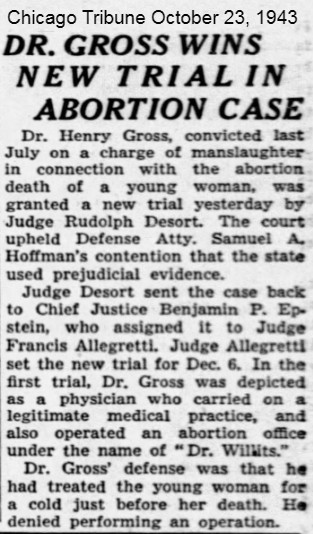
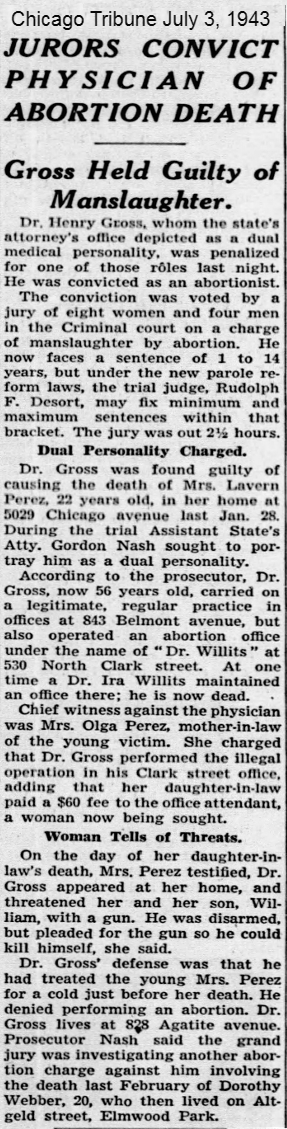
Dr. Henry Gross, age 56, had a reputable medical practice at 843 Belmont Avenue in Chicago in the 1940s. However, after a Dr. Ira Willits died, Gross purchased the dead man's office and set up an abortion practice there under Willits's name.

According to Olga Perez, in January of 1943, her daughter-in-law 22-year-old Lavern Perez went to "Dr. Willits" at 530 North Clark Street for an abortion. Mrs. Perez said that Lavern had paid an office attendant $60 for the abortion. 

Lavern died in her Chicago home on January 28.

The day Lavern died, Mrs. Perez said, Dr. Gross appeared at her home with a gun, which he used to threaten both her and her son. They wrestled the gun away from him, whereupon he begged for the weapon back so he could kill himself. 

Gross had insisted that he'd only been treating Lavern for a cold. However, he was also investigated for the February 26, 1943 abortion death of 20-year-old waitress Dorothy Webber.

A jury of eight women and four men found Gross guilty of manslaughter by abortion in Lavern's death. He won a new trial on the grounds that the state used prejudicial evidence. 

The trail ends there. I've been unable to find out the outcome of the second trial, and Gross doesn't show up again on census records or, as far as I can find, death records.

Watch Abortionist and Dead Women Vanish on YouTube.

Sources:


January 28, 1947: The Lay Abortionist

Twenty-nine-year-old waitress Kerneda Bennett, though living with her husband in Harrisonburg, Virginia, got pregnant as a result of an extramarital affair in late 1946. She asked her friend, Irene Davis, to help her arrange an abortion. Irene called her friend, Iva Rodeffer Davis Coffman, to make arrangements. At around the end of the first week of January, 1947, Kerneda and Irene went to Coffman's home at Mt. Crawford, near Harrisonburg .  

Coffman took Kerneda into a bedroom. "When they came out," according to legal records, "Mrs. Coffman told Mrs. Bennett to come back if nothing had happened in fourteen days, and if anything was said about why they were there to say they came to have a dress made."

About two weeks later, on January 27, Kerneda "had not had the result expected." She asked Irene to contact Coffman again. The two of them took a taxi back to Coffman's home about 7:30 on the evening of January 28. While the taxi was waiting, Coffman took Kerneda back into the bedroom. About fifteen or twenty minutes later Irene thought she heard something fall. A few minutes later, Coffman told her that Kerneda had fainted and asked her to come back to the bedroom. Irene found Kerneda lying, groaning, face-down on the floor beside the bed, dressed except for her shoes and coat. 

Coffman seemed very nervous and said that they needed to get Kerneda to a hospital. Irene summoned the taxi driver, who carried Kerneda out to the cab. Kerneda, who had been nearly lifeless when loaded into the taxi, was dead on arrival at the hospital.

That night Coffman's home was searched, but nothing of evidential value was found. Coffman told the sheriff that Kerneda had asked to use the bathroom, and was shown to the bedroom, and asked for a glass of water. Coffman said she'd brought Kerneda the water, which she had used to wash down two pills from her purse, joking that they were poison. A few minutes later, Coffman said, Kerneda fell onto the floor.

The Harrisonburg/Rockingham County coroner, Dr. Byers, performed the autopsy assisted by Dr. Hill. They found no evidence of external injuries except for a small genital scratch. A piece of tissue from the placenta was in the cervix, a small blood clot was in the vagina, and the uterus was in place, appearing at first to be a normal pregnant uterus with no signs of injury. Upon removing the uterus, the doctors noted a sensation as if the organ contained air. They opened the uterus and found an intact pregnancy with a fetus of about three to four months of gestation. Byers concluded that an abortion had been attempted, which had caused a fatal air embolism. After the embolism killed Kerneda, the baby died as well. He based the embolism diagnosis on the crepitation (feeling as if air was present) of the uterus. Coffman was convicted of performing the fatal abortion and incarcerated to serve a five year sentence. 

Watch The Dressmaker Abortionist? on YouTube.

Sources:

January 28, 1911: Doctor Implicated but Never Tried

 On January 28, 1911, 18-year-old homemaker Lillie Hirst died in Chicago from septicemia caused by an abortion that had been perpetrated less than a week prior. Dr. Aldrich and Mrs. Treshelling were held by the Coroner's Jury and indicted, but the case never went to trial.