Thursday, April 27, 2023

April 27, 1990: Bled to Death in Front of Her Children

SUMMARY: Sandra Milton, age 28, bled to death in front of her three children on April 27, 1990 after an abortion performed by Carl Armstrong at Toledo Medical Services in Toledo, OH.

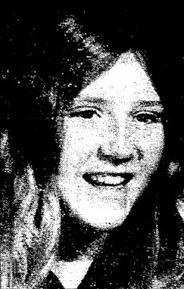
B&W high school yearbook photo of a smiling white teenage girl with long hair parted in the middle
Sandra Milton

On April 27, 1990, 28-year-old divorcee Sandra Earle Milton underwent an abortion, performed by Dr. Carl Armstrong at Toledo Medical Services in Ohio. (Armstrong is John Roe 67 in Lime 5.) Neither her ex husband nor her parents had known that she was pregnant.

Sandra’s abortion was performed at 10 a.m., and she was discharged shortly thereafter for the 90-minute drive home to Sandusky.

The babysitter stayed with Sandra and her three children, ages 10, 7, and 5, for three hours as the young mother slipped in and out of consciousness and suffered pain and abdominal swelling. Twice the alarmed babysitter called the clinic, but was told that the symptoms were normal. The third time the babysitter called the clinic, she got no response at all, and summoned an ambulance. Sandra was pronounced dead on arrival at Fremont Memorial Hospital at 6:01 p.m..

Dr. Carl Armstrong
The medical examiner found a one-inch uterine perforation. Her abdomen was full of blood. She had bled to death internally.

Sandra, who came to the US from England with her family when she was a toddler, had graduated from Fremont Ross High School and worked at a factor assembling household appliances.

Sources:

  • Ohio death certificate Registrar’s No. 158;
  • Fremont News-Messenger 4/29/90;
  • Columbia Dispatch 5/23/90
  • Ohio Post-Mortem Examination Autopsy No. OA-90-8
  • “Abortion debate shifting,” Cleveland Plain Dealer, Sept. 9, 1990


Wednesday, April 26, 2023

Why I Can't Attend a Methodist Church

When I first moved to the area where I live now, I went to Yahoo! Local looking for churches near my new home. My choices are Methodist, Methodist, Methodist, Methodist, Methodist, Catholic, and Mennonite.

That's one of the things I hate about this area -- how thoroughly saturated it is with United Methodist Churches.

What do I have against Methodists? They're proud founding members of the "Religious Coalition for Abortion Rights", an umbrella-group of idolaters. I'd as soon go to a Black Mass as go into a Methodist church. It's a visceral thing, a total revulsion. "Abortion rights" and Christianity are antithetical. Look at the nauseatingly heretical and downright Satanic things people say to justify embracing abortion as a "Christian" thing. It all boils down to ME ME ME ME ME ME ME ME ME ME ME ME with no room for even one's own child, much less room for God.

Abortion is anti-Scriptural, anti-life, anti-love, anti-God.

I can look around at all the wonderful ministries local Methodist congregations have going, but there's always that undercurrent of "But you're cool with KILLING BABIES." Not to mention supporting organizations that lie to women and endanger their lives in order to gain money and political clout by killing babies. That's not something that I can just casually overlook. It's a big honking deal. It's big a deal as if the Catholic Church had responded to the pedophilia scandal with twisted justifications of child molesting and actually promulgated position papers on why the choice to molest children should rest in the conscience of each individual priest and that his choices as a moral agent needed to be respected as holy. At least by covering the abuse up they were showing that they still knew that it's wrong. As inexcusable as the cover-ups were, they were straightforward sin, they were ordinary human sin, ordinary human evil, not an embrace of evil as a right sanctioned by God.

</>soapbox

Tuesday, April 25, 2023

April 25, 1931: Fiancé Arranged Deadly Abortion

SUMMARY: On April 25, 1931, 20-year-old Alma Bromps died in Chicago after an abortion perpetrated by Dr. Thomas Ney.

The Couple 

Bob Berry testified that he met Alma Bromps in September, 1930 when she was nineteen years old. The relationship became sexual in November. They became engaged on Christmas day, and the two went out consistently afterwards.

On about the 15th or 16th of April, 1931, Bob had a conversation with Alma and after that conversation telephoned Dr. Thomas J. Ney at his office, 7110 Stony Island avenue, Chicago. That the same night he went to Ney’s office. Bob said that he had talked first with Mabel Boggs, Ney’s nurse. Ney then came in. Bob, giving his own name as Robert Webster, told Ney that sister was pregnant, that he understood Ney took care of abortion cases, and that he would like to have him take care of this case. Ney said he charged $50 for taking care of such cases and told Bob to bring her up any time. That's nearly $1,000 in 2023 dollars.

Was Bob paying any attention to the news? If so, he would have known that the abortionist he'd chosen for his fiancĂ©e was out on bail pending his trial for the 1928 abortion death of Eunice McElroy. Evidently nobody was keeping an eye on Ney, and he was left free to ply his deadly trade.

The Abortion 

Dr. Thomas Ney
Bob Berry took Alma to Ney’s office next evening. Ney asked if that was the girl Bob had consulted him about, and Bob replied she was. Ney said, “All right” and asked her to come into his private office. Just before he went in he said, “You can pay me now if you want to.”

Bob paid him in cash and asked for a receipt; Ney said he would give him a receipt after he got finished, but Bob never got that receipt.

Bob remained in the reception room while Ney, Mabel Boggs and Alma were in the private office. In about ten minutes the three came out. Bob and Alma went back to Ney’s office on five consecutive nights after that; and several additional times at Ney’s request.

Alma Takes Ill

After the fifth visit Bob took Alma home and she went to bed. The following morning, April 23, she took sick at work and had to go home. Bob saw her in bed at three o’clock that afternoon and called Ney, telling him that Alma was pretty sick and asked him to come and see her.

Ney did not come but Mabel Boggs did. Bob did not see Mabel do anything. He called Ney the next day and Ney and Mabel arrived together and went into Alma’s room. Bob said that he was not in the room all the time that Ney and Mabel were there. Before Ney and his nurse left, Bob asked if Alma was was all right, and Ney said she would be all right and not to worry.

Bob called Ney the next day and told him that Alma did not seem to be getting any better, so Bob wanted to call in another doctor. Ney said not to do that — that he would come and bring another doctor with him. Ney came that night, bringing Dr. William White. Both doctors went into Alma’s room without Bob. Dr. White said that Alma was pretty sick and that they had “better send her to a hospital right away.” Ney agreed, and said “if anyone should ask us any questions, tell them nothing.” He told Bob absolutely not to mention that any instrument had been used at all.

Hospitalized 

At Dr. White’s suggestion, Bob called Dr. William T. Carlisle at St. Luke’s Hospital and Dr. White talked to him. Ney and Dr. White then left. Dr. Carlisle arrived about five minutes later and remained about ten minutes. An ambulance was called and Bob went along with Alma to the Cook County Hospital.

A Witness to the Goings-On 

Katherine Kolb testified that in April, 1931, she ran a rooming house and rented rooms at 2358 Indiana avenue, Chicago. Alma was living there during that month. On the afternoon of April 24, Katherine saw Ney and another doctor come out of Alma’s room, and that she recognized Bob’s voice in the room.

Katherine also said that while they were in the room she listened through the door and heard Alma screaming. Somebody said that they were recommending a doctor from St. Luke’s Hospital and she had to go there, that this doctor was a “cracker-jack” and would pull her out of her condition. She heard the same voice add that they should not say a word to anybody who sent them over there and who treated her or anything.

Katherine asked Ney who he was, and he identified himself as Dr. Snyder. About twenty minutes after Ney and White left, the doctor from St. Luke’s came. Katherine saw Alma being removed. She added that she looked at Alma’s bed been and the bed clothes were soaked with blood.

The Doctors at the Hospital 

Dr. William T. Carlisle testified that he was an assistant in gynecology on the staff of St. Luke’s Hospital. On April 24, 1931, he received a telephone call with reference to Alma from a party representing himself as her husband. Someone else got on the telephone and asked Carlisle to take Alma to St. Luke’s Hospital. He then understood the name of this latter as Dr. Wright but later ascertained it was White.

Carlisle said that Dr. White told him over the phone that his patient had some serious complication of appendicitis. There were no doctors with Alma when Carlisle arrived at her room. He examined her and found her in a stuporous condition, with a markedly distended and tense abdomen. There were blood-stained cloths around her vulva and vagina and stains on the bed clothes. Her temperature was 102 and pulse rapid. Carlisle said that in his opinion Alma was not then suffering from acute appendicitis but that the distended condition of the abdomen at that time was due to generalized peritonitis. He had her sent immediately to the Cook County Hospital.

Dr. Edwin J. DeCosta, resident physician at the Cook County Hospital attending in obstetrics, testified that he examined Alma there. She was acutely ill — practically “in extremis” at the time. Her abdomen was distended, peristaltics were absent and she had free blood inside her abdominal cavity. Her pulse about 141 and her temperature 107. In short, she presented the findings of a generalized peritonitis. DeCosta he examined the vagina, which had a small amount of blood, and that the opening to the womb was dilated.

All efforts to save Alma were in vain. She died on April 25.

Postmortem 

Dr. Samuel Levinson, the coroner’s physician who performed the autopsy on Alma on April 26, 1931 testified that her abdomen was distended, her pubic hairs had been shaved, and upon opening her abdomen he found an excessive greenish-gray sticky fluid in the lowermost part of the abdomen. Her intestines were greenish-red and their covering matted together by a thick, pus-like fluid. The part of the intestines in the pelvic floor region were greenish in color, showing gangrenous changes. Alma had a marked hyperemia in the lungs -- meaning that they had far more blood in them than normal, with clots in the vessels leading to the lungs. Her heart was soft and flabby and the heart muscle cloudy in appearance, showing it had undergone degenerative processes characteristic of a septic condition. Her liver presented a similar septic change and her spleen was enlarged, soft and purplish-red and when cut open the pulp could be scraped away with ease.

Her uterus was markedly enlarged and the cervix was open and very soft, The upper area of the interior of the uterus had placental tissues that had a very foul odor. When Levinson cut into the uterine muscle and applied pressure to it there was free blood and a dirty-looking exudate came out. He was able to press blood out of the fallopian tubes; and when he cut into the ovary there was a large corpus luteum, with several luteum cells surrounding it. The ovary itself was filled with pus cells, showing infection of the ovary as well as of the uterus and tubes.

Levinson preserved the uterus, fallopian tubes and ovaries in a jar and noted that the uterus indicated from its enlargement a pregnancy of three to four months. The upper part of the cervix had signs of instrumentation.

Levinson took tissues of the uterus, fallopian tubes and ovary to make microscopic tests. The section from the uterus showed the wall of the uterus was markedly thickened, and distributed throughout the entire surface of the uterus was pus. The inner lining of the uterus, containing evidence of residual cells, fibers and blood, indicated microscopically placental tissues. The section from the fallopian tubes was covered with pus, indicating an infection of the tubes. The section from the ovary showed large groups of luteum and the ovary itself was filled with pus.

He concluded that Alma had been pregnant; that she had a septic condition of the uterus and that she died of a purulent peritonitis, resulting from the pus going out of the uterus through the tubes into the abdominal cavity and the pus infection getting into the blood stream, producing a septic condition which caused the degenerative changes of the heart muscle and liver and produced an acute septic spleen.

On Trial

Ney’s trial took place while he was dragging out three years of continuances pending his trial for the 1928 abortion of Eunice McElroy.

Ney did not take the stand during the trial. The only witnesses called by the defense were Mabel Boggs and Dr. White.

Mabel Boggs testified that she was a practical nurse and had worked for Ney from June, 1930, to the first part of May, 1931. She had seen Alma at the office of Ney. Bob had been with her the first and second times she came. The next time Boggs saw Alma, she said, was when Ney sent her to Alma’s home. Boggs said that she gave Alma an enema; and that while the enema was being given Bob was in the room next door. Boggs said that she talked to Berry after giving it, saying to him that it looked like appendicitis. She said that Bob said that Alma had chronic appendicitis.

Dr. White testified that he visited Alma at the request of Ney, who told him that she was turning yellow and he was not sure of the diagnosis of the case. White examined her at her room and found her to be suffering from peritonitis and in a serious condition Her pulse was racing at about 152 and her temperature 102.8. He recommended that she be taken to a hospital. Bob, who had introduced Alma as his wife, wanted her sent to St. Luke’s Hospital. White recommended Dr. Carlisle.

White said that he made no vaginal examination and saw no blood, but did notice that Alma’s abdomen was greatly distended. Alma was conscious all the time he was there. He also said that when he went outside he found Katherine Kolb going from door to door trying to block the passage of White and Ney. White told her the case was not to be discussed with strangers.

Legal Fallout 

Ney was convicted in Alma’s death after a belated trial that had been delayed by 25 continuances. Though the state had sought the death penalty, Ney was merely sentenced to 15 years.

The first contention of Ney on appeal was that he was inadequately defended. The appellate judge ruled, "Assuming this to be the case, it does not follow that he can for that reason call upon this court to reverse the judgment. His defense was conducted by counsel of his own choosing."

Ney summarized the alleged shortcomings of counsel at the trial by saying that said counsel “did not object to the conduct of the court in examining in chief at great length the witnesses for the prosecution and cross-examining witnesses for the defense; did not object to the repeated and unnecessary repetition by the court of culpatory evidence by the prosecution after it had been brought out by the court; did not object to the court’s taking charge of and conducting the prosecution, and did not object to the court’s lecturing witnesses and counsel for the defense and using the pronoun ‘we’ therein when and where the pronoun ‘we’ could refer only to the prosecution.”

The judgment of the criminal court was affirmed.


Sources:


Monday, April 24, 2023

April 24, 1937: Deadly Work of Oklahoma Midwife

A glamorous headshot of a beautiful young woman with short, dark hair looking over her shoulder into the camera with her large, wide-set eyes
Merl Williams
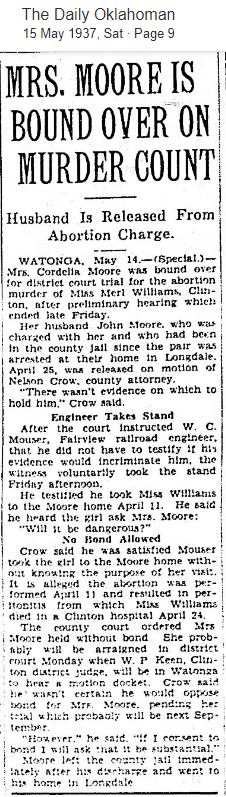
On April 24, 1937, Merl Williams of Watonga, Oklahoma, died of peritonitis. She was 21 years old, a worker in a poultry packing plant. Her death was attributed to a botched abortion.

A midwife, 57-year-old. Cordelia "Della" Moore, was charged with abortion murder. An investigation found evidence that Moore, formerly a registered nurse, had perpetrated hundreds of abortions in her home in Longdale, Oklahoma.

Moore was arrested on April 25 and was held without bond until she was released on $6,000 bond on May 14.  After her arrest, she "unworriedly set her glasses on the end of her nose and continued her quilting in the county jail." Her husband, John, actually got up in his cell and jigged when a jaunty tune came on the radio.

Della's trial was delayed so many times that eventually the judge dropped the bail requirement in August of 1939.

W. C. Mouse, a railroad engineer, testified that he had taken Merl to Moore's 3-room farm house on April 11, not knowing the reason for the visit. He said only that he had heard Merl ask Moore, "Will it be dangerous?" 

Cordelia Moore
The state also gathered 14 additional witnesses in the case against Moore, including women swearing under oath that Moore had done abortions on them. The prosecutors were also investigating the possible abortion death of a married woman a few years previously.

In October, Moore took ill, resulting in a continuance of her trial. At the time she was free on a $6,000 bond.

Cordelia Moore was tried for the crime; her husband, John, was arrested but released. I have been unable to determine that outcome of any trial in Merl's death.

Sources:


April 24, 1893: Racist Coverage of an Abortion Death

An article on the death of 19-year-old Emma Hub underscores the racism of the time. It begins, "Uncle Billy Nickens, a well-known colored character of Hannibal [Illinois], was arrested there yesterday charged with causing the death of Emmy Hub by a criminal operation."

Emma was the daughter of Jacob Hub, a German shoemaker living just south of the Hannibal city limits. Jacob had expelled his daughter from the house due to "her wild habits", so she had moved in with a painter named Mathew Seoville.  Around April 15 of 1893, Emma took ill, and was tended by a Dr. Ebbits. Ebbits suspected an abortion and refused to treat Emma until she admitted to it. "She continued to grow worse until death relieved her suffering at 1 a.m. yesterday" -- that being April 24.

Emma had told Mathew Seoville and his wife that she had gone to Nickens' house, where he had used instruments on her to cause an abortion. She said that a girl from Illinois was also there for an abortion. Mathew had pressed Emma to write up a declaration.

The fatal abortion was reportedly Emma's second; the previous had been performed the previous October. She also had given birth to a child about two years earlier.  The article notes that Nickens was arrested, adding, "The negro has been brought up on similar charges before, but always managed to clear himself."

Watch Racist Coverage of Abortion Death on YouTube.

Source: “Arrested for Abortion”, The Quincy Daily Journal, April 25, 1893

April 24, 1920: Scanty Info From Homicide in Chicago Database

On April 24, 1920, Emma Shanahan died at Chicago's St. Anthony Hospital from an abortion perpetrated by a person who was not identified. Most abortionists in Chicago in that era were doctors or midwives, which makes it likely that Emma availed herself of one of these trained medical professionals.

April 24, 1932: One Day, Two Doctors, Two Deaths

Poor qualilty profile shot of a middle-aged white man with eyeglasses.
Dr. J. W. Eisiminger
Virginia Lee Wyckoff, a University of Oklahoma student, age 21, died from complications of an abortion on April 24, 1932 Hers was one of a string of deaths in the city that year. 

Dr. J.W. Eisiminger, an osteopath, was tried and convicted of murder in Virginia's death. He admitted to having treated her in his office on April 3, but said that he didn't believe she was pregnant. Nevertheless, Virginia spent several days in a private home where Eisiminger kept recovering abortion patients under the care of Mrs. Luther Bryant Price. Dr. Richard Thacker, who had an abortion patient of his own die on April 24, 1932, also used Mrs. Price's home as a recovery center for his abortion patients.

Virginia was transferred from Mrs. Prices's home to Oklahoma City General Hospital, where she died of septicemia, first having told doctors there that Eisiminger had performed the fatal abortion.. A deathbed statement absolving Eisiminger was proven to be a forgery.

Eisiminger was sentenced to life in prison after pleading guilty to murder in her abortion death. The sentence was later reduced to 15 years.

A white man of about 60 years of age, with a very high forehead, large nose, and grim facial expression
Dr. Richard Thacker
Thacker's trial for the April 15, 1932 abortion death of Ruth Hall brought out testimony concerning the death April 24 death of 25-year-old Lennis May Roach and of other patients, including Robbie Lou Thompson, and Nancy Lee.

Mrs. Roach had come to Thacker's office several times, he admitted. Thacker said that she had been in poor health and emaciated, and had a white discharge, indicative of infection, from her vagina. She also, Thacker said, had pains in her abdomen. Thacker said that he treated her with a tonic and with antiseptic tampons.

He adamantly denied that he had performed an abortion on her. However, other witnesses, including Mrs. Roach's husband, testified that Thacker had indeed performed an abortion on Mrs. Roach, causing her death. Thacker was only prosecuted for Ruth Hall's death and was sentenced to life in prison. This is probably why he wasn't prosecuted for any of the other deaths. He died in prison in 1937.

Sunday, April 23, 2023

When the Products of Conception Really Are Just Tissue

Two common prochoice euphemisms for the fetus destroyed by abortion -- "products of conception" and "pregnancy tissue" -- really do accurately apply in those unusual circumstances when there is no fetus present in a pregnancy.

The two conditions in which a woman shows all the symptoms of pregnancy but is not sheltering a new human being are gestational trophoblastic disease (GTD) and blighted ovum.

In GTD, the conception results in what is called a "hydatidiform mole." This is a cluster of tissue with an appearance somewhat similar to a bunch of grapes. In blighted ovum, a placenta and amniotic sac form, but there is no fetus in the sac. Some researchers seem to believe that a blighted ova is caused by the same abnormal conception process that causes hydatidiform moles. Others say that they are two different kinds of abnormalities.

Actually, the existence of hydatidiform moles underscores the prolife position. One need only compare a fetus with a molar pregnancy of the same gestation age to see very clearly the difference between "pregnancy tissue" and a viable embryonic human being. In fact, even in a partial mole, there is a clear difference between the doomed fetus, which is recognizably a fetus, and the molar tissue (Warning: Very graphic!). For those of you with a strong stomach, here are a removed mole, a blighted ovum opened after it was expelled, and aborted fetuses, for your comparison:

Hydatidiform Mole
Blighted Ovum
First Trimester Abortion Photo (Warning: Very Graphic!)

You can see that the mole really is just a blob of tissue. Ditto for the blighted ovum. Nobody is going to be harvesting lungs, liver, thymus, long bones, or neural tissue from either because there are none. When there is a tiny human being present it's different. No matter how thoroughly shredded the embryo is, you can still see recognizable human body parts, such as arms, legs, hands, feet, and face. Only the degree to which the organs are damaged would stop a procurement company from harvesting a heart or a head.

To reiterate for the benefit of the terminally clueless: Prolifers don't oppose removing tissue. We oppose killing fetuses. Any questions?

Saturday, April 22, 2023

April 22, 1923: Doctor Indicted for Chicago Death

On April 22, 1923, 30-year-old Daisy Anna Singerland died at Chicago's Robert Burns Hospital from complications of a criminal abortion performed earlier that day.  On June 1, 54-year-old Dr. James W. Lipscomb was indicted for felony murder in Daisy's death. I have been unable to determine the final outcome of the case.

Watch From the Homicide in Chicago Interactive Database on YouTube.

April 22, 1910: Lingering Death at Cook County Hospital

"Phyllis," identified in the source document as "Mrs. M.," was 46 years old when she had an abortion performed by a physician in Chicago on or around April 4, 1910.  The abortion was followed by pain, fever, and hemorrhage. On April 18, about two weeks after the abortion, she was admitted to Cook County Hospital with a pulse of 102, respirations of 24, and fever of 102. She was in a stupor upon admission, with her tongue dry and furred. Her abdomen was distended and tender. Her liver was enlarged. The lower lobe of her right lung had sounds indicating the presence of fluid.  That evening, Phyllis became delirious and had to be restrained to her bed. Staff were unable to record a pulse for her, but her temperature had risen to 102.4 and her respirations were a racing 50 per minute.  Phyllis died on April 22 from peritonitis and septic pneumonia.

April 22, 1920: Chicago Midwife's Fatal Work

On February 19, 1920, 40-year-old midwife Mary Simkus evidently perpetrated an abortion on 28-year-old homemaker Sophia Krawczyk in the Krawczyk home.  After the abortion, Sophie took ill. Eventually she was taken to Cook County Hospital, where she died from sepsis on April 22.  Simka was indicted for Sophie's death, but for reasons I have been unable to determine the case never went to trial.

Friday, April 21, 2023

April 21, 1955: Pro-Choice Icon's Forgotten Victim

1970s photo of a 30-something white man in a classroom, wearing a white turtlenedk under a dark, double-breasted jacket and holding what looks like some sort of plastic medical instruments
Self-styled "Doctor" Harvey Karman
Nearly two decades before the "Mothers Day Massacre" pulled off with Kermit "House of Horrors" Gosnell in Philadelphia, 30-year-old Harvey Karman was working at the University of California at Los Angeles, seeking a doctorate in psychology. At times he claimed that he was an instructor at the university, but his instruction duties were likely limited. 

He was not licensed to practice medicine.

The Abortion

Around early February of 1955, 26-year-old Joyce Yvonne Maynard Johnson told her husband, Ben, that she was pregnant. The couple already had two children, and they discussed an abortion. Ben was friends with Harvey Karman. Karman had a passion for writing, inventing, performing medical experiments on rattlesnakes, and, as we already know, abortion. He agreed to perform an abortion on the young homemaker. His fee was $150, which was a substantial sum for somebody whose only income at the time was $180 a month for tutoring teens in remedial reading. 

On April 6, 1955, Karman met Joyce in a motel room in Westwood, California while Ben waited outside in the car. Using a speculum, Karman inserted a nutcracker into Joyce in order to perform an abortion. Karman walked Joyce out to the car, he said, and told Ben, "Get her to a doctor." He reportedly returned the $150 abortion fee to cover Joyce's inevitable medical bills.

On April 8, Joyce's husband took her to St. Joseph's Hospital. She was examined by a Dr. Moss who diagnosed her as suffering from "an infected criminal abortion." The dead fetus was still in her uterus. She expelled it while at St. Joseph's.

On April 13, Joyce was transferred to General Hospital for specialized treatment. She died there on April 21. An autopsy was performed, and Joyce's death blamed on bronchial pneumonia brought on by the septic abortion.

Karman was arrested. He admitted to perpetrating the abortion but said, "I only did it because she begged me to do it." Then again, Karman clearly needed the money.

The Trial

During the trial, a photograph of the autopsy was available, but the district attorney didn't display it. He instead told the jury, "you can look at it up in the jury room if you are so inclined--it's an autopsy picture--I'm not going to show it to you because some people don't like to see things like that--she was 26 years old April 6th. She was a girl in good health. She was pregnant. She wanted to do something about having an abortion for this pregnancy."

The district attorney also told the jury, "Frankly, I don't know how you feel about this matter of abortion--it is a matter of difference of opinion. Some people say well, people can't afford it, it's all right to have an abortion. Some people say if the woman's health won't stand it it's all right to have an abortion. Our law says it's all right to have an abortion if her health is of such nature she can't have a baby. Some people think abortions are all right. Some people are absolutely against all of them. If you want to know the truth, I'm pretty much against all abortions myself, I think it's a terrible thing for a girl to be talked into this."

Harvey was convicted on the illegal abortion charge but acquitted on the accompanying murder charge for a reason that would only make sense to a jury. He was given a one-to-ten-year prison sentence.

The Appeal

The appeals court found it "improper for the district attorney to express his personal belief as to all abortion," but noted that since the jury was admonished to ignore the comment Karman had no grounds for appeal in the fact that the DA made the comment.

Karman's defense called a Dr. Gilbert as an expert. He reviewed the autopsy report and medical records, an opined that Joyce did not die from a septic abortion. He was paid $150 for his testimony, ironically the same amount Joyce paid for the abortion.

The defense also appealed on the grounds that the the DA unduly prejudiced the jury by bringing out in cross-examining Karman that he'd been convicted previously of a felony. The appeals court ruled that this was proper impeachment of a witness.

Karman's defense further argued that Joyce's husband and friend, Patricia, were improperly granted immunity after they originally refused to testify.

Karman's defense also claimed that the prosecution failed to prove that the abortion wasn't necessary to save Joyce's life. But the appeals court found that the testimony of Ben and Patricia that Joyce had been in good health settled that matter. Of course, pure logic would prove that matter, since Joyce was seeking an illegal abortion from an amateur in a motel room. Had her life been in danger, an ob/gyn would have been able to admit her to a hospital and perform the abortion there.

An appeals court found that the district attorney's statement that what defendant did was "absolute butchery" was fair argument on the facts, and not an unduly prejudicious statement. It came out in the case that Joyce's husband was dating another woman and therefore had an interest in Joyce securing an abortion.

The Pardon

Though Karman had finished serving his sentence before Jerry Brown was sworn in as California Governor in 1975, Brown was enamored enough of Karman's work to issue him a pardon.

Joyce's abortion was unusual in that it was performed by an amateur, rather than by a doctor, as was the case with perhaps 90% of criminal abortions. However, it also stands out because Harvey Karman was treated like a real doctor by the abortion establishment. He was invited to train abortionists, and was celebrated by abortion advocates for having invented a suction cannula designed specifically for early abortions. Despite being an amateur, and despite the death of Joyce Johnson and the fiasco in Philadelphia, on his death Karman was eulogized as a champion of safe abortions.

Watch Pro-Choice Icon's Forgotten Victim on YouTube.

Sources:

April 21, 1912: Mystery Abortion in Chicago

In the morning of April 21, 1912, 38-year-old Mrs. Grace Peters died at Columbus Hospital in Chicago. She had been taken to the hospital after having taken very ill in her home the previous Thursday.

When asked who had perpetrated the abortion, Grace refused to say. There was some conjecture that she had perpetrated the abortion herself.

Source: "Criminal Operations are Fatal to Two Women," The Inter Ocean, April 22, 1912


Thursday, April 20, 2023

April 20, 1987: One of Three Deaths at Chicago Abortion Mill

A middle-aged white man wearing large eyeglasses
Dr. Dusan Zivkovic
Brenda Benton's survivors sued Biogenetics after her death, claiming that Dusan Zivkovic and/or V. Perez had performed a safe and legal abortion on her on March 13, 1987. She was placed under general anesthesia for the abortion. After she was discharged, Brenda developed fever, chills, and back pain.

The suit says that 35-year-old Brenda returned to Biogenetics to report these symptoms on March 27, and that Zivkovic examined Brenda and performed a D&C before transferring her to Martha Washington Hospital. There, Brenda's survivors say, Zivkovic called in other doctors for a consult. They then transferred Brenda to Rush-Presbyterian St. Luke's hospital on April 6. She died there on April 20.

Her death was due to infection and "overwhelming septicemia." Brenda's family said that Zivkovic failed to failed to determine that Brenda had had an adverse reaction to drugs he'd given her, and failed to detect and respond to her medical emergency. An expert opinion on the case attributes Brenda's death to inappropriate follow-up, and septicemia leading to fatal complications. Brenda's death certificate attributed death to hepatic necrosis due to toxicity reaction to abortion anesthesia.

"Susanna Chisolm" (1975) and Synthia Dennard (1989) also died after abortions at Biogenetics.

Watch He Could Have Saved Her on YouTube.

Sources: Sources: Cook County Circuit Court Case No. 89L 2906, Death Certificate No. 607697a

April 20, 1912: Pharmacy Clerk's Efforts Prove Fatal

On April 20, 1912, 19-year-old actress and newlywed Ruth Fox died at her Chicago residence from septic peritonitis caused by an abortion perpetrated, possibly there and on that day, by Frank J. Schwartz, a pharmacy clerk. He was arrested and held by the Coroner on May 2, and indicted by a Grand Jury on November 25, but the case never went to trial. Dr. Samuel T. Baldridge was arrested but exonerated after testimony at the coroner's inquest. It is unclear why, with all the physicians and midwives running thinly-veiled ads for abortion practices, Ruth instead went to somebody who had only marginal training in a medical field.

April 20, 1933: A Doctor When the Pills Didn't Work

 In Seattle, Washington in February of 1933, Mary Agnes McNeil, a 22-year-old unmarried grocery store clerk, discovered that she was pregnant. Mary informed her boyfriend of the pregnancy, and he got her some pills supposed to cause an abortion, but they didn't work. She tried another round of different pills in March.

On April 8, Mary went to a nursing home operated by a nurse to ask about an abortion. The nurse informed the woman and her lover that Dr. E. T. Martin or another doctor would be able to perform an abortion.

On April 11, Mary's boyfriend went to Dr. Martin's office and consulted with him. On Dr. Martin's instructions, Mary's boyfriend brought her back the next morning, a Wednesday, for an examination. Mary was in Dr. Martin's office for about half an hour. Dr. Martin then told Mary's boyfriend that the total fee, including a stay at the nursing home until Saturday night, would be $75. He then instructed the boyfriend to take Mary to the nursing home, which he did that afternoon.

On Friday the 14th, Dr. Martin performed a curettage on Mary to remove the fetus. The nurse claimed that she had no idea what Dr. Martin was planning to do.

After the D&C, Mary became alarmingly ill. Dr. Martin said that he himself was not in proper physical condition to care for the patient, so he summoned a Dr. Templeton. Dr. Templeton evidently cared for Mary at the nursing home until April 19, a Wednesday, when he advised staff to transfer Mary to Virginia Mason hospital. She died the following morning.

Dr. Martin, with some corroboration from the nurse, said that Mary already had a rapid pulse and fever when she first consulted with him. He also said that she was bleeding vaginally already. Dr. Martin said that Mary had told him she'd missed three periods, taken abortifacients, had fallen, and had a chronic bowel condition.

Dr. Martin testified that he'd recommended hospitalization, but that Mary wanted to avoid the possible publicity surrounding a hospitalization. It was then that he'd decided to send her to the nursing home instead. He also testified that she'd been bleeding from the 12th until the 14th, when he'd performed a curettage. He said that this curettage was necessary to treat her fever and bleeding.

Dr. Martin was convicted of manslaughter in Mary's death, but the nurse was acquitted.

April 20, 1939: Dillinger's Doc Does Fatal Abortion

Poor-quality newspaper photograph of a mostly bald, middle-aged white man, in profile
Dr. Clinton E. May
Dr. Clinton E. May had crossed paths with the law when he harbored John Dillinger. In an apparent attempt to keep a low profile, he relocated to California after his release and didn't bother to get licensed to practice medicine, but rather set up housekeeping, and an abortion practice, with a woman in San Francisco using the aliases Cy Dalton and Miss Ralston,

On April 12, 1939, a woman called St. Joseph's Hospital and anonymously told a doctor there that a woman had suffered uterine damage in an abortion. The doctor said to send the woman to the hospital immediately.

The woman, 30-year-old Doris Alexander, arrived at the hospital in a taxi. She was in critical condition. There, she told hospital staff, her husband, and the police about the abortion. Based on the information Doris had provided, police raided Clinton May's apartment the following day, finding a makeshift operating table, abundant surgical instruments typically used in abortions, and parts of a human fetus of about three or four months of gestation that was not Doris' fetus.

May was arrested and taken to the hospital, where Doris tentatively identified him. She never mentioned a woman being involved in the abortion. Doris died on April 20, and police arrested a woman named Frances Zoffel, whom they said was the mysterious "Miss Ralston."

May and Zoffel were charged with murder and conspiracy. May was convicted of second-degree murder, Zoffel of conspiracy. Zoffel was able to get a new trial on the grounds that she was not "Miss Ralston" and that there was no evidence linking her to May's practice, although she had been implicated in abortion rings in the past and would be implicated again in the future.

Wednesday, April 19, 2023

April 19, 1977: Fatal Abortion at San Jose Hospital

Mary Paredez was 26 years old when she underwent an abortion at San Jose Hospital on April 19, 1977.

During the procedure, Mary's uterus was perforated. She began to hemorrhage.

Less than seven hours later, she was dead.

The autopsy found 2500 cc of blood in Mary's abdomen.

Watch Fatal Abortion in California Hospital on YouTube.


Sources: California Death Certificate No. 77-051142; Santa Clara County (CA) Autopsy Report No. CA77-364

Tuesday, April 18, 2023

April 18, 1944: Abortion-Rights Death Claim Confirmed

I stumbled across a video about a self-induced abortion death -- one I was able to verify by searching for a death certificate. Winifred "Win" Mayer died on April 18, 1944, at around 2:00 in the afternoon. Her death certificate attributes her death to shock "due to attempt at criminal abortion self inflected." She was in the second month of her pregnancy. The autopsy showed cuts in her uterus, hemorrhage, and congestion of her lungs, liver, and kidneys.

According to the YouTube video, Win was living in military housing in Virginia with her husband and two small children. Her husband, Eddie, worked for the government was about to be deployed overseas for an undetermined amount of time and Win didn't feel prepared to care for a third child while he was away. She already had a son, Peter, who was not quite three years old and a 10-month-old baby girl, Judy. Win was college educated and financially comfortable, according to her granddaughter.

Win's mother, her granddaughter says, was a nurse in New York. Win travelled to New York to use her mother's connections with doctors who performed criminal abortions. For some reason this arrangement fell through. Win's father, who was a doctor, refused to perpetrate the abortion. Win's daughter said that Win's French stepmother told her that women in France "take care of this themselves." Win returned to Virginia.

Whether she got specific instructions from her stepmother or another person or just came up with an approach on her own, Win put the children down for their naps, went into the bathroom, and attempted the abortion. Eddie came home after work and found her dead.

Monday, April 17, 2023

April 17, 1998: Unheeded Pleas, Hemorrhage Death

Those insist that 
legalization of abortion is necessary to keep our daughters safe might want to speak to Lou Ann Herron's father, Mike Gibb, who silently wept in the courtroom as he listened to witnesses describe how his 33-year-old daughter bled to death on April 17, 1998  after a late abortion at the now defunct A-Z Women's Center.


Seven Ultrasounds

Medical assistant Sylvia Aragon wept on the witness stand as she said that Lou Ann's pregnancy was "too far along" for an abortion. The ultrasound Aragon did on April 9 showed a 26-week fetus, but Dr. John Biskind kept ordering more and more ultrasound scans to try to get one that would document the pregnancy as being early enough for the abortion to be legal. A total of seven ultrasounds were done before an estimate of 23 weeks was obtained the day prior to the abortion. 

Lou Ann's Pleas

The abortion was performed at 1:30 p.m. Biskind, his lawyer said, noted a small amount of blood on the sheets when he checked on Lou Ann after the abortion, but that he was not concerned because bleeding is normal after an abortion. Two medical assistants, however, testified that Lou Ann was very frightened about her condition as she lay in recovery. She became combative and anxious. She reported that her legs were going numb. She cried out in pain as she lay in a puddle of blood, begging to know what was wrong with her. These, emergency physician John Gallagher noted, are all clear signs of severe blood loss. 

Gallagher, who trains paramedics for the Phoenix Fire Department, said that the records he reviewed clearly indicated that Lou Ann's condition was life threatening and that Biskind should have recognized the severity of her injuries. Her medical records clearly indicated serious trouble at 1:25 p.m., 16 minutes after Lou Ann had been taken to the recovery room. Gallagher said that had he been treating Lou Ann, he would have ordered more IV fluids and blood immediately, and summoned an ambulance to take her to a hospital where she could be treated in a properly equipped operating room.

Lou Ann Herron
Instead of recognizing the danger his patient was in, Gallagher noted, Biskind instead tried to calm Lou Ann and reassure her that she would be "just fine." He tinkered with her IV (complaining that there was no qualified nurse on staff to do this), and left the building at around 3:45 p.m..

Clinic administrator Carole Stuart-Schadoff had a staffer page Biskind 25 minutes later when Lou Ann's condition worsened. Biskind did not return to the clinic, but told staff to call 911. Prosecutors estimate that by the time paramedics were summoned, Lou Ann had lost 2 to 3 liters of blood.

What the Medics Found

When the rescue crew arrived, Phoenix fire captain Brian Tobin testified, Lou Ann appeared to be dead. Nobody at the clinic seemed aware of how grave her condition was, he said, and nobody seemed to be helping her in any way. The only thing that anybody had done for her was put on an oxygen mask. 

Evidently somebody had removed Lou Ann's IV, because there wasn't one in place to allow life-saving medications to be administered. Nobody had put in an endotracheal tube and started "bagging" her to ensure that her body was getting enough oxygen to sustain life. "I very quickly felt that there wasn't a lot of competent medical care going on at the time," Tobin said.

Staff told rescuers that Lou Ann's vital signs were pulse 100, and blood pressure 90/50. "It was very difficult for me to believe that they could get the vital signs of a woman who, even as we walked in the door, looked really dead," Tobin testified.

Lou Ann was pronounced dead a the hospital.

Biskind Held Accountable

John Biskind
Biskind surrendered his license to practice medicine in Arizona after Lou Ann's death in order to stop an ongoing medical board investigation of the circumstances and his handling of the case. However, this was not enough to stop the police investigation. Both Biskind and the clinic's administrator, Carol Stuart-Schadoff, were charged with homicide.  A jury of seven women and one man immediately agreed that the defendants were guilty. It was simply a matter of deciding which charges they were guilty of: the manslaughter charge, or the lesser charge of negligent homicide. It took them 4 1/2 hours to conclude that Biskind was guilty of manslaughter, Stuart-Schadoff of negligent homicide.

Only after the trial was over did members of the jury learn of Biskind's history of misconduct, including the previous death of abortion patient Lisa Bardsley. The jury foreman said that this information "makes me feel better about my decision."

One guilty party, however, was not held accountable: The clinic's owner, Moshe Hachamovitch. Hachamovitch himself performed fatal abortions on Tanya Williamson, Luz Rodriguez, and Christina Goesswein. Jammie Garcia died after a safe and legal abortion at Hachamovitch's Texas facility. That's a total of six dead patients either at his hands or under his supervision.


Sources:


Sunday, April 16, 2023

Top Ten Signs That an Abortion Facility Isn't Safe

Abstracting thousands of abortion injury cases has taught me a few patterns about how to spot a seedy clinic or quack abortionist. Please remember, though, that you enter any abortion facility at your own risk. Just because you don't notice any of these signs doesn't mean the place is necessarily safe. It's just that these particular signs should set alarm bells ringing in your head about the place. You'll probably want to investigate further or go someplace else. An easy place to start is the AbortionDocs website, where they gather any and all documentation they can find about abortion practices and practitioners. Good, bad, or indifferent -- if it's connected to the person or place, AbortionDocs will share it. This can't guarantee safety, but it can at least warn you away from places that have documented problems.

Some of these things might seem so outrageous you'd wonder how anyplace could operate doing these things. And you might marvel that women don't just turn around and walk out when they see some of these things. All I can say to that is that I've seen the documentation myself. These kinds of things do, indeed, happen. The mantra of "safe and legal" has led to a false sense of security. Many women dismiss their fears about the clinic or the doctor because they assume that somebody must be overseeing the place, or it wouldn't be operating openly. This is not necessarily the case.

In the order you're most likely to notice them:

1. The person who answers the phone when you call for an appointment verifies your pregnancy and tells you how many weeks pregnant you are.

You can't make diagnoses over the phone, for one thing. And even professional pregnancy tests, much less the ones you buy in the grocery store, can give false positives. For another thing, even with an examination, a practiced doctor can be several weeks off in his estimate of how far a pregnancy has progressed. In facilities that pay the doctor on a sliding scale according to how advanced the pregnancy is, the final determination of his pay is typically made after the abortion, by comparing a fetal foot to a chart. If that kind of accuracy is necessary to determine how much to pay the doctor, how can they do your informed consent and counseling based on a guess made over the phone?

2. The prolifers outside are handing out copies of lawsuits against the facility or the doctor.

This one shouldn't need any elaboration, but women will walk into clinics, copies of malpractice suits in hand and climb on the table anyway. This is probably because by the time they get to the clinic for their appointment, they've gotten into a "Let's just get this over with" mindset and have turned off their emotions and critical thinking skills. Therefore, it's a good idea to bring a companion along who is watching out for your safety. Give him or her the materials the prolifers hand you, with a promise to get you out of there if the place seems unsafe.

3. You are asked for payment in full up front, before any examination or counseling has been done.

As I said in #1, nobody can really verify how far advanced the pregnancy is without an ultrasound -- unless, of course, the abortion is over and they're measuring a fetal foot. How can they answer your questions about risks, the fetus, and the procedure if they don't know how far advanced your pregnancy actually is?

4. You get vague, reassuring answers to your questions.

This might not mean quackery; it might just mean paternalism. But either way, you're being deprived of your right to make an informed decision. Any discussion of risks that doesn't cover failed abortion, hemorrhage, infection, and post-abortal syndrome (the uterus filling with clots immediately after the abortion) at a minimum is trying to gloss over risks and just sell the abortion. If questions about emergencies don't bring out what hospital you'd be taken to and what ambulance service they'd call, odds are nobody will know what to do if there is an emergency. And if you ask questions about the fetus and get answers that don't jibe with what you've seen on pregnancy websites such as BabyCenter, Parents, or What to Expect, they're not being honest with you. How can you trust them with your life if they won't give you truthful answers to simple questions?

5. You hear other patients moaning and/or screaming.

Obviously this place isn't using adequate pain management. Where else might they be skimping?

6. The facility appears dirty and/or disorganized.

A small, cluttered room with a toilet near a portable dishwasher
Combination patient bathroom
and "sterilization room" at
Krishna Rajanna's Affordable
Medicine Clinic

Abortion is a surgical procedure with inherent risks. If they're not keeping the waiting room, counseling area, rest rooms, and hallways clean and sanitary, they're probably not keeping the scrub room, procedure rooms, and other critical areas clean and sanitary either.

7. They can't describe the qualifications of the staff that are attending to you. 

Some places might have a doctor on staff -- on paper. That doesn't mean that the person doing your abortion has ever had any medical training at all. And in places where the doctor is such a quack the staff don't trust him, they might start doing medical procedures themselves because it seems safer that way. If the person about to do your abortion can't answer, "Where did you go to medical school?" as fast as you'd answer, "Where did you go to high school?" he or she might not have gone to medical school at all. The time to find out is before that person sticks sharp instruments into your body. Also, don't take it for granted that the person about to administer anesthesia knows what he or she is doing. Abortion clinics have been caught letting a "hand holder," a receptionist, and a janitor administer anesthesia. If the person standing at your head about to administer drugs can't say that he or she is an anesthesiologist or CRNA -- and say where he or she went to school, you might wind up being yet another anesthesia coma or death. Don't assume that just because the place is operating openly the staff are actually qualified.

8. They don't monitor you in the recovery room. 

Lou Ann Herron:
Pleas for help brushed off

They at the very least should be putting a pulse oximeter on your finger and checking your vital signs every ten to fifteen minutes. There should also be a nurse in the room. Ask for the person's qualifications. If you're not being monitored and you're not sure the recovery room is overseen by a nurse, be ready to call 911 to get help for yourself if you start to become alarmed at your symptoms. Women have died right in the recovery room because their pleas for help were ignored or handled by somebody who didn't know what to do.

10. When you call for follow-up, you can't get through to a human being that will listen to you and take you seriously.

Especially in facilities that rely on "circuit riders," there might not be anybody on staff who has a clue how to deal with complications. The phone might ring to an answering machine. If you are concerned about your symptoms and you can't reach a person, or you feel like you're being brushed off, seek care elsewhere regardless of what papers they asked you to sign before your abortion. When in doubt, go to the emergency room and bring any paperwork you have from the facility. Delays while trying to reach somebody who can and will direct you to proper aftercare can lead to disaster or death.

Watch the companion video on YouTube.