Wednesday, March 26, 2014

BREAKING: 911 Records Show Cleveland Abortion Patient “Not Breathing At All”

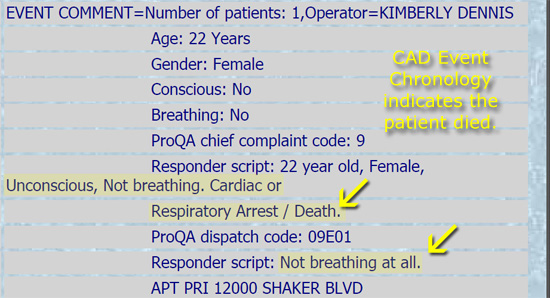
Operation Rescue has obtained a 911 tape and transcript from Friday, March 21. Staff at Cleveland's Preterm abortion facility called an ambulance for a 22-year-old patient who had stopped breathing and was being resuscitated.

Video of the woman being loaded into the ambulance does not seem to show any CPR being performed. It is possible that the caller confused "bagging" the patient (assisting with breathing" with CPR (trying to restore a heartbeat), and that this is just a case of respiratory arrest being addressed.

Since three staff followed -- believed to be a nurse, a doctor, and the office manager -- this seems to indicate attempts to retain control of a living patient. The office manager alone would suffice to do damage control for a dead patient.

I'm praying that this young woman is still alive and will recover.


A Safe-n-Legal Death from 1986

Gail Wright was 29 years old when she underwent a legal abortion. She was 20 weeks pregnant.
After her abortion, she developed sepsis. She died of adult respiratory distress syndrome on March 26, 1986, leaving behind a husband.

Tuesday, March 25, 2014

Fatal abortions of all sorts, from 1848 to 2000

In the late winter and early spring of 1848, 20-year-old Ann Gallager of Boston tried a variety of home abortion attempts, in spite of the attempts of a friend and two doctors, including Dr. John Stevens, to dissuade her.  Eventually she took ill with a severe fever. Prior to her death on March 25, Ann gave a sworn statement blaming the fatal abortion on Stevens.

On March 25 of 1889, in spite of the best efforts of three physicians, Delia Mae Bell of Birmingham, Alabama, died after a sudden, violent illness, eventually traced to an abortifacient purchased from a saloon keeper.


Homemaker Celia M. Schultz, age 29, died in a Chicago home from septicemia caused by an abortion on March 25, 1910. A woman named Mary Rommell was indicted for felony murder by a grand jury. The source document does not indicate her profession, or that the case ever went to trial.

Mary Colbert, age 21, died on March 25, 1933 from the effects of an abortion her boyfriend, Edward Dettman, had arranged at her behest with Chicago abortionist Dr. Emil Gleitsman.earlier in the month. 

Jolene Griffith died on March 25, 1962 of a lingering infection caused by an abortion prochoice hero Dr. W.J. Bryan Henrie, an osteopath, performed at his clinic in Grove, Oklahoma on March 3. According to her survivors, Griffith had abandoned her and provided no care to treat the infection. Henire was convicted, and served 25 months of a 4-year sentence. Upon his release, he went right back to doing abortions. 

On March 25, 2000, 22-year-old Maria Rodriguez went to Steve Lichtenberg at the Family Planning Associates Medical Group's Albany Medical Surgical Center for a late second trimester abortion. At around 9:00 a.m., Maria was showing signs of going into hemorrhagic shock. Rather than transfer to a hospital where there were adequate facilities to determine and treat the cause of the bleeding, Lichtenberg kept Maria at the clinic, where he made various attempts to deal with it himself for an hour and a half. Finally Maria was transported to a hospital, where doctors were unable to save her life. At a National Abortion Federation Risk Management Seminar in the 1990s, Michael Burnhill of the Alan Guttmacher Institute scolded Lichtenberg for "playing Russian roulette" with patients' lives by performing risky abortions in an outpatient setting and treating serious complications on site in his procedure room rather than transporting them to a hospital. Evidently Lichtenberg chose not to listen to Burnhill's warning. Other women to die from abortions at FPA facilities include:Denise HolmesPatricia ChaconMary PenaJosefina GarciaLanice DorseyJoyce OrtenzioTami SuematsuDeanna BellSusan LevyChristina MoraTa Tanisha WessonNakia JordenMaria LehoKimberly Neil, and Chanelle Bryant. FPA is a flagship member of the National Abortion Federation.

Monday, March 24, 2014

Two Doctors, a Dentist, and an Unknown

On March 24, 1870, Catherine Shields died in Jersey City from an abortion perpetrated by Dr. Charles Cobel. "The infamous doctor was arrested, as was also one Patrick Watson, charged with having outraged the person of the unfortunate girl. Cobel was held responsible for the 1856 death of Catharine DeBreuxal, the 1858 death of. Amelia Weber, the 1865 death of Emma Wolfer, and the 1875 death of Antoinette Fennor.

 On March 24, 1905, 28-year-old Ida Alice Bloom, a Swedish immigrant working as a domestic servant, died suddenly in Chicago from septic peritonitis caused by an apparent criminal abortion perpetrated on or about March 15. Dr. Julius N. Goltz as arrested as a principal, and James McDonald as an accessory. Both men were held without bail by a coroner's jury.

 On March 24, 1915, 31-year-old Frances Kulczyk died at her Chicago home from an abortion performed by an unknown perpetrator.

 On March 21, 1947, Ilene Lorraine Eagen, age 24, was brought to Mankato, Minnesota, to the dental office of W. A. Groebner for an abortion. Court records indicate that Ilene was pressured into the abortion by her paramour, Raymond Older, who refused to marry her and threatened her with bodily harm if she refused an abortion. After the abortion, Ilene became violently ill and lost consciousness. Groebner and Older failed to seek or provide properly care for the sick woman. Instead, Older took Ilene to his service station in Granada, Minnesota and kept her there through the remainder of the night, into the morning of March 22. Older allowed Ilene to languish without medical care. She died March 24, leaving a seven-year-old daughter motherless. Older tried to escape civil liability on the grounds that despite his refusal to marry her, and the threats, Ilene had consented to the abortion and that therefore she was responsible for her own sickness and subsequent death.

Sunday, March 23, 2014

Three Deadly Doctors and a Mystery Abortionist

On March 23, 1905, Mrs. Ida Pomering, a 30-year-old German immigrant, died in Chicago from an abortion performed earlier that day. Dr. Apollonia Heinle was held by the coroner's jury for Ida's death.

On March 23, 1907, Mrs. Dora Swan, age 24, died at Englewood Union Hospital in Chicago from infection caused by a criminal abortion. Louise Achtenberg, whose profession is not given, was held responsible by the coroner, but there is no record that charges were filed. Achtenberg, a doctor identified as a midwife due to her obstetric work, had been implicated in the 1909 abortion deaths of Stella Kelly and Florence Wright. She was also implicated in the 1921 abortion death of Violet McCormick. Later, in 1924, it was Dr. Louise Achtenberg who was held responsible for the death of Madelyn Anderson.

On March 23, 1917, 19-year-old Mary Conners died at Chicago's County Hospital, refusing to name the abortionist who had fatally injured her that day.

Life Dynamics lists 24-year-old Lynn McNair on their "Blackmun Wall" of women killed by legal abortions.
LDI notes that Lynn was 23 weeks pregnant when she was injected with saline by Dr. Edward Rubin at Jewish Memorial Hospital. The first injection of saline failed to kill the fetus, so Lynn was given a second injection. After this second dose, Lynn went into contractions and slipped into a coma. She died March 23, 1979 of a pulmonary embolism of amniotic fluid, leaving two children motherless.

Friday, March 21, 2014

Chicago Deaths, 1011, 1016, 1927

On March 21, 1911, 33-year-old homemaker Katherine "Kate" Kammer died of septic peritonitis at German Hospital in Chicago from an abortion perpetrated by a "midwife" around 5 days earlier. For reasons not given in the source document, there was never any prosecution for Kate's death.

On March 21, 1916, 30-year-old Mrs. Anna Krauz died at her home on Union Avenue in Chicago from infection caused by a perforated uterus. An abortion had been perpetrated by midwife Anna Kidicas, who was held by the Coroner but acquitted on trial.

On March 21, 1927, 25-year-old Nancy Dawson, an immigrant from England, died in Chicago from a criminal abortion performed that day. That same day, Dr. J.F. Peck and midwife Christine Sedwig were indicted for felony murder on April 1. Nancy's abortion was typical of illegal abortions in that it was performed by a physician.

Keep in mind that things that things we take for granted, like antibiotics and blood banks, were still in the future. For more about abortion in this era, see Abortion in the 1920s.

external image Illegals.png

Thursday, March 20, 2014

Repost: Where did Gosnell get the idea for "snipping"?

It's a year since infamous Philadelphia abortionist Kermit Gosnell (pictured, left) went on trial for murdering live-born infants at his filthy abortion mill. but where did Gosnell get the idea for "snipping" the necks of live-born infants in order to "ensure fetal demise"? 

Of all the ways to kill a squirming newborn, a scissors to the back of the neck seems a bit arbitrary. It doesn't even seem like the easiest method of "ensuring fetal demise." Even sharp scissors don't just snip through bone the way they snip through paper.

I don't think Gosnell simply pulled the idea of "snipping" out of thin air. I'm guessing he got it from somewhere. I'm guessing that he got it from a highly reputable source. 

I direct your attention, gentle reader, to Martin Haskell's D&X presentation paper to the National Abortion Federation, in which Haskell (pictured, right) teaches this prestigious group of highly reputable providers how to use his new and improved abortion method. This method, like Gosnell's preferred method, involved getting the fetus out entirely in one piece. You might have heard this procedure referred to as "partial birth abortion."

I'll let Haskell explain the method himself:

"...the surgeon takes a pair of blunt curved Metzenbaum scissors (pictured -- ed.) in the right hand. He carefully advances the tip, curved down, along the spine... until he feels it contact the base of the skull.... the surgeon then forces the scissors into the base of the skull.... Having safely entered the skull, he spreads the scissors to enlarge the opening."

That the baby starts out alive, and that the goal of using the blunt, curved Metzenbaum scissors is to to "ensure fetal demise" is pretty clear when one listens to Haskell's presentation and the discussion afterward. He chuckled that the baby sometimes "helps" -- his word -- by wrapping its little arms and legs around the "surgeon's" hand while the scissors are being positioned.

No, the idea of jamming scissors into the back of a living, wriggling baby's neck is not one that is original to the illustrious Dr. Kermit Gosnell. He clearly sat at the feet of the master when he learned how to make sure that the abortion patient doesn't go home with a live baby.

I don't even think that Gosnell came up with the term "ensure fetal demise" on his own. Haskell made reference to two different methods used in late second-trimester abortions to ensure "fetal demise." 

I would also love to know if Gosnell attended this particular gathering of reputable abortion providers. It was held in September of 1992 in Dallas. A peek into this -- and into entire extent of the National Abortion Federation's role in the Gosnell debacle -- would certainly be a more productive use of Congressional time than taking turns carping about whether or not journalists (who should, after all, be outside Congressional influence) are giving the Gosnell story enough coverage. 

Highlighted copy of Martin Haskell's D&X presentation paper at the National Abortion Federation. Highlighted sections show how the scissors are to be inserted into the back of the baby's neck, and note the use of the term "fetal demise."

PS: Please feel free to use these images which sum up the whole matter:


 Now get tweeting!

Tweet for the Gosnell Anniversary

A year ago, Kermit Gosnell, who worked part time at a National Abortion Federation clinic in addition to running his own "house of horrors," went on trial for capital murder for the deaths of live-born babies and of abortion patient Karnamaya Mongar, who was fatally overdosed by his staff.

Let's do some tweeting in his honor -- primarily to remind people that Gosnell was hardly an outlier. I'll do a few, and you can check at #Gosnell to find tweets to re-tweet. Here are some images, links, and ideals you can make use of:

 
How did this go on so long? In a word: #enablers.


Enabling abortion quackery? I call it the Compton-Carr effect.


Amateur and Professional and Equally Deadly: 1906 and 1926

In early March of 1906, Anna Gosch's boyfriend, Mr. Edwards, went to the town of Kearney, Nebraska and got a hotel room with the intent of perpetrating an abortion. Edwards wouldn't say what happened in the hotel room. He did say that the next day he took her to her home, and using a speculum he tried to insert a catheter into her uterus, which at the time was a method often used by doctors to cause an abortion. Edwards, however, couldn't get the catheter inserted. He said that Anna went upstairs and returned with a catheter with a wire in it, which would stiffen it for insertion. He said that the wire did its job in allowing him to get the catheter inserted. He then bent the wire and threw it away. A physician, Dr. Cameron, was called on Thursday, March 15, to care for Anna. He saw her twice a day until the Monday before her death. During that time he consulted with another physician and concluded that Anna was going to die, which she did at about 6:10 p.m. on Tuesday, March 20, 1906, at 6:10 PM. Edwards was convicted of homicide. Anna's death is similar to the death of "Daisy" Roe, a systems analyst who died in 1990 after allowing her boyfriend to attempt to perform an abortion on her with a piece of aquarium tubing.

On March 20, 1926, 19-year-old Alice Annalora died at the County Hospital in Chicago from complications of an abortion performed that day. Dr. Wilford Vine was booked for Alice's death, as was her husband, Joseph Annalora. Vine was indicted for felony murder. Ultimately, the coroner was unable to determine the legal status of the abortion that killed Alice, so Dr. Vine and Mr. Annalora were released.

external image Illegals.png
For more on pre-legalization abortion, see The Bad Old Days of Abortion

Wednesday, March 19, 2014

Criminal Deaths: 1867, 1907, 1916, & 1932

Mrs. Mary E. Noble, age 38, died at her home in New York's 28th Precinct on March 19, 1867. She had been separated from her husband, Ayers Noble of Tarrytown, for about a year. He testified that the split had been due to her being "too intimate with [George Wait] Carson (the seducer). The coroner's jury concluded that Mary had died from pyemia, "resulting from an abortion produced by the prisoner, Wm. F.J. Thiers, alias Dr. Dubois. They further hold Amelia Armstrong, alias Madame Dubois, as accessory before the fact." Carson was tracked to New Jersey and arrested as well for having arranged the abortion for a $10 down payment and pay another $15 after the abortion. "Dr. Dubois" provided care for Mary as she sickened over the course of about a month prior to her death.
 
On March 19, 1907, Mrs. Bessie F. Simmons, age 30, died at her Chicago home from infection caused by a criminal abortion perpetrated on February 22 at the office of Dr. Charles D. Hughes, who was arrested in the death.

On March 19, 1916, 30-year-old Carolina Petritz died at the Chicago office of midwife Paulina Erlomus, who had perpetrated the fatal abortion there that day. Erlomus was held by the Coroner but the case never went to trial.

Geraldine Easley, age 19, admitted before her death on March 19, 1932, that she had undergone a criminal abortion. Since Dr. James W. Eisiminger and Dr. Richard E. Thacker had been responsible for a string of other criminal abortion deaths in the Oklahoma City area, suspicion in Geraldine's death naturally leaned toward the two known quack abortionists.[1] However, to my knowledge the specific perpetrator in Geraldine's death was not identified.


Tuesday, March 18, 2014

Two Criminal Deaths from Chicago: 1913 & 1914

On March 18, 1913, 25-year-old homemaker Mary Brubaker died in her Chicago home on Inglewood Avenue from septicemia caused by an abortion perpetrated that day by Dr. H.W. Case. Case was held by the Coroner and indicted by a Grand Jury April 15, but the case never went to trial.

On March 18, 1914, 28-year-old dressmaker Irene Ridgeway died at Garfield Park Hospital in Chicago from an abortion performed by an unknown perpetrator.

Note, please, that with overall public health issues such as doctors not using proper aseptic techniques, lack of access to blood transfusions and antibiotics, and overall poor health to begin with, there was likely little difference between the performance of a legal abortion and illegal practice, and the aftercare for either type of abortion was probably equally unlikely to do the woman much, if any, good.

In fact, due to improvements in addressing these problems, maternal mortality in general (and abortion mortality with it) fell dramatically in the 20th Century, decades before Roe vs. Wade legalized abortion across America.

For more information about early 20th Century abortion mortality, see Abortion Deaths 1910-1919.

external image MaternalMortality.gif

Sunday, March 09, 2014

Claiming March 10: National Day of Outreach to Abortion Providers

March 10 has been designated "National Day of Appreciation for Abortion Providers" by the abortion lobby. This "celebration" was mainly intended to overcome the powerful negatives of working in abortion. Dr. Rachel McNair has explored the stresses of abortion work in her Achieving Peace in the Abortion War.

Though it was originally launched with much fanfare, it seems to be petering out over the years and becoming more of a day for prolifers to remember abortionists than for prochoicers to "appreciate" them. They've not forgotten that this was supposed to be a day where the people they "help" let them know how much they're appreciated. I picture the abortionists sitting lonely and forgotten, like the Maytag Repairman. This is where we can step into the gap!

Join National Day of Outreach to Abortion Providers!

On March 10, participate in any way you think appropriate to reach out to abortion workers so that they can follow in the footsteps of ex-abortionists and ex-clinic workers like Bernard Nathanson, Carol Everett, and Abby Johnson.

Here are a few suggestions for what people can do to reach out to abortion workers:
  • Send clinic staff letters or emails gently letting them know that though they may have meant well, they hurt you or your loved one.
  • Bring your local staff gift baskets that include information on And Then There Were None, or Clinic Worker.com. Make the gifts real gifts, like gift cards for a restaurant, a nice flower basket, bath salts, and so forth, not phony "gifts" intended to crush the worker's spirit, like dismembered baby dolls, baby clothes, etc.
  • Join the activities of the local 40 Days for Life in your community.
  • Invite your local abortion staff to coffee, to let him or her vent in a safe environment without fear of being labeled a traitor.
  • Write to your local newspaper, and call talk shows, to educate people about how people can provide real help to pregnant women.
  • Tweet, using the hashtags #abortionproviders and #appreciateabortionproviders, inviting abortionists to turn in their instruments of death and instead provide real help to pregnant women.
Keep in mind that we're not dealing with evil people who enjoy killing babies. Yes, there's greed. Yes, there's egotism. But a common underlying motivation is the idea that somehow what they're doing is helping the patients. The typical abortion worker views himself as bravely overcoming his natural revulsion at destroying fetal life in order to better the lives of women.

So what we need to do is break through that illusion.

Friday, March 07, 2014

The Not-a-First First: Abortion/Birthing Center Combo

"Nation's First Birthing Center/Abortion Clinic Opens in Buffalo. This Is Huge."

Thus gushes in her blog on Slate.com. You can read her piece for yourself to get her spin on it. Prolifers, myself included, find the idea every bit as revolting as Marcotte finds it refreshing.

Either way, though, this "first" is not a first. It's been done before.

Abortionist Raymond Showery
Raymond Showery ran a bi-named facility, Southside Medical Clinic or Family Hospital of El Paso. It was an inpatient facility where women could go to have their unborn children either delivered alive, aborted, or, a jury found, both. Showery was convicted of the murder of a baby born alive during an abortion. Shower was out on bail appealing the murder conviction when he performed the safe, legal abortion that killed 28-year-old Mickey Apodaca in 1984.

Ronald Tauber ran Orlando Birthing Center, a combination abortion/birthing facility, where he performed a fatal abortion on Gloria Small in 1978.

There might actually have been others. But the abortion/birthing combo in Buffalo is not breaking new ground. Others have dug that grave before, and buried many a child along with some mothers.

So, Buffalo Women's Service / Birthing Center of Buffalo, pride yourselves if you will on being a one stop fetus-disposition center. But you're not the first. And that's some interesting company you've chosen to keep.

Wednesday, January 15, 2014

Roe vs. Wade Events: Abortion Still Kills Women

With the upcoming anniversary of Roe vs. Wade, life advocates are planning marches, vigils, and rallies across the country. I first saw these tombstone signs in a picture of an Operation Rescue rally in Wichita back in the 1980s. They're a powerful reminder that women are still sometimes paying the ultimate price for the belief that they and their unborn children are mortal enemies.

The signs are easy to make, and now the foam board, that used to cost more than $3 a sheet at office supply stores, is available for $1 a sheet at Dollar Tree. I made a set of 40 for March for Life in DC.

Start by printing out the names, ages, dates of death, and so forth. I find that twice the width of a landscape-oriented letter-sized page is about the width of the sign. I also believe you get a nicer result if you vary the fonts among the signs. You can go to the Cemetery of Choice to choose women by age or date of death. If you want to choose women by location, you can do a search for a city or state. Or you can just drop me a note in the comments and I can email you a set that you can tweak with the fonts you want.

When it's time to cut the signs, you'll need something large and rounded to guide you in cutting the tops. As you can see, I used a Christmas tree stand. A trash can lid, saucer sled, or tray will do as well. Use a razor knife. I would just score the foamboard sometimes. Other times I'd stack the foam board, use a bit more force, and just slice them through. Both ways work just fine -- just be careful that you don't damage your floor.

If you don't cut through the whole way on the first stroke, use the razor knife to cut through the rest of the way to get a nice rounded top. Scissors don't work well; they tend to mash the board and not give you a nice clean cut.

Cut the words for the front from the page where you've printed them. I've found that the double width of a landscape-oriented letter-sized sheet is just the right width. I can't see any real advantage in using legal sized paper, because it's not wide enough for the sign if you use a single sheet, and it's two wide if you go twice the width. Ledger sized paper would probably work well.

Spray adhesive works best. It allows you to reposition the words if you need to. It's inexpensive and available in the craft department of Wal-Mart, though if you prefer you can also get it at craft stores. Just be careful when you spray -- it tends to land on other things around the signs you're working on. Put old newspapers down if you don't want a thin sticky layer of glue on the floor.

With the spray adhesive, you have plenty of time to place the words on the sign. You can move them if you need to. I find that the razor knife works well for lifting the edges for repositioning. Just be warned -- your hands will get pretty gunky with a mix of glue and printer ink.

Print out each woman's story and put it on the back. You can also add copies of relevant documents that I link to, such as medical board disciplinary documents or news clippings. I put pictures on the front when I can get them, with additional pictures on the back when a woman's story has more than one photograph with it.

I also suggest that if there's room, you print out information about abortion deaths over time -- and the fact that legalization had no impact whatsoever -- and put it on the back as well.

The tombstone signs are a real attention getter and are a great educational opportunity for prolifers and prochoicers alike.

Consider printing out different pages so that you're varying the content a bit:

The unmistakable, undeniable, clear impact of legalized abortion on maternal mortality

Did Legalization Make Abortion Less Deadly for Mothers? 

Hiding the Bodies in Plain Sight

The Truth of Pre-Roe Abortion Mortality

Let's prove that dastardly pro-abortion chants about women's lives are a lie.

Monday, January 06, 2014

1905 & 1924: The Fatal Work of Midwife-Abortionists

On January 6, 1905, a young woman was found dead in a ditch near Dunning, Illinois. The body was taken to an undertaking establishment, where it remained until nearly a month later, when the dead woman was identified by her siblings as 28-year-old Ida Vierow. It was determined that she had died on the day her body had been discovered, from an abortion performed in Chicago. Two midwives, Amella Maichrowicz and Anna Becker, were arrested, along with Maichrowicz's husband, Joseph. The Maichrowiczs, who ran an unlicensed hospital in Melrose Park, were arrested near the end of February.

On January 6, 1924, 26-year-old Helen Koss died at Norwegian American Hospital of complications from an abortion perpetrated in Chicago on December 23, 1923. Midwife Mrs. Emma Morch was arrested, and indicted for homicide by a grand jury.

Sunday, January 05, 2014

Four Criminal Deaths -- One Courtesy of Lucy Hagenow

Very little information is available about three of the women whose deaths we commemorate today.

Alphia Robinson, age 18, had been living with a man named Amos Kimberly for about two years in Iowa Township, Iowa. On January 5, 1876, she went up to her room "in a cheerful manner, and in apparent good health," but a few moments later her mother went up and found her dead. The coroner declared that she had died from an abortion attempted by Dr. J. F. Houser of West Branch, Iowa.

On January 5, 1912, 19-year-old Lottie Roeder, who was still in school, died at St. Elizabeth's hospital from infection caused by an abortion perpetrated earlier that day by a nurse/midwife referred to as "Mrs. Theodore Larson." Most criminal abortions not perpetrated by doctors were committed by nurses, midwives, or others with medical training like Larson. She was held by the Coroner's Jury on January 12 and indicted, but the case never went to trial.

On January 5, 1930, bookkeeper Sonia Ragins, age 26, died from an illegal abortion performed at an unknown location by an unknown person. On January 6 the coroner recommended identification and arrest of the guilty party.

Far more information is available about the January 5, 1925 death of 22-year-old factory worker Bridget Masterson, who died in her Chicago home from a botched abortion. Police
Abortionist Lucy Hagenow
were able to question Bridget prior to her death, but she refused to implicate anybody. John O'Malley, a boarder and the father of Bridget's baby, committed suicide by gas after learning of Bridget's death. He left a note implicating "a lady doctor at 310 W. North Ave." This was the address of Dr. Lucy Hagenow. Hagenow was arrested, but it is unclear when, since the date of her arrest is noted as being the day prior to Bridget's death. Hagenow was indicted for felony murder by a grand jury on January 5, 1926.

Hagenow (pictured), who had already been implicated of the abortion deaths of Louise Derchow, Annie Dorris, Abbia Richards, and Emma Dep in San Francisco, would go on to be linked to over a dozen Chicago abortion deaths, including Minnie Deering, Sophia Kuhn , Emily Anderson, Hannah Carlson, Marie Hecht, May Putnam, Lola Madison, Annie Horvatich, Lottie Lowy, Nina H. Pierce, Jean CohenElizabeth Welter and Mary Moorehead. Why Hagenow was able to ply her deadly trade brazenly remains a mystery to me.

Saturday, January 04, 2014

Four Fatal Criminal Abortions

All of the women whose deaths we commemorate today died of criminal abortions. The last woman, however, stands out from the others; she alone was unaware that the person perpetrating her abortion had no legal standing to do so.


Bertie Minnie Hammaremiller, age 19, had lived with her mother on Langdon Street in Chicago. She already had one child to 19-year-old Fred C. Dethloff. On January 4, 1887 Bertie died from a botched abortion. Dethloff, who admitted that this was the third time he'd helped Bertie to abort two other pregnancies with medications in the three years they'd been together, was put on trial for his life.


On January 4, 1921, 21-year-old Jennie Chubb died in her Chicago home from complications of an abortion performed that day. The coroner identified Veronica Rypcznski as the person responsible for Jennie's death. Veronica's profession is not mentioned in the source, nor is there any mention of prosecution.

On January 4, 1924, Elizabeth Strobel died in Chicago's Columbus Hospital from complications of an illegal abortion performed that day. Mrs. Anna Wenzig, whose profession is not given, was arrested January 15 for Elizabeth's death.

On January 4, 1983, Albert Payne got a phone call from a family friend with some shocking news: His 33-year-old wife, Shirley, mother of their three children ages 3 to 12, was dead. "No way my wife is pregnant," Albert had responded. He called the day care center. Shirley had never showed up to pick up the children.  Shirley had undergone what she expected to be a safe and legal abortion at Woman's Care Center in Miami. She suffered a perforated uterus. When paramedics arrived on the scene, they reportedly found Shirley lying on a couch, bleeding heavily. Shirley arrived at the hospital in critical condition due to delay of transfer. An emergency hysterectomy was performed to try to save Shirley's life, but she bled to death in surgery. Ruth Montero, Myrta Baptiste, and Maura Morales also died from abortions at the clinic, owned by Hipolito Barreiro. Trained in Argentina and West Africa, but not licensed in U.S. Barreiro evidently perpetrated Shirley's fatal abortion himself without documenting this fact on her clinic records. 


Tuesday, November 19, 2013

The Banality of Abortion

HT: Jill Stanek

"My Abortion," the New York Times hopes, will "destigmatize" abortion and generate -- um -- I hope they're not shooting for enthusiasm, because these aren't really your upbeat, "Abortion changed my life for the better" tales the collectors of said tales were probably hoping for.

Let's have some examples. (Emphasis mine)
Nicole, 19
Kentucky, 2013
It was this past spring. The due date’s coming up—I’m dreading it. I wanted to keep it. My boyfriend always had football practice, so he couldn’t go to the doctor appointments with me. If he’d gone, he would’ve felt differently. But he said, “No way.” I wanted to show him that I loved him enough to do it for him. When I was thirteen weeks, we made an appointment at the closest clinic in Kentucky, four hours away, but the night before, we decided not to go. At two in the morning, he called and said, “Get dressed.” I said, “I don’t want to go.” We both cried the whole way there. I don’t think abortion is killing, but I’d always been against it. When I told him the credit-card scanner at the clinic wasn’t working, he asked if I was making it up. We went to get $1,000 from a gas-station ATM. I was hysterical, and he said, “Okay, you don’t have to go back.” I was so happy. Then he said, “We drove all this way. Stop crying, act like a woman.” I was angry, but I was so sleepy and tired of fighting. When I had the ultrasound, I asked for the picture and a nurse said, “Seriously?” A month later, he said he regretted it too. When I cry about it, I cry alone. He thinks it would make me sad to talk about, but I don’t want our baby to think we forgot. I’ve never heard of anybody else having an abortion here.
So, that's Example #1: Browbeaten into unwanted abortion by boyfriend, feeling pretty miserable. She needed a friend, not an abortion.
Mira, 29
South Dakota, 2004
The day I got accepted to college, I had a positive pregnancy test. I went to a community health center and said I wanted to talk to a nurse about my options. They told me to leave. The closest three clinics were all 300 miles away. I borrowed my mother’s car. My boyfriend, now my husband, came with me. I honestly don’t remember how we came up with the $700. We left at 5 p.m., after work, and drove to Colorado. It was the dead of winter, cold. Weather can be touchy through the Rockies. We stayed in a hotel in Cheyenne, another $60, but we couldn’t sleep. I felt very on edge. I wished someone I knew besides my boyfriend was nearby. When we got to the clinic, an escort met us at the car and asked if we wanted a bulletproof vest. Inside the clinic, the doctor took my hand and apologized that I had to travel so far. Ten minutes later, it was done.
WTF? She remembers all those details, but there's no real content. No feelings (other than "on edge"), no thought process, no conclusion of anything but her baby's life.

Heather, 32
Tennessee, 2011 and 2013
I already had two daughters. Neither was planned, and it never, ever, occurred to me to terminate those pregnancies. I was brought up with a very religious background. Now I’ve had two abortions, and if my family knew, my relationship with my family would be gone. My first was two years ago. My husband and I were having financial problems and were considering separating. I just had to shut my conscience down. The doctor was grotesque. He whistled show tunes. I could hear the vacuum sucking out the fetus alongside his whistling. When I hear show tunes now, I shudder. Later, he lost his license. A few months ago, I got pregnant again. My in-laws have been helping us out financially, so we have no choice but to involve them in our decisions. They gave us $500 cash to bring to the clinic. I felt very forced. I felt like I was required to have an abortion to provide for my current family. Money help is a manipulation. I’m crazy in love with my daughters—imagine if I did that to them? It’s almost too much to open the door of guilt and shame because it’ll all overcome me. In the waiting room, there was a dead silence that’s hard to describe. Everyone was holding in her emotions to a heartbreaking degree. Truly pro-life people should go light on the judgment, because shame motivates abortions.
Feeling trapped and pressured and forced to violate her own conscience. The first clinic had a creepy quack doctor who ended up losing his license. The second one was like a tomb. Where's the free choice, the caring and compassionate professionals, the liberation?
Mayah, 23
Oregon, 2009
I was secretly excited for the ultrasound. But they couldn’t see it. They said I could let it grow and go back for the procedure, but I couldn’t stand the idea of letting it grow. I went into this refrigerator of a room, with a tiny poster of a tropical island pasted on the ceiling, and this middle-aged white lady nurse told me to breathe and hush. I wanted to sock her in the face. A couple days later, I found out I was still pregnant. The amoeba—my baby—was somehow surviving. The next time, I kind of hoped it wouldn’t work. I kept saying negative things to myself, like, “Stop being such a baby.” Afterwards, I felt this mix of regret, relief, gratitude, and I had a new sense of control and determination about my future, like, I’m going to do this and this and this. I tracked the whole pregnancy online, living in fantasies about how big my belly would be. The only people who would listen to me say I had any emotions were people who wanted me to fall down on my knees and ask for forgiveness. I saw a counselor at a crisis pregnancy center, but she gave me an icky feeling. There’s no room to talk about being unsure.

So many mixed emotions, so much uncertainty. And though she got rid of her baby, she couldn't let go. This is sad.
Janet, 48
California, 1983
When I was 18 I was drugged and date raped. I just remember waking up with the guy on top of me with this weird grin. When I found out I was pregnant I just thought: That asshole. I didn’t think about the baby. I had to save up money, so I had to wait for the very last possible week. My best friend drove me. I was very scared. When I was actually at the facility I thought, Oh my God, there’s a baby inside me. The staff was very matter-of-fact, no kindness. A nurse said, “It looks like it was a girl.”
Recognized that it was a baby, went through the abortion. And the only feeling expressed is disgust for the rapist. Like Mira's, her story is emotionally void.
Abby, 28
New York and Oklahoma, 2010 and 2011
The first time I was 25, in New York. From the time I was a teenager, the idea of having an abortion if pregnant was a no-brainer. I had this idea you can’t let life get in the way of your plans. My friend drove me. The procedure was in a tiny, bright white room—it was like a nightmare, but it was over really, really quickly. They moved me into this communal healing room. Women were reclining on big, pillowy chairs. I remember feeling comforted, warm—we’d all been through the same experience. Two years ago, I was in Oklahoma. I wasn’t given a choice in method—I got the pill. My boyfriend worked in Idaho—I was alone. They gave me all this paperwork that said, “This is serious. You could die,” and an antibiotic, painkiller, and a latex glove and a pill to shove up my vagina. At home, the antibiotic made me vomit and shit everywhere. I thought, Fuck the latex glove! Fuck them for thinking I can’t touch myself! After the contractions started, my hands turned into claws. I was dehydrated. I had this underlying feeling that I was being made to suffer, to repent for my situation. I called my boss. He took me to the ER. It cost $2,000. When I stood up, the bed was covered in blood. I felt ashamed, but the way he reacted with kindness, I saw that I could choose not to feel ashamed. When I went home, I got up to pee, and this gray golf-ball thing came out. I thought, So I just flush the toilet?

The first abortion was "like a nightmare" but at least "it was over really, really quickly." The second abortion, strangely enough, she doesn't describe as a nightmare. But then, she doesn't have to. It's hellish enough without being elaborated on. And again, like Mira's and Janet's stories, it just stops. In fact, it stops with a question that she never answers.
Maria, 38
Pennsylvania, 2003
We had a 1-year-old and a 3-year-old and hadn’t envisioned having more. At first I thought, Well, I love my husband, and we have plenty of money. I had this naïve notion that access to abortion was easy for people like us. I called my doctor, who referred me to someone else because that practice didn’t perform abortions. I’d never thought of myself as someone who goes to a clinic. I called five doctors, each time having to explain how I’d gotten the number, as if I needed some secret code. Pittsburgh has world-class medical centers, but it took a couple of days to get an appointment. Pennsylvania is one of 26 states that require a waiting period between counseling and the procedure. We went back the next day. The staff was great. It felt a lot like a regular checkup but with painful cramping. My insurance covered the whole thing. In the waiting room, my husband said, “Where do you want to go on vacation?” We booked a trip to Spain.
This is, I think, the creepiest story. A stable marriage, enough money, too hoity-toity to go to a clinic like the unwashed masses, and then off to Spain. WTF?
Anya, 36
New York and California, 2003 and 2006
I actively support Planned Parenthood for doing important work, but I was stuck in a waiting room for hours, with young girls, some flippant, some sad, and the doctor was dead-faced and didn’t make eye contact. I woke up in a gurney in the hallway, surrounded by chaos. No one checked on me. About three years later, in L.A., I found out I was pregnant again. There was this lightbulb moment when I realized I had health insurance. I made an appointment at a hospital, and the whole thing cost about $30. On the way, my boyfriend started freaking out, saying, “What if you’re killing my son?” I had him pull over so I could drive. I respect that it was an emotional experience for him. I never think about the abortions. When I tell people, they respond with a panic face, and when I say I’m truly okay with it, they make a second panic face. I end up comforting them. 

Another ringing endorsement for Planned Parenthood. And like so many of the others, she just comes across as emotionally flat.
Lynn, 28
Kentucky, 2012
I called the university health services from the Walmart parking lot and said I wanted the abortion pill, and the woman said, “The abortion pill is illegal in the United States.” I was livid. I said, “That is not correct.” How many young women has she told that to? I went directly to the doctor. The lady administering the pee test said, “Congratulations, you’re pregnant!” and I thought, Congratulations, you’re an idiot! I was in my gym clothes, obviously distraught. The doctor said the abortion pill wasn’t an option in our state. I called clinics all over until I found one a four-hour drive away in Tennessee. I couldn’t have told my family. The two girls I told have kids and husbands; they couldn’t just drop everything and come with me. I drove four hours by myself, thinking about what an idiot I was for stopping birth control. I took the first pill in Tennessee. I took the second one the next day, on the Fourth of July, my favorite holiday. I was expecting something terrible. I watched movies alone. I felt fine and could’ve even gone out, but I’d made up stories about where I was.
Not using birth control. And another emotionless story that just abruptly ends.

These stories are meant to normalize abortion and, I guess, make it seem more okay. Like just another life experience, on a par with having to get major suspension work done on your car. Expensive and inconvenient and well, that's life.

I'm not sure these dismal tales will have their intended effect. In fact, I think the overall effect will be to just leave people oddly disquieted but otherwise squarely where they started.

The whole thing -- all these matter-of-fact tales of dead babies -- is just depressing. Is this really the world people want? Women dully trudging in and out of abortion clinics, not even really sure why they're doing it?

Paint it all gray. Just one uniform shade of gray.


Wednesday, November 13, 2013

What's the Alternative? Choose "Choice"?

They're all a-flutter at the HuffPo over those mean old "antichoice" (their word) organizations getting money from those mean old "Choose Life" license plates.

Of course, the rational, adult response would be to create a plate putting out one's own message. But with what can one counter "Choose life"? Choose Choice?

I decided to revisit the old Choose Choice plates theme by critiquing what's there. Please let me know if there is any update in the status of these plates. And please note that I'm not going to address any of the assumptions behind the plates, just the plates themselves.

To be fair, all of these designs start at a disadvantage. Abortion is not exactly an upbeat thing, like the birth of a new baby, so it's hard to come up with a cheery graphic.

Massachusetts. They seem to be struggling pretty hard with the inherent downer that most people find abortion to be. They just drag out the standard non-approved fetus-dislodger, the coathanger. This is the only plate that in any way acknowledges that the topic in question is abortion rather than the market-tested "choice" that everybody else sticks with. As a result, the plate is simultaneously militant and depressing.
Florida. Adorable! Look how the little aborted baby stars fly up to Heaven while the one little lucky "chosen" star ... floats .....  Um.... Mom? You're not even holding that baby. That's a bit disturbing. I'll push that thought away by assuming that Junior is in a snugli. After all, there's no point in getting your hands all tied up with even a chosen child.


Alaska. Like Florida, they go for the floating-baby theme, though it's hard to say if these parents are throwing the baby or trying to catch him as he flies away. Are they letting him go or trying to hold on? Either way, it strikes me as a bit unsettling in the abortion context. Just as an aside, the people also look a bit like sleds, particularly against the snowy background. This is the only plate I've seen that graphically acknowledges the existence of the father.


Virginia. This seems to still be in the proposal stage and not gracing the Prius yet. Featuring minimalist art like the Florida and Alaska plates, this one is utterly childless. It's hard to tell if the checkmark-woman is fleeing or celebrating. Maybe she's not sure herself. Is that elongated arm holding her back or is she unable to let go?


Hawaii. A ballot graphic with the ambiguous word "choice" is dull and boxy. Placing it atop the rainbow background that's on all Hawaii plates leaves the meaning even more ambiguous. Is it a gay rights plate? What's the driver trying to say? Where did the extra money for the plate go? Maybe it's best not to ask too many questions.


Montana. They're not content with mere ambiguity and are going for a total message-flip. They might actually be hoping to sell these plates to people who like the mother-and-child design and who would never dream that they're taking a stand for abortion rights.


Pennsylvania. The straightforward Planned Parenthood logo lets people know up front where their money will be going. Kudos for the honesty in that, PP, especially considering how little honesty your organization is known for overall. Pennsylvania plates typically have much more dynamic designs, so this one took zero effort, as if they just couldn't be bothered.


These are the only plates I've been able to find. I'd love to list more.

*******

This last plate is totally unrelated to the  post but I spotted it and found it amusing, if somehow darkly ironic, considering the search that produced it:

Saturday, November 09, 2013

NARAL's latest Human Shield: Dana Weinstein

What kind of organization takes a devastated, bereaved mother and uses her as a human shield to protect their allies' political and financial interests?

The name of the organization is NARAL Pro-Choice America. The bereaved mother is Dana Weinstein.

Dana's pain is very real, as is the pain of women in similar situations. What compounds the tragedy is that her horrible anguish is being used for the political and financial gain of abortion practitioners and the political organizations they work with and through.


Using this poor woman as a human shield is absolutely despicable. This woman has been lied to at every turn by people she trusted.

Anencephaly does NOT cause the baby pain. Dana did NOT have to be alone, because perinatal hospice is available. Serious fetal problems are a MINORITY of the reasons for late abortions. This woman had already been abused by her health care providers and by Warren Hern who charged her thousands of dollars to kill her baby. She doesn't need to be exploited by people who are afraid of being called out on their lies and instead put them into the innocent mouth of a bereaved mother.

There are three important responses to this appalling exploitation:

1. Hold Dana's health care providers accountable for lying.

Dana was already traumatized beyond what any mother should have to endure in learning that her baby was going to die. It was an unconscionable act of cruelty to then tell her the flat-out lie that anencephaly would cause her baby pain. Though there is disagreement as to what, if anything, babies with anencephaly feel, the range of possibility runs from "the normal sensations any baby would feel" to "no sensations at all."

What possible justification could anybody have for lying to Dana, when she was already staggering beneath the horrible blow of devastating news? What justification could there be for adding to her anguish? Wasn't she already suffering enough? In fact, she was told that her only choice was abortion.

We can't know why the health care professionals in Dana's life chose to heap false horror on top of real tragedy. We do know, sadly, that this is not at all uncommon. Doctors -- such as the doctors these women had to deal with -- need to start being held accountable for bullying their patients.

2. Hold Dana's health care providers accountable for failing to provide appropriate care.

It's long been well documented that many women have very poor emotional and psychological results from abortions. Certain risk factors make it more likely that the woman will suffer serious emotional and psychological trauma from an abortion. Among those risk factors:

* The woman wants her baby.
* The abortion is taking place late in the pregnancy.
* The abortion is being done for some sort of medical indication.
* The woman finds the abortion decision to be a difficult one.

Dana, with all of these risk factors, was a poor candidate for an abortion. However, given the flat out lies she was told about her baby's condition, I sincerely doubt that she was informed of this. I also sincerely doubt that she was told about the option of  perinatal hospice.

Perinatal hospice helps the parents of a gravely ill unborn child the way a children's hospice helps the families of a gravely ill child of any age. The parents are given emotional support, help with writing a birthing plan, assistance in making plans for making the most of whatever time they might have with the child, and support in making arrangements for a memorial service.

There are also online supports available to parents who are facing a grave prenatal diagnosis. Again, I doubt that mentioning these supports to Dana even crossed anybody's mind.

In fact, Dana said that she felt alone when she got the diagnosis. So clearly she was not told that there are networks of people ready to help her, networks including families who faced exactly the same terrible diagnosis she and her husband were facing for their child.

3. NARAL needs to be held accountable for the full depth and breadth of the falsehoods they managed to cram into such a short ad.

FIRST: It's perfectly understandable that Dana believed that anencephaly would cause her baby to suffer needless pain. She was told this by her trusted health care professionals. But NARAL had a responsibility to vet the facts. Even something as brief and superficial as a Google search would have revealed that babies with anencephaly don't suffer any more pain than any other baby, if indeed they suffer pain at all. Including Dana's mistaken beliefs in the final cut amounts to a deliberate lie, that Dana's abortion was necessary to prevent her baby from suffering needless pain. I don't know why Dana's health care providers lied to her, but I have my suspicions about why NARAL lied to the public.

SECOND: NARAL can't fail to be aware of the facts about late abortions for fetal health reasons. The only reason the general public isn't more aware of the facts -- the terrible risk of psychiatric problems afterward, the high rate of browbeating women into aborting wanted babies -- is because organizations like NARAL deliberately hides these facts and presents to the public a picture that is the diametric opposite of reality. This is disgusting and inexcusable.

THIRD: NARAL asserted that late abortions "often happen in the most tragic circumstances." They knew full well that situations like Dana's are not even remotely representative of abortions past 20 weeks.  Clearly, somebody even told Dana that late abortions are typically cases such as her own, on order to have this bereaved woman unwittingly spouting their own lies, because who could challenge anything poor Dana said?

Even Ron Fitzsimmons, head of the National Coalition of Abortion Providers, has called upon the prochoice movement to stop lying about the reasons women undergo late abortions. George Tiller, the nation's  most famous (or infamous) late term abortion practitioner admitted that only 8% of his third-trimester abortions were done for fetal indications. And remember, "fetal anomaly" is a broad category that includes everything from a fetal condition like anenecephaly to conditions like Down Syndrome -- hardly a fate worse than death -- to simple cleft palate. It also includes mere suspicion of a fetal abnormality. So putting Dana in front of a camera and presenting her as if she is a typical late-abortion patient is a bald-faced lie. If late abortion is really something society can get behind, why aren't abortion advocates putting forth more typical cases? (For more on this theme, see Late Abortion Lies: They're Only Done for Health Reasons.)

Every decent human being in the United States needs to call NARAL out on this despicable stunt.