Saturday, March 30, 2024

March 30 and 31, 1930: One Doctor, Two Days, Two Deaths

Yearbook photo of a smiling young white woman with bobbed hair, wearing a print dress
Gladys Anderson
During an inquest into the March 30, 1930 death of Gladys Anderson, an 18-year-old freshman at the University of Illinois, word came that Cleo Hinton, a 24-year-old stenographer from Champaign, Illinois, had also died from a botched abortion. Both deaths were linked to Dr. Thomas Eade.

Cleo died in a Champaign hospital on March 31 due to peritonitis caused by an abortion. Eade was charged with murder in her death but was acquitted. Nevertheless the medical board was not satisfied and investigated to see if the evidence of his complicity was enough to revoke his license. 

Eade told the state medical board that when Cleo had come to him on March 23, he believed that she was suffering from intestinal influenza which could not have been caused by an abortion.


Friday, March 29, 2024

March 29, 2015: It Took Her Over 21 Years to Die

 Planned Parenthood referred 17-year-old Christi to an unsafe clinic for an abortion that left her brain damaged. It took her nearly 22 years to die.

It took her 21 years, 8 months, and 28 days to die.

Christi Stile was only 17 when she came home from roller skating with a friend. She looked shaken and distressed, but when her parents asked her what was wrong, she said that she had just had harsh words with somebody and didn't want to talk about it. Kay and Fred Stile gave the incident no more thought for a long, long time.

Four months later, Christi came to her mother and said that she was pregnant. She was crying, saying that she just couldn't have this baby; it would kill her. In retrospect, Kay said that this is what one should expect from a 17-year-old girl. But at the time, although Fred and Kay disapproved of abortion, Kay agreed to drive Christi to her abortion appointment at Aurora's Mayfair Women's Center.

To make a sad situation even sadder, the abortion was scheduled for the day after Christi's 18th birthday, July 1, 1993. Even though they'd been referred to Mayfair by a Planned Parenthood, Kay and Christi were nervous. Was abortion really safe? Kay went with Christi for the informed consent session and asked about safety. She was reassured that the only risk was of heavy bleeding, and that the clinic had everything on hand to deal with that situation should it arise. Kay felt reassured.

Kay stayed in the waiting area as Christi went back for her abortion. Suddenly, the demeanor of the staff changed. There was something wrong, Kay was sure. She was also sure that Christi was the patient who was in some sort of trouble. Kay questioned a staffer, who told her that Christi had experienced a minor complication and that she was being taken to the hospital for observation. Purely routine -- she would be discharged tomorrow. There was no cause for alarm, Kay was assured. Christi was fine; they were just being cautious.

Kay rushed to the hospital in a near panic. When she was arrived, staff told her that she couldn't see Christi until she calmed herself. Steeling her nerve, Kay steadied herself and was led to a patient's bedside.

The girl in the bed was unconscious, stuck full of tubes. Her face was swollen and distorted.

"That's not my daughter," Kay told them. But a nurse handed her a plastic bag containing Christi's jewelry. The girl in the bed was Christi.

Kay had to do the hardest thing she'd ever done in her life: call her husband and tell him he didn't have his daughter any more. She was alive, but she was no longer the same Christi.

Fred and Kay later learned what had happened at Mayfair. Abortionist Ronald Kuseski, not an anesthesiologist, had administered sedatives to Christi through her IV. After the abortion, he looked up to find Christi pale, with bluish lips, and no pulse or respiration. Her heart had stopped. Paramedics were summoned, who managed to restore Christi's pulse and respiration before rushing her to the hospital.


A thin, middle-aged white man sits at the bedside of a disabled young woman, looking into her face and holding her hand
Fred and Kay provided care for 22 years
The clinic had no record of Christi's vital signs being recorded during the abortion. Although Kuseski's attorney insisted that the clinic had a "crash cart" to deal with cardiorespiratory arrest, Kay says that Kuseski had told her that the clinic had no "crash cart." The medical board investigation found that Kuseski didn't have pulse oximetery equipment in place for Christi's abortion. Kuseski denied any misconduct during Christi's abortion. The Medical Board sent him a "Letter of Admonition" telling him to adhere to "Anesthesia Monitoring Guidelines" in the future, and to attend CPR and Advanced Cardiac Life Support training.

Perhaps out of concern that Fred and Kay might blame Christi's boyfriend for what had happened to her, Christi's friend told them what had really happened the night she and Christi had gone skating. Christi had been so upset not because she'd had a tiff with a friend, but because an acquaintance had raped her behind the rink.


Standing at Christi's bedside during the filming of Christi's Choice, a documentary video about the family's ordeal, Fred Stile commented that had Christi had her baby instead of having the abortion, he'd be changing diapers on his grandchild instead of on his incapacitated daughter. The baby, of course, would have long since been out of diapers by the time the video was released.

Christi finally died of her lingering complications on March 29, 2015, at the age of 39. Her baby would have been 21 years old. 
 

Thursday, March 28, 2024

March 28, 2014: Would "TRAP" Have Saved Lakisha?

 Abortion-rights groups have been fighting to halt laws that would treat abortion clinics like ambulatory surgical centers. The abortion lobby insists that regulations such as size of doorways and hallways and elevators are just nit-picky and have nothing to do with women's well-being. What they don't want you to know is why these size requirements are included in ambulatory surgery center regulations. If a patient is having a life-threatening emergency, EMS workers need to be able to get the patient onto a gurney and perform resuscitation efforts while moving the patient from the procedure room into the ambulance.

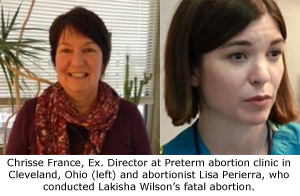
On this date in 2014, 22-year-old Lakisha Wilsondied because a clinic was not laid out to allow easy access by an ambulance gurney.

A smiling young Black woman, with bright jewelry and clothing, casually-coiffed hair, and a radiant smile
Lakisha Wilson
Operation Rescue obtained the autopsy report. Lakisha went to Preterm Clinic in Cleveland, Ohio on March 21, 2014. She was 19.4 weeks pregnant. Further investigation by Operation Rescue reveals further details on the pathetic excuse for treatment Lakisha received at the clinic, as well as how the substandard conditions in the clinic contributed to Lakisha's death. After the safe, legal abortion, performed by Lisa Perierra, she began bleeding heavily because her uterus had become soft (atony). 

The procedure rooms at Preterm are on the third floor of the building. When emergency medical services arrived, the elevator was malfunctioning. They were delayed in getting the gurney to Lakisha due to this problem. When they entered the room, where Lakisha still lay on the abortion table with her legs in the stirrups, they found her abortionist, Dr. Lisa Perriera, trying to resuscitate her with a pediatric-sized Ambu-Bag. The IV for administering medications had been torn loose somehow by clinic staff. 

EMS began working to revive Lakisha, who had no pulse and was not breathing. The medics were able to get her heart going but were hampered in their further resuscitation efforts because the elevator was too small to properly accommodate the gurney; Lakisha had to be taken into the elevator in a seated position that did not provide adequate access to her airway. 
Several house later she was finally taken to Chase University Medical Center, where she was placed on life support and pronounced dead on March 28.

Here is video, with 911 audio, of an ambulance call two years before Lakisha's death. This patient, like Lakisha, was hemorrhaging due to uterine atony. In this patient's case, the elevator wasn't working at all. Fortunately, she survived.


Wednesday, March 27, 2024

March 27, 1929: An Abortion-Rights Poster Child

Clara Bell Duvall
According to the National Organization for Women web site, Clara Bell Duvall was a 32-year-old married mother of five, aged 6 months to 12 years. She and her family were living with her parents in Pittsburgh, Pennsylvania due to financial problems. NOW says that Clara attempted a self-induced abortion with a knitting needle. Though she was seriously ill and severe pain, NOW says, Clara's doctor delayed hospitalizing her for several weeks. Her death, at a Catholic hospital on March 27, 1929, was attributed to pneumonia.

I'd welcome any verifying information on Mrs. Duvall's death. After all, NOW also claims that Becky Bell died from complications of an illegal abortion, when in fact she died of pneumonia concurrent with a miscarriage. (There was no evidence that Becky's pregnancy had been tampered with in any way.) But if people who think abortion is a good idea want to blame Clara's death on abortion, I'll let them claim her as somebody their ideology killed.

Clara Duvall seems to be the woman described in the chapter, "Marilyn," in The Worst of Times by Patricia G. Miller. Marilyn was Clara's daughter. There are differences in Marilyn's story and in the story NOW relates, but I was able to find enough information matching "Claudia" with the real Clara Bell Duval to conclude that they are the same woman.

"Claudia"

Marilyn gives her mother's name as Claudia, and her age as 34. The difference in ages may be attributed to people taking the years of the woman's birth and death and calculating her age without taking the months into account. Marilyn also said that her mother sang with the Pittsburgh light opera company, so it is possible that Marilyn might be using a false name for her mother to preserve the family's privacy.

Clara/Claudia's association with the opera company may also explain the elegant portrait on NOW's site -- a portrait that a poverty-stricken and desperate woman would have been unlikely to afford.

The following facts match:
  • Five children, from an infant to a 12-year-old
  • Living in Pittsburgh
  • Died in March of 1929
  • Death originally attributed to pneumonia
  • The woman used a knitting needle
  • Was at home for several days before being hospitalized
  • Died in a hospital
  • Cared for until her death by her usual doctor who seemed at a loss as to how to care for his moribund patient
Marilyn said that her brother Gerald was the oldest, twelve years old when Clara died. Eileen was ten. Rose was eight, Marilyn was six, and Constance was 18 months. Marilyn describes poignantly the difference between her life before her mother's death and her life after losing her mother. The loss was truly shattering for the entire family.

Marilyn said that her mother had gotten help from a friend for a successful abortion between the births of Marilyn and Constance. Marilyn didn't have any details of the first abortion, and got what she knew about the fatal abortion from her sister Eileen, who had spoken at length with their mother when she was hospitalized -- though it seems odd that a dying woman would be explaining to a 10-year-old girl how she performed a knitting-needle abortion on herself.

Differences in the Stories

NOW's story differs from Marilyn's in many aspects, however. Aside from the different age and name, the following aspects do not match:
  • NOW has the family living with the woman's parents; Marilyn said that they were living in a large house owned by her mother's parents.
  • NOW indicates that the family were too poor to afford a home of their own. Marilyn said that they lived in a large house, and that her father was an editor of one of Pittsburgh's daily newspapers, and that he did freelance public relations for sports events. Marilyn also said that one of her mother's friends was the wife of a well-known Pittsburgh industrialist. This is not a likely friendship for a destitute woman forced to move her family of seven into her parents' home. Marilyn also said that her mother was laid to rest in a magnificent mahogany casket with a satin lining, hardly the sort of burial a poverty-crushed widower could afford for his dead wife. Marilyn also said that the casket lay in the parlor, not a room that poor people were likely to have. In fact, Marilyn describes how shocking it was, after her mother's death, to go live with poor relatives. Poverty was a new experience for the child. In fact, Marilyn describes a riverboat outing the family took before her mother's death. She described how the girls were dressed in matching navy blue coats with red satin linings, and her brother had a jacket and tie.
Reconciling the Stories

Census data from 1920 indicates that Clara Duvall was the wife of Grafton Duvall. Grafton was a newspaper editor. In 1920 the couple had two children, Grafton Jr., age 4, and Elinor Jane, age 20 months. The couple and their children lived at 1616 Westfield Avenue, the same address at Clara's parents, Joseph and Sadie Bell and their two sons, Harry, age 31, and Joseph Jr., age 30. Joseph Sr. was an engineer. Harry was listed as "invalid," meaning incapacitated and unable to work. Joseph Jr. was listed as a fireman on the railroad. 

The Duvall family were still at the 1616 Westfield Avenue address at the time of Clara's death. 

The December 3, 1914 Pittsburgh Post notes: "Miss Bell's Betrothal: An interesting engagement announced yesterday was that of Miss Clara Jane Bell, daughter of Mr. and Mrs. Joseph H. Bell, of Aspinwall, to Grafton O. Duvall, son of Dr. and Mrs. Wirt Duvall of Baltimore. Mr. Duvall is a student in the University of Maryland, where he is in the law department."

Grafton and Clara married in 1915 in Aspinwall, Pennsylvania when he was 24 years old and she was 20. Grafton Jr. was born February 28, 1916 in Baltimore; Eleanor Jane was born June 28, 1918 in Baltimore. The couple moved to Pittsburgh in 1926, where their daughter Claire was born on September 10, 1927. The other children, Roxanna Bell and Mildred Linn, were mentioned in Clara's obituary, "Death Claims Church Singer," in the March 28, 1929 Pittsburgh Press

The January 9, 1922 Pittsburgh Post-Gazette notes for the night's KDKA radio program that Mrs. Grafton Duvall would sing soprano solos, "Summer Wind," "Mighty Lak a Rose," "My Shadows," and "The World is Waiting." In fact, Clara shows up frequently in the society pages as a soloist at various events in the city.

So there are two possibilities:
  1. Clara Bell Duvall and Claudia are two different women, both with five children, both of whom lived in homes owned by their parents, who both performed knitting-needle abortions in the same city in the same month, and who both died in hospitals and both had their deaths wrongly attributed to pneumonia.
  2. Clara and Claudia are the same woman, and but NOW turned her from a prosperous matron and opera singer into a wretched slum mother in order to make her situation seem more desperate.
If what NOW and Marilyn describe is accurate, then Clara/Claudia's abortion was unusual in that it was self-induced, rather than performed by a doctor, as was the case with perhaps 90% of criminal abortions.


For more on pre-legalization abortion, see The Bad Old Days of Abortion

To email this post to a friend, use the icon below.

Monday, March 25, 2024

March 25, 1941: Woman's Body Found on Country Road

Addie Wilson, age 48, was indicted for manslaughter and abortion conspiracy in connection with the death of 25-year-old Marie Swift. Marie's body was found on a country road on March 25, 1941.

Herman Ward, Marie's fiancé, was indicted for abortion and conspiracy.

Addie Wilson's 16-year-old son, Clarence, was held as a material witness.

Watch When Men Were Held Accountable on YouTube.

Source:
  • "Indict Two in Death of Girl Found Dead in MD," Lancaster (PA) Intelligencer Journal, April 18, 1941

Saturday, March 23, 2024

March 23: Body Dumped on Mountain

 On March 23, 1950, someone strolling on the mountain close to Route 460 near Blacksburg, Virginia, found a young woman's body. The dead woman was identified as Alice Marie Taylor, age 24, a clerk for the Veterans Administration in Roanoke.


A note written in green on her death certificate says, "Will not know any more details until the alleged murderer is tried. It is alleged that an attempted abortion was done -- died in the attempt."

Dartha Louise Fulton, a 42-year-old former taxi driver, was arrested at a tourist camp and charged with murder. Police believed that Fulton had perpetrated the abortion. Woodson Tuck, age 20, was arrested as an accessory. Christine Jones, age 28, was held as a material witness.

Sources:

Monday, February 26, 2024

February 26, 1943: Woman's Death Gets One Sentence of News Coverage

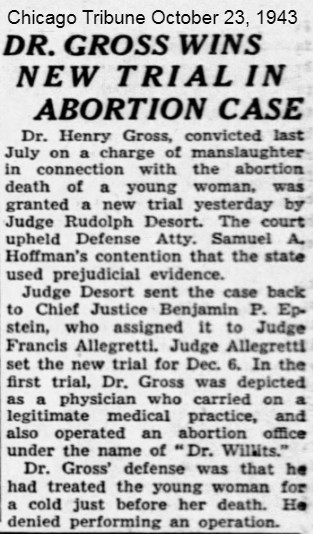
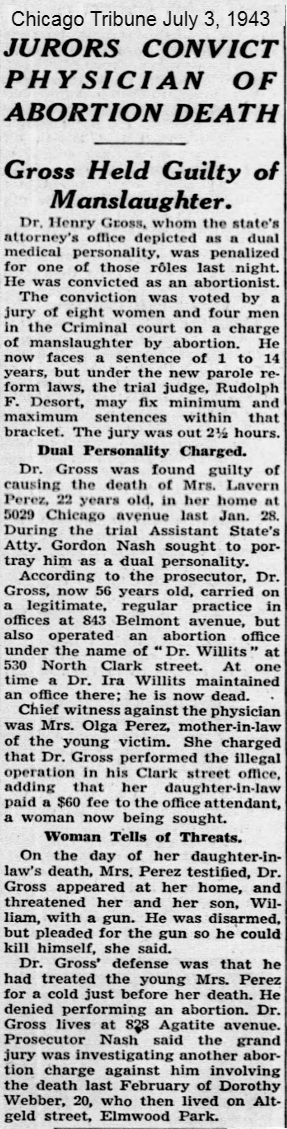
Dr. Henry Gross, age 56, had a reputable medical practice at 843 Belmont Avenue in Chicago in the 1940s. However, after a Dr. Ira Willits died, Gross purchased the dead man's office and set up an abortion practice there under Willits's name.

On January 28, 1943, 22-year-old Lavern Perez died in her Chicago home. Gross was convicted in her death but won a new trial.

Buried in the coverage of Lavern's death is a mention of the February 26, 1943 abortion death of 20-year-old waitress Dorothy Weber.

After Gross was granted a new trial, he and both the women vanish from the records.

Watch One-Sentence Coverage of Abortion Death on YouTube.

Sources:


Saturday, February 17, 2024

February 17, 1995: First of Biskind's Two Dead Patients

Lisa Bardsley was 26 years old and at least 20 weeks pregnant when she had a safe and legal abortion done by Dr. John Biskind (pictured) at A to Z Women's Clinic in Phoenix, Arizona on February 16, 1995. She was discharged an hour later.

On the way home to Flagstaff, Arizona, she took ill, so she and her boyfriend, who had accompanied her, stopped at a motel at Camp Verde. Lisa hoped that if she rested a while she'd feel better. However, her pain worsened and she began suffering shortness of breath. Her boyfriend called 911. 

Lisa was taken to a hospital in Cottonwood, where she died of blood loss from a uterine laceration on February 17. 

Biskind went on to get into further trouble for delivering a live, nearly term infant during an abortion performed on a teenager, and for the abortion death of Lou Ann Herron, for which he was convicted of manslaughter. The clinic where Lisa was fatally injured was owned by abortionist Moshe Hachamovitch, who was implicated in the abortion deaths of Christina Goesswein, Tanya Williamson, Luz Rodriguez, and Jammie Garcia.

Thursday, February 01, 2024

February Stella Lickerman needs rewrite

Stella: born Chicago to Charles and Celia Stifter. Family moved to Detroit between 1910 and 1920. Married Abner Lickerman in Detroit. Everybody returned to Chicago some time between 1920 and 1930.  Abner had been born in Poland and lived in Chicago but married stella in Detroit on 31 May 1925. 

Dr. William Eugene Shelton, who went by his first initial and middle name, was charged with murder in the February 6, 1927 abortion death of 23-year-old homemaker Stella Stifter Lickerman and five other women whose names I've been unable to determine.

Shelton wasn't arrested until October of 1928.

Shelton ran two "hospital flats" in Chicago, one on 6343 Halsted St. and one at 6341 Halsted St.

Two nurses were also arrested and charged with conspiracy. Nurse Sylvia Atcherly was arrested at the 6343 address while nurse Ophelia Roper Griffith worked at the 6341 address.

Two other women were arrested and released after three days of questioning: Mrs. Gertrude Vollert, who was a cook at one of the flats, and Pearl Hawkins, a maid. Mrs. Vollert had been arrested because, clad in her white cook's uniform, she had been mistaken at first for another nurse. She indicated that she was only a substitute cook, filling in for the regular cook on occasion. 

The raid took place based on a lead provided by a barber named Elmer Duval. Duval had married Sylvia Atcherly, the nurse, in 1924 and lived with her at the hospital until the couple split up. His evident motive for spilling the beans was that he hated Shelton.

Duval said that Shelton had fired one of his nurses, Helen Goode, blaming her for Stella's death and saying that it would cost him $5,000 to "square that case."

Police found indications that Shelton would perpetrate the abortions, and if the women suffered complications he would transport them in his car to a hospital on Chicago's west side. 

Based on Duval's statements, police began an investigation that led to the raid. They found two young women in hospital beds in a front room of the flat. Both had recently undergone abortions. After giving statements they were transferred to the county hospital for care. Shelton had charged each woman $200.

Duval said that the first woman to die at Shelton's hands had died in December of 1926.

Duval  said that Stella Lickerman was the second abortion patient to die. He provided information that led police to her family. They indicated that she had been treated by Shelton, and that another doctor who examined her later found evidence of an abortion.

The only other information I've been able to obtain is that Duval said that one of the victims was 18 years old. Strangely enough, all mention of Shelton seems to vanish from the records after his indictment.

Recently added sources:


February 1, 1977: Happy Birthday, Cecelia's Baby

Suction abortion performed after misdiagnosed fetal age, baby born partially scalped but survived: Dr. Joseph Rucker reportedly examined 14-year-old Cecelia G., estimated her pregnancy as 14 weeks, and tried to perform a suction abortion on her on January 26, 1977. Cecelia began to hemorrhage, and was transported to a hospital by car. There, a doctor examined her, and discovered she was 7 months pregnant. She was released, but returned days later. Her infant girl was born February 1, with a 2-inch piece of her scalp missing.

Sunday, January 21, 2024

January 21, 1982: Scant Information on Georgia Death

I put out a call for information on the following abortion death:

Mary Tennyson, age 20, Black, Richmond County, Georgia; January 21, 1982

My research arm, Keely, found some additional information -- she was born on October 15, 1961. Her death certificate number is 005646. She is buried next to a baby's gravestone with no name on it. This enabled me to look up genealogy records and find that she lived in Roberta, Georgia.

This gave me a lead to her obituary, which indicated that she died in a hospital in Augusta, Georgia and was a graduate of Crawford County High School and had attended Macon Vocational Technical School. 

How Mary came to her death remains unknown to me.

Tuesday, December 26, 2023

December 26, 1989: Happy Brithday, Taranda's Baby

 First-trimester abortion after misdiagnosed fetal age, infant survived: "Taranda," age 17, went to Family Planning Clinic for Reproductive Health for an abortion on December 22, 1989. Dr. Karen J. Smiley estimated the pregnancy at 6 weeks and performed an abortion. Four days later, Taranda gave birth to a one pound, critically ill infant girl in a hospital corridor. Taranda's lawyer said, "She's devastated, obviously. She would never have dreamed of having an abortion had she known it was 26 weeks old." Taranda needed psychiatric care after her ordeal.

Sunday, December 17, 2023

December 17, 1985: The Attempted Murder of Ximenia Renaerts

On December 16, 1985, 22-year-old Nadine Bourne arrived at the emergency room of Vancouver General Hospital, seeking care for complications of an abortion she'd undergone four days earlier at a Bellingham, Washington Planned Parenthood. She had fever and a rapid pulse. She said that she'd been 14 to 16 weeks pregnant.

Dr. Jaroudi, a resident, was summoned by the ER physian. He examined Nadine but failed to notice that she was still pregnant. Nadine was admitted to the hospital.

At 3:20 a.m. the next morning, December 17, Nadine gave birth to her baby while seatedon the toilet. The little girl weighed about three pounds -- more consistent with an infant much closer to term, well into the third trimester.

A nurse, Vera Wood, did not call a resuscitation team or an infant transport team to take the shivering, whimpering, gasping infant to Children's hospital. Instead, according to court records, "She took the baby into the service room where dead fetuses are stored, and left it there [in a bedpan] for 40 minutes."

Thomas Berger, an attorney representing the child and her adoptive family noted, "We could prove that Vera Wood and other nurses did nothing to suction the baby or to provide warmth or oxygen for the child. Our case was that the baby suffered severe [trauma] as a result of these acts or omissions by VGH and its employees, resulting in brain damage in the form of mental retardation and cerebral palsy." After 40 minutes, nurse Wood called the night nursing supervisor, Joyce Hatherall, who cleared the baby's air passages, provided warmth and called for oxygen.

Mr. Berger also said, "We also had evidence that Dr. Jaroudi, called up to the ward, realized the baby had been delivered by Nadine Bourne, and realized it was viable, but nevertheless told the nurses not to resuscitate the baby ('...let it go'). He was ignored by Joyce Hatherall."

But even after Hatherall's intervention, the baby was placed on a metal counter, where she likely suffered further hyperthermia. And when Jaroudi finally contacted the transport team for Children's Hospital, he gave them insufficient information, causing an additional half-hour delay in providing care to the baby.

Ximenia

That neglected baby, left to die, has since been adopted. And she has a name: Ximenia Renearts. But thanks to the attempts on her life both before and after her birth, she suffered permanent brain damage. She is quadriplegic and has the mental capacity of a three-year-old.

BC police made two abortive (how appropriate!) investigations of the case, with spokesman Sergeant Bob Cooper calling the case "bullshit", comparing it to cases where children die when being delivered by midwives. Which leaves me wondering if BC midwives routinely leave premature infants in metal bedpans in the closet for over half an hour at a time before somebody else comes along and provides care over the midwives' objections.

Part of the reason for the callous attitude of the police may be that the spokesman for the BC Minister of Health's Office, Michelle Stewart, is dismissive of the issue of infants born live during abortions, commenting, "As you know, this Ministry is very much in favor of giving women choices about their reproductive health." British Columbia's Chief Coroner Larry Campbell included a letter in a report on such live births, and dismissed them as to be expected in abortion and therefore outside the purview of BC coroners, who only get involved if a death is "unexpected". In other words, at least in British Columbia, abortion is 100% about achieving the death of the infant, even if the infant is born alive. Which leaves me to wonder if a perpetrator who shot Ximenia dead tomorrow would face charges at all. Is she still, legally, only an aborted fetus?

The family filed suit against the hospital, the doctor, and the nurse, settling out of court for over $8 million, which will be used to build an accessible hosue for Ximena and to provide her with the care she will need for the rest of her life.

The hospital never conducted an internal review of how a live-born infant was treated like a pathology specimen on their premises, in violation of the law forbidding anyone to abandon or expose a child under the age of ten "so that its life is or is likely to be endangered or its health is or is likely to be permanently injured." Under Canadian law, having been born alive, Ximenia was a living human being entitled to full protection under the law. Prolife activists hold that chareges of attempted murder might be more appropriate, since nurse Wood's intent in putting the child in the bedpan aside in a room for dead fetuses was to allow the baby to die and be sent to the pathology lab with the other results of recent abortions.

Ximena's adoptive mother, Margaret, says, "How can you ever bring justice when all the damage is done? I guess my big hope that what happened to Ximena won't be in vain. It could be you in the hospital and what if they feel that you're not worthy of life. We have to stop somewhere."

Sources: "Did Someone Try to Murder Ximena?", Terry O'Neill, B.C. Report, August 30, 1999; The Attempted Infanticide of XimenaSafe and Legal?, Ted Gerk, The Interim, September 1988; "Canadian babies born alive after abortion", Marnie Ko, reprinted from BC Catholic Newspaper; Ximenia Renaerts

Wednesday, November 29, 2023

November 29, 1926: Dr. Lucy Hagenow's Last Known Victim


On November 29, 1926, 25-year-old stenographer Mary Moorehead died from a criminal abortion perpetrated in the Chicago office of Dr. Lucy Hagenow. 

Hagenow (pictured) wasn't arrested until November 13 of the following year. 

Hagenow told the court that Mary had come to her office on November 5, giving her name as Margaret Sullivan. Hagenow said that she examined Mary, who had a foul-smelling vaginal discharge. Hagenow said that she concluded that Mary's unborn baby had died.

Hagenow said that she packed Mary's vagina with an antiseptic-soaked cotton ball and sent her home. She said that she told Mary that she would come by the next day with another doctor. If that doctor concurred that the baby was dead, Hagenow would get yet another doctor to come and perform an operation to remove the dead baby. 

Hagenow said that Mary paid her $50 in advance for the promised care and left, but when she went to the address "Margaret Sullivan" had provided she found only a vacant lot. That was the last she'd known of the woman, she said, until she was arrested for Mary's death.

The prosecution, however, asserted that several police officers had been present when Mary was about to go surgery in an attempt to save her life. With Hagenow present, Mary told the police that Hagenow had used instruments on her to perpetrate an abortion on November 5.

Dr. Charles H. Phifer testified that on November 7 he saw Mary at her home. She was in a lot of pain and told him that she had been to see Hagenow. Dr. Phifer concluded that Mary was in labor, though he could not determine if the unborn child was alive or dead. He said that he told Mary to consult with Dr. Hagenow.

The next time Dr. Phifer saw Mary it was at Illinois Central Hospital on November 12. She was no longer pregnant and was suffering from septicemia. 

Hagenow was convicted of murder by abortion for Mary's death. She was sentenced to 14 years at Joliet Penitentiary, but was able to get her conviction overturned by the Illinois Supreme Court, which ordered a new trial in 1929. The judge, noting that there was no new evidence, dismissed the case, telling Hagenow, "You had better make your peace with God, Lucy Hagenow. I do not think your months on earth are many." 

Hagenow, who also went by the name of Louise or Louisa Hagenow, had a long and unsavory history of being involved in women's abortion deaths. The first were in San Francisco before Hagenow relocated to Chicago around 1890. The abortion deaths Hagenow was linked to include:


Tuesday, November 14, 2023

November 14, 1979: Happy Birthday, Christelle Morrison

 From The Survivors, and others linked to below.

On the night of November 14, 1979, a two-pound baby girl of 28 weeks gestation was found in a Nevada field, wrapped in an old, wet, dirty shirt. Her umbilical cord was still attached. The baby was blue and unresponsive, which is hardly surprising since the temperature that night was only 15 degrees. The baby was rushed to a rural emergency clinic, where a doctor immersed her in warm water. She revived and was transferred to Medical Center in Reno. Registered Nurse Susan Walker was among the staff that tenderly cared for the little girl. When she was three months old, weighing in at three pounds, the baby underwent heart surgery.

Susan Walker and her husband adopted the discarded miracle baby, who they named Christelle. According to Mrs. Walker, Christelle is "bright, beautiful, strong and healthy, and probably the most loving person you could ever meet! She is a living testimony of God’s tremendous power and love and of the value of each and every unborn child."

Tuesday, November 07, 2023

November 7, 1979: Happy Birthday to "Kimala's" Baby

 John Roe 481 performed an abortion on "Kimala" in March of 1979. On November 7 she gave birth to an infant daughter born disfigured and with cerebral palsy. (Cook County Illinois Circuit Court Case No. 81L 26210)

Thursday, November 02, 2023

November 2, 2010: Family Alleges Improper Monotoring

Dr. George McMillan
The family of 32-year-old Lisa Marie Fusco sued Dr. George McMillan and Brooklyn Ambulatory Physician Associates on behalf of her surviving child after she died from abortion complications.

Lisa had gone to Ambulatory Surgery Center of Brooklyn on October 26, 2010. Staff performed an ultrasound and did blood tests preparatory for an abortion. She returned on October 27, when staff inserted laminaria for an abortion and packed her vagina with gauze. 

Lisa returned to Ambulatory Surgery Center on October 28 to undergo a D&E abortion. 

According to the lawsuit, the procedure was not performed properly, causing an unspecified injury. Failure to properly monitor and care for Lisa led to her decompensation -- meaning that her body was trying to maintain blood pressure and adequate perfusion but was unable to do so, causing her condition to deteriorate rapidly. The suit also asserted that the abortion was in some way contraindicated, meaning that Lisa had some medical condition that either meant that it was unsafe to perform an abortion in an outpatient setting or that it was unsafe to perform an abortion at all. 

Lisa's condition continued to deteriorate, leading to her death on November 2, 2010.

Nicey WashingtonNicey Washington had died after an abortion at Ambulatory Surgery Center ten years earlier. 

Sources:


November 2, 2010: Lack of Diligence Proves Fatal in Brooklyn

Lisa Marie Fusco died on November 2, 2010 after an abortion performed at Ambulatory Surgery Center of Brooklyn.

Lisa went to Ambulatory Surgery Center on October 27, 2010 to begin a multi-day abortion with the insertion of laminaria to dilate her cervix. The practitioner also packed Lisa's vagina with gauze. Lisa returned the next day for the abortion. The allegations in the lawsuit are fairly vague, just noting that due diligence was not followed, the procedure performed on Lisa was contraindicated, and Lisa was not properly monitored during the procedure.

The lawsuit filed on behalf of Lisa's surviving child also named Dr. George McMillan, presumably the abortionist.

Tuesday, October 31, 2023

October 31, 1921: Abortionist Accused by Dead Woman's Mother

 During the inquest into the 1923 abortion death of Lydia Nelson, Emma Sales of South Morgan Street, Chicago, jumped to her feet and struck Dr. Charles Klinetop in the face. Mrs. Sales said that the death of her daughter, Harriet Grimm, was due to an abortion Klinetop had perpetrated.

Harriet Ida Grimm, wife of Edward Grimm, had died at Chicago's Lakeside Hospital on October 31, 1921.

I've been unable to find any documentation on the cause of Harriet's death. She doesn't even show up on the Homicide in Chicago Interactive Database. All I can find is confirmation of her death at age 20.

Watch Did Dr. Klinetop Kill Harriet Grimm? on YouTube.