Fifteen-year-old Gwendolyn Drummer was a student at Harry Ellis High in Richmond, California, when she was admitted to Doctor’s Hospital of Pinole for a safe and legal abortion, to be performed January 28, 1972. Her doctor chose the saline abortion method.
These abortions are performed by replacing amniotic fluid with a strong salt solution. In the decades after WWII, saline was being abandoned in countires where abortion was legal, in favor of safer methods. But as laws loosened up in the US, American docors adopted the method. A British study published in 1966 found that the saline would enter the mother's bloodstream and cause brain damage. Swedish researchers noticed an unacceptably high rate of complications and deaths. Sweden and the Soviet Union followed Japan in abandoning saline abortion as too dangerous by the late 1960s.
Gwendolyn's doctor injected the saline into her utuerus. It got into Gwendolyn's blood stream, just as British, Japanese, Soviet, and Swedish doctors had repeatedly warned it could do. Gwendolyn suffered organ damage. She developed pneumonia, and died on January 31.
Hear Gwendolyn's story in a minute:
Saturday, January 31, 2009
1972: Doctor ignores warnings, uses antiquated method, kills teen
Labels:
California,
pre-Roe deaths,
saline,
teens
Friday, January 30, 2009
Marked in passing -- a prelude to Roe
As I was walking to work this morning, and acquaintance spotted me and handed me a copy of a clipping from the New York Times -- an obituary for Constance E. Cook.
Constance E. Cook is the unsung heroine of abortionists nationwide. She lay the groundwork for the semi-licensed and quasi-licensed and apparently-licensed and woefully unsupervised quackery that passes for professionalism in abortion practice today. She drafted New York's law, passed in 1970, legalizing abortion on demand.
I guess it seemed like a good idea at the time.
So Constance E. Cook's little brainchild made New York the first abortion free-for-all in the United States.
The fallout was almost immediate. Even before the law went into effect, abortionists were setting up shop openly. One woman who was injured before the law went into effect was surprised when her suit was thrown out of court. She hadn't realized abortion hadn't become legal until July 1.
New York abortionists were ready. Health officials were not.
The fallout wasn't pretty. With far more abortionists than officials to supervise them, the most egregious practices went unremarked. Saline abortions, which can be deadly to mothers even when performed in a hospital under careful monitoring, were being performed on an outpatient basis. Other abortionists, such as erstwhile criminal abortionist Jesse Ketchum, were doing hysterotomy abortions -- major abdominal surgery -- in their offices. Not surprisingly, women paid with their lives.
Despite this dismal beginning, enthusiasm for legalization continued unabated in many circles. Bernard Nathanson had his staff at CRASH (Center for Reproductive and Sexual Health) compile their statistics on complications recorded in patient charts. Never mind that the charts were known to be incomplete and inaccurate; what mattered was "proving" that freestanding clinics could do "safe" abortions. Abortion enthusiasts used Nathanson's tainted numbers to convince the Supreme Court that the picture was rosy. The dead women, of course, were not deemed worthy of mention.
New York's chaotic, grim years of legalized pre-Roe abortion paved the way for the current regime of unsupervised, marginally regulated abortion mills and the carnage they produce. In a way, all the infertility, and the post-abortion trauma, all the orphaned children and grieving families of women killed by legalized abortion in the United States, have their beginning in Constance E. Cook's misplaced faith in abortionists. For some reason, she thought that taking away the risk of prison would make them better doctors.
Time has proved her dead wrong.
So as abortion enthusiasts mark Constance Cook's passing, I'd like to remember some of the women who went into early graves thanks to the supposedly safe, legal abortions she made so readily available beginning July 1, 1970:
1970
1971
1972
And the women who have gone to their deaths since then, thinking that their abortions, being legal, were perfectly safe.
Now, some of you will argue that far more women would have died under the old, horrible, terrible, no-good, very bad "back alley butcher" abortions. You're failing to take into account the impact of legalized abortion on maternal mortality: Diddly/Squat.
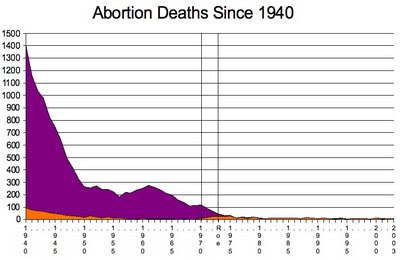
What changed was the doctors were no longer in danger of prison for injuring or killing their abortion patients. We can look to Jesse Ketchum, as mentioned above, to see what a dubious improvement that was. Who did abortions didn't change. The nature of abortion didn't change. What changed is that women's deaths were no longer treated like intolerable tragedies. They became something to shrug off with a muttered comment that all surgery has risks.
Imagine what would have happened if, instead of enshrining abortion as a good, a right, something to embrace, people like Constance Cook and other abortion supporters had done what Mary Calderone had been pushing for at the Planned Parenthood conference in 1955 -- finding out why women were seeking abortions and finding ways to address their concerns as a public health problem, rather than as an excuse to simply abort them. Imagine if instead of enshrining abortion, Constance Cook and others like her had pushed for such data collection, and for public policy that would instead enshrine confidential help. Real help, not the pseudo-help of a dead baby.
The self-proclaimed champions of women could have aimed for more of this:
And they didn't.
Instead of taking the existing trend of fewer and fewer abortion deaths every year and improving it by working to eliminate abortion, Constance Cook choose to go for an illusory "solution" to the abortion mortality problem: re-classify the women's deaths as just the ordinary risks of surgery, rather than as evidence that the woman had been wronged.
So, on January 20, 2009, Constance E. Cook died. And she is best remembered for something she did in 1970. Something that divided the country. Something that immeasurably cheapened not only unborn babies' lives, but their mothers' lives as well.
So let us mark a bit belatedly one other death:

For more abortion deaths, visit the Cemetery of Choice:

To email this post to a friend, use the icon below.
Constance E. Cook is the unsung heroine of abortionists nationwide. She lay the groundwork for the semi-licensed and quasi-licensed and apparently-licensed and woefully unsupervised quackery that passes for professionalism in abortion practice today. She drafted New York's law, passed in 1970, legalizing abortion on demand.
I guess it seemed like a good idea at the time.
So Constance E. Cook's little brainchild made New York the first abortion free-for-all in the United States.
The fallout was almost immediate. Even before the law went into effect, abortionists were setting up shop openly. One woman who was injured before the law went into effect was surprised when her suit was thrown out of court. She hadn't realized abortion hadn't become legal until July 1.
New York abortionists were ready. Health officials were not.
The fallout wasn't pretty. With far more abortionists than officials to supervise them, the most egregious practices went unremarked. Saline abortions, which can be deadly to mothers even when performed in a hospital under careful monitoring, were being performed on an outpatient basis. Other abortionists, such as erstwhile criminal abortionist Jesse Ketchum, were doing hysterotomy abortions -- major abdominal surgery -- in their offices. Not surprisingly, women paid with their lives.
Despite this dismal beginning, enthusiasm for legalization continued unabated in many circles. Bernard Nathanson had his staff at CRASH (Center for Reproductive and Sexual Health) compile their statistics on complications recorded in patient charts. Never mind that the charts were known to be incomplete and inaccurate; what mattered was "proving" that freestanding clinics could do "safe" abortions. Abortion enthusiasts used Nathanson's tainted numbers to convince the Supreme Court that the picture was rosy. The dead women, of course, were not deemed worthy of mention.
New York's chaotic, grim years of legalized pre-Roe abortion paved the way for the current regime of unsupervised, marginally regulated abortion mills and the carnage they produce. In a way, all the infertility, and the post-abortion trauma, all the orphaned children and grieving families of women killed by legalized abortion in the United States, have their beginning in Constance E. Cook's misplaced faith in abortionists. For some reason, she thought that taking away the risk of prison would make them better doctors.
Time has proved her dead wrong.
So as abortion enthusiasts mark Constance Cook's passing, I'd like to remember some of the women who went into early graves thanks to the supposedly safe, legal abortions she made so readily available beginning July 1, 1970:
1970
- Pearl Schweir, age 42: July 6
- "Judy" Roe, age 42: July 12
- Carmen Rodriguez, age 31: July 19
- Barbara Riley, age 23: July 20, 1970
- "Lori" Roe, age 17
- "Amanda" Roe, age 19: September 22
- Maria Ortega, age 23: October 10
- "Kimberly" Roe, age 25: December 23
1971
- "Amy" Roe, age 35: January 2
- "Andrea" Roe, age 26: January 20
- "Roseanne" Roe, age 26: February 27
- "Sandra" Roe, age 18: April 18
- "Anita" Roe, age 23: May 12
- Margaret Smith, age 25: June 16
- "Annie" Roe, age 44: June 24
- "Audrey" Roe: July 1
- "Vicki" Roe, age 26: August 17
- "April" Roe, age 17: August 22
- "Barbara" Roe, age 35: September 23
- "Becky" Roe, age 18: October 5
- "Tammy" Roe, age 33: October 13
- Carole Schaner, age 37: October 20
- "Beth" Roe, age 23: December 29
1972
- "Colleen" Roe, age 21: March 8
- "Connie" Roe, age 31: March 8
- "Julie" Roe, age 14: April 16
- "Robin" Roe, age 21: May 4
- "Roxanne" Roe, age 17: May 13
- "Danielle" Roe, age 18: May 17
- "Sara" Roe, age 20: June 18
And the women who have gone to their deaths since then, thinking that their abortions, being legal, were perfectly safe.
Now, some of you will argue that far more women would have died under the old, horrible, terrible, no-good, very bad "back alley butcher" abortions. You're failing to take into account the impact of legalized abortion on maternal mortality: Diddly/Squat.

What changed was the doctors were no longer in danger of prison for injuring or killing their abortion patients. We can look to Jesse Ketchum, as mentioned above, to see what a dubious improvement that was. Who did abortions didn't change. The nature of abortion didn't change. What changed is that women's deaths were no longer treated like intolerable tragedies. They became something to shrug off with a muttered comment that all surgery has risks.
Imagine what would have happened if, instead of enshrining abortion as a good, a right, something to embrace, people like Constance Cook and other abortion supporters had done what Mary Calderone had been pushing for at the Planned Parenthood conference in 1955 -- finding out why women were seeking abortions and finding ways to address their concerns as a public health problem, rather than as an excuse to simply abort them. Imagine if instead of enshrining abortion, Constance Cook and others like her had pushed for such data collection, and for public policy that would instead enshrine confidential help. Real help, not the pseudo-help of a dead baby.
The self-proclaimed champions of women could have aimed for more of this:
And they didn't.
Instead of taking the existing trend of fewer and fewer abortion deaths every year and improving it by working to eliminate abortion, Constance Cook choose to go for an illusory "solution" to the abortion mortality problem: re-classify the women's deaths as just the ordinary risks of surgery, rather than as evidence that the woman had been wronged.
So, on January 20, 2009, Constance E. Cook died. And she is best remembered for something she did in 1970. Something that divided the country. Something that immeasurably cheapened not only unborn babies' lives, but their mothers' lives as well.
So let us mark a bit belatedly one other death:

For more abortion deaths, visit the Cemetery of Choice:

To email this post to a friend, use the icon below.
Labels:
abortion activists,
abortion history,
death
There's just no pleasing some people
Instead of thanking God and Captain Sully that they're alive, a bunch of Flight 1549 passengers are bitching that they want free first-class upgrades for life in addition to the very nice $5,000 compensation, year of free upgrades, etc. that the airline has already bestowed upon them.
They survived the first successful ditching of a commercial jet in 45 farking years! And that isn't freaking good enough for them. They want somebody to wipe their asses with gold leaf.
Captain Sully made me proud to be an American. These people are an embarrassment. Gimme, gimme, gimme. No wonder people think we're assholes.
HT to my daughter for suggesting the Eagles' song. "You say you haven't been the same since you had your little crash but you might feel better if we gave you some cash."
PS. I can't blame anybody who found the entire experience traumatic. I'm sure it was terrifying. Especially since there was no way they could have realized that they'd all survive. But they DID. Which they never would have, had the airline not been so supportive of Sullenberger in his endeavors to become the best pilot he could be, and in his efforts to improve aviation safety.
Yeah, many of the passengers will likely have PTSD symptoms. They might be afraid of flying, have nightmares or flashbacks, have the jitters, be jumpy. But they're alive. And they're forgetting who they owe that to.
They survived the first successful ditching of a commercial jet in 45 farking years! And that isn't freaking good enough for them. They want somebody to wipe their asses with gold leaf.
Captain Sully made me proud to be an American. These people are an embarrassment. Gimme, gimme, gimme. No wonder people think we're assholes.
HT to my daughter for suggesting the Eagles' song. "You say you haven't been the same since you had your little crash but you might feel better if we gave you some cash."
PS. I can't blame anybody who found the entire experience traumatic. I'm sure it was terrifying. Especially since there was no way they could have realized that they'd all survive. But they DID. Which they never would have, had the airline not been so supportive of Sullenberger in his endeavors to become the best pilot he could be, and in his efforts to improve aviation safety.
Yeah, many of the passengers will likely have PTSD symptoms. They might be afraid of flying, have nightmares or flashbacks, have the jitters, be jumpy. But they're alive. And they're forgetting who they owe that to.
Labels:
off topic
Baby Shanice's mom suing clinic
Lest you have any doubts that the Born Alive Infants Protection Act has accomplished exactly diddly-squat, consider the lawsuit filed by Shanice's mother, Sycloria Williams. According to all reports, Sycloria was shocked and astonished to give birth to a live child during an abortion. Rather than provide the baby with medical care, staff put the living baby in a biohazard bag and threw her on the roof to prevent the police from finding the body.
An anonymous tipster helped police locate the child's body, and an autopsy showed that she had indeed been born alive and had drawn breath. But no murder charges were filed because the cause of death was listed as "extreme prematurity" -- ignoring the fact that Shanice was suffocated in a plastic bag. Even if she would only have lived a few hours, those were her hours of her life, not anybody else's to take away. To excuse suffocating Shanice in a plastic bag is akin to giving somebody the okay to walk into a cancer ward and start shooting the terminal patients.
And barring a murder charge, surely Shanice's appalling murder should have been prosecuted under the Born Alive Infants Protection Act, which required that Shanice be given the same care a baby would have been given had he been born alive due to illness or accident and not an induced abortion. In no hospital that I have ever heard of is it considered the standard of care to put a premature infant in a plastic bag and toss her on the roof of the building.
In closing, I'd like to note that everything done to Shanice would meet with our new President's enthusiastic approval. He believes that it is wrong to provide care to a baby who survives an abortion:
An anonymous tipster helped police locate the child's body, and an autopsy showed that she had indeed been born alive and had drawn breath. But no murder charges were filed because the cause of death was listed as "extreme prematurity" -- ignoring the fact that Shanice was suffocated in a plastic bag. Even if she would only have lived a few hours, those were her hours of her life, not anybody else's to take away. To excuse suffocating Shanice in a plastic bag is akin to giving somebody the okay to walk into a cancer ward and start shooting the terminal patients.
And barring a murder charge, surely Shanice's appalling murder should have been prosecuted under the Born Alive Infants Protection Act, which required that Shanice be given the same care a baby would have been given had he been born alive due to illness or accident and not an induced abortion. In no hospital that I have ever heard of is it considered the standard of care to put a premature infant in a plastic bag and toss her on the roof of the building.
In closing, I'd like to note that everything done to Shanice would meet with our new President's enthusiastic approval. He believes that it is wrong to provide care to a baby who survives an abortion:
Two other January deaths
I have two deaths at the Cemetery of Choice that I don't have specific dates for, but I was able to determine that they died some time in January.
At the very beginning of 1880, Mary McCarty, wife of C.H. McCarty of New Haven, was the "unsuspecting and unfortunate victim of the criminal or culpably stupid operation" that ended her life. She was approximately 30 years old. Dr. Banks was arrested on Pine Island.
On either January 21 or January 26 of 1926, Mrs. Victoria Smith died in Chicago from a botched abortion, evidently performed at Jefferson Park Hospital. On January 26, the coroner pushed for the arrest of Peter Krakowski as the principal and Mary Sprochi as an accessory. Krakowski's profession is not given, though he might have been some sort of medical professional, since the abortion was performed at a hospital. On February 15, Krakowski was indicted for felony murder.

For more on pre-legalization abortion, see The Bad Old Days of Abortion
To email this post to a friend, use the icon below.
At the very beginning of 1880, Mary McCarty, wife of C.H. McCarty of New Haven, was the "unsuspecting and unfortunate victim of the criminal or culpably stupid operation" that ended her life. She was approximately 30 years old. Dr. Banks was arrested on Pine Island.
On either January 21 or January 26 of 1926, Mrs. Victoria Smith died in Chicago from a botched abortion, evidently performed at Jefferson Park Hospital. On January 26, the coroner pushed for the arrest of Peter Krakowski as the principal and Mary Sprochi as an accessory. Krakowski's profession is not given, though he might have been some sort of medical professional, since the abortion was performed at a hospital. On February 15, Krakowski was indicted for felony murder.

For more on pre-legalization abortion, see The Bad Old Days of Abortion
To email this post to a friend, use the icon below.
Labels:
illegal abortion,
pre-Roe deaths
Thursday, January 29, 2009
A woman and her vacuum technician
From Jivin' J:
In other words, South Dakota is insisting that abortion supporters actually put into practice the whole "doctor" part of abortion supposedly being a decision "between a woman and her doctor".
Though, frankly, I don't like this approach. After all, the circuit rider isn't the woman's doctor. The circuit rider is some abortionist who has been brought in to simply vacuum out whichever wombs he or she is presented with, no questions asked, and never see the woman again.
The requirement should be that when the whole "woman and her doctor" choice is made, it's actually her doctor -- her ob/gyn, her family doctor, her PCP, whatever. Somebody who knows, and presumable actually cares about, this woman.
The circuit rider should only be allowed to carry out the abortion if a doctor who knows and has a doctor/patient relationship with the woman has actually had a consultation with her and is able to state, clearly and in writing, why abortion is, in his clinical opinion, the best course of action for this patient. What other options were rejected and why.
After all, what other surgery is done based 100% on a self-referral, with no prior medical consultation? If abortion really is, as its supporters insist, just a perfectly ordinary and necessary medical procedure, then treat it like one and start requiring a referral and a reason other than "Patient thinks this procedure will improve her condition."
A new bill has been introduced in South Dakota is aimed at Planned Parenthood’s practice of flying in abortionists. The bill would “require that a doctor performing an abortion in the state be available for a two-hour period on the day before the scheduled abortion for consultation with the patient in the same city where the abortion will be performed.
In other words, South Dakota is insisting that abortion supporters actually put into practice the whole "doctor" part of abortion supposedly being a decision "between a woman and her doctor".
Though, frankly, I don't like this approach. After all, the circuit rider isn't the woman's doctor. The circuit rider is some abortionist who has been brought in to simply vacuum out whichever wombs he or she is presented with, no questions asked, and never see the woman again.
The requirement should be that when the whole "woman and her doctor" choice is made, it's actually her doctor -- her ob/gyn, her family doctor, her PCP, whatever. Somebody who knows, and presumable actually cares about, this woman.
The circuit rider should only be allowed to carry out the abortion if a doctor who knows and has a doctor/patient relationship with the woman has actually had a consultation with her and is able to state, clearly and in writing, why abortion is, in his clinical opinion, the best course of action for this patient. What other options were rejected and why.
After all, what other surgery is done based 100% on a self-referral, with no prior medical consultation? If abortion really is, as its supporters insist, just a perfectly ordinary and necessary medical procedure, then treat it like one and start requiring a referral and a reason other than "Patient thinks this procedure will improve her condition."
Labels:
abortion activism,
south dakota
Applauding a child's death
Father Frank Pavone introduces a portion of a recording of a National Abortion Federation Risk Management Seminar in which Dr. Martin Haskell, who popularized what is known as "Partial Birth Abortion", introduces his favored technique to his fellow abortionists. As you hear the sound of the vacuum machine sucking out the baby's brain, killing the child, listen to what follows immediately: applause. Keep in mind that the applauding crowd is watching a VIDEO of Haskell doing this. They're seeing the baby, still moving, being partially delivered. They're applauding after Haskell sticks a tube into the base of the child's skull and vacuums out the brain. They are applauding as they watch a child be put to death -- if I recall correctly, for the unpardonable crime of having Down syndrome.
Labels:
pba
1883: Abortion by midwife proves fatal; saloon keeper and housekeeper also arrested
On January 29, 1883, a widow named Adeline Savroch died on the scene from a criminal abortion. Midwife Bertha Twachaus was held without bail for murder in Adeline's death. A saloon keeper named Julius Grosse, and his housekeeper, Celia Arlep, were held as accessories.
The most likely scenario is that the saloon keeper and the housekeeper arranged the abortion for Adeline, and perhaps helped Twachaus to try to cover up the real cause of death.

For more on pre-legalization abortion, see The Bad Old Days of Abortion
To email this post to a friend, use the icon below.
The most likely scenario is that the saloon keeper and the housekeeper arranged the abortion for Adeline, and perhaps helped Twachaus to try to cover up the real cause of death.

For more on pre-legalization abortion, see The Bad Old Days of Abortion
To email this post to a friend, use the icon below.
Labels:
illegal abortion,
pre-Roe deaths
1936: Tipster alerts authorities to fatal abortion
Rose Lipner, age 32, mother of 2, died at Riverdale Hospital on January 29, 1936. Dr. Maxwell C. Katz, who lived at Riverdale (maternity) Hospital, which he operated, signed a death certificate indicating that Rose had been operated on for a tumor.
After the funeral, an anonymous caller notified police that the death was suspicious, and Rose was exhumed for an autopsy. The medical examiner determined that Rose had died from an abortion. Katz was arraigned for second-degree manslaughter. Contrary to popular belief, it wasn't an easy thing to hide abortion deaths back when complicity in the cover-up could land you in prison as an accessory.
Rose's abortion was typical in that it was performed by a doctor, as was the case with perhaps 90% of criminal abortions.

For more on pre-legalization abortion, see The Bad Old Days of Abortion
To email this post to a friend, use the icon below.
After the funeral, an anonymous caller notified police that the death was suspicious, and Rose was exhumed for an autopsy. The medical examiner determined that Rose had died from an abortion. Katz was arraigned for second-degree manslaughter. Contrary to popular belief, it wasn't an easy thing to hide abortion deaths back when complicity in the cover-up could land you in prison as an accessory.
Rose's abortion was typical in that it was performed by a doctor, as was the case with perhaps 90% of criminal abortions.

For more on pre-legalization abortion, see The Bad Old Days of Abortion
To email this post to a friend, use the icon below.
Labels:
illegal abortion,
new york,
pre-Roe deaths
1857: Twin takes sis on fatal abortion journey
Olive Ash worked for a farmer, Mr. Beckwith, in Vermont, in the summer and fall of 1857. She was about 20 years old, and she lived with the family during her employment. In the autumn of that year, Olive returned to her family home in Sutton.
On December 28, 1857, Olive and her twin sister, Olivia, left their home and went by rail to the home of their cousin, Levi M. Aldrich, in Bradford, ostensibly to visit his widowed mother. During the visit, Olive seemed to her family to be in normal health.
The sisters remained at Aldrich's home about two weeks, then said that they were going to meet some friends at the Fairlee depot for an excursion into New York or Massachusetts. Instead, when they arrived at Fairlee depot they took a wagon to the home and office of Dr. William Howard, about six miles north of the depot and three miles south of Bradford.
On Friday, January 29, 1858, Olive's mother got a telegram telling her to come to Howard's home. She quickly complied, and was there when her daughter died at about 6 in the evening. Dr. Howard got a coffin for Olive, and the twins' mother took her daughter's body by train to Sutton.
On February 3, Olive's body was exhumed for an autopsy, which was performed by Dr. Frost and witnessed by Dr. Bliss, Dr. Carpenter, and others unnamed. Frost found evidence of recent pregnancy as well as signs of instrumentation and damage to the cervix. Dr. Frost believed that Olive had hemorrhaged due to the damage to her cervix. He removed and preserved her uterus. Another physician examined the uterus and concluded that the placenta had been retained for some time after the abortion, and that this retained placenta would also cause hemorrhage.
In the trial of Dr. Howard, Olivia testified that she knew her sister was pregnant and had accompanied her on the journey knowing that Olive was planning to get an abortion. Olivia said that Daniel Beckwith, the grown son of the farmer Olive had worked for, met them at their cousin's house, and he gave them the information on where to go and who to see for the abortion.
From Olivia's testimony, the sisters arrived at Dr. Howard's house and informed him that Olive was about six months pregnant. He spoke to the sisters and indicated that he wanted to consult with Daniel Beckwith before deciding if he was going to proceed with an abortion. The sisters remained at Dr. Howard's house for a few days until Olive got a letter from Beckwith, and she read part of it to Dr. Howard. He then agreed to perform the abortion for a sum of $100.
Dr. Howard told the sisters that the process would take three or four weeks. He gave Olive a concoction to drink two or three times. On the Friday the week after the sisters' arrival, Dr. Howard performed some sort of procedure on Olive as she lay on the bed in the room the twins shared. Olivia was permitted to remain with her sister during this procedure. She said that Dr. Howard used two or three of the three or four instruments he had at hand. Olive was in pain during the procedure, which took two or more hours, and resulted in a gush of fluid.
The following day, Dr. Howard performed another, similar, procedure on Olive, who clutched her sister's hand and reported great pain. Olive bled profusely. After this second operation, Olive kept to her bed.
That night, Dr. Howard performed yet another procedure, very painful for Olive to endure. This time he used instruments then reached in with his hand and pulled out a fetus, which Olivia reported as being about two-thirds the size of a newborn. Dr. Howard removed the fetus from the room, and Olivia never saw it again.
Olive bled after this, but not profusely. Afterward her behavior struck Olivia as violent and irrational. A girl named Margaret Kelley, who lived at Dr. Howard's house, also testified that Olivia had laundered her sister's bloody clothing while at the doctor's house. Bloody clothing were introduced into evidence, including two chemises and a small quilt or pad. The witness, Mrs. Wilson, who produced the evidence indicated that she'd found these things hidden in the rafters of the house when she was cleaning in the fall of 1858.
Mrs. Wilson also said that about two weeks after Dr. Howard's arrest, she saw one of Dr. Howard's dogs come out from underneath the office privvy with something in its mouth. She made the dog drop what it was carrying and discovered it to be a fetus of about four or five months, in a state of decomposition. While she was looking at the fetus, another of the doctor's dogs snatched the fetus up and ran off with it. The dogs, she testified, had been digging at the privvy for some time before retrieving the fetus. Mrs. Wilson's description of the fetus she'd seen the dogs with was similar in size to the fetus Olivia had described taken from her sister. Olivia had also testified to having seen a number of fetuses of various sizes preserved in containers in Dr. Howard's premises.
The defense presented a witness named Susan Squires, who was staying at Dr. Howards from January 23 until after Olive's death. She said that the Thursday before Olive's death, she had spoken with Olive while Olivia was eating lunch. Susan said that Olive told her that she didn't expect to live, that she'd taken poisons before coming to Dr. Howard, that Dr. Howard was not to blame in her death but had done everything in his power to help her. Susan said that Olive seemed rational at the time, but that by Friday morning Olive seemed to have lost her reason.
On cross examination, Susan indicated that she had stayed at Dr. Howard's off and on for two years, to do sewing and to receive medications. She indicated that on Thursday afternoon, at about 4:00 Friday morning Olive managed to kick the footboard off the bed, prompting Olivia to summon Susan and a Mrs. Green into the room. Olive complained of being tired and continued to thrash and kick for a short time before settling down.
Mrs. Green was brought as a witness. She said that she had gone to Dr. Howard's on Tuesday afternoon and remained there a week visiting the doctor's wife. She first saw Olive on Wednesday morning, when Olivia had summoned her to help attend to Olive, who was trembling, delierious, and bleeding from the nose. Mrs. Green also went to Olive during the episode when she'd kicked the footboard off the bed. She'd helped the others restrain Olive. Mrs. Green testified that Olive never revived enough to speak after that.
Dr. Howard's witnessed attempted to show that Howard was treating Olive for a miscarriage. Dr. Howard was nevertheless convicted.
Olive's abortion was typical of illegal abortions in that it was performed by a physician.

For more on pre-legalization abortion, see The Bad Old Days of Abortion
To email this post to a friend, use the icon below.
On December 28, 1857, Olive and her twin sister, Olivia, left their home and went by rail to the home of their cousin, Levi M. Aldrich, in Bradford, ostensibly to visit his widowed mother. During the visit, Olive seemed to her family to be in normal health.
The sisters remained at Aldrich's home about two weeks, then said that they were going to meet some friends at the Fairlee depot for an excursion into New York or Massachusetts. Instead, when they arrived at Fairlee depot they took a wagon to the home and office of Dr. William Howard, about six miles north of the depot and three miles south of Bradford.
On Friday, January 29, 1858, Olive's mother got a telegram telling her to come to Howard's home. She quickly complied, and was there when her daughter died at about 6 in the evening. Dr. Howard got a coffin for Olive, and the twins' mother took her daughter's body by train to Sutton.
On February 3, Olive's body was exhumed for an autopsy, which was performed by Dr. Frost and witnessed by Dr. Bliss, Dr. Carpenter, and others unnamed. Frost found evidence of recent pregnancy as well as signs of instrumentation and damage to the cervix. Dr. Frost believed that Olive had hemorrhaged due to the damage to her cervix. He removed and preserved her uterus. Another physician examined the uterus and concluded that the placenta had been retained for some time after the abortion, and that this retained placenta would also cause hemorrhage.
In the trial of Dr. Howard, Olivia testified that she knew her sister was pregnant and had accompanied her on the journey knowing that Olive was planning to get an abortion. Olivia said that Daniel Beckwith, the grown son of the farmer Olive had worked for, met them at their cousin's house, and he gave them the information on where to go and who to see for the abortion.
From Olivia's testimony, the sisters arrived at Dr. Howard's house and informed him that Olive was about six months pregnant. He spoke to the sisters and indicated that he wanted to consult with Daniel Beckwith before deciding if he was going to proceed with an abortion. The sisters remained at Dr. Howard's house for a few days until Olive got a letter from Beckwith, and she read part of it to Dr. Howard. He then agreed to perform the abortion for a sum of $100.
Dr. Howard told the sisters that the process would take three or four weeks. He gave Olive a concoction to drink two or three times. On the Friday the week after the sisters' arrival, Dr. Howard performed some sort of procedure on Olive as she lay on the bed in the room the twins shared. Olivia was permitted to remain with her sister during this procedure. She said that Dr. Howard used two or three of the three or four instruments he had at hand. Olive was in pain during the procedure, which took two or more hours, and resulted in a gush of fluid.
The following day, Dr. Howard performed another, similar, procedure on Olive, who clutched her sister's hand and reported great pain. Olive bled profusely. After this second operation, Olive kept to her bed.
That night, Dr. Howard performed yet another procedure, very painful for Olive to endure. This time he used instruments then reached in with his hand and pulled out a fetus, which Olivia reported as being about two-thirds the size of a newborn. Dr. Howard removed the fetus from the room, and Olivia never saw it again.
Olive bled after this, but not profusely. Afterward her behavior struck Olivia as violent and irrational. A girl named Margaret Kelley, who lived at Dr. Howard's house, also testified that Olivia had laundered her sister's bloody clothing while at the doctor's house. Bloody clothing were introduced into evidence, including two chemises and a small quilt or pad. The witness, Mrs. Wilson, who produced the evidence indicated that she'd found these things hidden in the rafters of the house when she was cleaning in the fall of 1858.
Mrs. Wilson also said that about two weeks after Dr. Howard's arrest, she saw one of Dr. Howard's dogs come out from underneath the office privvy with something in its mouth. She made the dog drop what it was carrying and discovered it to be a fetus of about four or five months, in a state of decomposition. While she was looking at the fetus, another of the doctor's dogs snatched the fetus up and ran off with it. The dogs, she testified, had been digging at the privvy for some time before retrieving the fetus. Mrs. Wilson's description of the fetus she'd seen the dogs with was similar in size to the fetus Olivia had described taken from her sister. Olivia had also testified to having seen a number of fetuses of various sizes preserved in containers in Dr. Howard's premises.
The defense presented a witness named Susan Squires, who was staying at Dr. Howards from January 23 until after Olive's death. She said that the Thursday before Olive's death, she had spoken with Olive while Olivia was eating lunch. Susan said that Olive told her that she didn't expect to live, that she'd taken poisons before coming to Dr. Howard, that Dr. Howard was not to blame in her death but had done everything in his power to help her. Susan said that Olive seemed rational at the time, but that by Friday morning Olive seemed to have lost her reason.
On cross examination, Susan indicated that she had stayed at Dr. Howard's off and on for two years, to do sewing and to receive medications. She indicated that on Thursday afternoon, at about 4:00 Friday morning Olive managed to kick the footboard off the bed, prompting Olivia to summon Susan and a Mrs. Green into the room. Olive complained of being tired and continued to thrash and kick for a short time before settling down.
Mrs. Green was brought as a witness. She said that she had gone to Dr. Howard's on Tuesday afternoon and remained there a week visiting the doctor's wife. She first saw Olive on Wednesday morning, when Olivia had summoned her to help attend to Olive, who was trembling, delierious, and bleeding from the nose. Mrs. Green also went to Olive during the episode when she'd kicked the footboard off the bed. She'd helped the others restrain Olive. Mrs. Green testified that Olive never revived enough to speak after that.
Dr. Howard's witnessed attempted to show that Howard was treating Olive for a miscarriage. Dr. Howard was nevertheless convicted.
Olive's abortion was typical of illegal abortions in that it was performed by a physician.

For more on pre-legalization abortion, see The Bad Old Days of Abortion
To email this post to a friend, use the icon below.
Labels:
illegal abortion,
pre-Roe deaths,
vermont
Wednesday, January 28, 2009
1974: Another Black mother enjoys the dubious benefits of "choice"
On January 28, 1974, after twelve days on life support, 38-year-old Evangeline McKenna was pronounced dead in Cedars of Lebanon Hospital in Los Angeles.
She had checked in for a safe, legal abortion two weeks earlier, and had opted to have a tubal ligation at the same time. Two days later, she had a seizure, stopped breathing, and went into cardiac arrest. Doctors told the family that Evanegline was brain dead, but they held out hope and asked that she be put on life support, where she remained until her death twelve days later.
Evangeline's death, in addition to being a tragedy for her family and loved ones, also highlights the disproportionate damage that legal abortion causes among Blacks in the United States. Though black women are only 13% of the female population in the US, and though they are more likely than white women to oppose abortion, they account for a full 35% of legal abortions reported. Black women, like Evangeline, also account for fully 50% of reported legal abortion deaths.
Evangeline's story in a minute:
She had checked in for a safe, legal abortion two weeks earlier, and had opted to have a tubal ligation at the same time. Two days later, she had a seizure, stopped breathing, and went into cardiac arrest. Doctors told the family that Evanegline was brain dead, but they held out hope and asked that she be put on life support, where she remained until her death twelve days later.
Evangeline's death, in addition to being a tragedy for her family and loved ones, also highlights the disproportionate damage that legal abortion causes among Blacks in the United States. Though black women are only 13% of the female population in the US, and though they are more likely than white women to oppose abortion, they account for a full 35% of legal abortions reported. Black women, like Evangeline, also account for fully 50% of reported legal abortion deaths.
Evangeline's story in a minute:
Labels:
abortion,
California,
coma,
death
Tuesday, January 27, 2009
Enough with "And then you can kill the baby"
I've seen a lot of snarkily-titled Pro Life News posts lately, reporting on -- and sneering at -- desperate prolife efforts to spare as many women and children as possible from the horrors of abortion. The posts will mention the legislation proposed/debated/voted on/passed, then add in parentheses, "And then you can kill the baby" -- implying that the people supporting the laws just want a formality in place before the baby dies. These words are for those people adding their snarky, backbiting jabs at fellow prolifers:
Get real!
We live in a society where abortion is normative, enshrined in law, and entrenched in the courts. Any direct assault on abortion is doomed to failure until we turn around the idea that abortion is some sort of palliative measure that merely postpones birth until a woman is ready for it.
These laws work. They have been shown again and again to reduce the abortion rates in states where they are passed. They save lives, and spare women much anguish and heartbreak, not to mention the scars abortion leaves on their hearts and souls.
Yes, for all practical purposes, they can still kill their babies. But many of them don't. And this makes a difference.
Oskar Schindler, Corrie ten Boom, and others who saved Jews from the Nazi death camps didn't save everybody. They couldn't. Should they therefore not have tried?
Quit trying to discourage people who are actually managing to do some good. Save the snarkiness for the hypocrisy of the abortion lobby, that purports to care about women's lives, then sets up legal defense funds for abortionists who kill their patients.
Stop shooting your own troops.
Until you, personally, are able to have 100% success stopping all abortions, stop with the air of smug superiority toward those who are having 10%, 20%, 30% success in stopping abortions.
They're accomplishing far more than all your sniping at them will ever do.
ADDENDUM: Imagine if some Germans (or Dutch or Poles) were able to successfully convince Nazis to spare Jews 10%, 20%, or 30% of the time? Should those Germans (or Dutch or Poles) have not bothered approaching the Nazis to get them to spare some Jews, on the grounds that 70%, 80%, 90% of the time it wouldn't work?
What's your cut off point for success? Is it based on how many lives you save? Or is it better to save zero Jews because a particular approach, however successful, might leave a Nazi thinking it's okay for him to kill the other Jews?
Get real!
We live in a society where abortion is normative, enshrined in law, and entrenched in the courts. Any direct assault on abortion is doomed to failure until we turn around the idea that abortion is some sort of palliative measure that merely postpones birth until a woman is ready for it.
These laws work. They have been shown again and again to reduce the abortion rates in states where they are passed. They save lives, and spare women much anguish and heartbreak, not to mention the scars abortion leaves on their hearts and souls.
Yes, for all practical purposes, they can still kill their babies. But many of them don't. And this makes a difference.
Oskar Schindler, Corrie ten Boom, and others who saved Jews from the Nazi death camps didn't save everybody. They couldn't. Should they therefore not have tried?
Quit trying to discourage people who are actually managing to do some good. Save the snarkiness for the hypocrisy of the abortion lobby, that purports to care about women's lives, then sets up legal defense funds for abortionists who kill their patients.
Stop shooting your own troops.
Until you, personally, are able to have 100% success stopping all abortions, stop with the air of smug superiority toward those who are having 10%, 20%, 30% success in stopping abortions.
They're accomplishing far more than all your sniping at them will ever do.
ADDENDUM: Imagine if some Germans (or Dutch or Poles) were able to successfully convince Nazis to spare Jews 10%, 20%, or 30% of the time? Should those Germans (or Dutch or Poles) have not bothered approaching the Nazis to get them to spare some Jews, on the grounds that 70%, 80%, 90% of the time it wouldn't work?
What's your cut off point for success? Is it based on how many lives you save? Or is it better to save zero Jews because a particular approach, however successful, might leave a Nazi thinking it's okay for him to kill the other Jews?
1987: Rushed abortion leaves woman in fatal coma
On January 27, 1987, 37-year-old Belinda Byrd breathed her last in a Los Angeles hospital. On January 24, she had been one of 74 women processed through safe and legal abortions at Inglewood Women's Hospital in Los Angeles, California. Her abortion, one of 24 rushed through in the last two hours of the day, was performed by Steven Pine.
Belinda was left unattended for three hours after the abortion, and was found unresponsive. Staff at Inglewood delayed an additional two hours before transferring her to a hospital with appropriate emergency services. She remained comatose until her death.
Belinda's mother wrote to a Los Angeles district attorney:
In the wake of the series of abortion deaths at Inglewood, the authorities inspected the place. Among other things, they caught an abortionist writing post-operative examination notes without even examining the patients. When the state closed Inglewood for numerous violations, the facility simply re-opened as Inglewood Women's Clinic; as a clinic rather than a hospital they were no longer subject to the same intense scrutiny and were able to remain in business.
Other women known to have died after abortions at the Inglewood facility include Kathy Murphy, Cora Lewis, Lynette Wallace, and Elizabeth Tsuji.
Belinda's story in a minute:
Belinda was left unattended for three hours after the abortion, and was found unresponsive. Staff at Inglewood delayed an additional two hours before transferring her to a hospital with appropriate emergency services. She remained comatose until her death.
Belinda's mother wrote to a Los Angeles district attorney:
I am the mother of Belinda Byrd, victim of abortionists at [Inglewood]. I am also the grandmother of her three young children who are left behind and motherless.
I cry every day when I think how horrible her death was. She was slashed by them and then she bled to death ... and nobody cares. I know that other young black women are now dead after abortion at that address. ... Where is [the abortionist] now? Has he been stopped? Has anything happened to him because of what he did to my Belinda? Has he served jail time for any of these cruel deaths? People tell me nothing has happened, that nothing ever happens to white abortionists who leave young black women dead. I'm hurting real bad and want some justice for Belinda and all other women who go like sheep to slaughter.
In the wake of the series of abortion deaths at Inglewood, the authorities inspected the place. Among other things, they caught an abortionist writing post-operative examination notes without even examining the patients. When the state closed Inglewood for numerous violations, the facility simply re-opened as Inglewood Women's Clinic; as a clinic rather than a hospital they were no longer subject to the same intense scrutiny and were able to remain in business.
Other women known to have died after abortions at the Inglewood facility include Kathy Murphy, Cora Lewis, Lynette Wallace, and Elizabeth Tsuji.
Belinda's story in a minute:
Labels:
abortion,
California,
death
Monday, January 26, 2009
We need to get past the idea that it's that simple
Angele sent me this excellent article by Barbara Hollingsworth. But I have a bone to pick with something she says:
Hollingsworth's article, first of all, starts with Angele, and focuses on her story. And Angele didn't have an abortion because she didn't want her baby. She wanted her baby very much. But she faced a lot of pressure from other people who insisted that in her very trying circumstance, abortion was the only answer. Under the relentless onslaught of loved ones and experts pressing her to do what they saw as the responsible, reasonable, rational thing, Angele finally buckled. It's a gross oversimplification -- to the point of misrepresenting what Angele went through -- to say that Angele chose abortion. The choice was to capitulate to the combined wishes of those around her, and their choice was abortion. Angele's choice was more of an unchoice.
Angele isn't alone in having made the unchoice of abortion. Ashli McCall very much wanted her baby. But a debilitating illness, and doctors too careless or lazy to provide her with the real options she wanted, crushed her. She capitulated to the illness, to the staggering and cruel indifference of the professionals around her. Again, it's a gross oversimplification -- to the point of misrepresenting reality -- to say that Ashli chose abortion. Ashli made an unchoice.
David Reardon has looked extensively into the degree to which abortion is an un-choice, made not because the woman doesn't want her baby, but because pressures -- from circumstances, from loved ones, from doctors -- crushed their spirits until they cracked, and in doing so they capitulated to what society is built to channel them into. They were ground up in a machinery of death, just so much grist for the abortion mills.
I'll concede that there are some babies put to death in abortion facilities because their mothers don't want them. There are plenty of hardcore, militant, radical abortion advocates who are very in-your-face about the fact that the children they're aborting are seen as loathsome intruders. But I'll go out on a limb and postulate that these women who are aborting because of animosity toward the baby are in the minority.
And until we grasp that, there will be no way out of the quagmire. Prolifers will keep dismissing aborting women as selfish bitches who hate babies. Prochoicers will keep dismissing aborting women's anguish as simple buyers' remorse, on a par with wishing you'd not bought that big-screen TV on credit.
It seems that there's a huge area of common ground in the idea of limiting abortions to those women who really want them, who really don't want their babies.
Let's start there -- and see the abortion rate fall.
For 36 years, [March for Life participants have] been in a quixotic quest to convince Congress, the Supreme Court, and every administration since Richard Nixon's to protect the civil rights of unborn children even their own mothers don't want.
Hollingsworth's article, first of all, starts with Angele, and focuses on her story. And Angele didn't have an abortion because she didn't want her baby. She wanted her baby very much. But she faced a lot of pressure from other people who insisted that in her very trying circumstance, abortion was the only answer. Under the relentless onslaught of loved ones and experts pressing her to do what they saw as the responsible, reasonable, rational thing, Angele finally buckled. It's a gross oversimplification -- to the point of misrepresenting what Angele went through -- to say that Angele chose abortion. The choice was to capitulate to the combined wishes of those around her, and their choice was abortion. Angele's choice was more of an unchoice.
Angele isn't alone in having made the unchoice of abortion. Ashli McCall very much wanted her baby. But a debilitating illness, and doctors too careless or lazy to provide her with the real options she wanted, crushed her. She capitulated to the illness, to the staggering and cruel indifference of the professionals around her. Again, it's a gross oversimplification -- to the point of misrepresenting reality -- to say that Ashli chose abortion. Ashli made an unchoice.
David Reardon has looked extensively into the degree to which abortion is an un-choice, made not because the woman doesn't want her baby, but because pressures -- from circumstances, from loved ones, from doctors -- crushed their spirits until they cracked, and in doing so they capitulated to what society is built to channel them into. They were ground up in a machinery of death, just so much grist for the abortion mills.
I'll concede that there are some babies put to death in abortion facilities because their mothers don't want them. There are plenty of hardcore, militant, radical abortion advocates who are very in-your-face about the fact that the children they're aborting are seen as loathsome intruders. But I'll go out on a limb and postulate that these women who are aborting because of animosity toward the baby are in the minority.
And until we grasp that, there will be no way out of the quagmire. Prolifers will keep dismissing aborting women as selfish bitches who hate babies. Prochoicers will keep dismissing aborting women's anguish as simple buyers' remorse, on a par with wishing you'd not bought that big-screen TV on credit.
It seems that there's a huge area of common ground in the idea of limiting abortions to those women who really want them, who really don't want their babies.
Let's start there -- and see the abortion rate fall.
TV station helps mother fight for unborn baby's life
Mother fights to save her unborn baby’s life
A woman whose insurance wouldn't pay for an "experimental" procedure to save her unborn baby got help from her local TV news. Good job, KGET-TV 17!
Labels:
tangential
1956: Roommates seek abortions; one dies
Lois Brown was tried in the Superior Court of Santa Barbara County of second degree murder and abortion in the January 26, 1956 death of Lucy Sanchez.
Statements by Lucy before her death were corroborated by the testimony of her friends. Lucy's sister testified that three or four months before her death, Lucy had told her that she was pregnant and planning an abortion. A man named Ira Gin testified that about two months prior to the abortion, Lucy had told him she was pregnant and planning to go to Tijuana for an abortion. Some time in November or December of 1955, Gin had brought Lois Brown to the cafe where Lucy worked and introduced them, telling Lucy, "This is the lady you want to see." Brown had told Lucy, "I know a lady who can help you." They made an appointment to meet in front of the post office at 6:00 the following day. Brown also gave Lucy her phone number.
Lucy and her roommate, Clara Thornton, were both pregnant. They went to Brown, who said that her name was Vi, on January 18, 1956.
Clara testified that she and Lucy met Brown on the street and got into a car with her. Brown asked "how far along I was and I told her that I was three months along. She said I didn't have anything to worry about. Lois said that Lucy was a bit further ahead of me [six months pregnant] and it was a little more dangerous for her to go through with it, but said she would be all right, if Lucy would be in the care of Vi and present to tie the baby's navel cord and watch her from hemorrhaging."
Then, Clara testified, Lucy got out of the car and went back home, while Brown drove Lucy to her practice. Clara, who had been in good health, paid $100. Brown used a syringe to inject Clara with a solution which looked and smelled like Lifebouy soap. Clara said that Brown told her that she needed money "and she wished she could take us both. She said she was doing it to us for $100 and she usually did it for $200 in Los Angeles." A syringe was entered into evidence, not as the actual syringe used in the abortion, but identified by Clara as similar to the one used by Brown.
Brown then took Clara to the cafe where Lucy worked and "told Lucy that I was going to be all right and told her that she would see her later and see if she could get any money to go through with hers."
Clara and Lucy went home, accompanied by their friend Beatrice Duran. Clara had "kind of a watery discharge," and the next morning "I started getting bad pains and then I started flowing blood, and then I was in terrible pain and then I went to the bathroom and passed a clot or something after quite a while, and the pain was relieved a little bit then." Brown came by at about 11:00. Clara was still cramping, and passed what she took for another clot. Brown examined it and "called Beatrice and Lucy to look at it and told them that it was the afterbirth and that I was going to be all right."
Brown massaged showed Clara's friends how to massage her abdomen, telling them to do it periodically, "so everything that was left in there would come out." Brown then pressured Lucy to come up with the money to have an abortion as well, even suggesting that she ask Ira Gin for a loan. She left, taking Lucy with her. Gin testified that Lucy and Brown had come to his home, and Lucy had asked to borrow money. Gin said he'd refused but had told Brown that she could trust Lucy to pay her because Lucy was honest.
Beatrice Duran testified in corroboration of what Clara had said, adding that Brown told Clara to go to a doctor and tell the doctor she had a cold so she could get a penicillin shot. Brown then drove Beatrice to work.
Evidently Clara dallied about following this advice, not going to Dr. Randall until January 30. He testified that he figured she had been pregnant and had undergone an abortion about ten days earlier. Clara described the abortion to Randall, who found it consistent with what he saw when he examined her.
In the mean time, Brown had evidently come to some agreement with Lucy Sanchez. Brown came to the young women's home on January 26 and left with Lucy at about 3 p.m. Clara had repaid Lucy the $100 she'd lent her, money Lucy evidently was going to use to pay Brown. Lucy had been in good health when she'd left her home.
At about 7:30 that evening, Brown went to the cafe where Clara worked, asking her to come to take Lucy home. Brown also wanted to know if anybody would disturb them at the house. Clara said that Brown told her "they had gotten through about 5 o'clock and that she started flowing pretty heavily at the time and she started getting dizzy, then went out into a coma, and she was moaning pretty bad and she was afraid that somebody in the neighborhood would hear her and that she'd stay over at our house with her overnight and take care of her."
Clara went to Brown's practice with her. Brown's mother was there as well. Lucy was lying on a couch, with her raincoat and some newspapers under her, and covered with a blanket and a bedspread. There was blood on the bedspread, newspapers, raincoat, and on Lucy. Clara also saw Lucy's clothing there. Brown was acting nervous and excited. Clara helped Brown carry Lucy down to the car, and accompanied by Brown's mother they drove Lucy to a hospital. Brown instructed Clara to tell staff there that Lucy had been in this condition at home, and that Clara had called Brown for help.
As Clara sat outside the emergency room with Brown and Brown's mother, Brown told clara "she knew she shouldn't have done it, and took out her wallet, took out $30 and gave it to me and said those $30 were to help me in case Lucy needed anything."
But Lucy was beyond needing any help. A doctor came out and informed the three women that Lucy had been dead on arrival.
Clara said that Brown then told her "that she didn't know what to do whether to tell the truth or deny it." She asked Clara "whether she should run away or stick it out and then she took out her wallet again from her purse and told me, 'Here's the rest of Lucy's money so you can use it for the funeral.'"
Though Clara said that the doctor in the emergency room had told her that Lucy had been dead on arrival, a doctor testified that Lucy had spoke to him before her death and told him she'd gone to "a residence south of the city" for the abortion, but also that Lucy didn't describe the instruments used. Other doctors who had treated Lucy conjectured as to what instruments would have been used.
The doctor who performed the autopsy said that Lucy had bled to death from large blood vessels in the uterus, and that the membranes had been forcibly separated, likely "by some blunt object which produced dilation of the cervix." The uterine membranes were a dark brown color with a granular appearance, which the physician testified could have been caused by the introduction of chemicals.
Brown testified in her trial that she had been introduced to Lucy, who had asked her for help arranging for an abortion. But, she insisted, she had only told Lucy that she would look for somebody to "help her", perhaps to arrange for her to go to Tijuana. Brown said that she had actually gone to Tijuana to research abortion options for Lucy. Brown also testified that it had been Lucy who had quoted $100 as the amount she could budget for an abortion. Brown also said that she'd told Lucy that she herself would not be able to accompany her to Tijuana.
Brown's attorney tried to use quotes from medical textbooks to counter the autopsy surgeon's testimony as to whether or not Lucy's injuries were indeed consistent with an induced abortion.
The defense also asked that instead of a reporter's notes of her statement being read, a recording be played that would show the jury that she had been questioned improperly. Brown complained that the Deputy District Attorney "would ask me three or four questions at a time, sort of shouting and yelling at me without letting me answer at least one of them before he got all the other ones in." When the judge ruled against this, the defense argued that this would cause the jury to believe there had been no impropriety in questioning. But when in rebuttal the prosecutors later wanted to enter the recording as evidence, the defense had countered that this would subject the jury to the same evidence twice and thus give it excessive weight. Thus, in the appeal, Brown's defense argued that the jury had been unduly prejudiced against the defendant both because the recording they'd wanted played hadn't been played, and because the prosecution, in offering to play it, had then made the jury wonder why the defense hadn't wanted it to be played. So they'd appealed both because they'd not been allowed to play the recording, and because the prosecution had offered to play it.
The defense also protested the admission into evidence of the syringe that was only similar to the one allegedly used on Clara, but the court ruled that there was nothing improper in the admission of the syringe, since it was clearly and accurately identified as only a similar syringe for purposes of illustration. The defense had even, during the trial, elicited a bit of testimony from Clara about how the syringe in evidence had differed from the syringe used on her.
A lawyer testified that he'd been meeting with Brown about a business matter shortly before noon on the 19th, and that Brown had returned "between 1:30 and 2:00," contrary to Beatrice Duran's testimony that Brown had been attending to Clara from about 11 a.m. to about 12:30. Brown's lawyer argued that "It is certainly more probably that an attorney at law would be speaking the truth than Mrs. Duran, Clara's girl friend." But both Beatrice and the lawyer had been speaking from memory, and Brown herself had testified that she'd visited Clara and Lucy's home at about noon on the 19th, and that she had driven Beatrice Duran to work at about 1:00 or 1:30. The judge instructed the jury to weigh for themselves how irreconcilable the time issue was. I'd add personally that if Brown really had been consulting with an attorney at the time, he'd have the appointment on his books -- otherwise how could he bill his client for his time?
The jury had found no trouble reconciling the testimony, and found Brown guilty of both abortions -- Lucy's and Clara's -- and of the murder of Lucy. Brown appealed on the grounds that she couldn't be convicted of two crimes -- murder and abortion -- for the same act. The court agreed with her, letting the murder conviction stand and throwing out the abortion conviction.
A dissenting judge opined, "The act of committing an abortion and the act of killing a person while attempting to do this are not merely the same act made punishable in different ways. Not only are these two offenses separate and distinct in a legal sense and each dependent upon evidence not required in the other, but as a practical matter it cannot be said that the two charges involve but one act. The act of committing an abortion may be done without causing the death of the party operated upon. The act which causes the death of the same person is usually another act, careless or otherwise, which, while it may be committed in connection with the first and about the same time, involves a further and additional element." In other words, he argued, the abortion was one crime; performing it so carelessly as to kill Lucy Sanchez was another.
Brown appeared to be a professional lay abortionist; I have been unable to determine if she had any medical training.

For more on pre-legalization abortion, see The Bad Old Days of Abortion
To email this post to a friend, use the icon below.
Statements by Lucy before her death were corroborated by the testimony of her friends. Lucy's sister testified that three or four months before her death, Lucy had told her that she was pregnant and planning an abortion. A man named Ira Gin testified that about two months prior to the abortion, Lucy had told him she was pregnant and planning to go to Tijuana for an abortion. Some time in November or December of 1955, Gin had brought Lois Brown to the cafe where Lucy worked and introduced them, telling Lucy, "This is the lady you want to see." Brown had told Lucy, "I know a lady who can help you." They made an appointment to meet in front of the post office at 6:00 the following day. Brown also gave Lucy her phone number.
Lucy and her roommate, Clara Thornton, were both pregnant. They went to Brown, who said that her name was Vi, on January 18, 1956.
Clara testified that she and Lucy met Brown on the street and got into a car with her. Brown asked "how far along I was and I told her that I was three months along. She said I didn't have anything to worry about. Lois said that Lucy was a bit further ahead of me [six months pregnant] and it was a little more dangerous for her to go through with it, but said she would be all right, if Lucy would be in the care of Vi and present to tie the baby's navel cord and watch her from hemorrhaging."
Then, Clara testified, Lucy got out of the car and went back home, while Brown drove Lucy to her practice. Clara, who had been in good health, paid $100. Brown used a syringe to inject Clara with a solution which looked and smelled like Lifebouy soap. Clara said that Brown told her that she needed money "and she wished she could take us both. She said she was doing it to us for $100 and she usually did it for $200 in Los Angeles." A syringe was entered into evidence, not as the actual syringe used in the abortion, but identified by Clara as similar to the one used by Brown.
Brown then took Clara to the cafe where Lucy worked and "told Lucy that I was going to be all right and told her that she would see her later and see if she could get any money to go through with hers."
Clara and Lucy went home, accompanied by their friend Beatrice Duran. Clara had "kind of a watery discharge," and the next morning "I started getting bad pains and then I started flowing blood, and then I was in terrible pain and then I went to the bathroom and passed a clot or something after quite a while, and the pain was relieved a little bit then." Brown came by at about 11:00. Clara was still cramping, and passed what she took for another clot. Brown examined it and "called Beatrice and Lucy to look at it and told them that it was the afterbirth and that I was going to be all right."
Brown massaged showed Clara's friends how to massage her abdomen, telling them to do it periodically, "so everything that was left in there would come out." Brown then pressured Lucy to come up with the money to have an abortion as well, even suggesting that she ask Ira Gin for a loan. She left, taking Lucy with her. Gin testified that Lucy and Brown had come to his home, and Lucy had asked to borrow money. Gin said he'd refused but had told Brown that she could trust Lucy to pay her because Lucy was honest.
Beatrice Duran testified in corroboration of what Clara had said, adding that Brown told Clara to go to a doctor and tell the doctor she had a cold so she could get a penicillin shot. Brown then drove Beatrice to work.
Evidently Clara dallied about following this advice, not going to Dr. Randall until January 30. He testified that he figured she had been pregnant and had undergone an abortion about ten days earlier. Clara described the abortion to Randall, who found it consistent with what he saw when he examined her.
In the mean time, Brown had evidently come to some agreement with Lucy Sanchez. Brown came to the young women's home on January 26 and left with Lucy at about 3 p.m. Clara had repaid Lucy the $100 she'd lent her, money Lucy evidently was going to use to pay Brown. Lucy had been in good health when she'd left her home.
At about 7:30 that evening, Brown went to the cafe where Clara worked, asking her to come to take Lucy home. Brown also wanted to know if anybody would disturb them at the house. Clara said that Brown told her "they had gotten through about 5 o'clock and that she started flowing pretty heavily at the time and she started getting dizzy, then went out into a coma, and she was moaning pretty bad and she was afraid that somebody in the neighborhood would hear her and that she'd stay over at our house with her overnight and take care of her."
Clara went to Brown's practice with her. Brown's mother was there as well. Lucy was lying on a couch, with her raincoat and some newspapers under her, and covered with a blanket and a bedspread. There was blood on the bedspread, newspapers, raincoat, and on Lucy. Clara also saw Lucy's clothing there. Brown was acting nervous and excited. Clara helped Brown carry Lucy down to the car, and accompanied by Brown's mother they drove Lucy to a hospital. Brown instructed Clara to tell staff there that Lucy had been in this condition at home, and that Clara had called Brown for help.
As Clara sat outside the emergency room with Brown and Brown's mother, Brown told clara "she knew she shouldn't have done it, and took out her wallet, took out $30 and gave it to me and said those $30 were to help me in case Lucy needed anything."
But Lucy was beyond needing any help. A doctor came out and informed the three women that Lucy had been dead on arrival.
Clara said that Brown then told her "that she didn't know what to do whether to tell the truth or deny it." She asked Clara "whether she should run away or stick it out and then she took out her wallet again from her purse and told me, 'Here's the rest of Lucy's money so you can use it for the funeral.'"
Though Clara said that the doctor in the emergency room had told her that Lucy had been dead on arrival, a doctor testified that Lucy had spoke to him before her death and told him she'd gone to "a residence south of the city" for the abortion, but also that Lucy didn't describe the instruments used. Other doctors who had treated Lucy conjectured as to what instruments would have been used.
The doctor who performed the autopsy said that Lucy had bled to death from large blood vessels in the uterus, and that the membranes had been forcibly separated, likely "by some blunt object which produced dilation of the cervix." The uterine membranes were a dark brown color with a granular appearance, which the physician testified could have been caused by the introduction of chemicals.
Brown testified in her trial that she had been introduced to Lucy, who had asked her for help arranging for an abortion. But, she insisted, she had only told Lucy that she would look for somebody to "help her", perhaps to arrange for her to go to Tijuana. Brown said that she had actually gone to Tijuana to research abortion options for Lucy. Brown also testified that it had been Lucy who had quoted $100 as the amount she could budget for an abortion. Brown also said that she'd told Lucy that she herself would not be able to accompany her to Tijuana.
Brown's attorney tried to use quotes from medical textbooks to counter the autopsy surgeon's testimony as to whether or not Lucy's injuries were indeed consistent with an induced abortion.
The defense also asked that instead of a reporter's notes of her statement being read, a recording be played that would show the jury that she had been questioned improperly. Brown complained that the Deputy District Attorney "would ask me three or four questions at a time, sort of shouting and yelling at me without letting me answer at least one of them before he got all the other ones in." When the judge ruled against this, the defense argued that this would cause the jury to believe there had been no impropriety in questioning. But when in rebuttal the prosecutors later wanted to enter the recording as evidence, the defense had countered that this would subject the jury to the same evidence twice and thus give it excessive weight. Thus, in the appeal, Brown's defense argued that the jury had been unduly prejudiced against the defendant both because the recording they'd wanted played hadn't been played, and because the prosecution, in offering to play it, had then made the jury wonder why the defense hadn't wanted it to be played. So they'd appealed both because they'd not been allowed to play the recording, and because the prosecution had offered to play it.
The defense also protested the admission into evidence of the syringe that was only similar to the one allegedly used on Clara, but the court ruled that there was nothing improper in the admission of the syringe, since it was clearly and accurately identified as only a similar syringe for purposes of illustration. The defense had even, during the trial, elicited a bit of testimony from Clara about how the syringe in evidence had differed from the syringe used on her.
A lawyer testified that he'd been meeting with Brown about a business matter shortly before noon on the 19th, and that Brown had returned "between 1:30 and 2:00," contrary to Beatrice Duran's testimony that Brown had been attending to Clara from about 11 a.m. to about 12:30. Brown's lawyer argued that "It is certainly more probably that an attorney at law would be speaking the truth than Mrs. Duran, Clara's girl friend." But both Beatrice and the lawyer had been speaking from memory, and Brown herself had testified that she'd visited Clara and Lucy's home at about noon on the 19th, and that she had driven Beatrice Duran to work at about 1:00 or 1:30. The judge instructed the jury to weigh for themselves how irreconcilable the time issue was. I'd add personally that if Brown really had been consulting with an attorney at the time, he'd have the appointment on his books -- otherwise how could he bill his client for his time?
The jury had found no trouble reconciling the testimony, and found Brown guilty of both abortions -- Lucy's and Clara's -- and of the murder of Lucy. Brown appealed on the grounds that she couldn't be convicted of two crimes -- murder and abortion -- for the same act. The court agreed with her, letting the murder conviction stand and throwing out the abortion conviction.
A dissenting judge opined, "The act of committing an abortion and the act of killing a person while attempting to do this are not merely the same act made punishable in different ways. Not only are these two offenses separate and distinct in a legal sense and each dependent upon evidence not required in the other, but as a practical matter it cannot be said that the two charges involve but one act. The act of committing an abortion may be done without causing the death of the party operated upon. The act which causes the death of the same person is usually another act, careless or otherwise, which, while it may be committed in connection with the first and about the same time, involves a further and additional element." In other words, he argued, the abortion was one crime; performing it so carelessly as to kill Lucy Sanchez was another.
Brown appeared to be a professional lay abortionist; I have been unable to determine if she had any medical training.

For more on pre-legalization abortion, see The Bad Old Days of Abortion
To email this post to a friend, use the icon below.
Labels:
California,
illegal abortion,
pre-Roe deaths
Fatal abortion in 1990
Ingar Lee Whittington Weber died January 26, 1990, in a Louisiana hospital. She had been treated for acute kidney failure after a safe and legal abortion performed at Delta Women's Clinic in Baton Rouge on January 20.
Ingar's family sued the clinic and its doctors, Richardson P. Glidden and Thomas Booker. They faulted the doctors with failing to diagnose Ingar's kidney problems, or her deteriorating physical condition, before, during, or after the abortion.
Delta had also been sued following the death of another abortion patient. This woman was most likely 27-year-old Sheila Hebert, who died after an abortion on June 6, 1984.
Delta was sued for an abortion performed in 1984 which left the patient with a uterine laceration and a retained fetal leg. She had to be hospitalizcd. Delta was sued after an abortion in 1974 that so badly damaged the patient's uterus that she needed a hysterectomy. Another patient reported that after surgery at Delta in 1998, she had to have a colostomy.
Delta shut down in 2001 after an electrical problem caused a fire which gutted the facility, but later reopened in another building.
Ingar's story in a minute:
Ingar's family sued the clinic and its doctors, Richardson P. Glidden and Thomas Booker. They faulted the doctors with failing to diagnose Ingar's kidney problems, or her deteriorating physical condition, before, during, or after the abortion.
Delta had also been sued following the death of another abortion patient. This woman was most likely 27-year-old Sheila Hebert, who died after an abortion on June 6, 1984.
Delta was sued for an abortion performed in 1984 which left the patient with a uterine laceration and a retained fetal leg. She had to be hospitalizcd. Delta was sued after an abortion in 1974 that so badly damaged the patient's uterus that she needed a hysterectomy. Another patient reported that after surgery at Delta in 1998, she had to have a colostomy.
Delta shut down in 2001 after an electrical problem caused a fire which gutted the facility, but later reopened in another building.
Ingar's story in a minute:
Sunday, January 25, 2009
I find three new (to me) criminal abortion deaths

Gertrude Pitkanen (pictured), born in 1878 in Lincoln, Nebraska, completed her nurse's training at Cook County Hospital in Chicago. She moved to Butte in 1907, and was one of the first surgical nurses at St. James Community Hospital, assisting her husband, Dr. Gustavus Pitkanen. Dr. Pitkanen was an abortionist until he was jailed for sedition in 1917, whereupon his wife took up the curette.
Nurse Pitkanen was charged with the abortion deaths of Hilja Johnson, Violet Morse, and Margie Fraser. A woman who was a student nurse at St. James Hospital in Butte remembered Pitkanen's victims. "They died horrible deaths from infection," she told a reporter from the Montana Standard.
These three deaths have been added to the Cemetery of Choice.
Labels:
illegal abortion,
montana,
pre-Roe deaths
"Did I Deserve the Death Penalty?"

Look into the eyes of this woman and ask yourself, "Did she deserve the death penalty?"
Unless you're already opposed to the death penalty on principle, you'd probably ask, "Well, it depends. What was her crime?"
Her name is Rebecca Kiessling. Her "crime" was being conceived through rape.
Do people who were conceived through rape deserve to die for what their fathers did? Feminists For Life of America is asking this question as part of their Question AbortionTM outreach campaign.
I've addressed the issue of abortion for rape before, from the perspective of the pregnant woman or girl. But it behooves us to look at the question from the perspective of the person with the most to lose: the unborn child.
From a purely secular perspective, it seems bizarre to punish the criminal with prison, and his child with death. In fact, killing the relatives of somebody who has harmed us sounds more like organized crime than it sounds like any kind of justice.
From a Christian perspective, we have Biblical admonitions not to put the child to death for the crimes of the father. ("The fathers shall not be put to death for the children, neither shall the children be put to death for the fathers: every man shall be put to death for his own sin."—Deuteronomy 24:16)
Yet even prolifers, even Christian prolifers, balk at defending the life of the child conceived through rape.
Is this child any less deserving of protection?
Question abortion. It's an imperative, now more than ever.
Labels:
rape
Saturday, January 24, 2009
Searches: Tietze and more
If you read the text of FOCA, it looks innocuous, to the point where some abortion advocates try to claim that it would prevent women from coerced abortions or from being given false information in order to get them to consent to abortions for eugenic reasons, or to protect a doctor who fears a lawsuit from a woman with medical issues. But if you look at how things actually work in practice, FOCA is another matter entirely.

Jennifer H. was given versed during her fatal abortion, as was Adelle Roe.
And here is Eliot's story:
At any rate, 1.3% of abortions are done at 21+ weeks. Which, again, doesn't sound like many until you reflect that this is still more than eight thousand babies a year.
Supposedly only about 100 abortions a year are done in the third trimester, but The American Journal of Public Health noted 86 third-trimester abortions in Georgia in just two years. If there are 43 third-trimester abortions a year performed in Georgia alone (which reported only 5% of the nation's abortions), it's hardly possible that fully 43% of third-trimester abortions are performed in Georgia. Though Georgia's percentage of abortions after 21 weeks is 3.5%, above the 1.3% national average, it's hardly the leader in late abortions. New York, in fact, is the leader:

So Georgia performs roughly 12% of all reported abortion past 20 weeks. It's reasonable to figure that they probably perform a similar percentage of abortions past 24 weeks as well. If 43 abortions is 12% of abortions, there are about 358 third-trimester abortions annually nationwide, not 100. And this has to be low, because the last time the CDC counted, there were about 400-500 Reported live births following abortions. It's hard to believe that there are more accidental live births during post-viability abortions than there are post-viability abortions being performed.
Compare songs about abortion to songs about birth, such as There Goes My Life (which I can't embed, sorry). How many of us went through those same feelings? Tough I think we know these feelings as well:
Hm....
***
That's all for now!
Labels:
searches
Can abortion kill the woman?
Yes.
Abortion can cause infection, hemorrhage, bowel injuries, clotting disorders, and other potentially fatal complications. Also, amniotic fluid, fetal tissue, or air can get into the woman's bloodstream and cause an embolism, which can be fatal.
The degree of risk of suffering any complication depends on the woman's health, the skill of the abortion practitioner, and how far advanced her pregnancy is. The risk of complications and death is also greater among Black woman and public-pay patients than among white women and private-pay patients, though researchers have been unable to determine why this is so.
The risk of death is widely touted to be less with abortion than with birth. This comparison is based on taking known abortion deaths -- detected mostly via statistical samples sent by state vital records offices to the National Center for Health Statistics -- and comparing them to maternal death rates from intensive maternal mortality studies. This means that we really don't know the risk of death from abortion.
But based on the scanty data available, the Centers for Disease Control has concluded that before 16 weeks, abortion is safer than childbirth, the risk is equal at sixteen weeks, and the risks of abortion death double every two weeks after week 16. This means that at 18 weeks, abortion is believed to be twice as risky as carrying to term, at 20 weeks four times as risky, and so forth. Most of the risk appears to be from the amount of effort it takes to dilate an unripe cervix to remove a large fetus, though injuries from bony fetal parts as the fetus is dismembered are also potentially catastrophic in later abortions.
Statistically, women who have undergone abortions also have a higher risk of suffering violent death -- suicide, homicide, or accident -- than women who have given birth or who have not been pregnant. The increased risk of suicide appears to be directly related to the abortion. The increased risk of homicide or accidental death has not been studied as much, and researchers currently can not determine if the increased risk is related to the abortion (strain on relationships, the known increased risk of drug or alcohol abuse in women who have undergone abortions), or if there is some common risk factor that leads women at higher risk of violent death to also be at higher risk of undergoing abortions.
I'd appreciate links to the most current research. From people who know what the heck they're taking about, not from people who are trusting the CDC and NARAL "fact sheets" which have been debunked to the point where anybody who hasn't relegated them to the status of bird-cage liners is delusional.
Abortion can cause infection, hemorrhage, bowel injuries, clotting disorders, and other potentially fatal complications. Also, amniotic fluid, fetal tissue, or air can get into the woman's bloodstream and cause an embolism, which can be fatal.
The degree of risk of suffering any complication depends on the woman's health, the skill of the abortion practitioner, and how far advanced her pregnancy is. The risk of complications and death is also greater among Black woman and public-pay patients than among white women and private-pay patients, though researchers have been unable to determine why this is so.
The risk of death is widely touted to be less with abortion than with birth. This comparison is based on taking known abortion deaths -- detected mostly via statistical samples sent by state vital records offices to the National Center for Health Statistics -- and comparing them to maternal death rates from intensive maternal mortality studies. This means that we really don't know the risk of death from abortion.
But based on the scanty data available, the Centers for Disease Control has concluded that before 16 weeks, abortion is safer than childbirth, the risk is equal at sixteen weeks, and the risks of abortion death double every two weeks after week 16. This means that at 18 weeks, abortion is believed to be twice as risky as carrying to term, at 20 weeks four times as risky, and so forth. Most of the risk appears to be from the amount of effort it takes to dilate an unripe cervix to remove a large fetus, though injuries from bony fetal parts as the fetus is dismembered are also potentially catastrophic in later abortions.
Statistically, women who have undergone abortions also have a higher risk of suffering violent death -- suicide, homicide, or accident -- than women who have given birth or who have not been pregnant. The increased risk of suicide appears to be directly related to the abortion. The increased risk of homicide or accidental death has not been studied as much, and researchers currently can not determine if the increased risk is related to the abortion (strain on relationships, the known increased risk of drug or alcohol abuse in women who have undergone abortions), or if there is some common risk factor that leads women at higher risk of violent death to also be at higher risk of undergoing abortions.
I'd appreciate links to the most current research. From people who know what the heck they're taking about, not from people who are trusting the CDC and NARAL "fact sheets" which have been debunked to the point where anybody who hasn't relegated them to the status of bird-cage liners is delusional.
Friday, January 23, 2009
1929: Homemaker kills women in botched abortion
On January 23, 1929, 22-year-old Edna Vargo died in Chicago from an abortion performed that day by Katherine Bajda. Bajda was identified as a homemaker. She was held by the Coroner on February 14. On March 15, she was indicted for felony murder in Edna's death.
Edna's abortion was unusual in that it was performed by an amateur, rather than by a doctor, as was the case with perhaps 90% of criminal abortions.

For more on pre-legalization abortion, see The Bad Old Days of Abortion
To email this post to a friend, use the icon below.
Edna's abortion was unusual in that it was performed by an amateur, rather than by a doctor, as was the case with perhaps 90% of criminal abortions.

For more on pre-legalization abortion, see The Bad Old Days of Abortion
To email this post to a friend, use the icon below.
Labels:
Chicago,
illegal abortion,
Illinois,
pre-Roe deaths
1925: The mysterious death of Kate Radochouski
On January 23, 1925, 34-year-old Kate Radochouski died at Chicago's Lakeside Hospital from complications of an abortion performed that day. The Homicide in Chicago database says that she died at the scene of the crime, and that there was an arrest on February 11. But there is no name given for the person arrested. No perpetrator was ever identified.

For more on pre-legalization abortion, see The Bad Old Days of Abortion
To email this post to a friend, use the icon below.

For more on pre-legalization abortion, see The Bad Old Days of Abortion
To email this post to a friend, use the icon below.
Labels:
Chicago,
illegal abortion,
Illinois,
pre-Roe deaths
Rally around Obama's words
"We will not apologize for our way of life, nor will we waver in its defense, and for those who seek to advance their aims by inducing terror and slaughtering innocents, we say to you now that our spirit is stronger and cannot be broken; you cannot outlast us, and we will defeat you."
(HT: Anybody There?)
We will not apologize for celebrating the lives of the vulnerable: of unborn children, disabled newborns, incapacitated adults. We will stand in solidarity with this mom and others like here:
We will stand in solidarity with parents like these, who recognize that even a dying child has worth and dignity:
We will never treat them like abortion supporters do -- as if they need to apologize for their children's very existence.
We will stand in solidarity with women like Ashli, who deserve real medical care, not abandonment to the anguish of a dead child:
We will never concede that what these women and families endured is an acceptable price to pay for "choice". We will never join you in abandoning demoralized women to the mercies of abortionists who stand to profit from their fear and despair.
We will continue to be there, to fight for women like this young mother:
And let me bring Obama's words back here: "...for those who seek to advance their aims by inducing terror and slaughtering innocents, we say to you now that our spirit is stronger and cannot be broken; you cannot outlast us, and we will defeat you."
We will never join Barack Obama in accepting the abandonment of fragile infants to a lonely death. We will never waver in our determinate to provide them with the care they deserve.
We will never buy into the lie that legal abortion supposedly saves women's lives. We will not give in to those who hold women hostage to rhetoric, to those who insist that we must allow them to kill babies with medical instruments, lest they kill mothers with coathangers. Those who threaten to kill women if abortion is criminalized are killing them anyway, even as they've been given free rein to kill the children.
We will never embrace buying anything at the cost of mothers' tears and children's lives.
We're not going away. And we won't stop until every child is welcomed, and ever mother given the support and love she deserves.
Thursday, January 22, 2009
Correlation isn't causality.... but let's look
Americans United for Life has rated states on their prolife laws. You can see the rankings and details here.
We can look Here for how the Alan Guttmacher Institute ranks states for "efforts to help women avoid unintended pregnancy". This publication also includes abortion statistics for the states. Granted, it's for the year 2000, so it's out of date, but it's all we have to work with
For 2000, the states with the highest prolife rankings have an average abortion rate (number of abortions per 1,000 women of childbearing age) of 11.4. The states with the lowest prolife rankings have an average abortion rate of 25.4. The national abortion rate was 21. So states with prolife laws had dramatically lower abortion rates than states that enshrine abortion rights in law. If we look at more recent data, from the 2005 CDC abortion surveillance, some states didn't report, but we can look at those that did. Of reporting states, the ones that rate best for prolife laws had an abortion rate of 9.22, compared to a national abortion rate of 15. The states that ranked least prolife in their laws had an average abortion rate of 18. And if we pull in the 2000 numbers for non-reporting states, the most prolife states had an abortion rate average of 9.4 -- still respectable and well below average for the nation. The least prolife states had an average abortion rate of 19.3.
The states with the highest "prevention" ratings from the AGI have an average abortion rate of 19.8. Considering that the national abortion rate is 21, that looks pretty good, prevention-wise, huh? Until you consider this: The states with the lowest "prevention" rankings from AGI have an abortion rate of 14.4 -- considerably lower. If we look at 2005 AGI data, the top states in "prevention" have an abortion rate of 13.67, compared to a national abortion rate of 15 -- which looks nice, until you factor in California. If we plug in the number for 2000 -- the only one we have -- that changes the abortion rate for the states with the best "prevention" to 15.4. If we look at the states the AGI ranks as worst at "prevention" we see an average abortion rate of 13.3 -- lower than the national average.
It's even more interesting to look at California. This state got the worst rating from the prolifers, so it's no surprise that it had a staggering 31 abortions per 1,000 women every year. But what is telling is that the Alan Guttmacher Institute ranks California #1 in efforts to prevent unintended pregnancy! New York, the state that's worst in 2005 data with an abortion rate of 30, ranked 43rd by prolifers because of its abortion supporting laws. The Alan Guttmacher Institute ranked it #5 in prevention! Clearly the Alan Guttmacher Institute gives A's for effort, not for results.
At first glance Wyoming looks like a winner for the AGI -- there were only 14 abortions performed there, too low a number to even calculate an abortion rate. But wait! Nine hundred Wyoming women went out of state for abortions, 9 per 1,000 women of childbearing age. Wyoming is a bit flukey. If we look at the remaining states, we see that Idaho and Kentucky tied for lowest abortion rate -- 4 per 1,000 women of childbearing age. The AGI ranks Idaho #26 and Kentucky #22 in prevention, even though they're the most successful.
American Life League rates Kentucky #12 in prolife laws, Idaho #26.
Granted, correlation isn't causality. It could be that states with low abortion rates also have prolife laws because of a culture that discourages abortion, and states that lack prolife laws also have a culture that encourages abortion. They certainly seem to have a culture that encourages the sorts of "prevention" efforts that the AGI pushes.
But they don't seem to have a whole lot of success.
We can look Here for how the Alan Guttmacher Institute ranks states for "efforts to help women avoid unintended pregnancy". This publication also includes abortion statistics for the states. Granted, it's for the year 2000, so it's out of date, but it's all we have to work with
For 2000, the states with the highest prolife rankings have an average abortion rate (number of abortions per 1,000 women of childbearing age) of 11.4. The states with the lowest prolife rankings have an average abortion rate of 25.4. The national abortion rate was 21. So states with prolife laws had dramatically lower abortion rates than states that enshrine abortion rights in law. If we look at more recent data, from the 2005 CDC abortion surveillance, some states didn't report, but we can look at those that did. Of reporting states, the ones that rate best for prolife laws had an abortion rate of 9.22, compared to a national abortion rate of 15. The states that ranked least prolife in their laws had an average abortion rate of 18. And if we pull in the 2000 numbers for non-reporting states, the most prolife states had an abortion rate average of 9.4 -- still respectable and well below average for the nation. The least prolife states had an average abortion rate of 19.3.
The states with the highest "prevention" ratings from the AGI have an average abortion rate of 19.8. Considering that the national abortion rate is 21, that looks pretty good, prevention-wise, huh? Until you consider this: The states with the lowest "prevention" rankings from AGI have an abortion rate of 14.4 -- considerably lower. If we look at 2005 AGI data, the top states in "prevention" have an abortion rate of 13.67, compared to a national abortion rate of 15 -- which looks nice, until you factor in California. If we plug in the number for 2000 -- the only one we have -- that changes the abortion rate for the states with the best "prevention" to 15.4. If we look at the states the AGI ranks as worst at "prevention" we see an average abortion rate of 13.3 -- lower than the national average.
It's even more interesting to look at California. This state got the worst rating from the prolifers, so it's no surprise that it had a staggering 31 abortions per 1,000 women every year. But what is telling is that the Alan Guttmacher Institute ranks California #1 in efforts to prevent unintended pregnancy! New York, the state that's worst in 2005 data with an abortion rate of 30, ranked 43rd by prolifers because of its abortion supporting laws. The Alan Guttmacher Institute ranked it #5 in prevention! Clearly the Alan Guttmacher Institute gives A's for effort, not for results.
At first glance Wyoming looks like a winner for the AGI -- there were only 14 abortions performed there, too low a number to even calculate an abortion rate. But wait! Nine hundred Wyoming women went out of state for abortions, 9 per 1,000 women of childbearing age. Wyoming is a bit flukey. If we look at the remaining states, we see that Idaho and Kentucky tied for lowest abortion rate -- 4 per 1,000 women of childbearing age. The AGI ranks Idaho #26 and Kentucky #22 in prevention, even though they're the most successful.
American Life League rates Kentucky #12 in prolife laws, Idaho #26.
Granted, correlation isn't causality. It could be that states with low abortion rates also have prolife laws because of a culture that discourages abortion, and states that lack prolife laws also have a culture that encourages abortion. They certainly seem to have a culture that encourages the sorts of "prevention" efforts that the AGI pushes.
But they don't seem to have a whole lot of success.
Define "private family decisions"
Barack Obama Statement: Reduce Abortions by Honoring Pro-Abortion Decision
To nobody's surprise, Obama took time on the anniversary of Roe vs Wade to celebrate in the name of "freedom of choice" the deaths of 50 million babies. Obama lauded the Roe decision as one that " not only protects women’s health and reproductive freedom, but stands for a broader principle: That government should not intrude on our most private family matters.”
1. How can you justify killing a child in the name of the mother's "health"? How can you justify messing with a healthy, natural process by means of sharp instruments and harsh chemicals in the name of "health"?
2. Calling abortion "reproductive freedom" is as much a misnomer as calling the gas chamber a "respiratory care center".
3. And if killing your child is a "most private family matter", then we owe John List a big apology, and ought to stop persecuting Caylee Anthony's mother.
So, one of his first acts as POTUS was to drive home that he wants prolifers to join him in celebrating abortion as a good, a right, a just practice.
Not in this or any other lifetime, Mr. Obama. Might I remind you of what you claim is a favorite Scripture -- albeit one you've evidently never actually read, studied, or thought about. Matthew 25. To be specific, Matthew 25:40:
"'I tell you the truth, whatever you did for one of the least of these brothers of mine, you did for me.'"
Every child torn to bits with your blessing, Mr. Obama, is one you're going to be called on the carpet for when you meet your Maker. And though Jesus will be standing with you, we won't.
Yeah, we'll have our own sins we'll be accountable for. And we see no reason to add the blood of tens of millions of innocent children to the tally. You're more than welcome to shoulder that burden in the name of "reproductive freedom".
You might also, if you're the Christian you claim to be, re-think your "babies as punishment" paradigm in the light of the Scriptures:
Psalm 127:3 "Sons are a heritage from the LORD, children a reward from him."
Babies aren't punishment. We're not going to join you in celebrating their destruction as a "freedom". Period. Paragraph.
Any questions?
To nobody's surprise, Obama took time on the anniversary of Roe vs Wade to celebrate in the name of "freedom of choice" the deaths of 50 million babies. Obama lauded the Roe decision as one that " not only protects women’s health and reproductive freedom, but stands for a broader principle: That government should not intrude on our most private family matters.”
1. How can you justify killing a child in the name of the mother's "health"? How can you justify messing with a healthy, natural process by means of sharp instruments and harsh chemicals in the name of "health"?
2. Calling abortion "reproductive freedom" is as much a misnomer as calling the gas chamber a "respiratory care center".
3. And if killing your child is a "most private family matter", then we owe John List a big apology, and ought to stop persecuting Caylee Anthony's mother.
So, one of his first acts as POTUS was to drive home that he wants prolifers to join him in celebrating abortion as a good, a right, a just practice.
Not in this or any other lifetime, Mr. Obama. Might I remind you of what you claim is a favorite Scripture -- albeit one you've evidently never actually read, studied, or thought about. Matthew 25. To be specific, Matthew 25:40:
"'I tell you the truth, whatever you did for one of the least of these brothers of mine, you did for me.'"
Every child torn to bits with your blessing, Mr. Obama, is one you're going to be called on the carpet for when you meet your Maker. And though Jesus will be standing with you, we won't.
Yeah, we'll have our own sins we'll be accountable for. And we see no reason to add the blood of tens of millions of innocent children to the tally. You're more than welcome to shoulder that burden in the name of "reproductive freedom".
You might also, if you're the Christian you claim to be, re-think your "babies as punishment" paradigm in the light of the Scriptures:
Psalm 127:3 "Sons are a heritage from the LORD, children a reward from him."
Babies aren't punishment. We're not going to join you in celebrating their destruction as a "freedom". Period. Paragraph.
Any questions?
A very unusual abortion death
On January 22, 1980, Vanessa Preston, the 22-year-old wife of a local minister, went with her husband and small son to Fairmount Clinic in Dallas. There, National Abortion Federation member Curtis Boyd performed a safe, legal dilaton and extraction abortion on her. During the abortion, Vanessa went into a grand mal siezure and then into cardiac arrest.
To the credit of Boyd and the Fairmount staff, emergency procedures were immediately instituted. An ambulance was summoned, and Boyd and a nurse performed CPR and got Vanessa's heart to beat again.
Before the ambulance arrived, Vanessa again went into cardiac arrest. Again, staff at Fairmount performed CPR. Paramedics and staff stabilized Vanessa for transport to the hospital.
About 40 minutes into exploratory surgery, trying to address a retained placenta and multiple vaginal punctures, Vanessa again went into cardiac arrest. She was given a total of 24 units of blood to try to keep her circulation entact despite her massive, unstoppable blood loss. For an hour and a half, hospital staff tried in vain to resuscitate Vanessa before finally pronouncing her dead.
An autopsy revealed that she had developed amniotic fluid embolism (AFE - amniotic fluid in the mother's bloodstream) and disseminated intravascular coagulopathy (DIC - a blood clotting disorder) during the abortion. This is what caused her cardiac arrest. When Boyd's staff resuscitated Vanessa, they caused a small laceration of her liver. This is typical in even properly performed CPR, and is not usually life-threatening. However, because of the DIC, Vanessa's blood couldn't clot, and she bled to death from the liver laceration. Since second-trimester evacuation abortions were still new (read "experimental") at the time, Boyd and his staff didn't realize that there was a risk of DIC.
Boyd, to his credit, reported Vanessa's death to the Centers for Disease Control. He also wrote a medical journal article about her death, warning other abortionists that DIC could occur during second-trimester evacuation abortions.
For more abortion deaths, visit the Cemetery of Choice:

To email this post to a friend, use the icon below.
To the credit of Boyd and the Fairmount staff, emergency procedures were immediately instituted. An ambulance was summoned, and Boyd and a nurse performed CPR and got Vanessa's heart to beat again.
Before the ambulance arrived, Vanessa again went into cardiac arrest. Again, staff at Fairmount performed CPR. Paramedics and staff stabilized Vanessa for transport to the hospital.
About 40 minutes into exploratory surgery, trying to address a retained placenta and multiple vaginal punctures, Vanessa again went into cardiac arrest. She was given a total of 24 units of blood to try to keep her circulation entact despite her massive, unstoppable blood loss. For an hour and a half, hospital staff tried in vain to resuscitate Vanessa before finally pronouncing her dead.
An autopsy revealed that she had developed amniotic fluid embolism (AFE - amniotic fluid in the mother's bloodstream) and disseminated intravascular coagulopathy (DIC - a blood clotting disorder) during the abortion. This is what caused her cardiac arrest. When Boyd's staff resuscitated Vanessa, they caused a small laceration of her liver. This is typical in even properly performed CPR, and is not usually life-threatening. However, because of the DIC, Vanessa's blood couldn't clot, and she bled to death from the liver laceration. Since second-trimester evacuation abortions were still new (read "experimental") at the time, Boyd and his staff didn't realize that there was a risk of DIC.
Boyd, to his credit, reported Vanessa's death to the Centers for Disease Control. He also wrote a medical journal article about her death, warning other abortionists that DIC could occur during second-trimester evacuation abortions.
For more abortion deaths, visit the Cemetery of Choice:

To email this post to a friend, use the icon below.
A year to the day before Roe
A year to the day before Roe vs. Wade, 26-year-old Kathryn Strong died at Civic Center Hospital in Oakland, California, of hemorrhage and shock from an abortion performed the day before. She left a three-year-old son motherless.
Though her abortion predated Roe by a year, it wasn't the back-alley kind Roe was heralded as eliminating. It was one of the safe and legal kind we were assured would usher in a new era of happy families, wanted children living free from abuse, and women who need never fear that their abortionist would also be their killer.
But as you can see from the graph below, legalization only changed what kind of abortions women died from. It didn't do anything to change the existing trend toward reduced maternal mortality:

Legalized abortion doesn't protect women from death. It protects abortionists from prosecution.
For more abortion deaths, visit the Cemetery of Choice:

For more abortion deaths broken down by year, see this post.
To email this post to a friend, use the icon below.
Though her abortion predated Roe by a year, it wasn't the back-alley kind Roe was heralded as eliminating. It was one of the safe and legal kind we were assured would usher in a new era of happy families, wanted children living free from abuse, and women who need never fear that their abortionist would also be their killer.
But as you can see from the graph below, legalization only changed what kind of abortions women died from. It didn't do anything to change the existing trend toward reduced maternal mortality:

Legalized abortion doesn't protect women from death. It protects abortionists from prosecution.
For more abortion deaths, visit the Cemetery of Choice:

For more abortion deaths broken down by year, see this post.
To email this post to a friend, use the icon below.
Labels:
California,
pre-Roe deaths
1900: Physician/Midwife abortion proves fatal
On January 22, 1900, Mrs. Barbara Shelgren, age 25, died at Augustana Hospital in Chicago of an abortion performed there that day. Paulina Bechtel, identified as a midwife, was arrested and held by Coroner's Jury and indicted of homicide by a grand jury, but the case was thrown out by Judge Holdom.
Bechtel was also implicated in the abortion death of Ida Henry in 1900, but was identified as a physician in that case. According to Leslie Reagan, author of When Abortion Was a Crime, it was common for female physicians to be misidentified as midwives. Therefore I am going to assume that Bechtel was indeed a doctor.
This would make Barbara's abortion typical of pre-legalization abortions.

For more on pre-legalization abortion, see The Bad Old Days of Abortion
To email this post to a friend, use the icon below.
Bechtel was also implicated in the abortion death of Ida Henry in 1900, but was identified as a physician in that case. According to Leslie Reagan, author of When Abortion Was a Crime, it was common for female physicians to be misidentified as midwives. Therefore I am going to assume that Bechtel was indeed a doctor.
This would make Barbara's abortion typical of pre-legalization abortions.

For more on pre-legalization abortion, see The Bad Old Days of Abortion
To email this post to a friend, use the icon below.
Labels:
Chicago,
illegal abortion,
Illinois,
pre-Roe deaths
Notorious Chicago abortionist of the early 20th Century
On January 22, 1925, 17-year-old Jean Cohen died at Chicago's Montrose Hospital from an abortion performed earlier that day. On January 31, Louise Hagenow was arrested in Jean's death. However, Hagenow, though a known abortionist, was cleared in Jean's death -- though sources are not clear why.
There were a number of deaths in Chicago attributed to either a Lucy Hagenow or a Louise Hagenow. These are the same woman, a physician/midwife who also called herself Ida Von Schultz. The deaths include:
1899: Marie Hecht
1906: Lola Madison
1907: Annie Horvatich
1925: Lottie Lowy, Nina H. Pierce, Bridget Masterson, and Elizabeth Welter
1926: Mary Moorehead
Hagenow was typical of criminal abortionists in that she was a physician.
Prochoicers would do well to remember that today's "professional provider of vital reproductive health care services" was yesterday's "back alley butcher". Pen on paper changed nothing about the kind of person who is attracted to abortion as a profession.
Prolifers would do well to remember how hard it can be to pin abortion quacks down and keep them locked up.
As long as the idea persists that women and their children are mortal enemies, women and children will continue to die from abortions.

For more on pre-legalization abortion, see The Bad Old Days of Abortion
To email this post to a friend, use the icon below.
There were a number of deaths in Chicago attributed to either a Lucy Hagenow or a Louise Hagenow. These are the same woman, a physician/midwife who also called herself Ida Von Schultz. The deaths include:
Hagenow was typical of criminal abortionists in that she was a physician.
Prochoicers would do well to remember that today's "professional provider of vital reproductive health care services" was yesterday's "back alley butcher". Pen on paper changed nothing about the kind of person who is attracted to abortion as a profession.
Prolifers would do well to remember how hard it can be to pin abortion quacks down and keep them locked up.
As long as the idea persists that women and their children are mortal enemies, women and children will continue to die from abortions.

For more on pre-legalization abortion, see The Bad Old Days of Abortion
To email this post to a friend, use the icon below.
Labels:
Chicago,
illegal abortion,
illin,
pre-Roe deaths
Wednesday, January 21, 2009
Zing! Ad nails it!
Given the reality, I think somebody owes 45 million people an apology. But of course, they can't accept the apology, being dead.
1961: Attempt to hide the body fails for back alley abortionist
On January 21, 1961, Dr. Mandel M. Friedman contacted a Queens undertaker, asking him to arrange burial for 23-year-old Vivian Grant of New York. Friedman told the undertaker that Vivian had died of a heart ailment.
The undertaker notified authorities, who determined that although Vivian had not been pregnant, Friedman had attempted to perform an abortion on her, causing her death.
Friedman was charged with homicide and falsifying a death certificate.
Vivian's abortion was typical in that it was performed by a doctor, as was the case with perhaps 90% of criminal abortions.
Friedman resurfaced late the following year. He was charged with homicide in the September 11, 1962 death of Barbara C. Covington, age 35, a Florida socialite.
When, God willing, we restore protection from abortion, we need to keep in mind how quacks like Friedman managed to get free to kill again, and head them off at the pass.

For more on pre-legalization abortion, see The Bad Old Days of Abortion
To email this post to a friend, use the icon below.
The undertaker notified authorities, who determined that although Vivian had not been pregnant, Friedman had attempted to perform an abortion on her, causing her death.
Friedman was charged with homicide and falsifying a death certificate.
Vivian's abortion was typical in that it was performed by a doctor, as was the case with perhaps 90% of criminal abortions.
Friedman resurfaced late the following year. He was charged with homicide in the September 11, 1962 death of Barbara C. Covington, age 35, a Florida socialite.
When, God willing, we restore protection from abortion, we need to keep in mind how quacks like Friedman managed to get free to kill again, and head them off at the pass.

For more on pre-legalization abortion, see The Bad Old Days of Abortion
To email this post to a friend, use the icon below.
Labels:
illegal abortion,
new york,
pre-Roe deaths
Tuesday, January 20, 2009
1846: Kept in a brothel during fatal abortion
Mary Ackerly of White Plains, New York, was the uneducated daughter of a poor family. So it was only natural that she would be won by the charms of Harry Nelson, "a person of considerable wealth and influence" who lived near Sing Sing.
When she was "in an advanced state of pregnancy, Mary was taken to New York, where board was provided for her in a house of ill fame", according to her deathbed statement. There, Nelson brought Dr. Shove to her room at night. Then "one of them blew out the light while the other proceeded against her will, to perform the operation", which led to the expulsion of a dead baby a day or two later.
Mary sickened, and died on January 20, 1846.
Shove was described as "a rather small man," in his early 30s, who had "heretofore stood high in the estimation of his acquaintances." He was from Ossinging, which is near Sing Sing.
Mary's mother and a girl who lived at her house with her both testified. Evidence was presented that Shove was at the brothel at the time of the abortion. He in turn implicated Nelson.
Shove was indicted for Mary's death.

For more on pre-legalization abortion, see The Bad Old Days of Abortion
To email this post to a friend, use the icon below.
When she was "in an advanced state of pregnancy, Mary was taken to New York, where board was provided for her in a house of ill fame", according to her deathbed statement. There, Nelson brought Dr. Shove to her room at night. Then "one of them blew out the light while the other proceeded against her will, to perform the operation", which led to the expulsion of a dead baby a day or two later.
Mary sickened, and died on January 20, 1846.
Shove was described as "a rather small man," in his early 30s, who had "heretofore stood high in the estimation of his acquaintances." He was from Ossinging, which is near Sing Sing.
Mary's mother and a girl who lived at her house with her both testified. Evidence was presented that Shove was at the brothel at the time of the abortion. He in turn implicated Nelson.
Shove was indicted for Mary's death.

For more on pre-legalization abortion, see The Bad Old Days of Abortion
To email this post to a friend, use the icon below.
Labels:
illegal abortion,
pre-Roe deaths
1974: New Years abortion proves fatal for young mother
The survivors of 21-year-old Linda Fondren sued after her death. Linda had a safe and legal abortion performed by Mohammad Pourtabib at Pre-Birth in Chicago on New Years Day, 1974. She suffered bleeding, but Pourtabib did not provide follow-up care.
Linda was taken by ambulance to Michael Reese Hospital, in shock and needing emergency care. They would not admit her, but instead sent her to Cook County Hospital, where doctors performed an emergency hysterectomy.
Linda remained hospitalized at Cook County. On January 16, doctors tried to drain fluids from Linda's chest and inadvertently punctured her spleen.
Linda died on January 20 from "hemoperitoneum with splenic rupture following hysterectomy and earlier dilatation and curettage." She left behind a small child.
For more abortion deaths, visit the Cemetery of Choice:

To email this post to a friend, use the icon below.
Linda was taken by ambulance to Michael Reese Hospital, in shock and needing emergency care. They would not admit her, but instead sent her to Cook County Hospital, where doctors performed an emergency hysterectomy.
Linda remained hospitalized at Cook County. On January 16, doctors tried to drain fluids from Linda's chest and inadvertently punctured her spleen.
Linda died on January 20 from "hemoperitoneum with splenic rupture following hysterectomy and earlier dilatation and curettage." She left behind a small child.
For more abortion deaths, visit the Cemetery of Choice:

To email this post to a friend, use the icon below.
1971: Safe and legal abortion leaves six kids motherless
"Andrea" was 26 years old when she underwent a safe, legal abortion at a New York City abortion facility on January 12, 1971.
After her abortion, Andrea contracted an infection. Her system was unable to fight the infection, and she died on January 20, 1971, leaving behind six children.
For more abortion deaths, visit the Cemetery of Choice:

To email this post to a friend, use the icon below.
After her abortion, Andrea contracted an infection. Her system was unable to fight the infection, and she died on January 20, 1971, leaving behind six children.
For more abortion deaths, visit the Cemetery of Choice:

To email this post to a friend, use the icon below.
Labels:
abortion,
new york,
pre-Roe deaths
Monday, January 19, 2009
Hell Freezes Over!
Although ordinary prochoice citizens are typically appalled by coerced or forced abortions, it's a very rare thing indeed to hear prochoice activists or politicians so much as acknowledge the problem, much less speak against it. But refreshingly, Felice Gaer, director of the Jacob Blaustein Institute for the Advancement of Human Rights and chairwoman of the United States Commission on International Religious Freedom, spoke out against forced contraception and abortion in China.
This marks the third time I've encountered prochoice opposition to forced or coerced abortion in China -- Betsy Hartman's opposition to all coercive population control in her excellent book, Reproductive Rights and Wrongs; Hillary Clinton in a speech fairly recently; and now Ms. Gaer.
The outspoken moments are coming closer together. Let's hope and pray that they become more frequent and more powerful, and that they break the taboo gainst admitting to anything amiss with modern legal abortion practice anywhere in the world.
This marks the third time I've encountered prochoice opposition to forced or coerced abortion in China -- Betsy Hartman's opposition to all coercive population control in her excellent book, Reproductive Rights and Wrongs; Hillary Clinton in a speech fairly recently; and now Ms. Gaer.
The outspoken moments are coming closer together. Let's hope and pray that they become more frequent and more powerful, and that they break the taboo gainst admitting to anything amiss with modern legal abortion practice anywhere in the world.
Labels:
abortion activists
1993: Not so safe and legal after all
Like the deaths of Jacqueline Smith and Barbara Lofrumento, the story of Angela Sanchez involves illegal abortion and attempts to hide the body. The difference is that Alicia Hannah's abortion clinic was operating openly and apparently legally.
On January 19, 1993, Angela Neito Sanchez, age 27, went to Clinica Feminina de la Comunidad with two of her four children: 12-year-old Maria, and 2-year-old Victor. Angela's family is adamant that Angela wasn't seeking an abortion. They said that she was excited about the pregnancy and was hoping it would be a girl so Maria would have a sister. Angela's sister Celia said that someone from the facility had called Angela, telling her to come in for a consultation about the pregnancy.
Maria and Victor waited for their mother in the lobby. A clinic staffer approached Maria and suggested that she take the car and drive Victor home. Maria protested that she was too young to drive. The children continued to wait for their mother.
At around noon, a staffer took the children to lunch. When they returned to the clinic, Angela's car was gone, and Maria was told that her mother had gone to another clinic. The children continued to wait, but when their mother failed to appear Maria finally called her uncle, Hemiberto Sanchez, who took them home with him.
By 10:00, Angela's family was frantic, and Celia took Maria to the clinic to look for the missing woman. When they arrived, they saw Angela's car. Maria jumped out of her aunt's pickup truck and ran to the car. There she saw her mother lying on the ground.
Maria asked two women from the clinic, who were standing nearby, what had happened to her mother, and they told her, "She's dead." Sobbing, Maria clung to and kissed her mother while the two women from the clinic told Celia that a man had shoved Angela from a car and they were picking her up. One of the women, Alicia Ruiz Hanna, who operated the facility, told Maria that her mother had just come knocking on the door, then collapsed.
Celia put her sister's body in the back of her truck and flagged down a policeman, who led her and Maria to a hospital. There, Celia was told that her sister had been dead for several hours.
After a prolonged investigation, and Hanna's jailhouse conversion to Christianity, the full story finally emerged. Hanna, who had been passing herself off as a doctor and performing abortions at the facility, had given Angela an injection to induce abortion. Angela stopped breathing, and staffers attempted to revive her but did not summon paramedics because Hanna feared that she would go to jail and lose her children if it was discovered that she was running the clinic illegally. She and the other woman had planned to put Angela's stiffening body into the trunk of her own car and abandon the vehicle at a distant location.
In December 1994, Hanna was convicted of second-degree murder for Angela's death. She was sentenced to 16 years to life.
On January 19, 1993, Angela Neito Sanchez, age 27, went to Clinica Feminina de la Comunidad with two of her four children: 12-year-old Maria, and 2-year-old Victor. Angela's family is adamant that Angela wasn't seeking an abortion. They said that she was excited about the pregnancy and was hoping it would be a girl so Maria would have a sister. Angela's sister Celia said that someone from the facility had called Angela, telling her to come in for a consultation about the pregnancy.
Maria and Victor waited for their mother in the lobby. A clinic staffer approached Maria and suggested that she take the car and drive Victor home. Maria protested that she was too young to drive. The children continued to wait for their mother.
At around noon, a staffer took the children to lunch. When they returned to the clinic, Angela's car was gone, and Maria was told that her mother had gone to another clinic. The children continued to wait, but when their mother failed to appear Maria finally called her uncle, Hemiberto Sanchez, who took them home with him.
By 10:00, Angela's family was frantic, and Celia took Maria to the clinic to look for the missing woman. When they arrived, they saw Angela's car. Maria jumped out of her aunt's pickup truck and ran to the car. There she saw her mother lying on the ground.
Maria asked two women from the clinic, who were standing nearby, what had happened to her mother, and they told her, "She's dead." Sobbing, Maria clung to and kissed her mother while the two women from the clinic told Celia that a man had shoved Angela from a car and they were picking her up. One of the women, Alicia Ruiz Hanna, who operated the facility, told Maria that her mother had just come knocking on the door, then collapsed.
Celia put her sister's body in the back of her truck and flagged down a policeman, who led her and Maria to a hospital. There, Celia was told that her sister had been dead for several hours.
After a prolonged investigation, and Hanna's jailhouse conversion to Christianity, the full story finally emerged. Hanna, who had been passing herself off as a doctor and performing abortions at the facility, had given Angela an injection to induce abortion. Angela stopped breathing, and staffers attempted to revive her but did not summon paramedics because Hanna feared that she would go to jail and lose her children if it was discovered that she was running the clinic illegally. She and the other woman had planned to put Angela's stiffening body into the trunk of her own car and abandon the vehicle at a distant location.
In December 1994, Hanna was convicted of second-degree murder for Angela's death. She was sentenced to 16 years to life.
Labels:
abortion,
California,
death,
illegal abortion
Sunday, January 18, 2009
New policy: Annoying comments nuked
It used to be I took a "free speech" stand and had to have a really good reason to nuke comments. But I'm switching to an "It's my blog, and if you don't like it, fark off" policy. I will have a kneejerk nuke policy. Annoy me, and your words go to the Great S**tin the Sky, where they belong.
This will include:
1. Gratuitous insults of anybody.
2. Vapidity.
3. Just being any grade of annoying twerp.
I'm tired of taking great care in not squealcing debate. If you don't contribute anything worth saying, I'm nuking it. This is not the place to demonstrate why you don't have any friends in meatspace.
This will include:
1. Gratuitous insults of anybody.
2. Vapidity.
3. Just being any grade of annoying twerp.
I'm tired of taking great care in not squealcing debate. If you don't contribute anything worth saying, I'm nuking it. This is not the place to demonstrate why you don't have any friends in meatspace.
What just a bit of awareness and care can do
It started with a rock band. It spread to sports teams. Now the Federal government. And they're shooting to get state goverments involved: Give leftover food to the hungry instead of throwing it out.
So simple. No skin off anybody's teeth. But I bet it makes a difference. Wouldn't you rather have food that was prepared for a rock star's dinner, that he didn't feel like eating and gave to you instead, rather than standard soup kitchen food?
And it's great that the food isn't being wasted any more.
Kudos. And pass it along in your own workplace if you ever have leftover food that would otherwise be thrown away.
So simple. No skin off anybody's teeth. But I bet it makes a difference. Wouldn't you rather have food that was prepared for a rock star's dinner, that he didn't feel like eating and gave to you instead, rather than standard soup kitchen food?
And it's great that the food isn't being wasted any more.
Kudos. And pass it along in your own workplace if you ever have leftover food that would otherwise be thrown away.
Labels:
off topic
Death needs verification
On January 18, 1988, Angela Reynolds, age 23, died at St. Joseph's Hospital in Paterson, New Jersey from septic shock that she got following an 8-week abortion.
Life Dynamics lists Angela on their Tombstone Project poster. They do not indicate how they determined that Angela's death was due to an induced abortion and not a spontaneous abortion (miscarriage). Thus, I don't include Angela in the Cemetery of Choice, since I can't verify that the abortion was induced.
Saturday, January 17, 2009
Brought a tear to my eye. Thank you, President Bush
George Bush & The Least Of These
The side of this President that the MSM and the Left daily pray to their gods that you never see.
Not as pervy as it sounds
I was reading an article at Cracked.com, with some embedded clips from McGyver. My daughter could hear them from across the room. This one nearly knocked her out of her chair. Read the dialogue first, then watch the clip. Or just listen to the clip with your eyes closed:
NUBILE YOUNG WOMAN: Why are you taking your pants off?
MacGYVER: You got a better idea?
NUBILE YOUNG WOMAN: I'm still trying to figure out what yours is.
MacGYVER: (Grunts) Come here. Grab this.
NUBILE YOUNG WOMAN: Uuhhhh!
NUBILE YOUNG WOMAN: Why are you taking your pants off?
MacGYVER: You got a better idea?
NUBILE YOUNG WOMAN: I'm still trying to figure out what yours is.
MacGYVER: (Grunts) Come here. Grab this.
NUBILE YOUNG WOMAN: Uuhhhh!
Labels:
off topic
Holy oilpans, Batman!
LeRoy Carhart's abortion mill looks like a freaking transmission shop! It was next door to a body shop, so you can tell that this neighborhood isn't exactly the high-rent district, and certainly isn't full of medical practices.
Does this look like a fire at a medical facility?
And if you check out the video, you can see that the brickwork in the building is of a car. And not just a car -- an old jalopy.
How fitting!
I know these guys are prone to running tacky practices. Scott Barrett, who killed Stacy Ruckman, ran his abortion mill in the basement of a used car dealership. But I can still never get used to it.
Oh -- and this high class joint is a member of the illustrious National Abortion Federation:


Now, I realize that this is pure conjecture, but -- according to this article, the basement contained papers and medical records.
If this was arson -- and mind you, I"m not saying it is, I'm just pondering -- if this was arson, who would want to burn the medical records, and why?
I wonder if there was a lawsuit filed against him, where he can't provide the patient's records now because they were burned up.
I still think the most likely scenario was just garden variety ill-maintenance of the building. Still, if it does turn out to be arson, cui bono?
Labels:
abortion mills
Not a happy birthday
On this date in 1996, Carolina Gutierrez's 21st birthday came and went as she remained critically ill in an intensive care unit of a Miami hospital. She had been hospitalized since December 21 of 1995, when her family had called an ambulance in their alarm over her difficulty breathing. Two days of trying to contact Maber Medical Center, where Carolina had undergone an abortion on the 19th, over her husband's objections, had yielded no help. The voice mails she left had gone unanswered. When somebody finally did pick up the phone, whoever it was had hung up on her. The young mother, who had no medical insurance, had been suffering from fever and pain since the evening of the 19th.She had arrived at the emergency room already in septic shock. Doctors had performed an emergency hysterectomy, trying to halt the spread of infection from her perforated uterus, but the sepsis raged on.
Carolina spent her birthday as she had spent Christmas and New Year's: on a respirator, sepsis raging through her body. Her two children from a previous relationship spent most of their time in the care of relatives as her husband, Jose Linarte, spent as much time as he could by Carolina's side, waiting and praying.The sepsis was getting worse. Carolina's fingers and toes were turning black with gangrene. But she was still hanging on, fighting for her life. The staff weren't going to give up on her.
Friday, January 16, 2009
Carhart's mill burns
Fire of Unknown Cause Burns Facility of Late-Term Abortion Practitioner Carhart
Carhart is the guy who was working ineffectually on Christin Gilbert as she was dying at George Tiller's abortion mill.
And given Carhart's dubious past -- his horses being confiscated because they were starving to death, among other things -- I'd not be surprised to learn that the fire was caused by garden-variety putziness on his part.
Though the jury, as they say, is still out.
Carhart is the guy who was working ineffectually on Christin Gilbert as she was dying at George Tiller's abortion mill.
And given Carhart's dubious past -- his horses being confiscated because they were starving to death, among other things -- I'd not be surprised to learn that the fire was caused by garden-variety putziness on his part.
Though the jury, as they say, is still out.
Labels:
abortionists
Poor choice in men leads women to the abortion table
New Study: Top Reason for Women's Abortions is No Supportive Partner, Father:
This isn't rocket science: If you pick a loser, you're not going to be happy about reproducing with him. But when you're in love, you're clinically insane. How do you retain enough judgment not to be suckered in by a loser who will leave you crying on the abortion table because you just can't trust him with the baby?
Don't put out until it's absolutely clear he's not a loser. Men worth having are willing to wait. Men unwilling to wait aren't worth having.
Again: Wait until you've gathered plenty of evidence that he's a keeper, somebody you'll be happy to reproduce with.
Which I'd put as "After the wedding. Which you only enter into after giving the guy a vetting on a par with the U.S. Supreme Court confirmation process."
Just ask my daughter, who's trying to get my approval of her current boyfriend.
While abortions have decreased in women having their first pregnancy, the number of repeat abortions has increased. Today, 47% of all abortions are obtained by women who have already had at least one previous abortion.
In addition, most abortions occur now in the group of women who already have one living child. ....
A new study by Priscilla Coleman and colleagues has been published in the International Journal of Mental Health Addiction. This study uses data from the Fragile Families and Well-Being Study.
The sample was drawn from hospitals in 16 cities around the country, which had high numbers of unmarried births. The final sample consisted of families with one child. The mothers then either aborted or gave birth to a subsequent child. ....
This study looked at the reasons women chose childbirth or abortion for their subsequent pregnancy. It is unique, in that, it examined the decision-making process in the context of the relationship with the father of the child. ....
The results of the study indicated that the most important factors in determining the women's choice to abort a second pregnancy were those associated with the father's inability or unwillingness to provide assistance in rearing the first child.
Women were significantly more likely to abort if they reported that the father of the child cannot be trusted to "watch the child for a week," "take good care of the child," "watch the child when the mothers needs to do things," "does not support the mother's way of raising the child," "does not respect the schedule and rules" for the child, etc.
In addition, it was found that mothers who were married to the father were significantly more likely to deliver the baby.
What is especially interesting are the variables that did not appear to influence the choice of abortion vs. delivery.
For example, the difficulty of raising the child, based on poor temperament of the child or the need for frequent medical intervention, did not affect the choice to abort. In addition, financial considerations were not important in the decision. ....
The results of this study are counter to the prevailing opinion that women abort because of poverty and financial considerations. Instead, these mothers were more apt to make the decision based on whether or not they would be supported in their role as a mother by a father who had already demonstrated an ability to care for one of his children.
This isn't rocket science: If you pick a loser, you're not going to be happy about reproducing with him. But when you're in love, you're clinically insane. How do you retain enough judgment not to be suckered in by a loser who will leave you crying on the abortion table because you just can't trust him with the baby?
Don't put out until it's absolutely clear he's not a loser. Men worth having are willing to wait. Men unwilling to wait aren't worth having.
Again: Wait until you've gathered plenty of evidence that he's a keeper, somebody you'll be happy to reproduce with.
Which I'd put as "After the wedding. Which you only enter into after giving the guy a vetting on a par with the U.S. Supreme Court confirmation process."
Just ask my daughter, who's trying to get my approval of her current boyfriend.
Labels:
tangential
1987: Safe, legal abortion leaves widower to raise two children alone
On January 16, 1987, 38-year-old Pamela Wainwright died at Shallowford Community Hospital in Dunwoody, Georgia. She left her husband to raise two children, including one with Down syndrome.
Pamela had been admitted to Shallowford on January 15, for an abortion and tubal ligation. She was 11 weeks pregnant. She was taken to the operating room for her surgery the next day. The abortion and tubal ligation were to be performed by Dr. Wendell Phillips.
Phillips placed a needle into Pamela's abdomen to pump in carbon dioxide. He did not ensure proper placement of the needle. Instead of pumping carbon dioxide into her abdomen, he pumped it into her bloodstream.
Pamela died almost immediately from cardiac arrest, due to vapor lock in her heart.
For more abortion deaths, visit the Cemetery of Choice:

To email this post to a friend, use the icon below.
Pamela had been admitted to Shallowford on January 15, for an abortion and tubal ligation. She was 11 weeks pregnant. She was taken to the operating room for her surgery the next day. The abortion and tubal ligation were to be performed by Dr. Wendell Phillips.
Phillips placed a needle into Pamela's abdomen to pump in carbon dioxide. He did not ensure proper placement of the needle. Instead of pumping carbon dioxide into her abdomen, he pumped it into her bloodstream.
Pamela died almost immediately from cardiac arrest, due to vapor lock in her heart.
For more abortion deaths, visit the Cemetery of Choice:

To email this post to a friend, use the icon below.
1901: Abortion by midwife proves fatal
On January 16, 1901, Jennie Mallard died at Alexian Brothers Hospital in Chicago from an abortion performed there that day. Mrs. Margaret Simmons, whose profession was listed as "nurse or midwife", was arrested and held in the death.
Read more about abortion deaths at the beginning of the 20th Century.

For more on pre-legalization abortion, see The Bad Old Days of Abortion
To email this post to a friend, use the icon below.
Read more about abortion deaths at the beginning of the 20th Century.

For more on pre-legalization abortion, see The Bad Old Days of Abortion
To email this post to a friend, use the icon below.
Labels:
Chicago,
illegal abortion,
Illinois,
pre-Roe deaths
Anniversary: The "Blood Money" Death
Former abortion entrepreneur Carol Everett, in Blood Money, tells of how the abortionist in one of her clinics sent a woman home to bleed to death over a pitcher of margaritas. Carol opens her book with the story of the woman she calls "Sheryl Mason." At first believed to be 18 weeks pregnant, Sheryl turned out to be twenty weeks pregnant, according to the abortionist's estimate on examining her. The clinic held the $375 she'd already paid and gave her until that Friday to come up with another $125.
It was already after 7 p.m. when Sheryl arrived with the extra cash, Carol said. She knew Sheryl would be in recovery for a long time because of her advanced state of pregnancy, so she moved her to the head of the queue to speed up the process. After Sheryl's safe and legal abortion was completed, Carol met the abortionist, Harvey Johnson, in the supply room to verify that all fetal parts were accounted for. As the fetus was verified complete, and Harvey ran the remains down the garbage disposal, they discussed their plans for the evening. Carol had a date; Harvey was going to have margaritas with his girlfriend, Carol recalled.
Carol proceeded to her office to tend to administrative work. Harvey resumed the evening's abortions.
Later that evening, Harvey called Carol to the recovery room; Sheryl was bleeding heavily. None of the staff had ever seen that much blood. They were all scared, but did their best to calm the patient and get on top of the situation. An aide massaged the patient's uterus to encourage it to contract and reduce the bleeding:
The staff cleaned Sheryl up as best they could, and brought her boyfriend back to keep her company. Carol finished up her administrative work, checked on Sheryl, and called her boyfriend to cancel their date.
Sheryl's blood pressure fell. Carol paged Harvey, but when he called back, the answering service rather than the clinic answered the phone. Harvey assumed that the problem had corrected itself -- whatever the problem had been. And Carol sat by Sheryl and the boyfriend, waiting to hear from Harvey.
Sheryl wanted to leave, to go home and be in her own bed. Carol was uneasy, but decided to let her go home at about 11:00, admonishing her to call if there was any trouble. So it was Carol, an administrator, who ended up making what should have been a medical decision made by a physician -- a physician who had left the hemorrhaging patient in the care of untrained staff because the margaritas were waiting.
Carol was awakened at 6:00 the next morning by a phone call from Harvey:
Stunned, Carol followed Harvey's instructions to just go about the day's business -- but to pull Sheryl's chart and keep it in her office. They went about their normal routine at the clinic, but Carol's thoughts were elsewhere. At first those thoughts were of the woman's children, left orphaned. But then came near panic over what this death would mean for Carol Everett. Would there be bad publicity? Would the clinic end up closed? Could they recover from this blow?
That night, Carol discussed the situation with Harvey again. He told her that since the boyfriend didn't want the woman's family to know about the abortion, he'd spoken to them and told them that he'd been treating Sheryl for genecolocical problems. They asked him flat out if she'd had an abortion, and he told her no, Carol said. Harvey had done damage control, Carol said. Nobody at the hospital would say anything to anybody about the death; Harvey's private practice and the clinic would be fine as long as they could keep the story from getting any publicity.
And, Carol said, Harvey and his girlfriend carefully edited the patient chart before providing it to the medical examiner's office.
The autopsy found that Sheryl had died of hemorrhaging from a cervical tear. At this news, Carol said, "I went numb:"
Prolifers tend to believe Carol's story. Scoffers dismiss it. But there's another course besides uncritical acceptance and contemptuous dismissal: Looking into the story and seeing if it's true.
At Life Dynamics, we knew we couldn't just use the story out of Carol's book when we did our research for Lime 5. We needed a "secular" source -- something more than a prolifer claiming that something had happened. So, as we did with all prolifers' reports of deaths, we started searching for a public record document to verify Carol's story.
We knew that Carol's abortion facilities were in Dallas. Elsewhere in Blood Money, Carol indicated that as of January of 1982, she was still proud of her clinics, which had recently expanded to doing later abortions. Elsewhere she said that to celebrate the boost in business that accompanied the expansion into later abortions, she bought a new car on March 2, 1982. The next date we can get a clue from is Harvey's marriage, which takes place in February of the following year. The woman Carol called "Sheryl" must have taken place in 1982, then.
We stared searching all public record sources in the Dallas metroplex area for an abortion death in 1982. And we found it:
Autopsy Report Case No. 0120-82-0057 on 34-year-old Shary Graham indicates that she was pronounced dead January 16, 1982, at an emergency room in Dallas. She had a 3cm tear in her cervix. "It is our opinion that Shary... died as a result of a laceration of the uterine cervix. By history, she had undergone a termination of pregnancy procedure the day prior to the death. Evidence of bleeding included large amounts of blood on three cloth robes that accompanied the body, and hemorrhage beneath the outer covering of the uterus."
The address of the facility where Shary had her abortion was the address of one of Carol's clinics.
Of course, no public record document is going to verify the story of the pitcher of margaritas. But when we consider what excuses other abortionists had for leaving patients with no medical supervision, the pitcher of margaritas is credible:
Carol places the responsibility for the death of the woman she calls Sheryl not only on abortionist Harvey Johnson's shoulders, but squarely on her own. Carol herself began laying the groundwork for what would happen to "Sheryl" with a business decision to do later abortions because of their higher profit margin.
For more abortion deaths, visit the Cemetery of Choice:

To email this post to a friend, use the icon below.
It was already after 7 p.m. when Sheryl arrived with the extra cash, Carol said. She knew Sheryl would be in recovery for a long time because of her advanced state of pregnancy, so she moved her to the head of the queue to speed up the process. After Sheryl's safe and legal abortion was completed, Carol met the abortionist, Harvey Johnson, in the supply room to verify that all fetal parts were accounted for. As the fetus was verified complete, and Harvey ran the remains down the garbage disposal, they discussed their plans for the evening. Carol had a date; Harvey was going to have margaritas with his girlfriend, Carol recalled.
Carol proceeded to her office to tend to administrative work. Harvey resumed the evening's abortions.
Later that evening, Harvey called Carol to the recovery room; Sheryl was bleeding heavily. None of the staff had ever seen that much blood. They were all scared, but did their best to calm the patient and get on top of the situation. An aide massaged the patient's uterus to encourage it to contract and reduce the bleeding:
Harvey and I stepped outside the recovery room to talk. .... He looked at his watch. "I'm leaving to meet Fredi at Ninfa's," he said. "Ill call back, and I have my beeper on if you need me. Sheryl will be fine. Just be sure to keep massaging her uterus until the bleeding stops. When her vital signs are stable, dismiss her. I'll see you in the morning."
The staff cleaned Sheryl up as best they could, and brought her boyfriend back to keep her company. Carol finished up her administrative work, checked on Sheryl, and called her boyfriend to cancel their date.
Sheryl's blood pressure fell. Carol paged Harvey, but when he called back, the answering service rather than the clinic answered the phone. Harvey assumed that the problem had corrected itself -- whatever the problem had been. And Carol sat by Sheryl and the boyfriend, waiting to hear from Harvey.
Sheryl wanted to leave, to go home and be in her own bed. Carol was uneasy, but decided to let her go home at about 11:00, admonishing her to call if there was any trouble. So it was Carol, an administrator, who ended up making what should have been a medical decision made by a physician -- a physician who had left the hemorrhaging patient in the care of untrained staff because the margaritas were waiting.
Carol was awakened at 6:00 the next morning by a phone call from Harvey:
"Her boyfriend called me this morning at about three and told me Sheryl was cramping heavily. I told him to put her in a tub of hot water. He called back a little later to say she was unconscious. I told him to get her to [the hospital] at once, and I would meet them there. When she arrived, I started intravenous fluids and a blood transfusion... but she's gone."
Stunned, Carol followed Harvey's instructions to just go about the day's business -- but to pull Sheryl's chart and keep it in her office. They went about their normal routine at the clinic, but Carol's thoughts were elsewhere. At first those thoughts were of the woman's children, left orphaned. But then came near panic over what this death would mean for Carol Everett. Would there be bad publicity? Would the clinic end up closed? Could they recover from this blow?
That night, Carol discussed the situation with Harvey again. He told her that since the boyfriend didn't want the woman's family to know about the abortion, he'd spoken to them and told them that he'd been treating Sheryl for genecolocical problems. They asked him flat out if she'd had an abortion, and he told her no, Carol said. Harvey had done damage control, Carol said. Nobody at the hospital would say anything to anybody about the death; Harvey's private practice and the clinic would be fine as long as they could keep the story from getting any publicity.
And, Carol said, Harvey and his girlfriend carefully edited the patient chart before providing it to the medical examiner's office.
The autopsy found that Sheryl had died of hemorrhaging from a cervical tear. At this news, Carol said, "I went numb:"
We could have saved Sheryl's life! my mind screamed. We only needed to have sutured her cervix. We had everything we needed in the clinic to save Sheryl's life, with one exception -- a doctor willing to take the time to re-examine his patient to determine the cause of the bleeding. But he had a date, and the margaritas were waiting."
Prolifers tend to believe Carol's story. Scoffers dismiss it. But there's another course besides uncritical acceptance and contemptuous dismissal: Looking into the story and seeing if it's true.
At Life Dynamics, we knew we couldn't just use the story out of Carol's book when we did our research for Lime 5. We needed a "secular" source -- something more than a prolifer claiming that something had happened. So, as we did with all prolifers' reports of deaths, we started searching for a public record document to verify Carol's story.
We knew that Carol's abortion facilities were in Dallas. Elsewhere in Blood Money, Carol indicated that as of January of 1982, she was still proud of her clinics, which had recently expanded to doing later abortions. Elsewhere she said that to celebrate the boost in business that accompanied the expansion into later abortions, she bought a new car on March 2, 1982. The next date we can get a clue from is Harvey's marriage, which takes place in February of the following year. The woman Carol called "Sheryl" must have taken place in 1982, then.
We stared searching all public record sources in the Dallas metroplex area for an abortion death in 1982. And we found it:
Autopsy Report Case No. 0120-82-0057 on 34-year-old Shary Graham indicates that she was pronounced dead January 16, 1982, at an emergency room in Dallas. She had a 3cm tear in her cervix. "It is our opinion that Shary... died as a result of a laceration of the uterine cervix. By history, she had undergone a termination of pregnancy procedure the day prior to the death. Evidence of bleeding included large amounts of blood on three cloth robes that accompanied the body, and hemorrhage beneath the outer covering of the uterus."
The address of the facility where Shary had her abortion was the address of one of Carol's clinics.
Of course, no public record document is going to verify the story of the pitcher of margaritas. But when we consider what excuses other abortionists had for leaving patients with no medical supervision, the pitcher of margaritas is credible:
- John Biskind left Lou Ann Herron without medical supervision so that he could keep an appointment with a tailor.
- No reason was given for Abram Zelikman's decision to leave the hemorrhaging Eurice Agbagaa in the care of a receptionist.
- Tommy Tucker seems to have left Angela Hall with no doctor to care for her because he'd had a fight with the nurse about whether or not to call an ambulance.
- Nareshkumar Gandalal was reprimanded by the Oklahoma medical board for leaving a patient "in post-operative condition in the treatment room under anesthesia" on June 10, 1989, so that he could take a friend to the airport.
Carol places the responsibility for the death of the woman she calls Sheryl not only on abortionist Harvey Johnson's shoulders, but squarely on her own. Carol herself began laying the groundwork for what would happen to "Sheryl" with a business decision to do later abortions because of their higher profit margin.
For more abortion deaths, visit the Cemetery of Choice:

To email this post to a friend, use the icon below.
1937: Back alley butcher kills patient in his office
On January 16, 1937, Dr. Samuel Roth performed a fatal abortion on an unidentified woman in his New York office. On December 23, 1941, Roth was sentenced to a year in prison after pleading guilty to manslaughter for her death.

For more on pre-legalization abortion, see The Bad Old Days of Abortion
To email this post to a friend, use the icon below.

For more on pre-legalization abortion, see The Bad Old Days of Abortion
To email this post to a friend, use the icon below.
Labels:
illegal abortion,
new york,
pre-Roe deaths
Thursday, January 15, 2009
News folks need to get terminology right
Ask any pilot: A good landing is one you walk away from. Even if you're walking away on the wings as it bobs in the Hudson.
This wasn't a crash, it was a controlled water landing. The flight crew needs to be getting full credit for this. The last time a flight crew managed this -- a successful controlled water landing of a passenger jet -- was 1963.
A good landing is one you walk away from. A great landing is one where you can use the plane again. This was a good landing.
This wasn't a crash, it was a controlled water landing. The flight crew needs to be getting full credit for this. The last time a flight crew managed this -- a successful controlled water landing of a passenger jet -- was 1963.
A good landing is one you walk away from. A great landing is one where you can use the plane again. This was a good landing.
What Bush did for women
The Left has a total fixation on abortion being the greatest good for women, ever, under any circumstances. If you're not out there promoting abortion, you are just terrible for women. So, by Leftie standards, Bush was a horrible President, because he just furthered the horrible oppression of women. After all, what does every woman in the world supposedly want? Abortion.
How about this woman, and all the women like her, enfranchised for the first time? Think of the millions of Iraqi women, recognized for the first time as full citizens with full rights. Before Bush and his supposedly unholy "invasion" they were not only disenfranchised -- they were property. They couldn't go out in public without being tented in clothing that kept you from seeing even their eyes. They couldn't go out without a male family member to accompany them. They were not permitted to be educated. How much did Bush do for them, compared to the National Abortion Rights Action League and all the other Lefties? This woman is free now, for the first time in her life. Her fellow female Iraqis are free now, for the first time in their lives. They're citizens, not chattel. But because the package didn't include a promise of free and unfettered abortions, somehow they're not free? Bush is oppressing them? Ask them. I think they'd beg to differ.
And what about these women, and other women like them in Africa? Bush has done more for Africa than any other US President, targeting poverty, AIDS, and genocide. What do you think the women of Africa want more -- safe drinking water for their children, or cheap abortions?
I have to leave for work now so I don't have time to blog more on this, but it's a point worth pressing. There are other kinds of women in the world besides those for whom "abortion rights" is the be-all do-all end-all of their existence. And a heck of a lot of them have a lot of very good reasons to thank President Bush.
How about this woman, and all the women like her, enfranchised for the first time? Think of the millions of Iraqi women, recognized for the first time as full citizens with full rights. Before Bush and his supposedly unholy "invasion" they were not only disenfranchised -- they were property. They couldn't go out in public without being tented in clothing that kept you from seeing even their eyes. They couldn't go out without a male family member to accompany them. They were not permitted to be educated. How much did Bush do for them, compared to the National Abortion Rights Action League and all the other Lefties? This woman is free now, for the first time in her life. Her fellow female Iraqis are free now, for the first time in their lives. They're citizens, not chattel. But because the package didn't include a promise of free and unfettered abortions, somehow they're not free? Bush is oppressing them? Ask them. I think they'd beg to differ.
And what about these women, and other women like them in Africa? Bush has done more for Africa than any other US President, targeting poverty, AIDS, and genocide. What do you think the women of Africa want more -- safe drinking water for their children, or cheap abortions? I have to leave for work now so I don't have time to blog more on this, but it's a point worth pressing. There are other kinds of women in the world besides those for whom "abortion rights" is the be-all do-all end-all of their existence. And a heck of a lot of them have a lot of very good reasons to thank President Bush.
1989: New York abortionist leaves receptionist to care for hemorrhaging patient
Eurice Agbagaa, a 26-year-old immigrant from Ghana, died in a New York hospital early in the morning of January 15, 1989. She had been in a coma since January 7.
Eurice had gone to Abram Zelikman for a safe, legal abortion that day. Zelikman estimated the pregnancy as 11 to 12 1/2 weeks. He performed the abortion at about 1pm, then sent Eurice to the recovery room.
Over the next 2 1/2 hours, Eurice bled so heavily that the receptionist, Yolanda Penalzer, became alarmed and asked Zelikman to do something. Zelikman told her that the bleeding was normal and that she should put an ice bag on the patient. He then left the facility, leaving Yolanda to care for the patients in recovery.
Yolanda continued to be concerned about Eurice's bleeding, and tried repeatedly to reach Zelikman at his home, but couldn't contact him. Finally she called an ambulance.
The ambulance crew found Yolanda performing CPR on Eurice, who was in shock. They were able to restore her breathing and transport her to a hospital, where an emergency hysterecomy was done. It was determined that Eurice had actually been at least 19 weeks pregnant. Zelikman had perforated her uterus and severed an abdominal artery.
Eurice survived the surgery and was put on life support, but remained in a coma until her death in the early morning of January 15.
For more abortion deaths, visit the Cemetery of Choice:

To email this post to a friend, use the icon below.
Eurice had gone to Abram Zelikman for a safe, legal abortion that day. Zelikman estimated the pregnancy as 11 to 12 1/2 weeks. He performed the abortion at about 1pm, then sent Eurice to the recovery room.
Over the next 2 1/2 hours, Eurice bled so heavily that the receptionist, Yolanda Penalzer, became alarmed and asked Zelikman to do something. Zelikman told her that the bleeding was normal and that she should put an ice bag on the patient. He then left the facility, leaving Yolanda to care for the patients in recovery.
Yolanda continued to be concerned about Eurice's bleeding, and tried repeatedly to reach Zelikman at his home, but couldn't contact him. Finally she called an ambulance.
The ambulance crew found Yolanda performing CPR on Eurice, who was in shock. They were able to restore her breathing and transport her to a hospital, where an emergency hysterecomy was done. It was determined that Eurice had actually been at least 19 weeks pregnant. Zelikman had perforated her uterus and severed an abdominal artery.
Eurice survived the surgery and was put on life support, but remained in a coma until her death in the early morning of January 15.
For more abortion deaths, visit the Cemetery of Choice:

To email this post to a friend, use the icon below.
Wednesday, January 14, 2009
Tombstone signs
With the upcoming anniversary of Roe vs. Wade, life advocates are planning marches, vigils, and rallies across the country. I first saw these tombstone signs in a picture of an Operation Rescue rally in Wichita back in the 1980s. They're a powerful reminder that women are still sometimes paying the ultimate price for the belief that they and their unborn children are mortal enemies.
The signs are easy to make, and now the foam board, that used to cost more than $3 a sheet at office supply stores, is available for $1 a sheet at Dollar Tree. I made a set of 40 for March for Life in DC.
Start by printing out the names, ages, dates of death, and so forth. I find that twice the width of a landscape-oriented letter-sized page is about the width of the sign. I also believe you get a nicer result if you vary the fonts among the signs. You can go to the Cemetery of Choice to choose women by age or date of death. If you want to choose women by location, you can do a search for a city or state.
When it's time to cut the signs, you'll need something large and rounded to guide you in cutting the tops. As you can see, I used a Christmas tree stand. A trash can lid, saucer sled, or tray will do as well. Use a razor knife. I would just score the foamboard sometimes. Other times I'd stack the foam board, use a bit more force, and just slice them through. Both ways work just fine -- just be careful that you don't damage your floor.
If you don't cut through the whole way on the first stroke, use the razor knife to cut through the rest of the way to get a nice rounded top. Scissors don't work well; they tend to mash the board and not give you a nice clean cut.
Cut the words for the front from the page where you've printed them. I've found that the double width of a landscape-oriented letter-sized sheet is just the right width. I can't see any real advantage in using legal sized paper, because it's not wide enough for the sign if you use a single sheet, and it's two wide if you go twice the width. Ledger sized paper would probably work well.
Spray adhesive works best. It allows you to reposition the words if you need to. It's inexpensive and available in the craft department of Wal-Mart, though if you prefer you can also get it at craft stores. Just be careful when you spray -- it tends to land on other things around the signs you're working on. Put old newspapers down if you don't want a thin sticky layer of glue on the floor.
With the spray adhesive, you have plenty of time to place the words on the sign. You can move them if you need to. I find that the razor knife works well for lifting the edges for repositioning. Just be warned -- your hands will get pretty gunky with a mix of glue and printer ink.
Print out each woman's story and put it on the back. You can also add copies of relevant documents that I link to, such as medical board disciplinary documents or news clippings. I put pictures on the front when I can get them, with additional pictures on the back when a woman's story has more than one photograph with it.
The signs are easy to make, and now the foam board, that used to cost more than $3 a sheet at office supply stores, is available for $1 a sheet at Dollar Tree. I made a set of 40 for March for Life in DC.
When it's time to cut the signs, you'll need something large and rounded to guide you in cutting the tops. As you can see, I used a Christmas tree stand. A trash can lid, saucer sled, or tray will do as well. Use a razor knife. I would just score the foamboard sometimes. Other times I'd stack the foam board, use a bit more force, and just slice them through. Both ways work just fine -- just be careful that you don't damage your floor.
1986: Obsolete abortion technique leaves teen screaming, convulsing, dying
Christella Marie Forte, age 16, screamed, convulsed, and went into cardiac arrest 27 hours after instillation of saline for a safe, legal abortion at New Centre Hospital on January 14, 1986. She died without ever expelling the 23-week fetus.
The concentrated salt solution that had been injected into Christella's uterus to kill the fetus got into her bloodstream, poisoning her and causing cardiac arrest.
Strangely, her death certificate lists her manner of death as "natural," rather than "accidental."
A medical journal article that appears to be about Cristella's death says that she was an obese Black girl experiencing her first pregnancy. The article gives the gestational age as 21.5 weeks. Nothing seemed to have gone wrong with the injection, until 26 hours afterward when she "complained of severe abdominal cramps with projectile expulsion of amniotic fluid. Generalized convulsions and shaking followed and the patient went into shock. Death occurred within 2 hours."
"At autopsy, microscopic examination of lungs revealed pulmonary edema with marked vascular congestion..... Positive test results ... confirmed a diagnosis of amniotic fluid embolism. There was marked congestion of the blood vessels of the kidneys, liver, brain, and spleen."
What is particularly disgusting about Christella's death is how utterly needless it was: saline abortions had been discredited as far too dangerous for over a decade. The documents surrounding her death do not explain why her abortionist chose an outdated, high-risk procedure for his young patient.
For more abortion deaths, visit the Cemetery of Choice:

To email this post to a friend, use the icon below.
The concentrated salt solution that had been injected into Christella's uterus to kill the fetus got into her bloodstream, poisoning her and causing cardiac arrest.
Strangely, her death certificate lists her manner of death as "natural," rather than "accidental."
A medical journal article that appears to be about Cristella's death says that she was an obese Black girl experiencing her first pregnancy. The article gives the gestational age as 21.5 weeks. Nothing seemed to have gone wrong with the injection, until 26 hours afterward when she "complained of severe abdominal cramps with projectile expulsion of amniotic fluid. Generalized convulsions and shaking followed and the patient went into shock. Death occurred within 2 hours."
"At autopsy, microscopic examination of lungs revealed pulmonary edema with marked vascular congestion..... Positive test results ... confirmed a diagnosis of amniotic fluid embolism. There was marked congestion of the blood vessels of the kidneys, liver, brain, and spleen."
What is particularly disgusting about Christella's death is how utterly needless it was: saline abortions had been discredited as far too dangerous for over a decade. The documents surrounding her death do not explain why her abortionist chose an outdated, high-risk procedure for his young patient.
For more abortion deaths, visit the Cemetery of Choice:

To email this post to a friend, use the icon below.
2004: Chemical abortion kills California woman
Twenty-two-year-old Chanelle Bryant was given the drugs for a safe and legal chemical abortion at a Family Planning Associates Medical Group facility in California, owned by the notorious Edward "Fast Eddie" Allred. Allred got his nickname because he's usually identified as the pioneer of abortion efficiency, cutting down doctor/patient contact to the bare minimum. He told the San Diego Union, "Very commonly we hear patients say they feel like they're on an assembly line. We tell them they're right. It is an assemble line, but that isn't necessarily bad." A colleague said that Allred "did for abortion what Ray Kroc did for hamburgers."
So this is the man who owned and was ultimately responsible for the facility where Chanelle trusted them with her life. A man whose attitude toward patient care was that they were to be processed efficiently, in and out as quickly as possible.
At the time of her visit, Chanelle was 9 weeks pregnant. The staff instructed her to use the prostaglandin as a suppository, rather than take an oral prostaglandin. This off-label use is being investigated by the CDC and FDA after Chanelle and four other US women died of infection after RU-486 abortions.
Chanelle suffered terrible pain four days after self-administering the medication. She sought emergency care at Huntington Memorial Hospital. Her condition deteriorated, and she wtas transferred to the intensive care unit at 1:20 PM. At 4:11 she went into cardiac arrest. She was taken into surgery at 5:27 to try to identify the source of her problems. Ten minutes into surgery she went into cardiac arrest again. She was pronounced dead at 5:51. The coroner's report attributed her death, January 14, 2004, to "sepsis and pneumonia due to Endomyometritis with abcess formation due to Termination of Pregnancy."
Thus Chanelle joined the sad ranks of women known to have died after FPA abortions: Denise Holmes, Mary Pena, Josefina Garcia, Lanice Dorsey, Joyce Ortenzio, Tami Suematsu, Christina Mora, Susan Levy, Patricia Chacon, Kimberly Neil, and Deanna Bell.
FPA is a member of the National Abortion Federation, an organization that ostensibly ensures that abortions are done safely.

Chanelle had been perfectly healthy before her abortion, according to her mother, Lynn Bryant. She told reporters that it was vital for medical professionals to be educated about the dangers of chemical abortions to prevent further maternal deaths.
Other women who have died after using the abortion cocktail include Holly Patterson, Cherish Roe, Tara Roe, Wanda Roe, Oriane Shevin, Vivian Tran, and Brenda Vise.

To email this post to a friend, use the icon below.
So this is the man who owned and was ultimately responsible for the facility where Chanelle trusted them with her life. A man whose attitude toward patient care was that they were to be processed efficiently, in and out as quickly as possible.
At the time of her visit, Chanelle was 9 weeks pregnant. The staff instructed her to use the prostaglandin as a suppository, rather than take an oral prostaglandin. This off-label use is being investigated by the CDC and FDA after Chanelle and four other US women died of infection after RU-486 abortions.
Chanelle suffered terrible pain four days after self-administering the medication. She sought emergency care at Huntington Memorial Hospital. Her condition deteriorated, and she wtas transferred to the intensive care unit at 1:20 PM. At 4:11 she went into cardiac arrest. She was taken into surgery at 5:27 to try to identify the source of her problems. Ten minutes into surgery she went into cardiac arrest again. She was pronounced dead at 5:51. The coroner's report attributed her death, January 14, 2004, to "sepsis and pneumonia due to Endomyometritis with abcess formation due to Termination of Pregnancy."
Thus Chanelle joined the sad ranks of women known to have died after FPA abortions: Denise Holmes, Mary Pena, Josefina Garcia, Lanice Dorsey, Joyce Ortenzio, Tami Suematsu, Christina Mora, Susan Levy, Patricia Chacon, Kimberly Neil, and Deanna Bell.
FPA is a member of the National Abortion Federation, an organization that ostensibly ensures that abortions are done safely.

Chanelle had been perfectly healthy before her abortion, according to her mother, Lynn Bryant. She told reporters that it was vital for medical professionals to be educated about the dangers of chemical abortions to prevent further maternal deaths.
Other women who have died after using the abortion cocktail include Holly Patterson, Cherish Roe, Tara Roe, Wanda Roe, Oriane Shevin, Vivian Tran, and Brenda Vise.

To email this post to a friend, use the icon below.
Tuesday, January 13, 2009
You, too, can chip in to perpetuate a living hell for a mentally disabled teenager
Dawn Eden is among the many blogging about the way "Neil" at the Abortion Clinic Days blog is trying to get people to pay for an abortion for a mentally disabled black teenager's abortion.
This girl's life is a living hell. Somebody keeps getting her pregnant, but nobody seems to be addressing that. They're just concerned with getting rid of the fetus.
Her mother is overstressed, decompensating, and clearly at the end of her rope. But all anybody can think about is getting rid of the fetus.
This family needs major intervention to address how their lives have become such a train wreck. But Neil and the smug folks at Abortion Clinic Days are content to help keep them in the hell they're in -- sexually abused mentally-disabled teenager, mom with no coping skills, baby living in a house where this sort of thing goes on.
Pray that they go to a CPC where they'll come to the attention of people who will actually see the fact that this situation is not caused by what's going on in that girl's uterus, nor is it going to be fixed by scraping the baby out.
I don't know what's sadder -- the fact that this family is so troubled, or the fact that so many people feel as if scraping the girl out and sending her home for more is something to congratulate themselves for.
This girl's life is a living hell. Somebody keeps getting her pregnant, but nobody seems to be addressing that. They're just concerned with getting rid of the fetus.
Her mother is overstressed, decompensating, and clearly at the end of her rope. But all anybody can think about is getting rid of the fetus.
This family needs major intervention to address how their lives have become such a train wreck. But Neil and the smug folks at Abortion Clinic Days are content to help keep them in the hell they're in -- sexually abused mentally-disabled teenager, mom with no coping skills, baby living in a house where this sort of thing goes on.
Pray that they go to a CPC where they'll come to the attention of people who will actually see the fact that this situation is not caused by what's going on in that girl's uterus, nor is it going to be fixed by scraping the baby out.
I don't know what's sadder -- the fact that this family is so troubled, or the fact that so many people feel as if scraping the girl out and sending her home for more is something to congratulate themselves for.
2005: "Lifesaving" abortion kills healthy teen with Down syndrome
Christin Gilbert, a 19-year-old woman with Down syndrome, was pronounced dead in a Wichita hospital on December 13, 2005, victim of a supposedly life-saving abortion performed at George Tiller's infamous facility.Christin had been brought from Texas to Tiller's facility for a presumably safe and legal late abortion on January 10, 2005. Christin was legally incompetent, unable to give her consent. She had no legal standing to defend either herself or her unborn child.
Christin had been raised by her family in a small Texas town, according to Operation Rescue West. She was mainstreamed into her local high school, where she served as a bat girl for the softball team. She graduated in 2004.
Like all Tiller late abortion patients, ostensibly so sick that their pregnancies endanger their lives or health, Christin spent the bulk of her time during the abortion process at a motel, in the care of her family -- reminiscent of the way "back-alley butcher" C. C. Keester handled his criminal abortion patients in Wichita three quarters of a century earlier. The supposedly gravely ill patient would be brought back to Tiller's facility each day for procedures to kill the fetus and dilate her cervix, then returned to the motel and the care of her family. Tiller has never been held accountable for this practice, of keeping supposedly dangerously sick pregnant women in a motel rather than in a hospital.
On January 12, Tiller's staff diagnosed Christin as being "dehydrated". She was given IV fluids then sent back to the motel. She had numerous episodes of vomiting, and lost consciousness several times. Rather than call an ambulance or take her to the hospital, Christin's family waited until morning and took her to Tiller's clinic. There she went into cardiac arrest. Tiller employee Marguerite Reed called 911. From the ambulance dispatch sheet, obtained by Operation Rescue West:
- CP VERY EVASIVE; PUT ON HOLD
- CP REFUSED TO GIVE ANY INFORMATION, JUST SAYING NEED EMS
- The caller is with the patient. She does not have chest pain. She is completely awake (alert). She has not fainted. She has pain above the belly button (navel).
Remember, these quotes are from the dispatch sheet. It was the caller, Marguerite Reed, who reported that Christin had no chest pain, abdominal pain above the navel, that Christin was alert and had not fainted. The investigation revealed that Christin was in fact in cardiac arrest when the call was made. LeRoy Carhart was performing CPR on a clinically dead patient, and the EMS services are being misled, told that she's alert.
Giving false information about a patient's condition to 911 can jeopardize the patient's life, because it can lead to inadequate help being sent. In a life-threatening situation, the patient needs the care of a paramedic. If the caller leads 911 staff to believe that the call is a routine transfer, only EMTs may be sent, meaning that there will be nobody on the ambulance crew qualified to perform intubations, administer lifesaving drugs, or use a defibrillator.
Ambulance staff found Tiller's contract abortionist, LeRoy Carhart, working on Christin in so inappropriate a manner that they didn't realize he was her doctor; they thought he was a bystander with no medical training. The medics resuscitated Christin, then transported her to the hospital. She was pumped full of antibiotics to try to treat the underlying sepsis that evidently had caused the cardiac arrest, but to no avail. She died that day of systemic organ failure.
The Texas Attorney General, Greg Abbott, launched an investigation into the circumstances in Texas leading to the fatal trip to Wichita, and subpoenaed Tiller as a "material witness." No Texas criminal charges were pending against Tiller. Wesley Medical Center was also subpoenaed. Christin's medical records were being requested for a Grand Jury investigation into possible felony sexual assault.
On February 2, Kansas Governor Kathleen Sebelius sent a memo to Larry Buening, Executive Director of the Kansas Board of Healing Arts (BOHA) asking the board to investigate Christin's death. Tiller is, both independently and through his ProKanDo PAC, a major contributor to Sebelius' campaigns. The members of the medical board are political appointees who owe their positions to Sebelius. Not surprisingly, in spite of the lack of any evidence that Christin had health problems justifying the abortion, in spite of the fact that she was returned to the motel in the care of her parents when she was already suffering complications during an abortion ostensibly performed because the pregnancy was endangering her life or health, despite the fact that Carhart's attempts at resuscitation were appallingly inept, despite Tiller's staff lying to 911 dispatch, the board decided that no wrong had been done to this young woman.
I must reiterate: Tiller allegedly justified performing an abortion on Christin on the grounds that it was necessary to preserve her health or life. I find this claim to be highly dubious. Had the pregnancy posed a threat to Christin's life or health, it could have been terminated within an hour by performing an emergency c-section in any properly-equipped obstetric ward. How it was supposed to preserve Christin's life or health to instead drive her past any number of hospitals into another state, and to perform a three-day procedure with the patient spending the bulk of her time in a motel room under the supervision of only her parents is a mystery.
Operation Rescue West has confirmed that Tiller had, at the time of Christin's death, an arrangement with erstwhile abortionist Kristin Neuhaus, who is no longer permitted to perpetrate abortion in Kansas due to gross irregularities in her practice. Tiller provided a space in his facility for Neuhaus to meet with the patients, who would pay her with a separate check. Neuhaus then rubber-stamped their "need" for an abortion. Learn more here about how these abortions are justified.
Tiller is a member of the National Abortion Federation, which promises safe abortions performed in clinics that meet high standards of professionalism.

Christin's was not the only tragic death caused by doctors who recommended (or excused) abortion as a life-saving or health-preserving option for the mother:
- Allegra Roseberry was pushed into an abortion in order to obtain experimental cancer treatment.
- Anjelica Duarte sought an abortion on the advice of her physician, and ended up dying under the care of a quack.
- Barbara Hoppert died after an abortion recommended due to a congenital heart problem.
- Erika Peterson died in 1961 when her doctors obtained her husband‘s permission to perform a "therapeutic" abortion.
- "Molly" Roe died in 1975 when her doctors made the dubious decision to perform a saline abortion to improve her chances of surviving a lupus crisis.
These mothers met their deaths through abortion. When will their lives start to matter to the abortion lobby?
For more about Christin's life and death, see Justice for Christin.
For more abortion deaths, visit the Cemetery of Choice:

To email this post to a friend, use the icon below.
Labels:
death,
kansas,
late abortion,
maternal indications,
NAF,
tiller
Monday, January 12, 2009
Pray for dicephalic twins
A woman in the UK has learned that she is pregnant with decephalic twins -- conjoined twins that share a body but each have a head. She has rejected abortion and is praying that her babies thrive like Abby and Britty Hensel in the US. Prayers, everybody!
1900: Physician kills housemate in criminal abortion
On January 12, 1900, Mrs. Ida Henry, age 26, died at the home she shared with Dr. Paulina Bechtel, from complications of an abortion Bechtel had performed on her there that day. Bechtel was held by the Coroner's Jury. Ida's abortion was typical of pre-legal abortions in that it was performed by a physician.

Bechtel was also implicated in the death of Barbara Shelgren shortly thereafter, but was identified as a midwife in that case. According to Leslie Reagan, author of When Abortion Was a Crime, it was common for female physicians to be misidentified as midwives, particularly if they practiced obstetrics.
For more on pre-legalization abortion, see The Bad Old Days of Abortion
To email this post to a friend, use the icon below.

Bechtel was also implicated in the death of Barbara Shelgren shortly thereafter, but was identified as a midwife in that case. According to Leslie Reagan, author of When Abortion Was a Crime, it was common for female physicians to be misidentified as midwives, particularly if they practiced obstetrics.
For more on pre-legalization abortion, see The Bad Old Days of Abortion
To email this post to a friend, use the icon below.
Labels:
Chicago,
illegal abortion,
Illinois,
pre-Roe deaths
1980: Erstwhile back-alley-butcher kills his second abortion patient
Former criminal abortionist Milan Vuitch (pictured) had been operating his Washington, D.C. clinic without a license for two years when 32-year-old Jeannie English came to him for a safe and legal abortion on January 12, 1980.Vuitch administered general anesthesia for Jeannie, and she never woke up. She was transported to a nearby hospital where she died. Vuitch settled with Jeannie's family for $150,000. When Vuitch was investigated, it was discovered that he kept patients overnight in his home (an unlicensed facility) which he designated "The Annexe." Inspectors also noted repeated violations of medical standards regarding sanitation and anesthesia. Vuitch also admitted during another case that he had lacked hospital admitting privileges since 1963.
Vuitch was also responsible for the 1974 abortion death of 17-year-old Wilma Harris.
Vuitch is one of three abortionists I know of who started out as criminal abortionists with clean records -- no patient deaths attributed to them -- who went on to kill two patient by performing the supposedly safer legal abortions. They are Jesse Ketchum (Margaret Smith and Carole Schaner) and Benjamin Munson (Linda Padfield and Yvonne Mesteth).
For more abortion deaths, visit the Cemetery of Choice:

To email this post to a friend, use the icon below.
1980: Louisiana woman bleeds to death from safe, legal abortion
Shirley Williams was 30 years old when she underwent a safe and legal abortion in January of 1980. She suffered from infection and severe bleeding after her abortion. On January 12, 1980, she was pronounced dead, from hemorrhage.
For more abortion deaths, visit the Cemetery of Choice:

To email this post to a friend, use the icon below.
For more abortion deaths, visit the Cemetery of Choice:

To email this post to a friend, use the icon below.
Sunday, January 11, 2009
Is it boredom or love?
I have a troll -- perhaps two trolls, but I'm assuming it's just SoMG, who swears it's not him -- who is here in perpetuity, endlessly letting me know how boring my blog is by reloading posts and voting that they're very boring or bogus. He came in twice to let me know that "A lesson in basic statistical analysis" is boring or bogus. Here's the count for other posts:
An even dozen each for "A happy anniversary", "1983: Teen loses three-month battle for her life after abortion punctures her bowel", "2004: Abortion arranged by abuser's sister fatal for teen", "1984: Fatal abortion in Rhode Island".
Thirteen reloads to let me know he thinks "1901: Abortion by midwife proves fatal" is boring or bogus.
He revisited "Today's questions" and "1923: Midwife's efforts prove fatal for Chicago woman", THIRTY THREE TIMES EACH to tell me how boring and bogus they are!
And "1988: Abortionist tries to cure hemorrhage with soup" brought him back THIRTY SEVEN TIMES!
"1930: Mystery abortion kills Chicago woman" - THIRTY EIGHT visits.
"Historic abortion death added to Cemetery of Choice" - 43!
He just can't stay away.
Maybe this is his way of throwing snowballs at Susie Durkins, if you get my drift. Maybe he's starting to turn into a Weird Al song:
OR --
Maybe this guy's mom's basement is so boring, and his life so empty and devoid of anything else to fill his time, that he's left with noting to do but read and re-read blog posts so he can complain about how boring they are.
Maybe it's both.
Come to think of it, it's probably both. Otherwise he'd be finding some Star Trek blog to get into and argue the finer points of the Klingon language.
Regardless, I'm not impressed. And I'm probably feeding into his obsession by paying this much attention to him. But this is one case where you've gotta share the joke.
In closing, O Stalker of Mine:
An even dozen each for "A happy anniversary", "1983: Teen loses three-month battle for her life after abortion punctures her bowel", "2004: Abortion arranged by abuser's sister fatal for teen", "1984: Fatal abortion in Rhode Island".
Thirteen reloads to let me know he thinks "1901: Abortion by midwife proves fatal" is boring or bogus.
He revisited "Today's questions" and "1923: Midwife's efforts prove fatal for Chicago woman", THIRTY THREE TIMES EACH to tell me how boring and bogus they are!
And "1988: Abortionist tries to cure hemorrhage with soup" brought him back THIRTY SEVEN TIMES!
"1930: Mystery abortion kills Chicago woman" - THIRTY EIGHT visits.
"Historic abortion death added to Cemetery of Choice" - 43!
He just can't stay away.
Maybe this is his way of throwing snowballs at Susie Durkins, if you get my drift. Maybe he's starting to turn into a Weird Al song:
OR --
Maybe this guy's mom's basement is so boring, and his life so empty and devoid of anything else to fill his time, that he's left with noting to do but read and re-read blog posts so he can complain about how boring they are.
Maybe it's both.
Come to think of it, it's probably both. Otherwise he'd be finding some Star Trek blog to get into and argue the finer points of the Klingon language.
Regardless, I'm not impressed. And I'm probably feeding into his obsession by paying this much attention to him. But this is one case where you've gotta share the joke.
In closing, O Stalker of Mine:
Saturday, January 10, 2009
A lesson in basic statistical analysis
Nothing sophisticated here. Just some simple logic applied to some statistics.
Sometimes people die when they engage in Activity X. Below is a chart showing deaths from Activity X over a multi-decade span.
During this time, there were three public policy changes, with the stated goal of reducing deaths from Activity X. We'll call it Operation Safe X. At one of the points below, there was limited implementation of Operation Safe X. At a subsequent point, there was a significant increase in implementation of Operation Safe X. And at a third point below, there was widespread nationwide implementation of Operation Safe X. Operation Safe X was declared to be a public health triumph.
There was another public policy change made during the time period below. Call it Operation Nasty. Proponents of Operation Safe X told us that if Operation Nasty was put into effect, it would cause a significant increase in deaths from Activity X.
Can you spot the three points in which Operation Safe X was put into limited, widespread, and total implementation?
Can you spot the point in which Operation Nasty was put into effect?

Now I'll be a bit more specific. Operation Safe X was legalization of abortion. At one point, states started loosening abortion laws, allowing legal abortions for social reasons and not just for medical reasons. At the next point, based on the purported success of this change in laws, New York and California legalized abortion on demand. And at the third point, Roe vs. Wade established legal abortion nationwide.
And Operation Nasty? That was the Hyde Amendment, restricting federal funds for elective abortions.
Limited legalization took place in 1968 -- Point G. New York and California's sweeping abortion law changes were in 1970 -- Point H. And Roe, supposedly ushering in the Golden Age and constituting the most significant public health victory in addressing abortion mortality, was at Point I.
The Hyde Amendment, which we were told would flood the morgues of America with coathanger-impaled women, went into effect in 1977 - Point J.
Does it really look to you as if Point I is the point at which the greatest public health improvement in abortion deaths was made? Point H? Point G?
Or was something else happening that was more significant?
And does it look like Point J marked some turning point, reversing the supposedly spectacular results of Roe?
Abortion advocates love to do data massage. They will point out -- quite truthfully -- that abortion deaths fell after legalization. What they omit is that abortion deaths had been falling, and at a much more impressive rate, long before the first states started to decriminalize abortion, long before New York and California made their sweeping changes, long before Roe vs Wade.
Are they claiming credit for somebody else's success?
It sure looks that way to me.
Why would they do such a thing?
Sometimes people die when they engage in Activity X. Below is a chart showing deaths from Activity X over a multi-decade span.
During this time, there were three public policy changes, with the stated goal of reducing deaths from Activity X. We'll call it Operation Safe X. At one of the points below, there was limited implementation of Operation Safe X. At a subsequent point, there was a significant increase in implementation of Operation Safe X. And at a third point below, there was widespread nationwide implementation of Operation Safe X. Operation Safe X was declared to be a public health triumph.
There was another public policy change made during the time period below. Call it Operation Nasty. Proponents of Operation Safe X told us that if Operation Nasty was put into effect, it would cause a significant increase in deaths from Activity X.
Can you spot the three points in which Operation Safe X was put into limited, widespread, and total implementation?
Can you spot the point in which Operation Nasty was put into effect?

Now I'll be a bit more specific. Operation Safe X was legalization of abortion. At one point, states started loosening abortion laws, allowing legal abortions for social reasons and not just for medical reasons. At the next point, based on the purported success of this change in laws, New York and California legalized abortion on demand. And at the third point, Roe vs. Wade established legal abortion nationwide.
And Operation Nasty? That was the Hyde Amendment, restricting federal funds for elective abortions.
Limited legalization took place in 1968 -- Point G. New York and California's sweeping abortion law changes were in 1970 -- Point H. And Roe, supposedly ushering in the Golden Age and constituting the most significant public health victory in addressing abortion mortality, was at Point I.
The Hyde Amendment, which we were told would flood the morgues of America with coathanger-impaled women, went into effect in 1977 - Point J.
Does it really look to you as if Point I is the point at which the greatest public health improvement in abortion deaths was made? Point H? Point G?
Or was something else happening that was more significant?
And does it look like Point J marked some turning point, reversing the supposedly spectacular results of Roe?
Abortion advocates love to do data massage. They will point out -- quite truthfully -- that abortion deaths fell after legalization. What they omit is that abortion deaths had been falling, and at a much more impressive rate, long before the first states started to decriminalize abortion, long before New York and California made their sweeping changes, long before Roe vs Wade.
Are they claiming credit for somebody else's success?
It sure looks that way to me.
Why would they do such a thing?
Labels:
abortion mortality
Friday, January 09, 2009
A happy anniversary
"Addie" underwent an abortion, done by Marvin K. Levin at Family Planning Centers on November 1, 1978. When she returned on December 20 for her follow-up appointment, she told them that she still felt pregnant, but staff insisted that the abortion had been successful. Addie went to a clinic for a pregnancy test on January 9 of 1979, and was informed that she was indeed still pregnant. By then, Addie was 14 weeks pregnant and decided to carry to term after all.
Cases like Addie's should cause a reassessment of the belief that abortion answers a true need. After all, if Addie's November 1, 1978 assessment that having her baby would ruin her life had been accurate, wouldn't she still have been just as "in need of an abortion" come January 9?
If abortion is a true need, the need wouldn't change based on a couple of weeks having passed. So what happened to Addie between November 1 and January 9? What happened to all those other women in between the day they got on the abortion table, and they day they found out they'd been given a second chance?
Had all of them won the lottery? Had all of them married great men with fantastic jobs, who just loved kids? Had all of them undergone sudden religious conversions? Had all of them had some massive life-changing event between the day they'd submitted to abortions and the day they'd decided that they really didn't need abortions after all?
Or is there something else behind the way so many women, after learning that the abortion didn't kill the baby after all, change their minds?
Cases like Addie's should cause a reassessment of the belief that abortion answers a true need. After all, if Addie's November 1, 1978 assessment that having her baby would ruin her life had been accurate, wouldn't she still have been just as "in need of an abortion" come January 9?
If abortion is a true need, the need wouldn't change based on a couple of weeks having passed. So what happened to Addie between November 1 and January 9? What happened to all those other women in between the day they got on the abortion table, and they day they found out they'd been given a second chance?
Had all of them won the lottery? Had all of them married great men with fantastic jobs, who just loved kids? Had all of them undergone sudden religious conversions? Had all of them had some massive life-changing event between the day they'd submitted to abortions and the day they'd decided that they really didn't need abortions after all?
Or is there something else behind the way so many women, after learning that the abortion didn't kill the baby after all, change their minds?
1983: Teen loses three-month battle for her life after abortion punctures her bowel
Seventeen-year-old high school student Sharon Davis died on January 9, 1983, in a hospital in Tucumari, New Mexico. She had been fighting for her life against an infection she had developed after a safe, legal abortion performed September 20, 1982 at 14 weeks into her pregnancy. The doctor had punctured her uterus and bowel.
For more abortion deaths, visit the Cemetery of Choice:

To email this post to a friend, use the icon below.
For more abortion deaths, visit the Cemetery of Choice:

To email this post to a friend, use the icon below.
Labels:
abortion,
death,
New Mexico,
teens
Thursday, January 08, 2009
2004: Abortion arranged by abuser's sister fatal for teen
As 2004 got started, 15-year-old Tamiia Russell was pregnant as a result of statutory rape. Her "boyfriend" was 24 years old. He recruited his sister to get rid of his problem. She took Tamiia to five different Detroit area abortion facilities, which turned her away because of how advanced the pregnancy was. One even offered the girl prenatal care and vitamins. But the abuser's sister hit pay dirt on January 7 at Womancare Clinic in Lanthrup Village, a National Abortion Federation member. 
Staff at Womancare Clinic inserted laminaria to dilate Tamiia's cervix and prepare her for the actual abortion to be performed the following day.
Upon returning home, Tamiia told her mother and aunt what was happening. They contacted WomanCare, asking to have the laminaria removed because Tamiia did not want the abortion. Staff lied, telling the family that removing the laminaria would kill the girl. So, the next day, Tamiia went through with the procedure, performed by Dr. Alberto Hodari (pictured).Tamiia bled heavily after coming home froom the abortion on January 8. She bled so heavily that the blood soaked a mattress. Her family called WomanCare, and were reassured that Tamiia's bleeding was normal. But rather than take their advice and do nothing, Tamiia's family called an ambulance. She was dead on arrival at the hospital despite paramedics' attempts to save her.
Dr. Leigh Hlavaty, who performed the autopsy on Tamiia, attributed her death to "uterine infarction with sepsis due to status second trimester abortion." Hlavaty said, "I ruled it normal because these complications are expected with this type of abortion."
Hodari was also implicated in the death of Chivon Williams. Dr. Miller, director of Citizens for a Pro-life Society, reports that there have been 23 lawsuits in the past 20 years against WomanCare facilities and Alberto Hodari, for abortion injuries including complications resuting on hysterectomies on 19, 22, and 23-year-old women. All were dismissed, with many referring to undisclosed settlements.
For more abortion deaths, visit the Cemetery of Choice:

To email this post to a friend, use the icon below.
1984: Fatal abortion in Rhode Island
Twenty-five-year-old Rita Goncalves died on January 8, 1984. She had been taken to Roger Williams General Hospital in Pawtucket, Rhode Island, suffering complications from a safe, legal abortion she had undergone in 1983.
For more abortion deaths, visit the Cemetery of Choice:

To email this post to a friend, use the icon below.
For more abortion deaths, visit the Cemetery of Choice:

To email this post to a friend, use the icon below.
Labels:
abortion,
death,
rhode island
Wednesday, January 07, 2009
1901: Abortion by midwife proves fatal
On January 7, 1901, Mrs. Julia K. Pettinger died in her home from an abortion performed there that day. Dr. Maggie Becker was arrested April 24, based on a coroner's verdict that day. Becker was held to grand jury, tried, convicted, and sentenced to 14 years in Joilet Penitentiary.
Read here for more about abortion in the beginning of the 20th Century.
Of course, now we care far too much about women to put abortionists who kill them in prison. We invite them to come to our college campuses and tell us how we can be more like them.

For more on pre-legalization abortion, see The Bad Old Days of Abortion
To email this post to a friend, use the icon below.
Read here for more about abortion in the beginning of the 20th Century.
Of course, now we care far too much about women to put abortionists who kill them in prison. We invite them to come to our college campuses and tell us how we can be more like them.

For more on pre-legalization abortion, see The Bad Old Days of Abortion
To email this post to a friend, use the icon below.
Labels:
Chicago,
illegal abortion,
Illinois,
pre-Roe deaths
Tuesday, January 06, 2009
Today's questions
Some of the searches that brought the last 20 people to my blog came in the form of questions, which I will answer forthwith:
Can you die from abortions? Yes. Even the nice sanitary safe and legal kind? Yes.
Though, surprisingly enough, if you're the fetus slated for death, sometimes you can survive.
Can you get a pulmonary embolism from an abortion? Yes. That's one of the ways you can die. See the first question, above.
How many women die from abortion each year? Who the heck knows? Nobody's counting. (Though the CDC claims to. But their method of counting abortion deaths is akin to putting a bushel basket down in the middle of an orchard, counting the apples that happen to land in it, and declaring that this is the grand total of all apples that fell in the entire orchard. It's not even data massage; they just lackadaisically count what lands in their laps, then pretend it's everybody.)
For more abortion deaths, visit the Cemetery of Choice:

To email this post to a friend, use the icon below.
Though, surprisingly enough, if you're the fetus slated for death, sometimes you can survive.
For more abortion deaths, visit the Cemetery of Choice:

To email this post to a friend, use the icon below.
1923: Midwife's efforts prove fatal for Chicago woman
On December 30, 1923, 26-year-old Helen Koss underwent an illegal abortion somewhere in Chicago. On January 6, 1924, she died at Norwegian American Hospital of complications. Midwife Emma Morch was arrested, and indicted for homicide by a grand jury.
Read this post for more about abortions in the 1920s.

For more on pre-legalization abortion, see The Bad Old Days of Abortion
To email this post to a friend, use the icon below.
Read this post for more about abortions in the 1920s.

For more on pre-legalization abortion, see The Bad Old Days of Abortion
To email this post to a friend, use the icon below.
Labels:
abortion,
Chicago,
illegal abortion,
Illinois
Monday, January 05, 2009
1988: Abortionist tries to cure hemorrhage with soup
On January 5, 1988, an 18-year-old patient identified as "S.G." underwent an abortion by Dr. Scott R. Barrett at Central Health Center for Women in Missouri.
S.G. awoke in pain during the abortion. While she was in recovery, her blood pressure fell, but nevertheless she was prepared for discharge. As S.G. was preparing to leave, she passed out. Barrett suctioned blood from her vagina, then instructed her family to take her home. Staff told them that S.G.'s problems were only a reaction to the anesthesia. But the family refused, staying at the facility with S.G.
S.G. and her family waited until after the facility had closed for the day. Family members brought S.G. soup at Barrett's suggestion, and remained at the facility waiting for S.G. to be provided with care. Four hours after the facility had closed, the family finally asked staff to call an ambulance, but they refused, so S.G.'s aunt called an ambulance herself. The ambulance crew found S.G. pale, lethargic, and in profound shock, with a pulse of 132. They transported her to a hospital, bringing with them a note form Barrett which misrepresented S.G's condition.
At the hospital, the emergency physician ordered additional IV fluids and 8 units of blood. S.G. had lost an estimated 2/3 of her blood volume. The surgeon found 2 liters of blood in S.G.'s abdomen. Her uterus was filled with clots. The surgeon repaired a 2.5 to 3-inch hole in S.G.'s uterus. S.G. remained hospitalized for six days.
Testimony at the medical board hearing reviewing Barrett's handling of the case characterized his conduct regarding S.G. as "incompetent," "grossly negligent," and "repeatedly negligent." However, these findings weren't enough to stop Barrett from practicing abortion. He went on to injure patient B.J. and to allow Stacy Ruckman to die under his care.
S.G. awoke in pain during the abortion. While she was in recovery, her blood pressure fell, but nevertheless she was prepared for discharge. As S.G. was preparing to leave, she passed out. Barrett suctioned blood from her vagina, then instructed her family to take her home. Staff told them that S.G.'s problems were only a reaction to the anesthesia. But the family refused, staying at the facility with S.G.
S.G. and her family waited until after the facility had closed for the day. Family members brought S.G. soup at Barrett's suggestion, and remained at the facility waiting for S.G. to be provided with care. Four hours after the facility had closed, the family finally asked staff to call an ambulance, but they refused, so S.G.'s aunt called an ambulance herself. The ambulance crew found S.G. pale, lethargic, and in profound shock, with a pulse of 132. They transported her to a hospital, bringing with them a note form Barrett which misrepresented S.G's condition.
At the hospital, the emergency physician ordered additional IV fluids and 8 units of blood. S.G. had lost an estimated 2/3 of her blood volume. The surgeon found 2 liters of blood in S.G.'s abdomen. Her uterus was filled with clots. The surgeon repaired a 2.5 to 3-inch hole in S.G.'s uterus. S.G. remained hospitalized for six days.
Testimony at the medical board hearing reviewing Barrett's handling of the case characterized his conduct regarding S.G. as "incompetent," "grossly negligent," and "repeatedly negligent." However, these findings weren't enough to stop Barrett from practicing abortion. He went on to injure patient B.J. and to allow Stacy Ruckman to die under his care.
1930: Mystery abortion kills Chicago woman
On January 5, 1930, Sonia Ragins, age 26, died from an illegal abortion performed at an unknown location by an unknown person.
For more about abortion in the 1930s, see this post.

For more on pre-legalization abortion, see The Bad Old Days of Abortion
To email this post to a friend, use the icon below.
For more about abortion in the 1930s, see this post.

For more on pre-legalization abortion, see The Bad Old Days of Abortion
To email this post to a friend, use the icon below.
Labels:
Chicago,
illegal abortion,
Illinois,
pre-Roe deaths
Sunday, January 04, 2009
Historic abortion death added to Cemetery of Choice
The newest addition to the Cemetery of Choice is the story of Alice Bowlsby -- the Trunk Murder Victim.
In contrast to most criminal abortion deaths, where I was lucky if I could find a name and an approximate date of death, I found an embarrassment of riches when researching Alice's death, including pictures of Alice, the abortionist, and the discovery of her body. Evidently Alice was the Natalee Holloway of her day -- the pretty, young, white, blonde, blue-eyed crime victim whose story was the relentless lead in every media outlet. Her death roused such outrage that abortion laws were toughened all over the country -- including, ironically, a change in New York law that the abortionist's attorney cleverly used to get his conviction overturned on a technicality, freeing him one year into his seven-year sentence.
With our propensity for naming legislation after the victim whose tragic tale prompted their passage, most of the abortion laws that were struck down by Roe vs. Wade could be called "Alice's Law". And by striking them down, the Supreme Court abolished not only Alice's Laws, but any public outrage over abortion butchery. Only prolifers are outraged anymore. The Guardians of Women's Lives no longer jeer at the abortionist who kills his patient. They no longer demand his head on a pike and cry out in solidarity with his victim. They ignore the dead woman and rally to the defense of the man who killed her.
How times have changed!
In contrast to most criminal abortion deaths, where I was lucky if I could find a name and an approximate date of death, I found an embarrassment of riches when researching Alice's death, including pictures of Alice, the abortionist, and the discovery of her body. Evidently Alice was the Natalee Holloway of her day -- the pretty, young, white, blonde, blue-eyed crime victim whose story was the relentless lead in every media outlet. Her death roused such outrage that abortion laws were toughened all over the country -- including, ironically, a change in New York law that the abortionist's attorney cleverly used to get his conviction overturned on a technicality, freeing him one year into his seven-year sentence. With our propensity for naming legislation after the victim whose tragic tale prompted their passage, most of the abortion laws that were struck down by Roe vs. Wade could be called "Alice's Law". And by striking them down, the Supreme Court abolished not only Alice's Laws, but any public outrage over abortion butchery. Only prolifers are outraged anymore. The Guardians of Women's Lives no longer jeer at the abortionist who kills his patient. They no longer demand his head on a pike and cry out in solidarity with his victim. They ignore the dead woman and rally to the defense of the man who killed her.
How times have changed!
1983: Another woman dies at seedy Florida mill
Shirley Payne, age 33, underwent a safe and legal abortion on January 4, 1983 at Woman's Care Center in Miami. She was 16-18 weeks pregnant.
Shirley suffered a perforated uterus. When paramedics arrived on the scene, they reportedly found Shirley lying on a couch, bleeding heavily. Shirley arrived at the hospital in critical condition due to delay of transfer. An emergency hysterectomy was performed to try to save Shirley's life, but she bled to death in surgery.
Clinic documents were unclear as to who did Shirley's abortion.
Ruth Montero, Myrta Baptiste, Maura Morales, and Shirley Payne all died in a clinic owned by Hipolito Barreiro, trained in Argentina and West Africa, but not licensed in U.S. Barreiro was accused of practicing without a license and tampering with witness.
Shirley's abortion, care, and death all stand similar to criminal abortion deaths. Authorities were unable to determine who had performed the fatal abortion, because poor records were kept. She was left bleeding on a couch rather than promptly hospitalized. Her abortion was tangled up in all manner of illegal activity, including unlicensed practice of medicine and witness-tampering. The biggest difference, it seems, it that Shirley had no reason to suspect that anything would be amiss. She had society reassuring her that abortion was a safe option, practiced only by reputable, upstanding physicians.
Society was wrong. And Shirley paid for our mistaken confidence with her life.
For more abortion deaths, visit the Cemetery of Choice:

To email this post to a friend, use the icon below.
Shirley suffered a perforated uterus. When paramedics arrived on the scene, they reportedly found Shirley lying on a couch, bleeding heavily. Shirley arrived at the hospital in critical condition due to delay of transfer. An emergency hysterectomy was performed to try to save Shirley's life, but she bled to death in surgery.
Clinic documents were unclear as to who did Shirley's abortion.
Ruth Montero, Myrta Baptiste, Maura Morales, and Shirley Payne all died in a clinic owned by Hipolito Barreiro, trained in Argentina and West Africa, but not licensed in U.S. Barreiro was accused of practicing without a license and tampering with witness.
Shirley's abortion, care, and death all stand similar to criminal abortion deaths. Authorities were unable to determine who had performed the fatal abortion, because poor records were kept. She was left bleeding on a couch rather than promptly hospitalized. Her abortion was tangled up in all manner of illegal activity, including unlicensed practice of medicine and witness-tampering. The biggest difference, it seems, it that Shirley had no reason to suspect that anything would be amiss. She had society reassuring her that abortion was a safe option, practiced only by reputable, upstanding physicians.
Society was wrong. And Shirley paid for our mistaken confidence with her life.
For more abortion deaths, visit the Cemetery of Choice:

To email this post to a friend, use the icon below.
Two Chicago abortions from the 1920s
On January 4, 1921, 21-year-old Jennie Chubb died in her Chicago home from complications of an abortion performed that day. The coroner identified Veronica Rypcznski as the person responsible for Jennie's death. Veronica's profession is not mentioned in the source.
On January 4, 1924, Elizabeth Strobel died in Chicago's Columbus Hospital from complications of an illegal abortion performed that day. Mrs. Anna Wenzig, whose profession is not given, was arrested January 15 for Elizabeth's death.
For more about abortion in the 1920s, see this post.

For more on pre-legalization abortion, see The Bad Old Days of Abortion
To email this post to a friend, use the icon below.
On January 4, 1924, Elizabeth Strobel died in Chicago's Columbus Hospital from complications of an illegal abortion performed that day. Mrs. Anna Wenzig, whose profession is not given, was arrested January 15 for Elizabeth's death.
For more about abortion in the 1920s, see this post.

For more on pre-legalization abortion, see The Bad Old Days of Abortion
To email this post to a friend, use the icon below.
Labels:
Chicago,
illegal abortion,
Illinois,
pre-Roe deaths
Saturday, January 03, 2009
"Pub in Oxford allegedly sold condemned lobsters"
Sometimes the wording trumps the story, such as in this piece in the Boston Globe: Police see something fishy in 1/2 price meals.
I was first amused by the subtitle, "Pub in Oxford allegedly sold condemned lobsters". Isn't any lobster in a restaurant tank pretty much "condemned"? There he sits, on Lobster Death Row, waiting for his meeting with the executioner. He's not serving a life sentence there, unless you mean that he'll be there for the rest of his (presumably now short) life.
It seems a restaurant owner was charged with, among other things, "unlicensed possession of shellfish".
The whole idea that you could be prosecuted for unlicensed possession of shellfish ought to send a chill down your spine.
I get the point -- the guy lifted lobsters and sold them. That's theft. And the lobsters had been exposed to spilled fuel, so they could have been contaminated and not safe to eat. That's a public health violation. But "unlicensed possession of shellfish"?
I'm glad the surviving lobsters were freed rather than slain. If you're not gonna eat them, put them back where they belong.
I was first amused by the subtitle, "Pub in Oxford allegedly sold condemned lobsters". Isn't any lobster in a restaurant tank pretty much "condemned"? There he sits, on Lobster Death Row, waiting for his meeting with the executioner. He's not serving a life sentence there, unless you mean that he'll be there for the rest of his (presumably now short) life.
It seems a restaurant owner was charged with, among other things, "unlicensed possession of shellfish".
The whole idea that you could be prosecuted for unlicensed possession of shellfish ought to send a chill down your spine.
I get the point -- the guy lifted lobsters and sold them. That's theft. And the lobsters had been exposed to spilled fuel, so they could have been contaminated and not safe to eat. That's a public health violation. But "unlicensed possession of shellfish"?
The story is about more than contraband seafood. It is a tale of lobsters on a death-defying journey, one marred by tragedy and for some, redemption. First, thousands of lobsters onboard the overturned truck narrowly missed becoming road kill. And then, those that did not become two-for-one boiled lobster specials were rescued by state environmental police, who returned them to the sea.
I'm glad the surviving lobsters were freed rather than slain. If you're not gonna eat them, put them back where they belong.
Labels:
off topic
1984: Teen collapses, dies after abortion
Sixteen-year-old Loretta Morton was at home when she began having trouble breathing on January 3, 1984. Her mother called for an ambulance. The ambulance crew assessed Loretta, decided she was stable, and left. They were called back ten minutes later because Loretta had lost consciousness. The crew rushed Loretta to a hospital, but attempts to resuscitate her were in vain. Within an hour of having lost consciousness, she was dead.
An autopsy showed that she had died from a pulmonary embolism from an abortion she had undergone in December of 1983.
For more abortion deaths, visit the Cemetery of Choice:

To email this post to a friend, use the icon below.
An autopsy showed that she had died from a pulmonary embolism from an abortion she had undergone in December of 1983.
For more abortion deaths, visit the Cemetery of Choice:

To email this post to a friend, use the icon below.
1978: Abortion by boyfriend proves fatal for St. Louis woman
On January 3, 1878, Maggie Gibbons died in St. Louis, Missouri. She had been ill since December 30, 1877, when her lover, Charles P. Emerich, had performed an abortion on her using instruments. He was found guilty of first-degree manslaughter in Maggie's death, and was sentenced to five years in prison.
And in case you think that such things never happen in the enlightened post Roe era, remember that Daisy Roe, a systems analyst for a defense contractor, let her boyfriend perform a fatal abortion on her in 1990.
Some risk-taking is done as the result of a cost-benefit analysis, however slipshod or ill-informed. And some is done because the person has mental health issues. And we can't always know why people did the things they did.

For more on pre-legalization abortion, see The Bad Old Days of Abortion
To email this post to a friend, use the icon below.
And in case you think that such things never happen in the enlightened post Roe era, remember that Daisy Roe, a systems analyst for a defense contractor, let her boyfriend perform a fatal abortion on her in 1990.
Some risk-taking is done as the result of a cost-benefit analysis, however slipshod or ill-informed. And some is done because the person has mental health issues. And we can't always know why people did the things they did.

For more on pre-legalization abortion, see The Bad Old Days of Abortion
To email this post to a friend, use the icon below.
Labels:
illegal abortion,
Missouri,
pre-Roe deaths
Friday, January 02, 2009
1978: Friends find woman dead in her bed
On the morning of January 2, 1978, 26-year-old Sherry Emry's friends when to check on her. They had left her the previous day, too sick to get up and sleeping fitfully, with chills and sweating. They found her dead, and called the police.
Sherry had been pain since New Years Eve. She had called Water Tower Reproductive Center in Chicago. She had undergone a safe, legal abortion there on December 28. They had assured her that her pain was normal. By New Years Day, Sherry was so sick that her friends tried to get her to seek medical care, but she had kept to her bed and assured them that she just had the flu.
The autopsy performed on Sherry found that her fetus had been implanted in her fallopian tube, which had ruptured. She had bled to death.
The coroner blamed Sherry's death on the fact that on instructions from clinic owner Arnold Bickham (pictured), Water Tower threw fetal remains away without a pathology analysis. Instead, the doctor would just watch the tissue as it passed through the suction tube and try to estimate if it looked like enough for the woman's estimated pregnancy. The police found that Sherry had a receipt from Water Tower indicating a $50 discount. They hypothesized that staff might have noted the lack of a fetus in the aspirator, concluded that Sherry hadn't been pregnant, and given her a partial refund.
Even though, in theory, women who choose abortion should be less likely to die of ectopic pregnancy complications, experiences shows that they're actually more likely to die, due to sloppy practices by abortion practitioners like Bickham. Interestingly, the CDC wrote up Sherry's case as an example of a legal abortion death from 1978, then changed their policy and stopped counting deaths caused by abortionists' failure to diagnose an ectopic pregnancy as abortion deaths, instead counting them with other pregnancy and childbirth mortality -- thus turning abortionists' fatal mistakes into statistics the abortion lobby could use to argue in favor of the comparative safety of legal abortions.
When Sherry's survivors filed suit against Bickham, he refused to turn over her medical records, first saying that they were privileged, then by claiming that they were his personal property and that Sherry's family had no right to them. Bickham was held in contempt of court for his refusal to cooperate with the courts in the matter.
Sherry wasn't the only woman to die after abortion in a Bickham facility. Sylvia Moore, age 18, died after Bickham shoved her out the door of his clinic New Years Eve of 1986.
For more abortion deaths, visit the Cemetery of Choice:

To email this post to a friend, use the icon below.
Sherry had been pain since New Years Eve. She had called Water Tower Reproductive Center in Chicago. She had undergone a safe, legal abortion there on December 28. They had assured her that her pain was normal. By New Years Day, Sherry was so sick that her friends tried to get her to seek medical care, but she had kept to her bed and assured them that she just had the flu.
The autopsy performed on Sherry found that her fetus had been implanted in her fallopian tube, which had ruptured. She had bled to death.
The coroner blamed Sherry's death on the fact that on instructions from clinic owner Arnold Bickham (pictured), Water Tower threw fetal remains away without a pathology analysis. Instead, the doctor would just watch the tissue as it passed through the suction tube and try to estimate if it looked like enough for the woman's estimated pregnancy. The police found that Sherry had a receipt from Water Tower indicating a $50 discount. They hypothesized that staff might have noted the lack of a fetus in the aspirator, concluded that Sherry hadn't been pregnant, and given her a partial refund. Even though, in theory, women who choose abortion should be less likely to die of ectopic pregnancy complications, experiences shows that they're actually more likely to die, due to sloppy practices by abortion practitioners like Bickham. Interestingly, the CDC wrote up Sherry's case as an example of a legal abortion death from 1978, then changed their policy and stopped counting deaths caused by abortionists' failure to diagnose an ectopic pregnancy as abortion deaths, instead counting them with other pregnancy and childbirth mortality -- thus turning abortionists' fatal mistakes into statistics the abortion lobby could use to argue in favor of the comparative safety of legal abortions.
When Sherry's survivors filed suit against Bickham, he refused to turn over her medical records, first saying that they were privileged, then by claiming that they were his personal property and that Sherry's family had no right to them. Bickham was held in contempt of court for his refusal to cooperate with the courts in the matter.
Sherry wasn't the only woman to die after abortion in a Bickham facility. Sylvia Moore, age 18, died after Bickham shoved her out the door of his clinic New Years Eve of 1986.
For more abortion deaths, visit the Cemetery of Choice:

To email this post to a friend, use the icon below.
1971: Christmas Eve abortion finally claims young mom's life
"Amy" Roe was 35 years old when she died in a New York hospital on January 2, 1971, leaving behind two children. She had suffered a massive pulmonary embolism during a safe, legal abortion she had undergone on Christmas Eve the previous year at 14 weeks into her pregnancy.
Though Amy was the first woman identified as an abortion victim in 1971, she wasn't the last. The National Center for Health Statistics noted 90 induced abortion deaths for 1971 -- 15 legal, 75 illegal. Though the total of abortion deaths had been falling since the introduction of antibiotics (except for a brief reversal in the mid-1950s), with massive decriminalization of abortion in 1970 we would see a quick rise in the legal abortion deaths like Amy's as they came to replace deaths from illegal abortions.

For more abortion deaths, visit the Cemetery of Choice:

To email this post to a friend, use the icon below.
Though Amy was the first woman identified as an abortion victim in 1971, she wasn't the last. The National Center for Health Statistics noted 90 induced abortion deaths for 1971 -- 15 legal, 75 illegal. Though the total of abortion deaths had been falling since the introduction of antibiotics (except for a brief reversal in the mid-1950s), with massive decriminalization of abortion in 1970 we would see a quick rise in the legal abortion deaths like Amy's as they came to replace deaths from illegal abortions.

For more abortion deaths, visit the Cemetery of Choice:

To email this post to a friend, use the icon below.
Labels:
abortion,
new york,
pre-Roe deaths
1929: Abortion kills teen
Mary Strugnall, age 17, died January 2, 1929 from an abortion performed that day, apparently by Dr. Joseph A. Harter. Harter was held by the coroner on February 28. His brother, a student named Irving Harter, and Vernon Keyser, the baby's father, were arrested as accessories. Dr. Harter was indicted for homicide, but was acquitted on June 26. The source doesn't say why Harter was acquitted -- whether because the jury didn't believe he had done the abortion, or because of technicalities.
Mary's abortion was typical of illegal abortions in that it was attributed to a physician.

For more on pre-legalization abortion, see The Bad Old Days of Abortion
To email this post to a friend, use the icon below.
Mary's abortion was typical of illegal abortions in that it was attributed to a physician.

For more on pre-legalization abortion, see The Bad Old Days of Abortion
To email this post to a friend, use the icon below.
Labels:
Chicago,
illegal abortion,
Illinois,
pre-Roe deaths
Thursday, January 01, 2009
New from Westlaw search: roommates seek abortions, one dies
Lois Brown was tried in the Superior Court of Santa Barbara County of second degree murder and abortion in the death of Lucy Sanchez.
Statements by Lucy before her death were corroborated by the testimony of her friends. Lucy's sister testified that three or four months before her death, Lucy had told her that she was pregnant and planning an abortion. A man named Ira Gin testified that about two months prior to the abortion, Lucy had told him she was pregnant and planning to go to Tijuana for an abortion. Some time in November or December of 1955, Gin had brought Lois Brown to the cafe where Lucy worked and introduced them, telling Lucy, "This is the lady you want to see." Brown had told Lucy, "I know a lady who can help you." They made an appointment to meet in front of the post office at 6:00 the following day. Brown also gave Lucy her phone number.
Lucy and her roommate, Clara Thornton, were both pregnant. They went to Brown, who said that her name was Vi, on January 18, 1956.
Clara testified that she and Lucy met Brown on the street and got into a car with her. Brown asked "how far along I was and I told her that I was three months along. She said I didn't have anything to worry about. Lois said that Lucy was a bit further ahead of me [six months pregnant] and it was a little more dangerous for her to go through with it, but said she would be all right, if Lucy would be in the care of Vi and present to tie the baby's navel cord and watch her from hemorrhaging."
Then, Clara testified, Lucy got out of the car and went back home, while Brown drove Lucy to her practice. Clara, who had been in good health, paid $100. Brown used a syringe to inject Clara with a solution which looked and smelled like Lifebouy soap. Clara said that Brown told her that she needed money "and she wished she could take us both. She said she was doing it to us for $100 and she usually did it for $200 in Los Angeles." A syringe was entered into evidence, not as the actual syringe used in the abortion, but identified by Clara as similar to the one used by Brown.
Brown then took Clara to the cafe where Lucy worked and "told Lucy that I was going to be all right and told her that she would see her later and see if she could get any money to go through with hers."
Clara and Lucy went home, accompanied by their friend Beatrice Duran. Clara had "kind of a watery discharge," and the next morning "I started getting bad pains and then I started flowing blood, and then I was in terrible pain and then I went to the bathroom and passed a clot or something after quite a while, and the pain was relieved a little bit then." Brown came by at about 11:00. Clara was still cramping, and passed what she took for another clot. Brown examined it and "called Beatrice and Lucy to look at it and told them that it was the afterbirth and that I was going to be all right."
Brown massaged showed Clara's friends how to massage her abdomen, telling them to do it periodically, "so everything that was left in there would come out." Brown then pressured Lucy to come up with the money to have an abortion as well, even suggesting that she ask Ira Gin for a loan. She left, taking Lucy with her. Gin testified that Lucy and Brown had come to his home, and Lucy had asked to borrow money. Gin said he'd refused but had told Brown that she could trust Lucy to pay her because Lucy was honest.
Beatrice Duran testified in corroboration of what Clara had said, adding that Brown told Clara to go to a doctor and tell the doctor she had a cold so she could get a penicillin shot. Brown then drove Beatrice to work.
Evidently Clara dallied about following this advice, not going to Dr. Randall until January 30. He testified that he figured she had been pregnant and had undergone an abortion about ten days earlier. Clara described the abortion to Randall, who found it consistent with what he saw when he examined her.
In the mean time, Brown had evidently come to some agreement with Lucy Sanchez. Brown came to the young women's home on January 26 and left with Lucy at about 3 p.m. Clara had repaid Lucy the $100 she'd lent her, money Lucy evidently was going to use to pay Brown. Lucy had been in good health when she'd left her home.
At about 7:30 that evening, Brown went to the cafe where Clara worked, asking her to come to take Lucy home. Brown also wanted to know if anybody would disturb them at the house. Clara said that Brown told her "they had gotten through about 5 o'clock and that she started flowing pretty heavily at the time and she started getting dizzy, then went out into a coma, and she was moaning pretty bad and she was afraid that somebody in the neighborhood would hear her and that she'd stay over at our house with her overnight and take care of her."
Clara went to Brown's practice with her. Brown's mother was there as well. Lucy was lying on a couch, with her raincoat and some newspapers under her, and covered with a blanket and a bedspread. There was blood on the bedspread, newspapers, raincoat, and on Lucy. Clara also saw Lucy's clothing there. Brown was acting nervous and excited. Clara helped Brown carry Lucy down to the car, and accompanied by Brown's mother they drove Lucy to a hospital. Brown instructed Clara to tell staff there that Lucy had been in this condition at home, and that Clara had called Brown for help.
As Clara sat outside the emergency room with Brown and Brown's mother, Brown told clara "she knew she shouldn't have done it, and took out her wallet, took out $30 and gave it to me and said those $30 were to help me in case Lucy needed anything."
But Lucy was beyond needing any help. A doctor came out and informed the three women that Lucy had been dead on arrival.
Clara said that Brown then told her "that she didn't know what to do whether to tell the truth or deny it." She asked Clara "whether she should run away or stick it out and then she took out her wallet again from her purse and told me, 'Here's the rest of Lucy's money so you can use it for the funeral.'"
Though Clara said that the doctor in the emergency room had told her that Lucy had been dead on arrival, a doctor testified that Lucy had spoke to him before her death and told him she'd gone to "a residence south of the city" for the abortion, but also that Lucy didn't describe the instruments used. Other doctors who had treated Lucy conjectured as to what instruments would have been used.
The doctor who performed the autopsy said that Lucy had bled to death from large blood vessels in the uterus, and that the membranes had been forcibly separated, likely "by some blunt object which produced dilation of the cervix." The uterine membranes were a dark brown color with a granular appearance, which the physician testified could have been caused by the introduction of chemicals.
Brown testified in her trial that she had been introduced to Lucy, who had asked her for help arranging for an abortion. But, she insisted, she had only told Lucy that she would look for somebody to "help her", perhaps to arrange for her to go to Tijuana. Brown said that she had actually gone to Tijuana to research abortion options for Lucy. Brown also testified that it had been Lucy who had quoted $100 as the amount she could budget for an abortion. Brown also said that she'd told Lucy that she herself would not be able to accompany her to Tijuana.
Brown's attorney tried to use quotes from medical textbooks to counter the autopsy surgeon's testimony as to whether or not Lucy's injuries were indeed consistent with an induced abortion.
The defense also asked that instead of a reporter's notes of her statement being read, a recording be played that would show the jury that she had been questioned improperly. Brown complained that the Deputy District Attorney "would ask me three or four questions at a time, sort of shouting and yelling at me without letting me answer at least one of them before he got all the other ones in." When the judge ruled against this, the defense argued that this would cause the jury to believe there had been no impropriety in questioning. But when in rebuttal the prosecutors later wanted to enter the recording as evidence, the defense had countered that this would subject the jury to the same evidence twice and thus give it excessive weight. Thus, in the appeal, Brown's defense argued that the jury had been unduly prejudiced against the defendant both because the recording they'd wanted played hadn't been played, and because the prosecution, in offering to play it, had then made the jury wonder why the defense hadn't wanted it to be played. So they'd appealed both because they'd not been allowed to play the recording, and because the prosecution had offered to play it.
The defense also protested the admission into evidence of the syringe that was only similar to the one allegedly used on Clara, but the court ruled that there was nothing improper in the admission of the syringe, since it was clearly and accurately identified as only a similar syringe for purposes of illustration. The defense had even, during the trial, elicited a bit of testimony from Clara about how the syringe in evidence had differed from the syringe used on her.
A lawyer testified that he'd been meeting with Brown about a business matter shortly before noon on the 19th, and that Brown had returned "between 1:30 and 2:00," contrary to Beatrice Duran's testimony that Brown had been attending to Clara from about 11 a.m. to about 12:30. Brown's lawyer argued that "It is certainly more probably that an attorney at law would be speaking the truth than Mrs. Duran, Clara's girl friend." But both Beatrice and the lawyer had been speaking from memory, and Brown herself had testified that she'd visited Clara and Lucy's home at about noon on the 19th, and that she had driven Beatrice Duran to work at about 1:00 or 1:30. The judge instructed the jury to weigh for themselves how irreconcilable the time issue was. I'd add personally that if Brown really had been consulting with an attorney at the time, he'd have the appointment on his books -- otherwise how could he bill his client for his time?
The jury had found no trouble reconciling the testimony, and found Brown guilty of both abortions -- Lucy's and Clara's -- and of the murder of Lucy. Brown appealed on the grounds that she couldn't be convicted of two crimes -- murder and abortion -- for the same act. The court agreed with her, letting the murder conviction stand and throwing out the abortion conviction.
A dissenting judge opined, "The act of committing an abortion and the act of killing a person while attempting to do this are not merely the same act made punishable in different ways. Not only are these two offenses separate and distinct in a legal sense and each dependent upon evidence not required in the other, but as a practical matter it cannot be said that the two charges involve but one act. The act of committing an abortion may be done without causing the death of the party operated upon. The act which causes the death of the same person is usually another act, careless or otherwise, which, while it may be committed in connection with the first and about the same time, involves a further and additional element." In other words, he argued, the abortion was one crime; performing it so carelessly as to kill Lucy Sanchez was another.

For more on pre-legalization abortion, see The Bad Old Days of Abortion
To email this post to a friend, use the icon below.
Statements by Lucy before her death were corroborated by the testimony of her friends. Lucy's sister testified that three or four months before her death, Lucy had told her that she was pregnant and planning an abortion. A man named Ira Gin testified that about two months prior to the abortion, Lucy had told him she was pregnant and planning to go to Tijuana for an abortion. Some time in November or December of 1955, Gin had brought Lois Brown to the cafe where Lucy worked and introduced them, telling Lucy, "This is the lady you want to see." Brown had told Lucy, "I know a lady who can help you." They made an appointment to meet in front of the post office at 6:00 the following day. Brown also gave Lucy her phone number.
Lucy and her roommate, Clara Thornton, were both pregnant. They went to Brown, who said that her name was Vi, on January 18, 1956.
Clara testified that she and Lucy met Brown on the street and got into a car with her. Brown asked "how far along I was and I told her that I was three months along. She said I didn't have anything to worry about. Lois said that Lucy was a bit further ahead of me [six months pregnant] and it was a little more dangerous for her to go through with it, but said she would be all right, if Lucy would be in the care of Vi and present to tie the baby's navel cord and watch her from hemorrhaging."
Then, Clara testified, Lucy got out of the car and went back home, while Brown drove Lucy to her practice. Clara, who had been in good health, paid $100. Brown used a syringe to inject Clara with a solution which looked and smelled like Lifebouy soap. Clara said that Brown told her that she needed money "and she wished she could take us both. She said she was doing it to us for $100 and she usually did it for $200 in Los Angeles." A syringe was entered into evidence, not as the actual syringe used in the abortion, but identified by Clara as similar to the one used by Brown.
Brown then took Clara to the cafe where Lucy worked and "told Lucy that I was going to be all right and told her that she would see her later and see if she could get any money to go through with hers."
Clara and Lucy went home, accompanied by their friend Beatrice Duran. Clara had "kind of a watery discharge," and the next morning "I started getting bad pains and then I started flowing blood, and then I was in terrible pain and then I went to the bathroom and passed a clot or something after quite a while, and the pain was relieved a little bit then." Brown came by at about 11:00. Clara was still cramping, and passed what she took for another clot. Brown examined it and "called Beatrice and Lucy to look at it and told them that it was the afterbirth and that I was going to be all right."
Brown massaged showed Clara's friends how to massage her abdomen, telling them to do it periodically, "so everything that was left in there would come out." Brown then pressured Lucy to come up with the money to have an abortion as well, even suggesting that she ask Ira Gin for a loan. She left, taking Lucy with her. Gin testified that Lucy and Brown had come to his home, and Lucy had asked to borrow money. Gin said he'd refused but had told Brown that she could trust Lucy to pay her because Lucy was honest.
Beatrice Duran testified in corroboration of what Clara had said, adding that Brown told Clara to go to a doctor and tell the doctor she had a cold so she could get a penicillin shot. Brown then drove Beatrice to work.
Evidently Clara dallied about following this advice, not going to Dr. Randall until January 30. He testified that he figured she had been pregnant and had undergone an abortion about ten days earlier. Clara described the abortion to Randall, who found it consistent with what he saw when he examined her.
In the mean time, Brown had evidently come to some agreement with Lucy Sanchez. Brown came to the young women's home on January 26 and left with Lucy at about 3 p.m. Clara had repaid Lucy the $100 she'd lent her, money Lucy evidently was going to use to pay Brown. Lucy had been in good health when she'd left her home.
At about 7:30 that evening, Brown went to the cafe where Clara worked, asking her to come to take Lucy home. Brown also wanted to know if anybody would disturb them at the house. Clara said that Brown told her "they had gotten through about 5 o'clock and that she started flowing pretty heavily at the time and she started getting dizzy, then went out into a coma, and she was moaning pretty bad and she was afraid that somebody in the neighborhood would hear her and that she'd stay over at our house with her overnight and take care of her."
Clara went to Brown's practice with her. Brown's mother was there as well. Lucy was lying on a couch, with her raincoat and some newspapers under her, and covered with a blanket and a bedspread. There was blood on the bedspread, newspapers, raincoat, and on Lucy. Clara also saw Lucy's clothing there. Brown was acting nervous and excited. Clara helped Brown carry Lucy down to the car, and accompanied by Brown's mother they drove Lucy to a hospital. Brown instructed Clara to tell staff there that Lucy had been in this condition at home, and that Clara had called Brown for help.
As Clara sat outside the emergency room with Brown and Brown's mother, Brown told clara "she knew she shouldn't have done it, and took out her wallet, took out $30 and gave it to me and said those $30 were to help me in case Lucy needed anything."
But Lucy was beyond needing any help. A doctor came out and informed the three women that Lucy had been dead on arrival.
Clara said that Brown then told her "that she didn't know what to do whether to tell the truth or deny it." She asked Clara "whether she should run away or stick it out and then she took out her wallet again from her purse and told me, 'Here's the rest of Lucy's money so you can use it for the funeral.'"
Though Clara said that the doctor in the emergency room had told her that Lucy had been dead on arrival, a doctor testified that Lucy had spoke to him before her death and told him she'd gone to "a residence south of the city" for the abortion, but also that Lucy didn't describe the instruments used. Other doctors who had treated Lucy conjectured as to what instruments would have been used.
The doctor who performed the autopsy said that Lucy had bled to death from large blood vessels in the uterus, and that the membranes had been forcibly separated, likely "by some blunt object which produced dilation of the cervix." The uterine membranes were a dark brown color with a granular appearance, which the physician testified could have been caused by the introduction of chemicals.
Brown testified in her trial that she had been introduced to Lucy, who had asked her for help arranging for an abortion. But, she insisted, she had only told Lucy that she would look for somebody to "help her", perhaps to arrange for her to go to Tijuana. Brown said that she had actually gone to Tijuana to research abortion options for Lucy. Brown also testified that it had been Lucy who had quoted $100 as the amount she could budget for an abortion. Brown also said that she'd told Lucy that she herself would not be able to accompany her to Tijuana.
Brown's attorney tried to use quotes from medical textbooks to counter the autopsy surgeon's testimony as to whether or not Lucy's injuries were indeed consistent with an induced abortion.
The defense also asked that instead of a reporter's notes of her statement being read, a recording be played that would show the jury that she had been questioned improperly. Brown complained that the Deputy District Attorney "would ask me three or four questions at a time, sort of shouting and yelling at me without letting me answer at least one of them before he got all the other ones in." When the judge ruled against this, the defense argued that this would cause the jury to believe there had been no impropriety in questioning. But when in rebuttal the prosecutors later wanted to enter the recording as evidence, the defense had countered that this would subject the jury to the same evidence twice and thus give it excessive weight. Thus, in the appeal, Brown's defense argued that the jury had been unduly prejudiced against the defendant both because the recording they'd wanted played hadn't been played, and because the prosecution, in offering to play it, had then made the jury wonder why the defense hadn't wanted it to be played. So they'd appealed both because they'd not been allowed to play the recording, and because the prosecution had offered to play it.
The defense also protested the admission into evidence of the syringe that was only similar to the one allegedly used on Clara, but the court ruled that there was nothing improper in the admission of the syringe, since it was clearly and accurately identified as only a similar syringe for purposes of illustration. The defense had even, during the trial, elicited a bit of testimony from Clara about how the syringe in evidence had differed from the syringe used on her.
A lawyer testified that he'd been meeting with Brown about a business matter shortly before noon on the 19th, and that Brown had returned "between 1:30 and 2:00," contrary to Beatrice Duran's testimony that Brown had been attending to Clara from about 11 a.m. to about 12:30. Brown's lawyer argued that "It is certainly more probably that an attorney at law would be speaking the truth than Mrs. Duran, Clara's girl friend." But both Beatrice and the lawyer had been speaking from memory, and Brown herself had testified that she'd visited Clara and Lucy's home at about noon on the 19th, and that she had driven Beatrice Duran to work at about 1:00 or 1:30. The judge instructed the jury to weigh for themselves how irreconcilable the time issue was. I'd add personally that if Brown really had been consulting with an attorney at the time, he'd have the appointment on his books -- otherwise how could he bill his client for his time?
The jury had found no trouble reconciling the testimony, and found Brown guilty of both abortions -- Lucy's and Clara's -- and of the murder of Lucy. Brown appealed on the grounds that she couldn't be convicted of two crimes -- murder and abortion -- for the same act. The court agreed with her, letting the murder conviction stand and throwing out the abortion conviction.
A dissenting judge opined, "The act of committing an abortion and the act of killing a person while attempting to do this are not merely the same act made punishable in different ways. Not only are these two offenses separate and distinct in a legal sense and each dependent upon evidence not required in the other, but as a practical matter it cannot be said that the two charges involve but one act. The act of committing an abortion may be done without causing the death of the party operated upon. The act which causes the death of the same person is usually another act, careless or otherwise, which, while it may be committed in connection with the first and about the same time, involves a further and additional element." In other words, he argued, the abortion was one crime; performing it so carelessly as to kill Lucy Sanchez was another.

For more on pre-legalization abortion, see The Bad Old Days of Abortion
To email this post to a friend, use the icon below.
Labels:
California,
illegal abortion,
pre-Roe deaths
A lesson in perspective
I love this kid. Who says you can't go to the skatepark and kick ass in a wheelchair?
His name is Aaron Fotheringham. He has spina bifida. Which is supposedly a good reason to just abort babies, since they couldn't possibly have a good and active life.
Tell Aaron that. And tell the company that makes his (evidently indestructable) wheelchairs. They use him to plug their equipment:
I found him looking for Mark Zupan's appearance on Larry King. (Can't find it; it was on the Extras on the "Murderball" DVD, but apparently not on YouTube.) But here's Zupan:
King had Zupan and some of his teammates, and the young guy, Kevin, who had just been injured at the time "Murderball" was filmed. After talking about the sport, about how they ended up with mobility issues, etc., King tried to get them into embryonic stem cell research. No doubt he expected them to go all Christopher Reeve on him. But to a man they just dismissed the whole issue with two words: "Not interested." King was stunned. "But... don't you want a cure?"
Comments to the effect of, "I'm not broken. I don't need to be fixed."
King pushed. "If somebody had some magic elixir, if they could..."
"NOT INTERESTED."
"But..."
"Look at our lives," they said. "We travel. We play sports. We meet great people. We have great lives. And we wouldn't change a thing."
And King had to stop projecting his own prejudices onto them.
When I first started taking Wolf Wolfensburger's "Social Role Valorization" (SRV) trainings, I wondered why he stressed pity as a poisonous response to somebody facing challenges. I thought, "Wouldn't pity move you to help the person?" But Wolfensburger was and is right -- pity is a poison. From pity you move to wanting to put the person out of his or her misery -- but it's really your misery, not theirs.
I was watching a documentary about the Hensel twins at my parents' house. My mother kept saying, "Oh, those poor little things!"
Where did that pity come from? Not from anything the girls were suffering. Does this look like suffering to you?
They play sports. They have a loving family, teachers and friends who love them. They're confident and capable. What's to pity?
I imagine Mark Zupan overhearing somebody lamenting the plight of "that poor crippled boy". He'd probably kick their ass. And Aaron? He'd probably not even consider them worth his attention.
Word to the wise: Don't project your perceptions onto other people's lives. Odds are that "poor crippled kid" is doing better than you think. And that wildly successful able-bodied person might be miserable underneath -- as we too often learn when somebody who seemed to have everything going for them commits suicide.
Reflections prompted by this post.
His name is Aaron Fotheringham. He has spina bifida. Which is supposedly a good reason to just abort babies, since they couldn't possibly have a good and active life.
Tell Aaron that. And tell the company that makes his (evidently indestructable) wheelchairs. They use him to plug their equipment:
I found him looking for Mark Zupan's appearance on Larry King. (Can't find it; it was on the Extras on the "Murderball" DVD, but apparently not on YouTube.) But here's Zupan:
King had Zupan and some of his teammates, and the young guy, Kevin, who had just been injured at the time "Murderball" was filmed. After talking about the sport, about how they ended up with mobility issues, etc., King tried to get them into embryonic stem cell research. No doubt he expected them to go all Christopher Reeve on him. But to a man they just dismissed the whole issue with two words: "Not interested." King was stunned. "But... don't you want a cure?"
Comments to the effect of, "I'm not broken. I don't need to be fixed."
King pushed. "If somebody had some magic elixir, if they could..."
"NOT INTERESTED."
"But..."
"Look at our lives," they said. "We travel. We play sports. We meet great people. We have great lives. And we wouldn't change a thing."
And King had to stop projecting his own prejudices onto them.
When I first started taking Wolf Wolfensburger's "Social Role Valorization" (SRV) trainings, I wondered why he stressed pity as a poisonous response to somebody facing challenges. I thought, "Wouldn't pity move you to help the person?" But Wolfensburger was and is right -- pity is a poison. From pity you move to wanting to put the person out of his or her misery -- but it's really your misery, not theirs.
I was watching a documentary about the Hensel twins at my parents' house. My mother kept saying, "Oh, those poor little things!"
Where did that pity come from? Not from anything the girls were suffering. Does this look like suffering to you?
They play sports. They have a loving family, teachers and friends who love them. They're confident and capable. What's to pity?
I imagine Mark Zupan overhearing somebody lamenting the plight of "that poor crippled boy". He'd probably kick their ass. And Aaron? He'd probably not even consider them worth his attention.
Word to the wise: Don't project your perceptions onto other people's lives. Odds are that "poor crippled kid" is doing better than you think. And that wildly successful able-bodied person might be miserable underneath -- as we too often learn when somebody who seemed to have everything going for them commits suicide.
Reflections prompted by this post.
Labels:
disabilities
Subscribe to:
Posts (Atom)


