 |
| Add caption |
Sunday, December 13, 2015
An Embolism in 1984 and Sent Home to Bleed to Death in 1996
Thirty-year-old Sandra Williams was 11 weeks pregnant when she underwent an abortion on December 12, 1984 at a Pennsylvania location. She went home following the abortion. Less than twelve hours later, on December 13, she was dead. Her death certificate noted that she died from a pulmonary embolism
Sharon Hamplton, age 27, went to Bruce Steir at A Lady's Choice Women's Medical Center for a safe, legal abortion on December 13, 1996. She was 20 weeks pregnant. Steir remained at the facility for about an hour after Sharon's abortion. She was still in the recovery room when he left. The statement Sharon's mother, Doris, made to the medical board can be found at ...And So I Could Hold You and You Could Go to Sleep. Here are some excerpts:


Friday, December 11, 2015
The Abortion Death That Led to a Death Sentence for Amante Rongetti
 |
| Dr. Amante Rongetti |
Rongetti had been convicted of murder in the December 11, 1927 abortion death of 19-year-old Loretta J. Enders and manslaughter in the death of her baby. Many factors disclosed in court helped to seal the jury's verdict:
- Witnesses said that the baby had been born alive; Rongetti left it unattended to die, then threw the body in the furnace. Rongetti's nurse, Hazel Reed, reportedly fainted on the witness stand during Rongetti's trial after relating the deaths of Loretta and the baby.
- After Loretta had developed sepsis (blood poisoning) from the abortion, Rongetti refused to provide follow-up care, including possibly life-saving additional surgery, because she had no money to pay him.
- Not only did Rongetti refuse to provide the care himself, but he prevented Loretta from going elsewhere for fear his practice would be exposed.
- Rongetti filed a falsified death certificate, claiming that Loretta had died of heart disease.
- Rongetti refused to summon a priest to perform last rites for Loretta, again fearing exposure of his illegal practices.
 |
| Nurse Reed |
Rongetti's defense claimed that Loretta came to him at his Ashland Boulevard Hospital after having undergone an illegal abortion elsewhere -- a claim that fell flat, considering the lack of proper aftercare.
The baby's father, William Cozzi, said that he'd taken Loretta to a midwife for an abortion a week before taking her to Rongetti for a second abortion after the first attempt had evidently failed.
Lorraine Irwin, one of Rongetti's former nurses, testified that Rongetti had relayed this to her the day after he'd admitted Loretta to his hospital for the abortion. Irwin admitted that she had taken Loretta to Rongetti in his operating room, but muttered that "he didn't do anything." She said that she was later called into Loretta's room where she found the dead baby lying near its mother. She admitted that she had burned the baby's body.
.
Witnesses in the case said that they received threats to try to intimidate them. Two of Rongettis' nurses indicated that they feared for their lives if they testified.
Rongetti's death sentence was handed down by a Chicago jury of 11 married men and one widower on March 1, 1928, after three hours of deliberation. Rongetti's scheduled execution date was to be April 13, 1928. Rongetti reportedly stood stunned and quiet as the sentence was read, but his wife became hysterical, pushing her way through the courtroom crowd crying, "Let me out."
After the sentence was handed down, Rongetti's attorney, Scott Stewart, immediately filed motion for a new trial. The legal wrangling took a while. Rongetti spent a year on death row before being released -- whereupon he was promptly implicated in the criminal abortion death of Elizabeth Palumbo, who died May 23, 1929 after an abortion performed May 10.
He was tried again for Loretta's death in December of 1929. Rongetti found guilty of manslaughter and sentenced to 14 years in Joliet.
Loretta's abortion was typical of illegal abortions in that it was performed by a physician.
The baby's father, William Cozzi, said that he'd taken Loretta to a midwife for an abortion a week before taking her to Rongetti for a second abortion after the first attempt had evidently failed.
Lorraine Irwin, one of Rongetti's former nurses, testified that Rongetti had relayed this to her the day after he'd admitted Loretta to his hospital for the abortion. Irwin admitted that she had taken Loretta to Rongetti in his operating room, but muttered that "he didn't do anything." She said that she was later called into Loretta's room where she found the dead baby lying near its mother. She admitted that she had burned the baby's body.
.
Witnesses in the case said that they received threats to try to intimidate them. Two of Rongettis' nurses indicated that they feared for their lives if they testified.
Rongetti's death sentence was handed down by a Chicago jury of 11 married men and one widower on March 1, 1928, after three hours of deliberation. Rongetti's scheduled execution date was to be April 13, 1928. Rongetti reportedly stood stunned and quiet as the sentence was read, but his wife became hysterical, pushing her way through the courtroom crowd crying, "Let me out."
After the sentence was handed down, Rongetti's attorney, Scott Stewart, immediately filed motion for a new trial. The legal wrangling took a while. Rongetti spent a year on death row before being released -- whereupon he was promptly implicated in the criminal abortion death of Elizabeth Palumbo, who died May 23, 1929 after an abortion performed May 10.
He was tried again for Loretta's death in December of 1929. Rongetti found guilty of manslaughter and sentenced to 14 years in Joliet.
Loretta's abortion was typical of illegal abortions in that it was performed by a physician.
Thursday, December 10, 2015
1998: Sloppy Anesthesia Practices Cost Teen her Life at NAF Clinic
 On December 10, 1998, Nakia "Kia" Jorden, who would have graduated from
Hyde Park High School in 2000, died of anesthesia complications during
an abortion at the Albany Medical Surgical Center at 5086 North Elston Avenue in Chicago.
On December 10, 1998, Nakia "Kia" Jorden, who would have graduated from
Hyde Park High School in 2000, died of anesthesia complications during
an abortion at the Albany Medical Surgical Center at 5086 North Elston Avenue in Chicago.
Family Planning Associates Medical Group, abortionist Steve Lichtenberg, and nurse anesthetist Lawrence Hill. FPA is a member of the National Abortion Federation.
According to an expert in anesthesia who reviewed Nakia's records, Nakia was obese, had a history of bronchitis, had some upper airway congestion, and had a pulse ox reading of only 94% when she was sedated for her abortion. The records from Albany indicate that "deep sedation if not general anesthesia was used," but Nakia was not given oxygen, and was not monitored by EKG as appropriate when administering this degree of anesthesia to an obese patient. There was no note of any proper method of monitoring Nakia while she was under sedation. Although she was entubated for anesthesia, there was no documentation that anybody verified proper placement of the endotracheal tube. Hill documented using only Brevital, but Lichtenberg noted administration of both Brevital and Stadol.
 The greatest fault that the anesthesia expert found was that Hill, upon
noting a pulse ox reading of only 74% -- clearly showing that Nakia was
not getting nearly enough oxygen -- he did nothing to ensure that she
was in fact getting enough oxygen into her lungs. Instead, he
administered atropine to increase her heart rate, "which likely delayed
the critical intervention of ventilating the patient with oxygen."
The greatest fault that the anesthesia expert found was that Hill, upon
noting a pulse ox reading of only 74% -- clearly showing that Nakia was
not getting nearly enough oxygen -- he did nothing to ensure that she
was in fact getting enough oxygen into her lungs. Instead, he
administered atropine to increase her heart rate, "which likely delayed
the critical intervention of ventilating the patient with oxygen."
Other abortion patients who have lost their lives after entrusting them to FPA include:
- Denise Holmes, age 24, 1970
- Patricia Chacon, age 16, 1984
- Mary Pena, age 43, 1984
- Josefina Garcia, age 37, 1985
- Lanice Dorsey, age 17, 1986
- Joyce Ortenzio, age 32, 1988
- Tami Suematsu, age 19, 1988
- Susan Levy, age 30, 1992
- Deanna Bell, age 13, 1992
- Christina Mora, age 18, 1994
- Ta Tanisha Wesson, age 24, 1995
- Maria Leho, 1999
- Kimberly Neil, 2000
- Maria Rodriguez, age 22, 2000
- Chanelle Bryant, age 22, 2004
Wednesday, December 09, 2015
"The Angel of Ashland" and the Death the Abortion Lobby Ignores
On Saturday, December 8, 1956, 26-year-old Mary Kathryn Davies of New York City arrived in the Ashland, Pennsylvania office of abortionist Dr. Robert Douglas Spencer. Mary, a part time student at Columbia University who worked at a rheumatic fever treatment center for children, was seeking an abortion. She was a native of Minnesota.
 As a physician, Spencer was typical of criminal abortionists.
What was unusual about him was that rather than sneak the woman in
through the back alley, Spencer plied his abortion trade openly. Spencer was so well-known and admired in abortion-rights circles that he was dubbed "The Angel of Ashland."
As a physician, Spencer was typical of criminal abortionists.
What was unusual about him was that rather than sneak the woman in
through the back alley, Spencer plied his abortion trade openly. Spencer was so well-known and admired in abortion-rights circles that he was dubbed "The Angel of Ashland."The Fatal Abortion
According to Spencer, Mary was alone, and reported that she'd been bleeding for about two weeks. He didn't examine her, but gave her medication for pain and Ergotrate to stop the bleeding. He told her to return the following day for her abortion. Spencer didn't indicate why Mary would seek an abortion if her pregnancy seemed to be ending on its own, which bleeding certainly would indicate.Mary returned at about 10 AM on the 9th. He administered 13 ccs. of Evipal in a 10% solution to induce anesthesia. "I injected that solution into the vein of the left arm and in ten seconds she was asleep." Spencer said that the next thing he noticed was that Mary wasn't breathing. She also appeared blue. He injected five ccc. of "Metrozol"(The drug is spelled "Metrozol" in Spencer's written statement. However, my web searches for "Metrozol" turn up a veterinary medication used to treat skin diseases in fish. Spencer clearly meant Metrazol, a drug used as a respiratory and circulatory stimulant.) into her left leg. She didn't respond, so he gave her an additional five ccs. of "Metrozol", this time injecting the drug into a vein. Mary still did not respond, so Spencer attempted to resuscitate her with oxygen. He called his assistant, Mildred Zettlemoyer, into the room to assist him. With Mary in Zettlemoyer's care, Spencer went to another part of the building to retrieve adrenaline. He gave Mary three injections of adrenaline.
Mary still was not responding, so Spencer had Zettlemoyer call the laboratory assistant, Steve Sekunda, and tell him to come to the office. Spencer put a breathing tube into Mary's throat, but had to work blind because the light on his scope wasn't working. He resumed artificial respiration, "and pulled on her tongue, but got no response." By the time Sekunda arrived, at around 11:30, Spencer had concluded that Mary was dead. The puzzled man concluded "that this patient died in my office from some heart disease."
Preparing for Trial
William J. Keuch, chief detective of Schuylkill (pronounced "school kill") County detective, said that Spencer had summoned him and informed him that he and his assistant had tried to revive Mary with medications and CPR to no avail. Keuch said that when he'd asked Spencer what a young woman from New York City was doing in Spencer's office in Ashland, Spencer answered, "I'm well known in the east. I specialize in women's diseases." Women, Spencer told Keuch, came to him from all over.Spencer wasn't arrested until after 12 weeks of investigation, which included sending Mary's organs to Dr. Milton Helman, a member of the New York Medical Board, for toxicology review..
When the case was finally ready to go to court in May of 1958, the entire trial was derailed when, during jury selection, one woman asked to be excused because, she said, "I served on a jury in which Dr. Spencer was involved before." This statement was considered prejudicial to Spencer, thus tainting the other jurors.
Trial
 |
| Dr. Robert Spencer |
The defense argued that the tests using the rabbit and the frog were not 100% accurate, leaving open the possibility that Mary was in the process of miscarrying. The argument evidently worked; Spencer was acquitted.
Speculations
Patricia G. Miller, author of The Worst Of Times, asked another doctor, "Dr. Bert," who had practiced before legalization, to review news reports of Mary's death and speculate as to whether Mary would have died had abortion been legal."Dr. Bert" faulted Spencer for not having an assistant while he was administering general anesthesia. "In my view, to give a general anesthetic alone is below good medical care, even in those days." He speculated that Spencer had not had an assistant working with him due to the law against abortion -- an odd speculation, since Spencer was doing abortions quite openly, with at least one member of his staff present in the building. It's also an odd speculation considering how many legal abortionists have had patients die from anesthesia complications, either due to inadequate supervision of the anesthesia process or inadequate resuscitation efforts.
Spencer's Response
Spencer's widow, Eleanor, told Patricia Miller that her husband had been quite stricken by Mary Davies' death. He continued to perform abortions, however, along with his regular medical practice, up until the trial. He was acquitted on all counts, likely because it was impossible to prove that Mary hadn't either miscarried during those two weeks of bleeding prior to her appointment with Spencer, or been aborted by somebody else. No mention is made of any fetal remains being found in Mary's body or in Spencer's office.Spencer briefly stopped doing abortions after the trial, "for a month or so," his widow said. But he resumed his business and eventually got entangled with a fellow named Harry Mace who set up a business for himself rounding up abortion patients and bringing them to Spencer. Spencer's widow lamented that Mace flooded Spencer with patients, pressuring him to rush through abortions. Spencer's health began to fail. He was arrested again, due to the attention from Mace's activities, but died before the case went to trial.
Mary Davies is the only woman known to have died from abortion related complications under Spencer's care. Spencer is estimated to have performed between 40,000 and 100,000 abortions.
Spencer in Context
During the 1950s, we see an anomaly: Though maternal mortality had been falling during the first half of the 20th Century, and abortion mortality in particular had been plummeting, the downward trend slowed, then reversed itself briefly. I have yet to figure out why. For more, see Abortion Deaths in the 1950's.For more on pre-legalization abortion, see The Bad Old Days of Abortion.

Tuesday, December 08, 2015
Doctor Still on the Run After Appalling 1994 Abortion Death
 |
| Fugitive Dr. Suresh Gandotra |
Gandotra called a hospital and asked for directions to send Magdalena there by car. The staff at the hospital insisted that Magdalena should be transported by ambulance. They began to assemble an expert team for the expected catastrophic injuries.
In the mean time, Gandotra left Magdalena unattended while he did abortions on other patients. After a half-hour delay, he finally called an ambulance. When the ambulance crew arrived, they found Magdalena lying on the floor, in ventricular fibrillation, bleeding and pulseless. The ambulance crew was not informed about the hospital that was awaiting this critically injured patient, so they took Magdalena to another hospital, one that was not prepared to treat a patient with her specific injuries.
Gandotra sent Magdalena to the hospital without a medical history or any information about her condition or what he'd done to her. The staff were totally unprepared for what they found when they examined her. Magdalena had no vitals on arrival at hospital. She was unresponsive with fixed, dilated pupils.
When the surgeon at the hospital opened Magdalena's peritoneum, it was so distended with blood that the operating room was spattered with the escaping blood. Magdalena's uterus was ruptured, with a fetal limb protruding into her abdomen. Her cervix, uterus, bladder, and colon were lacerated. The mangled and partially dismembered fetus was of approximately 30 weeks gestation. As the autopsy describes it, "the body of the baby was not complete when autopsied. Both arms had been cut off; the heart, lungs, liver, and other organs had been cut out, the front of the chest and abdomen were missing, the right femur was fractured, the head was intact except for an area on the scalp which had been taken off from the back of the head."
Magdalena bled to death during surgery. Her death was attributed to "complications of the acute pelvic injuries which consisted of lacerations of the lower uterus, vagina, bladder and colon."
Gandotra told the medical board that he had delayed calling an ambulance because he had no admitting privileges and that the patient had asked to be released so she could walk home. Gandotra's attorney said, "We don't believe this was blow the standard of care nor do we believe it was malpractice." A nurse at the hospital that tried to save Magdalena's life said, "I've never seen anything like this before and I don't want to again."
Gandotra's treatment of Magdalena was so appalling that he had to flee the US to avoid prosecution.
Three Equally Tragic Deaths: 1914, 1987, and 1994
 |
| Fugitive Suresh Gandotra |
Myria McFadden, age 28, underwent a second-trimester abortion on December 7, 1987, in Washington, DC, performed by Dr. Hazel Tape. Myria had trouble breathing after the abortion. She suffered heart and lung failure and died the following day, December 8, at Holy Cross Hospital in Silver Spring, Maryland.
Magdalena Rodriguez, age 23, bled to death on December 8, 9994 from horrific injuries sustained during an abortion performed by Suresh Gandotra at his El Norte Clinica Medica in San Diego, CA. Gandotra's treatment of Magdalena was so appalling that he had to flee the US to avoid prosecution. There is still a warrant out for his arrest.
Monday, December 07, 2015
A Mysterious Abortion Death in Chicago, 1925
On December 7, 1925, 18-year-old Margaret Zito died at Chicago's West End Hospital from a criminal abortion performed that day. The person responsible for Margaret's death was never identified.
Keep in mind that things we take for granted, like antibiotics and blood banks, were still in the future. For more about abortion in this era, see Abortion in the 1920s.
For more on pre-legalization abortion, see The Bad Old Days of Abortion
Keep in mind that things we take for granted, like antibiotics and blood banks, were still in the future. For more about abortion in this era, see Abortion in the 1920s.
For more on pre-legalization abortion, see The Bad Old Days of Abortion
Sunday, December 06, 2015
Deadly Illinois Abortion Doctors, Pre- and Post-Roe
On December 5, 1905, 19-year-old laborer Annie Killhoff died at her home on Ashland Avenue in Chicago from an abortion.
Two physicians, Joseph Vassumpaur and Charles Boddiger, were arrested, Vassumpaur as the principle and
Boddiger as an accessory. Patrick Dillon was also held as an accessory.
The case, however, never went to trial.
Annie's abortion was typical of pre-legalization abortions in that it was performed by a physician.
Seventeen-year-old Janice Gumm of Beach Park, Illinois, went to
Dimensions Medical Center at 1455 Golf Road in Des Plaines, Illionis,
for an abortion on December 5, 1998, to be performed under anesthesia.
Her abortionist was Dr. Jesse Chandler, and the anesthesiologist was Dr. Murray Rosenberg of Hospital Anesthesia Group.
The suit by Janice's survivors held that Dimensions failed to perform an
adequate physical examination prior to the abortion, particularly in
that they did not properly assess her increased risks due to the fact
that she had asthma. As a result, Janice suffered an anesthesia-related
complication that resulted in her death that day.
A Safe and Legal Florida Death, 1988
Life Dynamics lists 16-year-old Katrina Poole on their "Blackmun Wallsafe, legal abortions.
Supporters of legalized abortion would argue that though Katrina's death was indeed tragic, there would be more such tragic deaths were it not for the lifesaving effects of legalization. Is that assertion true? Look for yourself at the numbers:
During the 1940s, while abortion was still illegal, there was a massive drop in maternal mortality from abortion. The death toll fell from 1,407 in 1940, to 744 in 1945, to 263 in 1950. The graph below, showing illegal abortion deaths in purple and legal deaths in orange, shows the number of abortion deaths in the US each year from 1940 through 2003. The first state to legalize abortion-on-demand was New York in 1970. The Roe vs. Wade decision in 1973 struck down all the laws in the US criminalizing abortion. Would you conclude that legalization is what we have to thank for the fact that abortion deaths are not as commonplace now as they were in the 1930s? Or do you think there were other factors that did the job, and abortion advocates just claimed credit? Explore the question more here.

Katrina's abortion was performed the afternoon of December 5, 1988, in a doctor's office in Jacksonville, Florida. She suffered a perforated cervix and uterus. She died of hemorrhage the following day.
Supporters of legalized abortion would argue that though Katrina's death was indeed tragic, there would be more such tragic deaths were it not for the lifesaving effects of legalization. Is that assertion true? Look for yourself at the numbers:
During the 1940s, while abortion was still illegal, there was a massive drop in maternal mortality from abortion. The death toll fell from 1,407 in 1940, to 744 in 1945, to 263 in 1950. The graph below, showing illegal abortion deaths in purple and legal deaths in orange, shows the number of abortion deaths in the US each year from 1940 through 2003. The first state to legalize abortion-on-demand was New York in 1970. The Roe vs. Wade decision in 1973 struck down all the laws in the US criminalizing abortion. Would you conclude that legalization is what we have to thank for the fact that abortion deaths are not as commonplace now as they were in the 1930s? Or do you think there were other factors that did the job, and abortion advocates just claimed credit? Explore the question more here.

Saturday, December 05, 2015
Christi Stile of "Christi's Choice" Died in 2015

Christi Stile was only 17 when she came home from roller skating with a friend. She looked shaken and distressed, but when her parents asked her what was wrong, she said that she had just had harsh words with somebody and didn't want to talk about it. Kay and Fred Stile gave the incident no more thought for a long, long time.
Four months later, Christi came to her mother and said that she was pregnant. She was crying, saying that she just couldn't have this baby; it would kill her. In retrospect, Kay said that this is what one should expect from a 17-year-old girl. But at the time, although Fred and Kay disapproved of abortion, Kay agreed to drive Christi to her abortion appointment at Aurora's Mayfair Women's Center.
To make a sad situation even sadder, the abortion was scheduled for the day after Christi's 18th birthday, July 1, 1993. Even though they'd been referred to Mayfair by a Planned Parenthood, Kay and Christi were nervous. Was abortion really safe? Kay went with Christi for the informed consent session and asked about safety. She was reassured that the only risk was of heavy bleeding, and that the clinic had everything on hand to deal with that situation should it arise. Kay felt reassured.
Kay stayed in the waiting area as Christi went back for her abortion. Suddenly, the demeanor of the staff changed. There was something wrong, Kay was sure. She was also sure that Christi was the patient who was in some sort of trouble. Kay questioned a staffer, who told her that Christi had experienced a minor complication and that she was being taken to the hospital for observation. Purely routine -- she would be discharged tomorrow. There was no cause for alarm, Kay was assured. Christi was fine; they were just being cautious.
Kay rushed to the hospital in a near panic. When she was arrived, staff told her that she couldn't see Christi until she calmed herself. Steeling her nerve, Kay steadied herself and was led to a patient's bedside.
The girl in the bed was unconscious, stuck full of tubes. Her face was swollen and distorted.
"That's not my daughter," Kay told them. But a nurse handed her a plastic bag containing Christi's jewelry. The girl in the bed was Christi.
Kay had to do the hardest thing she'd ever done in her life: call her husband and tell him he didn't have his daughter any more. She was alive, but she was no longer the same Christi.
Fred and Kay later learned what had happened at Mayfair. Abortionist Ronald Kuseski, not an anesthesiologist, had administered sedatives to Christi through her IV. After the abortion, he looked up to find Christi pale, with bluish lips, and no pulse or respiration. Her heart had stopped. Paramedics were summoned, who managed to restore Christi's pulse and respiration before rushing her to the hospital.
 |
| Fred and Kay provided care for 22 years |
Perhaps out of concern that Fred and Kay might blame Christi's boyfriend for what had happened to her, Christi's friend told them what had really happened the night she and Christi had gone skating. Christi had been so upset not because she'd had a tiff with a friend, but because an acquaintance had raped her behind the rink.
Standing at Christi's bedside during the filming of Christi's Choice, a documentary video about the family's ordeal, Fred Stile commented that had Christi had her baby instead of having the abortion, he'd be changing diapers on his grandchild instead of on his incapacitated daughter. The baby, of course, would have long since been out of diapers by the time the video was released.
Christi finally died of her lingering complications on March 29, 2015, at the age of 39. Her baby would have been 21 years old.
Friday, December 04, 2015
The Second of Three Deaths at the Hands of Dr. George Fosberg
 |
| Fosberg at age 79 |
Pauline, who had been married about a year, had confessed the abortion to her husband before implicating Fosberg.
Even though Fosberg had a history of abortion allegations, including admitting to having perpetrated a fatal abortion on Mrs. John Orme in 1906, the case regarding Pauline's death never went to trial. Fosberg was sent to prison for bank fraud and lost his license. Upon his release, he opened a boarding home where he perpetrated a fatal abortion on Geraldine Schuyler in 1944.
Thursday, December 03, 2015
The Work of Physician Abortionists in 1917 and 1878
 |
| Dr. C Allen Snyder |
Ann E. Roberts, 25 years old, submitted to an abortion November 29, 1878 in Saint Louis, Missouri. She died of peritonitis on December 3. She was attended to by William Stapp and Stephen L. Metcalf, neither of whom was a doctor. Before her death, Ann identified Stapp as her abortionist. Metcalf was arrested as an accessory. Somebody -- possibly Dr. Hugo Auler (sp?), who is listed as the attending physician on the death register of the City of Saint Louis -- made out a falsified death certificate and attempted to make burial arrangements, but the coroner was tipped off and convened a jury.
Four Safe and Legal Deaths in the 1970s and 1980s
On December 2, 1977, 29-year-old Jacqueline Bailey was injected with saline by Dr. Eboreime for an instillation abortion at Pacific Glen Hospital in Los Angeles County. Five
hours after Jackie expelled the dead baby, her condition appeared
grave. Shortly after midnight, she was transferred to Memorial Hospital
of Glendale. Doctors
at Memorial suspected a uterine laceration, so they performed
exploratory surgery. The bleeding was so profuse that they then
performed a hysterectomy in a last-ditch attempt to save her life.
Jackie died just before sunrise on December 3. The autopsy report found that Jackie's uterus had ruptured during the abortion, and that her uterine artery had been lacerated. She had bled to death from her injuries. Two years earlier, Cheryl Tubbs had also bled to death from a ruptured uterus caused by a saline abortion at Pacific Glen.
Cora Lewis is one of six abortion deaths currently attributed to Inglewood Women's Hospital (aka Inglewood Women's Clinic) in Los Angeles County. Twenty-three-year-old Cora had her safe and legal abortion at Inglewood on November 4, 1983. She had gonorrhea at the time of the abortion, which led to inflammation of the cervix and uterus. Cora developed fever and chills after her abortion, and was finally admitted to a hospital on November 11. She was aggressively treated for pneumonia, including surgery, but died December 3. The coroner attributed her death to pneumonia and lung abscess contributed to by the uterine and cervical inflammation. Other abortion deaths at Inglewood include Yvonne Tanner, Kathy Murphy, Belinda Byrd, Lynette Wallace, and Elizabeth Tsuji.
Abortionist Andre Nehorayoff was disciplined over the 1983 abortion death of 18-year-old "Ellen."Nehorayoff performed a second-trimester safe and legal abortion on November 29, 1983. She was 18 years old and in the second trimester of pregnancy. Nehorayoff left the medical history section of her chart blank.Nehorayoff entered the following note in Ellen's chart: "Pt. is advised that she might pass some tissue, contact me at any time or if she bleeds heavily." So evidently he was aware that he'd preformed an incomplete abortion.Two days later, Nehorayoff recieved a lab report that detected only placental tissue in the specimen from Ellen's abortion, indicating that there was still a lot of fetal tissue in Ellen's body. He noted no attempt to notify Ellen of the incomplete abortion.At 5:10 AM on December 3, Ellen was rushed to an emergency room. She was already in a coma upon admission. An hour and 10 minutes later, she was pronounced dead. At autopsy there was a portion of the fetal left leg protruding from the uterus, and the cause of death was determined to be from hemorrhaging due to the incomplete abortion. Nehorayoff was also disciplined regarding Patient F, whom he left in a recovery room following her abortion on December 15, 1979, without any monitoring. She turned blue and no pulse could be detected. She was pronounced dead at a hospital.
Teresa Causey clutched her mother's hand during her safe and legal abortion by Joe Wesley McDaniel on December 3, 1988. Her mother later said that 17-year-old Teresa's last words were, "Oh, mama, mama, it hurts so much!" Then she lost consciousness on the abortion table. When McDaniel was unable to awaken her, he tried smelling salts, slapped her face, then tried to reach another doctor before finally calling an ambulance. Teresa had two perforations of her uterus and two lacerated veins. She died of massive hemorrhage the day of her abortion. An investigation found that McDaniel had been operating in an unlicensed facility, and that he had broken the law requiring abortions after 13 weeks be done in a hospital; Teresa had been 15 weeks pregnant with a little boy. No charges were pressed against McDaniel for Teresa's death, the illegal abortion, or the unlicensed facility. Teresa left behind two children.
Cora Lewis is one of six abortion deaths currently attributed to Inglewood Women's Hospital (aka Inglewood Women's Clinic) in Los Angeles County. Twenty-three-year-old Cora had her safe and legal abortion at Inglewood on November 4, 1983. She had gonorrhea at the time of the abortion, which led to inflammation of the cervix and uterus. Cora developed fever and chills after her abortion, and was finally admitted to a hospital on November 11. She was aggressively treated for pneumonia, including surgery, but died December 3. The coroner attributed her death to pneumonia and lung abscess contributed to by the uterine and cervical inflammation. Other abortion deaths at Inglewood include Yvonne Tanner, Kathy Murphy, Belinda Byrd, Lynette Wallace, and Elizabeth Tsuji.
Abortionist Andre Nehorayoff was disciplined over the 1983 abortion death of 18-year-old "Ellen."Nehorayoff performed a second-trimester safe and legal abortion on November 29, 1983. She was 18 years old and in the second trimester of pregnancy. Nehorayoff left the medical history section of her chart blank.Nehorayoff entered the following note in Ellen's chart: "Pt. is advised that she might pass some tissue, contact me at any time or if she bleeds heavily." So evidently he was aware that he'd preformed an incomplete abortion.Two days later, Nehorayoff recieved a lab report that detected only placental tissue in the specimen from Ellen's abortion, indicating that there was still a lot of fetal tissue in Ellen's body. He noted no attempt to notify Ellen of the incomplete abortion.At 5:10 AM on December 3, Ellen was rushed to an emergency room. She was already in a coma upon admission. An hour and 10 minutes later, she was pronounced dead. At autopsy there was a portion of the fetal left leg protruding from the uterus, and the cause of death was determined to be from hemorrhaging due to the incomplete abortion. Nehorayoff was also disciplined regarding Patient F, whom he left in a recovery room following her abortion on December 15, 1979, without any monitoring. She turned blue and no pulse could be detected. She was pronounced dead at a hospital.
Teresa Causey clutched her mother's hand during her safe and legal abortion by Joe Wesley McDaniel on December 3, 1988. Her mother later said that 17-year-old Teresa's last words were, "Oh, mama, mama, it hurts so much!" Then she lost consciousness on the abortion table. When McDaniel was unable to awaken her, he tried smelling salts, slapped her face, then tried to reach another doctor before finally calling an ambulance. Teresa had two perforations of her uterus and two lacerated veins. She died of massive hemorrhage the day of her abortion. An investigation found that McDaniel had been operating in an unlicensed facility, and that he had broken the law requiring abortions after 13 weeks be done in a hospital; Teresa had been 15 weeks pregnant with a little boy. No charges were pressed against McDaniel for Teresa's death, the illegal abortion, or the unlicensed facility. Teresa left behind two children.
Monday, November 30, 2015

Saturday, November 28, 2015
I Join Prolife Leders in Condeming the Planned Parenthood Shooting
Though the motives Robert Lewis Dear, the shooter at the Colorado Springs Planned Parenthood, are not known as of this writing, nearly all the speculation is that he was motivated by opposition to abortion.
Whatever the shooter's motives were, what he did was wrong.
Whatever the shooter's motives were, officer Garrett Swasey, a pro-life co-pastor who was killed trying to protect the patients and staff at that Planned Parenthood, is the hero of Colorado Springs.
Whatever the shooter's motives were, the entire prolife movement stands against anybody who thinks that the way to stop abortion is by killing those trapped in the evil of abortion.
Many of the most passionate activists against the violence that is abortion were once abortion workers themselves. The most high-profile is Abby Johnson, an ex-Planned Parenthood manager who now heads And Then There Were None, an organization dedicated to reaching out to abortion workers in love to rescue them from the evil of abortion work.
Abby Johnson and Garrett Swasey are what the prolife movement is all about: RESCUE. Rescuing babies slated for abortion, rescuing women who feel that abortion is their only option, rescuing the people inside clinics who are in danger from deranged gunmen.
As blogmistress of Real-Choice Post-Roe America and webmistress of the Cemetery of Choice, I join prolife leaders across the nation in condemning violence against abortion workers. They, like the innocent children and despairing mothers, are of incalculable worth, precious human beings made in the image and likeness of God.

Whatever the shooter's motives were, what he did was wrong.
Whatever the shooter's motives were, officer Garrett Swasey, a pro-life co-pastor who was killed trying to protect the patients and staff at that Planned Parenthood, is the hero of Colorado Springs.
Whatever the shooter's motives were, the entire prolife movement stands against anybody who thinks that the way to stop abortion is by killing those trapped in the evil of abortion.
Many of the most passionate activists against the violence that is abortion were once abortion workers themselves. The most high-profile is Abby Johnson, an ex-Planned Parenthood manager who now heads And Then There Were None, an organization dedicated to reaching out to abortion workers in love to rescue them from the evil of abortion work.
Abby Johnson and Garrett Swasey are what the prolife movement is all about: RESCUE. Rescuing babies slated for abortion, rescuing women who feel that abortion is their only option, rescuing the people inside clinics who are in danger from deranged gunmen.
As blogmistress of Real-Choice Post-Roe America and webmistress of the Cemetery of Choice, I join prolife leaders across the nation in condemning violence against abortion workers. They, like the innocent children and despairing mothers, are of incalculable worth, precious human beings made in the image and likeness of God.

Monday, November 23, 2015
Call for Comments from Pro-Choice Readers: What do you think?
Let's imagine for a moment that we had Star Trek style technology available and that made "beaming" the z/e/f (zygote/embryo/fetus) into a biohazard container the preferred and safest abortion method.
Let's say that the technology was further modified so that the z/e/f could be beamed instead into an artificial womb where it could complete gestating and be placed for adoption. Let's say that the entire cost of the artificial womb were paid for voluntarily by pro-adoption people so that there was no additional expense to the woman or to her insurance company or to the government.
Would you consider beaming the z/e/f into the safe place to be an acceptable alternative to beaming it into the biohazard container? Or would the destruction of the z/e/f be a key and non-negotiable component of the right to end the pregnant state?
Let's say that the technology was further modified so that the z/e/f could be beamed instead into an artificial womb where it could complete gestating and be placed for adoption. Let's say that the entire cost of the artificial womb were paid for voluntarily by pro-adoption people so that there was no additional expense to the woman or to her insurance company or to the government.
Would you consider beaming the z/e/f into the safe place to be an acceptable alternative to beaming it into the biohazard container? Or would the destruction of the z/e/f be a key and non-negotiable component of the right to end the pregnant state?
Friday, November 20, 2015
Karnamaya Mongar: A Referral to a House of Death

Just When Life Seemed Safe
 |
| Karnamaya Mongar |
Karnamaya, her husband, Ash, their three children and one grandchild arrived in the United States on July 19, 2009 as part of a resettlement program. Karnamaya was more than 18 weeks pregnant when went to a clinic in Virginia for an abortion. But the Virginia clinic, and another in Washington, D.C., did not do abortions that late in the pregnancy. One of the clinics referred Karnamaya to Kermit Gosnell's Women’s Medical Society in Philadelphia because Gosnell had a reputation for performing abortions regardless of gestational age.
Karnamaya went with her daughter to the Gosnell's clinic on November 18, 2009. That afternoon, Latosha Lewis, who had completed a medical assistant course but had never been certified, conducted the clinic’s version of a “pre-examination,” which was so scanty it didn't even involve weighing the patient. Falsified informed consent forms were added to Karnamaya's file.
After the "pre-examination" was done and the paperwork was completed, Randy Hutchins, a part-time physician’s assistant who worked without State Board of Medicine approval, inserted laminaria to dilate Karnamaya’s cervix and administered Cytotec to soften it. Hen then told Karnamaya to return the next day to complete the abortion.
Drugged Up
 |
| Kermit Gosnell's Philadelphia "house of horrors" where Karnamaya Mongar was drugged to death by unqualified staff. |
Lynda Williams and Sherry West, who were without any medical-related qualifications medicated Karnamaya in the “recovery room” while she waited for Gosnell.
Karnamaya's daughter, Yashoda Gurung, told the Grand Jury that she waited with her mother in the recovery room for several hours. During that time, between 3:30 and 8:00 p.m., her mother was given five or six doses of oral medicine and repeated injections into an IV line in her hand. As usual at Gosnell's clinic, no equipment was available to ensure proper monitoring of vital signs.
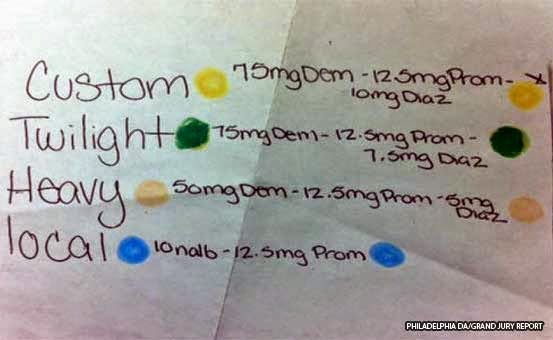 |
| Anesthesia chart drawn up by 15-year-old Gosnell employee Ashley Baldwin |
The standard practice was for Gosnell's untrained staff to give repeated doses of sedative and pain-killing drugs to the patients, without regard to a woman's size or weight, whenever it was deemed necessary by the untrained staff. For example, if the woman started moaning, she was presumed to be in pain, and would be given another dose of drugs. Karnamaya, at only 4'11" in height and 110 lb. in weight, would have been endangered by a dose appropriate for an average-sized women, much less by the massive doses administered at Women's Medical Society.
A little before 8:00 p.m., West and Williams sent Karnamaya's daughter to another waiting area. She was left there, with no idea what was happening to her mother until the ambulance arrived after 11 p.m.
Williams helped Karnamaye into the procedure room, put her on the table, and drugged her again, this time with the clinic's "custom" dose of 75 mg. of Demerol, 12.5 mg. of promethazine, and 10 mg. of diazepam. The heavily drugged patient was then left, unattended and with no monitoring equipment, alone in the procedure room.
Cardiac Arrest
 |
| Kermit Gosnell mugshot |
O'Neill told the Grand Jury that she thought Karnamaya was already dead by the time she got to the procedure room, but she took over administering CPR because Gosnell wasn't doing it correctly. Gosnell, meanwhile, left to retrieve the clinic’s only “crash cart” (the emergency kit to treat a cardiac arrest) from the third floor. After returning with the kit, however, Gosnell did not use any of the drugs in it to try to save Karnamaya's life. Instead he just looked through them and seemed pleased that they were up to date. He seemed purely interested in keeping outsiders from finding out that the crash cart had been nowhere near the procedure room while patients were being sedated.
O’Neill testified that Gosnell told her not to administer Narcan, a drug that could have reversed the effects of the Demerol. She said that Gosnell told her it would not work on Demerol. O’Neill also said that she tried to use the defibrillator to revive Karnamaya, but that the paddles did not work.
Emergency Services
 |
| One of Gosnell's filthy procedure rooms |
Emergency personnel arrived at 11:13. They found Karnamaya lifeless in the procedure room and Gosnell just standing there, not doing anything. The paramedics immediately intubated Karnamaya to give her oxygen, and started an intravenous line to administer emergency medications, since for some reason clinic staff had removed the IV line they'd been using all day to drug their patient. They also failed to tell the paramedics about the drugs they had administered.
The medics were able to restore weak heart activity. But getting Karnamaya to the ambulance was needlessly and dangerously time-consuming because the emergency exit was locked. Gosnell sent Ashley to the front desk to look for the key, but she could not find it. Ashley told the grand jury that a firefighter needed to cut the lock, but “It took him [20 minutes]… because the locks is old.” Karnamaya's daughter and friend ran outside, crying, and witnessed this. After cutting the locks, responders had to waste even more time struggling to maneuver through the cramped hallways that could not accommodate a stretcher.
When the ambulance arrived at the hospital shortly after midnight, Karnamaya had no heartbeat, no blood pressure, and was not breathing. After aggressive resuscitation efforts, doctors were able to restore a weak heartbeat. Karnamaya was then sent to the Intensive Care Unit, where she remained on life support until family members could make the trip from Virginia to say good-bye. She was pronounced dead at 6:15 p.m. on November 20. She had died of a massive overdose of Demerol.
Two Deaths, One Day: Chicago, 1925
On November 20, 1925, 29-year-old Anna Kick died in Chicago's Washington Park Hospital from an abortion performed that day at an undisclosed location. The coroner determined that a midwife was responsible for Anna's death, but did not determine the midwife's name.
On that very same day, 23-year-old Helen Bain, a homemaker, died in Chicago from complications of a criminal abortion performed that day. Dr. George Slater was arrested on November 21 for Helen's death. Slater was indicted by a grand jury for homicide on May 1, 1926.
Helen's abortion was typical of criminal abortions in that it was performed by a physician. The mantra among abortion-rights organizations that before legalization, the world of abortion was a world of rusty coathangers and untrained quacks is false. In fact, it's an insult to the abortion-minded women of yesteryear to assume that they were all so mentally unhinged or utterly mindless as to reflexively reach for the rustiest knitting needle in the basket. The vast majority sought out professionals of the same caliber they'd go to for any other obstetric or gynecological issue, as Anna went to a midwife.

On that very same day, 23-year-old Helen Bain, a homemaker, died in Chicago from complications of a criminal abortion performed that day. Dr. George Slater was arrested on November 21 for Helen's death. Slater was indicted by a grand jury for homicide on May 1, 1926.
Helen's abortion was typical of criminal abortions in that it was performed by a physician. The mantra among abortion-rights organizations that before legalization, the world of abortion was a world of rusty coathangers and untrained quacks is false. In fact, it's an insult to the abortion-minded women of yesteryear to assume that they were all so mentally unhinged or utterly mindless as to reflexively reach for the rustiest knitting needle in the basket. The vast majority sought out professionals of the same caliber they'd go to for any other obstetric or gynecological issue, as Anna went to a midwife.

Subscribe to:
Posts (Atom)
I saw Sharon in the recovery room about 3:30 or 4:00 pm. She looked so bad that I felt scared. She was laying on a lazyboy style chair with an IV in her left arm and a blood pressure cuff on the other. She looked very pale. Her eyes were partially open and I could see only the whites of her eyes as if she were in shock. She was not speaking and her whole body was shaking real hard in big shivers. Her legs were especially bad. The doctor said, "She doesn't react to drugs well." .... I went back to the waiting room and a Spanish lady came out and said that Sharon would be ready in a few minutes as soon as the IV finished.
Sharon was in the recovery for only about 45 minutes, because at 5:00 pm they came out and said she was ready to leave. I heard someone say that the doctor was real busy and he had to rush out like he was going to the airport, something about him having to go to Sacramento or San Francisco. I saw two women struggling to place Sharon in a wheelchair. Sharon could not walk at all and she was not speaking. She looked very, very pale now.
....
On the way home to Barstow, I stopped at Wendy's to get a sandwich for little Curtis. .... Sharon was lying in the backseat of the car and said to Curtis, "Come on back with me Curtis. I love you and so I could hold you and you could go to sleep." She was silent for about one hour. Near Victorville, she said, "I'm so hot. Please let the window down." I opened the window a bit. After that, Sharon was silent forever.
We got home to Barstow and I saw that Sharon, still laying in the back seat was naked from the waist up, having removed her shirt, shoes and socks. I started yelling, "Sharon. Sharon. Wake up," but she didn't and my husband, Ben Hamptlon, said, "Call 911."
According to Nancy Myles, an untrasound technician who was assisting Steir during Sharon's abortion, Steir was having trouble locating and extracting the fetal skull. She said that he looked at her strangely and said, "I think I pulled bowel."
Pro-choice organizations, including the national leadership of NOW, and the National Abortion Federation and the California Abortion and Reproduction Rights League, rallied around Steir. One supporter stood outside the courthouse with a sign reading, "Abortion doctors are heroes, defend Dr. Bruce Steir." The Feminist Women's Health Center in Chico, with whom he once was affiliated, set up a "defense committee" and raised funds for his legal expenses.
Joseph Durante, who owned the facility, was also on probation with the medical board at the time of Sharon's fatal abortion. He had attempted a late abortion which resulted in the birth of a live but injured infant.
Sharon was a single mother who worked part-time at Burger King while attending community college. Sharon's mother said that she wanted to go off welfare and become a nurse. California taxpayers funded the fatal abortion through Medi-Cal.
Steir eventually plea bargained. He was sentenced to a year in prison, with six months of the sentence suspended in leiu of community service. He was also given five years' probation. At the sentencing hearing, four years after Sharon's death, Sharon's father said he still often pulled his car to the side of the road, looked at his daughter's picture, and wept.
Steir was released after serving only four months of his sentence.
Again, from Doris Hamplton's statement:
I don't know how she heard about Dr. Durante's offices. I think he was recommended by the people at San Bernardino County Social Services or by Dr. Krider. Sharon was on Medi-Cal and had Pacific Care as the Medi-Cal managed care agent. I understand that because Dr. Durante and Dr. Steir were on probation they were not entitled to Medi-Cal payment, but they got it anyway. I understand that their office was not accredited as an ambulatory surgical office, and that it was supposed to be accredited to comply with the law. I had no idea that Dr. Durante and Dr. Steir were on probation with the Medical Board for incompetence and negligence against women patients. I am sure that Sharon did not know either. If I had known, I would never have taken Sharon to such a bad place with such bad doctors. I learned about their records in the newspaper articles.
....
I cry every day for the terrible loss of my daughter, and I am overwhelmed that 3 year old Curtis had his mother taken away forever. My husband, Ben Hamptlon, (father of Sharon), is sick with grief, has terrible head pain, is under the care of a doctor for this and has been taking strong pain medicine since Sharon's death. My prayer is that these doctors be stopped immediately so that no other girl will be killed and that no other family will have to suffer as we have.
Links about Sharon's death and the aftermath:
Abortion Doctor To Be Tried For Second-Degree Murder, Riverside Press-Enterprise, February 19, 1998
Death From Abortion Makes For Explosive Case, Legal Action for Women,
Doctor Loses Bid to Avoid Murder Case, Riverside Press-Enterprise, July 11, 1998
History of Bruce Steir
Steir and NAF in Perspective
Second-Degree Murder Trial of California Abortionist Delayed
Abortionist Steir Pleads Guilty to Involuntary Manslaughter for Botched Abortion
Abortion debate turns to doctor's murder case, Fresno Bee, Feb. 18, 1999
The Medical Board of California, Dr. Bruce Steir, and Anti-Abortion Politics, ACLU Reproductive Rights Project
Steir Defense Committee Update, Refuse & Resist